

Picture this: your sales team, freed from the drudgery of manual research, spending their time actually building relationships and closing deals. That’s the promise of sales research automation. It’s not just another piece of software; it’s a strategic shift that uses technology to automatically gather, analyze, and deliver critical insights about your prospects and accounts.
It turns the slow, manual grind for data into a fast, precise, and powerful advantage.
Move Beyond Manual Research and Start Closing Faster
In a traditional sales environment, reps burn a massive chunk of their week just hunting for information. They comb through LinkedIn profiles, company websites, news articles, and financial reports, trying to piece together a puzzle for every single prospect.
This old-school approach is painfully slow, inefficient, and riddled with human error. It’s like trying to navigate a new city with a paper map when everyone else is using real-time GPS.
Sales research automation changes the game completely. Instead of your reps acting as data miners, the technology steps in as a tireless research assistant that works 24/7. This frees up your team to focus on what they do best: selling. The benefits are immediate and impactful.
The True Cost of Manual Prospecting
That manual research isn't just a time-suck; it's a direct drain on your revenue. Every hour a rep spends digging for data is an hour they’re not spending on high-value activities that move deals forward. This inefficiency creates huge bottlenecks in your sales cycle and puts a hard cap on your team's ability to scale.
Here's why the old way is broken:
- Inconsistent Data Quality: Manually gathered information is often outdated, incomplete, or just plain wrong, leading to poorly targeted outreach.
- Wasted Rep Time: Studies show salespeople can spend up to 40% of their time just looking for someone to call. That's a staggering loss of productivity.
- Missed Buying Signals: A rep can easily miss a crucial company announcement or an executive change that signals the perfect time to engage.
- Generic Outreach: Without deep, timely insights, outreach becomes generic and easy to ignore. A structured process is essential to avoid this. You can find a complete guide in our ultimate account research checklist.
This classic diagram from Wikipedia breaks down the core parts of a sales force management system, where automation is the engine driving everything.
It shows how contact management, opportunity tracking, and forecasting all depend on each other, with automation tying them together for maximum efficiency.
To put it into perspective, here's how the two approaches stack up.
Manual vs. Automated Sales Research at a Glance
This table breaks down the practical differences between the old manual grind and a modern, automated approach. It’s not just about speed; it’s about the quality of the outcomes.
| Metric | Manual Research Process | Automated Research Process |
|---|---|---|
| Rep Time Investment | Hours per account, often inconsistent | Minutes per account, consistently deep |
| Data Accuracy | Prone to errors, quickly outdated | Real-time, verified, and continuously updated |
| Coverage | Limited to a few high-priority accounts | Scalable across hundreds or thousands of accounts |
| Insight Quality | Surface-level facts and figures | Strategic insights, buying signals, and context |
| Outreach Relevance | Generic and often poorly timed | Highly personalized and triggered by real events |
| Speed to Lead | Slow, creating delays in follow-up | Instant, allowing immediate engagement on signals |
The comparison makes it clear: automation doesn't just do the same work faster. It produces a fundamentally better result that empowers sales teams to operate at a much higher level.
By automating foundational research, you're not just saving time—you're equipping your team with the intelligence to have more meaningful conversations from the very first interaction.
The market’s adoption of these tools tells the story. The global sales force automation market was valued at $8.6 billion in 2023 and is projected to skyrocket to $19.5 billion by 2030.
It’s no surprise that top-performing sales teams are leading this shift, with 61% of overperformers already integrating automation into their workflows. You can explore more data on the rise of sales automation on repordermanagement.com.
See Salesmotion in action
Take a self-guided interactive tour — no signup required.
The Three Pillars of Sales Research Automation
To understand what sales research automation does, you have to look under the hood. This isn't just a single piece of tech; it’s a powerful system built on three interconnected pillars. Together, they create a seamless flow of information that turns mountains of raw data into deal-winning intelligence.
Think of it as an assembly line for insights. Each pillar handles a critical step, transforming scattered information into an advantage that lands right in your sales team's hands when they need it most.
Pillar 1: Data Aggregation
The first pillar, data aggregation, is the foundation. This is where automation casts a wide net, pulling in massive amounts of information from a huge range of public sources. Instead of a sales rep burning hours jumping between browser tabs, the system does all the heavy lifting in an instant.
This process gathers data from places like:
- Company Sources: Press releases, SEC filings, earnings call transcripts, and official company blogs.
- News & Media: Industry news outlets, financial publications, and trade journals.
- Professional Networks: LinkedIn updates, job postings, and executive changes.
- Digital Footprints: Podcasts, executive interviews, and conference presentations.
The goal is to collect every relevant piece of information and pull it into one centralized spot. This creates a rich profile of a target account that would be impossible for a human to build manually at scale.
 Salesmotion aggregates data from hundreds of sources and synthesizes it into an actionable account summary with key insights, talking points, and strategic context.
This infographic breaks down the shift from a slow, manual grind to a fast, automated system.
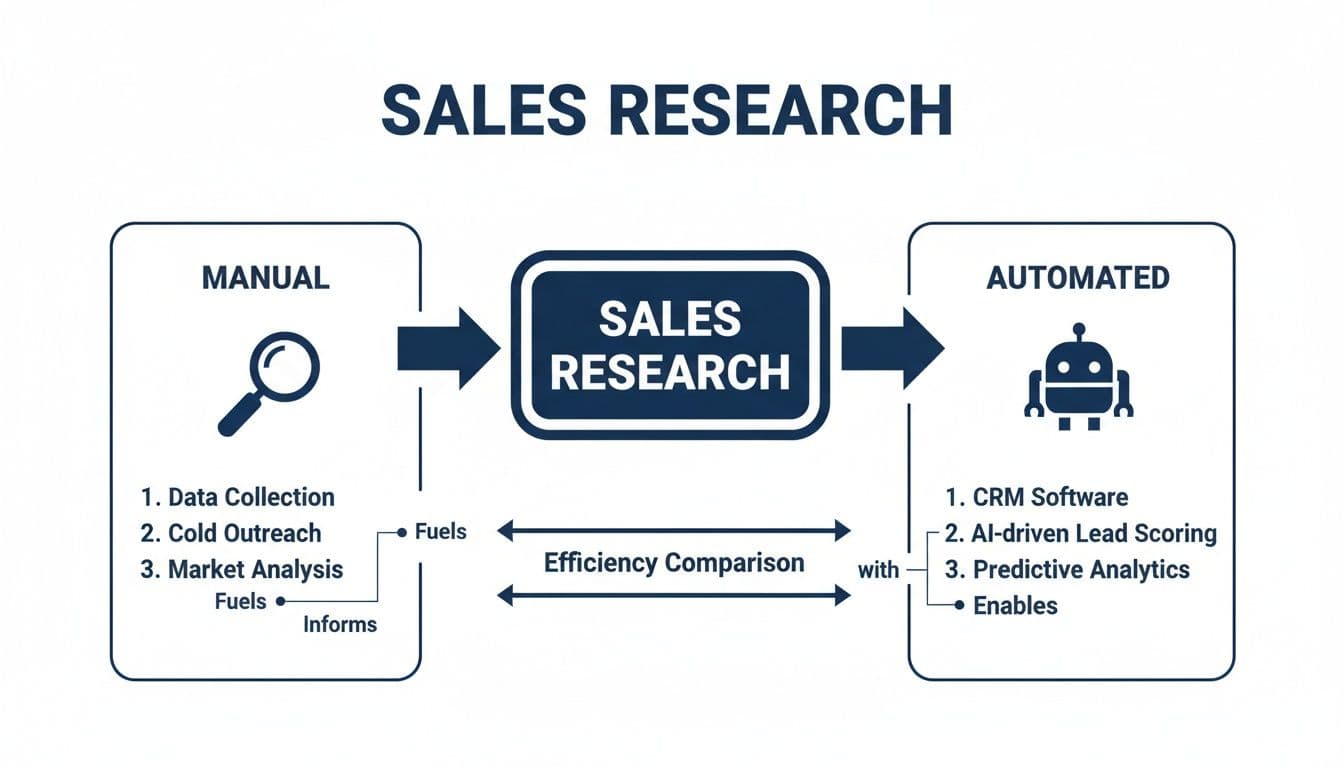
As you can see, automation replaces fragmented, time-consuming tasks with a unified, intelligent system. Once the data is collected, the next pillar makes sense of it all.
Pillar 2: AI-Powered Analysis
With all the raw data in one place, the second pillar—AI-powered analysis—gets to work. This is where the magic happens. Imagine having a team of research analysts who can read, understand, and connect the dots across thousands of documents in seconds.
The AI sifts through the noise to pinpoint what actually matters. It’s trained to spot critical buying signals, like a company announcing a new strategic initiative, hiring a key executive, or mentioning a specific business pain in an earnings call.
This analysis goes beyond simple keyword matching. A powerful sales intelligence platform uses sophisticated algorithms to understand context, sentiment, and intent. It figures out not just what was said, but why it’s important to your sales team right now.
This stage turns information into intelligence. The AI doesn’t just hand you a news article; it tells you, "This company is struggling with efficiency, and that's your opening."
By scoring leads and flagging high-priority accounts based on these signals, the AI ensures your team always focuses its energy where it will have the most impact.
Pillar 3: Seamless Workflow Integration
The final pillar is workflow integration. After all, brilliant insights are useless if they’re buried in a separate dashboard that reps never check. This pillar makes sure the intelligence generated by the AI is delivered directly into the tools your sales team already lives in every day.
This integration is critical for adoption and action. Alerts and insights can be pushed directly to:
- Your CRM: Populating account and contact records in platforms like Salesforce or HubSpot with fresh intelligence.
- Communication Tools: Sending real-time notifications through Slack or email when a key buying signal is detected.
- Sales Engagement Platforms: Automatically enrolling contacts into relevant outreach sequences based on specific triggers.
This seamless delivery eliminates all friction. A sales rep can get a Slack alert about a target account’s new expansion plan, click through to their CRM record to see the full context, and immediately launch a personalized outreach campaign.
This closes the loop, turning automated research into direct, timely, and relevant sales actions that speed up the entire deal cycle.

“The moment we turned on Salesmotion, it became essential. No more hours on LinkedIn or Google to figure out who we're talking to. It's just there, served up to you, so it's always 'go time.'”
Adam Wainwright
Head of Revenue, Cacheflow
Measuring the Business Impact of Automation
Investing in new tech always comes down to one question: what’s the ROI? With sales research automation, the answer shows up in concrete, measurable improvements across your entire sales process. It’s about turning saved hours into closed deals and better data into bigger contracts.

This isn’t just about making reps faster. It’s about making them smarter and more effective, which directly fuels revenue growth and delivers a clear financial payoff.
Massive Productivity Gains
The most immediate impact is the sheer amount of time automation gives back to your sales team. When reps no longer spend hours each day digging through news articles, LinkedIn profiles, and company reports, they can reinvest that time into selling.
Imagine your top account executive getting back eight hours every week. That’s an entire extra day to build relationships, run discovery calls, and craft perfect proposals. This is a fundamental shift in how your team operates.
The results are tangible. Sales automation has been shown to deliver a 14.5% increase in sales productivity and a 12.2% reduction in marketing costs. With nearly 30% of all sales activities expected to be automated, 82% of sales professionals already say they have more time for direct customer interactions. You can find more data on the business impact of automation on electroiq.com.
Better Lead and Pipeline Quality
Productivity is only half the story. Automation also dramatically improves the quality of your pipeline by making sure reps focus on the right accounts at the right time. This is where AI-driven systems shine.
These platforms continuously scan the market for buying signals and match them against your Ideal Customer Profile (ICP). This process automatically surfaces accounts that aren't just a good fit on paper but are actively showing they're in a buying cycle.
The result is a pipeline filled with opportunities that are far more likely to close. Instead of chasing cold leads, your team engages with prospects who have already shown interest. These tools are especially good at spotting and interpreting intent data, which flags accounts actively researching solutions like yours. If you want to go deeper, you can learn more about what is intent data in our complete guide.
By focusing on high-propensity accounts, you’re not just increasing efficiency—you’re improving your odds of winning before you even send the first email. This proactive approach leads to higher conversion rates at every stage of the funnel.
This shift from quantity to quality has a huge impact on team morale. Reps feel more confident and motivated when they're working on deals with a genuine chance of success.
Accelerated Revenue Growth
When you combine massive productivity gains with a higher-quality pipeline, the natural outcome is accelerated revenue growth. This is where sales research automation proves it’s a core business investment, not just a departmental tool.
The connection is direct and easy to see in your key performance indicators (KPIs). Here’s how it typically plays out:
- Higher Close Rates: Better-qualified leads and deeper account insights mean reps have more relevant, value-driven conversations. This naturally leads to more wins.
- Larger Deal Sizes: Armed with strategic intelligence, reps can better position your solution as a critical investment, justifying a higher price.
- Shorter Sales Cycles: When you engage prospects at the exact moment of need, you eliminate wasted time and move deals through the pipeline faster.
The table below shows how these sales metrics typically improve after implementing sales research automation.
Key Performance Indicators Improved by Automation
| KPI | Average Improvement Percentage | Business Outcome |
|---|---|---|
| Time Spent on Research | -80% | Reps focus on selling, not searching. |
| Lead Conversion Rate | +35% | Higher quality leads fill the pipeline. |
| Sales Cycle Length | -20% | Deals close faster with timely engagement. |
| Pipeline Creation | +40% | More qualified opportunities are identified. |
Ultimately, the data tells a clear story. Sales research automation is a direct lever for financial performance, transforming the sales process from a reactive, manual effort into a proactive, data-driven engine for growth.
How AI Is Redefining Sales Prospecting
Let's be clear: artificial intelligence isn't a sci-fi concept anymore. It's the engine running the most successful sales teams today. AI is turning prospecting from a game of high-volume guesswork into a data-driven science, giving reps the power to find and qualify the best leads with surgical precision.

This image captures modern prospecting perfectly. Instead of drowning in spreadsheets and raw data, AI gives the sales pro a complete, easy-to-digest picture of an account, instantly surfacing what matters.
From Manual Lists to Predictive Leads
Not long ago, prospecting meant building static lists based on basic firmographics—industry, company size, location. That approach is useful, but it misses the most important factor: timing. AI flips this on its head by analyzing dynamic datasets to predict which prospects are most likely to buy right now.
One of the most powerful ways it does this is through predictive lead scoring. AI algorithms look at the DNA of your past closed-won deals and then scan your current pipeline for similar traits. It assigns a score to every prospect, so your team can immediately see which accounts are clones of your best customers and prioritize them.
By using AI to score leads, you're not just finding good-fit companies. You’re finding good-fit companies that are showing the digital body language of a potential buyer, dramatically increasing your chances of success.
This focus on timing and fit is a game-changer. Instead of carpet-bombing a huge list, reps can engage a much smaller, highly targeted group with a message that lands because it’s delivered at the perfect moment.
Uncovering Intent and Buying Signals
Beyond knowing who to talk to, AI is brilliant at figuring out when to reach out. It does this by sifting through intent data, which flags accounts actively researching solutions like yours across the web. If someone at a target company suddenly starts binge-watching webinars about a problem your product solves, AI raises a flag.
These systems go deeper than just tracking web searches. They monitor critical buying signals like:
- Content Consumption: Which articles, whitepapers, or case studies are employees from a target account reading?
- Competitor Analysis: Are they looking at your competitors' websites or pricing pages?
- Event Participation: Have key decision-makers signed up for relevant industry webinars or conferences?
This gives your sales team an almost unfair advantage. You can craft a perfectly timed, relevant message just as a prospect realizes they have a need, turning a cold call into a warm, consultative conversation.
Crafting Personalized Outreach at Scale
So you've found the perfect account showing strong buying signals. Now what? The next hurdle is writing an email that gets a response. This is where generative AI steps in, turning raw research insights into compelling, personalized messages.
Instead of reps burning hours writing every email from scratch, generative AI can instantly draft outreach that weaves in specific details about the prospect's company, their role, and their recent activities. It might reference a recent funding announcement or a new strategic goal mentioned on an earnings call, making the message feel specific and well-researched. This isn't just about research; AI is also transforming live sales calls by providing immediate support to reps. You can see how this works with AI-powered real-time agent assistance.
This move toward intelligent automation is happening fast. AI-driven sales tools are fundamentally changing B2B sales, with digital channels expected to make up 80% of all engagements by 2025. By 2027, an estimated 95% of seller research will start with AI—a massive leap from under 20% today. This isn't just a trend; it’s a fundamental shift in how sales teams operate, empowering them to work smarter, not harder.
“Automatic account profile detail I can use to manage my territory. Using Salesmotion AI to generate value statements per persona, account, etc. Using Salesmotion to give me a starting point based on new hires, or news alerts is critical.”
Adam Wainwright
Head of Revenue, Cacheflow
Your Framework for Implementing Automation
Bringing new tech into your sales organization can feel like a massive project, but it doesn’t have to be. With a clear roadmap, integrating sales research automation becomes a strategic advantage, not a technical headache. A smart, structured approach is the difference between solving the right problems and creating new ones.
This framework breaks the process down into four manageable stages. Following these steps will help you roll out the new system smoothly, empower your team, and see a clear return on your investment from the start.
Start With Your Objectives
Before you look at a single tool, you need to define what a "win" looks like. What specific sales challenges are you trying to solve? Vague goals like “improve efficiency” won’t cut it. You have to get specific and tie every objective back to a measurable business outcome.
Are you dealing with:
- Poor lead quality? Your objective could be to boost the conversion rate from initial outreach to the first meeting by 25%.
- Long sales cycles? The goal could be to cut the average time to close by 15% for your key accounts.
- Time-consuming prospecting? You might want to free up 8 hours of manual research time for every rep, every week.
Nailing down your pain points and setting concrete goals gives you a North Star for the entire process. It ensures you pick the right solution and can prove its impact later on.
Choose the Right Tools for Your Team
Now that your objectives are clear, you can start evaluating platforms. The market is packed with options, but the best tool is the one that fits your team's unique needs. Don't get distracted by shiny features you'll never use. Focus on the core capabilities that directly support your goals.
Keep these factors in mind:
- Team Size and Needs: A small team might need a simple, all-in-one tool that's easy to use. A large enterprise might need a more powerful, customizable solution to fit its complex structure.
- Budget: Nail this down upfront. Remember to account for the subscription cost as well as any hidden implementation or training fees.
- CRM Integration: This is non-negotiable. The tool must plug seamlessly into your existing CRM (like Salesforce or HubSpot). Anything less creates data silos and disrupts your reps' daily flow. Understanding concepts like agentic workflows for AI automation can also help you streamline complex tasks when building your framework.
Choosing the right technology is less about finding the platform with the most features and more about finding the one that solves your specific problems with the least friction for your team.
Create a Practical Implementation Plan
Once you've picked your tool, it's time to map out the rollout. A phased approach is almost always better than a company-wide "big bang" launch. It minimizes disruption and gives you a chance to get feedback and make adjustments.
A solid plan should cover a few key areas:
- Data Migration: Work with the vendor to make sure all your existing account and contact data gets moved over cleanly into the new system.
- Team Training: Schedule dedicated training sessions. Don't just show them the buttons to click; explain how this tool will help them hit their numbers and make their jobs easier. For a deeper dive, check out our guide on using AI in sales to enhance performance.
- Workflow Setup: Configure the initial workflows. This could be as simple as setting up real-time alerts for buying signals or creating automated templates for account briefings.
Start with a small pilot program. Pick a few of your most engaged reps, let them run with it, and learn from their experience. Their success stories and feedback will build momentum for the wider rollout.
Measure Success and Continuously Optimize
Your job isn't done just because the tool is live. The final and most important step is to constantly measure your progress against the objectives you set at the beginning. Track the metrics that matter. Are conversion rates climbing? Has manual research time dropped?
Get regular feedback from your sales team. What’s working? What’s not? Where are they getting stuck? Use their input to fine-tune your workflows and offer extra coaching where it's needed. The goal is to create a feedback loop where the tech and your process evolve together, driving sustainable growth.
The Future of Sales Is Automated and Data-Driven
So, where does this leave us? We’ve seen how sales research automation is fundamentally changing how modern sales teams work. This isn't a future concept; it's a necessity for any organization that wants to compete and grow today.
The old way—reps spending hours digging for scraps of information—is not just slow, it's expensive. Automation flips that model on its head. It turns your team from data miners into strategic advisors, freeing them up to focus on what matters: building relationships and closing deals.
Give Your Team Intelligence They Can Actually Use
When you embrace automation, you’re unlocking three massive advantages that directly impact your bottom line:
- Give Reps Their Time Back: We're talking hundreds of hours per year that can be poured back into revenue-generating activities.
- Skyrocket Lead Quality: AI-driven analysis means your team is always focused on high-intent accounts that are ready to talk.
- Make Every Conversation Strategic: Armed with deep, real-time insights, reps can have meaningful, value-driven conversations from the very first hello.
The point of sales research automation is to give your sellers the intelligence they need to win. It’s about working smarter, not harder, and turning data into a decisive competitive advantage.
If your team is still stuck in the manual research grind, it’s time for a change. You need an automation strategy that aligns with your goals and gives your team the tools they deserve.
The message is clear: the future belongs to sales teams that are both automated and data-driven. This investment isn't just about adopting new tech. It's about building a smarter, more empowered, and more successful sales force.
Key Takeaways
- Sales research automation replaces hours of manual account research with AI-driven insights delivered in minutes, freeing reps to focus on selling.
- The three pillars of automation -- data aggregation, AI-powered analysis, and seamless workflow integration -- work together to turn raw information into actionable intelligence.
- Measurable ROI shows up in concrete metrics: up to 80% reduction in research time, 35% higher lead conversion rates, and 20% shorter sales cycles.
- AI-driven predictive lead scoring and intent data detection help reps engage the right accounts at exactly the right moment, replacing high-volume guesswork with precision.
- Successful implementation starts with defining specific objectives, choosing tools that integrate with your existing CRM, and running a focused pilot program.
- The shift from manual to automated research isn't just about speed -- it fundamentally improves pipeline quality, deal sizes, and the relevance of every sales conversation.
Frequently Asked Questions
When you start looking at sales research automation, a few questions always come up. It's natural to wonder how a new piece of tech fits with your team, your budget, and your current process. Let's tackle the most common ones.
Will sales automation replace my sales reps?
Not a chance. In fact, it's the opposite. The point of sales research automation is to make your reps better, not to replace them.
Think of it this way: you're taking away the tedious, mind-numbing data gathering that reps hate and handing it to a machine. This frees them up to do what they do best—build relationships, understand a customer's real problems, and navigate a complex deal. It's like giving every rep their own personal research assistant.
Is this technology only for large enterprises?
That might have been true a few years ago, but not anymore. While large companies were the first to jump on board, the market has exploded with powerful, affordable tools designed for small and mid-sized businesses.
The impact can be even bigger for a smaller team. Automation lets you punch way above your weight, giving you the same level of account intelligence as a competitor with a massive sales force.
It levels the playing field. A small, focused team can suddenly compete with giants because they're working smarter, not just harder.
How do I ensure the data from these tools is accurate?
This is a crucial question. Any reputable platform lives and dies by its data quality. The best ones don't just scrape a single source; they pull information from multiple, verified places like financial filings, press releases, and trusted industry news. Then, they use AI to cross-reference and clean everything up.
When you're looking at different tools, be direct and ask about their data sources. Here are a few things to check for:
- Multi-Source Aggregation: Does the tool pull from a wide variety of reliable public sources?
- AI-Powered Verification: Do they use algorithms to confirm accuracy and remove duplicate or conflicting info?
- Real-Time Updates: Is the data constantly refreshed? Stale data is useless data.
A good practice is to ensure the tool can integrate with your CRM's own data validation rules. This keeps your entire tech stack clean and trustworthy.
What is the typical learning curve for these tools?
It varies, but most modern platforms are built with the end-user—your sales rep—in mind. The top-tier tools offer smooth, almost instant integrations with CRMs like Salesforce or HubSpot, which cuts down the onboarding time dramatically.
Because these platforms are designed to fit right into the workflows reps already use, most people get the hang of the core features within a week. The focus is on intuitive design so your team can start pulling valuable insights right away, without a steep learning curve.
Ready to stop searching and start selling? Salesmotion is the AI-powered account intelligence platform that delivers real-time, actionable insights directly into your workflow. Empower your reps to have more strategic conversations and close bigger deals, faster. See how it works.


