CRM data enrichment is the process of layering fresh, third-party information onto your existing customer records to make them smarter. It’s about turning incomplete contact details into rich profiles that give your sales team a full 360-degree view of every prospect and customer.
Why Your Raw CRM Data Is a Liability
Imagine your sales team trying to navigate a new city with an outdated paper map—it’s full of dead ends, old street names, and missing landmarks. That’s what it’s like for them to rely on raw, unenriched CRM data. It’s static, often incomplete, and decays at a shocking rate as people change jobs and companies pivot.
This stale information creates two massive problems for your revenue team:
- The Manual Research Tax: Reps burn hours every week piecing together context from a dozen different sources instead of actually selling. This soul-crushing busywork kills productivity and leads straight to burnout.
- A Weak “Why Now”: Without timely triggers and relevant context — the buying signals that create urgency — every outreach attempt feels generic and falls flat. Your sales team lacks the compelling reason needed to kick off a meaningful conversation at the right moment.
Simply put, relying only on the data you happen to collect is a surefire way to miss opportunities and drag out your sales cycles.
Moving From Static Lists to Dynamic Intelligence
This is where modern CRM data enrichment comes in. It transforms your CRM from a dusty address book into a dynamic sales intelligence hub. We’re not just talking about fixing a typo or adding a missing phone number; this is about layering in strategic information that gives you a real competitive edge.
The process works by automatically adding crucial external data points to your existing records. Think of it like giving each contact a real-time background check that reveals what matters for your sales process. Understanding core technologies like Intelligent Document Processing (IDP) shows how AI automates data extraction from various sources, making enrichment seamless and effective.
The goal is to arm your revenue teams with the complete picture. When that happens, every interaction is informed, relevant, and timely. You stop guessing what a prospect needs and start knowing what’s happening in their world.
The Growing Market for Better Data
This shift toward data-driven sales isn't just a trend; it's a massive market movement. The Data Enrichment Solutions market was valued at $2.37 billion in 2023 and is projected to hit $4.58 billion by 2030. This growth shows how urgently companies need high-quality data to spot opportunities and create better customer experiences—something essential for Account Executives and Sales Managers in competitive spaces like Financial Services and IT Consulting.
See Salesmotion in action
Take a self-guided interactive tour — no signup required.
The Four Pillars of B2B Enrichment Data
Successful CRM data enrichment isn’t about vacuuming up every possible data point; it’s about layering in the right information at the right time. Think of a raw contact in your CRM as the basic foundation of a house. It’s a start, but you can’t live in it. To make it valuable, you need to add the walls, roof, and plumbing—the essential structures that turn it into a complete, functional home.
In the B2B world, these structures are the four pillars of enrichment data. Each one provides a unique layer of intelligence that, when combined, gives your revenue team a powerful strategic advantage.
The process of turning raw data into a complete customer profile is simpler than it sounds. It’s all about layering these pillars to build a full picture.
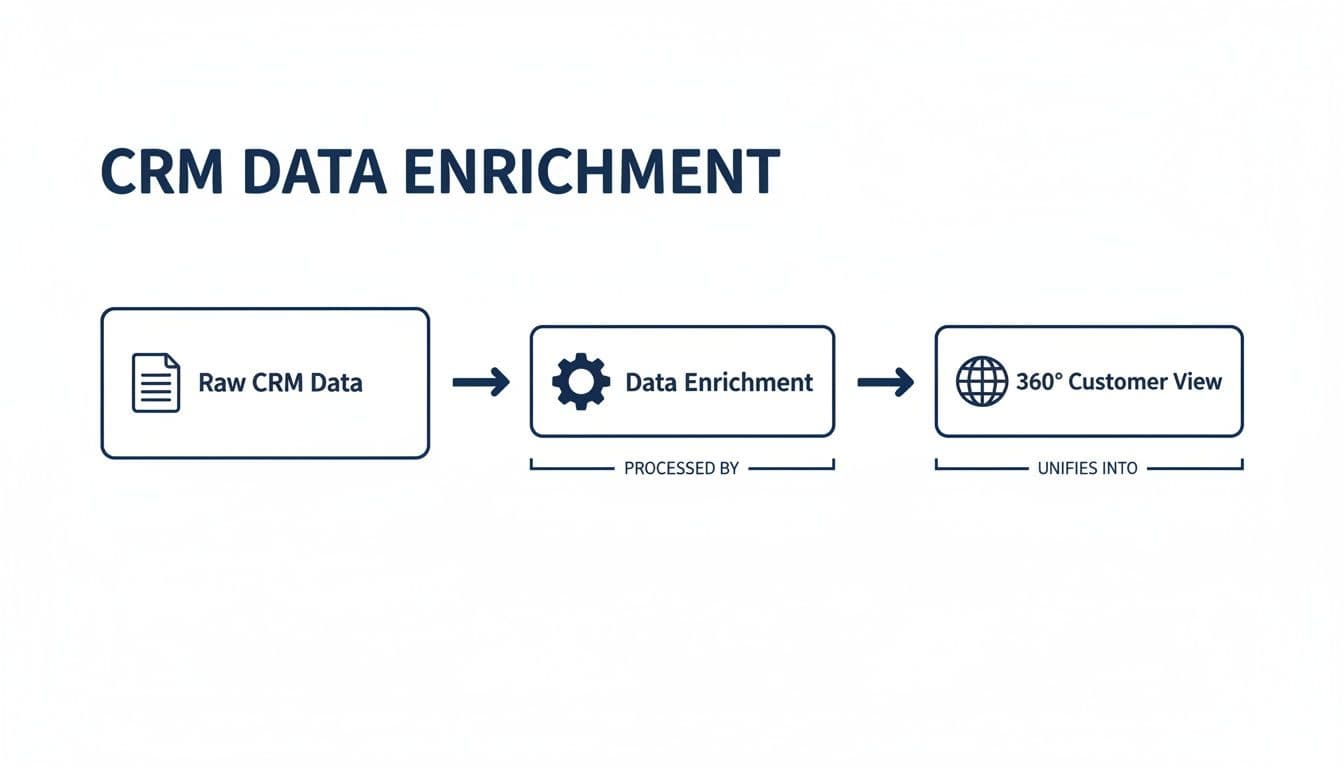
This visual shows how enrichment acts as the engine, turning basic records into comprehensive profiles ready for strategic action.
Let's break down exactly what these four data pillars are and why each one is critical for building a high-performing sales and marketing machine.
Four Pillars of B2B Data Enrichment
| Data Type | What It Reveals | Why It Matters for Sales | Example Signal |
|---|---|---|---|
| Firmographics | The basic, factual identity of a company. | Narrows the field to only your Ideal Customer Profile (ICP). | A B2B SaaS company with 500+ employees and $50M+ ARR. |
| Technographics | The specific technologies a company uses. | Unlocks hyper-relevant messaging and integration angles. | A prospect uses Salesforce Marketing Cloud and is hiring a new CRM Admin. |
| Intent Data | Digital "breadcrumbs" showing active research. | Separates "maybe later" accounts from "ready to buy now" ones. | Multiple employees from one company are searching for "CRO services." |
| Trigger Events | Real-world business events creating new needs. | Provides a compelling, timely reason to reach out immediately. | A life sciences company announces a $20M Series B funding round. |
By weaving these four data types together, you move from guesswork to a data-driven strategy that hits the right accounts with the right message at the perfect time.
Firmographics: The Foundational Blueprint
Let’s start with the basics. Firmographics are the foundational details about a company. This is the "who" and "where" of your target accounts. If your firmographic data is wrong, your entire go-to-market strategy is built on shaky ground.
These are the core attributes you need:
- Company Size: How many employees work there?
- Annual Revenue: What’s their financial scale?
- Industry & Vertical: Which market do they serve (e.g., Life Sciences, B2B SaaS)?
- Geography: Where are their headquarters and key offices?
A rep at an enterprise software company, for example, can use firmographics to instantly filter their territory for businesses with over 1,000 employees and $100M+ in revenue. Just like that, they’re focusing only on accounts that can actually buy and implement their solution.
Technographics: What’s in Their Toolbox?
Next up is technographics. This is where you find out what technologies a company uses every day—the software, hardware, and digital tools embedded in their operations. Knowing a prospect's tech stack is like knowing which language they speak before you start a conversation.
This information is a goldmine for crafting outreach that connects. If you sell a cybersecurity solution that integrates seamlessly with Salesforce, knowing a prospect uses it is a massive advantage. You can skip the generic pitch and jump straight to a specific conversation about protecting their existing ecosystem. It’s the difference between a cold call and a warm introduction.
Intent Data: Reading the Buying Signals
While firmographics and technographics describe a company's current state, intent data tells you what they might do next. It captures the digital breadcrumbs an account leaves across the web, signaling active interest in a product or service like yours.
Intent data is the closest thing to a crystal ball in B2B sales. It reveals which of your "good-fit" accounts are actually in a buying cycle right now, allowing you to prioritize outreach with surgical precision.
This could be a surge in keyword searches for "contract research organization services" from a specific company, or multiple people from one account downloading a whitepaper on IT consulting. To get a deeper understanding of how these signals work, you can explore the nuances of B2B intent data and its applications in modern sales. This is how you separate the curious browsers from the committed buyers.
Trigger Events: The Perfect Moment to Engage
Finally, trigger events are real-world happenings that create immediate windows of opportunity. Unlike intent signals, which are often digital, these are tangible business events that shake up the status quo and create a compelling reason for a conversation.
Common trigger events include:
- Leadership Changes: A new executive is hired (e.g., a new Chief Information Officer).
- Funding Rounds: The company just closed a significant investment.
- Mergers & Acquisitions: The business is acquiring or being acquired.
- Product Launches: They're entering a new market or releasing a major product.
- Regulatory News: A change in compliance rules affects their industry.
For instance, when a medical device manufacturer announces a major new funding round, it's a flashing neon sign that they have capital to invest in growth. For a CRO or B2B SaaS provider, this is the perfect moment to start a conversation about scaling their operations.
By combining these four pillars, you transform your CRM from a passive address book into a proactive revenue machine.

“Salesmotion is instrumental in helping me prioritize net-new accounts, understand their strategic initiatives, and cover more ground. With a lot of green-field accounts, I'm heavily leaning on the AI insights to tier my accounts and focus my time. The platform is incredibly intuitive and easy to use.”
Rob Webster
Enterprise Account Executive, Synthesia
How to Build Workflows That Win Deals
Powerful data is useless if it's just sitting in your CRM. The real magic happens when you weave it into your team’s daily rhythm, turning raw intelligence into actual revenue. This is where you build practical workflows that get your reps focused on the accounts ready to buy, right now.

First things first: you need to decide on the right cadence for your CRM data enrichment. This isn't a one-size-fits-all decision. The best approach depends on your sales motion and your goals. It boils down to two main methods: real-time and batch enrichment.
Real-Time vs. Batch Enrichment
Think of real-time enrichment as a live news feed for your sales team. The second a new lead hits your system or a key event happens at a target account, the data is instantly added. This is critical for capitalizing on immediate buying signals, like when a prospect downloads a whitepaper and you need to get them to the right AE in seconds.
Batch enrichment, on the other hand, is like a scheduled system update. It runs at set intervals—daily, weekly, or quarterly—to refresh your entire database. This is perfect for maintaining the accuracy of foundational data points like employee counts or contact info, ensuring your long-term account plans are built on solid ground.
The most effective strategies almost always use a hybrid model. They use real-time enrichment for high-intent actions and triggers, while using batch processes to keep the core database clean and current. This gives you the best of both speed and accuracy.
The market is clearly moving toward these dynamic, automated solutions. The global Data Enrichment Tool market is projected to grow from $697 million in 2024 to over $1 billion by 2032. This growth is driven by AI-powered tools that deliver 30-40% greater accuracy in data management compared to older methods. It's no surprise that cloud-based solutions now make up 72% of the market, thanks to how easily they integrate.
Maintaining Data Hygiene
Once you've picked your enrichment cadence, the next job is to make sure the new data flows correctly into your CRM without creating a mess. Poor data hygiene can kill your strategy before it starts, leading to duplicate records and confused reps.
This is where a few key technical steps are essential:
-
Proper CRM Field Mapping: This is the non-negotiable step of telling your enrichment tool exactly where to put each new piece of information. You have to map each external data point (e.g., "Annual Revenue") to the correct field in your CRM (e.g.,
Account.AnnualRevenue). Without precise mapping, you risk overwriting good data or creating chaos. For a deeper dive, check out our guide on best practices for integration in Salesforce CRM. -
Deduplication and Match Rules: Before your system adds new information, it needs to check if that record already exists. Set up clear rules that define what makes a record unique (like a combination of company domain and contact email). This stops duplicate accounts or contacts from cluttering your CRM, which is a major source of friction for any sales team.
From Technical Process to Sales Outcomes
With the right processes in place, you can finally build workflows that directly drive revenue. These workflows connect your enriched data to tangible sales actions, making your team far more efficient and effective.
Here are a couple of powerful examples:
-
Meeting Prep in Minutes: An AE has a call with a prospect in 30 minutes. Instead of scrambling through news sites, an automated workflow pulls the latest trigger events—like a recent funding announcement or a new product launch—directly into the CRM account record. The rep gets an instant, relevant talking point without lifting a finger.
-
Trigger-Based Outreach Sequences: A target account in the Life Sciences industry announces positive clinical trial results. That trigger event automatically enrolls key contacts from that account into a pre-built email sequence tailored to companies hitting a major growth spurt. Using AI tools for lead generation that incorporate data enrichment can seriously streamline this entire process.
These automated, intelligent workflows are what transform CRM data enrichment from a simple database update into a dynamic, deal-winning engine.
Putting Data Enrichment into Practice Across Industries
Theory is great, but the real test of any data strategy is how it performs in the real world. Once your workflows are dialed in, the magic happens when you apply CRM data enrichment to the specific challenges and opportunities within your key verticals. A single trigger event can mean wildly different things from one industry to another, which makes a tailored approach the key to winning complex deals.

Let's look at how top-performing revenue teams turn these enriched signals into tangible pipeline growth. These are proven plays that create timely, hyper-relevant reasons to start a conversation.
Life Sciences: The Art of Timed Outreach
In the competitive world of Life Sciences, timing isn't just important—it's everything. A Contract Research Organization (CRO) can't afford to pitch its services a moment too soon or too late. The most critical trigger for them isn't just a funding round; it's the announcement of a successful Phase II clinical trial.
That single piece of news signals a massive operational shift. The company is now scrambling to prepare for a much larger, more complex Phase III trial. An automated enrichment workflow catches this announcement, instantly alerting the right account executive.
Instead of a generic "checking in" email, the AE can now lead with pure value:
"Congratulations on the positive Phase II results for [Drug Name]. As you prepare to scale for Phase III, our experience supporting companies through this exact transition can help you navigate the increased regulatory and logistical demands."
This isn't just a cold email. It's an informed, strategic move that shows deep industry awareness and positions the CRO as an essential partner.
B2B SaaS: Cracking the Enterprise Account
For any Account Executive in B2B SaaS, breaking into a massive enterprise account can feel like scaling a fortress wall. Firing off cold emails to a single contact is a recipe for failure. The real goal is to multi-thread—building relationships across different departments and leadership levels at the same time.
This is where a leadership change trigger becomes a powerful Trojan horse. The AE gets an alert: a target account just hired a new VP of Engineering. This is a golden opportunity. New leaders almost always have a mandate to review existing tools and processes within their first 90 days.
Armed with this signal, the AE orchestrates a coordinated play:
- Direct Outreach: A welcome message to the new VP, referencing their past role and offering insights relevant to their new one.
- Internal Networking: Engaging with directors and managers under the new VP to uncover their current pain points and priorities.
- Executive Alignment: Reaching out to the CTO with a high-level message that acknowledges the new hire and speaks to broader strategic goals.
This isn't one random act of outreach. It’s a multi-pronged strategy that uses an internal change to build widespread influence inside the account.
IT Consulting: The Competitive Displacement Play
In IT consulting and managed services, a competitor's misstep is your biggest opening. An account that seemed loyal to another provider can suddenly come into play, but the window to act is razor-thin.
Imagine a consulting firm that specializes in cloud infrastructure. Their enrichment platform flags a news article detailing a major service outage at a key competitor. This isn't just industry gossip; it's a powerful business trigger. The system immediately cross-references this news, identifying which of their target accounts are customers of that struggling competitor.
The sales team now has the perfect reason to reach out with a timely, empathetic message that speaks directly to the prospect's pain. They can highlight their own reliability, share case studies of seamless migrations, and offer a complimentary infrastructure audit. This play transforms a competitor's bad press into a compelling, value-driven reason for a conversation.

“The Business Development team gets 80 to 90 percent of what they need in 15 minutes. That is a complete shift in how our reps work.”
Andrew Giordano
VP of Global Commercial Operations, Analytic Partners
Measuring the Real ROI of Your Data Strategy
Investing in a strong CRM data enrichment strategy feels right, but how do you prove it’s actually working? Tying better data to a healthier bottom line means looking past anecdotes and focusing on cold, hard numbers—the key performance indicators (KPIs) that really matter.
This is how you build a business case that shows exactly how enrichment fuels pipeline velocity, makes your sales team more efficient, and drives real revenue growth. It’s not just about having cleaner records; it’s about what your teams can finally do with them.
Tracking Key Revenue Metrics
The most powerful ROI story is always told through core revenue metrics. When your sales team has complete, timely information, their performance naturally improves across the entire sales cycle. These are the top-line numbers every revenue leader cares about.
Keep a close eye on these metrics:
- Lead-to-Opportunity Conversion Rate: Enriched leads are better qualified from the start. An uptick here is proof you’re focusing on the right people.
- Shorter Sales Cycles: With instant access to trigger events and deep account context, reps can build urgency and relevance, closing deals faster.
- Increased Average Contract Value (ACV): A 360-degree view helps reps spot cross-sell and up-sell opportunities, turning average deals into strategic wins.
By tracking these numbers before and after you roll out an enrichment strategy, the financial impact becomes impossible to ignore. For a closer look at these foundational metrics, check out our guide on essential lead generation key performance indicators.
Measuring Crucial Process Improvements
Beyond the big revenue numbers, data enrichment delivers huge efficiency gains that save your team time and money. These process improvements are just as critical for building your business case because they show how your team is getting more effective every day.
The real value isn’t just in what you gain, but in what you eliminate. Wasted time on manual research is a direct tax on your revenue engine, and enrichment is the most effective way to remove it.
Focus on these operational wins:
- Reduced Manual Research Time Per Rep: Calculate the hours reps get back each week now that they have automated intelligence. That time goes straight back into high-value activities, like actually selling.
- Higher Meeting Acceptance Rates: When your outreach is personalized with relevant triggers, more prospects say "yes." This is a direct measure of how much better your messaging has become.
- Increased Lead Routing Accuracy: Automated enrichment ensures new leads are instantly qualified and sent to the right AE, preventing great opportunities from falling through the cracks.
This shift to automated intelligence is happening at a massive scale. The CRM industry itself is projected to hit $114.4 billion by 2027, a growth curve fueled by the need for smarter data. It’s no surprise that 65% of businesses have already adopted AI-enhanced CRMs to auto-refresh contacts and slash that painful research time. By tracking these KPIs, you can confidently prove the powerful ROI of your own data strategy.
Common Pitfalls in CRM Data Enrichment (and How to Sidestep Them)
Rolling out a CRM data enrichment strategy is a massive step forward, but it’s not a magic wand. Like any big initiative, it has potential traps that can sink your investment if you aren't paying attention. Getting ahead of these common mistakes is what separates a high-value data asset from just another expensive project.
One of the biggest blunders is treating enrichment as a one-time, "set it and forget it" task. Data isn’t static; it decays. Fast. In fact, business contact information degrades by about 30% every single year as people switch jobs, companies get acquired, and titles change.
A one-off data scrub feels productive, but a few months later, you’re right back where you started. The fix is to see enrichment for what it is: a continuous process, not a one-and-done event. To nail this, you need solid data discipline. We break down the ongoing practices you need in our guide to effective CRM hygiene practices.
The Signal Overload Problem
Another classic mistake is "signal overload"—the temptation to enrich your CRM with every data point imaginable just because you can. It’s easy to get excited and flood your reps with dozens of new fields, but this usually just creates a wall of noise. When reps are staring at a screen packed with information, they don't know what actually matters, so they end up ignoring all of it.
This leads to frustrated teams and a project that goes nowhere. You have to resist the urge to enrich just for the sake of enrichment. Focus only on the specific, actionable signals that plug directly into your sales plays.
The goal isn't to have the most data; it's to have the right data at the right time. Every data point you add should have a clear purpose tied to a specific workflow, like qualifying leads or personalizing outreach.
Ignoring Governance and User Adoption
Finally, many companies stumble because they never establish clear data governance from the start. Without rules for how data is mapped, validated, and used, you’re inviting chaos into your CRM. It quickly becomes a messy, untrustworthy database that nobody wants to use. This technical oversight often goes hand-in-hand with an even bigger error: overlooking user training and adoption.
You can pipe in the best data in the world, but if your sales team doesn’t understand what it is or how to use it in their day-to-day work, the entire strategy is dead on arrival.
To steer clear of these issues, stick to a few simple principles:
- Start with a Phased Rollout: Don't try to boil the ocean. Kick things off with a small pilot group to test your workflows, prove the value, and work out the kinks before going company-wide.
- Establish a Data Stewardship Program: Assign clear ownership for data quality. This ensures someone is responsible for monitoring accuracy and fine-tuning your processes over time.
- Prioritize Actionable Insights: Don't just add more fields to your CRM views. Integrate your enrichment tools in a way that truly empowers your sales team by giving them the "so what" behind the data.
Key Takeaways
- CRM data enrichment transforms raw, incomplete records into rich 360-degree profiles by layering in four pillars of intelligence: firmographics, technographics, intent data, and trigger events.
- Business contact data decays by roughly 30% every year, making enrichment a continuous process rather than a one-time project -- use real-time enrichment for high-intent actions and batch processes for foundational data.
- The most effective enrichment strategies connect data directly to sales workflows, such as automated meeting prep that surfaces recent trigger events or trigger-based outreach sequences that enroll contacts when key signals appear.
- Avoid "signal overload" by focusing only on actionable data points tied to specific sales plays -- every field you add to your CRM should have a clear purpose connected to qualifying leads, personalizing outreach, or accelerating deals.
- The Data Enrichment Solutions market is projected to hit $4.58 billion by 2030, reflecting the urgent demand for high-quality, automated data to drive modern B2B revenue operations.
Frequently Asked Questions
What is CRM data enrichment?
CRM data enrichment is the process of layering fresh, third-party information onto your existing customer records to transform incomplete contact details into rich 360-degree profiles. It goes beyond fixing typos or adding missing phone numbers to include strategic information like firmographics, technographics, intent data, and trigger events. The goal is to give your sales team the complete context needed to make every interaction informed, relevant, and timely.
What are the four pillars of B2B data enrichment?
The four pillars are firmographics (company size, revenue, industry, geography), technographics (the technologies and software a company uses), intent data (digital signals showing active research interest in solutions like yours), and trigger events (real-world business events like funding rounds, executive hires, and M&A activity). Combining all four pillars transforms your CRM from a passive address book into a proactive revenue engine.
What is the difference between real-time and batch data enrichment?
Real-time enrichment instantly adds data the moment a new lead enters your system or a key event occurs, which is critical for capitalizing on immediate buying signals. Batch enrichment runs at scheduled intervals (daily, weekly, or quarterly) to refresh your entire database with updated foundational data. Most effective strategies use a hybrid model: real-time enrichment for high-intent actions and triggers, paired with batch processes to keep core data like firmographics and contact details accurate.
How fast does CRM data decay?
Business contact information degrades by approximately 30% every single year as people switch jobs, companies get acquired, and titles change. This rapid decay means that treating enrichment as a one-time project will leave you right back where you started within a few months. Continuous enrichment is essential to maintain data quality and keep your sales team working with accurate, current information.
What is the difference between data enrichment and data cleansing?
Data cleansing fixes what you already have (correcting typos, merging duplicates, standardizing formats, verifying existing information), while data enrichment adds what you are missing (appending new external information like annual revenue, employee count, tech stack, and recent executive hires). Both are essential for a healthy CRM: you need a clean data foundation before you can effectively layer on powerful new intelligence.
How do you avoid signal overload when enriching CRM data?
The most common mistake is enriching your CRM with every possible data point just because you can, which creates a wall of noise that reps end up ignoring entirely. Focus only on specific, actionable signals that plug directly into your sales plays. Every data point you add should have a clear purpose tied to a specific workflow, like qualifying leads, personalizing outreach, or accelerating deals. Start with a phased rollout and pilot group to test and prove value before scaling.
A Few Common Questions About CRM Data Enrichment
Even with a solid plan, a few questions always come up when putting a new process into play. Let's tackle some of the most common ones about CRM data enrichment with quick, straightforward answers.
How Often Should We Enrich Our CRM Data?
Think of data enrichment as a continuous health check for your CRM, not a one-time procedure. The right rhythm depends on your sales motion and the speed of your market.
For high-velocity sales teams, real-time enrichment is a must. You need to act on buying signals the second they surface. For strategic accounts with longer, more complex cycles, a hybrid approach is often the sweet spot. You'll want continuous, automated monitoring for major trigger events (like M&A activity or big funding rounds) paired with a scheduled quarterly batch refresh to keep foundational data like firmographics and contact details solid.
How Does This Help With Account-Based Marketing?
Simple: data enrichment is the fuel for any serious Account-Based Marketing (ABM) engine. It’s what takes your strategy from guesswork to surgical precision.
With properly enriched data, you can build hyper-targeted account lists based on the exact firmographic, technographic, and intent signals that define your ideal customer. This ensures your marketing and sales teams are perfectly aligned on who to go after and why. It also powers personalization at scale, letting you craft messages based on an account’s recent news, tech stack, or leadership changes.
Enrichment transforms ABM from a broad strategy into a precise, targeted revenue engine. It gives you the "why now" for every account on your list, making every interaction more relevant.
What Is the Difference Between Data Enrichment and Data Cleansing?
It's a simple but critical distinction. Data cleansing fixes what you already have, while data enrichment adds what you’re missing. They’re two sides of the same data quality coin, but they do very different jobs.
- Data Cleansing: This is all about quality control. Think of it as tidying up your database—correcting typos, merging duplicate records, standardizing formats, and verifying existing info. For example, fixing a misspelled company name.
- Data Enrichment: This is about adding value and context. It’s the process of appending new, external information to your existing records to make them more complete and insightful. For example, adding that same company's annual revenue, employee count, and the fact they just hired a new CIO.
Both are essential for a healthy CRM. You need a clean data foundation before you can start layering on powerful new intelligence.
Stop wasting time on manual research and start winning timely conversations. Salesmotion automates account intelligence, turning real-world signals into actionable insights that fuel your pipeline. See how we can help your team focus on the accounts most likely to move by visiting https://salesmotion.io.