
Signal-based selling is a sales strategy that swaps the volume game for timing and relevance. It’s about focusing your team's energy on the small slice of your market—typically just 3-5%—that's actively looking to buy right now. This approach turns real-time data into a competitive advantage, letting your team show up with the right message at the perfect moment.
What Is Signal Based Selling?
Imagine a fisherman using a high-tech fish-finder instead of casting a net randomly across the ocean. That's signal-based selling. It’s a smarter, more precise way to find and engage prospects who are actually ready to buy.
This strategy is the antidote to the outdated "spray and pray" tactics that burn out sales teams and annoy potential customers. Instead of blasting generic messages to a massive list, your team zeroes in on accounts showing clear, real-time indicators of buying intent.
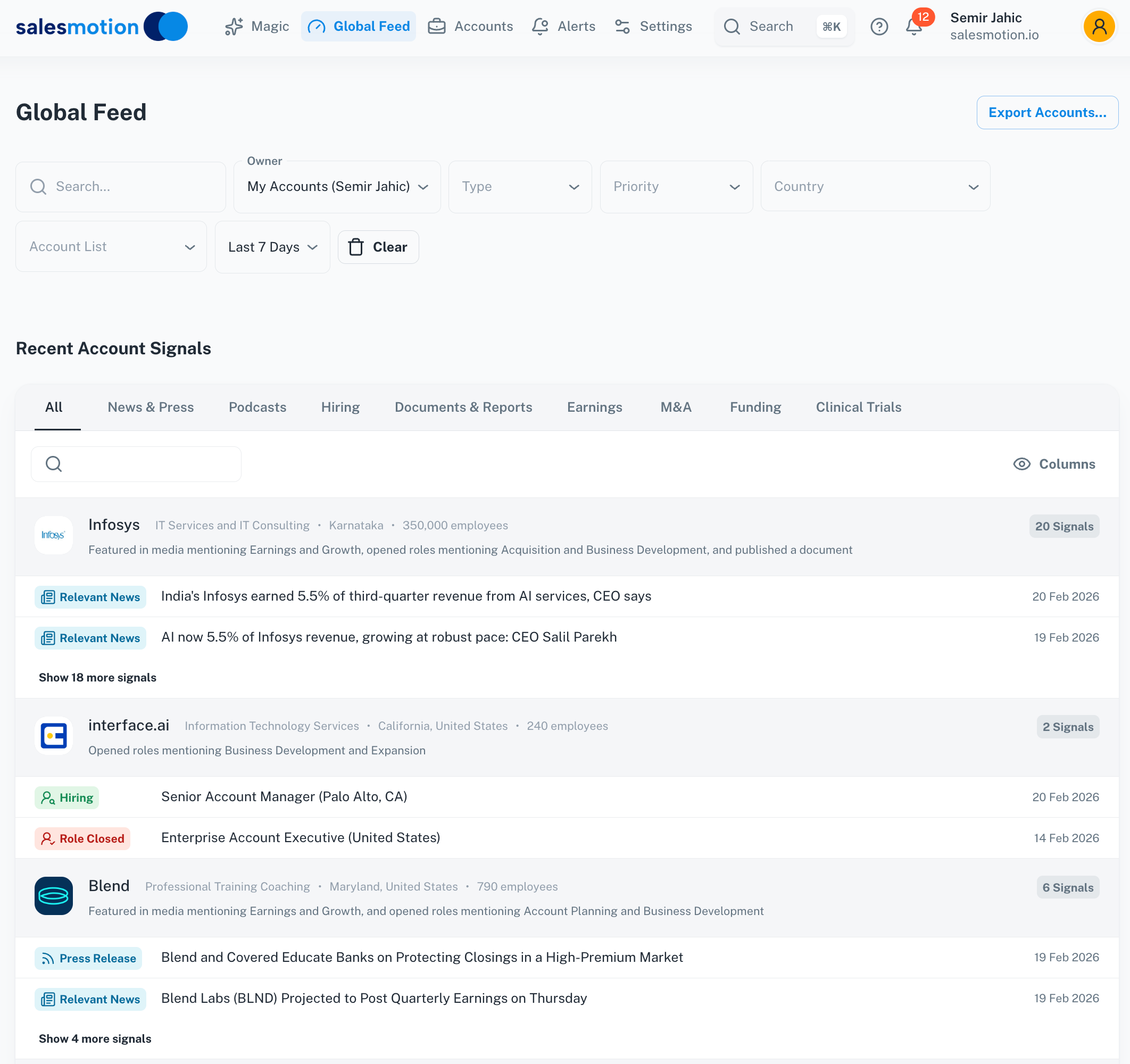 A real-time signal feed surfaces buying triggers like leadership changes, earnings events, and hiring surges across your entire territory.
The Problem with Traditional Outreach
For years, the standard sales playbook was a numbers game. Success was measured by volume: more calls, more emails, more meetings. But that approach is hitting a wall. Today's buyers are informed, protective of their time, and have zero patience for irrelevant pitches.
This leads to common frustrations in sales:
- Ignored Emails: Your messages land in the trash because they aren't relevant to what the recipient is focused on today.
- Low Meeting Rates: Prospects decline because there’s no compelling "why now?" for them to take the meeting.
- Wasted Effort: Reps spend hours chasing accounts with no budget, no immediate need, or who are locked into a competitor's contract.
The core issue is simple: most of your market isn't ready to buy. Industry experts find that only about 3-5% of your Total Addressable Market (TAM) is in-market at any time. Old-school tactics waste nearly all their resources on the other 95-97%, leading to dismal response rates and frustration.
Here’s a side-by-side comparison.
| Attribute | Traditional Selling | Signal Based Selling |
|---|---|---|
| Focus | Volume & Activity | Timing & Relevance |
| Timing | Arbitrary Outreach | Trigger-Based Engagement |
| Targeting | Broad & Static Lists | Dynamic & In-Market Accounts |
| Messaging | Generic & One-Size-Fits-All | Personalized & Contextual |
| Rep Role | Pitcher & Interrupter | Advisor & Problem-Solver |
| KPIs | Dials, Emails Sent | Meaningful Conversations, Pipeline Quality |
| Outcome | High Burnout, Low Conversion | High Efficiency, Better Win Rates |
The table makes it clear: one approach is brute force, the other is strategic precision. Signal-based selling isn't a minor tweak—it's a fundamental shift in how you approach the market.
How Signal Based Selling Solves This
Signal-based selling flips the script by making timing and relevance the priority. It uses technology to monitor for "signals"—specific actions or company events that indicate an account is entering a buying cycle.
These signals can be anything from a target company hiring a new VP of Engineering to a prospect binge-watching your case studies. To dive deeper into the different types of buying triggers, check out our complete guide on what intent data is.
By acting on these triggers, sales teams can engage prospects at the exact moment their message will have the most impact. It’s no longer about interrupting their day; it’s about showing up with a helpful solution when they are actively looking for one.
This strategic shift delivers a powerful competitive advantage. It allows your team to stop guessing and start making data-driven decisions about which accounts to prioritize and when. The result is a more efficient sales process, higher-quality conversations, and a more predictable pipeline. It transforms reps from generic pitchers into timely, trusted advisors.
See Salesmotion in action
Take a self-guided interactive tour — no signup required.
Identifying the High-Value Signals That Drive Revenue
In signal-based selling, not all triggers are created equal. A random website visit is just noise. A new funding announcement paired with a C-suite hire? That’s a high-impact buying signal. The key is to separate the whispers from the sirens.
The real skill isn’t just collecting data; it's interpreting it. You have to understand the "why" behind each signal and connect it to a potential business need. This is how you turn raw information into a clear reason to engage.
Company Growth Signals
Some of the most powerful signals are tied to a company's growth. When a business is expanding, it’s actively investing in new tools, processes, and people. This creates a prime window of opportunity.
Key growth signals include:
- New Funding Rounds: Fresh capital almost always comes with a mandate to spend on strategic initiatives. For example, a Series B round often means a company is building scalable systems, creating an immediate need for new software and services.
- Hiring Surges: When a company posts multiple job openings in a specific department—like hiring ten new sales reps—it's a dead giveaway of where their priorities and budget are going. This signals a need for tools to support that growing team.
- Geographic Expansion: Opening a new office creates a cascade of operational challenges, from navigating local regulations to setting up new IT infrastructure. This opens the door for solutions that can ease that transition.
These signals tell you an account has both the budget and the momentum to make a purchase. They are actively building for the future, and your solution can be positioned as a critical part of that build-out.
Leadership and Strategic Shifts
A change at the top or a new company direction is another category of high-value signals. New leaders are often hired to drive change, and they typically bring in their own trusted tools and strategies.
A new executive is one of the most reliable triggers for a buying cycle. Studies show that nearly 80% of new leaders make significant purchasing decisions within their first year to make an impact. This is your chance to become part of their new vision.
Look for these strategic signals:
- New C-Suite Hires: A new Chief Revenue Officer will reassess the sales tech stack. A new Chief Technology Officer will review infrastructure. These leadership changes create a natural opening to introduce new ideas.
- Product Launches: A new product line means the company needs to support it with new marketing, sales, and customer service processes. This creates demand for everything from campaign management to specialized support software.
- Mergers and Acquisitions (M&A): When two companies combine, they face the massive challenge of integrating systems and processes. This is a powerful trigger for solutions that can unify data and streamline workflows.
These shifts signal a disruption to the status quo, making accounts far more receptive to change than they would be during business as usual.
Industry-Specific Triggers
The most sophisticated signal-based selling strategies go beyond general business events and dial into industry-specific triggers. These nuanced signals show deep market understanding and make your outreach incredibly relevant.
For example, in the Life Sciences sector, a successful Phase II clinical trial is a massive buying signal. It means the company is preparing to scale for commercialization, creating needs for everything from marketing agencies to supply chain software. Similarly, for companies in Financial Services, a new regulatory filing creates immediate urgency to adopt new compliance and reporting tools.
By understanding the unique triggers within your target verticals, you move from being a generic vendor to a strategic partner who gets their world. You can learn more about how to identify the best signals for enterprise sales in our detailed guide. This level of focus is what separates good outreach from great outreach.

“Salesmotion is instrumental in helping me prioritize net-new accounts, understand their strategic initiatives, and cover more ground. With a lot of green-field accounts, I'm heavily leaning on the AI insights to tier my accounts and focus my time. The platform is incredibly intuitive and easy to use.”
Rob Webster
Enterprise Account Executive, Synthesia
Putting Signals into Action with a Practical Workflow
Spotting a high-value signal is like seeing a flare in the distance—it tells you where the opportunity is, but you still need a plan to get there. Turning that insight into revenue requires a repeatable workflow. Without a clear process, even the best signals get lost in daily sales activities.
This is where theory meets reality. A structured workflow ensures every important signal is captured, understood, and acted on quickly. It transforms signal-based selling from a cool concept into a practical, revenue-generating engine.
The goal is to move from signal detection to personalized outreach in minutes, not days. This speed and precision create a powerful competitive advantage.
From Signal Detection to Meaningful Outreach
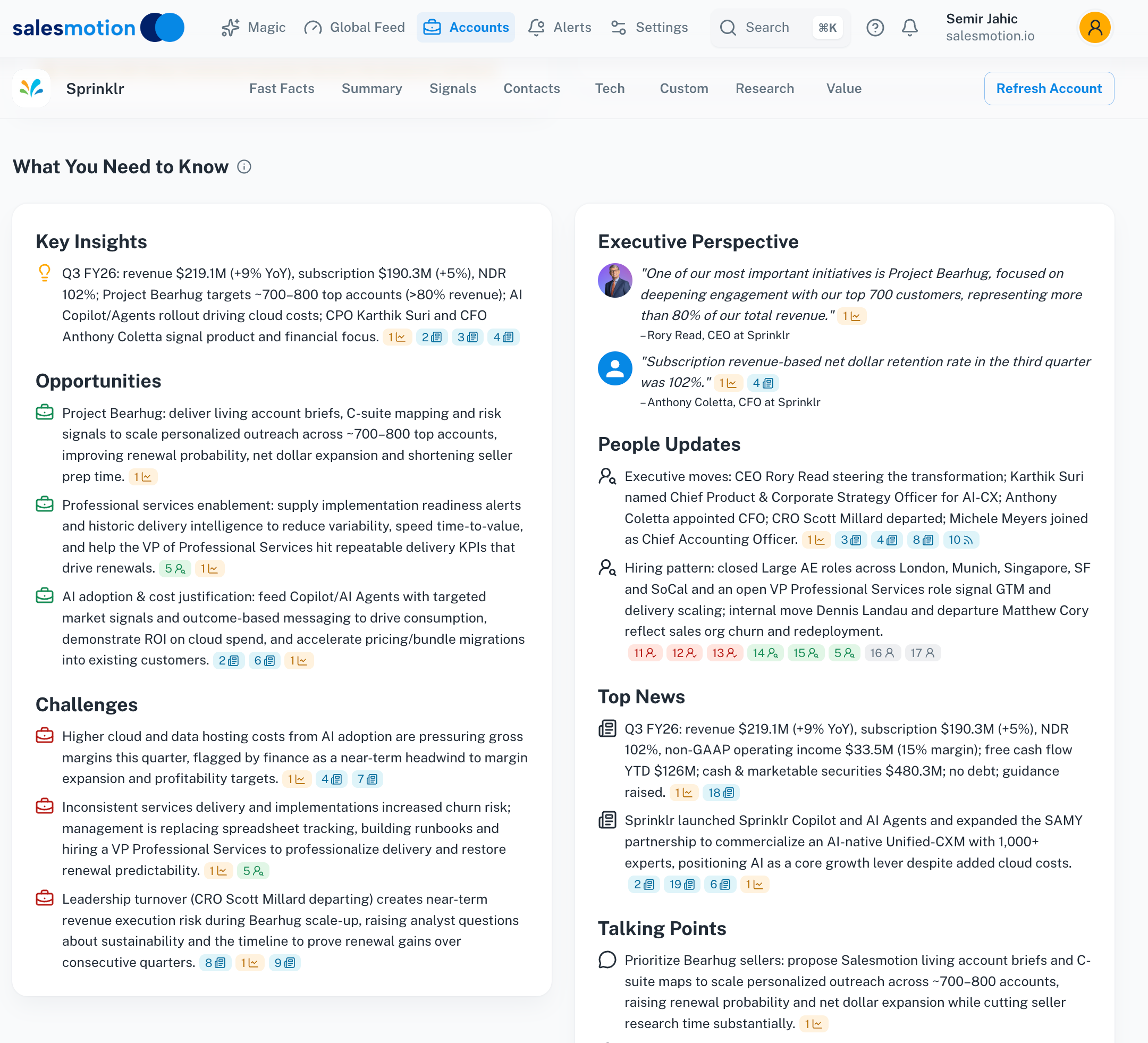 An AI-generated account brief combines signals, strategic priorities, and stakeholder data so reps can move from detection to outreach in minutes.
An effective workflow breaks down into four key stages. Each step builds on the last, creating a smooth path from raw data to a qualified sales conversation. This process ensures reps get actionable intelligence, not just alerts.
Here’s what the signal-to-outreach workflow looks like in practice: a buying signal fires, the platform surfaces context, and the rep drafts personalized outreach anchored to real intelligence.
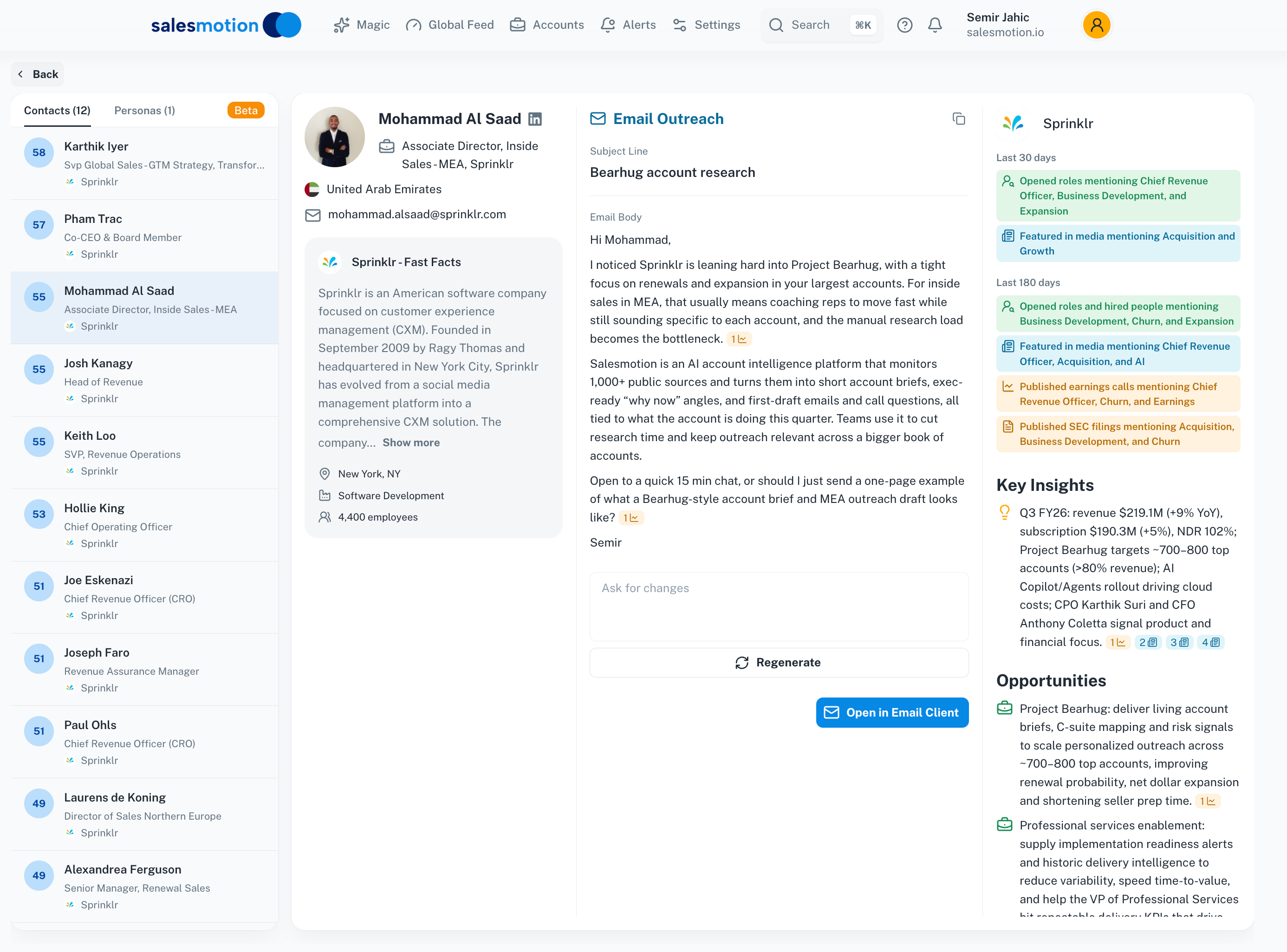 Signal-driven outreach: the platform turns account intelligence and buying signals into personalized email drafts reps can review and send in minutes.
Let’s follow a signal from detection to outreach.
-
Automated Monitoring and Triage: It starts with technology that constantly scans thousands of sources for your predefined signals. When a trigger event occurs—like a new funding round—the system captures it. Setting up robust AI agent input pipelines is key to automating this heavy lifting.
-
Intelligent Prioritization: Not all signals are equal. An AI-powered system then scores the signal based on its potential impact and your Ideal Customer Profile (ICP). A funding round at a top-tier target, for example, would be flagged as high-priority, rising above the noise.
-
Instant Contextualization: This is where raw data becomes valuable insight. Instead of just a headline, the sales rep receives a concise, AI-generated brief. This summary explains the "so what" behind the signal—connecting the funding to likely business initiatives, identifying key stakeholders, and even suggesting talking points.
-
Triggering Personalized Outreach: The final step is action. The system pushes an alert with all the necessary context directly into the rep's workflow, like Slack or their CRM. The rep can then launch a highly personalized outreach that speaks directly to the account's current situation.
A Story-Driven Example in Action
Let’s make this tangible. Imagine a sales rep named Alex. At 9:05 AM, an automated alert hits Alex's Slack channel: "Acme Corp, a Tier 1 target, has just announced a $50 million Series C funding round to expand into the EMEA market."
Instead of spending an hour digging through news articles, Alex gets an instant AI-generated brief. It confirms the funding, identifies the new VP of EMEA Sales hired last month, and highlights a CEO quote about needing to "build scalable infrastructure."
By 9:10 AM, Alex is ready. Armed with this context, Alex drafts a personalized email that bypasses the usual generic pitch. It leads with a congratulatory note on the funding and directly connects their solution to the challenge of building scalable infrastructure for a rapid EMEA expansion.
The email is sent by 9:15 AM—just ten minutes after the initial signal was detected. This is the power of a streamlined, signal-based selling workflow. It closes the gap between insight and action, enabling reps to engage with relevance and precision at the exact moment it matters most.
How to Build Your Signal-Based Selling Playbook
Execution is what separates a good idea from a great revenue engine. Knowing about buying signals is one thing, but turning that intel into consistent wins requires a clear, repeatable process.
This is where your signal-based selling playbook comes in. It’s the blueprint that turns raw data into timely, effective sales actions.
Without a playbook, your team is left to interpret signals on their own, leading to scattered outreach and missed opportunities. A well-defined playbook removes the guesswork, ensuring every rep knows exactly how to act when a high-value trigger appears. It’s the key to making this strategy scalable and predictable.
Start with Your Ideal Customer Profile
Before you can spot the right signals, you have to be crystal clear on who you're listening for. Your Ideal Customer Profile (ICP) is the foundation of your playbook. A fuzzy ICP means you’ll waste time chasing signals from accounts that were never a good fit.
Your ICP has to go beyond basic firmographics. It should be a detailed portrait of the accounts that get the most value from your solution.
- Firmographics: Nail down your non-negotiables like industry, company size, and location.
- Technographics: What technologies are they already using? Are there tools that signal a good fit or an integration opportunity?
- Behavioral Traits: How do they buy? Are they driven by top-down executive mandates or bottom-up team adoption?
A sharp ICP acts as the most important filter for your signal-based selling engine, guaranteeing your team only focuses on accounts with real potential.
Map and Prioritize Your Critical Signals
Once you know who to target, the next step is defining what you're looking for. Not all signals are created equal. A new funding round is interesting, but a direct competitor getting dropped from a target's tech stack is a five-alarm fire. You have to create a hierarchy to focus your team’s effort where it counts.
Get your sales and marketing teams in a room and map out the signals that matter for your business. For a deeper dive into creating a structured approach, you might find our guide with real-world sales playbook examples helpful.
A simple tiered system can bring immediate clarity. Tier 1 signals demand an immediate, personalized response, while Tier 3 signals might just trigger a lighter, automated touchpoint. This prioritization is crucial for managing rep bandwidth and maximizing impact.
Create Specific Plays for Each Trigger
This is the operational heart of your playbook. A "play" is a predefined set of actions a rep should take when a specific signal surfaces. It connects the "what" (the signal) to the "how" (the outreach).
Each play should clearly outline:
- The Trigger: The specific signal that kicks off the play.
- The Persona: The exact person or role to contact.
- The Channel: Where to reach out (email, LinkedIn, call).
- The Message: A powerful, context-aware template that weaves the signal into the conversation.
Here’s how this looks in the real world:
| Trigger Signal | Outreach Snippet Example |
|---|---|
| New Funding for Expansion | "Congratulations on the new funding for your EMEA expansion—companies we help at this stage often face challenges with scaling their sales enablement across new regions." |
| Hiring a New C-Suite Leader | "Saw that you recently brought on a new CRO. New leaders often look to reassess their tech stack in the first 90 days to make a quick impact." |
| Negative Mention of Competitor | "Noticed your post about challenges with [Competitor Name]'s uptime. We offer a more reliable solution with a dedicated support model for enterprise teams." |
By defining these plays, you establish clear rules of engagement and arm your team with proven, repeatable tactics. This transforms signal-based selling from an abstract concept into a powerful, day-to-day sales motion that drives results.

“The Business Development team gets 80 to 90 percent of what they need in 15 minutes. That is a complete shift in how our reps work.”
Andrew Giordano
VP of Global Commercial Operations, Analytic Partners
Measuring Success and Proving the ROI of Your Efforts
Adopting a new strategy is one thing; proving it works is another. How do you show that signal-based selling is more than just a slick idea? The trick is to look past vanity metrics and zero in on the business outcomes your leadership team cares about.
It’s not about how many signals you find; it’s about what you do with them. Success isn't a busy sales team—it's shorter sales cycles, higher conversion rates, and a healthier pipeline. Tracking the right key performance indicators (KPIs) lets you draw a straight line from your signal-driven plays to real revenue growth.
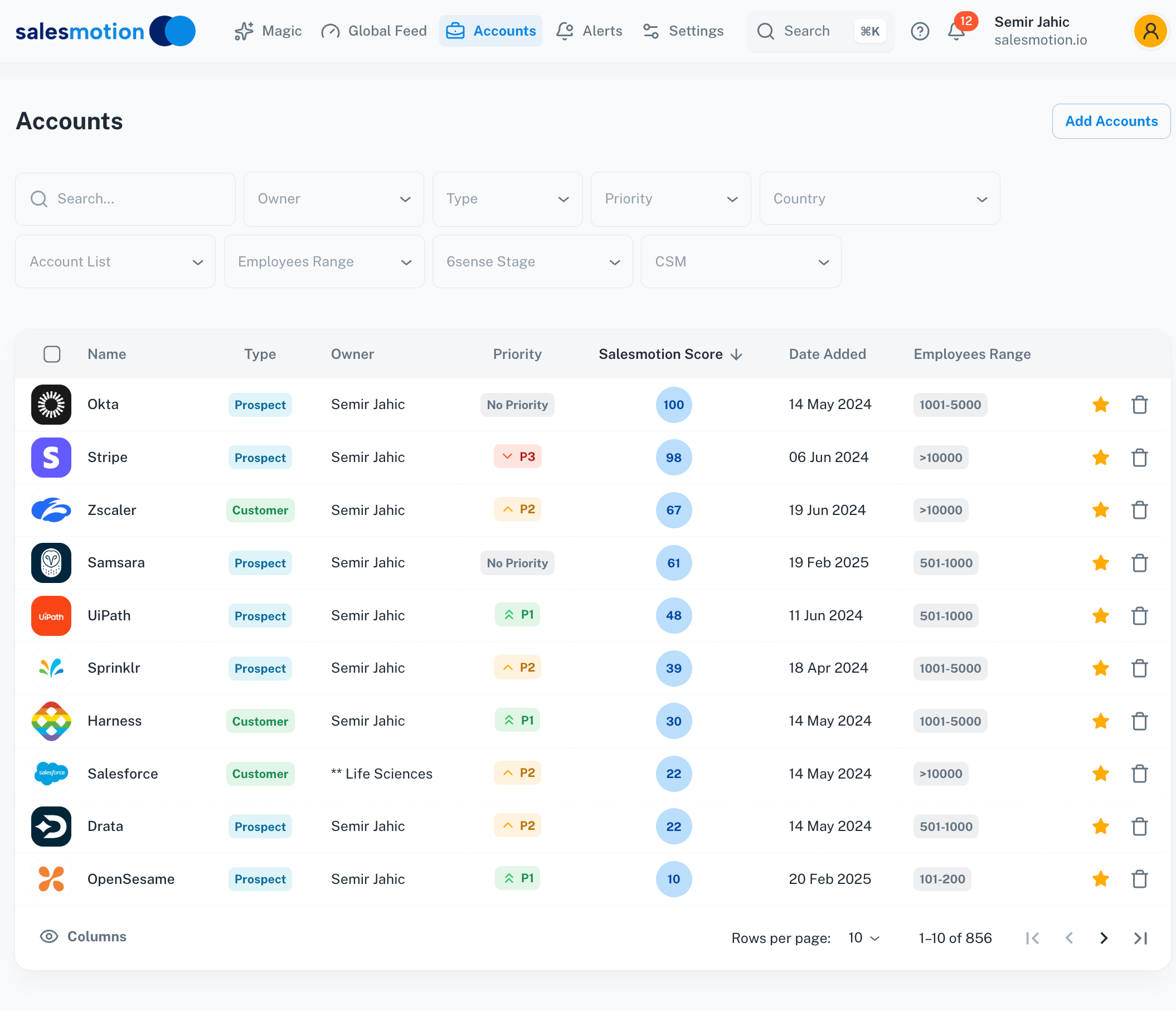 Account scoring and prioritization based on real-time signal activity, helping reps focus on the accounts most likely to convert.
Key Metrics That Tell the Real Story
To build a compelling business case, you need to track metrics that reflect sales efficiency and effectiveness. These KPIs show the impact of engaging the right accounts at the right time.
Here are the essentials for your dashboard:
- Meeting Acceptance Rate: This is your first gut check. Are prospects more willing to meet when your outreach is tied to a timely signal? A rising acceptance rate proves your messaging is hitting home.
- Opportunity-to-Close Conversion Rate: This one is all about pipeline quality. Signal-based selling should generate higher-intent opportunities that are more likely to become closed-won deals.
- Sales Cycle Length: How long does it take to close a deal? When you engage accounts already in a buying mindset, you can dramatically shorten that timeline.
- Average Contract Value (ACV): Are the deals you win with signals bigger? Often, engaging at a strategic moment—like after a funding round—lets you position a more comprehensive, higher-value solution.
Connecting Metrics to Tangible ROI
Tracking these KPIs is step one. The real magic is translating them into a clear return on investment (ROI). This is how you prove the value of your signal-based selling program to the entire organization.
Think about the impact of a shorter sales cycle. If your average cycle is six months, knocking just one month off means you can close two additional deals per rep, per year. That small improvement has a massive ripple effect on revenue.
The core idea is to confidently attribute wins back to specific signal-driven plays. When you can show that 70% of deals from a "new executive hire" signal closed 30% faster than average, you have a powerful, data-backed story.
This kind of analysis transforms the conversation from "we think this is working" to "we know this is working, and here's the data to prove it."
Building Your Business Case with Data
The evidence for this approach is compelling. Top-performing sales teams see measurable lifts in revenue simply by acting on high-intent triggers. Data shows that smart prioritization can cut sales cycles by 25-40%. In competitive fields like financial services, leaders use signals to achieve 40% better qualification accuracy.
Ultimately, this strategy transforms reps from hunters into trusted advisors, with win rates climbing by 28% for signal-savvy teams versus those relying on volume. For a deeper dive into these performance benchmarks, you can explore the findings on how top sales teams use buying signals.
This is the kind of data that builds a powerful business case. By setting up the right dashboards and tracking the right outcomes, you can show how investing in a signal-based selling approach directly fuels faster, more predictable revenue growth.
Common Pitfalls and How to Sidestep Them
Let's be real—adopting any new sales motion comes with bumps in the road. Signal-based selling is powerful, but a few common mistakes can trip you up. Knowing them ahead of time is half the battle.
The goal is to be proactive, not reactive. If you can anticipate these challenges, you can build a more resilient process that turns potential headaches into moments of refinement. You'll get your team hitting their stride much faster and with less friction.
Drowning in Signal Overload
One of the first things teams run into is signal overload. You turn on the data firehose, and suddenly your reps are buried under hundreds of low-value alerts. A notification that an intern at a target account liked a LinkedIn post? That’s just noise, not a real opportunity.
This constant stream of irrelevant pings leads to alert fatigue, fast. Before you know it, reps are ignoring the entire system—including the high-impact signals you want them to act on.
The fix is aggressive curation. You have to be ruthless about defining what a high-value signal looks like for your business and filter out everything else.
- Set Strict Filters: Configure your system to only surface triggers that align with your Ideal Customer Profile (ICP) and meaningful buying behaviors.
- Prioritize with Tiers: Not all signals are equal. A company announcing a $50M funding round is a Tier 1, drop-everything-and-call event. A mention in a blog post might be a Tier 3, perfect for a lighter touchpoint.
- Use a Smart Platform: A purpose-built account intelligence platform like Salesmotion does this heavy lifting for you. It uses AI to curate and score signals, so your team only sees what truly matters.
Getting Data Without Context
Another classic mistake is getting signals without the crucial "so what?" A raw alert—"Acme Corp just hired a new CRO"—is interesting, but it's not actionable by itself. Your reps are still stuck doing manual research to figure out why it matters.
Without context, a signal is just a fact. With context, it becomes a conversation starter. The goal is to close the gap between information and action, enabling reps to engage thoughtfully within minutes.
To fix this, your workflow needs to automatically deliver context alongside the alert. The best platforms don’t just report the news; they interpret it. They’ll connect that new CRO to their past roles, highlight their likely priorities, and maybe even suggest a few talking points. It transforms a data point into a clear reason to reach out.
Suffering from Poor Workflow Integration
Even the best intelligence is useless if your team has to leave their existing tools to find it. If reps have to log into a separate platform, hunt through dashboards, and then manually copy-paste insights back into their CRM, they just won't do it. The friction is too high.
The intelligence has to live where your reps work. Period.
This means embedding signal alerts directly into their daily flow, whether that’s Slack, email, or your CRM. When an actionable alert pops up in a familiar tool—complete with context and a direct link to the account record—you make it effortless for reps to act immediately. That seamless integration is the secret to driving consistent follow-through and making signal-based selling a core part of your team's daily rhythm.
Key Takeaways
- Signal-based selling replaces static lead scoring and cold outreach with real-time event detection that tells reps who to contact, what to say, and when to say it.
- The most valuable signals combine multiple data types: organizational changes like executive hires, financial events like funding rounds, and behavioral indicators like website visits or content downloads.
- Building a signal-based playbook requires mapping specific signals to predefined outreach sequences so reps can act immediately when a high-value trigger fires rather than researching from scratch.
- Measuring ROI requires tracking both leading indicators like signal response time and reply rates and lagging indicators like pipeline velocity and win rate improvements.
- Integration is critical; signal intelligence must live where reps already work, in Slack, email, or the CRM, to drive consistent follow-through and adoption.
Frequently Asked Questions
What is signal-based selling and how does it differ from traditional outreach?
Signal-based selling is a strategy that uses real-time buying triggers, such as funding rounds, executive hires, and product launches, to identify accounts that are actively entering a buying cycle. Unlike traditional outreach that relies on volume and static lead lists, signal-based selling focuses on timing and relevance, targeting only the 3-5% of your market that is in-market right now. This shifts reps from being interrupters to being timely, trusted advisors.
How is signal-based selling different from Account-Based Marketing?
Think of them as complementary strategies. Account-Based Marketing (ABM) defines who your most valuable target accounts are, while signal-based selling provides the when and why for engaging them. Signals are the real-time triggers that turn a well-laid ABM plan into perfectly timed action, ensuring your message lands at the exact moment it matters most.
What types of buying signals should we prioritize?
The highest-value signals combine specificity and urgency. Tier 1 signals that demand immediate action include new funding rounds, C-suite hires, and competitor displacement events. Tier 2 signals like department-specific hiring surges and product launches warrant a timely but less urgent response. Create a clear tiered system so your team knows which triggers to drop everything for and which can be addressed with a lighter automated touchpoint.
How do we avoid signal overload and alert fatigue?
Aggressive curation is the answer. Configure your system to only surface triggers that align with your Ideal Customer Profile (ICP) and meaningful buying behaviors, and filter out everything else. Use a tiered prioritization framework so reps see high-impact signals prominently while lower-priority alerts are handled through lighter automated sequences. A purpose-built account intelligence platform uses AI to score and curate signals, ensuring your team only sees what truly matters.
How much manual work does signal-based selling require?
Without the right tools, it is extremely labor-intensive, as reps would spend half their day hunting for information online. Modern account intelligence platforms do the heavy lifting by scanning thousands of sources, detecting relevant signals, and delivering them with full context and suggested talking points. The rep's job shifts from hunting for intelligence to acting on it, often going from signal detection to personalized outreach in under ten minutes.
Can signal-based selling work for smaller sales teams?
It is often even more critical for smaller teams. When you have limited resources, you cannot afford to waste time chasing the 95% of the market that is not ready to buy. Signal-based selling empowers a lean team to have smarter, higher-impact conversations by laser-focusing on accounts showing clear buying intent, resulting in better efficiency, shorter sales cycles, and more predictable growth without needing to hire more reps.