Your SaaS go-to-market strategy starts with a simple truth: you can't sell effectively if you don't know exactly who you're selling to. This isn't just a nice-to-have; it's the foundation that guides every marketing, sales, and product decision you'll make.
It all comes down to creating a detailed, data-driven Ideal Customer Profile (ICP).
Build Your Foundation With an Ideal Customer Profile
Launching a new SaaS product can feel like shouting into a void. You've built a great solution, but who really needs it? The classic mistake is casting the widest net possible, hoping to catch anyone. That approach just burns cash and makes your message generic.
A winning GTM strategy starts with the opposite: extreme focus.
Before you spend a dime on ads or hire a salesperson, nail down your ICP. This isn't a vague persona. It’s a specific definition of the perfect company for your product—the one that will get the most value, stick around the longest, and become your biggest fan.
Go Beyond Basic Demographics
An effective ICP digs deeper than just company size and industry. While those firmographics are a good starting point, the real insights come from understanding the context where your product solves a critical, expensive problem.
If you have early customers, start there. Look for common threads:
- Company Attributes: What’s their typical employee count and annual revenue? Are they in a specific vertical like FinTech or HealthTech?
- Technographic Data: What other software is in their stack? Do they use Salesforce? Are they heavily invested in HubSpot? Technographic targeting tells you a lot about their operational maturity.
- Pain Points and Buying Triggers: What specific event forced them to look for a solution like yours? A failed audit? A missed revenue target? A manual process that finally broke?
Uncover the Real Problem With Insightful Interviews
Data analysis tells you the "what," but customer interviews reveal the "why." The goal is to get past feature requests and dig into the business pain your product solves. Don't just ask if they like your product; ask what broke in their world that led them to you.
A few questions to get you started:
- "Before you found us, how were you handling [the specific problem]?"
- "Walk me through the tipping point. What finally made you say, 'We need a new tool for this'?"
- "What was the one business outcome you were hoping to achieve?"
The answers are pure gold. They help you craft messaging that connects, moving beyond generic benefits to specific, value-driven outcomes. This deep understanding also fuels your account-based marketing efforts. For more on that, check out our guide on target account planning strategies.
This process boils down to three core steps: analyze the data, interview for the "why," and document everything.
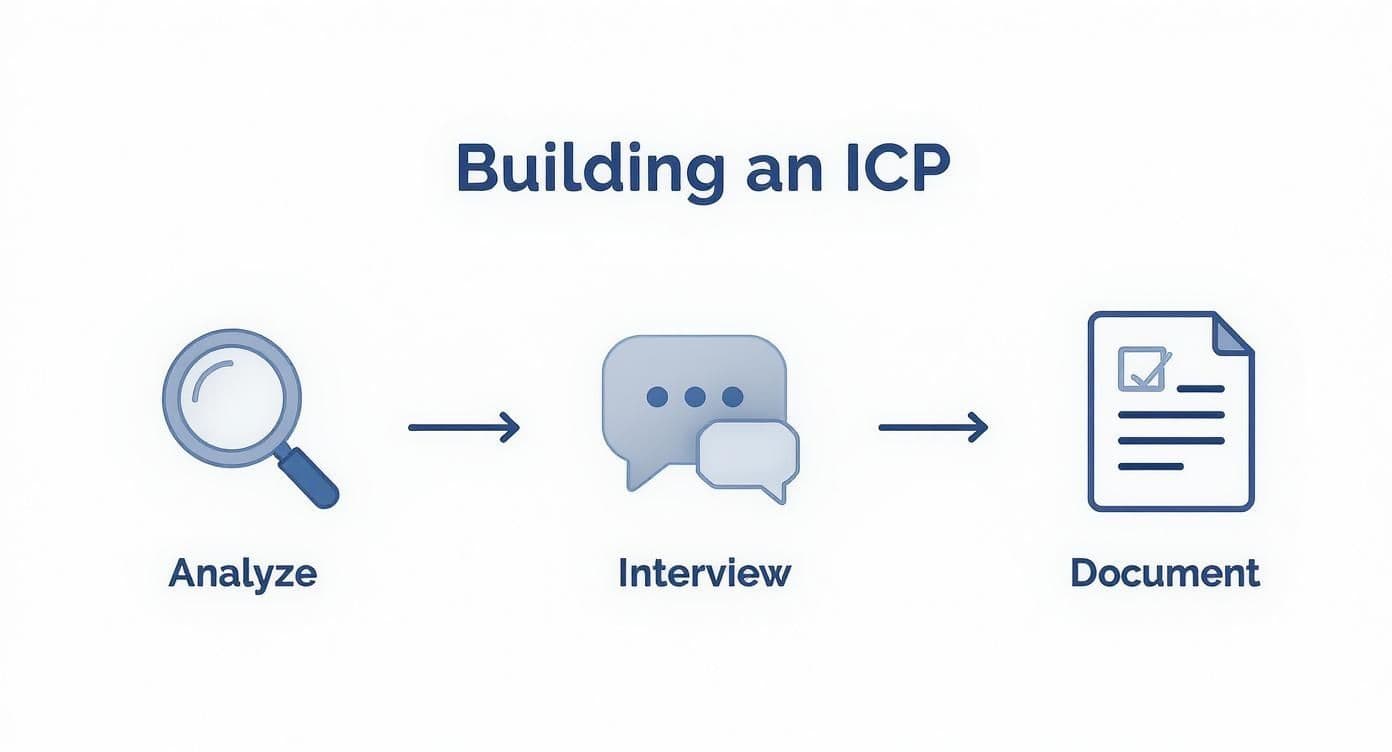
This simple flow turns raw data and real conversations into a strategic asset that aligns your entire company.
To help structure your ICP, use a checklist to make sure you're capturing the right information.
ICP Component Checklist
| Component Category | Key Data Points to Collect | Why It Matters |
|---|---|---|
| Firmographics | Industry/Vertical, Employee Count, Annual Revenue, Geography | Narrows the market to a manageable size for initial targeting. |
| Technographics | Core SaaS platforms (CRM, ERP), tech stack, internal tools | Reveals integration opportunities and indicates technical maturity. |
| Behavioral | Social media presence, content consumption, event attendance | Informs channel strategy and shows where they look for information. |
| Situational | Trigger events, strategic initiatives (e.g., digital transformation) | Pinpoints the "why now" and creates urgency for your solution. |
| Pain Points | Business challenges, operational bottlenecks, financial impact | Forms the core of your messaging and value proposition. |
| Goals & Outcomes | Desired business results, KPIs they track, success metrics | Helps you frame your solution in terms of tangible business value. |
This checklist provides a solid framework for building an ICP that's both comprehensive and actionable.
Defining your ICP isn't a one-and-done task. It's the compass for your entire go-to-market motion. When marketing, sales, and product all point to the same true north, you eliminate wasted effort and accelerate growth.
It’s impossible to overstate how critical this first step is. The ROI of your entire GTM strategy is directly tied to the quality of your customer insights. Research shows that companies with a clear GTM plan report 10% higher success rates—and it all starts with a rock-solid ICP. Get this foundation right, and every action that follows will be more precise, targeted, and effective.
See Salesmotion in action
Take a self-guided interactive tour — no signup required.
Craft a Message That Cuts Through the Noise
You’ve nailed down your Ideal Customer Profile. That's a huge win, but it's only half the battle. Now you have to craft a message that actually gets their attention.
In a crowded market, simply listing features is a surefire way to be ignored. Your go-to-market strategy needs messaging that resonates on a deeper level. This means shifting the conversation from what your product does to what it enables. A solid product marketing strategy connects your product’s features to your ICP’s most urgent problems. The goal is to create a narrative where your ideal customer feels completely understood.
Analyze Your Competitors' Messaging, Not Just Their Features
Most competitive analysis falls flat because it gets stuck in a feature-for-feature spreadsheet. While that’s helpful for your product team, it does little to inform a powerful GTM message.
Instead, dissect how your competitors position themselves. Visit their websites. Read their ads. Sit through their demos. As you do, ask yourself:
- Who are they talking to? Is their language for technical users, executives, or frontline managers?
- What pain points are they hitting? Is the focus on saving time, cutting costs, or avoiding risk?
- What's their core promise? What is the one big outcome they claim to deliver?
- What's their tone? Do they sound academic and serious, or more casual and modern?
This exercise will quickly reveal the "messaging gaps" in the market. You'll likely find everyone is using the same tired jargon or hammering the same generic benefit. That's your opening to say something different—and far more meaningful—to your ICP.
Define Your Unique Value Proposition
Your Unique Value Proposition (UVP) is the heart of your message. It’s a clear, concise statement that answers three questions for your customer:
- What specific problem do you solve for me?
- What tangible results can I expect?
- Why should I choose you over anyone else?
A great UVP isn't just a clever tagline; it’s a commitment. It needs to be specific, outcome-driven, and directly tied to the pains you uncovered when building your ICP. This is the essence of communicating value, a core principle you can explore in our guide on what is value selling.
Your UVP isn't about being unique for the sake of it. It’s about being uniquely valuable to a specific audience. The tighter your ICP, the sharper your UVP can become.
For example, a generic UVP like "The best CRM for small businesses" is forgettable. A more powerful version: "The all-in-one CRM that helps solo consultants win 20% more proposals by automating follow-ups and tracking client engagement." See the difference? It’s specific, highlights a real result, and speaks directly to a niche audience.
Build a Messaging Framework for Consistency
With a strong UVP, the final step is to translate it into consistent copy across all your channels. A simple messaging framework ensures everyone on your team—from marketing to sales—is speaking the same language.
This framework breaks your core message into three parts:
- Pillar 1: The Problem: Clearly state the specific, costly problem your ICP faces. Use their words, not yours.
- Pillar 2: The Solution: Introduce your product as the clear path to solving that problem. Focus on the outcome, not just features.
- Pillar 3: The Differentiator: Explain what makes you the best choice. This could be your technology, support model, or focus on their industry.
By mapping your website copy, ad campaigns, and sales scripts back to these pillars, you create a cohesive and compelling story. This consistency builds trust and makes it easy for your ideal customer to see why you're the obvious choice.

“Salesmotion has been a game-changer for me. I used to spend 12 hours a week on prospect research, now it's down to 4. Plus I'm finding stuff I was totally missing - podcasts, news mentions, the good bits.”
George Treschi
Account Executive, FY25 President's Club, Sigma
Design Your Pricing and Packaging Strategy
Once you've nailed your messaging, it's time to tackle pricing. This is one of the trickiest, yet most powerful, levers in your go-to-market strategy. Get it right, and you create a smooth path for growth. Get it wrong, and you can cripple your business before it starts.
Your price isn't just a number; it's a signal about the value you deliver. The goal is a structure that feels like a no-brainer to your customers while building a sustainable business. It needs to be simple enough for a prospect to understand in seconds, yet sophisticated enough to grow with them.
Choosing the Right Pricing Model
There’s no magic bullet here. The best pricing model depends on your product, your customers, and how they get value. Some models encourage widespread adoption, while others maximize revenue from power users.
Let's break down the most common options:
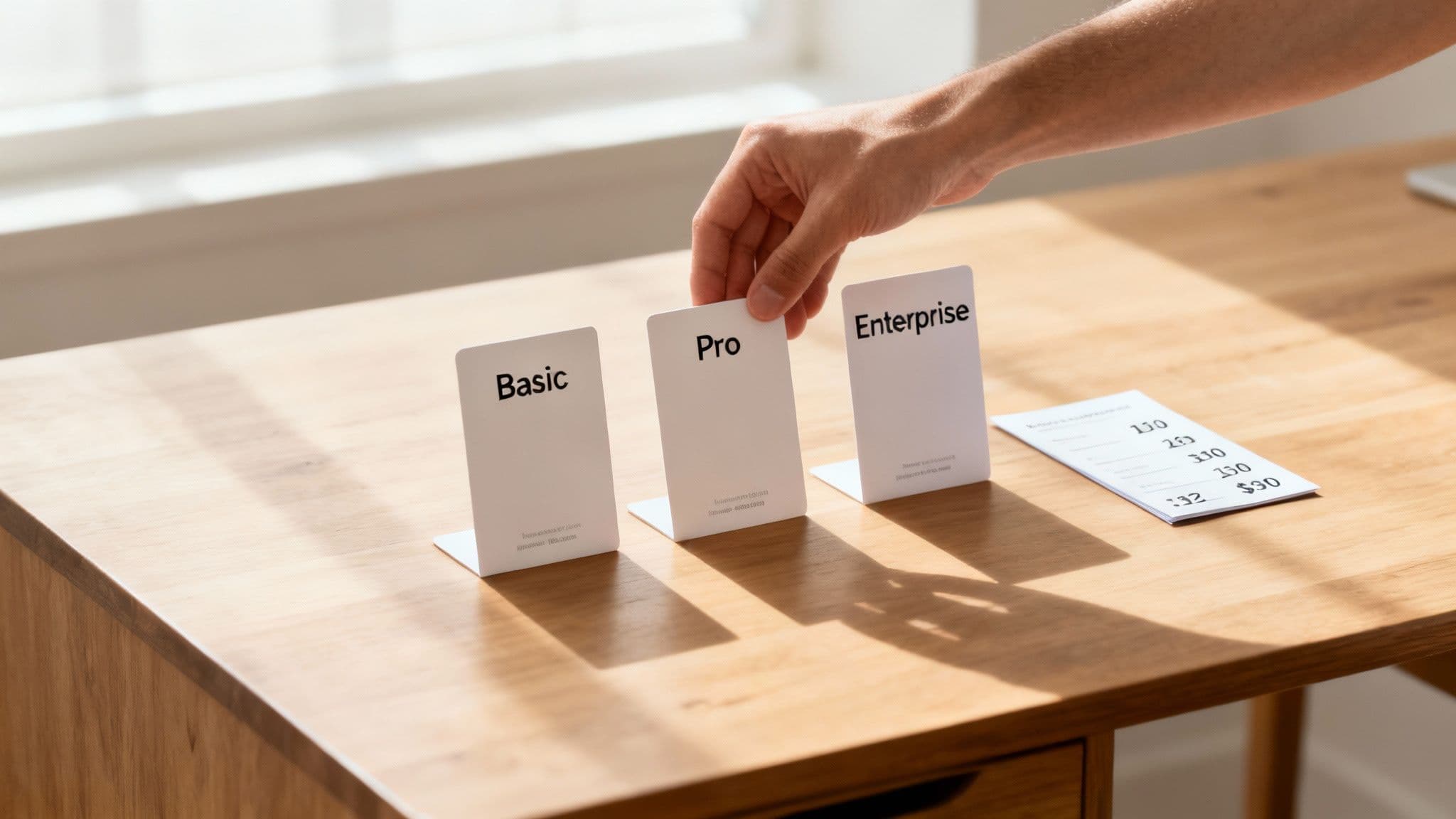
- Tiered Pricing: The classic SaaS playbook. You create a few distinct packages (e.g., Basic, Pro, Enterprise) with more features at each level. It's a great fit when you serve different types of customers with varying needs and budgets.
- Usage-Based Pricing: Customers pay only for what they use—think API calls or data storage. This aligns your revenue directly with customer consumption, making it feel fair and scalable.
- Flat-Rate Pricing: One price, one set of features, zero confusion. Its main benefit is simplicity. It's easy to communicate and sell, but you might leave money on the table if you have a wide range of customer sizes.
- Per-User Pricing: Straightforward and predictable. The cost scales directly with the number of people on a team using the software. It’s a common starting point but can create friction when teams hesitate to add more paid seats.
To make the choice clearer, let's compare how these models stack up. Each approach has its own strengths and is better suited for different types of products and customer bases.
SaaS Pricing Model Comparison
| Pricing Model | Best For | Pros | Cons |
|---|---|---|---|
| Tiered | Products with distinct user segments and a clear feature progression. | Caters to diverse needs; creates clear upgrade paths. | Can be complex; customers might feel stuck between tiers. |
| Usage-Based | Infrastructure or API-first products where value is tied to consumption. | Price scales with value; low barrier to entry for small users. | Revenue can be unpredictable; can be complex to forecast. |
| Flat-Rate | Simple tools with a single, clear use case for a uniform audience. | Extremely easy to understand and sell. | One-size-fits-all approach misses revenue opportunities. |
| Per-User | Collaboration tools where value increases with more users. | Predictable revenue; simple for buyers to calculate costs. | Can discourage team-wide adoption due to rising costs. |
Ultimately, choosing a model is just the beginning. The real breakthrough comes when you anchor your price not to your costs, but to the value your customers receive.
Anchor Your Price to Value
Value-based pricing is more of a mindset than a formula. Instead of asking, "What does it cost us to run this?" you need to ask, "What is this outcome worth to our customer?"
This approach ties your price directly to the ROI your customer sees, whether that’s in time saved, revenue gained, or risks avoided. To do this well, you have to truly understand the financial impact of the problem you solve—which brings us back to your ICP research.
For instance, if your software saves a 10-person sales team 2 hours per week each, that’s 20 hours of productive time you've just given back. You can quantify that value in dollars and then price your product as a small fraction of that gain.
Your price shouldn't just cover your costs; it should be a fraction of the value you create. When a customer feels like they're getting a 10x return on their investment, the price becomes an easy decision.
Package Your Features Intelligently
How you bundle features into your plans is critical for driving upgrades. The key is to map your tiers directly to your customer's growth journey.
Your entry-level tier should solve an immediate problem and deliver a quick win. It needs to feel valuable on its own.
As your customers grow, your higher-tier plans should offer the features that solve their next set of challenges. This creates a natural, frictionless path for expansion revenue. A common mistake is to gatekeep essential features in lower tiers, which just creates frustration. Instead, make your entry-level plan a fantastic deal for the right user, and let the advanced features in your higher tiers pull them forward when the time is right.
Build Your Demand Generation Engine
You’ve locked in your ICP, messaging, and pricing. Now it's time to build the engine that brings the right people to you. This is demand generation—the systematic process of creating awareness and interest in what you're selling.
This isn't about just throwing money at ads and hoping for the best. A smart B2B SaaS go-to-market strategy uses a deliberate mix of channels that work together, guiding prospects from "Who are you?" to "Where do I sign?" The point is to meet your ideal customers where they already are.
Choosing Your Core Channels
The number of marketing channels can feel paralyzing. Should you pour everything into SEO? Is Account-Based Marketing (ABM) a smarter play? The answer is almost always found by looking at your ICP and average deal size.
- For smaller deals (low ACV): Your strategy has to be scalable and efficient. This is where inbound marketing shines. Think content marketing, SEO, and tightly targeted social media ads. The game is to attract a high volume of the right traffic and guide them into a smooth, self-service experience.
- For larger deals (high ACV): You need a high-touch, laser-focused approach. This is ABM territory. You aren't trying to attract everyone; you’re going after a specific list of high-value accounts. Tactics shift to personalized outbound email, LinkedIn ads aimed at specific job titles, and bespoke content for key decision-makers.
Most B2B SaaS companies find their sweet spot with a blended approach. You might use broad content marketing to build awareness and then switch to an ABM strategy to engage the most promising accounts. This balanced method is one of many effective demand generation strategies you can use to build a healthy pipeline.
Mapping the Funnel and Setting Goals
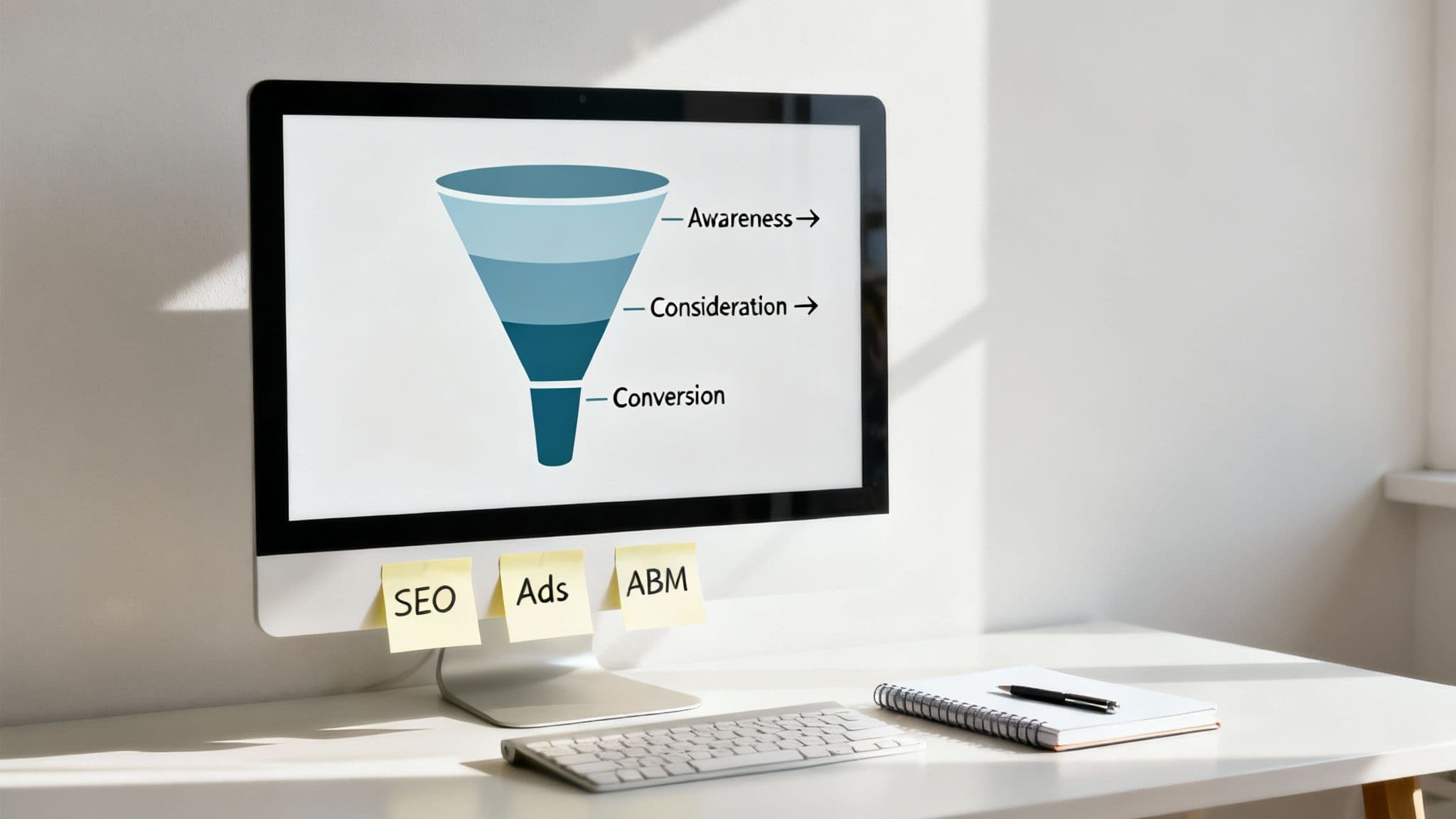
Your demand gen engine isn't just about making noise; it’s about guiding prospects on a journey. You need a clear funnel that nurtures interest from initial awareness all the way to a demo request or trial signup.
A simple B2B SaaS funnel breaks down like this:
- Top of Funnel (Awareness): Attract your ICP with helpful, educational content that speaks to their biggest problems—think blog posts, webinars, or industry reports. You're not selling yet; you're being useful.
- Middle of Funnel (Consideration): They know who you are. Now, show them how you solve their problem. This is where you introduce lead magnets like case studies, ROI calculators, or detailed solution guides.
- Bottom of Funnel (Decision): Prospects at this stage are actively comparing solutions. Your job is to make it easy for them to take the next step with crystal-clear calls-to-action for free trials, demos, or a pricing chat.
The speed at which you move people through this funnel matters. Top-tier SaaS companies reach 1,000 subscribers in just 11 months on average, while the median company takes about two years to hit that same milestone. That gap often comes down to GTM execution efficiency. You can find more insights on this in Iconiq Capital's GTM report.
Creating Lead Magnets That Actually Convert
A classic mistake is creating generic lead magnets like a simple "subscribe to our newsletter" form. Sure, it builds an email list, but it doesn't necessarily generate qualified leads. Your lead magnets have to offer a tangible solution to a specific problem your ICP is facing.
Your lead magnet should feel like a small-scale version of the value your product delivers. It’s a free sample of the expertise and results you bring to the table.
Here are a few examples of high-converting lead magnets for B2B SaaS:
- A "State of the Industry" Report: Collect unique data, then present it with insights relevant to your ICP's strategic planning.
- A Niche-Specific Template: Give them a pre-built spreadsheet, project plan, or checklist that saves them hours of work.
- An Interactive ROI Calculator: Let prospects plug in their own numbers and see a personalized estimate of the financial upside of using your solution.
These assets don't just collect contact info; they attract people who are actively trying to solve a real business problem. They pre-qualify themselves, giving your sales team a much warmer lead.

“The Business Development team gets 80 to 90 percent of what they need in 15 minutes. That is a complete shift in how our reps work.”
Andrew Giordano
VP of Global Commercial Operations, Analytic Partners
Define Your Sales Motion and Enable the Team
How you sell is just as important as what you sell. Once your strategy is set, it's time to build a repeatable process that turns prospects into customers. This means defining your sales motion and then arming your team with everything they need to execute it.
Think of your sales motion as the playbook that guides every prospect interaction. It’s the bridge between a warm lead and a closed deal. Picking the right one is about matching your process to your product's price and complexity.
Choosing Your Primary Sales Motion
For a B2B SaaS company, there are three main models to consider. Each one fits a different customer journey and demands a unique set of skills and resources.
-
Product-Led Growth (PLG): The product does the heavy lifting. Customers sign up for a free trial or freemium plan, discover value on their own, and often upgrade without talking to a human. This is an efficient model for products with a lower price point and a great user experience. Think Slack or Canva—the product is the salesperson.
-
Sales-Led Growth (SLG): The classic model where a salesperson guides the prospect from start to finish. It’s a must for complex or expensive products that demand discovery calls, tailored demos, and negotiation. It’s a high-touch process that lands bigger contracts but comes with a higher Customer Acquisition Cost (CAC).
-
Hybrid Model: This approach takes the best of both worlds. You use a product-led motion to get users in the door, then use a sales team to spot the most promising accounts—your Product-Qualified Leads (PQLs)—for upselling. It's a powerful model if you serve everyone from small teams to large enterprises.
The right sales motion is all about reducing friction for your buyer. If you have a simple, low-cost tool, don't force prospects through a long sales cycle. On the flip side, trying to sell a complex, six-figure platform with a self-service checkout is just as ineffective.
Arming Your Sales Team for Success
Once you know how you'll sell, you need to give your team the assets to win. This is sales enablement: the process of giving your reps the strategy, content, and tools they need to engage buyers effectively. It’s about making sure every rep can tell a consistent, compelling story.
If you're looking for a structured way to build this out, exploring a complete sales enablement framework can give you a solid roadmap. A good library of enablement materials ensures your team is ready for any conversation or objection.
Must-Have Sales Enablement Assets
Building out your enablement content is a marathon, not a sprint. But there are a few foundational pieces every B2B SaaS team needs from the start.
-
The Master Sales Deck: This isn't just a list of features. It’s a story. A good deck walks a prospect from their current pain to their desired future, with your product as the bridge. It should flow directly from your messaging framework.
-
Competitor Battle Cards: Your reps will face the competition. Battle cards are cheat sheets that arm them to win those fights. Each one should break down a competitor: their positioning, their weaknesses, and the talking points your reps can use to highlight your strengths.
-
Effective Demo Scripts: A great demo is a value story, not a feature tour. A script should be a flexible outline that connects every part of the demo back to the specific pain points you found in discovery. The goal is to show not just what the product does, but how it solves the customer's real-world problem.
By defining your sales motion and investing in these core assets, you build a sales machine that's not just effective, but repeatable and ready to scale.
Key Takeaways
- A data-driven Ideal Customer Profile is the foundation of every successful SaaS GTM strategy. Without it, your messaging, pricing, and sales motion will lack focus.
- Your messaging must shift from what your product does to what it enables for the buyer. A clear, outcome-driven Unique Value Proposition is the heart of your narrative.
- Value-based pricing, anchored to the ROI your customer receives rather than your costs, creates a no-brainer purchase decision and supports sustainable growth.
- Demand generation should blend inbound content marketing for awareness with account-based strategies for high-value targets, meeting prospects where they are in their buying journey.
- Choosing the right sales motion, whether product-led, sales-led, or hybrid, depends on your product complexity and price point. Arm your team with battle cards, demo scripts, and a master sales deck to execute it effectively.
Measure Success and Optimize Your GTM Strategy
Launching your SaaS is a huge milestone, but a go-to-market strategy doesn't end when the first customer signs. That's just the starting line. Your GTM plan should be a living document that evolves with real-world data and customer feedback.
To scale, you have to get obsessed with measuring what’s working and fixing what isn't.
This means looking past vanity metrics. Website traffic and social media followers feel good, but they don't pay the bills. Sustainable growth comes from a handful of core SaaS metrics that reveal the true health of your business. These numbers are the pulse of your GTM strategy.
Key Metrics for Your GTM Dashboard
You need a simple, focused dashboard to get a clear picture of your performance. Zero in on the numbers that have the biggest impact on your revenue and profitability.
Your essential GTM dashboard must include:
- Customer Acquisition Cost (CAC): The total cost of sales and marketing divided by the number of new customers. A rising CAC is a red flag that your channels are becoming less efficient.
- Customer Lifetime Value (LTV): The total revenue you can expect from a single customer over their entire relationship with you. A strong LTV proves you're attracting high-value customers who stick around.
- LTV to CAC Ratio: This is the magic number. A healthy SaaS business aims for an LTV that is at least 3x its CAC. If your ratio is lower, you're likely spending too much to acquire customers.
- Monthly Recurring Revenue (MRR) Growth: The lifeblood of any SaaS company. Tracking MRR growth shows your momentum and ability to consistently add new revenue.
- Churn Rate: The percentage of customers who cancel their subscriptions in a given period. High churn will silently kill your business, no matter how fast you acquire new customers.
The best SaaS companies treat their GTM strategy like a product—it's never finished. They constantly ship new iterations, run tests, and use data to make smarter bets. An optimized strategy is your best defense against market shifts.
Tracking these metrics isn't optional. Research shows that SaaS firms with structured GTM frameworks grow 20-30% faster than those without one. This gap isn't magic; it comes from the discipline of monitoring key metrics like CAC, LTV, MRR, and churn to make better, faster decisions.
Create a Continuous Feedback Loop
Data tells you what is happening, but human insights tell you why. The final piece of an optimized GTM strategy is building strong communication channels between your teams. Sales, marketing, product, and customer success must be in constant conversation.
Think about it. When the sales team keeps hearing the same objection about a missing feature, that insight needs to get back to the product team—fast. When customer success pinpoints the features that make new users "stick," that's gold for marketing's messaging.
This collaborative loop ensures your strategy is built on real market feedback, allowing you to adapt quickly and stay aligned with what your customers truly need. For a deeper dive into crafting a holistic GTM plan, consult this Essential Go To Market Strategy Guide.
Frequently Asked Questions
What is a SaaS go-to-market strategy?
A SaaS go-to-market strategy is a structured plan that defines how a software company will reach its target customers, communicate its value, and generate revenue. It covers everything from identifying your ideal customer profile and crafting messaging to setting pricing, building demand generation channels, and defining the sales motion your team will use.
How long does it take to build a SaaS GTM strategy?
Building a foundational GTM strategy typically takes four to eight weeks, depending on how much customer research and competitive analysis is needed. However, a GTM strategy is never truly finished. The best SaaS companies treat it as a living document, continuously refining their ICP, messaging, and channels based on real-world performance data.
What is the most important metric for a SaaS GTM strategy?
The LTV-to-CAC ratio is widely considered the most important metric. A healthy SaaS business aims for a customer lifetime value that is at least three times its customer acquisition cost. This ratio tells you whether your growth is sustainable or whether you are spending too much to acquire customers relative to the revenue they generate.
Should a SaaS company start with product-led or sales-led growth?
The best model depends on your product complexity and average deal size. Product-led growth works well for lower-priced products with an intuitive user experience, where customers can self-serve. Sales-led growth is essential for complex or high-priced solutions that require discovery calls and tailored demos. Many companies find success with a hybrid approach that uses a free trial to attract users and a sales team to convert the most promising accounts.
Ready to stop guessing and start winning with data-driven insights? Salesmotion is the AI-powered account intelligence platform that automates the research process, so your sales team can focus on what they do best: selling. Discover how to save reps over 8 hours a week and increase pipeline by 40% at https://salesmotion.io.