Does your sales team have all the right ingredients, but they’re scattered across a dozen different kitchens? One person digs through a shared drive for a case study, another tries to remember which slide deck is current, and a new hire is completely lost.
A sales enablement platform solves that exact problem. It’s not just another piece of software; it’s the fully-stocked, professional kitchen your revenue team needs to cook up wins.
What Is a Sales enablement Platform?

Think about the gap between your marketing and sales teams. Marketing creates great assets—case studies, one-pagers, pitch decks—but reps on the front lines can't find them when it matters most. So what happens? They go rogue, creating their own materials or giving up entirely.
A sales enablement platform bridges that gap. It acts as a single source of truth, bringing everything a seller needs—the right content, training, and data—into one unified space. It’s the ultimate toolkit for your revenue team.
The Core Purpose of an Enablement Platform
At its heart, a sales enablement platform is designed to make sellers more productive and successful. It moves your organization away from disconnected folders, outdated spreadsheets, and forgotten email threads where critical information goes to die.
The goal is to arm every seller with the best materials and knowledge for any situation. The system doesn't just store content; it intelligently recommends the perfect asset at the perfect moment based on the deal stage, industry, or buyer persona.
A modern sales enablement platform unifies content and learning, delivering it just-in-time within a seller's workflow. The standard is getting from search to answer in under 30 seconds.
Moving From Chaos to Cohesion
Without a dedicated platform, businesses lose productivity. Reps waste a shocking amount of time—some studies show up to 30% of their week—searching for or recreating materials. That’s time they should be spending with prospects and moving deals forward.
A sales enablement platform brings order to the chaos by providing:
- A Centralized Content Hub: One place for every approved case study, pitch deck, and battle card. No more version control nightmares.
- Contextual Training: Bite-sized learning modules and coaching reps can access on demand, right when they face a challenge.
- Actionable Analytics: Real insights into which content actually helps close deals and how buyers are engaging with it.
By adding this technology to your stack, you're not just buying a tool. You're building the foundation for a more strategic and scalable sales motion. For teams looking to build this structure, a great next step is learning how to design a comprehensive sales enablement framework to guide your strategy.
See Salesmotion in action
Take a self-guided interactive tour — no signup required.
Exploring the Core Features That Drive Success
A sales enablement platform is more than a digital filing cabinet. Think of it as a high-performance engine for your sales team, where every component is engineered to cut friction and accelerate results. To understand what it's about, let's look at the core features that change how sellers work.
These features aren’t a random collection of tools; they’re interconnected pillars that support the entire sales motion. They work together to make sellers smarter, faster, and more in tune with their buyers.
Intelligent Content Management
The foundation of any sales enablement platform is intelligent content management. This isn't just another shared drive. Instead of forcing reps to hunt for the right case study or guess which slide deck is the latest version, the platform serves up the perfect asset at the perfect moment.
Imagine a seller prepping for a call with a prospect in the financial services industry. A smart platform will instantly recommend:
- A case study featuring a similar bank.
- A battle card breaking down how your solution beats a key competitor.
- A pricing one-pager that has a track record of closing late-stage deals.
This eliminates the guesswork and wasted time, which can consume as much as 30% of a rep's week. It ensures every seller uses the most effective, on-brand content, creating a consistent experience for the buyer.
Just-in-Time Training and Coaching
Annual sales kickoffs are great, but real learning happens in the flow of work. Modern sales enablement platforms deliver just-in-time training and coaching, serving up bite-sized learning modules and guidance exactly when a seller needs them.
For example, when a rep updates an opportunity in the CRM to the "negotiation" stage, the platform can automatically push a short video from a top performer on handling common pricing objections. That contextual learning is far more impactful than a generic training session from months ago. It helps shorten ramp-up times for new hires and keeps veteran sellers sharp.
The real gap in sales performance isn’t the volume of training content; it's the lack of immediate access and application in daily work. The best platforms close this gap.
Advanced Analytics and Revenue Insights
You can't improve what you don't measure. This is where advanced analytics sets a sales enablement platform apart. It gives you clear visibility into what’s working and what isn’t, helping leaders answer critical questions like:
- Which content is used most often in deals that we win?
- How are buyers engaging with the materials we send them?
- Where are new reps getting stuck in the sales process?
These insights create a powerful feedback loop. Marketing learns which assets connect with buyers, and sales leaders can spot coaching opportunities based on real performance data, not just gut feelings. This data-driven approach is a key reason the sales enablement platform market is exploding. Valued at USD 5.23 billion, the global market is projected to hit USD 12.78 billion by 2030. You can find more detail on this market growth over at Grandview Research.
Seamless CRM Integration and Workflow Automation
Finally, these features don't matter if they just add complexity to a seller's day. That’s why seamless CRM integration is non-negotiable. The best sales enablement platforms live inside the tools your reps already use, like Salesforce or HubSpot.
This means a rep can access recommended content, log a call, and complete a quick training module without ever leaving their CRM. This integration keeps sellers focused on selling, not on juggling a dozen different tabs. It also enriches your CRM data, painting a more complete picture of every customer interaction. To go deeper, check out our guide on how sales process automation can streamline these workflows.

“The account and contact signals are key for reaching out at important times, and the value-add messaging it creates unique to every contact helps save time and efficiency.”
Daniel Pitman
Mid-Market Account Executive, Black Swan Data
Connecting Features to Tangible Business Results
A slick platform with a long list of features is nice, but leaders care about outcomes. The real question is how a sales enablement platform turns its capabilities into measurable growth, productivity, and revenue.
It's about drawing a straight line from a function, like content management, to a concrete result, like a shorter sales cycle. When sellers can instantly find the perfect case study for a buyer's pain point, they do more than save a few minutes. They build credibility faster, handle objections on the spot, and speed up the customer's decision-making process.
These small daily wins compound across the team, turning minor efficiencies into major quarterly results.
Accelerating the Sales Cycle
One of the first things you'll notice with a good sales enablement platform is how it shortens the sales cycle. In complex B2B deals, delays are often caused by reps scrambling for information or sending generic materials that fall flat. By serving up battle cards, competitive intel, and success stories at the exact moment of need, the platform removes that friction.
This diagram shows how a central platform becomes a command center for a salesperson, arming them with the content, training, and analytics needed to drive performance.
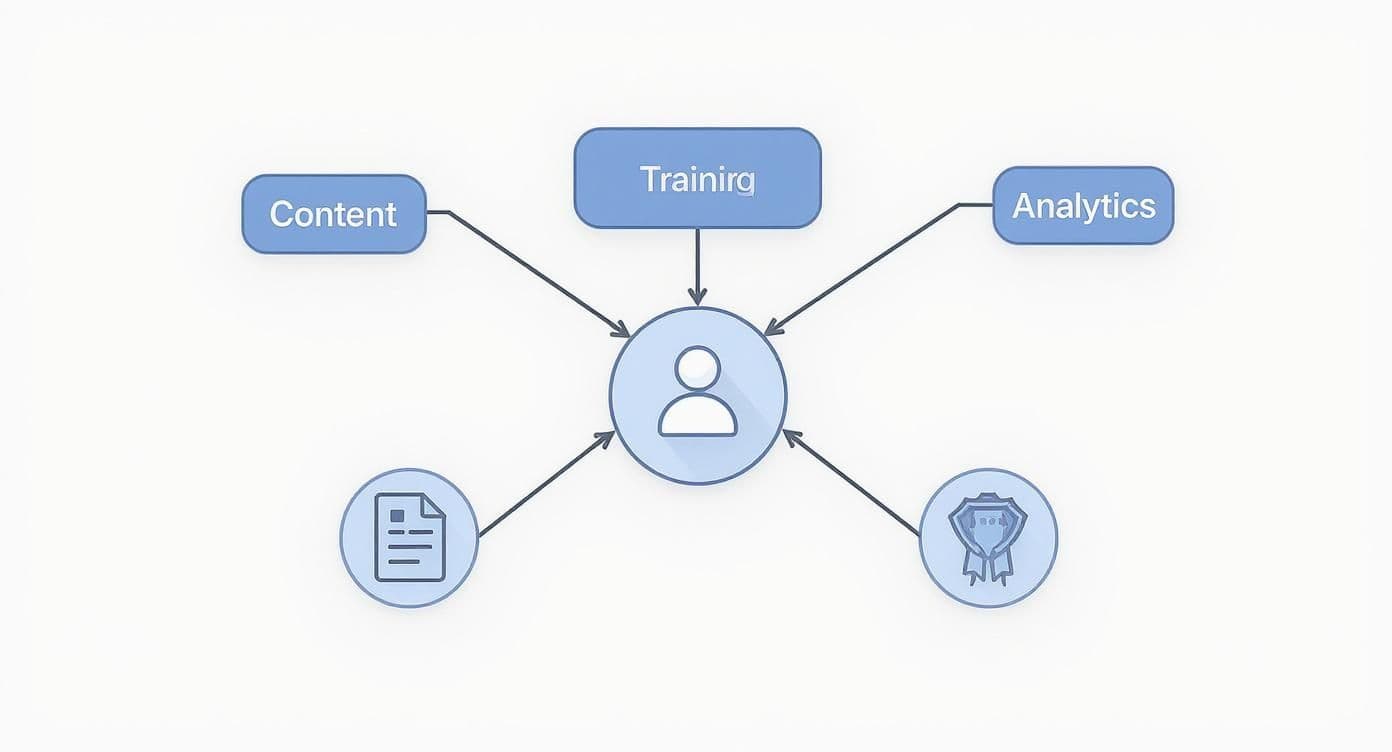
When a seller is empowered by these connected resources, they operate with a new level of speed and precision.
The benefit isn't just about doing things faster; it's about increasing the velocity of value you deliver to the prospect. When buyers get relevant, helpful information at every touchpoint, trust builds, and deals move forward with less resistance.
Key Performance Indicators (KPIs) to watch include:
- Average Sales Cycle Length: The time from the first qualified conversation to a closed-won deal.
- Stage-to-Stage Conversion Velocity: How quickly opportunities move from one pipeline stage to the next.
Boosting Quota Attainment and Seller Productivity
Ultimately, the goal is to help more reps hit their numbers. A sales enablement platform contributes directly to this by cutting the administrative work that pulls sellers away from selling. Research shows reps can spend up to 30% of their week just searching for or creating their own content.
By reclaiming that lost time, sellers can focus on high-value activities: engaging prospects, running demos, and building relationships. A great platform also brings in insights from various B2B lead generation strategies to help reps maximize every opportunity. It's a powerful combination of efficiency and effectiveness.
The table below connects platform features directly to the business metrics they influence.
Mapping Platform Features to Business KPIs
| Core Feature | Business Benefit | Key Performance Indicator (KPI) |
|---|---|---|
| Content Management | Shortens sales cycle with instant access to relevant materials. | Average Sales Cycle Length, Content Engagement Rate |
| Sales Training & Coaching | Increases seller effectiveness and reduces new hire ramp time. | Quota Attainment, Time to First Deal |
| Analytics & Reporting | Provides visibility into what's working to enable data-driven decisions. | Win Rate, Forecast Accuracy |
| CRM Integration | Reduces admin tasks and keeps seller activity in one system. | CRM Adoption Rate, Time Spent on Non-Selling Activities |
| Account Intelligence | Empowers reps with deep insights for strategic buyer conversations. | Average Deal Size, Stage-to-Stage Conversion Rate |
This mapping clarifies how technology investments translate into tangible financial outcomes.
Driving Meaningful Customer Conversations
Finally, the quality of seller-buyer interactions improves dramatically. Instead of leading with generic product pitches, reps armed with deep insights can have strategic, value-driven conversations. The platform gives them the talking points, industry data, and customer stories needed to connect your solution directly to the buyer's biggest challenges.
This shift elevates your sales team from vendors to trusted advisors. The result isn't just higher win rates but also stronger customer relationships and bigger deal sizes, because your reps are better equipped to uncover and solve broader strategic needs.
How to Choose the Right Platform for Your Team
Choosing a sales enablement platform can be overwhelming. Every vendor promises game-changing results, but how do you cut through the noise? The goal isn't just to buy software; it's to find a partner that understands your sales motion and can grow with you.
The search starts with your end-users: the reps. If they don't find the tool intuitive and useful in their daily work, adoption will flatline, and your investment will become just another ignored login.
Define Your Core Requirements First
Before booking a single demo, get clear on what problems you're trying to solve. Are reps wasting hours finding the right content? Is new hire onboarding painfully slow? Is there a disconnect between the assets marketing creates and what sales actually uses?
Pull together a small, cross-functional team including top-performing reps, a sales manager, and someone from marketing and IT. Getting these perspectives early ensures you’re not solving for one department’s needs at another's expense.
This first step is about creating a scorecard of must-haves versus nice-to-haves. Key areas to consider include:
- Ease of Use: How quickly can a new rep learn it? Is it intuitive or clunky?
- CRM Integration: How deep is the connection with your CRM? Does it live inside the workflow or force reps to switch tabs?
- Scalability: Can the platform support you as the team grows from 50 to 500 reps?
- Vendor Support: What does their onboarding look like? What kind of ongoing support can you expect?
Create a Vendor Evaluation Checklist
Once you’ve defined your requirements, you can start talking to vendors. A structured checklist is your best friend—it helps you compare platforms objectively and ensures you ask the right questions during demos.
Don’t just listen to a vendor’s canned pitch. Come prepared with questions about your team's biggest pain points. A great vendor won't dodge them; they'll show you exactly how their platform solves your specific problems.
Here are some essential questions to include:
- Onboarding and Implementation: Walk us through your typical implementation timeline. What resources will we need from our side?
- Product Roadmap: What new features are you planning for the next 6-12 months? How do you decide what to build next?
- Security and Compliance: What are your data security protocols? Are you compliant with standards like SOC 2 or GDPR?
- Adoption and Training: What's your plan to ensure our sales team actually uses this? What resources do you provide?
- Analytics and ROI: How does your platform help us measure the impact on metrics like win rates, sales cycle length, and quota attainment?
This process can be complex, and an outside perspective can be valuable. Many companies find that working with experts clarifies their needs. You can learn more by exploring the benefits of sales enablement consulting to guide your decision.
Involve Stakeholders for Broader Buy-In
Remember that choosing a platform is a team sport. The decision can't be made in a vacuum. Involving sales, marketing, and IT from day one creates the shared ownership that is crucial for long-term success.
- Sales: They are the primary users. Their feedback on usability is non-negotiable.
- Marketing: They are the primary content creators. The platform must make it easy for them to manage, update, and track asset performance.
- IT: They will own security, data governance, and integration with your existing tech stack.
By following this structured approach—defining your needs, using a checklist, and involving key players—you can move past the marketing hype and choose a sales enablement platform that becomes a catalyst for growth.

“All of the vendors that I've worked with, all of the onboarding that I have had to deal with, I will say, hands down, Salesmotion was the easiest that I have had.”
Lyndsay Thomson
Head of Sales Operations, Cytel
The Impact of AI on Sales Enablement

The next evolution of sales enablement is here, powered by Artificial Intelligence. AI is changing what a sales enablement platform does, shifting it from a passive content library into a proactive co-pilot for your sales team. The old model was about giving reps access to resources. The new model is about actively guiding them to a win.
This shift is a game-changer. Instead of a seller digging for the right case study, an AI-driven platform anticipates their needs. It analyzes a deal's context—the prospect's industry, their recent website activity, their role—and instantly recommends the perfect asset to send.
It’s the difference between a library and a personal research assistant who knows what you need before you ask.
From Reactive Tools to Proactive Guidance
Traditionally, enablement platforms were systems of record—great for storing and organizing materials, but little else. Their value depended entirely on a rep's ability to find and use what they needed.
AI flips this model on its head by injecting predictive intelligence directly into the seller's workflow.
These advanced platforms can now spot real-time buying signals that were previously invisible. For example, an AI might flag an account that starts posting jobs for a specific skill set, signaling a new project and a perfect time for outreach. It can also identify at-risk deals by analyzing communication patterns, alerting a manager to step in before it’s too late. You can see this in action with modern AI-powered lead generation strategies.
The biggest impact of AI is its ability to recommend the 'next best action.' By analyzing thousands of data points from past deals, AI can suggest what a rep should do right now to maximize their chance of winning.
This guidance moves your team from guesswork to data-backed decisions, creating a serious competitive advantage.
Intelligent Automation That Empowers Sellers
AI doesn't just offer insights; it automates the tedious tasks that kill a seller's productivity. Instead of reps spending hours on pre-call research, AI can instantly generate concise account briefs, executive profiles, and strategic talking points tailored to a prospect’s specific challenges.
This automation frees up sellers to focus on what they do best: building relationships and having meaningful conversations. The platform handles the heavy lifting of data analysis and content curation, so reps can walk into every meeting prepared and confident.
Key AI-driven automations include:
- Automated Content Personalization: Instantly generating email templates or presentation slides fine-tuned to the buyer's persona and pain points.
- Predictive Forecasting: Analyzing pipeline health and deal engagement to deliver more accurate revenue forecasts.
- Real-time Coaching Prompts: Offering on-the-fly suggestions during live calls based on keywords or conversational cues.
By bringing these capabilities together, a modern sales enablement platform becomes an indispensable partner. To go deeper, our guide on using AI in sales explores more practical applications. This intelligent layer transforms the platform from a simple tool into a system that actively helps your team win.
Key Takeaways
- A sales enablement platform centralizes content, training, and analytics in one system, ensuring reps always have the right materials and knowledge to engage buyers effectively.
- Core features to evaluate include smart content management with search and tagging, integrated training and onboarding modules, engagement analytics, and deep CRM integration.
- The business impact is measurable: organizations see shorter sales cycles, faster new-hire ramp times, higher content utilization, and improved win rates when enablement is done right.
- AI is transforming these platforms by automating content recommendations, generating coaching insights from call recordings, and delivering real-time prompts during live conversations.
- The right platform depends on your industry, team size, and compliance needs. Regulated industries need strong governance features, while high-growth teams benefit most from automated content delivery and analytics.
Seeing the Platform in Action Across Industries
Theory is one thing, but seeing how a sales enablement platform performs in the real world is what matters. These platforms aren’t a one-size-fits-all solution; their value comes from how they adapt to the unique challenges of different industries. From fast-paced tech to regulated finance, the right platform delivers measurable results.
This isn't a niche trend. The market shows how widespread adoption has become, with the IT & Telecom sector leading the way. The finance industry is another heavy user, as its sales process is incredibly data-intensive and compliance-driven. You can dig into more of this data and the broader shift toward modern selling models at Next Move Strategy Consulting.
Let's look at a few examples to see what this looks like on the ground.

Tech and SaaS: Taming Complexity
A fast-growing SaaS company was dealing with a classic "good problem." Their product suite was getting more complex with every release, and their reps were struggling to keep up. They often pitched with outdated slide decks or fumbled the value proposition for specific customers.
-
The Challenge: Inconsistent messaging, long new hire ramp times, and a lengthening sales cycle. Reps wasted hours just trying to find the right technical doc or case study.
-
The Solution: They rolled out a sales enablement platform focused on smart content management and just-in-time training. The system automatically served up the most relevant content based on CRM data like deal stage and industry. Bite-sized training videos on new features were pushed directly to reps on launch day.
-
The Outcome: The company saw a 15% reduction in their average sales cycle within six months. New hire ramp time was cut by 30%, and content analytics showed them which assets were actually helping to close deals.
Financial Services: Mastering Compliance
Now picture a mid-sized wealth management firm. Their biggest challenge wasn't complexity—it was compliance. Every client-facing document had to pass through a painstaking approval process. Making sure advisors only used the latest, FINRA-approved materials was a constant headache.
For regulated industries, a sales enablement platform is more than a productivity tool—it's a system of governance. It provides an auditable trail and ensures every seller operates within strict compliance boundaries.
-
The Challenge: A high risk of compliance breaches, slow content updates, and zero visibility into what materials were being shared with clients.
-
The Solution: The firm chose a platform with strong content governance and version control. All materials were locked in a central, audited library. When a document was updated, the old one was automatically archived, making it impossible for reps to use anything but the current, compliant version. Engagement tracking also gave them a clear line of sight into what was shared and when.
-
The Outcome: Compliance risk plummeted, with zero instances of non-approved content used in the first year. The time it took to distribute updated materials to the entire advisory team dropped from weeks to minutes.
A High-Growth SME: Scaling Without the Headcount
Finally, consider a small but scrappy manufacturing SME. With a lean sales team of just ten people, they had to compete with industry giants. They couldn't afford a large sales support staff, so every seller had to be an A-player, but they were bogged down by admin work and inconsistent processes.
-
The Challenge: Limited resources, the need for every rep to be hyper-efficient, and no scalable way to grow their sales process.
-
The Solution: The SME chose an all-in-one sales enablement platform that plugged directly into their CRM. It automated content delivery, served up simple playbooks for different sales scenarios, and gave the sales leader clear performance analytics without needing a full-time analyst.
-
The Outcome: The team boosted its outbound meeting booking rate by 25% by using system-recommended email templates and one-pagers. Seller productivity soared as reps reclaimed nearly five hours a week previously lost to administrative tasks.
Frequently Asked Questions
What is a sales enablement platform and how does it differ from a shared drive?
A sales enablement platform is a centralized system that brings content, training, and analytics together in one place for your sales team. Unlike a shared drive that simply stores files, an enablement platform intelligently recommends the right asset at the right moment based on deal stage, buyer persona, and industry, while also tracking engagement and content effectiveness.
How long does it take to implement a sales enablement platform?
Implementation timelines vary depending on your team size and complexity. A straightforward rollout for a small team can take just a few weeks, while a larger enterprise deployment with deep CRM integration and custom training modules might take two to three months. A phased approach, starting with a pilot group, is the most effective way to ensure a smooth launch.
What ROI can we expect from a sales enablement platform?
Organizations typically see measurable improvements across several areas, including shorter sales cycles, faster new-hire ramp times, and higher content utilization rates. By reclaiming the estimated 30% of a rep's week lost to searching for or recreating materials, teams can redirect that time toward high-value selling activities that directly drive revenue.
How does a sales enablement platform integrate with our CRM?
The best platforms integrate seamlessly with CRMs like Salesforce and HubSpot, living directly inside the tools your reps already use. This means sellers can access recommended content, log activities, and complete training without switching tabs. The integration also enriches your CRM data, giving leadership a more complete picture of every customer interaction.
How do we drive adoption among our sales team?
Adoption depends on making the platform an indispensable part of each seller's daily workflow. Start by involving top reps and managers in the vendor selection process to build early buy-in, then focus training on how the tool will help them close more deals and save time. Seamless CRM integration that eliminates friction is the single biggest factor in sustained adoption.
Is a sales enablement platform only for large enterprise teams?
Not at all. While enterprise organizations benefit from features like advanced governance and compliance controls, small and mid-market teams can see outsized returns as well. A lean team of ten reps using system-recommended templates and automated content delivery can perform like a much larger sales organization, making it a force multiplier regardless of company size.
Ready to see how intelligent insights can transform your sales process? Salesmotion is an AI-powered account intelligence platform that automates research and delivers the "why now" for every conversation. Learn how you can save your reps 8+ hours per week and increase pipeline creation by 40% by visiting https://salesmotion.io.