When it comes to B2B sales, the biggest benefits of outbound dialing software circle back to one thing: giving your team back their time and boosting productivity. By taking over the repetitive, manual tasks, this tech frees up your reps to do what they do best—have high-impact conversations, which increases call volume and drives more revenue.
The Hidden Costs of Manual Dialing for Your Sales Team
Let's be honest. Your sales team is losing valuable time every single day. Picture a typical sales development rep's (SDR) afternoon. They're bogged down with grunt work: looking up numbers, punching them in, hitting dead ends, and leaving voicemail after voicemail. These non-selling activities are a "manual task tax" on their productivity.
This tax isn't just an annoyance; it's a direct hit to your pipeline and your team's morale. Instead of building relationships, your best people are stuck in administrative quicksand. It’s no surprise that research shows sales reps often spend a measly 28% of their week actually selling. The rest is eaten up by these inefficient tasks.

The Daily Grind of Inefficiency
The cost of manual dialing isn't just about lost minutes; it's about the opportunities that vanish with them. Every moment a rep spends on a task a machine could do is a moment they aren't building rapport or moving a deal forward. Multiply that across your entire team, and you're looking at significant revenue leakage.
The core problem is that manual dialing forces highly skilled sellers to perform low-value administrative work. It's like asking a master chef to wash every dish by hand—it’s slow, demoralizing, and keeps them from the job you hired them for.
This constant administrative slog leads to frustration and burnout, making it harder to keep your top talent. From a bigger perspective, this operational drag is a major hurdle. Thinking about broader strategies for reducing overall operational costs is a smart move for any modern business.
A Strategic Solution to Reclaim Time
This is where outbound dialing software comes in. It’s not just a tool for making more calls; it’s a system built to eliminate that manual task tax and give your team back its most valuable asset: time. By automating the entire dialing workflow, you empower your reps to spend their day having more critical, high-impact conversations.
This shift changes their role from data entry clerk to strategic seller. In today's market, embracing this level of sales process automation isn't a luxury. It's a necessity for any sales team that wants to stay competitive, build a stronger pipeline, and hit its revenue goals.
Skip the comparison fatigue?
If you're shopping for a sales intelligence tool, here's the short version.
Salesmotion combines account intel, buying signals, verified contacts, and AI-drafted outreach in one tool. From $85/mo, live in an hour, no annual contract.
What Exactly Is Outbound Dialing Software?
Now that we’ve seen how manual dialing can hold a team back, let's talk about the solution. At its core, outbound dialing software is a tool designed to automate the most repetitive parts of making sales calls.
Think of it this way: manual dialing is like being a DJ with two turntables. You have to find the right record, queue it up, and drop the needle for every single song. It’s slow and clunky. Outbound dialing software is like having a perfectly curated playlist—it lines up the next great conversation, one after another, without any dead air.
The technology automatically works through a contact list, weeds out busy signals, disconnected numbers, and voicemails, and instantly connects a live person to an available sales rep. The shift is simple but massive: your team spends their time talking to people, not listening to dial tones.
The Core Types of Dialing Automation
Not all dialers are the same. The right one for you depends on your sales motion, call volume, and how much personalization goes into each conversation.
You'll generally find three primary modes:
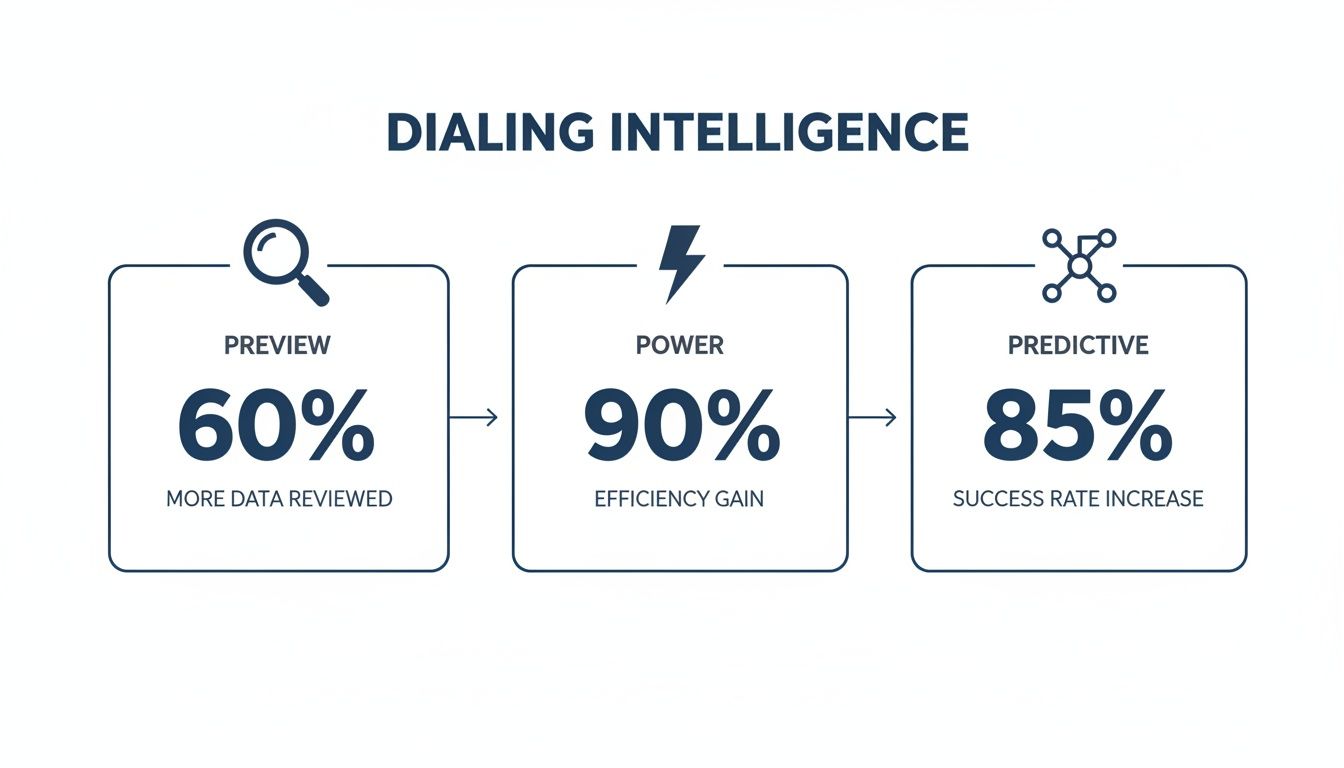
- Preview Dialer: This mode is all about preparation. It shows the rep the contact's information before placing the call, giving them a few moments to review notes and tailor their opening. It's perfect for complex sales where a personal touch makes all the difference.
- Power Dialer: This is the workhorse for many sales teams. As soon as one call ends, the power dialer automatically rings the next number on the list. It strikes a great balance between automation and rep control, making it ideal for teams that need to make a high volume of calls.
- Predictive Dialer: This is the most aggressive of the three. It uses an algorithm to dial multiple numbers at once for each available rep, predicting when they will finish their current call. It aims to have a live person on the line the second a rep is free, maximizing talk time in high-volume environments.
To make this more concrete, let's look at a typical day with and without this kind of automation.
Manual Dialing vs Automated Outbound Dialing Software
The table below shows the daily grind for a sales rep. On the left is the old-school manual process. On the right, you see how much more time is spent on revenue-generating activities when an automated dialer is in the mix.
| Activity | Manual Dialing (Without Software) | With Outbound Dialing Software |
|---|---|---|
| Call Attempts | 100-150 per day | 300-400+ per day |
| Time Spent Dialing | 2-3 hours | < 30 minutes (mostly automated) |
| Conversations | 5-10 meaningful conversations | 15-25+ meaningful conversations |
| Admin Work | 1-2 hours (manual logging, notes) | < 15 minutes (auto-logging) |
| Idle/Wasted Time | 2+ hours (voicemails, busy signals) | Minimal (filters non-live calls) |
As you can see, the difference isn't a small boost. It's a fundamental change in how a sales rep spends their day, shifting their focus from tedious tasks to actual selling.
Why CRM Integration Is a Game Changer
Outbound dialing software becomes truly powerful when it’s plugged directly into your Customer Relationship Management (CRM) system. The integration creates a seamless workflow that eliminates manual data entry for good.
For an in-depth look at this strategy, see our guide on what is outbound sales.
When your dialer and CRM are in sync, every call is automatically logged against the right contact. Notes are instantly saved, and follow-up tasks can be created in a click. This ensures that every interaction is tracked, giving you a complete history of your engagement with every prospect. This clean, reliable data is the foundation for smarter coaching, accurate forecasting, and an efficient sales operation.

“The account and contact signals are key for reaching out at important times, and the value-add messaging it creates unique to every contact helps save time and efficiency.”
Daniel Pitman
Mid-Market Account Executive, Black Swan Data
Supercharge Your Team's Productivity and Efficiency
Let's get straight to the point. The biggest reason B2B sales teams adopt outbound dialing software is the massive, immediate boost in productivity. It’s all about shifting your reps from low-value admin work—like looking up numbers and punching them in—to high-value conversations.
By automating the most tedious parts of their day, reps get hours back every week to do what they were hired for: selling.
This isn’t just a minor adjustment; it’s a complete overhaul of their daily workflow. Think about all the dead time in a single manual call: fumbling with the keypad, listening to ringing, and manually logging the outcome in the CRM. Now, multiply that small time-suck by hundreds of calls per rep, every day. The efficiency gains are exponential.
The Real-World Math of Automation
The numbers behind this shift are stark. Sales teams using a dialer can radically increase their daily call volume. Reps can comfortably hit 60 calls per day, a huge jump from manual dialing that unlocks hours of pure selling time each week.
Imagine a team of 10 SDRs. By automating the dialing process, they collectively gain an extra 25 hours of productive time every single week. That's like adding three full workdays of pure selling to the team's output without hiring anyone new. This is possible because dialers help eliminate the staggering 70% of time reps typically waste on non-selling tasks.
This reclaimed time isn't just about making more calls; it's about making better calls. Instead of feeling rushed to hit a number, reps can prepare, listen, and focus on their pitch. To push this even further, many teams are now looking at how an AI Sales Assistant can handle post-call summaries and CRM updates, freeing up even more mental space.
Ultimately, the core benefit is simple: more at-bats. When your team connects with more prospects, they have more qualified conversations. More conversations directly lead to a healthier, more predictable sales pipeline.
This increased activity at the top of the funnel is what drives real business outcomes. Of course, you need to track these improvements, and our guide on how to measure sales productivity walks you through exactly how to do that. By arming your team with the right tools, you're not just making them faster—you're making them more effective.
Drastically Improve Connect Rates and Conversation Quality
While increasing call volume is a nice perk, the real game-changer is connecting with the right people at the right time. This is where outbound dialing software becomes a strategic weapon for your sales team. It's not just about dialing faster; it’s about having smarter, more effective conversations.
Think about it. How many times have your reps dialed a prospect only to hit voicemail because they're in a different time zone? How often do people ignore calls from a number they don't recognize? Good dialers are built to solve these problems.
Take local presence dialing, for instance. This feature automatically shows a local area code on the prospect’s caller ID. That small change can dramatically increase the odds they’ll answer. It builds a sliver of familiarity and trust before your rep even says a word.
From Cold Calls to Warm Conversations
The biggest leap in quality comes when you connect your dialer with real-time account intelligence. Instead of burning through a generic contact list, your reps can act on genuine buying signals. They can get alerts for key events like an executive changing jobs, a company landing a new round of funding, or a major expansion announcement.
This instantly transforms a cold call into a timely, relevant conversation. A rep is no longer leading with, "Hi, I'm..." but with something powerful like, "I saw your company just secured Series B funding to expand operations, and I had an idea..."
This is the fundamental difference between activity and progress. A dialer integrated with intelligence empowers reps to lead with genuine value, turning a pattern interrupt into a meaningful business discussion. They are no longer just making calls; they are capitalizing on opportunities.
This approach completely changes the dynamic of each interaction, leading to more engaged prospects and a much healthier pipeline.
Timing Is Everything
Knowing when to call is just as crucial as knowing what to say. The best outbound dialing software helps sales teams schedule and automate outreach during peak connection windows when people are most likely to pick up. The data doesn't lie: timing has a massive impact.
For example, studies show you can see up to a 15% higher connection rate just by calling between 8-11 AM in the prospect's local time. When you combine smart timing with automation that skips voicemails and busy signals, connect rates can easily double. This timing advantage is critical, especially when you learn more about the best time to cold call.
Ultimately, by using these features, your team spends less time listening to dial tones and more time in high-quality discussions. For more data on this, read the full research about cold calling success rates and see how much timing really matters. It's a strategic approach that ensures every call has the best possible shot at becoming a real sales opportunity.

“All of the vendors that I've worked with, all of the onboarding that I have had to deal with, I will say, hands down, Salesmotion was the easiest that I have had.”
Lyndsay Thomson
Head of Sales Operations, Cytel
Gain Actionable Insights with Real-Time Analytics
If you can't measure it, you can't improve it. For sales leaders and RevOps professionals, that’s the simple truth. Historically, call performance was a black box filled with subjective feedback and guesswork. One of the biggest outbound dialing software benefits for sales teams is its ability to illuminate that black box with clear, actionable data.
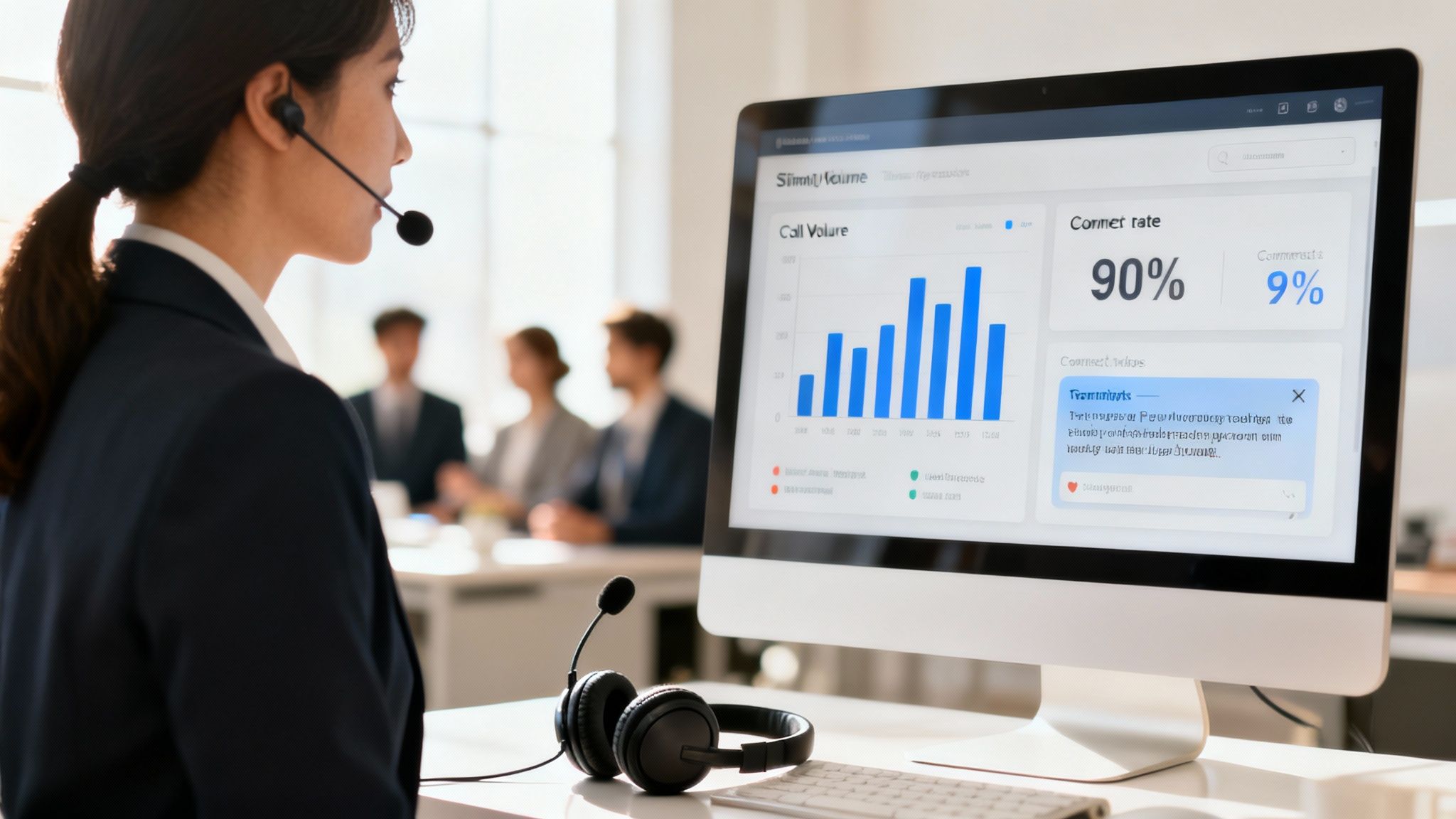
This tech gives you a stream of information that was once impossible to track at scale. Instead of relying on gut feelings, you can monitor concrete metrics from one central dashboard.
From Guesswork to Data-Driven Coaching
Modern dialers automatically track every aspect of your team's calling activity. This gives you a real-time, objective view of performance, letting you answer critical questions with hard data, not hunches.
The core shift is moving from "I think my team is doing well" to "I know why my top performers are succeeding and how to replicate that success." This data-driven approach is the foundation of a scalable and predictable sales engine.
With these insights, you can quickly pinpoint the specific behaviors that separate your A-players from the rest of the team. This transforms coaching from generic advice into a targeted, evidence-based process designed to lift everyone's performance.
Key Metrics to Monitor and Improve
The analytics dashboard in your outbound dialing software becomes your command center for sales performance. It surfaces the exact data points you need to make smarter strategic decisions.
Here are a few of the essential metrics you can track with precision:
- Call Volume: Understand which reps are putting in the necessary activity to build their pipeline. Are they making enough dials to hit their quota?
- Connect Rates: See who is most effective at getting prospects to answer the phone. This helps you identify patterns in timing, messaging, or call lists.
- Conversation Duration: Pinpoint which reps are successfully engaging prospects in real discussions versus getting shut down in the first 30 seconds.
- Call Dispositions: Track the outcomes of calls (e.g., meeting booked, follow-up scheduled) to see conversion rates at a glance.
By keeping a close eye on these numbers, you can spot trends, diagnose problems before they grow, and provide targeted support exactly where it's needed most.
It gets even better. Features like AI-powered call recording and transcription take this a step further. Managers can review entire conversations to hear exactly how reps handle objections or explain the value proposition. This leads to specific feedback like, "On the call with Acme Corp, you handled the pricing question this way. Let's try this approach next time." This level of detail makes coaching more impactful and helps standardize winning behaviors across the entire team.
Key Takeaways
- Outbound dialing software eliminates the manual task tax that keeps reps from selling, giving them back hours each day for high-impact conversations.
- The three core dialer types, preview, power, and predictive, serve different sales motions. Choose based on your call volume, deal complexity, and personalization needs.
- Higher connect rates come from features like local presence dialing, voicemail drop, and intelligent call routing that maximize the chances of reaching a live person.
- Real-time analytics and AI-powered call recording give managers the data to coach reps on specific behaviors, turning every interaction into a learning opportunity.
- The biggest strategic benefit is converting saved time into deeper account research and trigger-based outreach, making every call more consultative and relevant.
Scale Personalization and Strategic Account Planning
Efficiency without strategy is just busywork. This is where many sales teams get it wrong.
One of the biggest advantages of using an outbound dialing software is how it converts saved time into a strategic weapon. By automating the grind of manual dialing, your reps get back precious hours—hours they can finally pour into the high-value work that actually closes deals.
Instead of racing to hit a call quota, reps can do meaningful account research. This is the big shift. They move from generic, one-size-fits-all scripts to crafting genuinely personal outreach. The real win from a dialer isn't just making more calls; it's about making every call count.
Turning Automation into Deeper Engagement
With this newfound time, your sales reps can dig into what really matters to a prospect. They can read company reports, understand business challenges, and figure out who the real stakeholders are. This is the prep work that separates average performers from top-tier closers.
A dialer clears the administrative junk off a rep's plate, freeing up the mental bandwidth they need to focus on strategy and human connection. Every conversation can shift from being purely transactional to truly consultative.
By handling the low-value tasks, outbound dialing software empowers reps to focus on the high-value work of building relationships. Technology doesn’t replace the human element; it creates more space for it.
This strategic pivot is critical for winning complex, multi-stakeholder deals where a generic approach is guaranteed to fall flat.
Activating Trigger-Based Sales Plays
Now, here's where things get interesting. When you connect your dialing software with an account intelligence platform, you unlock a more sophisticated outbound motion. Your team can ditch static call lists and move to dynamic, trigger-based sales plays that capitalize on real-time events.
Picture this: a rep gets an alert that a target account just announced a major expansion. With an integrated system, they can instantly kick off a targeted call sequence to the key executives running that project. Suddenly, a cold call becomes a relevant, high-impact conversation.
This modern approach gives you a proactive, event-driven sales strategy where your team always has a compelling "why now?" The combination of smart automation and sharp intelligence elevates your sales team from just making calls to orchestrating strategic, personalized outreach at scale.
Got Questions About Outbound Dialing Software?
Even with the benefits laid out, you probably have a few practical questions. Let’s tackle some of the most common ones.
What's the Real Difference Between a Power Dialer and a Predictive Dialer?
Think of it like fishing. A power dialer is like casting one line at a time. It dials a single number for a rep, and the second that call is done, it dials the next. This method guarantees a rep is ready for every connected call, making it perfect for high-value outreach where you’ve done your homework.
A predictive dialer, on the other hand, is like casting a wide net. It uses an algorithm to dial multiple numbers at once, predicting when a rep will be free. It only connects your rep when a live person answers, which is all about maximizing talk time in high-volume environments like call centers.
Will This Software Make My Sales Team Sound Like Robots?
It's the opposite. The point of this software is to automate the process, not the personality. By taking over the manual work of dialing, logging notes, and updating your CRM, the software frees up your reps' mental energy.
This lets them focus 100% on the conversation. They can listen more actively and engage more authentically because they aren't juggling five other tasks. The result is more human, personalized interactions—not less.
How Does This Kind of Software Plug Into Our CRM?
Good news. Most modern dialing platforms are built to integrate smoothly with major CRMs like Salesforce and HubSpot. The connection is usually handled through a simple, one-time setup.
Once linked, the dialer can:
- Pull contact lists straight from your CRM to build calling campaigns.
- Automatically log every call activity, note, and recording back to the correct contact record.
- Help you keep your data clean and accurate across your entire sales operation.
This eliminates manual data entry and creates a single source of truth for all your sales activities. No more guessing who called whom and when.
Ready to turn manual research into revenue? Salesmotion gives your team the real-time account intelligence they need to have more "why now" conversations. Stop guessing and start engaging with context. Discover how Salesmotion can fuel your outbound strategy.
Frequently Asked Questions
What is outbound dialing software?
Outbound dialing software is a tool designed to automate the most repetitive parts of making sales calls, including dialing numbers, filtering out voicemails and busy signals, and logging call activity in your CRM. It automatically works through a contact list and connects live prospects to available reps, fundamentally shifting how salespeople spend their day from administrative tasks to actual selling conversations.
What is the difference between a power dialer and a predictive dialer?
A power dialer dials one number at a time, automatically calling the next contact as soon as the previous call ends, giving reps control and preparation time between calls. A predictive dialer uses an algorithm to dial multiple numbers simultaneously for each available rep, predicting when they will be free. Power dialers are better for personalized, high-value outreach, while predictive dialers maximize talk time in high-volume environments.
How much more productive can reps be with outbound dialing software?
The productivity gains are substantial. Reps using automated dialers can increase daily call attempts from 100-150 to 300-400 or more, while meaningful conversations can jump from 5-10 per day to 15-25 or more. Administrative work drops from 1-2 hours daily to under 15 minutes thanks to automatic call logging. A team of 10 SDRs can collectively gain an extra 25 hours of productive selling time every week.
How does CRM integration make outbound dialing software more effective?
When your dialer integrates directly with your CRM, every call is automatically logged against the correct contact record, notes are saved instantly, and follow-up tasks can be created in a click. This eliminates manual data entry entirely and ensures a complete history of engagement with every prospect. The result is cleaner data, more accurate forecasting, and a seamless workflow where reps never have to leave their primary system.
What is local presence dialing and why does it matter?
Local presence dialing is a feature that automatically displays a local area code on the prospect's caller ID, regardless of where the rep is actually calling from. This small change dramatically increases the odds that a prospect will answer the phone, because people are far more likely to pick up a call from a familiar local number than from an unknown or out-of-state area code.
Will outbound dialing software make sales conversations feel robotic?
The opposite is true. By automating the mechanical process of dialing, logging, and updating the CRM, the software frees up reps' mental energy to focus entirely on the conversation itself. Reps can listen more actively and engage more authentically because they are not juggling multiple administrative tasks during or after each call. The result is more human, personalized interactions with better outcomes.