Target Account Selling, or TAS, is a simple concept with a massive impact. It’s a B2B sales strategy where you focus all your resources on a short, handpicked list of high-value accounts.
Instead of casting a wide net, TAS is like spear-fishing. You identify the biggest targets and go after them with absolute precision.
What Is Target Account Selling?
Let's cut through the jargon. Target Account Selling is a strategic shift from quantity to quality. It's a disciplined approach where sales and marketing teams join forces to win "perfect-fit" customers—the ones with the greatest potential to become long-term partners.
This methodology is built on deep research and personalization. Forget generic pitches. Your team invests time understanding the unique challenges, goals, and internal politics of a few select companies.
This focused approach is critical. When you consider that sales pros only spend about 28% of their week actually selling, TAS ensures every minute is spent on opportunities with the highest chance of closing.
Why This Focused Approach Matters
There's a myth that more leads automatically equals more revenue. The reality? Chasing every possible lead stretches your resources thin, hurts conversion rates, and burns out your team.
TAS flips this broken model on its head by forcing your team to be selective.
By concentrating firepower on a limited number of high-potential accounts, you can deliver a superior buying experience, build stronger relationships with key decision-makers, and ultimately close larger, more profitable deals.
To understand Target Account Selling, it helps to see where it fits in the modern B2B lead generation playbook. While it's a specific sales motion, it shares DNA with other account-centric strategies. For instance, people often use TAS and Account-Based Selling interchangeably, but they aren't the same. To learn more, check out our guide on the nuances of account-based selling.
TAS vs. Traditional Lead Generation
The difference between TAS and the old-school volume game is stark. This table breaks down just how different the philosophies are.
Aspect
Target Account Selling (TAS)
Traditional Lead Generation
Focus
Quality over quantity; targets a small, pre-qualified list of best-fit accounts.
Quantity over quality; aims to generate a high volume of leads.
Approach
Highly personalized and research-intensive, tailored to each account's specific needs.
Broad and generalized outreach using mass-marketing tactics.
Primary Goal
Win large, strategic deals and build long-term customer relationships.
Fill the top of the sales funnel and maximize lead count.
Team Alignment
Requires deep collaboration between sales, marketing, and customer success teams.
Sales and marketing often work in separate, siloed functions.
TAS isn't just a tactic; it’s a fundamental change in your go-to-market process, demanding focus, alignment, and a deep commitment to understanding your customers.
The Core Components of a TAS Strategy
A solid Target Account Selling (TAS) strategy isn't built on guesswork. It's a system made of a few essential parts that work together to land your most valuable accounts.
The process starts with a deep understanding of who your best customers are. This foundation ensures every action that follows is focused and effective, preventing your team from chasing dead-end leads.
Building Your Ideal Customer Profile
The first pillar of any TAS strategy is the Ideal Customer Profile (ICP). This isn't just a vague sketch of a company you'd like to work with. It's a data-driven blueprint of the perfect organization for your solution.
A powerful ICP includes attributes that signal a high chance of success and long-term value. You find these by studying your best existing customers—the ones who get the most from your product and are a pleasure to work with.
Key attributes for a modern ICP often include:
Technographic Data: What technology are they already using? Does it integrate well with your solution?
Growth Signals: Are they hiring for specific roles, expanding into new markets, or recently funded?
Operational Maturity: What does their business model look like? How complex are their internal workflows?
These deeper insights help you paint a clear picture of an ideal target.
Creating a Prioritized Target Account List
Once your ICP is defined, it's time to build your Target Account List (TAL). This is your handpicked roster of companies that perfectly match your criteria. The goal here is precision, not volume.
A common mistake is making this list too long. An effective TAL is focused and manageable, giving your team the space to invest the time each account deserves. Prioritization is also key; not all target accounts are equal. You’ll want to tier them based on revenue potential, strategic importance, or their current buying intent.
A well-defined Target Account List transforms your sales effort from a speculative search into a calculated pursuit. It's the practical application of your ICP, giving your team a clear set of goals.
Knowing which accounts are already looking for solutions is a huge advantage. You can learn how to spot these in-market buyers by reading our guide on leveraging B2B intent data.
Mapping the Organization and Multi-Threading
With your TAL locked in, the focus shifts to navigating each company's internal landscape. This is where Account Mapping and Multi-Threading come in. Account mapping is about identifying the key players, from the economic buyers who sign checks to the champions and influencers who can make or break your deal.
Multi-threading is the practice of building relationships with several of these stakeholders at the same time. Relying on a single point of contact is risky. If that person leaves, your deal can die overnight. By engaging multiple decision-makers, you build consensus, gather more intelligence, and create a stronger foundation for the sale.
How TAS Directly Impacts Revenue Growth
How does focusing on target accounts translate into revenue? Target Account Selling isn't just a theory; it's a direct line to healthier, more predictable growth. When you concentrate your team's energy on the best-fit accounts, you change the math of your entire sales process.
Instead of stretching resources thin, your team can go deep on high-potential opportunities. This focus means every conversation is more relevant and every proposal hits closer to home, leading to a more efficient sales motion.
Larger Deals and Higher Win Rates
One of the first things you'll see with TAS is a jump in your average deal size. When you're targeting companies that match your Ideal Customer Profile, you're solving a major business problem they already face.
These accounts see more value in your offer, which leads to larger contracts. Teams using TAS consistently close higher-value deals compared to their non-target pursuits, directly boosting the bottom line. You can dig deeper into how these strategies impact sales over at Arpedio.com.
Because your team invests heavily in research and personalization, they show up to every meeting as trusted advisors, not just another vendor. This builds credibility, dismantles objections, and significantly improves your win rate.
Shorter Sales Cycles
It might sound counterintuitive, but more upfront research often leads to faster closes. The deep discovery in the TAS process eliminates the guesswork that plagues most sales cycles. Your team isn't wasting months on deals that were never going to happen.
By identifying and engaging all key stakeholders early on—a process known as multi-threading—you build consensus across the buying committee. This prevents deals from stalling when they hit a roadblock or when your single point of contact leaves. A well-executed TAS motion accelerates decisions and improves your sales pipeline velocity.
Increased Customer Lifetime Value
The impact of TAS doesn't stop when the contract is signed. The trust-based relationships you build during the sales process create the perfect foundation for long-term success.
This leads directly to a higher Customer Lifetime Value (CLV) for a few key reasons:
Easier Upsells: Customers who are a great fit from day one are far more likely to upgrade their plans.
More Cross-Sell Opportunities: A deeper understanding of their business makes it easy to spot new problems you can solve.
Higher Retention: Strong relationships built on proven value lead to greater loyalty and lower churn.
Ultimately, TAS transforms sales from a numbers game into a strategic engine that delivers predictable growth and builds a healthier business.
Comparing TAS to Other Sales Models
The B2B sales world is full of acronyms that sound similar but are very different. To understand target account selling, it helps to see how it compares to other account-based strategies. They all focus on accounts, but they play different roles.
Some strategies warm up the entire field, while others are designed for the final play. Getting this distinction right is key to building a go-to-market plan where marketing and sales are perfectly in sync.
TAS vs. ABS and ABM
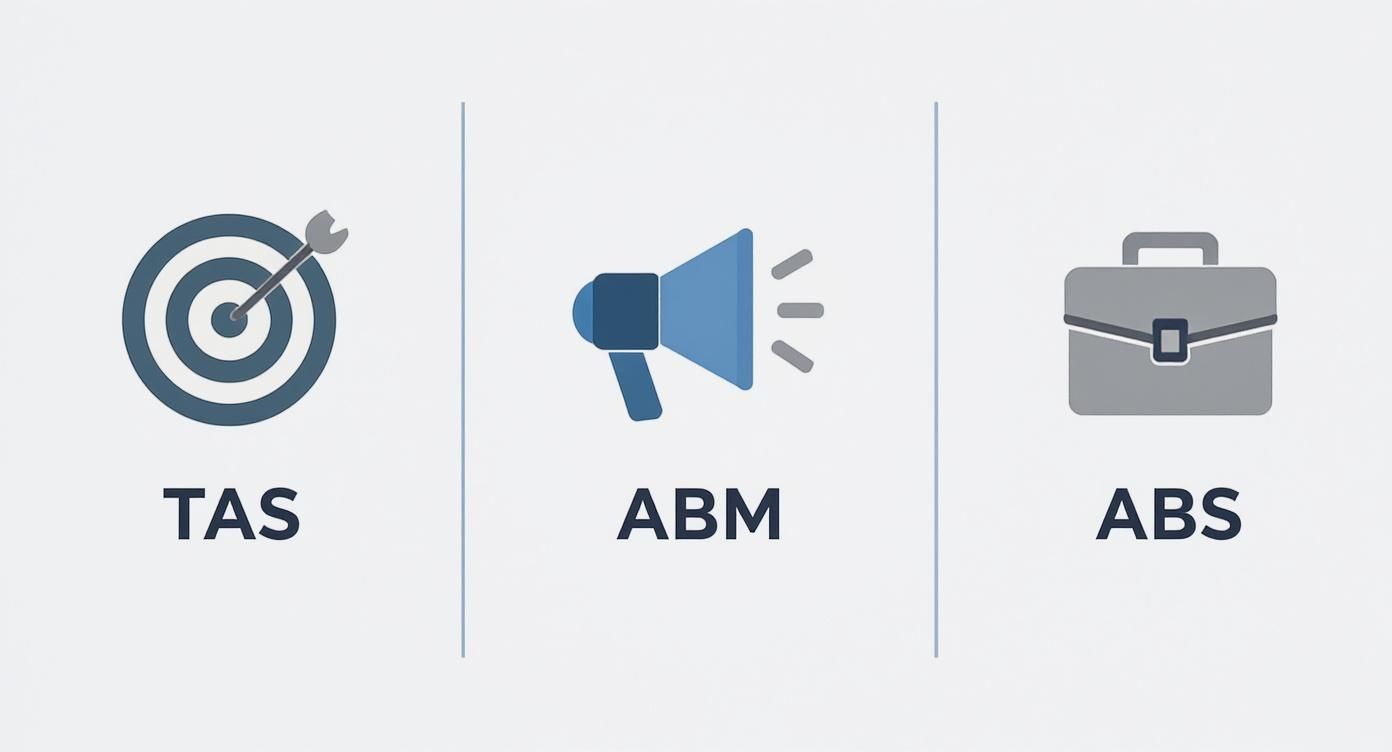
Target Account Selling (TAS), Account-Based Selling (ABS), and Account-Based Marketing (ABM) are often used together, but they have different owners and goals. ABM is marketing's "air cover"—generating awareness within a list of ideal companies. ABS is the overarching sales philosophy of focusing team resources on a set of high-value accounts.
TAS, on the other hand, is the "ground assault." It’s a specific, structured sales methodology an account executive uses to close a deal within a single, high-stakes account. It’s the playbook for the crucial final mile.
While ABM and ABS set the stage, TAS provides the specific, repeatable process for sales reps to win those strategic deals. It’s less a philosophy and more a tactical framework.
The biggest difference is scope and execution. ABM and ABS are broad strategies. TAS is a focused, sales-led methodology for a specific opportunity already in the pipeline.
A Clear Side-by-Side Comparison
To clear up any confusion, let's break down the core differences. Understanding who leads each effort and their primary goal helps you see where each strategy fits.
Comparing Sales Strategies: TAS vs. ABM vs. ABS
Strategy
Primary Focus
Led By
Key Objective
Target Account Selling (TAS)
Executing a specific sales process to win a single, high-value opportunity.
Sales (Account Executives)
Close a large, complex deal by navigating the buying committee and proving value.
Account-Based Marketing (ABM)
Generating awareness and engagement across a list of target accounts.
Marketing
Warm up target accounts, build brand reputation, and create sales-ready opportunities.
Account-Based Selling (ABS)
A broader sales strategy of focusing efforts on a defined set of target accounts.
Sales Leadership
Align sales resources with the highest-potential accounts for long-term revenue growth.
This table highlights how these strategies are collaborators, not competitors. ABM creates interest, ABS provides strategic direction, and TAS gives individual reps the tactical plan to turn an opportunity into a closed deal. They work best together.
Your Step-by-Step TAS Implementation Plan
Switching to a Target Account Selling model is a deliberate process that needs a clear roadmap and total team alignment. This plan breaks it down into actionable steps.
Secure Leadership Buy-In and Align Teams
First, you need a champion in the C-suite. Get leadership on board by building a solid business case. Show them how TAS will impact average deal size, win rates, and customer lifetime value. Frame it as a strategic move toward more predictable revenue.
Once you have executive support, get your sales and marketing teams aligned. This is a shift in your entire go-to-market strategy. Hold joint workshops to agree on shared goals, define roles, and establish the KPIs both teams will use.
This visual helps clarify where TAS fits with other models.
It shows that TAS is the sharp execution layer, working with the broader efforts of ABM and the strategic overview of ABS.
Build Your ICP and Target Account List
With your teams aligned, get specific about who you're targeting. Start by building a data-driven Ideal Customer Profile (ICP). Dig into your best current customers to find the common firmographic, technographic, and behavioral traits that signal a perfect fit.
Use that ICP to build your Target Account List (TAL). This is a curated, manageable roster, not a spray-and-pray list. A focused list of 50-100 accounts is far more powerful than a bloated list of 500 you can't give proper attention to.
Next, tier your accounts to focus your energy:
Tier 1: Your dream customers. These get the full white-glove, hyper-personalized treatment.
Tier 2: High-potential accounts that receive a slightly less intensive but still customized approach.
Tier 3: Good-fit accounts nurtured with a mix of one-to-one and one-to-few programs.
A great strategy is useless if your team isn't equipped to execute it. This is where solid sales enablement best practices come in. This means dedicated training on the TAS methodology, account-specific playbooks, and access to the right research tools.
The heart of TAS execution is personalized, multi-threaded outreach. Reps must go beyond generic templates and show a real understanding of each account's specific challenges.
This is where modern tools are essential. Platforms like Salesmotion automate the research process, monitoring your target accounts for critical buying signals and generating tailored insights. Instead of spending hours digging for intel, your reps get actionable intelligence delivered to them.
This frees them up to do what they do best: build relationships and close bigger deals.
Common TAS Mistakes and How to Avoid Them
Even a well-designed Target Account Selling strategy can fail if you fall into common traps. Knowing these pitfalls ahead of time is the best way to keep your program on track.
One of the most common mistakes is creating a Target Account List (TAL) that’s too big. It's easy to include every company that could be a good fit, but that dilutes your team's focus and makes deep personalization impossible. The point of TAS is depth, not breadth.
A poorly researched list is just as bad. If your TAL is built on outdated data or shallow information, you're sending your team in the wrong direction from day one.
Forgetting to Unify Sales and Marketing
Another critical failure point is when sales and marketing aren't on the same page. When these teams operate in silos, the customer experience feels disjointed. Marketing might run broad campaigns while sales tries to do hyper-personalized outreach, sending mixed signals and undermining your efforts.
A successful TAS program needs a single, unified go-to-market motion. Both teams must agree on the target list, messaging, and shared KPIs to present a cohesive front to every account.
This disconnect often leads to the next big mistake.
Relying on Generic Outreach
Want to kill a TAS initiative fast? Treat it like a traditional numbers game. Sending generic, templated emails to your top-tier accounts defeats the entire purpose of the strategy. It shows your high-value prospects that you haven't done your homework.
Instead, every touchpoint needs to be grounded in real personalization and deep research. You have to prove you understand their specific challenges and strategic goals. There's no faking it here; meaningful outreach is non-negotiable.
Here are two final mistakes that can sink your efforts:
Giving Up Too Soon: TAS is a long game. It builds momentum over time, not overnight. Don't expect a flood of massive deals in the first month. Patience and persistence are required to build the deep relationships that turn into strategic wins.
Not Investing in the Right Tools: Expecting your reps to manually research dozens of accounts is a recipe for burnout. Modern tools that automate signal collection and generate insights are essential for scaling a TAS program.
Common Questions About TAS
Even the best plans raise questions, especially when you're rolling out a focused strategy like Target Account Selling. Let's tackle some of the most common ones.
How many accounts should be on a target list?
There’s no magic number, but the rule is quality over quantity. For a single account executive, a great starting point is typically between 10 to 25 accounts at any given time.
This range is small enough for your team to do the deep research and hyper-personalization that TAS requires. If the list gets too big, focus is diluted, and you’ll slip back into a high-volume mindset.
How is success measured in a TAS model?
Closing big deals is the ultimate goal, but you also need to track leading indicators that prove the strategy is working.
Look beyond just closed-won revenue and monitor metrics like:
Engagement Rate: Are the right people at your target accounts responding and taking meetings?
Deal Velocity: Are these opportunities moving through your pipeline faster than non-TAS deals?
Average Contract Value (ACV): Is the deal size for your target accounts increasing?
Multi-Threading Rate: How many contacts are you engaged with inside each target account? A single thread is a red flag.
These metrics provide an early warning system, showing whether your focused efforts are building real traction.
What’s the difference between TAS and Key Account Management?
This is a common point of confusion, but the distinction is simple: it's all about timing. TAS is a pre-sale methodology. It’s about acquiring new, high-value logos that are a perfect fit for your ICP. This is the plan for landing the whale.
Key Account Management (KAM), on the other hand, is a post-sale strategy. Its job is to nurture and grow your existing top-tier customers to maximize their lifetime value through renewals and upsells.
In short: TAS wins the account; KAM keeps and expands it.
Ready to stop guessing and start engaging your most valuable accounts with precision? Salesmotion automates the research and insight generation process, giving your team the tailored talking points they need to win bigger deals, faster. See how it works.
Unlock the power of B2B intent data. Learn how it works, why it matters, and how to use it to identify buyers and close deals before your competitors...