SALES
Lead Generation Key Performance Indicators Guide
Stop guessing and start measuring. This guide unpacks the essential lead generation key performance indicators (KPIs) you need to track for real...
Discover outbound lead generation that builds a predictable pipeline with signal-driven targeting, personalized messaging, and measurable growth.
Outbound lead generation is all about proactively reaching out to potential customers who haven’t found you yet. Think of it as using channels like cold email, cold calls, and LinkedIn outreach to start conversations and build a solid sales pipeline.
Let's be honest—the old way of doing B2B outbound is broken. It was a numbers game of endless cold calls and generic email blasts that annoyed far more people than they converted. That brute-force approach just doesn't work anymore. Today's buyers are smarter, more informed, and fiercely protective of their time.
Modern outbound lead generation isn’t about blasting a huge list with a templated message. It's a surgical, strategic way to build a predictable pipeline. This requires a complete shift in mindset, moving from sheer volume to high-quality, relevant engagement. The goal is no longer just to book a meeting; it's to start a meaningful conversation at the right time.
The old tactics are fading fast. A recent study found that only 18% of marketers believe outbound generates valuable leads, a number that screams "this isn't working." You can read the full research on lead generation statistics to see just how dramatically things have changed.
Why the drop? Buyers have tuned out the noise. They ignore generic pitches and delete emails that don't immediately prove their relevance.
Before we dive into the "how," let's compare the old and new ways of thinking. The table below breaks down the fundamental shift from brute-force tactics to a more intelligent, modern approach.
| Attribute | Traditional Outbound (The Old Way) | Modern Outbound (The New Way) |
|---|---|---|
| Approach | Volume-based, brute force | Value-based, surgical precision |
| Focus | Hitting activity metrics (dials, emails) | Starting relevant conversations |
| Targeting | Broad, static lists | Niche, dynamic ICP segments |
| Timing | Random, seller-centric | Signal-driven, buyer-centric |
| Messaging | Generic, one-size-fits-all templates | Personalized, context-aware |
| Goal | Book a meeting at any cost | Build trust and create pipeline |
| Reputation | Annoying interruption | Helpful resource |
This shift is more than a change in tactics; it’s a complete evolution in mindset. The new way respects the buyer's intelligence and delivers real results.
This infographic captures the core philosophical shift perfectly—from a disruptive, outbound-centric model to an insightful, buyer-focused one.

The big takeaway here is the move from a megaphone—blasting one message to everyone—to an intelligent system that prioritizes personalization and timing.
So, what replaces the old playbook? A signal-driven framework that puts the customer first. Instead of just interrupting prospects, you engage them based on specific events or "signals" that point to a potential need.
These signals could be anything from:
By focusing on these triggers, you transform your outreach from a cold interruption into a timely, relevant, and helpful touchpoint. You're no longer a random salesperson; you're a valuable resource showing up at the exact moment of need.
This modern approach respects your prospect's time and delivers measurable results for your pipeline. The rest of this guide will walk you through the step-by-step framework to build and scale this system.
A winning outbound campaign starts long before you write a single email. It begins with knowing exactly who you're talking to and, just as importantly, who you're not talking to.
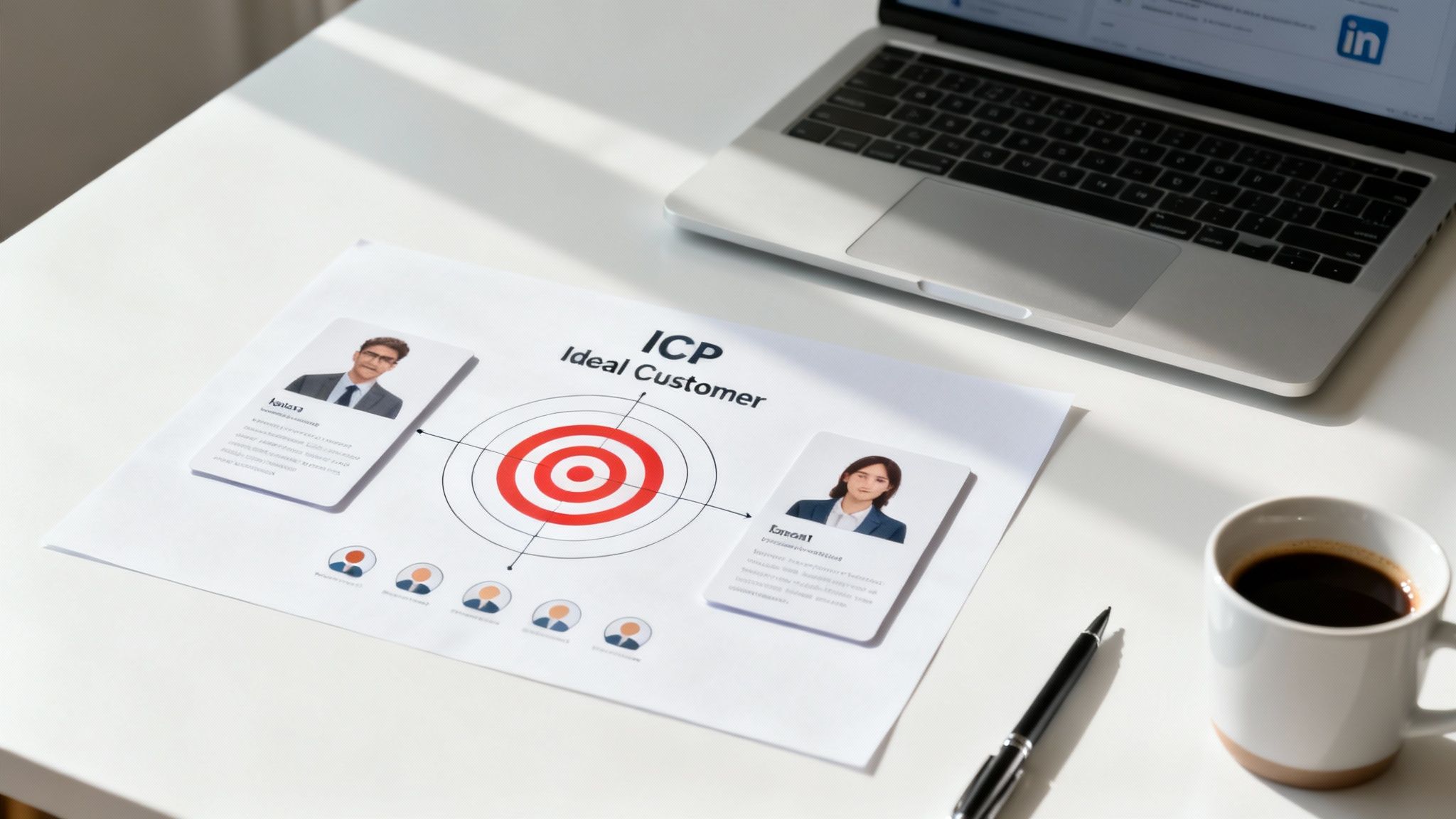
This is where your Ideal Customer Profile (ICP) comes in. Think of it as the blueprint for your entire outbound strategy. Without a sharp, detailed plan, everything you build on top of it will be unstable.
Too many teams make the mistake of keeping their ICP vague, defining it with basics like "mid-market tech companies in North America." While that's a start, it’s not nearly enough to create personalized outreach that actually breaks through the noise. A powerful ICP goes much deeper.
To build an effective outbound engine, you need to layer in more specific, actionable criteria. This means moving beyond the basics and adding data points that hint at a company's challenges, priorities, and readiness to buy.
Here are the key layers to consider when refining your ICP:
By combining these, you move from a generic description to a high-resolution picture of your perfect customer. For example, instead of targeting all software companies, you might target B2B SaaS companies with 200-1000 employees in the US, who use Salesforce, recently hired a VP of Sales, and have a culture of rapid growth. That level of detail is a game-changer.
Once you know which companies to target, the next step is identifying the right people inside them. This is where buyer personas come in. An ICP defines the ideal company, while a buyer persona defines the ideal individual you need to engage.
You’ll likely have several key personas involved in any B2B purchase, and each has different responsibilities, pain points, and motivations.
A common mistake in outbound is focusing only on the economic buyer. While their sign-off is essential, your initial outreach is often far more effective when aimed at the champion—the person whose daily work will be directly improved by what you're selling.
With a defined ICP and clear personas, you can start building your list of target accounts. This isn't a one-time task of buying a static list; it’s an ongoing process of intelligence gathering.
Tools like LinkedIn Sales Navigator are indispensable here. They let you apply your ICP criteria with precision, filtering by industry, company size, geography, and even specific keywords in job titles.
This screenshot shows just how granular you can get.

Here, we've filtered for specific roles within a target industry and company size, instantly generating a list of relevant contacts who match our persona.
Building these lists is just the beginning. The real magic happens when you enrich this data with deeper research. To streamline this, follow a structured approach to ensure you're gathering the critical info needed for personalization. For a detailed guide, check out our ultimate account research checklist to see how you can systematically uncover insights that fuel compelling outreach. This disciplined approach ensures every message you send is built on a solid foundation of relevance.
Your Ideal Customer Profile tells you who to target. That's only half the battle. The other, arguably more important, half is knowing when to reach out.
It doesn't matter how perfect your message is if you send it at the wrong time—you're just another cold email. But when you time your outreach around specific company events, or "buying signals," you instantly transform from an interruption into a timely, relevant problem-solver.
These are the triggers that tell you a company isn't just a good fit, but a good fit right now.
Not all signals are created equal. Some scream "immediate need," while others are subtle whispers of a future opportunity. Knowing the difference helps you prioritize your efforts and craft messaging that actually lands.
Strong signals are direct, clear signs that a company is actively looking to solve a problem you can fix. They basically say, "We have a need and potential budget!"
Soft signals are more nuanced. They don't point to an immediate purchase but suggest a strategic shift or a new challenge on the horizon that could create an opening down the line.
The key is to see these signals not just as an excuse to send an email, but as the context you need to start a smarter conversation. A signal is your permission to be relevant.
Trying to manually track these events across hundreds of accounts is a recipe for failure. This is where modern sales intelligence platforms become essential.
Tools like ZoomInfo, Cognism, or Salesmotion are built to monitor these signals in real-time. They do the heavy lifting of scanning news, press releases, job boards, and social media, then feed you the relevant triggers. This lets you act on opportunities the second they appear, giving you a huge first-mover advantage.
Here's a quick look at how a platform like ZoomInfo can surface these time-sensitive insights, letting you filter for specific company events.
This kind of real-time feed is the engine of a modern outbound strategy. It ensures your team's outreach is always timely and steeped in context.
By setting up alerts for your target accounts, you can stop hunting for reasons to reach out and instead have them delivered right to you. For a deeper look at the kinds of triggers you can track, check out this detailed guide on using buying signals in sales, which breaks down how to turn these events into real pipeline.
The most sophisticated teams take this a step further by mapping these signals directly to a structured sales methodology like MEDDICC. This approach connects a real-world event to a specific qualification criterion, helping you build a strategic playbook for your outreach.
This alignment turns raw data into strategic intelligence. It guides not just when you reach out, but what you say and who you should be talking to.
Connecting common buying signals to a MEDDICC-style sales qualification framework helps build a strategic playbook, turning random events into purposeful outreach.
| Buying Signal | Potential MEDDICC Implication | Example Outreach Angle |
|---|---|---|
| Hired a new CRO | Champion, Economic Buyer: A new leader is looking to make an impact and has the authority to drive change. | "Saw you just joined as CRO. Leaders in your role often re-evaluate their sales engagement tools in the first quarter to hit their new targets." |
| Acquired a smaller company | Metrics, Pain: They now face integration challenges and need to consolidate systems and reporting. | "Congrats on the acquisition! Merging sales data can be a major headache. We help companies like yours unify their CRM data in weeks, not months." |
| Mentioned "supply chain risk" in an SEC filing | Pain, Metrics: The company has a publicly acknowledged, high-priority problem with measurable financial implications. | "Noticed the mention of supply chain risk in your latest 10-K. Our platform helps mitigate that by providing predictive analytics on supplier viability." |
This systematic approach makes sure every piece of outreach is purposeful. You're not just name-dropping a recent event; you're connecting it directly to a likely business pain and positioning your solution as the obvious next step. This is what modern, successful outbound is all about.

You’ve got a sharp ICP and a steady stream of buying signals. Those are the raw materials for a killer outbound lead generation campaign. But none of it means anything if your message falls flat.
Generic templates are the fastest way to get your email deleted and your domain flagged as spam. Let's be real, nobody wants that.
Success in modern outbound boils down to one simple idea: relevance. Your message must instantly answer the prospect's two unspoken questions: "Why are you contacting me?" and "Why should I care about this right now?"
This is the entire philosophy behind the 'Why You, Why Now' framework. It forces you to connect your solution directly to what's happening in their world, using the intelligence you've gathered to build a bridge between their problem and your value.
Forget everything you think you know about cold email templates. An email that gets a response isn't a five-paragraph essay about your company. It's a short, sharp, and personalized note that respects the reader's time.
Here’s how to structure an email that starts a conversation, not ends one.
The Subject Line: This is your first impression. The goal isn't clever clickbait but clear relevance. Reference the buying signal you found. Instead of "Quick Question," try "Your recent hire for VP of Data Science." It immediately shows you've done your homework.
The Opening Sentence: This is your most critical real estate. You have about five seconds to prove you're not a robot. Lead with the 'Why Now' signal and connect the dots for them. For instance: "Saw your team is hiring several new data scientists, which usually means scaling your analytics stack is a top priority."
The Value Proposition: This is where you briefly introduce the 'Why You.' Connect their likely challenge to your solution, but frame it as an outcome, not a feature. Don't list what your product does; explain what it helps them achieve. Something like, "We help fast-growing data teams like yours deploy new models 30% faster without adding headcount."
The Call-to-Action (CTA): Stop asking for "15 minutes to chat." It’s a weak, overused ask. Instead, offer a low-friction, interest-based CTA. Ask a question that invites a simple yes/no or offers immediate value. Try, "Is scaling your analytics stack a focus for you right now?"
The goal of the first email isn't to book a meeting. It's to confirm that the problem you've identified is a priority and to earn the right to have a deeper conversation. Think of it as a conversation starter, not a sales pitch.
Manually personalizing hundreds of emails is impossible. This is where AI becomes a powerful ally, not a replacement for human insight. Personalization has become a key differentiator, with nearly 80% of marketers reporting that consumer expectations for personalized content have changed dramatically.
Today, companies that use AI to personalize outbound emails see much higher engagement than those relying on generic templates. In fact, research shows that adapting at least 50% of an email's content using AI can significantly improve open and response rates.
Modern AI tools can help you scale the 'Why You, Why Now' framework without sounding robotic. For instance, a platform like Salesmotion can take a buying signal, like an earnings call transcript, and automatically generate a strategic point of view. It transforms raw data into a tailored message angle.
For more hands-on advice, you can check out our guide on using ChatGPT for lead generation, which offers specific prompts and workflows.
Relying only on email is a huge mistake. Your prospects live on multiple channels, and a coordinated multi-touchpoint strategy dramatically increases your chances of breaking through the noise. A well-orchestrated sequence combines email, LinkedIn, and even a few strategic calls into a cohesive story.
Here’s what a simple, effective sequence might look like over two weeks:
This multi-channel approach makes your outreach feel more like a persistent, helpful conversation and less like an automated blast. Each touchpoint reinforces the last, building familiarity and making it far more likely you'll get that reply.
Open rates are interesting, but they don't pay the bills. An impressive open rate might feel good, but it's a vanity metric if it doesn't lead to actual pipeline. To prove your outbound engine is working, you need to measure what really matters—how your team's effort translates into qualified meetings and closed deals.
This is about shifting your focus from top-of-funnel activity to bottom-of-funnel outcomes. It's the classic difference between tracking motion and tracking progress. Let's break down the key stages and the KPIs that tell you the real story.
You can't measure what you haven't defined. A clear, agreed-upon funnel is the foundation for any smart measurement strategy. It gives sales and marketing a shared language and lets you spot exactly where your process is working well or breaking down.
A solid outbound funnel usually includes these core stages:
The magic is in tracking the conversion rates between each of these stages. If you see a big drop-off from MQLs to SQLs, for example, that’s a red flag. It could mean your initial qualification is weak or the handoff to your Account Executives is fumbled.
While the funnel gives you the map, specific Key Performance Indicators (KPIs) tell you how the journey is going. Don't drown in data; just focus on the numbers that directly connect your outbound activities to revenue.
Here are the essential KPIs you should have on your dashboard:
The ultimate goal is to connect every dollar spent on outbound to the pipeline it generates. This allows you to make data-driven decisions about where to invest your time, budget, and energy for the greatest return.
For a deeper dive into the metrics that matter most, you can explore our complete guide on essential lead generation key performance indicators.
Knowing your cost per lead is a start, but it can be misleading. Global data shows that the mean cost per lead is $198.44, but a staggering 80% of those leads never become sales. This stat alone shows why focusing only on the initial cost is a flawed strategy.
The metric that really cuts through the noise is Cost Per Opportunity (CPO). This calculation tells you exactly how much you're spending to generate a qualified, pipeline-worthy opportunity.
The formula is straightforward: Total Outbound Costs (salaries + tools + data) / Number of Opportunities Created.
Tracking your CPO gives you a clear-eyed view of your program's financial health. To get a broader sense of how leads move through the funnel, it's helpful to understand different lead collection features, even those used in tools like chatbots. By obsessing over CPO, you can confidently prove the ROI of your outbound engine and build a bulletproof case for future investment.
Even the best-designed outbound programs run into challenges. Building a modern engine for outbound lead generation has a lot of moving parts, so it’s normal to have questions. Let’s tackle some of the most common ones.
This is the classic quality vs. quantity debate. The honest answer? It depends on how much an account is worth to you. Not every prospect deserves an email that took an hour to research. A tiered approach is the most effective path forward.
The golden rule is that zero personalization is never an option. Every message should, at a minimum, show that you know who they are and what their company does.
The modern sales tech stack can feel like a maze. It's easy to get overwhelmed, but you only need a few core tools to build a powerful outbound system. Adding too many platforms at once just creates confusion and hurts adoption.
Start with these three non-negotiables:
Your CRM is the foundation. But these three pillars are what turn it from a passive database into an active outbound engine. Everything else is a "nice-to-have" until you've mastered the fundamentals.
There’s no single magic number, but the most common mistake is giving up too soon. A prospect’s silence isn't always a "no"—more often, it's just a "not right now."
A solid sequence typically runs for 2-4 weeks and includes 8-12 touchpoints spread across multiple channels (email, LinkedIn, and maybe a call or two).
The goal is to be professionally persistent, not annoying. Vary your messaging with each step, offer a new piece of value or a different insight, and always keep the tone respectful. If you get radio silence after a dozen well-crafted attempts, it’s probably time to move on.
For a deeper dive into weaving technology into your prospecting, this comprehensive guide to automated lead generation breaks down how to structure and scale your outreach. This methodical approach helps you stay top-of-mind without burning bridges.
Ready to stop the manual research and start acting on real-time buying signals? Salesmotion uses AI to monitor your target accounts and deliver strategic, personalized insights directly to your team. Save hours of research, increase pipeline by 40%, and scale your outbound lead generation. Learn more at https://salesmotion.io.
Stop guessing and start measuring. This guide unpacks the essential lead generation key performance indicators (KPIs) you need to track for real...
Learn how signal based selling helps you find in-market buyers, personalize outreach, and close more deals. A practical guide to growing your sales...
What is outbound sales? This guide breaks down the process, channels, and metrics that help B2B companies drive predictable revenue and sustainable...
