Signal-based selling is the art of listening to what your prospects do, not just what they say. It’s the difference between guessing and knowing when to reach out.
The data backs this up: signal-personalized outreach achieves 15–25% reply rates compared to the 3–5% industry average for cold email — a 5x improvement (Instantly 2026 Cold Email Benchmark Report). And according to Gartner’s 2025 Sales Survey, 61% of B2B buyers now prefer a rep-free buying experience, meaning the window for relevant, well-timed outreach is shrinking. Sellers who miss the signal miss the deal.
Imagine your sales team gets an alert the moment a key decision-maker at a top account revisits your pricing page for the third time this week. That’s not just vague interest—that’s a clear buying signal. This approach transforms sales from a game of high-volume outreach into one of high-value, perfectly timed conversations.
What Is Signal Based Selling?
 Signal-based selling applies retail intuition to the digital world.
Think of a great retail salesperson. They don’t hit everyone walking through the door with the same generic pitch. Instead, they watch for cues. They know to approach the customer who is intently comparing two products, not the one just killing time by the entrance.
Signal-based selling takes that same intuition and applies it to the digital world.
It’s a strategic shift away from the old "spray and pray" method. Instead of blasting emails to a massive, cold list, your team focuses on prospects who are already showing behaviors that suggest they’re ready to buy. For a comprehensive taxonomy, see our complete buying signals guide. These actions, or "signals," provide the critical context needed for outreach that feels personal and helpful.
The Core Idea Behind Signals
At its heart, signal-based selling is about using real-time data—like website activity, content downloads, or even company changes—to prioritize and tailor your outreach. Traditional sales is often a monologue; signal-based selling is a dialogue that starts when the buyer is ready. Tools like Salesmotion's Signal Agent automate this by monitoring 1,000+ sources 24/7 and surfacing the triggers that matter — so reps act on timing, not guesswork.
This shift means your sales team can stop guessing and start responding to actual, observable interest. It’s the difference between knocking on a hundred random doors and knocking on the one where someone is already looking out the window for help. For a deeper look into the specific actions that count, check out our guide to buying signals in sales.
To really grasp the difference, let’s break down how this modern approach stacks up against old-school tactics.
Traditional Selling vs. Signal-Based Selling
| Aspect | Traditional Selling | Signal-Based Selling |
|---|---|---|
| Primary Focus | Volume of activity (dials, emails) | Quality of engagement |
| Timing | Based on seller's schedule or cadence | Based on buyer's actions and intent |
| Messaging | Generic, one-size-fits-all pitch | Personalized and context-aware |
| Data Source | Static lists (firmographics, titles) | Dynamic behavioral and intent data |
| Success Metric | Number of meetings booked | Pipeline quality and conversion rates |
| Seller's Role | Hunter, persuader | Advisor, problem-solver |
The table makes it clear: this isn't just a minor tweak. It's a fundamental change in philosophy, moving from a seller-centric world to a buyer-centric one.
Key Components of This Approach
This strategy is built on a few core pillars that work together to create a smarter, more effective sales process.
- Data Collection: It all starts with gathering the right information. This includes behavioral data (your website), firmographic data (company details), and intent data from third-party sources (what they're researching online).
- Signal Prioritization: Not all signals are created equal. A key part of the strategy is learning which actions—like someone downloading a case study vs. just visiting the homepage—truly indicate buying intent.
- Response Strategy: This is where the magic happens. You need to create specific, relevant outreach plays for different signals. A brief website visit might trigger a light touchpoint on LinkedIn, while a demo request requires an immediate, detailed response.
The fundamental shift is from a volume-based mindset to a value-based one. Instead of asking, "How many calls can we make today?" the question becomes, "Which accounts are showing the strongest intent, and how can we best help them?"
Turn buying signals into booked meetings
Salesmotion surfaces leadership changes, earnings mentions, hiring surges, and news events across your territory — so reps reach out when timing actually matters.
Why Traditional Outreach Is Inefficient
 Traditional outreach wastes time on cold leads instead of focusing on accounts with real intent.
Here's a hard truth: a huge chunk of your sales team's day is spent on activities that don’t generate revenue. They're working hard, but their efforts are often aimed at the wrong targets at the wrong time.
This isn't an effort problem. It's a process problem.
Traditional outreach operates on a simple, outdated model of pure volume. The belief is that if you just send enough emails and make enough calls, you'll eventually hit your number. That might have worked a decade ago, but today’s B2B buyers are drowning in generic pitches.
The result is a frustrating cycle of inefficiency. Sellers chase cold leads, craft generic emails that get deleted instantly, and try to piece together mixed signals from a dozen different channels. It’s like yelling into a crowded room and hoping the right person happens to hear you.
The Problem of Wasted Effort
Think about the daily grind for a typical sales rep. They start with a long list of accounts that vaguely fit an ideal customer profile but lack any context about their current needs. They then spend hours researching, guessing at pain points, and sending messages that land with a thud.
This entire approach is flawed because it ignores the single most important factor: timing. A perfectly crafted message sent to a company that isn't in a buying cycle is just noise. It doesn't matter how great your solution is if the prospect isn't looking for one.
The math makes the problem obvious. Industry analysts consistently estimate that only about 3–5% of your total addressable market is actively in a buying cycle at any given moment. Volume-based outreach spends almost all of its energy on the other 95–97% — accounts with no budget, no immediate need, or a contract locking them into a competitor.
This inefficiency has a real, measurable cost. Sales reps spend only about 30% of their time actively selling, according to Salesforce's State of Sales report. The rest of their day is swallowed by admin tasks, manual research, and scrambling to find prospects who are actually ready for a conversation. If you want to see how signal-based selling flips this on its head, check out this great explainer on what is signal based selling from Salesloft.
Pain Points of an Outdated Sales Cycle
The old-school sales model creates the same recurring problems over and over, draining resources and stalling growth. By ignoring clear buyer signals, teams face predictable hurdles.
-
Low Engagement Rates: When outreach isn't tied to a specific buyer action, engagement plummets. Why would anyone reply to a generic message that has no relevance to their current situation?
-
Deals Stalling Mysteriously: A deal that seems promising can suddenly go cold. Without insight into what’s happening inside the account, reps are left guessing why the momentum vanished.
-
Wasted Marketing Qualified Leads (MQLs): Marketing works hard to generate leads, but many are still early in their journey. A traditional approach treats a simple whitepaper download the same as a pricing page visit, leading sales to burn valuable time on prospects with low intent.
The real opportunity cost isn't just the time spent on cold outreach. It’s the deals you miss because your team was too busy chasing silent accounts to notice the ones actively signaling their intent.
This isn’t about working harder; it’s about shifting your resources to where they’ll have the greatest impact. The goal is to focus on accounts that are actively showing they’re ready for a conversation, turning wasted effort into a predictable pipeline.
Practitioners are seeing the shift firsthand. Across B2B sales communities, the consensus is converging:
"The best outbound outreach in 2026 is not truly ‘cold.’ It’s signal-triggered. The highest-performing teams anchor every touchpoint to a real business event — a leadership change, an earnings mention, a funding round — and that alone drives 3–5x higher reply rates compared to template-based outreach." — B2B sales community consensus, Outreach 2025 data report
Teams that act on intent signals within 24 hours see a 29% lift in opportunity creation compared to slower responders. Speed matters as much as the signal itself.

“Automatic account profile detail I can use to manage my territory. Using Salesmotion AI to generate value statements per persona, account, etc. Using Salesmotion to give me a starting point based on new hires, or news alerts is critical.”
Adam Wainwright
Head of Revenue, Cacheflow
Identifying the Signals That Actually Matter
Let's be clear: not all signals are created equal. In signal-based selling, a random website visit is a whisper, but a VP of Engineering from a target account downloading your technical whitepaper? That’s a siren.
The real skill isn't just collecting data. It's learning to interpret it correctly. You're building a clear picture of an account's readiness to buy by separating meaningful signals from the background noise.
Think of yourself as a detective. A single clue is interesting, but it's the pattern of multiple clues that cracks the case. Your job is to find the patterns that point to a sales opportunity.
To do this right, you need to categorize your signals. Each category tells a different part of the buyer's story. When you combine them, they create a complete narrative of intent.
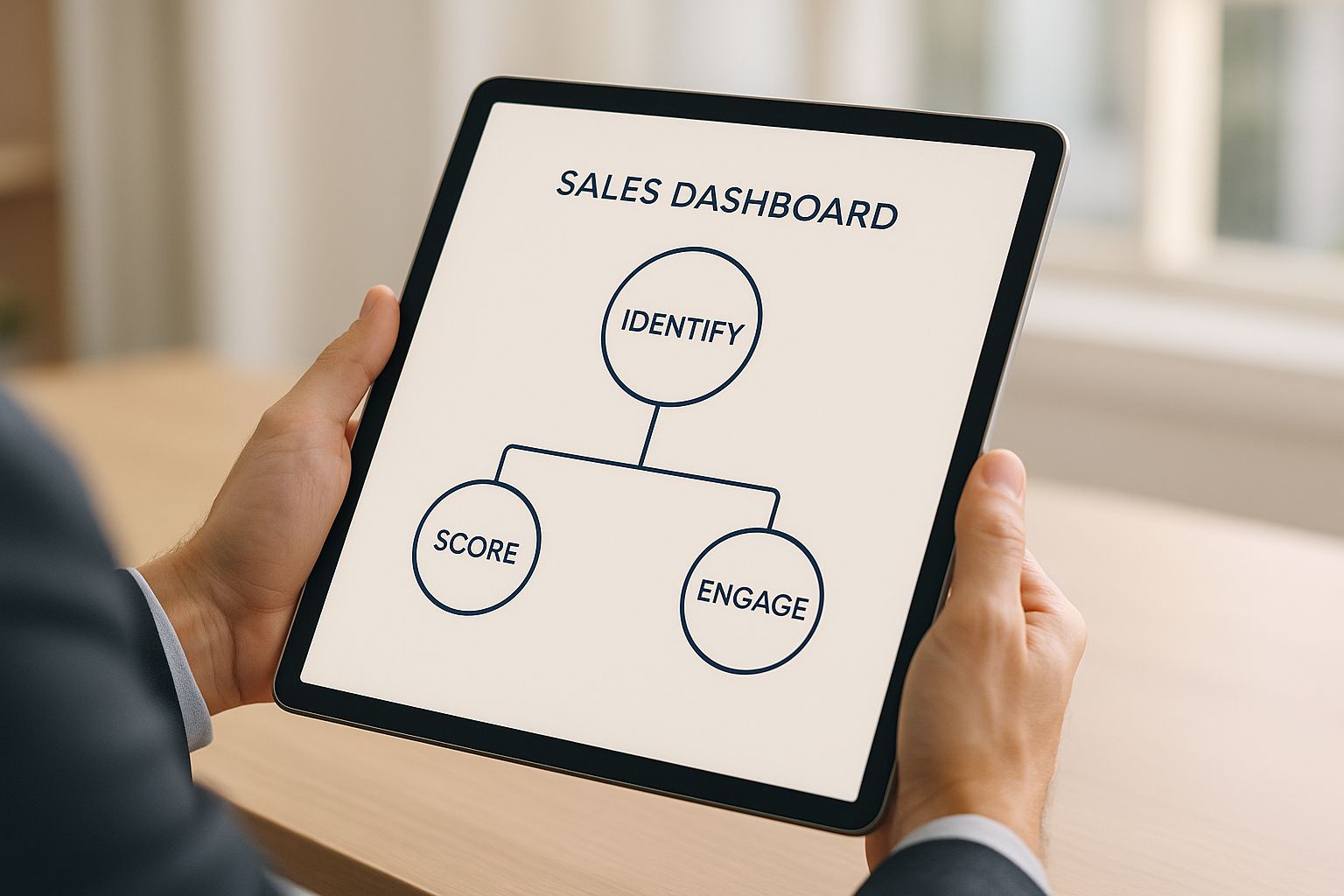 Categorizing and prioritizing signals turns raw data into strategic engagement opportunities.
This process is about transforming raw signals into actionable sales plays. You move from simple data collection to intelligent, prioritized engagement that gets results.
Here's a breakdown of the different B2B buyer signals and what they're telling your sales team.
Key Buyer Signals and What They Mean
| Signal Category | Example Signals | Potential Meaning for Sales |
|---|---|---|
| Intent Signals | - Keyword searches for your product category | |
| - Researching your brand vs. a competitor | ||
| - Browsing review sites like G2 or Capterra | An account is problem-aware and in the early research phase. It's time to start nurturing, but a hard pitch is likely too soon. | |
| Engagement Signals | - Downloading a technical whitepaper | |
| - Attending a live webinar or event | ||
| - Multiple visits to your pricing page | The account is now actively exploring your specific solution. This is a strong indicator of direct interest and a cue to prioritize them. | |
| Timing Signals | - A new executive hire in a key department | |
| - A recent funding announcement | ||
| - Negative social media posts about a competitor | An external event has created an immediate need or window of opportunity. This is the catalyst that makes outreach urgent and relevant. |
Each category provides a crucial piece of the puzzle. When you see signals from all three categories for a single account, you've likely found a golden opportunity.
Intent Signals: The What
Intent signals tell you what a company is actively researching, both on your own website and across the web. These are the first clues that a prospect is aware of a problem and is starting to look for a solution. For a deep dive on this data type, see our guide to intent data. They're often the earliest indicators that an account is entering a buying cycle.
Here's what to look for:
- Topic Searches: An account searching for keywords related to your product category (e.g., "AI account intelligence platforms").
- Competitor Comparisons: Researching your company versus a direct competitor shows they are deep in the evaluation phase.
- Review Site Visits: Prospects browsing sites like G2 or Capterra for your solution are actively vetting their options.
These signals tell you a need is forming. They are your cue to start paying closer attention, but it's probably too early for a hard sales pitch.
Engagement Signals: The Where
While intent signals show what a prospect is looking for, engagement signals show where they are looking—specifically, how they interact directly with your brand. These are much stronger indicators of interest because the prospect has moved from general research to exploring your specific solution.
A prospect's direct engagement with your content is one of the most powerful predictors of sales success. It's the digital equivalent of them walking into your store and picking a product off the shelf.
Examples of high-value engagement signals include:
- High-Value Content Downloads: A prospect downloading a technical whitepaper, an ROI calculator, or a detailed case study.
- Webinar and Event Attendance: Signing up for and attending a live event demonstrates a significant time investment and genuine interest.
- Pricing Page Visits: Multiple visits to your pricing or demo request page are one of the strongest buying signals you can get. For more on this, it's worth exploring the nuances of RFP request signals and what they mean.
A critical part of making sense of these signals is understanding lead scoring, which helps you prioritize prospects based on a combination of their engagement and how well they fit your ideal customer profile.
Timing Signals: The Why Now
Timing signals are the catalyst. They're the events that answer the crucial question: "Why now?" These are external changes within a target account that create an immediate need or open a window of opportunity for your solution.
- Key Executive Hires: A new VP of Sales or CRO is almost always hired to make changes and will bring in new tools.
- New Funding Rounds: A recent injection of cash means a new budget is suddenly available for strategic projects.
- Company Expansion or Mergers: Growth almost always creates new operational challenges that your solution can solve.
- Negative Mentions of a Competitor: An account complaining about their current provider on social media is the perfect opening.
The most sophisticated teams go one level deeper and track industry-specific timing signals. In life sciences, a successful Phase II clinical trial readout means a company is preparing to scale toward commercialization — and will need new vendors to do it. In financial services, a new regulatory filing creates immediate urgency for compliance and reporting tools. Knowing the triggers unique to your verticals is what separates a generic vendor from a strategic partner; our guide to the best signals for enterprise sales digs into these in detail.
When you combine a strong intent signal with a direct engagement signal and a compelling timing signal, you've hit the jackpot. This is the moment to act with a personalized, relevant, and timely outreach message.
How AI Supercharges Your Sales Strategy
Let's be realistic: manually tracking thousands of signals across hundreds of accounts is impossible. Imagine trying to keep tabs on every job posting, press release, and website visit for all your target companies. No human team can keep up.
This is where Artificial Intelligence (AI) becomes your most valuable player. AI doesn’t just collect data; its real magic is in connecting the dots and finding patterns a human rep would almost certainly miss. It’s the engine that makes a modern signal-based selling strategy work at scale.
Think of AI as a tireless analyst working for you 24/7. It cuts through the noise to surface the hottest opportunities, suggests the smartest next move, and frees up your sellers to do what they do best: build relationships and close deals.
From Data Overload to Actionable Insights
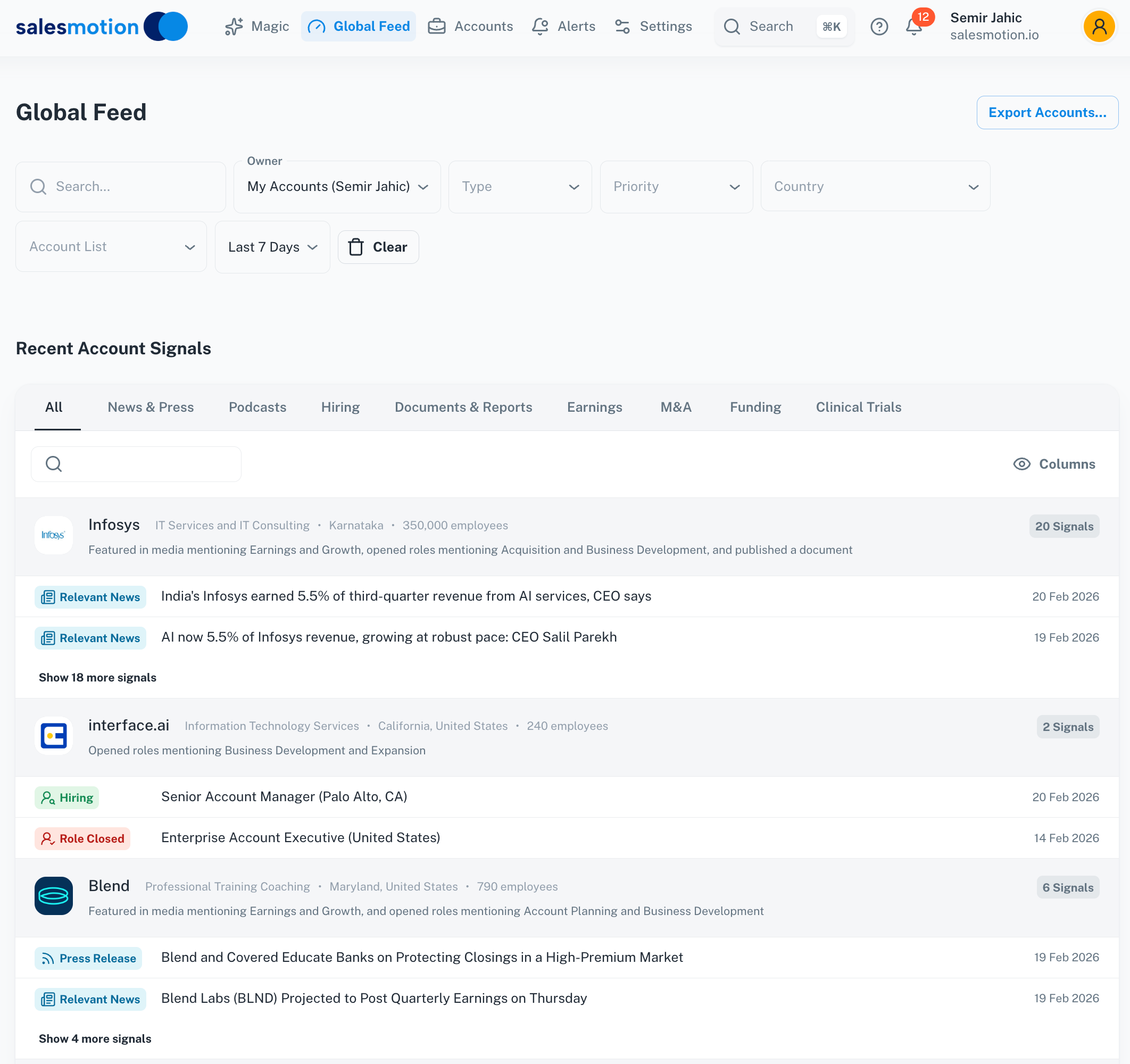 A live signal feed across your accounts: earnings mentions, hiring surges, and role changes surface automatically — a focused list of accounts ready for outreach instead of a data firehose.
Without AI, signals are just isolated data points—a pricing page visit here, a new executive hire there. An AI-driven platform acts as a central nervous system, pulling these scattered pieces of information together to tell a coherent story about an account’s journey.
It transforms a chaotic flood of raw data into a clear, prioritized list of actions. Instead of your team guessing which account to call next, they're handed a pre-qualified list of prospects who are actively showing clear signs of interest.
The core job of AI in sales is to translate messy data into clear, strategic direction. It answers the questions that matter most: "Who should we talk to?" "What should we say?" and "Why now?"
AI-powered systems do the heavy lifting, turning what was once a reactive, hope-based process into a proactive, data-driven one.
The results are measurable. Frontify saw a 42% increase in sales velocity after adopting a signal-based approach with AI-powered account intelligence, along with 4x growth in self-sourced revenue. When signals surface the right accounts at the right time, reps spend less time hunting and more time closing.

“The talking points are gold. If they're in Salesmotion, I know they're being discussed inside that business. That makes it easy to spark a real conversation, which is 90 percent of the battle.”
Andrew Giordano
VP of Global Commercial Operations, Analytic Partners
Key Capabilities AI Brings to the Table
Artificial Intelligence isn't some vague, futuristic concept in sales. It’s a set of practical tools that deliver real results today. Its main role is to amp up your strategy by automating signal detection, enriching your data, and running predictive analytics. These systems watch for buyer signals across countless platforms in real-time, score their likelihood to convert, and recommend personalized ways to engage.
Here’s how AI-driven platforms supercharge your efforts:
- Automated Signal Detection: AI constantly scans the web, news articles, financial reports, and social media for relevant timing and intent signals. It catches things like a new funding announcement or a key executive change the moment it happens.
- Buying Committee Identification: Instead of guessing, AI can map out entire buying committees within a target account. It identifies the key stakeholders—even those who haven't directly engaged with you yet.
- Data Enrichment: It automatically fills in the blanks in your CRM, adding missing info like job titles, direct dials, and tech stack details. This ensures your data is always accurate and ready to use.
- Predictive Scoring: By analyzing historical data, AI can predict which combination of signals is most likely to lead to a sale. This allows your team to stop chasing cold leads and focus on high-potential accounts.
This level of automation means sellers can stop wasting hours on manual research and start having strategic conversations. You can see how this works in practice by exploring the role of an AI sales agent in modern revenue teams, or compare the best B2B sales automation tools with AI agents to find the right platform for your team. For a ranked comparison of the platforms themselves, see our guide to the best signal-based selling tools.
Putting AI Into Action: An Example
Let’s walk through a real-world scenario. A sales rep has a target account, "Innovate Corp." Without AI, they might check the company’s LinkedIn page once a week and set a reminder to send a generic follow-up.
With an AI-powered platform, the process looks completely different:
- The Trigger: The AI system detects that Innovate Corp. just posted three new job openings for "Senior Data Engineers."
- The Connection: At the same time, the system notices that two directors from Innovate Corp.'s engineering team have been researching keywords related to "cloud data infrastructure."
- The Insight: The platform connects these signals and alerts the sales rep. The insight? Innovate Corp. is scaling its data team and likely has a fresh budget for the technology to support it.
- The Action: It then provides the contact information for the newly hired VP of Engineering and suggests a personalized outreach template referencing their team's expansion.
This entire sequence happens automatically and in real time.
Ultimately, the power of signal-based selling, especially when amplified by AI, is about implementing effective strategies to improve sales performance and drive real revenue growth. It’s about being in the right place, at the right time, with the right message—every single time.

“The account and contact signals are key for reaching out at important times, and the value-add messaging it creates unique to every contact helps save time and efficiency.”
Daniel Pitman
Mid-Market Account Executive, Black Swan Data
Building Your Signal-Based Selling Playbook
Knowing about buying signals is one thing. Turning that data into a revenue-generating machine is a different ballgame. This is where a structured playbook comes in—it’s the bridge between knowing a signal exists and your team taking the right action at the right time.
A playbook gets rid of the guesswork. It gives your sales and marketing teams a clear, repeatable framework for how to act on different signals, which is the only way to make this strategy consistent and scalable.
Without one, your reps are just winging it. That leads to messy outreach, missed opportunities, and a process that feels more like chaos than strategy. A well-defined playbook is the operational backbone of any real signal-based selling effort.
Start with a Rock-Solid ICP
Before you can think about which signals to listen for, you need absolute clarity on who you're listening to. Your Ideal Customer Profile (ICP) is the foundation of your entire playbook. Get this wrong, and you'll waste countless hours chasing signals from accounts that were never a good fit.
Your ICP has to be more than just company size and industry. It should be a detailed portrait of the accounts that get the most value from what you sell.
- Firmographics: What are the non-negotiables? Think employee count, revenue, and geography.
- Technographics: What's in their tech stack? Are there specific tools they must have (or can't have) for your solution to work?
- Behavioral Traits: How do they make decisions? Are they driven by product-led growth, or is it a top-down enterprise sale?
A sharp, well-defined ICP acts as the first, most important filter for your signal-based selling engine. It makes sure you’re only spending time on accounts that can actually become high-value customers.
Identify and Prioritize Your Critical Signals
Once you know who to look for, the next step is to define what you're looking for. You need to build a hierarchy based on how strongly a specific action points to purchase intent.
Sit down with your sales and marketing teams and map out the signals that matter most at each stage of the buyer's journey. This is how you build a shared language around what a "hot" lead actually looks like.
A simple tiered system works well here:
- Tier 1 (High Intent): These are the five-alarm fires. They demand immediate, thoughtful action. Think demo requests, multiple pricing page visits from a key persona, or an executive mentioning a core pain point on a podcast.
- Tier 2 (Growing Interest): These signals show someone is actively kicking the tires. This could be someone downloading a technical case study, attending a webinar, or a spike in website visits from several people at the same company.
- Tier 3 (Early Awareness): These are your top-of-funnel breadcrumbs. Think of a key persona liking one of your LinkedIn posts or a target account announcing a new round of funding.
This tiered approach helps your team focus their time on the opportunities most likely to close.
Define Your "Plays" for Each Signal
This is the heart of your playbook: creating specific, actionable "plays" for your team to run. A play is a pre-defined sequence of steps a rep should take when a certain signal (or combination of signals) appears. It’s how you turn abstract data into concrete sales motions.
Each play needs to be crystal clear.
- The Trigger: What specific signal kicks off this play?
- The Persona: Who, exactly, are we reaching out to?
- The Channel: Where is this happening? Email, LinkedIn, a phone call?
- The Message: What’s the core message, and how do we personalize it based on the signal?
Let's look at a few practical examples of plays you could build:
| Trigger | Play |
|---|---|
| A Director from an ICP account visits the pricing page twice in one week. | The Pricing Page Play: The assigned Account Executive sends a personalized LinkedIn connection request mentioning their potential interest in ROI, followed by an email offering to build out a tailored business case. |
| A target account posts a job opening for a role your solution supports (e.g., "Head of Revenue Operations"). | The Job Post Play: An SDR messages the likely hiring manager (maybe the CRO), congratulating them on the team's growth and sharing a relevant case study on how you help similar roles get up to speed faster. |
| A key executive at a target account is interviewed on an industry podcast. | The Podcast Play: The AE listens to the interview, pulls out a direct quote about a challenge they mentioned, and references it in a concise, value-first email. |
Creating these clear, signal-driven plays is a core part of many modern sales training methodologies and sales enablement best practices that equip reps with situation-specific tactics instead of tired, generic scripts. When you operationalize your insights this way, you ensure every signal is met with a swift, relevant, and effective response.
Track the Metrics That Prove It's Working
A playbook is only as good as the results it drives, so build measurement in from day one. Four KPIs tell you whether your signal-based plays are actually paying off:
- Meeting Acceptance Rate: Your first gut check. Are prospects more willing to take a meeting when outreach is tied to a timely signal?
- Opportunity-to-Close Conversion Rate: The pipeline quality test. Signal-driven opportunities should convert to closed-won at a higher rate than cold-sourced ones.
- Sales Cycle Length: Engaging accounts that are already in a buying mindset should visibly shorten the time from first touch to signature.
- Average Contract Value (ACV): Reaching out at a strategic moment — like right after a funding round — often lets you position a more comprehensive, higher-value solution.
When you can attribute wins back to specific signal-driven plays, the conversation shifts from "we think this is working" to "we know this is working, and here's the data."
Common Mistakes to Avoid When Getting Started
Let's be honest: rolling out any new strategy has its bumps. While signal-based selling can transform your pipeline, a few common stumbles can kill your momentum before you even get going. Sidestepping these early pitfalls is key to a smooth rollout and a faster return on your effort.
One of the biggest mistakes? Treating all signals as equal. It’s easy to get overwhelmed by the sheer volume of data and start chasing every little thing. But reacting to every website visit or social media “like” is a surefire way to burn out your team and drown out the signals that actually matter.
You have to build a hierarchy. A VP of Engineering downloading a technical whitepaper is a world away from an intern skimming your blog. Without prioritizing signals based on intent and persona, your team will waste precious time on low-quality noise.
Failing to Align Sales and Marketing
This one’s a classic, but it’s a killer. Marketing gets excited about a spike in MQLs from a webinar, but if sales sees those leads as lukewarm, the whole handoff falls apart. This disconnect is the single biggest roadblock to success.
Both teams must agree on a unified definition of what makes an account "hot." This shared understanding, often formalized in a service-level agreement (SLA), ensures everyone is reading from the same playbook.
Without that alignment, you get finger-pointing and a leaky funnel. Marketing pushes leads that sales ignores, and sales complains about lead quality. For the marketing side of this equation, see our signal-based marketing playbook. A successful signal-based selling program demands that both teams are completely in sync on what a high-value signal looks like.
Choosing the Wrong Tech or Forgetting Training
It's tempting to throw money at a shiny new tool without thinking through how it fits into your existing workflow. You can buy the best intent data provider on the market, but if it doesn't talk to your CRM, your reps will find excuses not to use it. A fragmented tech stack just creates friction and kills efficiency. If you're evaluating options, our guides on Bombora alternatives, Koala alternatives, and Pocus alternatives break down where each tool fits in a signal-based workflow.
But even with the perfect, integrated toolset, the initiative can still fall flat if the team isn't trained on how to use it. This is a critical mistake.
- Reverting to Old Habits: Without clear guidance, reps will naturally fall back on what they know—cold calling and generic email blasts. They need to understand how to turn signals into relevant, timely conversations.
- Misinterpreting Signals: A signal is only as good as the action it inspires. Training needs to focus on translating raw data into specific outreach "plays" so reps know exactly what to do when a high-value signal appears.
- Lack of Confidence: If your team doesn't trust the data or feel confident in the new workflow, adoption will stall before it even starts.
At the end of the day, making this work isn’t just about buying new software. It’s a strategic shift that requires a unified team, a well-integrated tech stack, and a real commitment to continuous training.
Key Takeaways
- Signal-based selling is a fundamental shift from volume-based cold outreach to precision engagement triggered by real-time buying events like funding rounds, leadership changes, and competitive disruptions.
- Not all signals are equal; the ones that matter most indicate a funded initiative, a new decision-maker with a mandate to act, or a strategic shift that creates an immediate need for your solution.
- AI-powered account intelligence platforms transform signal-based selling from a manual, ad-hoc practice into a scalable system that continuously monitors thousands of accounts and surfaces actionable opportunities.
- Building a signal-based playbook with pre-defined outreach sequences for each trigger type ensures reps can act within hours of a signal firing, when relevance and timing are at their peak.
- Common mistakes include tracking too many signals without prioritization, failing to train reps on how to translate signals into relevant conversations, and not integrating intelligence into existing CRM workflows.
Stop wasting hours on manual research and start acting on real-time buying signals. Salesmotion delivers AI-powered account intelligence directly to your sales team, turning insights into pipeline. See how it works.
Frequently Asked Questions
What is signal-based selling?
Signal-based selling is a strategic approach where sales teams focus their outreach on prospects who are already showing behaviors that indicate buying readiness, rather than blasting generic messages to cold lists. It uses real-time data like website activity, content downloads, executive hires, and funding announcements to prioritize accounts and personalize messaging. The fundamental shift is from volume-based outreach to precision engagement timed to when the buyer is most receptive.
How is signal-based selling different from traditional lead scoring?
Traditional lead scoring is mostly static, assigning points based on demographic attributes like job title, company size, or industry. Signal-based selling focuses on dynamic, real-time behaviors and events that reveal what accounts are doing right now. The key difference is that lead scoring tells you who a prospect is, while signal-based selling tells you what they are actively doing, providing the critical timing context that makes outreach relevant.
How is signal-based selling different from Account-Based Marketing?
Think of them as complementary strategies. Account-Based Marketing (ABM) defines who your most valuable target accounts are, while signal-based selling provides the when and why for engaging them. Signals are the real-time triggers that turn a well-laid ABM plan into perfectly timed action, ensuring your message lands at the exact moment it matters most.
What are the three categories of buying signals?
The three categories are intent signals (what a company is researching, like keyword searches or competitor comparisons), engagement signals (how they interact directly with your brand, like pricing page visits or whitepaper downloads), and timing signals (external events that create an immediate need, like new executive hires, funding rounds, or competitor dissatisfaction). When you see signals from all three categories for a single account, you have likely found a high-priority opportunity.
What tools do I need to implement signal-based selling?
A typical setup requires three core components: a solid CRM like Salesforce or HubSpot as your system of record, intent data sources that reveal what topics your target accounts are researching across the web, and a sales intelligence platform that uses AI to connect these signals, enrich your account data, and surface actionable insights. For a detailed look at how these platforms compare, see our account intelligence tools guide. The critical requirement is that these tools integrate seamlessly so intelligence flows directly into your reps' daily workflow.
How much manual work does signal-based selling require?
Without the right tools, it is extremely labor-intensive — reps would spend half their day hunting for information online. Modern account intelligence platforms do the heavy lifting by scanning thousands of sources, detecting relevant signals, and delivering them with full context and suggested talking points. The rep's job shifts from hunting for intelligence to acting on it, often going from signal detection to personalized outreach in under ten minutes.
What are the most common mistakes when starting signal-based selling?
The biggest mistakes are treating all signals as equal without building a prioritization hierarchy, failing to align sales and marketing on a shared definition of what makes an account "hot," choosing tools that do not integrate with your existing CRM, and neglecting to train reps on how to translate signals into relevant conversations. Without proper training, reps tend to fall back on old habits of cold calling and generic email blasts.
Is signal-based selling only for large enterprise companies?
Not at all. While large enterprises benefit from the automation and scale that AI platforms provide, the core principles work for businesses of any size. A smaller company can start simply by tracking high-value signals on its own website, such as multiple pricing page visits or demo requests from target accounts. As the business grows, more advanced tools can be layered in to automate signal detection and expand coverage across a larger set of accounts.