Let's be honest: casting a wide net and hoping for good leads is a broken strategy. It’s time to stop boiling the ocean.
Target account management is a fundamental shift in how you sell. It’s about focusing your entire revenue team—sales, marketing, customer success—on a curated list of high-value accounts most likely to buy, renew, and expand. You move from the high-volume, low-impact grind of traditional prospecting to a precise, intelligence-driven approach that builds real, predictable growth.
Why Target Account Management Is Your New Growth Engine

Too many sales teams are stuck in a frustrating cycle. They burn hours on manual research, struggle to find a compelling "why now" to reach out, and send generic messages that go straight to the trash. The result? Wasted effort, inconsistent account plans, and a pipeline that feels more like a lottery than a predictable system.
Target account management solves these problems.
Instead of treating every potential customer the same, it forces your team to align on the opportunities that actually matter. This isn't just another sales tactic; it’s a core business strategy that gets sales, marketing, and customer success rowing in the same direction to create a scalable engine for predictable revenue.
The Real Shift: From Volume to Value
The old sales model often resembles a factory floor, where the main goal is cranking out as many calls and emails as possible. The new model, rooted in target account management, is more like a specialized workshop focused on the quality and precision of every interaction.
This is a complete transformation in how your team operates.
It’s not just a trend. Account-Based Marketing (ABM), a close relative of TAM, has seen massive adoption, with 82% of B2B companies now running active programs. This highlights the power of aligning teams around specific, high-value accounts—a strategy that’s especially potent in complex B2B sectors like SaaS and Financial Services.
Need more proof? 56% of marketers report that personalized content deepens their understanding of key target accounts. The data is clear: focus wins.
By concentrating your resources on a handpicked list of accounts, you stop trying to appeal to everyone and start fishing in a well-stocked pond. The result is higher engagement, bigger deal sizes, and a more efficient sales cycle.
Let's look at the practical differences between the old spray-and-pray method and a focused TAM approach. The table below breaks down the key distinctions.
Manual Prospecting vs. Target Account Management
| Attribute | Manual Prospecting (The Old Way) | Target Account Management (The New Way) |
|---|---|---|
| Focus | High volume of activities | High value of accounts |
| Targeting | Broad, based on basic firmographics | Narrow, based on Ideal Customer Profile |
| Research | Ad-hoc, shallow, and manual | Systematic, deep, and signal-driven |
| Outreach | Generic, one-to-many messaging | Personalized, one-to-one messaging |
| Alignment | Siloed teams (sales, marketing) | Integrated revenue team |
| Goal | More meetings | More qualified pipeline |
| Metrics | Activity counts (calls, emails) | Engagement, pipeline velocity, deal size |
This isn't just a minor adjustment; it's a complete overhaul of your go-to-market motion. By adopting a TAM strategy, you're building a more sustainable, effective, and profitable sales engine.
Solving the Core Frustrations in Sales
A well-executed target account management program directly solves several pain points that hold revenue teams back. It provides a clear framework for success, turning random acts of selling into a coordinated, effective go-to-market motion.
Here are the key problems it finally puts to rest:
- Eliminates Wasted Effort: Your team stops chasing poor-fit leads and concentrates its energy where it counts: on accounts with the highest potential for conversion and long-term value.
- Strengthens Outreach: It provides a strong "why now" for every interaction. This means replacing cold, generic pitches with timely, relevant, and value-driven messaging that actually gets a response.
- Creates Scalable Planning: Inconsistent, ad-hoc account plans get replaced with a repeatable process. This ensures every rep approaches their top accounts with the same strategic rigor. For more on this, check out our guide on the fundamentals of account-based selling.
- Aligns the Entire Revenue Team: Suddenly, everyone is on the same page. Marketing creates content for specific accounts, sales executes hyper-relevant outreach, and customer success is ready for expansion opportunities. It’s a unified front.
See Salesmotion in action
Take a self-guided interactive tour — no signup required.
How to Select and Tier Your Target Accounts

Let's be blunt: a world-class target account program is built on one thing—choosing the right accounts. If you get this step wrong, even the most creative outreach and brilliant planning will fall flat. The goal is to create a dynamic, intelligence-driven target account list your entire revenue team can get excited about.
This process starts by defining your Ideal Customer Profile (ICP), but we need to push past the basics. Traditional firmographics like company size, industry, and location are a decent starting point, but they barely scratch the surface. The best ICPs are multi-dimensional, weaving in deeper insights that signal a strong potential fit.
Building a Modern Ideal Customer Profile
To zero in on your best-fit accounts, you have to layer in more sophisticated data points. This gives you a much sharper picture of who is most likely to buy from you—and just as importantly, why.
Think about integrating these key data categories into your ICP:
 Salesmotion scores and ranks your target accounts based on real-time signal activity, helping you tier accounts dynamically rather than relying on static lists.
- Firmographics: The fundamentals. This includes industry, annual revenue, employee count, and geographic location. Consider this your first, broad filter.
- Technographics: What tech are they already using? Knowing their current stack (like their CRM or marketing automation) can reveal integration opportunities, competitive weaknesses, and their overall tech maturity.
- Buying Intent Signals: What are they actively researching right now? Data on their online behavior, like downloading content or searching for topics related to your solution, is a huge sign that a buying cycle might be underway.
- Strategic Fit: How well do their business goals align with your solution? This could be a public plan to expand into a new market or a focus on improving operational efficiency—exactly where your product can make a real difference.
Your ICP shouldn't be a static document. It's a living profile. Revisit and refine it every quarter based on your latest closed-won deals, market shifts, and new intel from your sales team.
From Profile to Actionable List
Once you have a solid ICP, you can build your initial, broad list of potential targets. From there, the real work of refinement begins. After you’ve identified that wider group, you have to qualify sales leads to sharpen your focus. This step turns a vague list into a high-potential one.
For instance, a cybersecurity SaaS company might start with firmographics (companies with 1,000+ employees in financial services). But then they'd layer on more specific triggers. Their true ICP might be companies that recently hired a new CISO or have active job postings for cybersecurity talent—clear signals of an investment in security.
The Power of Tiering Your Accounts
Not all target accounts are created equal. A simple but effective tiering system helps you focus your team's time, budget, and energy where they'll have the biggest impact. A three-tier structure is a common and proven model.
- Tier 1: The Bullseye Accounts. A perfect match for your ICP. They represent your biggest opportunities, and you should dedicate 70% of your resources here with highly personalized, multi-threaded outreach.
- Tier 2: Strong Contenders. These accounts check most, but not all, of your ICP boxes. The potential is there, but they might need more nurturing. Allocate about 20% of your resources to this group.
- Tier 3: The Long Game. These accounts are a potential fit down the road but might have timing or budget issues. They get lighter, automated touches to stay top-of-mind, consuming the final 10% of your resources.
This approach gives everyone a clear framework for prioritization. For a deeper dive, check out our post about the benefits of tiering accounts in sales. A tiered system transforms a long list of names into a strategic action plan.

“Salesmotion is instrumental in helping me prioritize net-new accounts, understand their strategic initiatives, and cover more ground. With a lot of green-field accounts, I'm heavily leaning on the AI insights to tier my accounts and focus my time. The platform is incredibly intuitive and easy to use.”
Rob Webster
Enterprise Account Executive, Synthesia
Using Account Intelligence to Find Your 'Why Now'
You've built your tiered target account list. That's a huge step, but it's only half the battle. Now comes the real work: finding a compelling, authentic reason to reach out.
Without a strong 'why now', even the perfect message to a dream account feels cold and opportunistic. This is where account intelligence becomes your secret weapon.
It’s about shifting from static account plans to an 'always-on' monitoring system. Think of it as your eyes and ears, constantly scanning for the critical buying signals that give your team a legitimate reason to start a conversation. Forget drowning in irrelevant news—the goal is to surface actionable insights that tell your reps precisely why this account, this contact, and this moment matter.
Ditching the Noise for Real Signals
Let's be honest: not all information is created equal. A successful target account program hinges on your ability to filter out the noise and lock onto the signals that indicate a window of opportunity. These triggers are often specific to the industries you serve.
For example, if you sell to biotech, news of a successful clinical trial or a fresh round of funding is gold. Those events signal an immediate need for services to help them scale. But if you're a cybersecurity firm, you'd be far more interested in an enterprise company hiring a new CISO or kicking off a digital transformation project.
The most powerful 'why now' moments are born from understanding an account's specific context. It transforms your outreach from "I'd like to sell you something" to "I see what you're doing, and I know how we can help you get there faster."
This is the shift from generic prospecting to intelligence-led selling. It's about showing up with a point of view.
Here’s a look at some high-impact buying signals that sales teams should be tracking across different verticals. This kind of focused monitoring provides the timely, relevant triggers you need for outreach that connects.
Key Buying Signals by Industry Vertical
| Industry Vertical | High-Impact Buying Signals to Track |
|---|---|
| Life Sciences & Healthcare | Recent funding rounds, M&A activity, clinical trial results, new drug approvals, key executive hires in R&D or commercial roles. |
| B2B SaaS & Enterprise Software | Announcements of major product launches, new strategic partnerships, significant ARR milestones, hiring for key roles (e.g., Head of Sales, VP of Engineering). |
| Financial Services & Insurance | Regulatory changes impacting their business, announcements of digital transformation projects, fintech partnerships, key leadership changes. |
| Industrial & Manufacturing | Plans for new facility construction or expansion, major capital equipment purchases, supply chain restructuring initiatives, ESG commitments. |
Of course, this table just scratches the surface. To pinpoint the 'why now' for your specific accounts, you need the right technology. Exploring powerful AI lead generation tools can help you automate the discovery of these signals at scale.
Creating an 'Always-On' Monitoring System
Building a system to catch these signals doesn't have to be a massive manual effort. The trick is to create a framework of custom alerts that pushes real-time notifications directly into your team's workflow. This solves the problem of reps hunting for information and ensures they can act the second a signal appears.
For example, you could set up alerts for:
- Executive Moves: A new CIO joins a target account. This is a prime opportunity. New leaders almost always look to make an impact within their first 90 days.
- Company Initiatives: An earnings call transcript mentions a strategic focus on "improving operational efficiency." Your alert can trigger an outreach sequence with messaging that speaks directly to that goal.
- Technology Mentions: A key decision-maker mentions struggles with their current data analytics stack on a podcast. This is a golden opportunity for a value-based conversation. For more, find a list of the best signals for enterprise sales in our detailed guide.
This alert shows how a platform like Salesmotion can surface a key trigger—in this case, a leadership change—and provide immediate, actionable context.
Instead of just getting a raw news link, the rep gets a concise summary of the event and its potential implications. This empowers them to act fast and with relevance.
Turning Intelligence into Immediate Action
The final piece of the puzzle is connecting intelligence to execution. It’s not enough to just see a signal. When a high-value trigger is detected, it should automatically kick off a pre-defined playbook. This ensures a consistent, high-quality response across the team and removes the guesswork.
Picture this workflow:
- Signal Detected: Your system flags a Tier 1 account announcing a major expansion into the European market.
- Alert Triggered: The assigned Account Executive instantly gets a Slack notification with the news, key contacts, and a link to the source.
- Playbook Activated: The alert suggests a specific outreach "play" from your library, complete with talking points and an email template referencing the expansion and positioning your solution as a key enabler.
This closed-loop process makes target account management so powerful. It systematically connects real-world events to relevant, timely outreach, solving the 'weak why now' problem for good. Your team is no longer guessing; they're engaging with purpose.
Executing Outreach Plays That Actually Work
Great account intelligence is a fantastic start, but it's wasted if you don't stick the landing. All the signals in the world mean nothing if your outreach falls flat. This is where you translate the "why now" into messaging that gets a response.
The point is to move far away from the generic, self-serving pitches we all hate. Instead, you build value-based outreach that speaks directly to what’s happening right now at a target account—their specific situation, challenges, and goals. You’re crafting a point of view that proves you’ve done your homework.
Crafting Value-Based Messaging
True personalization goes way beyond dropping and Salesmotion into an email. It’s about weaving the specific intel you’ve gathered into a compelling narrative. Each signal you detect should trigger a specific "play" from your playbook—a pre-defined set of actions and messaging angles.
Consider these real-world scenarios:
-
The Funding Announcement Play: Your target, a biotech firm, just closed a $50 million Series B round. Your outreach shouldn't be a lazy "Congrats on the funding!" It needs to connect that event to a specific problem you solve: "With your new funding focused on scaling commercial operations, teams often struggle with [common pain point]. Our platform helps leaders like you solve this by..."
-
The New Leader Play: A new CIO joins one of your Tier 1 accounts. You know new execs are under pressure to make an impact in their first 90 days. Your message could reference one of their past projects (found on LinkedIn) and tie it to a potential initiative at their new company.
-
The Strategic Initiative Play: An earnings call transcript reveals a company's plan to slash operational costs by 15%. Your outreach can hit this head-on, showing exactly how your solution contributes to that goal with quantifiable examples from other clients.
This level of detail changes the entire dynamic. You’re no longer just another vendor asking for 15 minutes; you’re a strategic partner offering relevant insights.
The Art of Multi-Threading
In any complex B2B sale, you’re never selling to just one person. A successful target account program depends on multi-threading—building relationships with multiple stakeholders across the buying committee.
Relying on a single champion is a massive risk. If they leave the company or their priorities shift, your entire deal can evaporate.
A single point of contact is a single point of failure. Effective multi-threading ensures your deal has the resilience to navigate internal changes and win broad consensus.
First, map the buying committee. Identify not just the decision-makers but also the influencers, champions, and potential blockers. For each persona, tune your messaging to what they care about most.
- For the CFO: The conversation is all about ROI, cost savings, and mitigating financial risk.
- For the Head of Engineering: You’ll want to talk technical integration, security, and scalability.
- For the End User: It boils down to making their day-to-day job easier and more effective.
By engaging multiple stakeholders with relevant context, you build internal support and dramatically increase your odds of closing the deal.
Building Your Outreach Playbook
A structured playbook makes this approach consistent and scalable. It gives your reps proven templates and talk tracks for different signals and scenarios, taking the guesswork out of the equation. This isn't about scripting every word but providing a solid foundation to build from.
Here’s a simple structure for an outreach play:
- The Trigger: What specific signal kicks off this play? (e.g., new executive hire, negative customer reviews of a competitor).
- The Objective: What's the main goal of the outreach? (e.g., book a discovery call, get an intro to another stakeholder).
- Key Personas & Talking Points: Who are you targeting, and what are the core messages for each?
- Channel Sequence: What's the mix of channels? (e.g., Day 1: Personalized email. Day 3: LinkedIn connection request. Day 5: Follow-up call).
- Content Assets: What relevant content can you share? (e.g., a case study from their industry, a whitepaper on their specific challenge).
When you execute targeted playbooks like this, the results are clear. Win rates and account penetration metrics often show a dramatic lift. For instance, deals influenced by this approach can boast win rates up to 50%, a huge jump from the 20% baseline for non-targeted opportunities. What's more, 74% of companies using these strategies report stronger client relationships.
To learn more about the key metrics that define success, you can explore the latest findings on account-based marketing metrics on Salesmotion.io.
Ultimately, effective outreach is about scaling personalization. It’s making sure every message you send is timely, relevant, and lands with impact.

“The Business Development team gets 80 to 90 percent of what they need in 15 minutes. That is a complete shift in how our reps work.”
Andrew Giordano
VP of Global Commercial Operations, Analytic Partners
The Tech Stack and KPIs for Scaling Your Program
A world-class target account management program runs on more than just good intentions. To scale your efforts and prove their value, you need the right tech and the right metrics. Your tech stack is the engine, and your KPIs are the dashboard telling you if you’re getting anywhere.
Let's start with the tools. Building a powerful, integrated stack isn’t about buying every shiny new object. It’s about creating a seamless flow of information between three core systems your team probably already uses.
The goal is to connect intelligence directly to action. It's a simple flow: find an insight, craft a message around it, and start a real conversation.
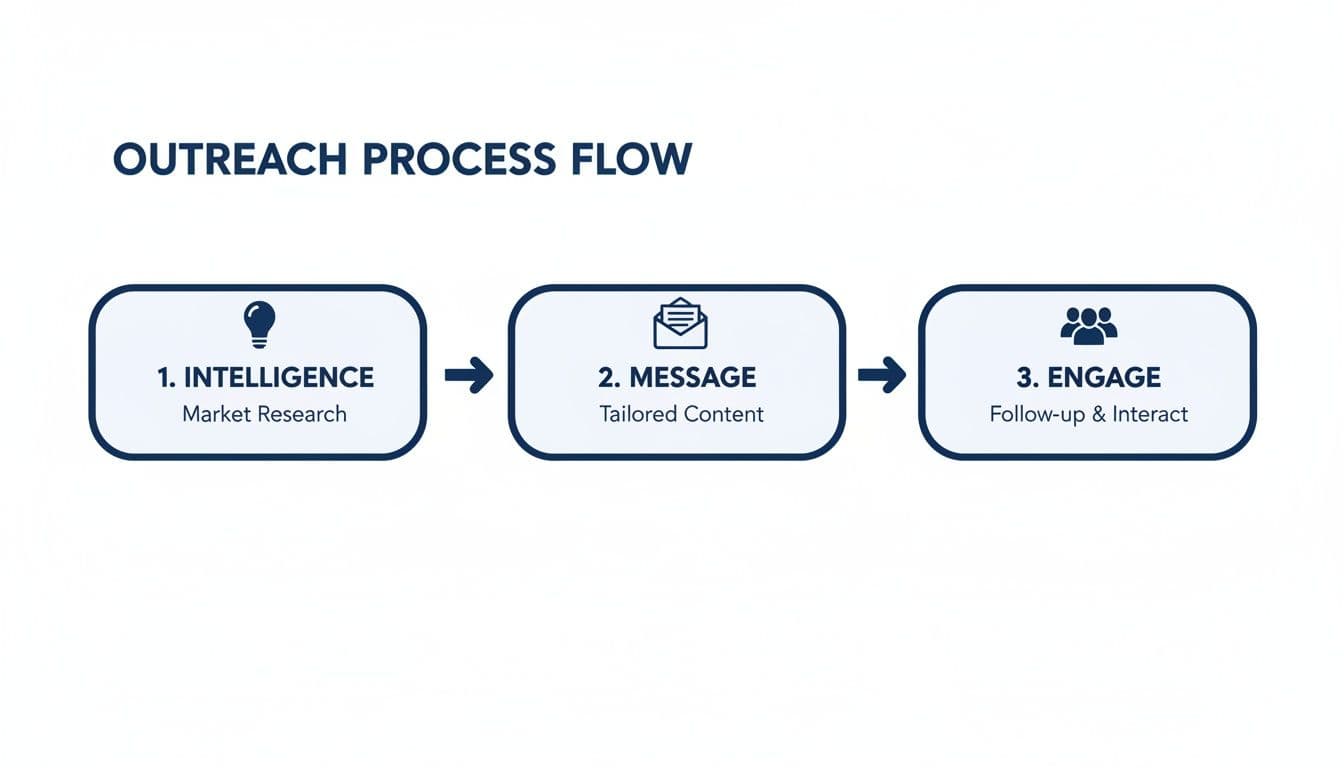
This visual breaks it down perfectly. You start with Intelligence (a key signal), build a relevant Message, and then Engage to kick off a meaningful dialogue.
Building Your Core Tech Stack
Your stack needs a central hub, and that's your CRM. It’s your system of record. From there, you layer on tools for intelligence and engagement to create a closed-loop process.
-
CRM (e.g., Salesforce, HubSpot): This is the foundation where your target account lists, contact data, and deal history live. Every other tool should feed data into and pull data from your CRM to maintain a single source of truth.
-
Account Intelligence Platform (e.g., Salesmotion): Think of this as your "always-on" monitoring layer. It automates manual research, tracks your target accounts for critical signals, and pushes actionable insights directly to your reps where they work.
-
Sales Engagement Tool (e.g., Outreach, Salesloft): This is your execution engine. Once a rep gets a signal, this platform helps them enroll contacts into personalized, multi-step sequences across email, phone, and social.
When these systems are properly integrated, the magic happens. A signal detected in your intelligence platform can automatically trigger a task in your CRM and suggest a specific outreach sequence in your sales engagement tool. This is how you scale relevance without burning out your team.
Defining KPIs That Actually Matter
Measuring the success of your TAM program means moving beyond vanity metrics like call volume and email opens. Sales leaders care about one thing: outcomes tied directly to revenue.
Focusing on the right KPIs is crucial for measuring success and justifying the investment. Getting the data and tech right is the biggest hurdle for 43% of marketers. While only 25% of companies have a mature tech stack for this, the ones that do report a 40-60% drop in research time. And with 66% of teams measuring success by revenue growth, your KPIs have to prove the ROI.
Here are the four core metrics that should be on every TAM dashboard:
Account Engagement Score
This isn’t about one person clicking an email. It’s a holistic score that measures interaction across an entire target account. Are multiple stakeholders from the buying committee engaging with your content, visiting your site, or responding to outreach? A rising score means you're successfully penetrating the account.
Pipeline Velocity in Target Accounts
How fast are deals moving from first touch to closed-won within your target list? A healthy pipeline velocity shows that your signal-based outreach is creating qualified opportunities that don't get stuck in the sales cycle. Compare this to your non-target accounts—the difference is often striking.
Win Rate in Target Accounts
This one is straightforward but critical. What percentage of your opportunities within your target account list are you winning? A high win rate here is the ultimate validation that you're focusing on the right accounts with the right message at the right time.
If your win rate on target accounts isn't significantly higher than your baseline, it's a clear signal. You either need to revisit your ICP and account selection or overhaul your outreach playbooks.
Average Contract Value (ACV)
Finally, are the deals you're closing from your target accounts bigger than your average deal? A successful program doesn’t just win more deals; it wins bigger deals. An increasing ACV demonstrates that you're effectively communicating value and landing accounts with greater revenue potential. For a deeper analysis, check out our guide on the most important account-based marketing metrics.
By building a simple dashboard around these four KPIs, you can clearly communicate the impact of your target account program and continuously refine your strategy.
Key Takeaways
- Target account management replaces high-volume, spray-and-pray prospecting with a focused, intelligence-driven approach that aligns sales, marketing, and customer success around your highest-value accounts.
- Building a modern Ideal Customer Profile requires layering firmographics with technographics, buying intent signals, and strategic fit data to create a multi-dimensional view of your best targets.
- A three-tier account structure ensures your team dedicates roughly 70% of resources to Tier 1 accounts, 20% to Tier 2, and 10% to Tier 3, creating a clear framework for prioritization.
- The strongest outreach is triggered by real-time buying signals like executive moves, funding rounds, and strategic initiative announcements rather than generic cold outreach.
- Multi-threading across the buying committee is essential because relying on a single champion creates a single point of failure that can kill any deal.
- Track account engagement scores, pipeline velocity, win rates, and average contract value in target accounts to prove the ROI of your TAM program and continuously refine your strategy.
How Do You Turn All This Into Revenue?
Let's pull it all together. A solid Target Account Management program isn't a one-off campaign; it's a strategic discipline. It's about getting your entire revenue organization—from marketing and sales to customer success—rowing in the same direction, focused on your most valuable customers and prospects.
When you shift from manual research to automated, signal-driven intelligence, you build an engine for predictable growth. Selling transforms from a game of chance into a game of strategy. It stops being about who you know and starts being about what you know and when you know it.
The core takeaway is simple: TAM allows your team to stop wasting energy on low-potential leads. Instead, they can focus their skills where it matters most—closing bigger deals, faster, with accounts that are a perfect fit.
With the right framework, tools, and mindset, your team can move beyond generic messaging. They can engage buyers with timely, relevant insights that prove you've done your homework and understand their business.
This isn't just a better way to sell; in a competitive market where context is everything, it's the only way to win. This is how you turn strategy into measurable revenue.
Got Questions? We've Got Answers
Shifting to a more focused sales strategy always brings up questions. Here are some of the most common ones we hear from teams building out their own target account management program.
What's The Difference Between TAM and ABM Anyway?
This one comes up all the time. Think of it this way: Target Account Management (TAM) is the overarching sales strategy, while Account-Based Marketing (ABM) is the marketing engine that powers it.
TAM is the sales-led discipline of choosing, prioritizing, and planning how to engage a specific list of high-value accounts. It answers the question: who are we going after?
ABM is the marketing team's answer. They take the who from sales and build highly personalized campaigns, content, and experiences for those accounts. In short, TAM sets the targets, and ABM executes the marketing plays to help win them. They're two sides of the same coin.
How Do I Get My Sales Team to Actually Buy In?
Getting your reps on board is everything. It boils down to answering their favorite question: "What's in it for me?" You have to frame target account management as the straightest line to hitting their quota.
Here’s how to make the case:
- Less grunt work. You're swapping hours of manual research for automated, actionable intelligence. That means less time digging and more time selling.
- Better conversations. Show them how signal-based outreach leads to warmer, more relevant conversations from the very first touchpoint. This makes their job more engaging and effective.
- Bigger commission checks. Be direct. Connect the dots between focusing on a curated list of high-value accounts and closing bigger deals. A higher Average Contract Value (ACV) is the most convincing argument you can make.
Pro Tip: Start with a pilot program. Don't try to boil the ocean. Pick a small group of your most respected reps, give them the tools and a few solid plays, and then shout their early wins from the rooftops. Success is contagious.
How Can I Measure Success In The First 90 Days?
It's tempting to look at closed-won revenue right away, but that's a lagging indicator. In the first 90 days, focus on the leading indicators that prove the strategy is taking hold and building momentum.
Instead of just looking at the finish line, track these metrics to show you're on the right path:
- Account Engagement: Are you getting deeper into your key accounts? Track the number of new, relevant contacts you're engaging per target account. This shows if you're truly multi-threading.
- Meeting Conversion Rate: Of your initial outreach to target accounts, what percentage turns into a qualified meeting? This is a direct measure of your messaging quality.
- Pipeline Creation: How much new, qualified pipeline have you generated specifically from your tiered target account list? This is the clearest sign that your focus is paying off.
Ready to stop guessing and start engaging your top accounts with purpose? Salesmotion is the account intelligence platform that delivers actionable insights and turns signals into revenue. See how Salesmotion can transform your target account management strategy.
Frequently Asked Questions
What is the difference between target account management and account-based marketing?
Target account management is the overarching sales strategy of selecting, prioritizing, and planning how to engage a curated list of high-value accounts. Account-based marketing is the marketing engine that supports that strategy by creating personalized campaigns, content, and experiences for those same accounts. TAM sets the targets and strategy, while ABM executes the marketing plays to help win them.
How many accounts should be on a target account list?
The right number depends on your team size and the complexity of your sales cycle, but a focused list of 50 to 100 accounts per team is a strong starting point. For individual account executives, 10 to 25 accounts ensures the depth of research and personalization that target account management requires. A bloated list of hundreds of accounts will dilute your team's focus and push you back toward a volume-based approach.
What is multi-threading and why does it matter in TAM?
Multi-threading is the practice of building relationships with multiple stakeholders across a target account's buying committee rather than relying on a single champion. It matters because a single point of contact is a single point of failure; if that person leaves the company or shifts priorities, your entire deal can collapse. Engaging decision-makers, influencers, and end users simultaneously builds broader consensus and dramatically improves your odds of closing.
How do I measure the success of a target account management program?
Focus on four core metrics: account engagement score, pipeline velocity within target accounts, win rate on target account opportunities, and average contract value. These KPIs directly tie your focused efforts to revenue outcomes and show whether your strategy is working. If your win rate on target accounts is not significantly higher than your baseline, it signals a need to revisit either your account selection or your outreach playbooks.
What buying signals should I track for target accounts?
The most valuable signals vary by industry, but universally powerful ones include executive moves, funding rounds, strategic hiring surges, and public announcements of new initiatives. For SaaS targets, watch for product launches and ARR milestones. For manufacturing, track plant expansions and capital investments. The key is to focus on signals that indicate new budget, new leadership mandates, or strategic shifts that create an immediate need your solution can address.