Tiering your sales accounts is a method for categorizing customers based on their potential value to your business. This isn't just about making neat lists; it's a framework to help your team focus its most precious resource—time—on the accounts that will actually move the needle. You're shifting from a generic, one-size-fits-all approach to a smarter, more targeted sales motion.
Why Account Tiering Is Your Sales Team's Secret Weapon
Let's be honest: not all accounts are created equal. In a world where every minute counts, your sales team's biggest challenge isn't a lack of leads, but a lack of focus. Spreading effort thinly across every name in the CRM is a surefire recipe for missed quotas and burnt-out reps.
This is where a structured approach to tiering your accounts becomes a game-changer. Some prospects have the potential to become million-dollar partners, while others might only make a small, one-time purchase. Account tiering gives you a clear way to tell the difference, leading to a much more intelligent allocation of your team's energy.
Shifting from Reactive to Proactive Sales
Without a tiering system, reps naturally gravitate toward the "loudest" accounts—the ones who reply to emails quickly or are constantly raising their hands. It’s human nature. But this reactive mode means your most strategic, high-value targets might be getting ignored simply because they're busy running their own businesses.
By implementing tiers, you flip this dynamic. It forces a proactive strategy where your best reps dedicate their prime selling hours to nurturing the accounts with the highest revenue potential, not just the ones making the most noise.
Account tiering is more than just organizing a list; it's a fundamental shift in sales philosophy. It empowers your team to move from being order-takers to strategic partners who invest their time where it will generate the greatest return.
Core Benefits of Effective Account Tiering
A well-defined tiering model brings clarity and efficiency to your entire sales organization. The table below breaks down the key advantages, but it all comes down to focus and smarter execution.
| Benefit | Impact on Sales Operations |
|---|---|
| Smarter Resource Allocation | Focus your top sales talent on high-touch, personalized engagement for Tier 1 accounts. |
| Increased Sales Velocity | Shorten sales cycles by concentrating on best-fit accounts that see your value faster. |
| Enhanced Personalization | Justify and scale deep personalization for top accounts, a core tenet of effective account-based selling. |
| Tighter Sales & Marketing Alignment | Get both teams focused on the same high-value targets for synchronized, impactful campaigns. |
Ultimately, a tiered approach ensures your highest-value accounts receive more personalized sales engagement while lower tiers are addressed with scalable, tech-driven efforts. As teams are constantly pressed to 'do more with less,' this focused effort leads directly to a healthier pipeline and more predictable revenue growth. It's a foundational strategy in modern Account-Based Marketing (ABM) for a reason. For more on this, check out the great resources over on Demandbase.com.
See Salesmotion in action
Take a self-guided interactive tour — no signup required.
Building Your Tiering Framework From the Ground Up
Let's move from the "why" to the "how." A great tiering framework isn't built on gut feelings; it's built on solid data. The goal is to create a system that your team understands, trusts, and uses to decide where to spend their time.
The foundation rests on one thing: a crystal-clear Ideal Customer Profile (ICP). This needs to be a detailed profile that becomes the gold standard for your Tier 1 accounts—the absolute best-fit customers who get the most from you and, in return, give you the most value.
Defining Your Core Tiering Criteria
To build a useful ICP, you have to blend different types of data. A common mistake is relying on just one or two data points, which often leads to a flawed list. You need a more complete picture.
We recommend combining these three crucial categories:
- Firmographics: These are the basics, your non-negotiables. Think company size, annual revenue, industry, and geography. It's your first filter to weed out companies that are obviously not a good fit.
- Technographics: What’s in their current tech stack? Knowing what tools an account already uses can tell you a lot. It might reveal compatibility with your solution, highlight specific pain points you can solve, or signal that they’re ready to invest in new tech.
- Engagement Signals: This is where the data gets interesting. How are these accounts interacting with you? Track everything—website visits, content downloads, webinar attendance, email opens. High engagement is one of the strongest indicators of active interest.
When you bring these data points together, you get a multi-dimensional view of each account. A company that fits your firmographic and technographic profile and is lighting up your engagement reports? That’s a prime candidate for Tier 1. This data-driven approach removes the guesswork and gets your whole team aligned on what a top-tier target truly looks like. You can see how this thinking feeds into your broader go-to-market plan by exploring different target account planning strategies.
This simple diagram shows how the process works in practice, taking you from a massive list of potential accounts to a focused set of targets.
As you can see, your tiering criteria act as the essential filter, turning a sea of accounts into a manageable group where your sales team can focus their efforts.
Structuring Tiers 2 and 3
Once you've locked in your Tier 1 definition based on that solid ICP, figuring out the other tiers becomes much more straightforward.
Tier 2 accounts are your high-potential targets. They look pretty good, fitting most of your ICP criteria but not all of them. Or perhaps their engagement is just starting to warm up. These accounts represent serious future opportunities and deserve a balanced approach of personalized outreach and more scalable tactics.
Tier 3 is your broadest bucket. These accounts meet your basic qualifications but have lower immediate revenue potential or strategic value. Engagement here needs to be efficient, often driven by marketing automation to nurture them over time until they show stronger buying signals.
As you build this out, think about how it all connects with your overall sales strategy, including developing a winning sales rep territory plan. A simple three-tier model like this provides all the clarity you need to execute effectively without overcomplicating things.

“There's been a big focus on hyper personalization and relevance in our outbounding efforts. Salesmotion has been a key partner in hitting our significantly increased meeting targets. What stands out is how simple it is. Reps can log in and get valuable account insights within 30 seconds to a minute.”
Joe DeFrance
VP of Sales, Incredible Health
Crafting Your Sales Plays for Each Tier
So, you’ve defined your tiers. Great. But a tiering model is just a list until you attach specific actions—or "plays"—to each category. This is where the strategy becomes a concrete action plan for your sales team. Without it, reps are left guessing, which defeats the purpose of tiering. The goal is to create a clear, repeatable process that aligns your best resources with your biggest opportunities.
Tier 1 Plays: High-Touch and Highly Personalized
Your Tier 1 accounts are your crown jewels. They represent the highest revenue potential and are a perfect match for your ICP. The sales plays here are all about depth, personalization, and building strategic, executive-level relationships. Think of it as a "white-glove" service.
- Executive Alignment: The goal is to build relationships at the top. This means your own executives should be involved, reaching out to their counterparts. A C-level to C-level connection can open doors that reps can't.
- Custom Proposals and ROI Models: Generic sales decks won't cut it. Each proposal should be a bespoke document, complete with a custom ROI model built from the account's specific financial data and strategic goals.
- On-Site Visits and Workshops: Investing face time is critical. Plan strategic on-site visits or collaborative workshops to show your commitment and understand their business on a deeper level.
The rule for Tier 1 is simple: do things that don't scale. The potential return on these accounts justifies a significant, hands-on investment from your most experienced sellers.
Tier 2 Plays: A Balanced Approach
Tier 2 accounts are your rising stars. They have strong potential but might not warrant the same all-out resource blitz as Tier 1. The key here is to blend personalization with efficiency, creating a smart "one-to-few" approach.
For these accounts, you’re aiming for meaningful engagement without the deep customization reserved for the top tier. It's about finding the sweet spot between a fully automated process and a fully manual one. You can get ideas for structuring these actions from various sales playbook examples that show how to build repeatable yet effective engagement sequences.
Here are a few effective plays for Tier 2 accounts:
- Industry-Specific Webinars: Invite small, curated groups of Tier 2 accounts from the same industry to a private webinar that tackles their unique challenges.
- Personalized Video Outreach: A quick, personalized video message from a rep can cut through the noise of standard email cadences and make a real connection.
- Targeted Content: Send them high-value content that speaks directly to their pain points, like case studies from similar companies or relevant industry reports.
Tier 3 Plays: Efficiency Through Automation
Tier 3 is your largest group of accounts. While they meet your basic criteria, the immediate revenue potential is lower. For this tier, the name of the game is efficiency. The goal is to nurture these accounts at scale until they show stronger buying signals.
Your marketing team is your best friend here. Lean on automation to maintain a presence and provide value without draining sales resources.
- Automated Nurture Campaigns: Use your marketing automation platform to send a steady stream of relevant content, like newsletters and blog posts, keeping you top-of-mind.
- Digital Advertising: Target Tier 3 accounts with programmatic ad campaigns to build brand awareness over time.
- Broad Event Invitations: Invite them to your larger-scale webinars or virtual events designed for a wider audience.
To help visualize how this all comes together, here's a simple table outlining what these different plays look like in practice.
Sample Sales Plays by Account Tier
| Account Tier | Primary Goal | Example Sales Plays | Resource Intensity |
|---|---|---|---|
| Tier 1 | Strategic Partnership & Maximum Revenue | Executive-to-executive mapping, custom ROI modeling, on-site strategy workshops, bespoke proposals. | Very High |
| Tier 2 | Nurture High Potential & Drive Growth | Industry-specific webinars, personalized video outreach, targeted case studies, semi-custom proposals. | Medium |
| Tier 3 | Maintain Awareness & Identify Signals | Automated email nurtures, programmatic advertising, invitations to large-scale events, digital content. | Low |
By defining these distinct plays, you create incredible clarity for your team. Reps know exactly how to prioritize their day, ensuring their time is spent on activities that will generate the biggest impact.
The Future of Account Tiering with AI
Manual tiering gets the job done, but it’s a snapshot in time. It's often built on static rules and historical data that can become stale the moment you finalize the spreadsheet. That’s why savvy sales organizations are using technology to build more dynamic, accurate, and predictive tiering models.
The future of tiering accounts in sales isn't about letting robots take over. It's about giving your team superpowers. AI and machine learning can analyze massive datasets to spot hidden patterns and predict future buying behavior with startling accuracy.
Moving Beyond Static Rules
One of the biggest headaches with traditional tiering is the constant churn. An account rockets into Tier 1, only to get demoted a few months later. This shuffling creates whiplash for the sales team and disrupts focus.
AI-driven models offer a more stable alternative.
Take Microsoft's next-generation customer tiering system. They built a hybrid model that blended four key performance indicators into a single score. The result? They cut their account reassignment volatility down to just ~5%, a huge improvement over the 20-40% churn they saw with older methods. You can read more about Microsoft's advanced tiering system to see how they created more stability and confidence across their sales org.
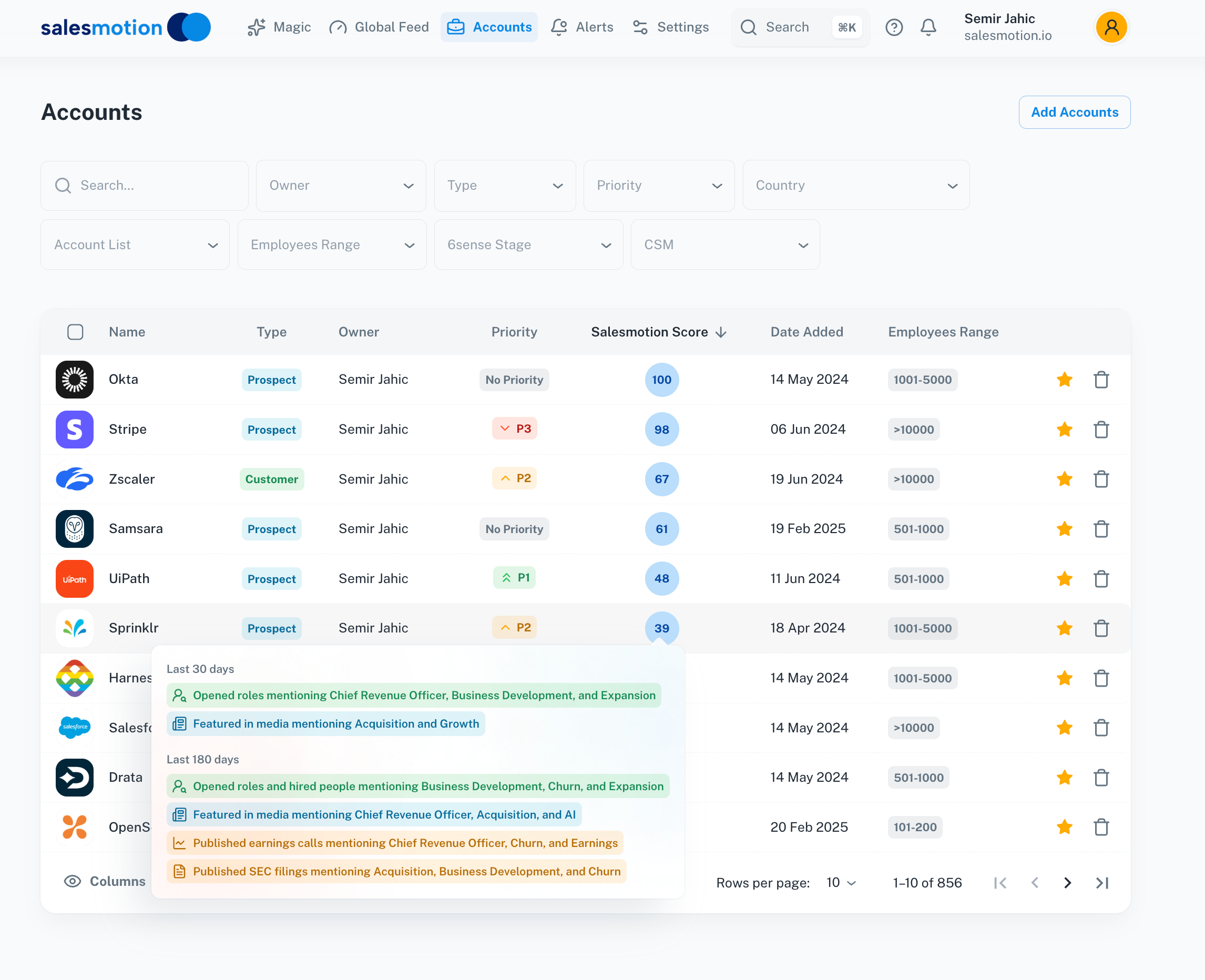 An AI-driven scoring model ranks accounts by combining real-time signals with ICP fit — automatically surfacing which targets belong in Tier 1 right now.
How AI Enhances Account Scoring
So, how does this work? AI-powered platforms don't just look at firmographics. They create a living score for each account by continuously analyzing a huge range of buying signals.
These systems are always monitoring data points like:
- Financial Performance: Tracking earnings calls, SEC filings, and financial reports to see an account's health and investment priorities.
- Strategic Shifts: Picking up on new initiatives or leadership changes from press releases, industry news, and executive interviews.
- Growth Indicators: Analyzing job postings for key roles that signal expansion into new markets or product lines.
By processing this information 24/7, AI can instantly flag accounts that are showing strong "why now" signals, automatically bumping up their priority. This means your reps are always aimed at accounts with the highest propensity to buy right now. For a deeper look, check out our guide on using AI in sales.
AI transforms account tiering from a quarterly planning exercise into a real-time strategic advantage. It ensures your team's effort is perpetually aligned with the accounts that have the highest probability of closing.
Ultimately, this intelligent approach makes tiering accounts in sales far more sophisticated. It takes the guesswork out of the equation, minimizes human bias, and makes sure your sales efforts are always pointed at the most promising opportunities as they emerge.

“This is my singular place that very simply summarizes a company's top initiatives, strategies and connects them to my solution. Something I would spend hours researching manually, now it's automated.”
Derek Rosen
Director, Strategic Accounts, Guild Education
Common Tiering Pitfalls and How to Avoid Them
Rolling out an account tiering system is a huge step, but it's not a magic bullet. Even the best-designed frameworks can fall flat if you’re not watching out for common traps. Success often comes down to knowing what can go wrong before it does.
One of the biggest mistakes is the "set it and forget it" mindset. Your market, your accounts, and your company goals are always in motion. A tiering model built in January is probably stale by June, leaving your reps chasing targets based on outdated assumptions.
Another killer is bad data. If your CRM is a mess of inaccurate or incomplete information, your entire tiering structure is built on quicksand. This leads to flawed segmentation, where your best potential accounts are mistakenly tossed into lower tiers and ignored.
The Dangers of a Static Model
Your tiering framework has to be a living system, not a static spreadsheet you dust off once a year. When tiers get stale, you miss important buying signals. An account in Tier 3 might suddenly land a new round of funding or hire an executive who was your champion at their last company. Miss that, and you miss the deal.
To prevent this, you need a regular review cadence.
- Quarterly Re-evaluation: At a minimum, your sales and marketing leadership should get together every quarter to review the tiering criteria and account placements.
- Monthly Spot Checks: Sales managers should look at their team’s top accounts every month to catch any big changes in engagement or company status.
Don't let your tiering model become a historical artifact. Build a process for regular updates so it reflects what’s happening in the market right now. This keeps your sales team aimed at the right targets.
Overcoming Bad Data and Winning Over Your Team
Even with a great review process, garbage data will always give you garbage results. Inaccurate firmographics or zero engagement tracking means your segmentation is little more than a wild guess. You have to get serious about data hygiene to keep your CRM trustworthy.
Finally, a tiering system forced on a sales team without their input is dead on arrival. Reps will naturally push back against a framework they don’t understand or believe in. The secret to getting them on board is co-creation.
Bring your top-performing reps into the room when you’re defining the tiering criteria and sales plays. When they help build the system, they own it. Show them how this new focus helps them close bigger deals faster, and they won't just adopt it—they'll become its biggest champions.
Key Takeaways
- Account tiering is a strategic framework that categorizes accounts by potential value, ensuring your best reps spend their time on the highest-opportunity targets.
- A strong Ideal Customer Profile (ICP) built on firmographics, technographics, and engagement signals is the foundation of an effective tiering model.
- Each tier requires distinct sales plays: Tier 1 gets high-touch, personalized engagement; Tier 2 gets a balanced blend; and Tier 3 relies on efficient automation.
- AI and machine learning are transforming tiering from a static, quarterly exercise into a dynamic, real-time strategic advantage that continuously reprioritizes accounts.
- Common pitfalls include treating tiers as static, relying on bad CRM data, and failing to involve sales reps in building the framework.
Your Questions on Account Tiering Answered
Even with a clear strategy, you're going to have questions when you start putting account tiering into practice. Let's tackle some of the most common ones.
How often should we update our account tiers?
Your tiers should never be set in stone. The market changes, new data comes in, and your strategy evolves.
A full review every quarter is a great rhythm to start with. Think of it as a routine health check for your sales focus. This keeps your tiers aligned with reality.
However, if you’re in a fast-moving market, don't wait three months. A quick monthly check-in on just your Tier 1 accounts can be a game-changer, letting you jump on emerging opportunities before your competition.
Treat your tiering model as a living document, not a project you set and forget. A tiering model is only valuable when it reflects current reality. Stale tiers lead to missed opportunities.
What is the ideal number of tiers?
You could slice your accounts into a dozen tiers, but that’s usually a mistake. For most B2B sales teams, a three-tier model is the sweet spot. It strikes the perfect balance between useful segmentation and something your reps can actually use.
This structure is simple enough for everyone to get behind:
- Tier 1: The absolute best-fit, highest-value accounts.
- Tier 2: High-potential targets that are a strong fit, but maybe not perfect... yet.
- Tier 3: The broader market, which gets a more automated, scalable approach.
Start with three. Only add more layers if you have a rock-solid business case for it.
How do we get sales reps to actually use the tiers?
This is the big one. Getting reps to adopt any new process comes down to two things: involvement and value. If your team sees this as just another administrative task, they’ll ignore it.
First, get them involved from the start. Pull your top reps into the room when you’re defining the tiering criteria. Ask for their input on what makes a great account and what sales plays would actually work. This creates a sense of ownership.
Then, you have to sell them on the "what's in it for me." Show them—don't just tell them—how this focus helps them cut through the noise, spend time on deals that are more likely to close, and ultimately, hit their number faster.
When reps see that tiering accounts in sales directly helps them win, adoption becomes a non-issue.
Stop wasting time on manual research and start focusing on what matters—closing deals. Salesmotion provides real-time, AI-powered intelligence on your target accounts, delivering structured insights directly into your workflow so your team is always ready for the next conversation. See how you can increase your pipeline.
Frequently Asked Questions
What is account tiering in sales?
Account tiering is a method of categorizing your sales accounts into groups based on their potential value to your business. It creates a structured framework that tells your team exactly how to allocate time, energy, and resources across different accounts. The most common approach uses three tiers: Tier 1 for your best-fit, highest-value accounts, Tier 2 for strong contenders, and Tier 3 for the broader market that receives more automated engagement.
What data should I use to tier my accounts?
Effective account tiering combines three key data categories: firmographics (company size, revenue, industry, geography), technographics (their current tech stack and tools), and engagement signals (website visits, content downloads, email opens, and webinar attendance). Using only one or two data points leads to a flawed list, so layering all three creates a multi-dimensional view that accurately reflects each account's true potential and buying readiness.
How do sales plays differ across account tiers?
Tier 1 accounts receive high-touch, highly personalized engagement including executive alignment, custom ROI models, and on-site visits. Tier 2 accounts get a balanced approach with industry-specific webinars, personalized video outreach, and targeted content. Tier 3 accounts rely on efficient, automated tactics like nurture campaigns, programmatic advertising, and broad event invitations. Matching your sales effort to the tier ensures your most valuable accounts get the attention they deserve.
How often should account tiers be reviewed and updated?
A full review every quarter is a solid starting point, treating it as a routine health check for your sales focus. If you are in a fast-moving market, a quick monthly spot check on Tier 1 accounts can help you catch emerging opportunities before competitors do. The key is to never treat your tiers as static; an account in Tier 3 might suddenly land new funding or hire an executive who was your champion elsewhere, warranting an immediate promotion.
How does AI change the way accounts are tiered?
AI transforms tiering from a static, quarterly exercise into a dynamic, real-time strategic advantage. AI-powered platforms continuously analyze buying signals like financial performance, strategic shifts, growth indicators, and job postings to create a living score for each account. This means accounts showing strong "why now" signals are automatically bumped up in priority, ensuring your reps are always aimed at the accounts with the highest propensity to buy right now.
How do I get my sales team to actually follow the tiering system?
Adoption comes down to two factors: involvement and demonstrated value. Pull your top reps into the room when defining tiering criteria and sales plays so they feel ownership over the system. Then show them how the focused approach helps them close bigger deals faster and hit their numbers more consistently. When reps see that tiering directly improves their results, adoption becomes a non-issue.