When I was at Salesforce, "sales intelligence" meant a ZoomInfo license and a prayer. The category has exploded since then — there are now 50+ sales intelligence tools claiming to give your reps an edge. Most of them are just contact databases with a fresh coat of AI paint. A few actually change how your team sells. I've spent the last decade buying, evaluating, and eventually building in this space, so here's my honest breakdown of the 12 that matter most.
Quick Summary: For contact databases, ZoomInfo and Apollo dominate. For conversation intelligence, Gong leads. For intent data, 6sense and Bombora. For deep account research and proactive buying signals, Salesmotion is purpose-built. LinkedIn Sales Navigator remains essential for relationship mapping across all categories.
TL;DR: B2B sales intelligence tools turn scattered signals -- leadership changes, funding news, hiring surges -- into a clear reason for your reps to reach out. This guide compares 12 leading platforms so you can find the right fit for your team size, budget, and sales motion.
Why Trust This Guide?
I'm Semir Jahic, CEO of Salesmotion. I've been selling, evaluating, and building sales intelligence tools for over a decade — from Salesforce to Clari to founding Salesmotion. I've sat on both sides of the table: as a seller choosing tools for enterprise sales teams, and as a builder creating one.
This guide comes from real experience. We work with teams at companies like Analytic Partners (40% pipeline increase), Frontify (42% sales velocity boost), and Cytel (50% less research time) who've tested many of these tools. Salesmotion is on this list because account intelligence is our category, but we'll tell you exactly when a different tool is the better fit.
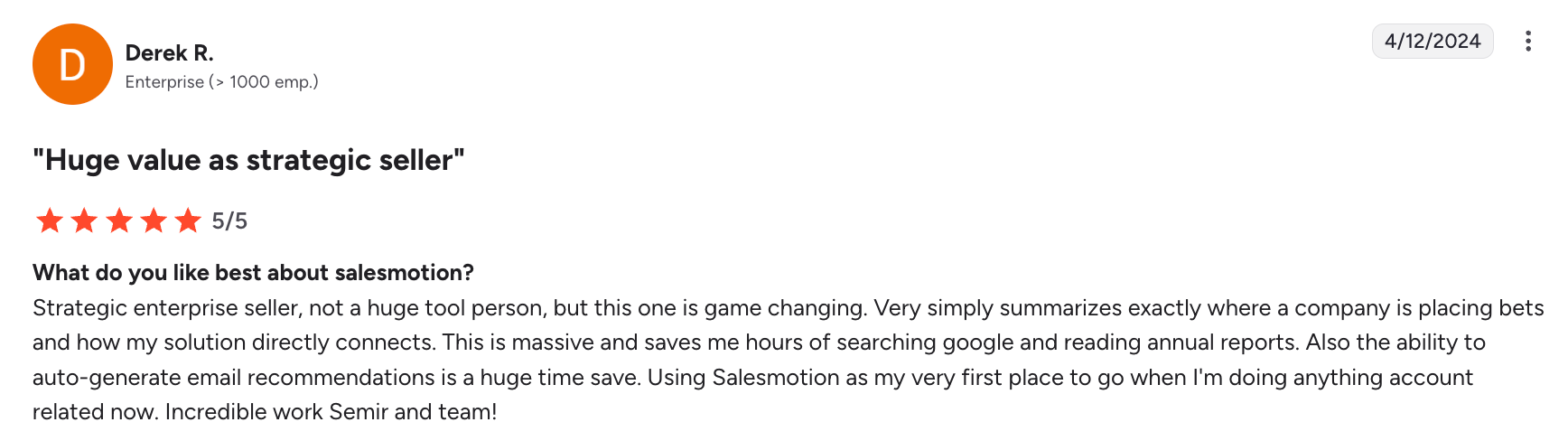 Real G2 review from an enterprise seller. We base our recommendations on years of selling and buying these tools, not just reviewing marketing pages.
B2B sales intelligence tools are no longer a luxury; they're the engine of modern selling. They turn scattered data—like leadership changes, funding news, or new company goals—into a clear, actionable reason for your team to reach out. This allows for personalized outreach that actually connects. To see how this fits into a broader strategy, check out these B2B lead generation best practices.
This guide cuts through the marketing fluff to give you a straight look at the 12 best platforms. We'll break down who each tool is for, its key strengths, and its potential downsides. You'll find detailed analysis, screenshots, and direct links for each tool, from powerhouses like ZoomInfo to agile solutions like Apollo.io.
Our goal is simple: to help you choose the right platform for your needs, whether you're an SDR, a sales leader, or a RevOps pro. By the end, you'll have the clarity you need to equip your team, stop guessing, and start selling with precision.
See Salesmotion in action
Take a self-guided interactive tour — no signup required.
1. Salesmotion
Salesmotion is an AI-powered account intelligence platform designed to turn scattered account activity into actionable, sales-ready context. Instead of just giving you static contact lists, it acts as a constant monitoring system for your key accounts, delivering the crucial "why now" for your outreach. The platform scans over 1,000 public sources—news, earnings calls, job postings, and LinkedIn activity—to spot meaningful buying signals in real time.
This continuous monitoring powers its standout feature: AI-generated account briefs, points of view (POVs), and talking points. For sales teams, this automates a process that used to be a time-consuming manual chore. The result is a huge reduction in prep time, letting reps focus on selling with relevance. For example, customer Guild Education reported saving its sellers about six hours per week, while Incredible Health increased their meetings booked by 50% after implementing it.
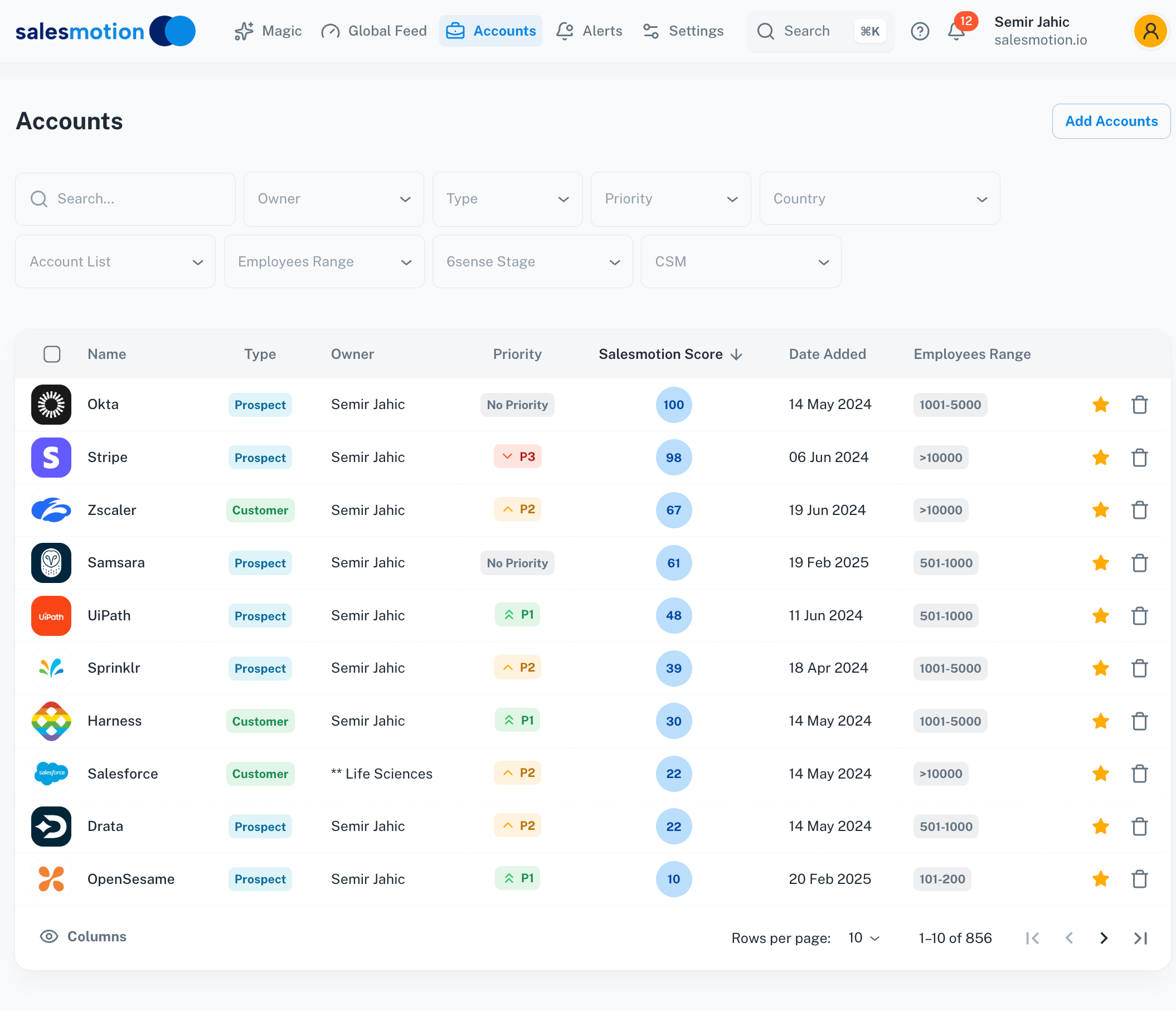 Salesmotion's account dashboard — scored accounts with AI-generated briefs, buying signals, and one-click research.
Key Features:
- Always-On Signal Monitoring. Automatically track key accounts for trigger events like leadership changes or new strategic initiatives. This helps AEs prioritize high-opportunity accounts at the perfect moment.
- AI-Generated Sales Context. The platform doesn't just find a signal; it explains why it matters. It provides a "so what" analysis and even drafts MEDDICC-aligned outreach, backed by source links to ensure every insight is verifiable.
- Seamless Workflow Integration. Insights are delivered directly into the tools your team already uses, including Slack, email, Salesforce, and HubSpot. This makes intelligence easy to use without disrupting existing workflows.
- Rapid Time-to-Value. Onboarding is fast. A basic setup takes about 10 minutes, and teams often see value within days, not months.
- Privacy-First Data Policy. Customer data is encrypted and not used for external AI model training.
Pricing: From $85/month for individuals. $990/month for teams with unlimited users. Month-to-month, no annual commitment. Enterprise plans available.
G2 Rating: 4.8/5 (reviews on G2)
Best for: Enterprise sales teams in industries like SaaS, financial services, and life sciences who need to scale personalized outreach and prioritize accounts with real buying intent.
✅ Pros
- Dramatically cuts weekly research time, freeing up sellers for revenue-generating activities.
- Surfaces timely, actionable buying signals from a wide array of public sources.
- Provides verifiable, source-backed insights to reduce the risk of AI "hallucinations."
- Integrates directly into CRM and communication tools, making insights accessible and actionable.
❌ Cons
- Focused on account intelligence rather than raw contact data — if you need a massive contact database, pair it with a tool like Apollo or ZoomInfo.
- Its effectiveness for companies with a small digital footprint depends on the volume of available public signals.
- Some integrations with specific sales engagement platforms are still on the roadmap.
Website: https://salesmotion.io
Salesmotion's Take
I built Salesmotion because I lived the intelligence gap at Salesforce and Clari. We're strong at proactive account intelligence — earnings analysis, buying signals, and research automation that no contact database delivers. If you need raw contact data at scale, ZoomInfo is the right call. If you need conversation intelligence, Gong is best in class. But if your reps are spending hours researching accounts before every meeting and still walking in underprepared, that's the problem we solve.

Semir Jahic
CEO & Co-Founder, Salesmotion

“Salesmotion empowers me to cultivate a great buyer experience. I'm able to challenge prospects' thinking and be a trusted consultative seller. A major part of this is Salesmotion insights.”
Austin Friesen
Account Executive, FY25 #1 President's Club, Clari
2. LinkedIn Sales Navigator
LinkedIn Sales Navigator taps into the world's largest professional network, turning its massive user base into a powerful B2B sales intelligence tool. Instead of relying on third-party data that can go stale, it uses information directly from the source, providing real-time updates and insights. This native integration lets sellers prospect, research, and engage without leaving the familiar LinkedIn ecosystem.
The platform is excellent at identifying and tracking key decision-makers. Its advanced search lets you filter prospects by over 50 criteria, including seniority, company size, and recent job changes. Sales teams can build and save dynamic lead lists that automatically update when prospects change roles—a crucial signal for new opportunities. For account-based strategies, its AI-powered Account IQ feature provides summaries and alerts on growth trends and key personnel shifts.
Key Features:
- Advanced Lead/Account Search. Filter prospects by over 50 criteria, including seniority, company size, and recent job changes to build highly targeted lists.
- Real-Time Job Change Alerts. Track when prospects and past champions change roles, surfacing warm entry points into new accounts.
- TeamLink. Reveals team connections across your organization, showing the best path to reach a prospect through existing relationships.
- AI-Powered Account IQ. Provides summaries and alerts on growth trends and key personnel shifts for target accounts.
- CRM Integrations. Syncs with Salesforce and Microsoft Dynamics 365 (advanced sync on higher tiers).
Pricing: Core ~$100/user/month, Advanced ~$150/user/month, Advanced Plus custom pricing (all annual billing).
G2 Rating: 4.3/5 (reviews on G2)
Best for: Sales teams of all sizes that rely on relationship-based selling and want to leverage real-time professional network data.
✅ Pros
- Access to a huge, self-updating professional network.
- Intuitive interface that most sellers are already familiar with.
- Native buying signals (like job changes) are highly accurate.
❌ Cons
- Advanced CRM sync is locked behind the highest, custom-priced tier.
- Data is limited to what users publicly share on their profiles.
Website: https://business.linkedin.com/sales-solutions
3. ZoomInfo SalesOS
ZoomInfo SalesOS is an enterprise-level B2B intelligence platform known for the sheer volume of its contact and company data. It has built its reputation on a massive, proprietary database that includes direct dials, verified emails, and detailed company information. This makes it a go-to resource for sales teams that need to quickly build targeted lists and identify key stakeholders.
Beyond static data, the platform offers dynamic intelligence like buyer intent signals, which track online research to flag accounts actively looking for solutions. It also provides website visitor identification and technographic data, revealing the tech stacks used by target companies. This mix of foundational contact data and advanced buying signals makes ZoomInfo a comprehensive solution for sophisticated GTM teams looking for powerful b2b sales intelligence tools. For more on this, read about B2B data enrichment here.
Key Features:
- Extensive Contact/Company Database. Massive, proprietary database with direct dials, verified emails, and detailed company information for quick list-building.
- Buyer Intent Data. Tracks online research to flag accounts actively looking for solutions, surfacing in-market buyers before they raise their hand.
- Website Visitor Tracking. Identifies anonymous website visitors and ties activity back to specific companies in your pipeline.
- Organizational Charts. Maps reporting structures and key stakeholders within target accounts.
- Technographics. Reveals the tech stacks used by target companies, enabling tech-based prospecting and competitive displacement plays.
- Scoops. Curated intelligence on funding events, M&A activity, and executive hires providing timely outreach triggers.
Pricing: Quote-based. Professional, Advanced, and Elite tiers with pricing based on user licenses and data credits. Intent and other modules typically sold separately.
G2 Rating: 4.4/5 (reviews on G2)
Best for: Enterprise and mid-market sales/marketing teams needing an all-in-one data provider with deep integrations into their CRM and marketing automation platforms.
✅ Pros
- Vast and generally accurate database of B2B contacts, including direct dials.
- Mature platform with a wide ecosystem of add-on products and deep integrations.
- Powerful intent and technographic data for advanced prospecting.
❌ Cons
- Pricing is not public and often requires a significant commitment with strict, multi-year contracts.
- The credit-based system can be confusing and lead to unexpected costs.
Website: https://www.zoominfo.com

“We have very limited bandwidth, but Salesmotion was up and running in days. The template made it easy to load our accounts and embedding it in Salesforce was simple. It was one of the easiest rollouts we've done.”
Andrew Giordano
VP of Global Commercial Operations, Analytic Partners
4. Apollo.io
Apollo.io has quickly become a favorite for startups and SMBs by bundling a massive B2B contact database with a full suite of sales engagement tools. Its core value is consolidation: it combines prospecting, sequencing, and a dialer into a single workflow. This all-in-one approach eliminates the need for multiple tools, making it easy for sales teams to quickly build a pipeline.
The platform’s strength is its seamless integration of data and action. Users can find verified contacts, enroll them in automated email and call sequences, and track engagement without leaving the Apollo ecosystem. This makes it an incredibly efficient solution for SDRs and full-cycle AEs who manage their own prospecting, positioning it as a powerful, cost-effective sales intelligence tool.
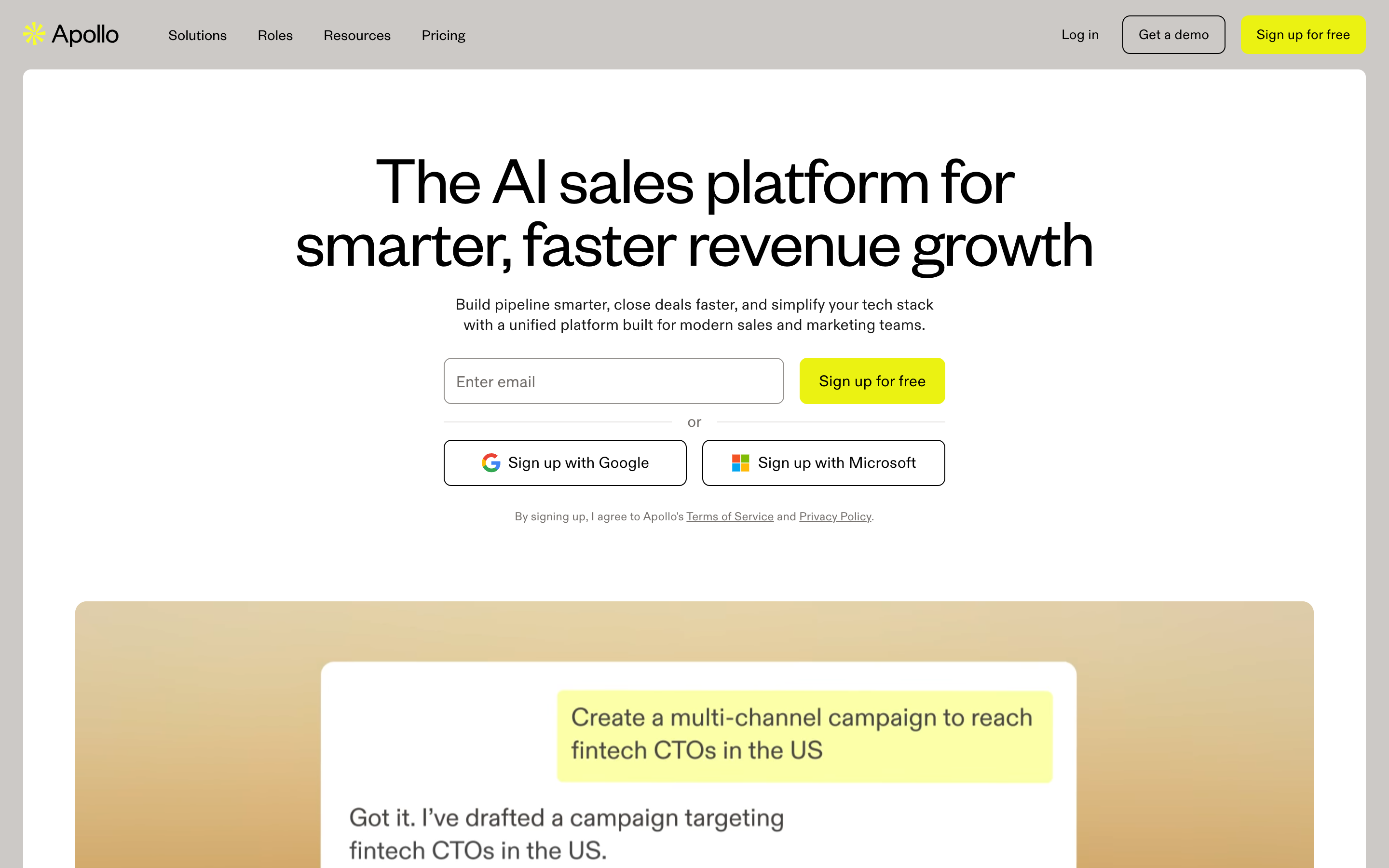 Apollo.io — AI-powered prospecting and engagement platform.
Key Features:
- B2B Database (275M+ Contacts). Massive contact database with verified emails and phone numbers for targeted list-building across industries and roles.
- Email/Call Sequencing. Build and launch automated multi-step outreach sequences combining email and calls from a single platform.
- Built-In Dialer. Call prospects directly from Apollo without switching to a separate tool, with call recording on higher tiers.
- Data Enrichment. Automatically enrich CRM records with firmographic, technographic, and contact data.
- Chrome Extension. View employee data and tech stack info on any company website and add prospects to sequences with one click.
Pricing: Free tier available. Basic ~$49/user/month. Professional ~$79/user/month. Organization ~$119/user/month.
G2 Rating: 4.7/5 (reviews on G2)
Best for: Startups, SMBs, and individual sales professionals who need an affordable, all-in-one platform for prospecting and engagement.
✅ Pros
- Excellent value, combining a large database with engagement tools at a low price.
- Generous free tier makes it highly accessible for new teams.
- All-in-one platform reduces tool sprawl and simplifies the sales stack.
❌ Cons
- The credit system for mobile numbers and data exports can get costly at scale.
- Contact data accuracy can be less consistent than more expensive providers.
Website: https://www.apollo.io
5. Cognism
Cognism positions itself as a premium B2B sales intelligence tool with a strong focus on data compliance and accuracy, especially in the EMEA market. Its key differentiator is a rigorous data verification process that provides sales teams with reliable direct-dial phone numbers and compliant email addresses. This includes features like scrubbing against global Do-Not-Call (DNC) lists, making it a go-to choice for teams doing heavy outbound prospecting across Europe and North America.
The platform's standout feature is its phone-verified "Diamond Data," a set of mobile numbers confirmed by a human research team. This significantly increases connect rates for SDRs, getting them past gatekeepers and directly to decision-makers. By focusing on high-quality, actionable contact info that respects GDPR and CCPA, Cognism helps revenue teams build pipeline confidently and efficiently.
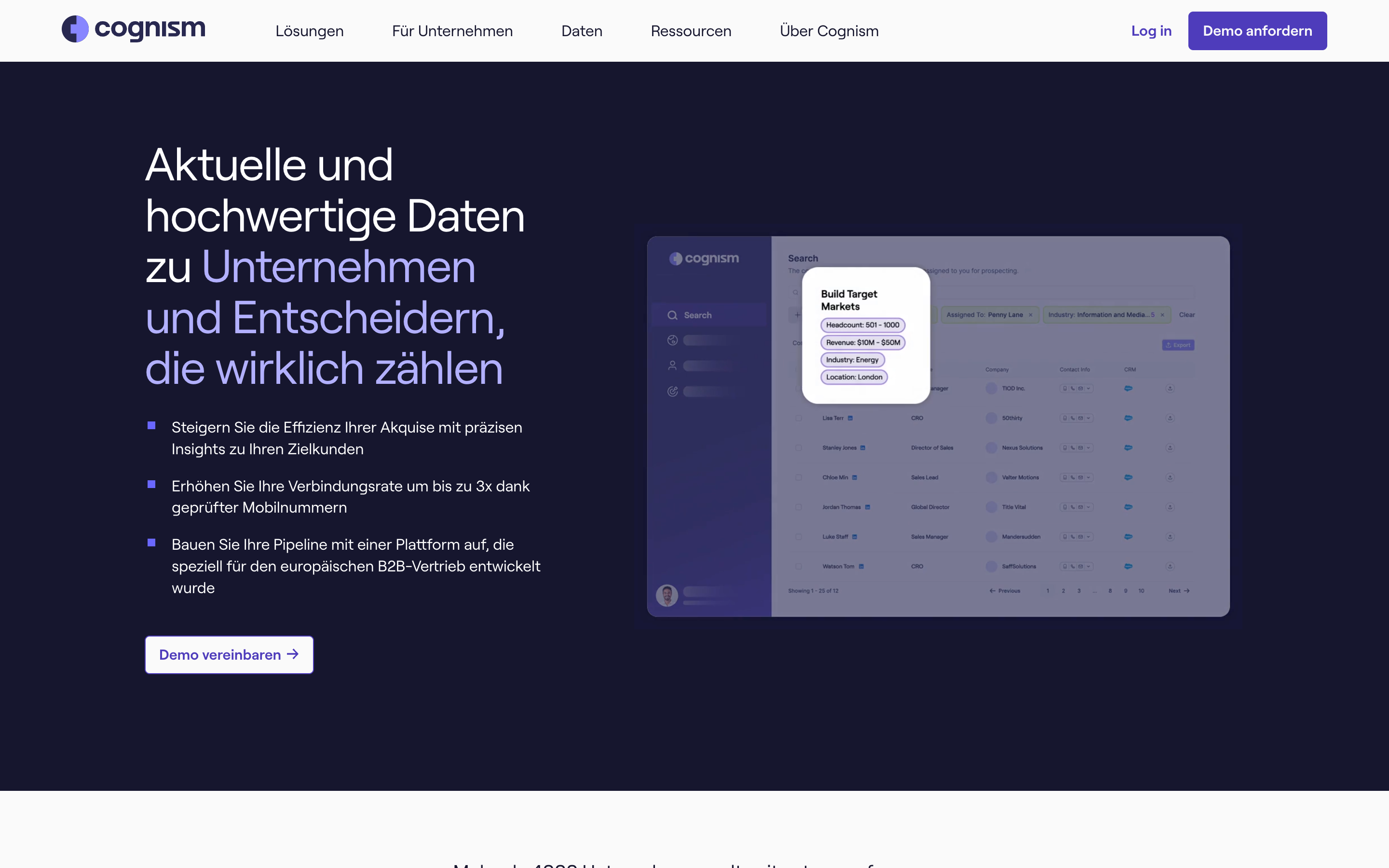 Cognism — premium B2B data with phone-verified contacts and GDPR compliance.
Key Features:
- Phone-Verified Diamond Data. Mobile numbers confirmed by a human research team, significantly increasing connect rates and getting reps past gatekeepers.
- DNC List Scrubbing. Automatically scrubs contacts against global Do-Not-Call lists, ensuring compliant outbound across regulated markets.
- Strong EMEA Data Coverage. Premium contact data for European markets where many US-centric providers fall short.
- CRM/SEP Integrations. Seamless connections with Salesforce, HubSpot, and Outreach for smooth workflow continuity.
Pricing: Quote-based. Varies by team size and data needs. Generally requires an annual commitment.
G2 Rating: 4.6/5 (reviews on G2)
Best for: Outbound sales teams that prioritize phone prospecting and need high-accuracy mobile numbers, especially those selling to the EMEA region.
✅ Pros
- High-quality, phone-verified mobile numbers significantly boost connect rates.
- Strong focus on GDPR/CCPA compliance gives peace of mind to global teams.
- Robust integrations ensure smooth workflow continuity.
❌ Cons
- No public pricing or free trial, requiring a sales conversation to evaluate.
- The price can be a significant investment, better suited for established teams.
Website: https://cognism.com
6. Demandbase One (Sales Intelligence)
Demandbase One shifts the focus from individual leads to entire buying accounts, making it a powerhouse for organizations using an Account-Based Marketing (ABM) strategy. It unifies sales and marketing intelligence by combining firmographic data, intent signals, and real-time website engagement. This creates a complete view of an account's journey, helping revenue teams prioritize the right accounts at the right time. Its core strength is identifying and mapping the entire buying committee within a target organization.
The platform is great at connecting anonymous website activity to specific accounts and scoring them based on their interest and fit. This lets sales teams move beyond guesswork and focus on accounts actively researching solutions like theirs. By providing deep context on who is engaged and what they care about, Demandbase One is one of the most effective B2B sales intelligence tools for orchestrating complex, multi-stakeholder enterprise deals.
Key Features:
- AI-Driven Account Prioritization. Scores and ranks accounts based on fit, intent, and engagement so revenue teams focus on the highest-opportunity targets.
- Buying Group Mapping. Identifies all relevant personas within a target account, enabling multi-threaded outreach to the entire buying committee.
- Cross-Channel Intent Data. Combines firmographic data, intent signals, and real-time website engagement to create a complete view of an account's journey.
- Website Engagement Tracking. Connects anonymous website activity to specific accounts and scores them based on interest and fit.
Pricing: Custom quote-based. Platform fee plus per-user fees, structured for mid-market to enterprise companies.
G2 Rating: 4.3/5 (reviews on G2)
Best for: Mature sales and marketing teams executing coordinated ABM strategies for complex sales cycles.
✅ Pros
- Provides deep, unified account context across both marketing and sales.
- Excellent for aligning revenue teams around high-priority accounts.
- Strong at identifying and tracking the entire buying committee in complex deals.
❌ Cons
- Can be a significant investment, better suited for established teams.
- Requires strong adoption from both sales and marketing departments to get the best ROI.
- Can be overly complex for small teams not focused on ABM.
Website: https://demandbase.com/products/sales-intelligence
7. 6sense Revenue AI
6sense Revenue AI moves beyond traditional prospecting lists by using predictive analytics to tell sellers not just who to target, but when and why. It works on the principle that buyers leave anonymous digital footprints, and its core job is to de-anonymize that activity and interpret it as buying intent. The platform ingests vast amounts of third-party intent data, combines it with a company's own website and CRM data, and uses AI to score accounts on their likelihood to purchase.
 6sense — predictive intelligence and buyer intent platform.
This predictive intelligence is its key differentiator among B2B sales intelligence tools. Instead of just giving you contact data, 6sense delivers a prioritized list of in-market accounts, surfacing specific buyer personas who are actively researching relevant keywords. Its Sales Copilot feature then provides next steps and talking points, guiding sellers on how to engage based on the account's intent signals. For teams focused on efficiency, this means less time on cold outreach and more time engaging accounts that are already showing they're interested.
Key Features:
- Predictive AI Account Scoring. Uses AI to score accounts on their likelihood to purchase by combining intent data, website activity, and CRM data.
- De-Anonymized Website Visitor Identification. Identifies anonymous digital footprints and ties them to specific accounts showing buying intent.
- Third-Party Intent Data Aggregation. Ingests vast amounts of third-party intent data to surface specific buyer personas actively researching relevant keywords.
- Sales Copilot. Provides prescriptive next steps and talking points, guiding sellers on how to engage based on an account's intent signals.
Pricing: Enterprise pricing (not publicly listed). Free starter tier available with limited credits.
G2 Rating: 4.3/5 (reviews on G2)
Best for: Enterprise sales and marketing teams executing complex ABM strategies that need to prioritize outreach based on predictive buying signals.
✅ Pros
- Powerful predictive models that effectively prioritize accounts showing buying intent.
- Prescriptive actions help guide sellers on the most effective next steps.
- Free tier provides a valuable way to test the platform's core capabilities.
❌ Cons
- Enterprise pricing is not public and can be a significant investment.
- Requires organizational change and strong adoption to realize its full value.
Website: https://6sense.com/platform/sales
8. Bombora (Company Surge intent data)
Bombora is a leader in B2B intent data, providing powerful signals that show which companies are actively researching solutions like yours. Instead of focusing on contact details, it identifies accounts showing buying intent across the web through its unique data co-op of publisher partners. This allows revenue teams to focus on accounts that are already in-market, dramatically improving the timing and relevance of their outreach.
The core of its offering is the "Company Surge" score, which measures when a business is consuming more content than usual on a specific topic. This makes Bombora an essential B2B sales intelligence tool for ABM and sales strategies. It helps teams uncover hidden opportunities, allocate resources effectively, and tailor their messaging to what an account is actually interested in.
 Bombora — B2B intent data from the largest publisher co-op.
Key Features:
- Company Surge Intent Scores. Measures when a business is consuming more content than usual on a specific topic across thousands of B2B topics.
- Massive Publisher Data Co-Op. Unique data cooperative of B2B publisher partners providing intent signals you cannot get from any single source.
- Extensive Platform Integrations. Connects with major CRM and marketing automation platforms to activate intent data across your existing workflows.
- Dynamic Audience Segmentation. Trigger targeted ad campaigns or email nurtures the moment a target account shows a surge in intent.
Pricing: Quote-based with annual commitments. Premium solution, often starting in the low five figures annually.
G2 Rating: 4.4/5 (reviews on G2)
Best for: Marketing and sales teams running sophisticated ABM programs who need to prioritize accounts and personalize outreach based on real-time buying signals.
✅ Pros
- High-quality, account-level intent data from an exclusive publisher co-op.
- Excellent for prioritizing target accounts and enabling effective ABM plays.
- Strong integration capabilities with major sales and marketing platforms.
❌ Cons
- Premium pricing with annual contracts can be a barrier for smaller businesses.
- Provides account-level signals, not specific contacts; you'll need another tool for that.
Website: https://bombora.com
9. Crunchbase
Crunchbase has a distinct niche as the go-to source for private company intelligence, making it an essential B2B sales intelligence tool for teams targeting startups and high-growth businesses. Its primary strength is its comprehensive data on funding rounds, investors, acquisitions, and leadership changes. This focus lets sales pros pinpoint companies that have fresh capital, are actively scaling, or are experiencing big organizational shifts—all powerful buying signals.
Unlike broad data providers, Crunchbase offers a focused lens on the startup and venture capital ecosystem. It empowers sales reps to qualify accounts based on financial health and growth trajectory. Its transparent, self-serve plans also make it accessible for individual reps and smaller teams to get started quickly without enterprise-level commitments.
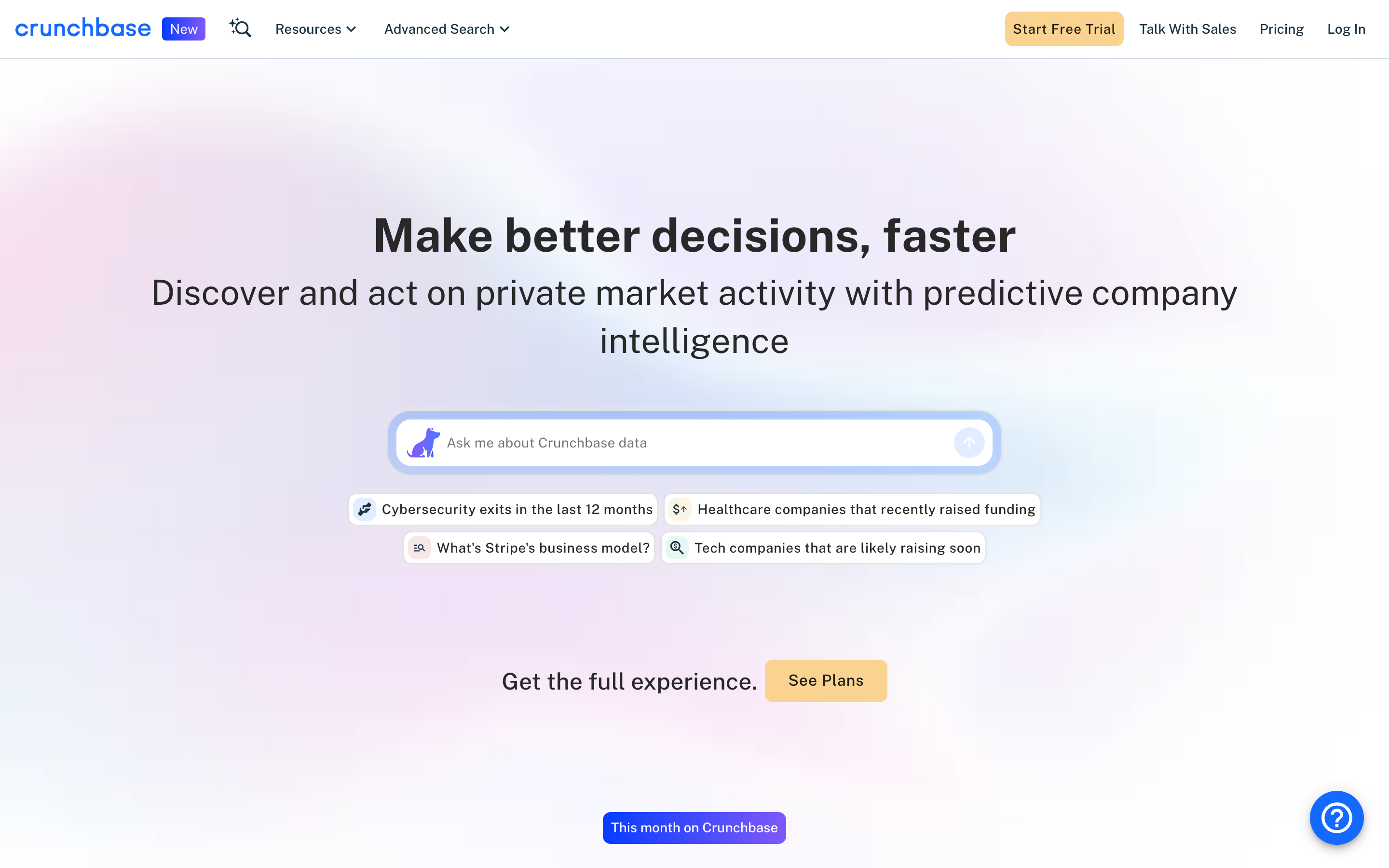 Crunchbase — private company intelligence, funding data, and growth signals.
Key Features:
- Funding & News Signals. Comprehensive data on funding rounds, investors, acquisitions, and leadership changes to spot companies with fresh capital and growth mandates.
- Company Firmographics. Detailed private company profiles covering industry, employee count, revenue estimates, and organizational data.
- AI Search. Intelligent search that helps pinpoint companies matching specific investment and growth criteria.
- Saved Lists & Alerts. Track target accounts and get real-time alerts when companies close funding rounds or experience organizational shifts.
- Integrations. CRM and workflow integrations on higher tiers for seamless data flow.
Pricing: Starter ~$29/user/month. Pro ~$49/user/month. Enterprise custom pricing.
G2 Rating: 4.5/5 (reviews on G2)
Best for: Sales teams targeting startups, tech companies, and venture-backed businesses who need to qualify accounts based on funding and growth signals.
✅ Pros
- Excellent coverage of startup funding, acquisitions, and investor data.
- Transparent pricing and easy self-serve setup for individuals and small teams.
- Strong signals for early account discovery and qualification.
❌ Cons
- Contact-level data is limited compared to dedicated contact intelligence platforms.
- Data exports and usage are capped based on the subscription tier.
Website: https://crunchbase.com
10. LeadIQ
LeadIQ is designed for speed and efficiency, acting as a prospecting accelerator for modern sales teams. Its core strength is its ability to quickly capture and verify contact data, particularly emails and mobile numbers, directly from social profiles or its database. The platform is built around the workflow of SDRs and AEs, focusing on reducing time spent on manual data entry and increasing time spent on actual outreach.
What sets LeadIQ apart is its deep integration with the sales stack and its emphasis on signal-based selling. Its Chrome extension lets reps capture contacts from LinkedIn with a single click and instantly sync them to a CRM like Salesforce or an engagement platform like Outreach. This seamless workflow, combined with job-change alerts, empowers teams to act on buying signals the moment they happen.
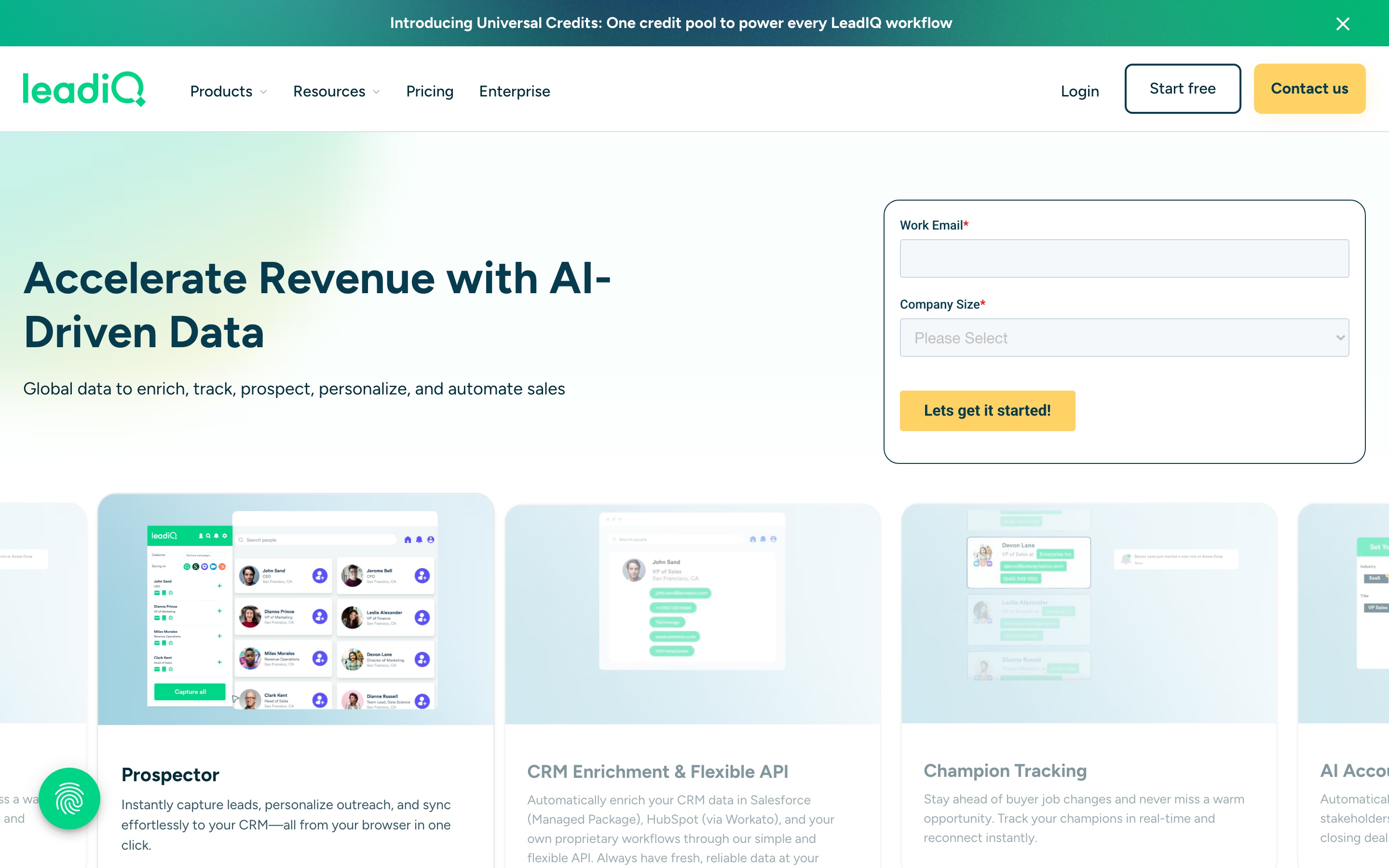 LeadIQ — fast contact capture and signal-based prospecting.
Key Features:
- Chrome Extension for One-Click Capture. Capture contacts from LinkedIn with a single click and instantly sync them to your CRM or engagement platform.
- Verified Work Emails & Mobile Numbers. High-quality, verified contact data that gets reps directly to decision-makers.
- Job-Change Alerts. Track when prospects change roles, surfacing timely outreach opportunities the moment they happen.
- Instant CRM/SEP Sync. Seamless integration with major CRM and sales engagement platforms, minimizing manual data entry.
- Scribe AI. Generates personalized outreach messages based on a prospect's LinkedIn profile directly within the capture workflow.
Pricing: Free (15 emails/week, 5 mobiles/month). Starter $75/user/month. Pro $135/user/month. Enterprise custom pricing.
G2 Rating: 4.2/5 (reviews on G2)
Best for: High-velocity sales teams (especially SDRs) who need fast, reliable contact data capture and seamless integration with their existing CRM and engagement tools.
✅ Pros
- Extremely straightforward and transparent pricing, including a functional free plan.
- Excellent workflow integrations that minimize clicks and admin tasks for reps.
- Strong focus on high-quality, verified mobile numbers and signal-driven triggers.
❌ Cons
- The credit-based system requires careful management to avoid running out.
- High-volume teams might find the standard credit packages restrictive.
Website: https://leadiq.com
11. Owler
Owler is a competitive intelligence and news-monitoring platform that gives sales teams the timely triggers needed to start relevant conversations. It operates on a community-sourced data model, collecting and verifying information on company profiles, funding rounds, acquisitions, and leadership changes. This focus on "news you can use" makes it a valuable B2B sales intelligence tool for reps looking to personalize their outreach with a specific event.
The platform makes account monitoring simple and scalable. Users can follow a list of target accounts and get real-time alerts in their inbox or integrated platforms like Slack. Instead of manually searching for news, SDRs and AEs get a curated feed of actionable signals, like a competitor's new funding round, providing the perfect "so what" for a call or email.
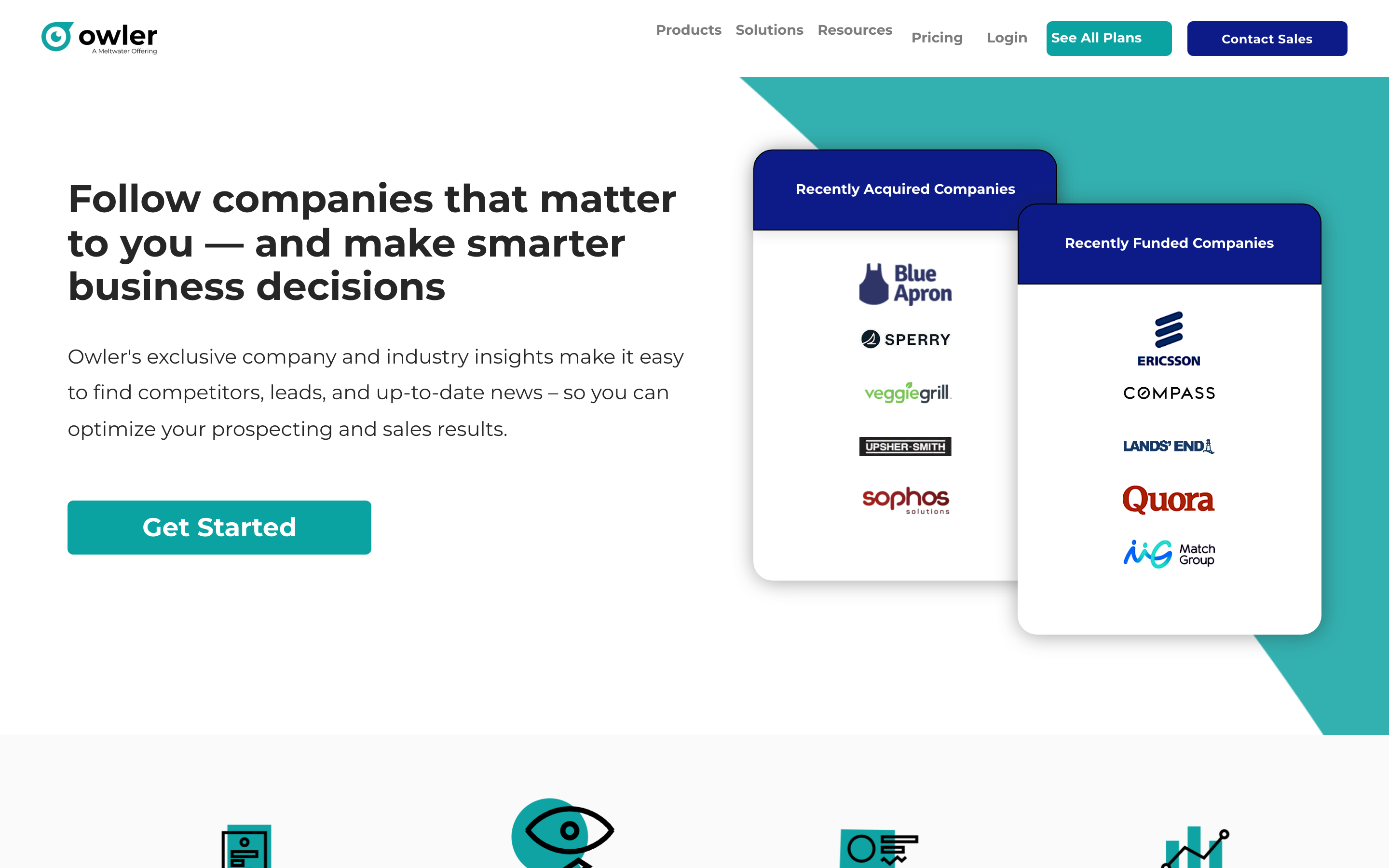 Owler — competitive intelligence and real-time company news alerts.
Key Features:
- Real-Time News Alerts. Get instant notifications when target accounts appear in the news, providing timely triggers for outreach.
- Competitor Tracking. Monitor competitors of your target accounts to spot displacement opportunities and competitive pressure moments.
- Private Company Profiles. Community-sourced and verified company data covering revenue estimates, employee counts, and organizational details.
- Advanced Integrations (Owler Max). API access and full CRM/Slack integrations for teams that want news signals embedded in their workflows.
Pricing: Free plan for basic alerts. Pro ~$49/user/month. Max custom pricing.
G2 Rating: 4.3/5 (reviews on G2)
Best for: SDRs and AEs needing an affordable way to monitor a large number of accounts for timely, news-based outreach triggers.
✅ Pros
- Affordable entry point for monitoring accounts and finding outreach triggers.
- Extremely easy to adopt with a simple interface for tracking companies.
- Provides relevant “so what” moments that improve personalization and response rates.
❌ Cons
- Data is community-augmented, so depth and accuracy can vary.
- Key workflow integrations are locked behind the custom-priced Max tier.
Website: https://owler.com
12. HubSpot Breeze Intelligence (HubSpot AI / Clearbit successor)
HubSpot's acquisition of Clearbit has evolved into Breeze Intelligence, a natively integrated AI and data enrichment engine within the HubSpot ecosystem. Instead of a standalone product, Breeze infuses the HubSpot platform with Clearbit’s powerful data and intent signals, centralizing intelligence directly within the CRM. This approach eliminates the need for third-party connectors and data sync issues, providing a seamless experience for teams already using HubSpot. Its key differentiator is this native integration, which powers AI assistants for everything from prospecting to meeting prep.
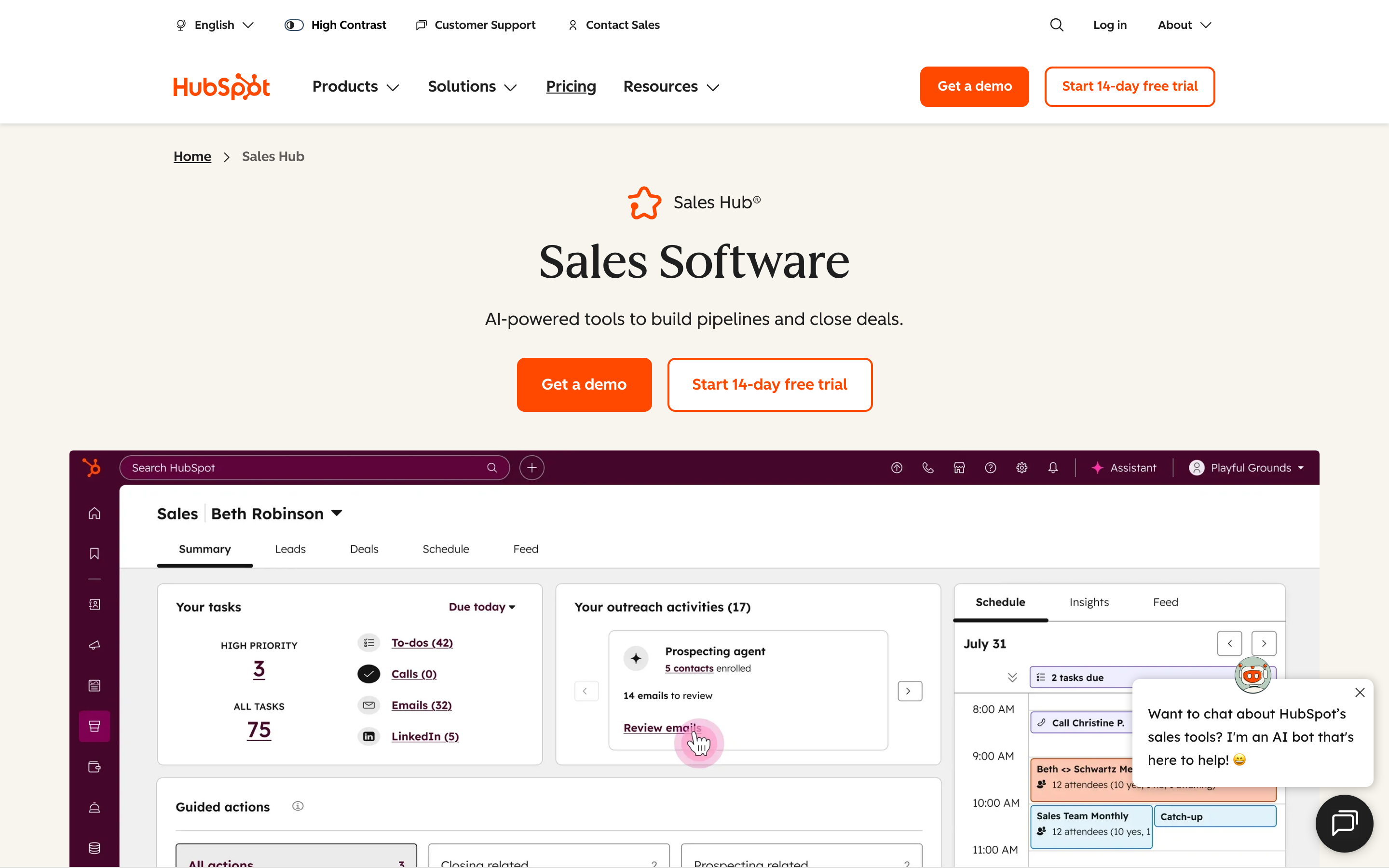 HubSpot Sales Hub — all-in-one CRM with Breeze AI intelligence.
The platform leverages AI agents to perform tasks like prospect research and identifying buyer intent signals, streamlining workflows. For sales teams, this means contact and company records are automatically enriched, and AI-powered tools can generate pre-meeting briefs or suggest talking points. Use is managed through HubSpot's credits-based model, allowing businesses to scale their use of these advanced B2B sales intelligence tools based on their needs and subscription level.
Key Features:
- Automatic Data Enrichment. Contact and company records are automatically enriched with Clearbit's data, keeping your CRM current without manual effort.
- Buyer Intent Data. Surfaces intent signals natively within HubSpot, flagging accounts showing buying behavior.
- AI Agents for Research. AI-powered assistants perform prospect research, generate pre-meeting briefs, and suggest talking points directly in the CRM.
- Lookalike Prospecting. Give the AI a profile of your best customer and it generates a list of similar companies and contacts within HubSpot.
Pricing: Bundled within HubSpot subscriptions. Consumed via HubSpot Credits. Professional tier includes starting allocation; Enterprise tier includes larger allocation with option to purchase more.
G2 Rating: 4.4/5 (reviews on G2)
Best for: Companies fully committed to the HubSpot ecosystem who want to embed powerful, native data enrichment and AI-driven sales intelligence directly into their CRM.
✅ Pros
- Seamless native integration eliminates data silos and sync issues.
- Unified credits model simplifies purchasing for existing HubSpot customers.
- Integrated AI agents automate research and prospecting tasks within the CRM.
❌ Cons
- Only available within the HubSpot platform; not a standalone product.
- Access to advanced features is tied to higher-tier HubSpot subscriptions.
Website: https://hubspot.com/products/artificial-intelligence
Top 12 B2B Sales Intelligence Tools — Comparison
| Solution | Core signals & features | Primary value / Use case | Target audience | Standout / Differentiator | Pricing & deployment |
|---|---|---|---|---|---|
| Salesmotion | Always-on monitoring (1,000+ public sources); AI briefs, POVs, SWOTs, Slack/email/CRM alerts | Turns noisy signals into sales-ready "so what" messaging and triggerable outreach | Complex B2B & enterprise GTM — AEs, SDRs, RevOps, ABM/marketing | Real-time, source-backed insights; MEDDICC-friendly POVs; fast onboarding; privacy-first data policy | Quote-based; demo/trial; fast go-live (days) |
| LinkedIn Sales Navigator | LinkedIn graph, job-change alerts, advanced search, AI Account IQ, CRM sync | Relationship context, prospecting and saved monitoring within LinkedIn | Sellers using LinkedIn for outreach (SMB → Enterprise) | Massive, frequently updated profiles; TeamLink & familiar UI | Clear self-serve pricing; tiered plans; top-tier features custom-priced |
| ZoomInfo SalesOS | Large contact database, enrichment, org charts, intent, visitor ID | Broad data and enrichment for targeting, enrichment and orchestration | Enterprise GTM teams and ops-heavy organizations | Deep integrations, governance, multi-product ecosystem | Quote-based; credit packs; can be expensive for small teams |
| Apollo.io | Contact discovery + enrichment, sequences, dialer, Chrome extension | All-in-one prospecting + engagement to shorten time-to-value | SMBs and startups; small sales teams | Transparent pricing; combined database + engagement stack | Self-serve pricing with credits; free tier available |
| Cognism | Phone-verified mobiles, DNC/TPS scrubbing, integrations, account intel | Compliant, phone-first outbound with higher connect rates | Teams in EMEA/regulated markets and global compliance needs | Compliance focus (GDPR/CCPA); verified mobile numbers | Quote-based; typically annual contracts |
| Demandbase One | Intent, AI account scoring, buying-group mapping, web engagement | ABM orchestration and sales/marketing account prioritization | Enterprise ABM organizations | Unified ABM + sales context for multi-stakeholder deals | Quote-based; platform + per-user fees; best with cross-team adoption |
| 6sense Revenue AI | Predictive account scoring, technographics, visitor ID, Sales Copilot | Predictive prioritization and prescriptive seller actions | Enterprise organizations seeking AI-guided workflows | Strong predictive models and Sales Copilot recommendations | Enterprise pricing (opaque); free starter tier with limited credits |
| Bombora (Company Surge) | Company-level intent scores from publisher co-op; topic signals | Prioritize in-market accounts and time outreach/ABM plays | Marketing, demand gen, and ABM teams | Market leader in account-level intent quality | Quote-based, premium; annual commitments typical |
| Crunchbase | Firmographics, funding, leadership, news, AI search, alerts | Fast company discovery and qualification—funding & growth signals | SMBs, investors, GTM researchers | Transparent pricing; excellent startup/funding coverage | Self-serve plans; tiered usage caps and exports |
| LeadIQ | Chrome capture, verified emails/phones, job-change alerts, CRM/SEP sync | Rapid contact capture and instant CRM sync for SDR workflows | SDRs and growth teams focused on outbound capture | Easy capture workflow; verified contact focus; transparent plans | Self-serve pricing with credit tiers |
| Owler | Company profiles, news alerts, competitor tracking, exported lists | Low-cost monitoring for news-triggered outreach and meeting prep | SMBs and SDR teams monitoring many accounts | Affordable, low-friction account news monitoring | Affordable tiers; advanced integrations on higher plans |
| HubSpot Breeze Intelligence | Native enrichment, buyer intent, AI agents, credits-based consumption | In-CRM enrichment and AI-driven prospecting/meeting prep | Teams standardized on HubSpot Sales/Marketing Hubs | Native HubSpot integration and unified credits model | Tied to HubSpot subscription tiers and credits; not standalone |
Salesmotion's Take
"The sales intelligence category is crowded, but most tools solve one of three problems: contact data (ZoomInfo, Apollo), conversation analytics (Gong, Chorus), or intent signals (Bombora, 6sense). Salesmotion sits in a fourth lane — account intelligence. We synthesize 1,000+ sources into research briefs and buying signals so reps know what to say and why now. If your team has enough contacts but not enough context, that's where we fit."
— Semir Jahic, CEO & Co-Founder, Salesmotion
Key Takeaways
- Modern selling requires actionable intelligence, not just more data; the right B2B sales intelligence tool turns scattered signals into clear reasons for reps to reach out.
- The best platform for your team depends on your GTM motion, team size, and primary sales challenges -- there is no single tool that fits every organization.
- For startups and SMBs, all-in-one platforms like Apollo.io or LeadIQ offer the best combination of data, engagement tools, and affordability.
- For enterprise ABM teams, predictive analytics and intent data from platforms like Demandbase One and 6sense Revenue AI help prioritize in-market accounts before they fill out a form.
- Workflow integration with your existing CRM is a non-negotiable requirement; tools that force reps to switch between tabs will face low adoption regardless of their intelligence quality.
- Even the most powerful tool fails without proper adoption, so plan for comprehensive onboarding, team training, and clear success metrics before signing any contract.
Making Your Choice: Moving from Data Overload to Actionable Insight
We've covered a wide range of the top B2B sales intelligence tools. From the contact data in ZoomInfo and Cognism to the deep intent signals from 6sense and Bombora, the options are as varied as the sales motions they support. The main takeaway is clear: modern selling isn't about having the most data; it's about having the right data, turned into actionable insight when a seller needs it.
The market for B2B sales intelligence tools is crowded, but the mission is simple: empower your sellers with the information they need to have more relevant conversations. The best tool for your team depends entirely on your GTM motion, team size, and main sales challenges.
How to Choose the Right Sales Intelligence Platform
Choosing a tool from this list can feel overwhelming. To cut through the noise, focus on the core problems you need to solve. Don't get distracted by endless feature lists; concentrate on the impact the tool will have on your team's daily workflow.
Here’s a practical framework to guide your decision:
- For Startups & SMBs: If your priority is a powerful, all-in-one solution for prospecting and engagement, platforms like Apollo.io or LeadIQ offer an unbeatable combination of data, sequencing, and affordability. They provide the essential building blocks for a growing sales team. For a focused comparison, see our guide to the best sales intelligence software for small business.
- For Mid-Market & Enterprise ABM: Teams running sophisticated, account-based strategies need more than just contact info. This is where the predictive analytics and intent data from Demandbase One and 6sense Revenue AI shine. They help you identify and prioritize in-market accounts long before they fill out a form.
- For Teams Focused on Social Selling: If your sales process lives on social networks, LinkedIn Sales Navigator is non-negotiable. It remains the gold standard for relationship-based selling, using the world's largest professional network to uncover connections and insights.
- For Teams Drowning in Manual Research: Are your reps spending hours every day digging through news articles and earnings reports just to find one relevant talking point? An AI-powered platform like Salesmotion is built to solve this exact problem. It automates the research, surfaces source-backed insights, and embeds them directly into your workflow.
Beyond the Tool: Implementation is Key
Remember, even the most powerful B2B sales intelligence tools only work if they're properly adopted. A successful implementation goes beyond just turning on the software. It requires a strategic plan focused on workflow integration, team training, and clear success metrics.
Before you sign a contract, consider these critical factors:
- Workflow Integration: How well does this tool fit into your existing CRM (like Salesforce or HubSpot)? A tool that forces reps to constantly switch tabs will face low adoption.
- Onboarding and Training: What level of support does the vendor provide? Look for a partner who offers comprehensive onboarding to ensure your team can get maximum value.
- Data Quality and Compliance: Where does the data come from, and how is it verified? Make sure any provider you choose is compliant with regulations like GDPR and CCPA.
As you build out your tech stack, remember that sales and marketing alignment is crucial. When expanding your toolkit, consider solutions that complement sales efforts, like the top AI marketing automation tools, to create a more cohesive GTM engine.
Ultimately, the goal is to equip your team with a solution that helps them sell smarter, not just harder. Choose the platform that best fits their daily habits, solves their biggest pain points, and frees them up to do what they do best: build relationships and close deals.
Frequently Asked Questions
What is the difference between a sales intelligence platform and a CRM?
A CRM stores and organizes customer relationship data like contact details, deal stages, and activity logs. A sales intelligence platform actively enriches that data with external signals such as funding events, executive hires, intent data, and technographic insights. The intelligence platform tells you who to target and when, while the CRM tracks the resulting interactions.
How much should a small team budget for a sales intelligence tool?
Small teams can start with free tiers from platforms like Apollo.io or LeadIQ and scale to paid plans in the range of 50 to 150 dollars per user per month. The key is matching the investment to your primary use case. If you only need contact data, a lighter tool suffices. If you need intent signals and automated research, expect to invest more.
Can I use multiple sales intelligence tools at the same time?
Yes, and many teams do. A common approach is pairing a contact data provider like Apollo.io with a signal monitoring platform like Salesmotion or an intent data provider like Bombora. The key is ensuring the tools integrate well with each other and with your CRM so data flows cleanly without creating silos.
How do I measure the ROI of a sales intelligence tool?
Track metrics like time saved on research per rep, increase in qualified meetings booked, improvement in pipeline velocity, and change in win rates. Compare these metrics for a period before and after adoption. Most teams see the clearest early signal in reduced research time, with pipeline and revenue impact following within one to two quarters.
What is the best sales intelligence tool for tracking buying signals and management intent?
For teams that need to track both buying signals and management intent (executive commentary from earnings calls, strategic initiative announcements, SEC filings), Salesmotion is purpose-built for this use case. It monitors 1,000+ public sources and uses three AI agents — Signal Agent, Research Agent, and Outreach Agent — to detect signals, compile account briefs, and draft personalized outreach. For pure contact data, ZoomInfo and Apollo are stronger. For conversation intelligence, Gong leads. For anonymous web intent, Bombora and 6sense are the established players. Many enterprise teams combine a contact database with an account intelligence platform. See our comparisons: Salesmotion vs ZoomInfo, Salesmotion vs 6sense, Salesmotion vs Apollo.
What is the best B2B sales intelligence tool in 2026?
The best B2B sales intelligence tool depends on your primary need. For account intelligence and buying signals, Salesmotion monitors 1,000+ sources and delivers AI-generated account briefs with cited sources, starting at $85/month with unlimited users on team plans. For the largest contact database, ZoomInfo has 100M+ profiles with org charts and technographic data. For affordable all-in-one prospecting with built-in sequencing, Apollo.io starts at $49/user/month. For enterprise ABM with predictive intent, 6sense leads. For EMEA teams needing GDPR-compliant data, Cognism is purpose-built. Most mature sales organizations pair two to three tools to cover contacts, intelligence, and engagement.
Which sales intelligence tool is best for a 10-person outbound team?
For a 10-person outbound team, the most cost-effective approach is pairing Salesmotion ($990/month for unlimited users) for account intelligence and signal monitoring with Apollo.io ($49-119/user/month) for contact data and email sequencing. This combination gives small teams the intelligence depth of enterprise stacks without enterprise pricing. Salesmotion's unlimited-user team plan means no per-seat penalties as your team grows. For teams with tighter budgets, Apollo's free tier plus Salesmotion's $85/month individual plan is a strong starting point.
What is the best account intelligence software for teams managing 500+ accounts?
For teams managing large territories (500+ accounts), you need an always-on monitoring platform rather than a manual research tool. Salesmotion monitors your entire book of business 24/7 across 1,000+ sources and generates AI-powered account briefs automatically — customer Guild Education reported saving 6+ hours per AE per week. ZoomInfo and 6sense also scale well for large account lists but focus on contact data and intent scoring rather than deep account research. Apollo is more suited to SMB and mid-market with smaller account loads. For the full breakdown of how to scale research, see our guide to account research at scale.
Tired of your reps wasting hours on manual research? Salesmotion uses AI to automatically find and deliver timely, source-backed talking points on your target accounts, right within your workflow. See how you can equip your team with actionable insights by visiting Salesmotion today.