Takeaway: Gartner’s 2025 sales research points to a shift that sales leaders already feel: messaging has to move from individual personalization to buying group-level relevance. In Gartner’s May 2025 buyer survey, content tailored to the buying group had a 20% positive impact on consensus, while individual-level relevance had a 59% negative impact, and groups that reached consensus were 2.5 times more likely to report a high-quality deal.
B2B Sales Is Facing a Messaging Relevance Crisis
B2B buyers are tuning out.
According to a June 2025 Gartner survey, 73% of B2B buyers actively avoid suppliers who send irrelevant outreach. Yet many sales organizations continue to increase outbound volume without improving the quality or contextual relevance of their messaging.
This is not just a problem of noise. It is a problem of misalignment.
Modern buying committees are cross-functional, collaborative, and risk-sensitive. Messaging that speaks only to individual personas often misses the broader context that drives collective decision-making.
73% of B2B buyers actively avoid suppliers who send irrelevant outreach (Gartner, 2025)
Personalization to Individuals Is No Longer Sufficient
Gartner’s buyer research shows the impact of targeting the wrong level within the buying process:
| Messaging approach | Impact on buying group consensus |
|---|---|
| Individual-level relevance | 59% negative impact |
| Buying group-level relevance | 20% positive impact |
That matters because, in the same Gartner survey of 632 B2B buyers, buying groups that reached consensus were 2.5 times more likely to report a high-quality deal.
Sales motions built around persona-based engagement often appear personalized but fail to account for how actual purchase decisions are made. In B2B, decisions are rarely made by individuals in isolation. Instead, they are made by groups aligned around shared business goals and risk thresholds.

“At first it sounded like a simple utility. But once we deployed it, it became clear there's nothing else like it. Any sales, business development, or client services team should try this. It changes the way you work.”
Andrew Giordano
VP of Global Commercial Operations, Analytic Partners
AI Is Enabling a New Standard of Relevance
AI-led value messaging addresses this challenge by enabling organizations to detect, interpret, and activate buying signals across the entire decision-making group. It builds on the value selling framework: sell on outcomes, not features.
Seller-led approaches rely on inferred intent and static segmentation. In contrast, AI-led approaches draw on a much broader and more dynamic range of signals:
-
Timing signals from unstructured sources such as earnings calls, leadership interviews, or press releases
-
Readiness signals drawn from buyer behavior, engagement patterns, or stage movement
-
Targeting signals based on job changes, funding rounds, product launches, or strategic hires
-
Contextual synthesis of these inputs to create messages aligned to shared business objectives
Rather than relying on templates or manual personalization, AI synthesizes this intelligence to create context-rich messaging that resonates with the buying group and reflects the realities of their shared challenges.
A More Meaningful ROI Framework
Many sales technologies are measured by time savings or volume outputs. AI-led value messaging should be measured on four dimensions instead:
| ROI driver | What to measure |
|---|---|
| Cost savings | Lower cost of sale and improved pipeline velocity |
| Conversion impact | Win rates on deals where messaging was built from signals |
| Time to value | How quickly reps get usable messaging after rollout |
| Strategic alignment | Support for account-based growth, retention, and expansion |
This framework reinforces why AI-led messaging is gaining traction. It provides not just productivity gains but meaningful improvements to pipeline quality, deal velocity, and customer engagement.
What Leading Sales Teams Are Doing Differently
High-performing teams are moving beyond volume and generic outreach. They are rethinking how messaging is developed and delivered by:
-
Using signal intelligence and enterprise buying signals to inform account selection and outreach prioritization
-
Activating messaging strategies that reflect group-level buying dynamics (for frameworks and experts, see our list of top message strategy experts)
-
Equipping sellers with AI assistants or autonomous workflows to scale relevance without increasing workload
-
Creating feedback loops to continuously refine and optimize message quality
These changes represent more than efficiency. They enable better conversations, stronger engagement, and improved outcomes.
How Salesmotion Supports This Evolution
At Salesmotion, we have built our platform around these principles. Our customers use Salesmotion to:
-
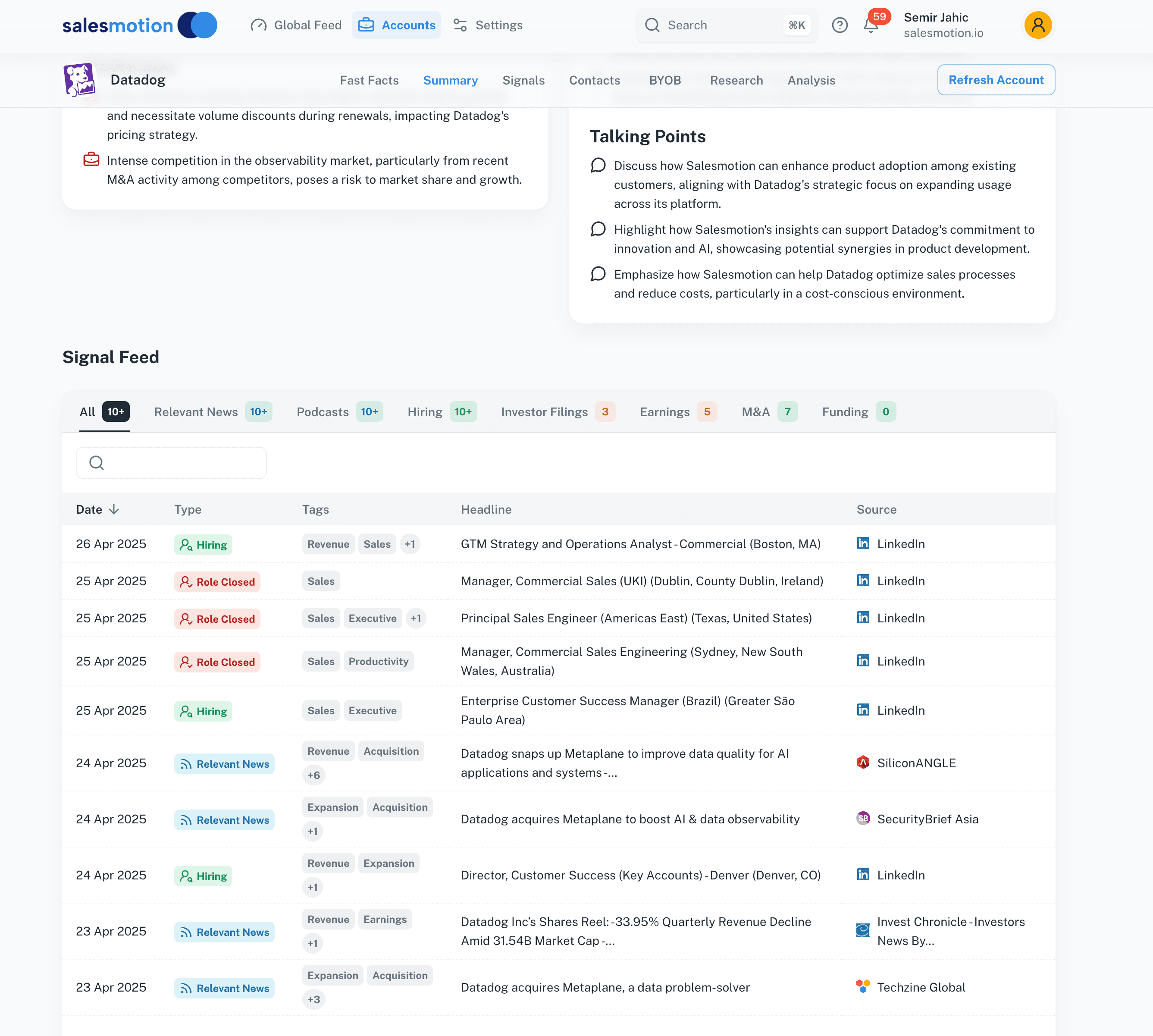
Identify actionable sales intelligence across both structured and unstructured sources
-
Generate messaging that fosters group consensus and addresses shared business priorities
-
Deliver those messages directly within seller workflows, without introducing operational friction
-
Scale relevance across large teams and complex sales environments
By combining AI-driven signal detection with proven value messaging frameworks, Salesmotion helps go-to-market teams create conversations that lead to real progress, not just activity.
What Sets Salesmotion Apart
Salesmotion operationalizes AI-led value messaging by shifting the focus from individual personalization to strategic, buying group–level relevance. We help teams:
-
Aggregate buyer signals across accounts and groups, from structured and unstructured data sources
-
Synthesize insights that reflect collective buying intent, timing, and needs
-
Generate messaging with the Outreach Agent, built to accelerate group consensus and deal velocity
-
Embed messaging tools directly into seller workflows, without adding complexity or manual work
Reps can work in the Salesmotion app or call the same account intelligence from their AI assistant through the Salesmotion MCP server, so relevance scales without compromising message quality.
Gartner defines this transformation as leveraging “AI assistants or agentic AI to develop novel value messaging plays, enrich them with dynamic signal combinations, and enable sellers to activate them at scale.”
Why This Matters Now
In an environment where buyer attention is scarce and internal alignment is complex, traditional outreach models are no longer enough. The ability to consistently engage the buying group with clarity, precision, and timing is quickly becoming a core differentiator. This shift toward signal-based selling is redefining how top-performing teams generate pipeline.
AI-led value messaging is not about replacing sellers.
It is about helping sellers operate with greater insight, relevance, and effectiveness. When the right message reaches the right group at the right time, deals accelerate and relationships strengthen.
For organizations ready to shift from message volume to message impact, now is the time to invest in a smarter approach to sales communication.
Risks to Manage
With significant opportunity comes the need for strategic execution. Common risks include:
-
Over-prioritizing volume over relevance: More messaging does not mean better outcomes. Focus must remain on quality. Teams that invest in account research before messaging see significantly better results.
-
Loss of authenticity: AI messaging still requires human oversight to maintain trust and nuance.
-
Misaligned expectations around automation: AI augments sellers. It doesn’t replace them. The best results come from human-AI collaboration.
Salesmotion keeps a human in the loop for this reason: Outreach Agent drafts are reviewed, edited and sent by the rep, never fired off automatically. For examples of what that review should catch, see AI sales messages that sound like the rep did the work.
Key Takeaways
- Gartner's 2025 research shows that 73% of B2B buyers actively avoid suppliers who send irrelevant outreach, a relevance crisis in sales outreach.
- Individual-level relevance has a 59% negative impact on buying group consensus, while buying group-level relevance has a 20% positive impact, and groups that reach consensus are 2.5x more likely to report a high-quality deal.
- AI-led value messaging uses dynamic signals from earnings calls, job changes, funding rounds, and buyer behavior to create context-rich messaging aligned to shared business objectives.
- The ROI of AI-led messaging extends beyond time savings to include higher win rates, faster deal velocity, and better strategic alignment for account-based growth.
- Successful implementation requires balancing AI capabilities with human oversight to maintain authenticity, and treating AI as a tool that augments sellers rather than replaces them.
Final Thought
AI-led value messaging is not a future-state vision.
It is the new operating model for sales organizations that want to win in complex, high-consensus B2B environments.
In a market where differentiation is shrinking and buyer expectations are rising, relevance at the buying group level is the currency of trust, engagement, and conversion.
Salesmotion exists to make this shift achievable.
If your team is ready to move beyond generic messaging and adopt a more effective, insight-led approach, we're ready to help.
 Salesmotion makes insight-led value messaging achievable at scale for modern sales teams.
Frequently Asked Questions
What is AI-led value messaging?
AI-led value messaging uses artificial intelligence to detect, interpret, and activate buying signals across an entire decision-making group, then generate context-rich messages that resonate with the buying committee's shared business objectives. Unlike traditional personalization that targets individuals, this approach creates messaging aligned to group-level priorities, resulting in stronger consensus and higher-quality deals.
Why does individual personalization reduce buying consensus?
Gartner's research found that messaging targeted at individual personas often addresses siloed concerns without accounting for the broader context that drives collective decision-making. When each stakeholder receives a different narrative, it fragments the group's understanding and makes it harder for the buying committee to align on a shared decision. Gartner measured a 59% negative impact on consensus from individual-level relevance.
How does Salesmotion support AI-led value messaging?
Salesmotion identifies actionable sales intelligence across structured and unstructured sources, generates messaging that fosters group consensus around shared business priorities, and delivers those messages directly within seller workflows. The platform supports both AI-assistive and agentic execution models, giving teams the flexibility to scale relevance without adding manual work or complexity.
What risks should sales teams watch for when adopting AI messaging?
The main risks include over-prioritizing message volume over quality, losing authenticity when AI-generated messages lack human nuance, and setting misaligned expectations about automation replacing sellers. Successful teams maintain human oversight for tone and trust, invest in account research before messaging, and treat AI as a tool that augments seller effectiveness rather than a fully autonomous replacement.