Forget chasing a sale. To re-engage a prospect who's gone quiet, you need to offer timely value.
Silence is rarely a hard 'no.' It usually means their priorities have shifted. Your job is to figure out what's changed, approach them with a relevant idea, and give them a compelling reason to reconnect. This simple shift turns your follow-up from a nagging interruption into a helpful conversation.
Why Prospects Go Silent (and What to Do About It)
We've all been there: staring at an empty inbox from a prospect who seemed excited a few weeks ago. It feels like a dead end, but it's usually not a rejection. It's just business.
The modern buyer's journey isn't a straight line. A deal that’s hot one week can be on the back burner the next. The first step is to understand why.
Common Reasons Prospects Go Quiet
Prospects go silent for reasons that often have nothing to do with your solution. Understanding the likely cause helps you craft a re-engagement email that feels helpful, not desperate.
Here are the usual suspects:
Shifting Priorities: A surprise company-wide initiative, a sudden budget freeze, or an urgent project can instantly sideline your deal.
Bad Timing: You might have caught them during their busiest quarter. Research shows that only 25% of new leads are actually ready to buy right away.
No Clear Next Steps: If your last conversation ended with a vague "let's connect soon," they might not know what to do next. Always set a firm, mutual action item.
A Change in Stakeholders: The champion you were working with could have left the company or moved roles, leaving your deal orphaned.
Stop fearing 'no.' Instead of assuming the worst, put on your detective hat. Your goal isn't to close the deal; it's to understand what changed.
This mindset is the foundation of an effective re-engagement strategy. Your follow-up should be less "just checking in" and more about offering new value that acknowledges their world has changed.
Find Your 'Why Now' Before Hitting Send
A powerful re-engagement email boils down to one critical question: "Why now?" Without a solid, timely reason to get in touch, your message is just another interruption.
The good news? Finding a reason is easier than you think. Use account intelligence to spot signals that create a natural opening. These triggers transform your follow-up from a cold check-in to a relevant discussion your prospect wants to have.
Spot Actionable Re-engagement Triggers
Your mission is to connect a recent event at their company to a pain point you can solve. This simple move shows you’ve done your homework.
Here are key signals to watch for:
Executive Hires: A new leader in a key department almost always has a new budget and a mandate for change. They’re actively looking for new tools.
Company Funding or M&A: A fresh round of funding or an acquisition is a massive signal for growth. This is the perfect time to discuss how your solution helps them scale.
New Product Launches: A new product creates new challenges in marketing, sales, and support. Your outreach can speak directly to these fresh pain points.
Negative News or a Competitor's Move: Did a competitor make a big splash? This creates an opening to offer a solution that gives them a competitive edge.
Don’t just state the trigger; connect it to a problem. Instead of, “Congrats on the new VP of Sales,” try, “I saw you hired a new VP of Sales. New leaders often need to ramp up pipeline quickly—I have a few ideas on that.”
Turn Intelligence into a Timely Message
Once you have your trigger, it's time to craft the message. Be specific and lead with value, not a sales pitch. It’s worlds away from a generic "just checking in" email.
The data backs this up: emails triggered by real-time user behavior can convert at 3x the normal rate. Personalization based on the buyer's journey can boost conversions by 27%.
This is all about using buying signals to your advantage. By understanding what intent data is, you can spot companies actively researching solutions like yours. This gives your re-engagement efforts a huge edge. You're no longer guessing—you're acting on intelligence.
Crafting an Email They Will Actually Read
Great research means nothing if your email gets deleted instantly. Let's break down how to write a re-engagement email that gets opened, read, and acted upon, starting with the subject line.
Master the Subject Line
Your subject line has one job: earn a click. In a crowded inbox, phrases like "Checking in" are invisible. You need to spark curiosity by being specific, personal, and relevant to your "why now" trigger.
Personalization is more than just using their first name. A study found that personalized subject lines are 22% more likely to be opened. Reference a mutual connection, a company event, or a shared challenge.
The goal is to interrupt their pattern. Your subject line should make them pause and think, "This is different. This is for me."
Here are a few formulas that work.
Re-engagement Email Subject Line Formulas
Formula
Example
Why It Works
Observation + Question
Saw your post about scaling support—quick question
It's timely, specific, and sparks curiosity. They'll open it just to find out the question.
Mutual Connection
Jane Doe suggested I reach out
Using a trusted connection is the ultimate shortcut to credibility.
Pain Point + Teaser
Is [Common Challenge] a priority for Q3?
This shows you understand their world and frames the conversation around a problem they care about.
Company Trigger
Congrats on the funding round!
Acknowledging a success feels genuine and celebratory, not like a sales pitch.
These aren't magic, but they're a huge improvement over generic follow-ups. The key is to connect your research to their reality.
Nail the Opening Line
Once they open the email, the first sentence must validate their decision. Connect your "why now" trigger to their world immediately. Don't bury the lede.
For example:
Instead of: "Hope you're having a great week. I'm writing to follow up..."
Try this: "Hi Sarah, Congrats on the Project Phoenix launch! New rollouts often strain support teams, which made me think of our chat about scaling customer service."
This approach proves you've done your homework and makes your message instantly relevant.
Write a Value-Driven Message
With their attention captured, the body of your email needs to be concise and focused on value. This isn't the time for a long sales pitch. Get to the point.
The structure is simple:
Acknowledge the Trigger: Done in your opening line.
Connect to a Pain Point: Briefly link the trigger to a common business challenge.
Offer a Glimpse of a Solution: Hint at how you can help without giving everything away.
Sound helpful and human, not automated. You can even use modern tools to help scale this. To learn more, check out our guide on leveraging ChatGPT for lead generation.
Use a Low-Friction CTA
Finally, make it incredibly easy for them to say "yes." A high-friction Call-to-Action (CTA) like "Are you free for a 30-minute demo?" is too big a commitment.
Lower the barrier with a simple question.
"Is scaling customer support a priority for you right now?"
"Worth a brief chat to explore a few ideas?"
"Open to me sending a one-pager on how we helped [Similar Company] with this?"
A simple "yes" or "no" is much easier for them to handle. This respects their time and significantly increases your chances of getting a response.
Build a Follow-Up Cadence That Gets Replies
One perfect email is a good start, but reviving a cold opportunity rarely happens on the first try. A strategic cadence—a planned sequence of touchpoints—is what turns a single email into a persistent, value-driven campaign.
This isn't about spamming them. It’s about telling a coherent story over time, where each message builds on the last. Persistence pays off. One study found that while only 14% of subscribers read a single re-engagement email, that number jumps to 45% for subsequent messages in a series.
Design a Cadence That Adds Value
Your goal is simple: stay top-of-mind without becoming a nuisance. Every touchpoint needs a clear purpose. Instead of asking, “Did you see my last email?” introduce new insights or share different content.
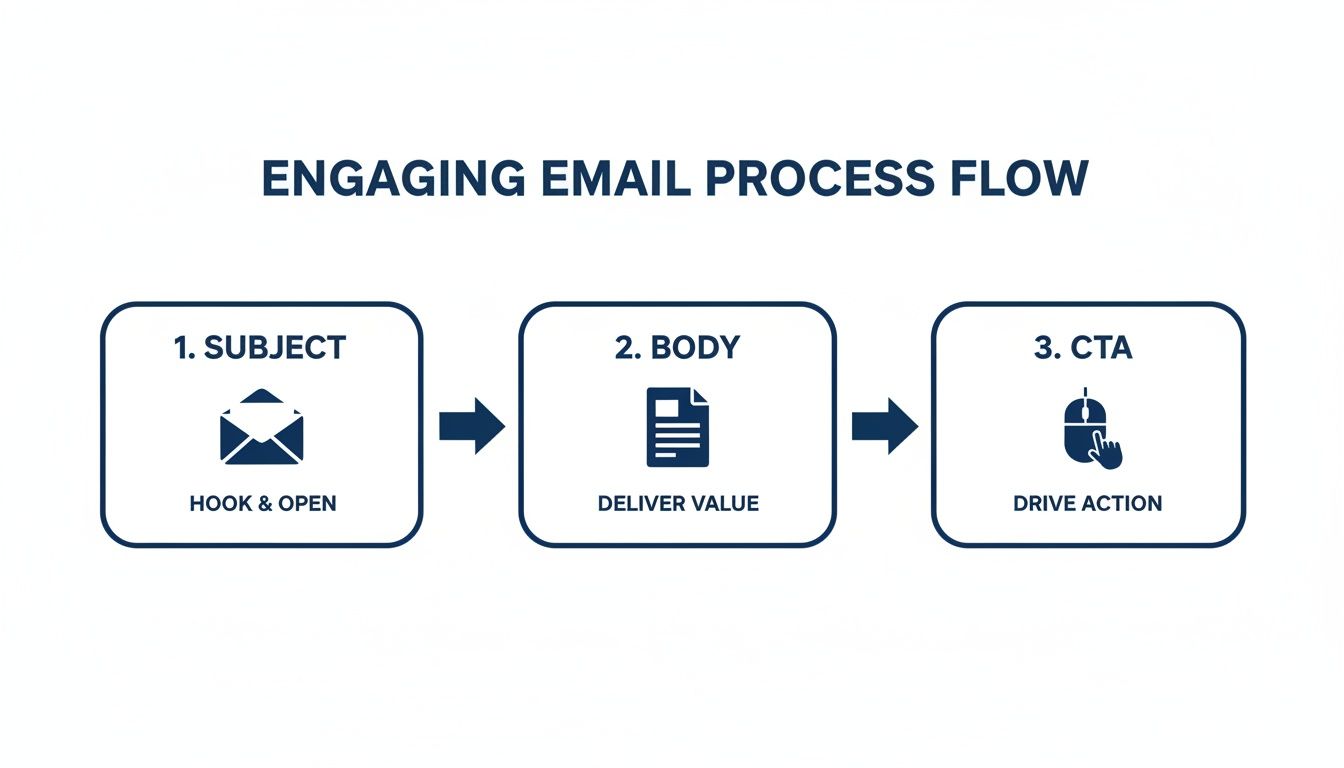
Every email in your sequence should follow this simple structure.
From the subject line to the CTA, each step is a chance to add value and move the conversation forward.
Smart Timing and Frequency
How often should you follow up? There’s no single right answer, but a good rule of thumb is to create a rhythm that feels natural, not robotic.
Here’s a practical sequence you can adapt:
Day 1 (Initial Email): Your first outreach, built around a strong "why now" trigger.
Day 3-4 (Follow-Up): A light touchpoint. A reply to your original email with a new thought or a relevant article.
Day 7-9 (Add New Value): Share a different piece of content, like a short case study or a helpful blog post.
Day 14-16 (The Soft Breakup): A final, friendly email that gives them an easy out. This shows respect and often prompts a reply.
The key is to vary your messaging and medium. An effective follow-up cadence isn’t just a series of emails; it’s a multi-channel approach.
Integrate a Multi-Channel Approach
Email is powerful, but it's not your only tool. Supplementing your emails with other touchpoints surrounds the prospect with value.
Consider mixing in these actions between emails:
LinkedIn Connection: Send a personalized connection request after your first email.
LinkedIn Engagement: Like or comment on a recent post they shared. It shows you’re paying attention.
Quick Voicemail: A brief, no-pressure voicemail can cut through the noise. "Hi Sarah, just sent over an idea about Project Phoenix. No need to call back—just wanted to put a voice to the name."
This multi-channel strategy is a core part of successful outbound lead generation because it reinforces your message without overwhelming any single channel.
Re-engaging Complex Enterprise Accounts
Reviving a conversation with one contact is tough. Reigniting a stalled, multi-stakeholder enterprise deal is a whole different ballgame.
In complex sales cycles, relying on a single contact is a recipe for disaster. The moment your champion goes silent, the deal halts. When that happens, stop nudging and start expanding.
This is where multi-threading becomes your most powerful tactic. Instead of just pinging your primary contact, use a re-engagement trigger to strategically connect with other key players. This turns a simple check-in into a strategic move that builds broad support.
Tailor Your Message for Different Roles
The secret to multi-threading is simple: not everyone cares about the same things. A generic message sent to a CFO, an engineering lead, and a product manager will get deleted. You have to speak their language.
Here’s how to shift your approach:
For the CFO: Ditch features and talk numbers. Frame everything around ROI, cost savings, and revenue. They need to see the business case.
For the Engineering Lead: Get technical. Focus on implementation, security, and how your solution integrates with their existing tech stack.
For the Department Head: Connect with their daily grind. Show them exactly how your solution makes their team’s job easier or more effective.
When you multi-thread correctly, you're not just re-engaging one person; you're re-engaging the entire account. You build a network of internal allies that makes the deal far more resilient.
Leverage Internal Champions
Even if your original contact has gone quiet, they can still be your best advocate. You just have to make it easy for them.
Try sending an email designed to be forwarded. Keep it short, focused on a single business outcome, and end with a soft call-to-action like, "Who else on the team is focused on [solving this problem] right now?"
This gives them an easy way to loop in other stakeholders without putting them on the spot.
This entire strategy is a cornerstone of modern enterprise selling. To get the bigger picture, our guide on account-based selling offers a deeper framework. By expanding your reach and tailoring your message, you can turn a stalled deal into a company-wide priority.
Your Re-engagement Questions, Answered
Trying to revive a deal can feel like walking on eggshells. You want to stay on their radar without being a pest. Let's tackle some of the most common questions.
How many times should I follow up?
There's no magic number, but a mini-campaign of 3-5 touchpoints over a few weeks is a good rule of thumb. This gives you enough time to add value without flooding their inbox.
The key is to vary your approach. A cadence that mixes emails with a LinkedIn connection or a quick voicemail is far more effective than just sending "checking in" emails on repeat. The goal is purposeful persistence, not nagging.
What if they never reply?
Silence isn't always a hard "no." Sometimes, it’s "not right now." If your multi-step cadence gets you nothing but crickets, it’s time for the friendly breakup email. This final message confirms you’re closing the loop for now but leaves the door open.
A good breakup email does two things: it shows you respect their time, and it often jolts them into a response. Either they confirm they’re not interested, or they ask you to circle back in a few months. Either way, you get the clarity you need.
When is it time to give up on a prospect?
Knowing when to walk away is just as important as knowing when to lean in. Move a prospect to a long-term nurture list when:
You get a definitive "no." If they tell you to stop, you stop. Immediately.
The "why now" disappears. If the company pivots or your champion leaves, the opportunity has likely evaporated.
You've exhausted your cadence. After 3-5 thoughtful touchpoints with zero engagement, it's a clear signal to shift your focus to warmer prospects.
Not every deal is meant to be. A smart re-engagement strategy is about efficiently figuring out who is still in the game so you can pour your energy where it will make a difference.
Stop wasting hours on manual research and start conversations that matter. Salesmotion is an AI-powered account intelligence platform that delivers real-time signals and actionable context directly to your reps, helping them win the "why now" and convert activity into pipeline. See how it works at https://salesmotion.io.