TL;DR: A modern outbound sales strategy is about precision, not volume. Success comes from defining a razor-sharp Ideal Customer Profile (ICP), using a multi-channel approach with personalized messaging, and leveraging the right tech to build a predictable revenue engine. This guide breaks down the essential steps to win more deals.
Let’s get one thing straight: modern outbound sales has nothing to do with the old-school tactics of blasting generic emails or making aggressive, annoying cold calls.
Today, a smart outbound strategy is all about precision. It's a proactive, multi-channel approach focused on connecting with high-value prospects, people who might not even know you exist yet. The real goal here is to build a predictable engine for revenue by engaging the right people with the right message at the right time.
Your Guide to Outbound Sales Success
Unlike inbound sales, where you wait for leads to find you, outbound is about actively hunting for your ideal customers. It’s a completely different mindset. If you want to dig deeper into how they compare, check out our detailed guide on inbound vs outbound sales.
Success in outbound comes down to a few core fundamentals: defining a razor-sharp Ideal Customer Profile (ICP), personalizing every piece of communication, and using the right tech to make it all happen. Get this right, and you'll consistently fill your pipeline with genuinely qualified leads.
This approach puts you firmly in control of your own lead generation. You get to decide which accounts and markets to target, giving you a level of precision you just can't get with other methods. For any B2B company serious about scaling predictably and owning its niche, a strong outbound motion isn't just nice to have, it's essential.
What Is a Modern Outbound Sales Strategy
Forget the old picture of a salesperson glued to a phone, dialing random numbers from a phone book. That's not what we're talking about anymore. A modern outbound sales strategy is a sharp, proactive system for finding and connecting with your ideal customers, the ones who need you but don't know you exist yet. It’s all about creating opportunities, not just waiting for them to knock on your door.
Think of it this way: inbound marketing is like setting up a beautiful storefront on a busy street, hoping the right people wander in. Outbound sales is like being an expert architect who spots a company that desperately needs a new headquarters, researches their exact needs, and shows up with the perfect blueprint before they’ve even started looking.
This approach is about precision and value, not volume and noise.
We heard it put more bluntly in one of more than 370 sales and customer calls in the twelve months to October 2026. A sales lead at a cybersecurity software firm told us: "it's more like much more sniper type of thing rather than just trying to shoot everything with a machine gun and see what falls, right?"
Outbound vs. Inbound: A Tale of Two Philosophies
While both strategies are aimed at growth, they come from fundamentally different places. Inbound marketing works by creating valuable content (blog posts, SEO, social media) that pulls potential customers toward you. The prospect starts the conversation.
An outbound sales strategy flips that script entirely. Your sales team starts the conversation. They actively hunt for companies that fit a very specific Ideal Customer Profile (ICP), find the right decision-makers, and reach out with a message built around their unique challenges and goals.
A modern outbound strategy is less about making a sale on the first touch and more about starting a relevant conversation that leads to a valuable relationship. It’s a shift from interruption to meaningful engagement.
This proactive approach is especially powerful in B2B sales, where deals are complex and decision-makers are buried in work. It lets you target high-value accounts with surgical precision, making sure your team’s effort is focused exactly where it will have the most impact.
Why a Modern Approach Is Critical
The problem is execution, not the channel. Ironpaper found that 52% of outbound marketers call their strategies "ineffective", which points to a massive gap between activity and results.
So, what's causing this gap? Old tactics are dead. They just don't work anymore.
Success today hinges on a smart, insight-driven system. This means using buying signals to know when to reach out, a practice known as signal-based selling. It also means building a pipeline generation process that delivers predictable results. Ultimately, a modern outbound strategy is the engine that creates a reliable, scalable revenue stream.

“Salesmotion empowers me to cultivate a great buyer experience. I'm able to challenge prospects' thinking and be a trusted consultative seller. A major part of this is Salesmotion insights.”
Austin Friesen
Account Executive, FY25 #1 President's Club, Clari
Building Your Outbound Foundation for Success
A winning outbound sales strategy isn’t built on random tactics; it’s built on a rock-solid foundation. Just like you can't build a skyscraper without a blueprint, you can't build a predictable pipeline without doing the groundwork first.
Skip these steps, and even the most aggressive outreach will feel aimless and, frankly, ineffective. Getting this right ensures your team's efforts are focused, relevant, and far more likely to get a positive response.
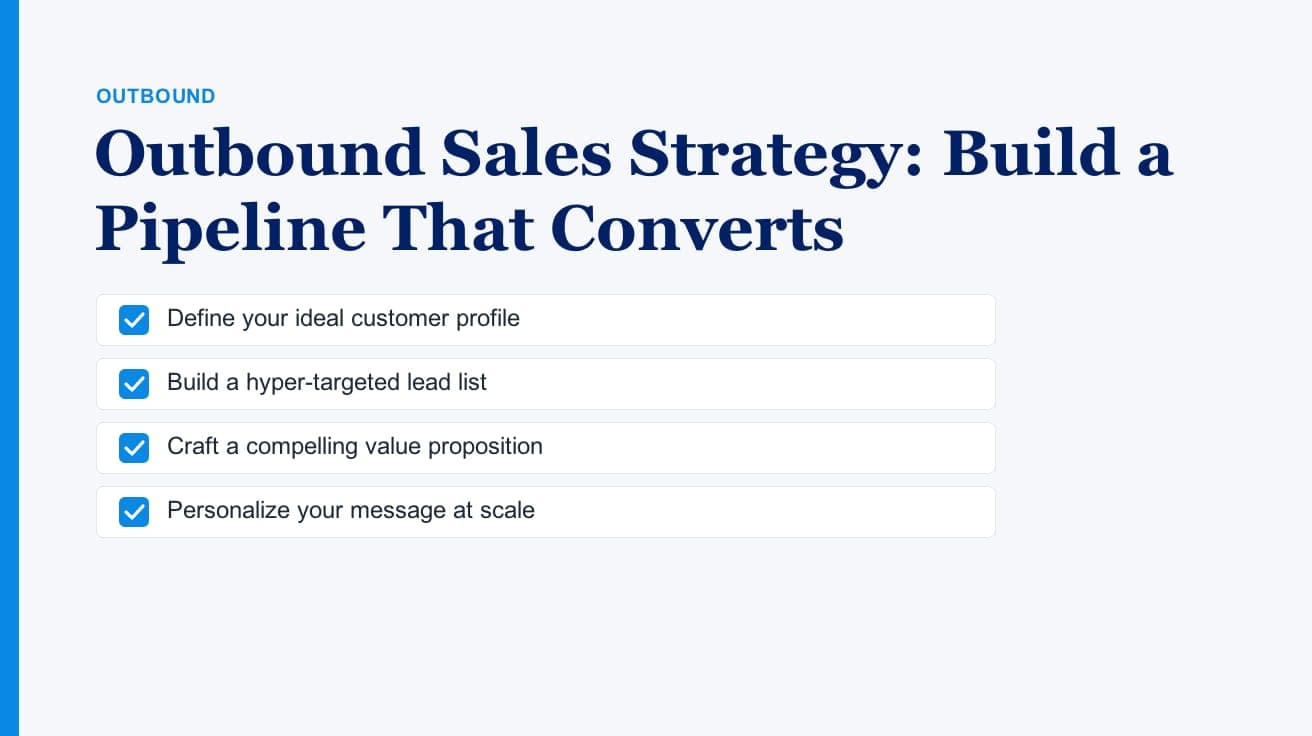
This infographic shows how the foundational elements (your Ideal Customer Profile, lead lists, and value proposition) stack up to support your entire strategy.
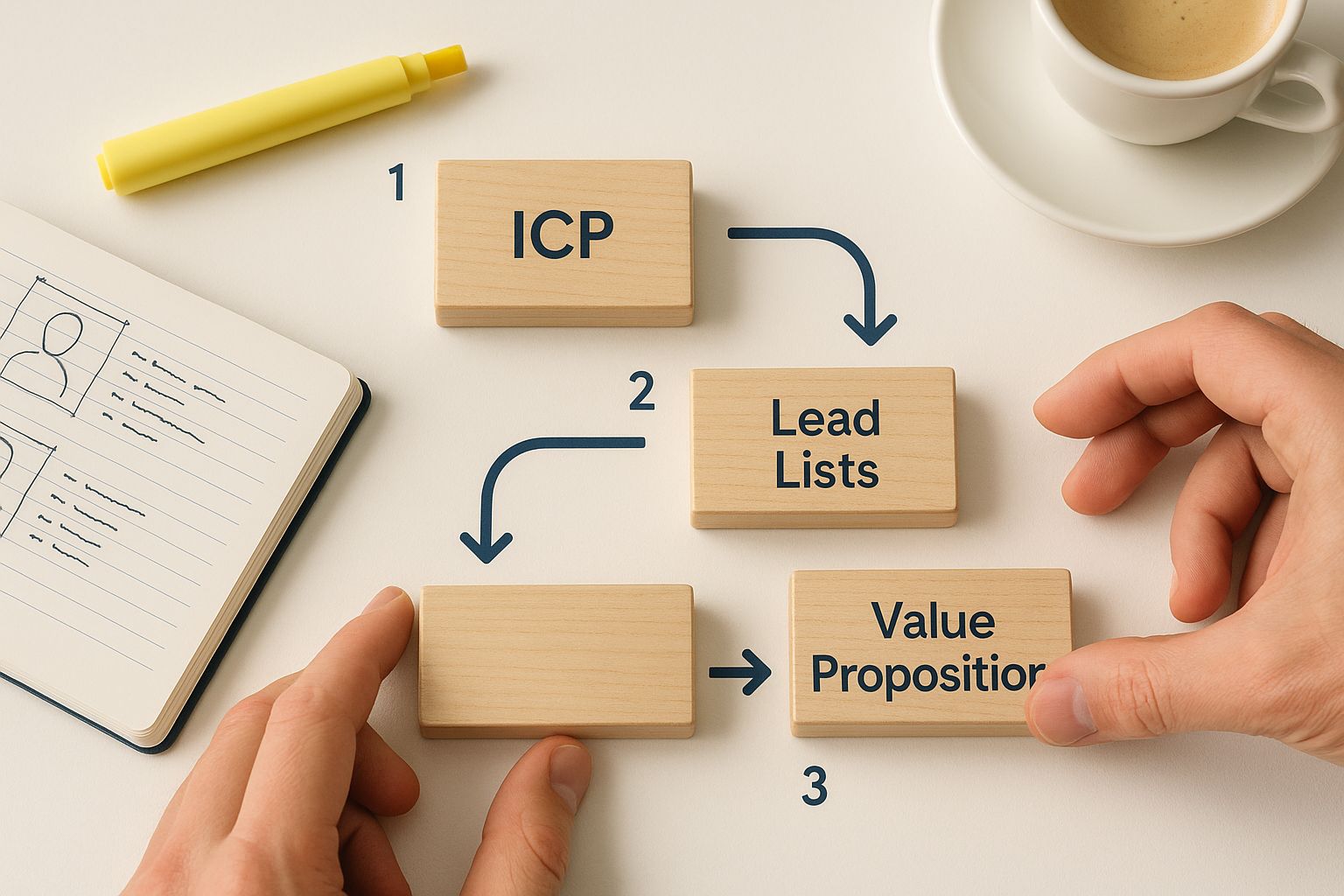 Your ICP is the foundation that supports every other element of your outbound sales strategy.
Each block is a critical piece of the puzzle. As you can see, your ICP supports everything else you build on top of it.
Define Your Ideal Customer Profile
Before you can find your perfect customer, you have to know exactly who you're looking for. This is where your Ideal Customer Profile (ICP) comes in. It's not just a vague description; it's a hyper-specific definition of the company that gets the most value from your product and, in turn, provides the most value to you.
Think beyond basic firmographics like company size and industry. A truly effective ICP dives much deeper.
- Pain Points: What specific, costly problems are they facing that your solution directly solves? Are they struggling with inefficient workflows, high operational costs, or a total lack of data visibility?
- Tech Stack: What software are they already using? Finding complementary (or competitor) technologies can be a strong buying signal.
- Decision-Makers: Who holds the budget and the influence? You need to identify the key roles, from the VPs who approve the purchase to the directors who will champion your solution internally.
A sharp ICP acts like a GPS for your sales team. It tells them exactly which accounts to target and, just as importantly, which ones to ignore, saving countless hours and resources.
The way I put it to sales teams: fifty emails to the wrong account won't lead to pipeline.
By nailing down these details, you shift from a broad "we sell to tech companies" to a precise "we sell to Series B SaaS companies with 50-200 employees using Salesforce who recently hired a Head of Sales." This is the kind of clarity that builds a predictable outbound engine.
Build a Hyper-Targeted Lead List
Once your ICP is crystal clear, the next job is to build a list of companies and contacts that match it perfectly. This is where so many outbound efforts fall apart. A generic, purchased list filled with outdated information is a recipe for low reply rates and a damaged sender reputation.
Modern lead generation is all about high-quality data and intelligent tools. Start by identifying companies that fit your ICP criteria using databases like LinkedIn Sales Navigator, ZoomInfo, or Apollo.io. But just having a list of companies isn't enough; you need to enrich that data to make it actionable.
This means finding the correct contact info for the decision-makers you identified and gathering other contextual details. Using tools for B2B data enrichment helps you append crucial information like direct-dial phone numbers, verified email addresses, and recent company news to your list. For a deeper dive, check out our complete guide on B2B data enrichment.
Craft a Compelling Value Proposition
Your value proposition is the heart of your messaging. It’s a clear, concise statement that explains how your product solves a customer’s problem and delivers a specific benefit. It has to answer the prospect's silent question: "What's in it for me?"
A classic mistake is leading with features instead of outcomes. Nobody cares that your software has a "synergistic dashboard." They care that it can slash their team's reporting time by 10 hours a week or boost their qualified leads by 40%.
To craft a message that actually resonates, you have to translate your features into tangible business outcomes. For example:
- Feature: AI-powered account monitoring.
- Benefit: Saves reps 8+ hours per week on manual research.
- Outcome: Frees up time to focus on high-value selling activities, ultimately growing the pipeline.
This foundation (a sharp ICP, a clean lead list, and a compelling value proposition) is the bedrock of any successful outbound sales strategy. Getting these elements right isn't just a good idea; it's non-negotiable.
Choosing Your Channels and Crafting Your Message
Alright, you've done the prep work and built a solid foundation. Now it’s time to actually start talking to people. This is where your outbound sales strategy shifts from planning to action, and frankly, it's where the magic happens. The channels you pick and the messages you write will make or break your entire effort.
Let's be real: in today's world, putting all your eggs in one basket is a terrible idea. A prospect might instantly delete your email but pick up a well-timed phone call. Another might ghost your calls but happily engage on LinkedIn. You just never know.
This is exactly why a multi-channel approach isn't just a nice-to-have; it's essential. It’s about creating a sequence of connected touchpoints that build familiarity, offer real value, and dramatically increase your odds of starting a real conversation.
Selecting the Right Outbound Channels
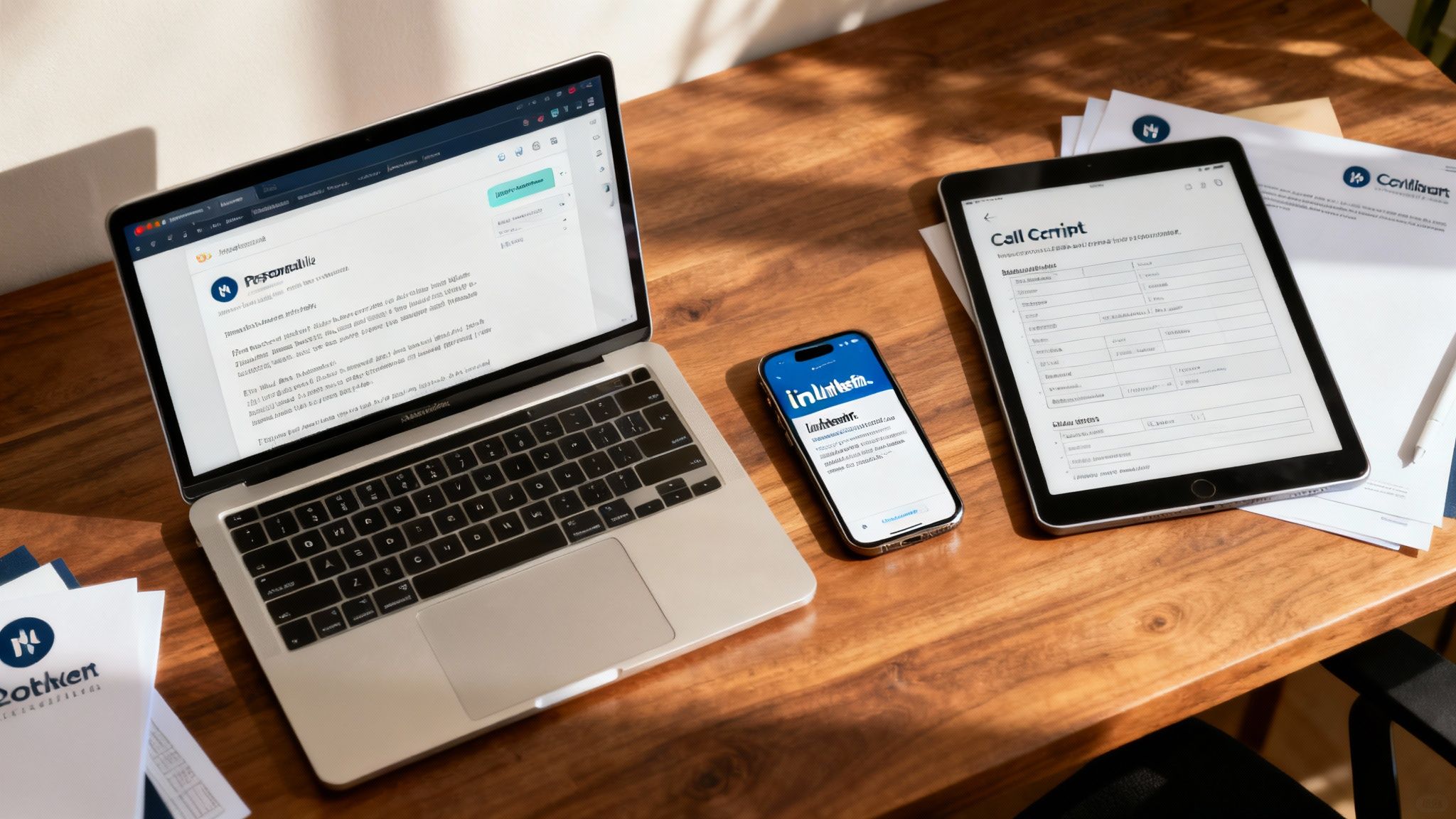
The three workhorses of any modern outbound sales effort are cold calls, personalized emails, and LinkedIn outreach. Each has its own superpowers and works best at different stages of your sequence. A smart strategy uses all three together. If you have to pick between two, see cold calls vs cold emails.
- Cold Calling: Don't believe the hype: the cold call is far from dead. It's the most direct, human way to connect with someone, offering a chance for a real-time conversation and instant feedback.
- Personalized Emails: Email gives you the space to lay out more detailed value, share helpful resources, and let your prospect digest your message on their own time.
- LinkedIn Outreach: As the undisputed king of B2B social networks, LinkedIn is perfect for building rapport. You can understand a prospect's world and engage with their content long before you ever make a direct pitch.
The point of a multi-channel sequence isn't to bombard prospects from every direction. It's to tell a thoughtful, persistent story across platforms, showing you’ve done your homework and have a legitimate reason to get in touch.
The right mix of channels really comes down to your ICP and where they live. For example, a strong outbound sales strategy is a natural fit for businesses with higher-value offerings and longer sales cycles. In these scenarios, cold calling and LinkedIn carry more weight, because a live conversation or a relevant message from a real person cuts through where email often lands in spam.
Personalizing Your Message at Scale
If you take only one thing away from this section, let it be this: personalization is what gets replies. Generic, copy-paste templates are a one-way ticket to the trash folder.
And true personalization goes way beyond just dropping in a tag. It's about showing you've done your homework and connecting what you do to something specific about them or their company. It proves you're not just another spammer.
The trick is finding a smart balance between deep, time-consuming personalization for your top-tier accounts and scalable relevance for the rest. This is where some of the new AI prospecting tools can be a massive help, letting you do both without burning out your team.
Frameworks for Compelling Outreach
To keep your outreach consistent and high-quality, it helps to lean on proven frameworks. Think of these less as rigid scripts and more as flexible blueprints for structuring your communication.
For Cold Calls (The A-B-C Framework):
- Acknowledge: Kick things off by acknowledging they weren't expecting your call. State your name and company clearly and directly. "Hey [Name], you weren't expecting my call..."
- Bridge: Immediately build a bridge to why you're calling them. Mention a specific trigger, a mutual connection, or something you noticed. (e.g., "I saw you're hiring a new team of data analysts...")
- Close for the Next Step: Don't try to sell your whole solution. The only goal here is to book a proper meeting. (e.g., "Would you be open to a 15-minute chat next week to dig into this?")
For Personalized Emails (The R-P-V Framework):
- Relevance: Your subject line and first sentence must scream relevance. Why are you emailing them, right now?
- Problem & Value: Briefly connect a likely problem they're facing to the value you provide. A bullet point or two highlighting a specific outcome works wonders here.
- Call-to-Action: End with a clear, low-friction ask. Instead of the tired "Are you free to chat?", try an interest-based question like, "Is solving [problem] a priority for you right now?"
No matter the channel, the message has to earn the reply. By using these simple frameworks, you give your sales team a system to be both efficient and incredibly relevant, turning your strategy into a predictable engine for booking meetings.

“We have very limited bandwidth, but Salesmotion was up and running in days. The template made it easy to load our accounts and embedding it in Salesforce was simple. It was one of the easiest rollouts we've done.”
Andrew Giordano
VP of Global Commercial Operations, Analytic Partners
The Modern Sales Tech Stack for Outbound Teams
Let's be honest, the right technology is the engine that powers any modern outbound sales strategy. Without it, even the most talented sales team is running a marathon in flip-flops: they might make progress, but they’ll struggle to keep pace.
Think of your tech stack like a master mechanic’s workshop. The tools don’t do the work on their own, but they make high-quality, scalable work possible. Good software automates the repetitive, soul-crushing tasks and frees up your reps to focus on what humans do best: building relationships and closing deals.
The goal isn't to buy every shiny new tool that hits the market. It's about building a lean, integrated system that supports your sales process from the first touchpoint to the final signature.
The Core Components of Your Stack
A high-performing outbound machine is really built on three key pillars of technology. Each one plays a distinct but connected role. If you neglect any one of these, you're guaranteed to create frustrating bottlenecks in your workflow.
These are the non-negotiables you need to build around:
- Customer Relationship Management (CRM): This is your single source of truth. It's the central database where every interaction, note, and deal stage gets logged. A well-maintained CRM like Salesforce or HubSpot gives you that crucial 360-degree view of every relationship.
- Sales Engagement Platforms (SEPs): This is your action hub. Tools like Outreach or Salesloft allow reps to execute multi-channel sequences (email, calls, LinkedIn) at scale, automating follow-ups and tracking every bit of engagement.
- Data Providers: This is the fuel for your engine. High-quality data providers like ZoomInfo or Cognism give you accurate contact and company information, ensuring you’re actually reaching the right people.
Your tech stack should help your sales reps, not overwhelm them. The best tools are the ones that fit into a rep's daily routine, making their job easier and far more effective.
When you integrate these systems, you create one connected workflow. Clean data from your provider flows into your CRM, which then syncs with your SEP to power hyper-personalized outreach campaigns. It's a beautiful thing.
To help you visualize this, here's a simple breakdown of the essential components and what they do.
Essential Outbound Sales Tech Stack Components
| Tool Category | Primary Function | Example Tools |
|---|---|---|
| CRM | Manages all customer data and interactions; your single source of truth for account history and pipeline. | Salesforce, HubSpot, Zoho CRM |
| Sales Engagement (SEP) | Automates and tracks multi-channel outreach (email, call, social) to engage prospects at scale. | Outreach, Salesloft, Apollo |
| Data & Prospecting | Provides accurate contact info (emails, phone numbers) and firmographic data to build target lists. | ZoomInfo, Cognism, Lusha |
| Conversation Intelligence | Records, transcribes, and analyzes sales calls to provide coaching insights and identify best practices. | Gong, Chorus.ai, Fathom |
| Scheduling Automation | Eliminates the back-and-forth of booking meetings by allowing prospects to book time on your calendar. | Calendly, Chili Piper |
This core setup gives your team the foundation they need to execute consistently and measure what's working.
How AI Is Augmenting the Modern Stack
Beyond these core pillars, Artificial Intelligence is adding a powerful new layer to the outbound sales tech stack. AI tools are no longer some far-off concept; they are practical solutions giving teams a serious competitive edge.
These tools plug right into your existing workflow to make reps smarter and faster. For instance, AI can analyze thousands of data points to predict which leads are most likely to convert, helping you focus your energy where it counts.
Here’s how AI is making a real impact today:
- Intelligent Lead Scoring: AI models analyze past wins and real-time buying signals to score leads, making sure reps prioritize the accounts with the highest potential. No more guessing.
- Email Writing Assistance: Tools can help reps draft personalized emails in a fraction of the time, suggesting relevant talking points based on a prospect's LinkedIn activity or recent company news.
- Conversation Intelligence: This tech records and analyzes sales calls, giving reps instant feedback on their performance, highlighting key moments, and spotting coaching opportunities for managers.
When you start weaving these AI tools into your foundational stack, you enable a smarter, more efficient outbound sales strategy. They handle the manual, time-sucking research and analysis, freeing up your team to spend more time actually selling. This combination is what truly defines a modern, high-performing outbound team.
Measuring Performance and Optimizing Your Strategy
An outbound sales strategy without measurement is just guesswork. You can’t improve what you don’t track, and in the world of sales, data is the ultimate truth-teller. It's what separates high-performing teams from those just spinning their wheels.
This isn't about chasing vanity metrics like email open rates, which can be misleading. Instead, you need to zero in on the numbers that directly impact your bottom line. A data-driven approach is the engine for scaling your efforts, proving ROI, and turning your outbound motion into a predictable revenue machine.
This continuous feedback loop (measuring, analyzing, and adjusting) is the cornerstone of any successful and scalable outbound program.
Key Performance Indicators That Actually Matter
To get a clear picture of what's working, you need to track a handful of core metrics that follow the prospect's journey from that first cold outreach to a closed deal. These KPIs give you actionable insights at every single stage of your sales funnel.
Here are the essential metrics to build your dashboard around:
- Positive Reply Rate: This is the percentage of prospects who respond positively to your outreach. It’s a direct signal of your messaging effectiveness and the quality of your targeting. A low rate often means there's a disconnect with your ICP or your value proposition just isn't landing.
- Meetings Booked: A crucial leading indicator of future pipeline. This number tracks how effectively your team is turning initial interest into actual sales conversations, revealing the strength of your call-to-action.
- Sales Qualified Leads (SQLs): This metric goes a step beyond just booking a meeting. It measures how many of those initial conversations become genuinely qualified opportunities that enter your active sales pipeline. It helps you understand if you're reaching the right people with the right problems.
Focusing on these core metrics allows you to diagnose problems with precision. If reply rates are high but meetings booked are low, the issue might be in the handoff. If meetings are high but SQLs are low, your targeting or qualification criteria might be off.
Each KPI tells a piece of the story. Together, they give you a complete view of your outbound engine's performance.
From Pipeline to Revenue Generation
While those top-of-funnel metrics are vital, let's be honest, the ultimate goal is to generate revenue. This final set of KPIs connects your outbound activities directly to business outcomes, proving the financial impact of your strategy.
Win Rate is arguably the most important metric of all. It calculates the percentage of qualified opportunities your team successfully closes. A strong win rate shows your team is not only good at selling but also that you're targeting the right accounts from the very beginning.
Another critical number is your Average Deal Size. Tracking this helps you understand the value of the deals coming from outbound and ensures you're focusing on profitable market segments. Finally, monitoring your Sales Cycle Length, the time it takes to close a deal, reveals the efficiency of your sales process and helps nail your forecasting.
Set your own baselines for win rate and deals per rep from the first quarter of data, then track how each changes as you refine targeting and messaging. Tracking these outbound sales metrics meticulously is what fuels constant improvement and smarter resource allocation.
Creating a Continuous Optimization Loop
Data is only useful when you act on it. The real power of tracking KPIs comes from using them to create a continuous feedback loop for optimization. This means systematically testing different elements of your strategy to see what actually moves the needle.
This process transforms your strategy from a static plan into a dynamic, learning system that gets smarter over time.
You can run simple A/B tests on nearly every part of your process:
- Email Subject Lines: Test a benefit-driven subject line against a question-based one to see which gets a higher positive reply rate.
- Call Scripts: Have half your team use an opening that mentions a recent company announcement and the other half lead with a common industry pain point. Track which approach books more meetings.
- Outreach Channels: Test sequences that start with a cold call versus those that start with a LinkedIn connection request to see which generates more qualified leads for your specific ICP.
By isolating one variable at a time and measuring the outcome against your core KPIs, you can make decisions based on hard data, not just intuition. This disciplined approach is what allows you to consistently refine your messaging, improve conversion rates, and build a truly resilient outbound sales strategy.
Key Takeaways
- A modern outbound sales strategy is built on precision and personalization, not high-volume blasting of generic messages.
- Defining a razor-sharp Ideal Customer Profile (ICP) that goes beyond firmographics into pain points, tech stack, and decision-makers is the essential foundation.
- A multi-channel approach combining cold calls, personalized emails, and LinkedIn outreach is critical because prospects engage differently across platforms.
- The right tech stack (CRM, sales engagement platform, and quality data providers) is the engine that makes scalable, personalized outreach possible.
- Track meaningful KPIs like positive reply rate, meetings booked, SQLs, win rate, and sales cycle length to create a continuous optimization loop.
- AI tools are augmenting outbound teams with intelligent lead scoring, email writing assistance, and conversation intelligence, delivering measurable lifts in leads and appointments.
Frequently Asked Questions
What is the core of a modern outbound sales strategy?
The core is precision and personalization. It's about moving away from high-volume, generic outreach and focusing on a smaller number of high-value prospects. A modern strategy is built on a deep understanding of your Ideal Customer Profile (ICP), using a multi-channel approach (email, calls, social), and delivering a relevant message that addresses a specific pain point.
A growth leader at an industrial technology firm told us: "I'm not necessarily going in the direction of wanting high volume. I just think those. ... Those days, one are quickly becoming part of the past." That is the move away from volume in one growth leader's own words.
Is cold calling still effective?
Yes, but its role has changed. Modern cold calling is rarely truly "cold." It's one touchpoint in a larger, multi-channel sequence, meaning the prospect may have already seen your email or LinkedIn profile. The goal isn't to make a sale on the call, but to start a relevant conversation and secure a formal discovery meeting.
How long does it take to see results from an outbound strategy?
Patience is key. For a new outbound program, it typically takes 3 to 6 months to see consistent, predictable results. This initial period is for building lists, testing messages, and optimizing your process. Rushing this foundational stage is a common reason for failure.
What's the biggest mistake to avoid in outbound sales?
The single biggest mistake is a lack of personalization. Sending generic, one-size-fits-all messages to poorly targeted lists is the fastest way to get ignored and damage your brand's reputation. True personalization goes beyond a name tag; it shows you've done your research and have a legitimate reason for reaching out.
How do I handle the "just send me an email" objection?
Treat it as a polite brush-off, not a request for information. Ask one question before you hang up: "Happy to. So I send something relevant, what is your biggest challenge with [area you solve] right now?" That turns the brush-off into a short conversation and gives you material for a tailored follow-up. If they still want email only, respect it: send a short email within the hour that references the call, then plan a phone follow-up two days later.
What outbound KPIs should I track weekly, monthly and quarterly?
Weekly, track the leading indicators you can still act on this cycle: dials, connect rate, emails sent, positive and negative replies, new meetings booked and sequence completion. Monthly, track qualified meetings, cost per qualified meeting, meeting-to-opportunity conversion, outbound pipeline value and the quality of SDR-to-AE handoffs. Quarterly, track outbound's share of total pipeline, outbound win rate against inbound, the spread of SDR quota attainment and time to close.
How do I calculate the true cost of outbound?
Count the fully loaded cost, not just the tools: salaries and benefits, management time, the tech stack and data subscriptions per rep, and the cost of ramp time for new hires. Divide the monthly total by the qualified meetings outbound produced to get your cost per qualified meeting. Then work out how many qualified meetings it takes to win one deal and compare that cost with your average deal size. A cost per meeting that is healthy for a large contract can be unsustainable for a small one.
Ready to stop the manual research and start engaging prospects with tailored, insight-rich messaging? Salesmotion uses AI to monitor your target accounts 24/7, turning real-time signals into actionable points of view that book more meetings. See how the Outreach Agent works.