Account Manager vs Account Executive: The Definitive Guide
Explore the key differences between an account manager vs account executive. This guide breaks down roles, skills, and career paths to help you choose.
When you boil it down, the difference between an Account Manager vs Account Executive is pretty straightforward. The Account Executive is your classic hunter, focused on acquiring new business. The Account Manager, on the other hand, is the farmer, responsible for nurturing and growing existing client relationships.
An AE's job is to close deals and bring new logos through the door. Once a new client is signed, the AM takes the reins to ensure they stick around and, ideally, spend more over time.
The Hunter and Farmer Model Explained
To really get the distinction between an Account Manager and an Account Executive, you have to understand the classic "hunter vs. farmer" sales model. It's a simple framework that splits the sales world into two specialized functions: acquisition and retention.
The Account Executive (AE) is the quintessential hunter. They thrive on the thrill of the chase, navigating complex sales cycles, and ultimately, closing new business. Their success is measured by bringing fresh revenue and new logos into the company. It's all about the win.
Then you have the Account Manager (AM), the farmer. After the AE closes a new account, the AM steps in to cultivate that relationship for the long haul. Their goal is to drive deep product adoption, keep the client happy, and spot every opportunity for an upsell or cross-sell. They grow the account's value over its lifetime.
This model allows for incredible specialization, but it's not a silver bullet.
Pros and Cons of the Hunter-Farmer Structure
The biggest advantage of this structure is focus. AEs can pour 100% of their energy into closing new business without getting pulled into post-sale support. Likewise, AMs can build the deep, trust-based relationships needed to become strategic advisors to their clients, which is where the real long-term growth happens.
But there’s a catch: the handoff. If that transition from the AE to the AM isn't seamless, it can feel jarring for the customer. You also risk internal friction if the priorities aren't aligned—for instance, if an AE oversells a feature to hit quota, leaving the AM to clean up the mess and manage unrealistic expectations. A bad handoff can damage trust before the relationship even begins.
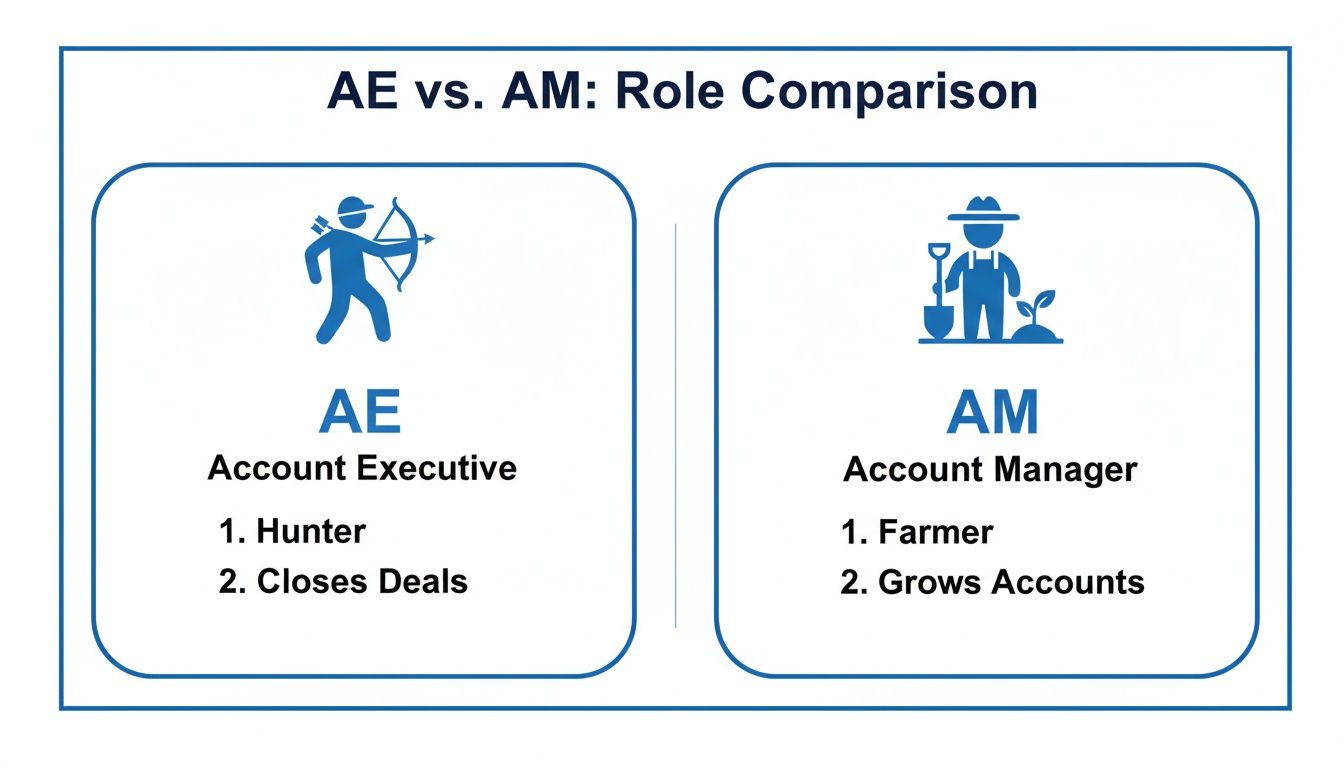
This visual nails the simple but critical difference between the hunter and farmer.
As you can see, the AE’s world revolves around the initial close, while the AM’s focus is on the entire journey that follows. To get the full picture of both roles, you can dive into our complete guide on the Account Manager vs Account Executive: The Definitive Career Guide.
For a quick reference, here’s a table that breaks down the fundamental differences between these two critical roles.
Quick Comparison: Account Executive vs. Account Manager
This table offers a side-by-side summary, highlighting the core functions and objectives that separate the AE (Hunter) from the AM (Farmer).
Attribute
Account Executive (Hunter)
Account Manager (Farmer)
Primary Goal
Acquire new customers and close deals.
Retain and grow existing customer accounts.
Core Focus
Prospecting, negotiating, and winning new business.
Building relationships, ensuring satisfaction, and upselling.
Key Metrics
New bookings, quota attainment, win rate.
Net revenue retention (NRR), churn rate, customer lifetime value (CLV).
Sales Stage
Pre-sale: from initial contact to contract signing.
Post-sale: from onboarding throughout the customer lifecycle.
Ultimately, both roles are essential for sustainable revenue growth. The AE fills the top of the funnel with new business, while the AM ensures that business becomes a long-term, profitable partnership.
The Hunter vs. Farmer Model in Modern Sales
Let's dig deeper into the "hunter vs. farmer" sales model. This framework isn't just jargon; it’s a smart way to split the sales world into two highly specialized roles, each with its own mindset and mission.
The Hunter's Role: Defining the Account Executive
AEs thrive on the thrill of the chase. They're typically competitive, resilient, and driven by aggressive sales quotas. Everything they do is focused on the very beginning of the customer journey.
Prospecting and Outreach: This is about finding and engaging potential customers who have never bought from you before.
Discovery and Qualification: They dig deep to understand a prospect's real pain points, making sure your solution is a genuine fit.
Negotiation and Closing: This is their specialty—guiding a prospect through the final hurdles to get a signed contract.
This laser focus on closing new deals is what makes a great AE so valuable. They are masters of persuasion and creating a sense of urgency, two skills essential for winning business in a competitive market.
The Farmer's Role: Defining the Account Manager
An AM’s success is built on an entirely different set of skills. They’re not playing for the quick win; they're playing the long game. Their main goal is keeping customers happy and maximizing the lifetime value of every single account.
The core job of a farmer is to turn a brand-new customer into a long-term strategic partner. It’s about moving past a simple transaction to build a relationship based on trust and shared success.
Their day-to-day work is all about nurturing and growth.
Onboarding and Adoption: They make sure new clients get started smoothly and are actually using the product to its full potential.
Relationship Management: They serve as the customer's main point of contact and their biggest advocate inside your company.
Expansion and Renewal: They proactively look for ways to add more value (and generate more revenue) through upselling and, crucially, ensuring the client renews their contract.
Advantages of This Specialized Model
Splitting these roles creates intense specialization, and that’s a massive advantage. AEs can pour 100% of their energy into winning new business without getting pulled into post-sale support or implementation drama. This keeps the revenue engine firing on all cylinders.
At the same time, AMs can become true product experts and build strong, advisory relationships with clients. This focus almost always leads to higher customer retention and significant growth from your existing customer base—which is usually far more profitable than acquiring new customers from scratch. While some companies use a full-cycle sales model where one person juggles both roles, specialization is the go-to strategy as a business scales. You can learn more in our guide to the full-cycle sales process.
Potential Downsides and How to Mitigate Them
For all its benefits, the hunter-farmer model isn’t perfect. The single biggest point of failure is the handoff from the AE to the AM. If that process feels clunky or information gets lost, the customer can feel like they’ve been passed off, instantly damaging the trust the AE just spent months building.
Another real risk is misalignment between the two teams. An AE, eager to close a deal, might oversell a feature or set unrealistic expectations, leaving the AM to deal with the fallout. Top-tier companies like Salesforce get ahead of this by creating crystal-clear rules of engagement, holding joint account planning sessions, and using shared incentives that reward both new business and long-term customer success. This ensures the hunter and the farmer are always aiming for the same target.
A Day In The Life of an AE and AM
Let's move past the theory and get into what the daily grind actually looks like for an Account Executive versus an Account Manager. While both live in the world of sales, their calendars, priorities, and rhythms are miles apart. Understanding these day-to-day differences is key to figuring out which role truly fits your personality.
The Account Executive’s World: The Hunter
An AE’s day is all about momentum and urgency. Their world revolves around the front end of the sales cycle, where every activity is a step toward closing a brand-new deal. A typical day is a high-energy mix of prospecting, pitching, and pushing opportunities forward.
The morning for an AE usually kicks off with a pipeline review, identifying key accounts that need a nudge. From there, it’s straight into the action.
9:00 AM - 11:00 AM: Prospecting and Outreach. This is primetime for crafting personalized emails, making cold calls to fresh leads, or engaging with prospects on LinkedIn. The goal is simple and relentless: book more meetings.
11:00 AM - 1:00 PM: Product Demonstrations. This is where AEs truly shine, connecting a prospect's specific pain points directly to the solution's features. Every demo is a performance designed to build value.
2:00 PM - 4:00 PM: Proposals and Follow-Up. After a great demo, the AE is on the clock to draft a tailored proposal or contract. This block also involves chasing down stakeholders, navigating procurement, and handling last-minute objections.
4:00 PM - 5:00 PM: Internal Syncs and CRM Hygiene. They’ll touch base with Sales Development Representatives (SDRs) on lead quality and then meticulously update their CRM. Clean data is everything for an accurate forecast.
An AE’s calendar is a strategic puzzle. Juggling these demanding tasks requires exceptional time management skills. For anyone looking to sharpen those abilities, our guide on sales rep time management offers some practical strategies.
The Account Manager’s World: The Farmer
By contrast, an Account Manager’s day is built around nurturing existing relationships and strategically finding growth opportunities within their book of business. Their schedule is more proactive and consultative, focused on creating long-term value rather than chasing an immediate close.
An AM’s day is less about the hunt and more about cultivation. They serve as the client's internal champion and most trusted advisor.
9:00 AM - 10:00 AM: Proactive Check-ins. The day starts by reviewing their portfolio, flagging any potential risks (like a dip in product usage), and sending out thoughtful, non-salesy check-in emails to key clients.
10:00 AM - 12:00 PM: Onboarding and Training. They might spend a couple of hours walking a new client through the platform or hosting a deep-dive training session to help a team master an advanced feature.
1:00 PM - 3:00 PM: Quarterly Business Reviews (QBRs). This is a cornerstone of the AM role. They prepare and present data-driven reviews that showcase the value delivered and outline a strategic roadmap for the future, often identifying natural upsell opportunities.
3:00 PM - 5:00 PM: Internal Collaboration. An AM spends a ton of time working with the support team to resolve client issues, relaying customer feedback to the product team, and coordinating with finance to manage upcoming renewals.
The core difference is crystal clear: AEs chase the close, while AMs cultivate the relationship. An AE's win is a signed contract; an AM's win is a renewed—and expanded—contract.
This practical, day-in-the-life look highlights the fundamental split in the account manager vs account executive debate. The AE role is perfect for someone who thrives on the high stakes and fast pace of closing new business. The AM role, on the other hand, is ideal for strategic thinkers who enjoy building deep, lasting partnerships.
Key Skills and Career Paths For Each Role
So, what does it take to be good at each job, and where can these paths take you? The skills needed are quite different, and they directly shape where you can go in your career.
Choosing between these roles isn't just about what you do, but who you are. One path is all about the thrill of the win, while the other rewards strategic patience and building lasting relationships.
Core Competencies for the Account Executive
To make it as an AE, you need a mix of grit, persuasion, and a mind for strategy. This isn't a role for the faint of heart. It’s for people who get a rush from pressure and are driven by hitting aggressive targets.
The skills that really matter for an AE are:
Persuasion and Negotiation: You have to be able to build a case for value, handle objections without breaking a sweat, and steer prospects toward a confident "yes."
Resilience: AEs hear "no" a lot. The best ones learn from it, bounce back fast, and keep a positive, forward-thinking attitude.
Prospecting Prowess: The modern AE has to be a master at finding and engaging potential clients everywhere—from cold calls to social selling.
Time Management: When you're juggling a pipeline with dozens of deals at different stages, you need killer organizational skills to keep everything moving.
Success is measured in cold, hard numbers. Quota attainment, new logo acquisition, and deal size are the stats that separate a great AE from an average one.
Essential Skills for the Account Manager
While AEs master the art of the deal, AMs are all about mastering the art of the relationship. Their skills are built on a foundation of empathy, strategic planning, and a relentless focus on delivering long-term customer value.
The most important skills for a successful AM include:
Empathy and Relationship Building: You have to genuinely understand a client's business, their challenges, and their goals to earn the right to be their trusted advisor.
Strategic Account Planning: This is about creating a long-term roadmap for each client, making sure they hit their goals and see new value in your partnership over time.
Problem-Solving: When things go wrong, AMs are the first call. They need to be pros at navigating their own company to find solutions for their clients.
Commercial Acumen: A great AM has a knack for spotting an upsell or cross-sell opportunity that feels like a natural, helpful solution to a client’s evolving needs.
An Account Executive sells a promise; an Account Manager ensures that promise is delivered and expanded upon, turning a single transaction into a lasting partnership.
Here, performance is all about Net Revenue Retention (NRR) and churn rates. The ultimate goal isn't just to keep clients, but to grow their business with you. To sharpen these skills, check out our deep dive into the best practices for account management.
Comparing Career Trajectories and Opportunities
Both roles offer rewarding careers, but the paths diverge as you move up. An AE’s journey often keeps them on the new business side of the house, leading to senior sales and leadership positions. A successful AE might go from a Mid-Market role to an Enterprise AE, then step into management as a Sales Manager or, eventually, a VP of Sales.
The AM path, on the other hand, leads toward customer-focused leadership. A sharp AM could become a Senior AM or a Strategic Account Director before moving into a role like Director of Customer Success or VP of Account Management. For both AEs and AMs, moving up the ladder depends on setting clear development goals to build the specific skills needed for that next step.
Comparing Compensation and Earning Potential
Let's talk money. When you stack up an account manager vs account executive, how they get paid highlights the fundamental differences in their jobs. While the base salaries might look similar, their total earnings tell two different stories.
An Account Executive's pay is built for the hunt. Their compensation is almost always heavily skewed toward commission, often landing in a 50/50 split between base salary and variable pay. It’s an aggressive structure designed to reward one thing: closing big deals and hauling in new revenue. For AEs, a hot streak can trigger massive payouts, but a slow quarter hits their paycheck directly, making it a classic high-risk, high-reward role.
The Account Manager’s More Stable Path
Account Managers, on the other hand, have a much more predictable compensation model. Their package is usually front-loaded with a higher base salary, complemented by smaller bonuses or commissions. This setup perfectly mirrors their mission: retention and steady, incremental growth.
Their variable pay isn't tied to the adrenaline rush of a single close. Instead, it’s linked to performance indicators that show they’re nurturing the relationship for the long haul:
Customer Retention Rate: Making sure clients stick around and renew their contracts.
Net Revenue Retention (NRR): Successfully upselling or cross-selling to grow the account’s total value.
Client Health Scores: A measure of overall satisfaction and product adoption.
This model provides more financial stability, since an AM’s income isn't riding entirely on landing the next big deal. The focus is on consistent, long-term performance across their entire book of business.
On-Target Earnings and Long-Term Growth
On-Target Earnings (OTE) is central to both roles, showing the total income you can expect if all targets are hit. Understanding how OTE is built is crucial when deciding which path fits your financial style. You can dive deeper with our detailed guide on what OTE means in sales.
For an Account Executive, OTE is a direct reflection of their ability to close new business. For an Account Manager, OTE is a measure of their skill in cultivating and expanding existing partnerships.
Experience also plays a massive role. While average base salaries in the US are nearly identical—$57,055 for Executives and $56,792 for Managers—their long-term trajectories diverge. Veteran AEs often see their base pay climb by 25-38% above average, backed by commissions that can scale to $51,000 a year. In contrast, experienced AMs see a more modest base pay bump of 13-16%, with commissions averaging around $38,000. You can explore more data on these salary trajectory differences on Holistique Training.
Ultimately, the choice comes down to your personal risk tolerance and what motivates you. The AE path offers a higher ceiling for earnings but with far less predictability. The AM path provides a more stable, consistent income stream built on nurturing long-term success.
Which Sales Path is The Right Fit for You?
Choosing between an Account Manager and an Account Executive role really comes down to knowing yourself. It’s about being honest about what drives you, where your natural talents lie, and what kind of work environment leaves you feeling energized instead of drained.
If you have a fierce competitive streak, are laser-focused on hitting targets, and genuinely get a rush from winning brand-new business, the Account Executive role is almost certainly for you. This path is for the person who loves the art of persuasion, performs best under pressure, and feels that unique thrill of closing a deal.
On the other hand, if you're a natural relationship-builder who thrives on solving complex problems and gets satisfaction from creating long-term value, the Account Manager path is likely a much better fit. This role is perfect for those who are patient, empathetic, and strategic—people who find deep satisfaction in helping clients succeed and growing those partnerships over years.
A Quick Self-Assessment
To get some clarity, ask yourself these direct questions. Your gut reaction will probably point you in the right direction.
Do you prefer the thrill of the chase or the satisfaction of cultivation? The first screams AE, the second is classic AM.
Are you more motivated by a huge commission check or a stable, predictable income? AEs chase the high ceiling, while AMs often value consistency.
Do you enjoy building broad networks or deep, lasting partnerships? AEs are masters of the initial connection; AMs are masters of sustained trust.
Do you see yourself as a closer or a strategic advisor? This is the core difference in mindset between the two roles.
No matter which path you choose, both roles are equally vital to a healthy sales organization. The key is to align your career with your inherent strengths and professional ambitions, ensuring you’re in a position to not just succeed, but to thrive.
Interestingly, even with these differences, the pay can be quite similar at the median level. Both Account Executives and Account Managers in the US see median salaries hovering around $53,000 to $54,000 annually. This shows how both positions balance base pay with performance incentives, rewarding the distinct value each brings to the table. You can find more details in these career path salary comparisons on Coursera.
Got Questions? We've Got Answers
After breaking down the Account Manager vs. Account Executive roles, a few common questions always seem to come up. Let's tackle them head-on.
Can an Account Manager become an Account Executive?
Absolutely. Making the jump from AM to AE is a common and achievable path. Pulling it off comes down to one thing: proving you can build new business from the ground up. An AM can show they're ready by showcasing a strong track record of generating new revenue through strategic upselling and cross-selling. This isn't just about managing an account; it's about proving you have the commercial grit to spot an opportunity and close it.
Which role is a better start for a sales career?
Both roles are fantastic entry points, but they appeal to different personalities. The right choice really depends on what drives you. If you thrive on the thrill of the chase and want to master the art of the deal, the Account Executive path—often starting as a Sales Development Representative (SDR)—is for you. On the other hand, if you excel at building deep relationships and enjoy becoming a product and industry expert, the Account Manager path is a much better fit.
Do these two roles actually work together?
Yes, and when they don't, the entire customer experience falls apart. The collaboration between an AE and an AM is the critical link in the customer lifecycle, and a seamless handoff is everything. The AE’s job is to close the deal and set realistic expectations. The AM then takes the baton to deliver on that promise and nurture the relationship for the long haul. You'll often see them team up again on major expansion deals, where the AE’s sharp closing skills are needed to get a complex contract over the line.
By automating research and turning account signals into actionable insights, Salesmotion helps both Account Executives and Account Managers have more relevant, timely conversations. See how you can cut out the manual research and focus on what you do best by visiting https://salesmotion.io.
Discover how modern account planning drives revenue. This guide covers core components, AI integration, and actionable steps for a winning B2B sales...