Let's cut to the chase. Full cycle sales is when one salesperson handles the entire process—from finding a lead to closing the deal and ensuring the customer succeeds.
Think of them as a master craftsperson. They don't just build one part of a watch; they design it, assemble it, and deliver it. This creates a seamless experience for the customer and builds trust that's hard to achieve with constant handoffs.
What Is Full Cycle Sales
Imagine a relay race, but instead of four runners passing a baton, one person runs the entire race. That's the full cycle sales model in a nutshell.
It's the opposite of the specialized or "pod" model, where an SDR finds the lead, an AE closes the deal, and a CSM manages the relationship. In a full-cycle setup, one rep owns the entire journey from prospect to customer.
This end-to-end ownership makes a huge difference. For the customer, it means no more frustrating handoffs or re-explaining their needs to three different people. They get one trusted advisor who truly understands their business.
Why This Model Is Gaining Traction
Companies are increasingly moving away from the sales assembly line toward this holistic approach. It’s not just a trend; there are solid business reasons for the shift.
- Deeper Customer Relationships: When a customer works with one person, they build real rapport. This is crucial for complex deals where trust is everything.
- Improved Sales Efficiency: Information doesn't get lost between departments. The process is smoother, and deals often close faster without the friction of internal handoffs.
- Greater Rep Ownership: Salespeople who own the entire process feel a stronger sense of accountability and accomplishment. They're not just a cog in the machine; they're the engine.
This integrated model often drives better results. Teams using a full-cycle approach can see up to 30% higher win rates compared to those with segmented roles.
A full-cycle sales rep doesn't just sell a product; they sell a solution and a relationship. They guide a prospect from initial curiosity to becoming a loyal, long-term customer.
This model blends roles that used to be separate. A great full-cycle rep is part business developer, part account executive, and part relationship manager. For a deeper comparison of these roles, see our guide on account manager vs account executive or the critical differences between business development and sales in our detailed guide. The goal is to build a more strategic, efficient, and customer-focused sales engine.
Full Cycle Sales vs Specialized Sales Roles
To make the distinction clear, let's compare the two models side-by-side. The table below highlights the core differences in responsibilities, skills, and outcomes.
| Aspect | Full Cycle Sales Rep | Specialized Sales Rep (SDR/AE) |
|---|---|---|
| Responsibility | Owns the customer lifecycle, from prospecting to close and expansion. | Focuses on a specific stage, like lead generation or closing deals. |
| Customer Experience | A single, consistent point of contact, leading to deeper trust. | Multiple handoffs, which can sometimes lead to disjointed communication. |
| Skill Set | Requires a broad skill set: prospecting, discovery, negotiation, closing, and relationship management. | Develops deep expertise in a narrow area, like cold outreach or product demos. |
| Deal Complexity | Ideal for complex, high-value sales with longer cycles. | Efficient for high-volume, transactional sales with shorter cycles. |
| Accountability | Fully accountable for the final revenue outcome. | Accountable for stage-specific KPIs, like meetings booked or deals closed. |
Neither model is inherently "better"—they suit different sales environments. The full-cycle approach thrives in complexity, while specialization excels in high-volume scenarios.
See Salesmotion in action
Take a self-guided interactive tour — no signup required.
Breaking Down the 7 Stages of Full Cycle Sales
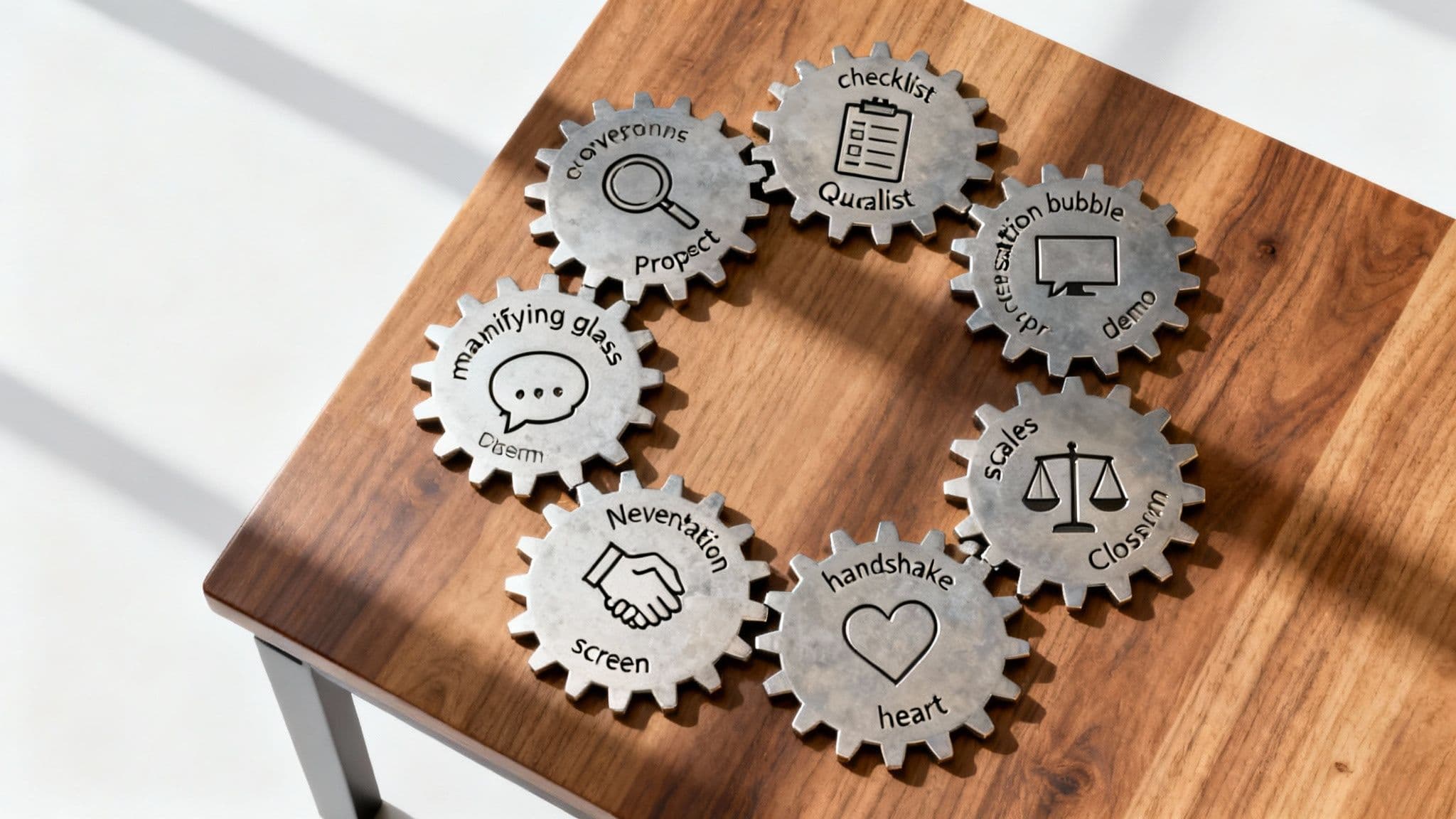
Think of a full-cycle sale as a continuous journey with a customer, not a series of separate tasks. Each stage flows into the next, building momentum and strengthening the relationship. Nailing this flow is what separates good reps from great ones.
It’s like building a bridge. Every stage is a critical support pillar. If one is weak—say, your discovery is poor or your negotiation is sloppy—the whole deal is at risk. A top-tier rep ensures every pillar is solid, from the first email to the final handshake.
This infographic simplifies the process into three core actions: Find, Close, and Manage.
As you can see, the work doesn't stop once the contract is signed. The best reps nurture the relationship to ensure long-term value.
1. Prospecting: Find Your Ideal Buyers
Prospecting is about identifying potential customers who are a perfect fit for your Ideal Customer Profile (ICP). This isn't about sending a million generic emails; it's about strategic, targeted outreach to companies with a problem you can solve. The goal isn't just to fill your funnel, but to fill it with high-quality leads.
Effective prospecting requires:
- Deep Research: Know a company’s pain points and strategic goals before you reach out.
- Smart Personalization: Write messages that speak directly to a prospect’s unique situation.
- Multi-Channel Outreach: Use a mix of email, calls, and social media to get their attention.
2. Qualification: Separate Contenders from Pretenders
Once you've made contact, it’s time to qualify. This is where you determine if a lead has the need, budget, and authority to buy. Getting this right saves you from wasting hours on deals that were never going to close.
As you move through the sales cycle, mastering your lead qualification process is essential for focusing your energy on the deals that matter. Ask the right questions to uncover the truth without making it feel like an interrogation.
The real goal of qualification isn't just to find out if they can buy. It's to understand why they should buy. A truly qualified lead has a compelling reason to change.
3. Discovery: Uncover the Real Problem
Discovery is arguably the most important stage. Here, you move from surface-level chat to a deep, meaningful conversation. By asking insightful questions and listening intently, you uncover the prospect’s biggest challenges and what their ideal solution looks like.
Think of yourself as a doctor. You wouldn't prescribe treatment without a thorough diagnosis. A great salesperson never pitches a solution until they fully understand the problem. A strong discovery phase builds the business case for you.
4. Presentation: Connect Your Solution to Their Pain
Now that you understand their needs, you can present your product as the answer. A powerful demo isn't a feature tour; it’s a story where the prospect is the hero, and your solution helps them win.
Look at the premium bicycle market. Up to 60% of purchase decisions are driven by innovations like electric motors or carbon fiber frames. A generic pitch about specs would fall flat. Instead, reps present those features as solutions to a rider’s specific goals—more speed, better endurance, or greater comfort. The pitch is always tailored to the rider's "why."
5. Negotiation: Find Common Ground
This is where you handle objections and finalize the terms—price, contract length, and implementation details. Remember, this is a collaboration, not a battle.
Anchor the conversation to value, not just price. Remind the prospect of the pains you uncovered during discovery and reinforce how your solution solves them. A successful negotiation is a win-win, where both sides feel they got a great deal.
6. Closing: Get the Signature
Closing is the finish line. All the trust you’ve built culminates here. If you’ve nailed the previous stages, closing should feel like a natural next step, not a high-pressure moment.
There are many closing techniques, but the most effective approach is almost always direct and confident. Summarize the agreed-upon terms and state the next steps to get started.
7. Nurturing: Build the Long-Term Relationship
A full-cycle rep knows the journey doesn't end when the ink dries. The final stage, nurturing, is about ensuring a smooth onboarding, checking in on their success, and cementing your role as a trusted advisor. This is how you foster loyalty, spot upsell opportunities, and generate referrals.
This step transforms a one-time sale into a long-term partnership. To see how these phases fit into the bigger picture, you can explore these essential sales pipeline stages in more detail.

“Salesmotion empowers me to cultivate a great buyer experience. I'm able to challenge prospects' thinking and be a trusted consultative seller. A major part of this is Salesmotion insights.”
Austin Friesen
Account Executive, FY25 #1 President's Club, Clari
Measuring Your Full Cycle Sales Performance
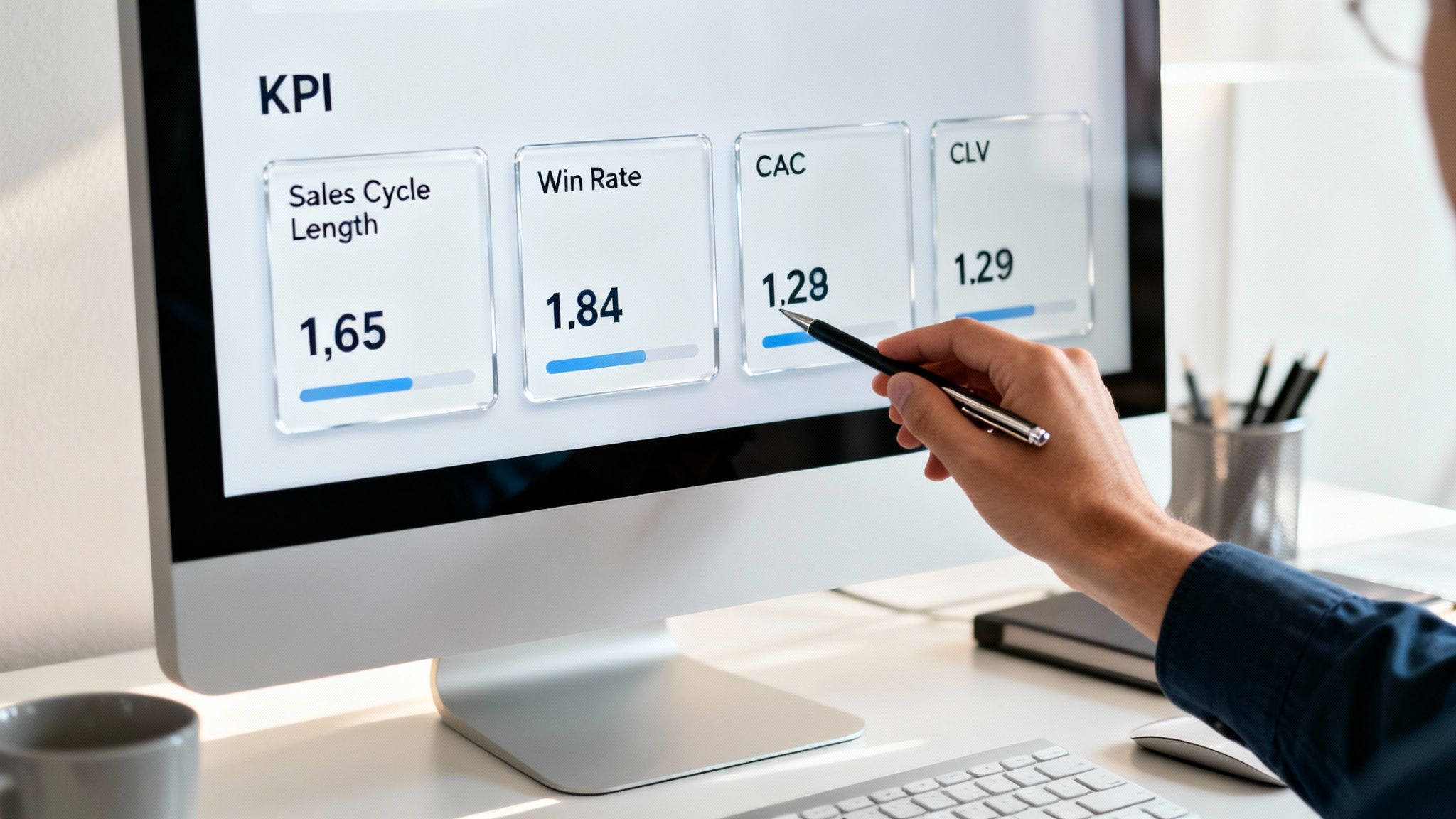
Owning the entire sales process is empowering, but you can't improve what you don't measure. You need to focus on the key performance indicators (KPIs) that define success for a full cycle sales rep. These metrics connect your daily activities to bottom-line results and help you spot bottlenecks before they kill deals.
Tracking performance isn't just about hitting quota; it's about understanding the health of your sales engine. It’s the difference between driving with a full dashboard and flying blind.
Core Metrics Every Rep Should Track
Let's break down the essential KPIs. These aren't just numbers; they tell a story about your sales motion.
1. Sales Cycle Length
This measures the time it takes to turn a new lead into a customer. To find it, add up the total days for all closed deals and divide by the number of deals.
A shorter cycle usually means more efficiency. For a full-cycle rep, a long cycle is a red flag. It might point to a stage where deals are getting stuck, like weak discovery calls or a drawn-out negotiation process.
2. Win Rate
Your win rate is the percentage of opportunities you close. Divide the number of deals you won by the total number of opportunities you worked (wins and losses).
This metric directly reflects your effectiveness. A low win rate might signal problems with lead qualification or an inability to communicate value. A high win rate shows you’re targeting the right prospects and guiding them skillfully. This is a key part of how you measure your overall sales productivity.
Customer Acquisition Cost (CAC): This metric hits the bottom line. It's the total cost to acquire one new customer, including salary, commissions, marketing, and tools. To calculate it, divide your total sales and marketing costs over a set period by the number of new customers you acquired.
A full-cycle rep has a huge impact on CAC. By owning the whole process, you can find efficiencies that drive this cost down, making every new customer more profitable.
The Ultimate Goal: Customer Lifetime Value
Finally, let's zoom out to the metric that truly matters in the long run.
Customer Lifetime Value (CLV)
This is the total revenue a business can expect from a single customer over their entire relationship. It’s a powerful metric because it shifts the focus from a single transaction to a long-term partnership—the core of the full cycle sales model.
Why does CLV matter so much?
- It Justifies Acquisition Costs: A high CLV makes it easier to justify a higher CAC.
- It Spotlights Relationship Quality: Great full-cycle reps create stickier customers with higher CLV.
- It Drives Smarter Decisions: Understanding CLV helps the business focus on acquiring and retaining its most profitable customers.
By balancing these four metrics—Sales Cycle Length, Win Rate, CAC, and CLV—you get a complete view of your performance and can make strategic improvements.
The Essential Toolkit for Full Cycle Sales Reps
Success in a full cycle sales role requires more than a charming personality. It’s a hybrid job that demands you be part strategist, part consultant, and part relationship builder. Unlike specialized reps, full-cycle reps must be chameleons, moving from prospecting to closing to nurturing with confidence.
This means you need to be good at strategic research, ask sharp discovery questions, master negotiation, and build genuine partnerships. The best reps are adaptable, resilient, and curious. They don’t just sell a product; they solve business problems.
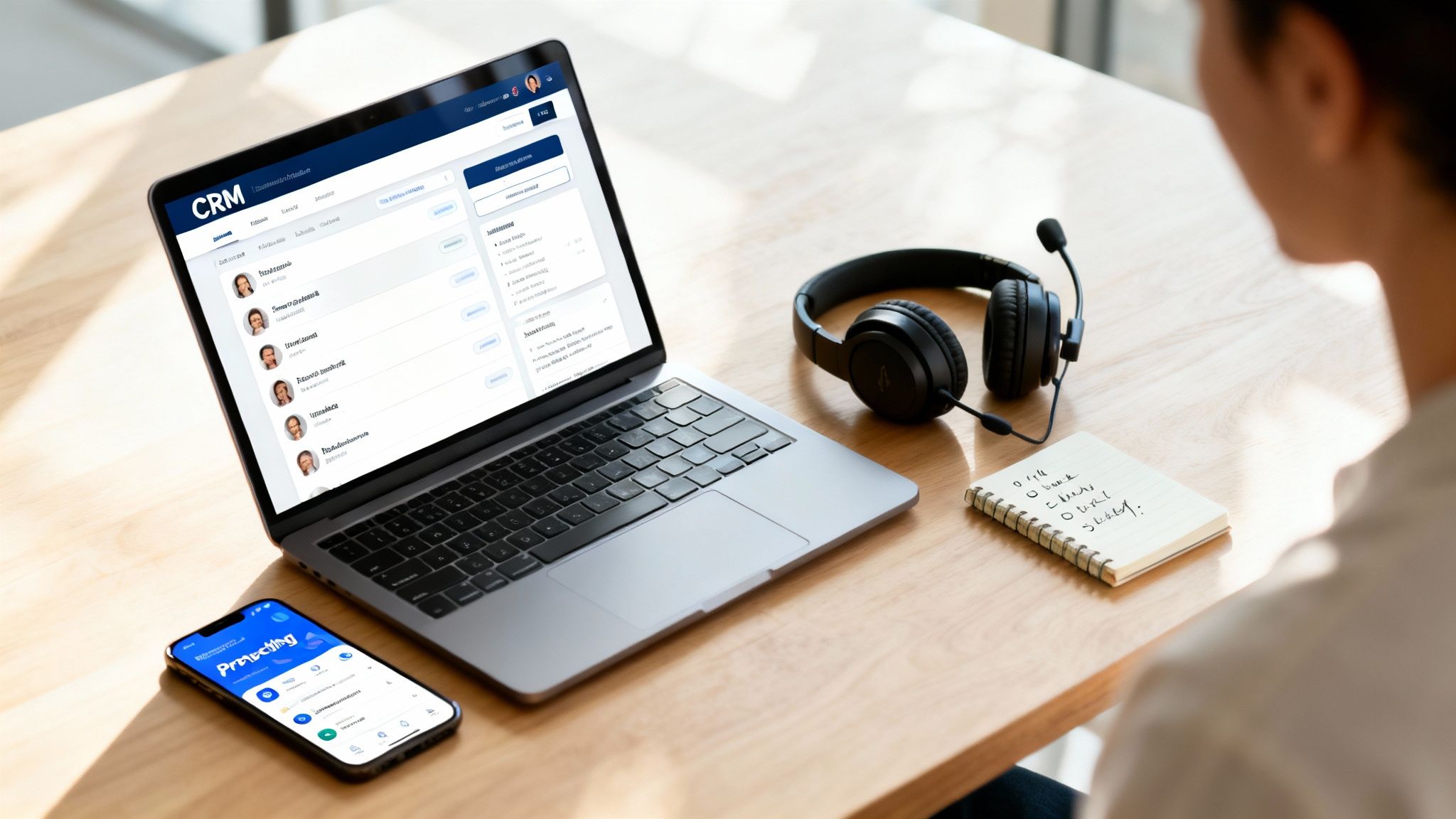
But even the most talented salesperson needs the right technology. A modern sales stack isn't a perk; it's the engine that drives efficiency and frees up reps to do what they do best—connect with people.
Building Your Modern Sales Stack
Your toolkit needs to support you at every stage of the sales journey. Think of it as an integrated system built to make you faster, smarter, and more effective.
Here are the core tools every full-cycle rep needs:
-
Customer Relationship Management (CRM): This is your command center. A solid CRM like Salesforce or HubSpot is your single source of truth for tracking interactions, managing your pipeline, and forecasting deals. You can't operate without one.
-
Prospecting and Outreach Tools: These tools help you find and engage potential buyers efficiently. Platforms like LinkedIn Sales Navigator are essential for pinpointing the right people, while outreach automation tools help manage smart, multi-channel sequences.
-
Communication and Demo Software: When it's time to connect live, you need reliable tech. Video conferencing platforms are standard for virtual meetings and demos. Call-recording software is also valuable for reviewing conversations and improving your skills.
These tools are the foundation of a great tech stack. They handle repetitive work and keep your process organized.
The Force Multiplier: AI-Powered Intelligence
The biggest game-changer for today's full cycle sales teams is the rise of AI-powered intelligence platforms. These tools go beyond simple data entry, acting as a true force multiplier for every rep.
Instead of spending hours digging through news articles and earnings reports, these platforms do the heavy lifting. They monitor your target accounts 24/7, surfacing critical buying signals and account intelligence that tell you why you should reach out and why now.
Top-performing sales reps don't win because they work harder; they win because they work smarter. AI-powered intelligence automates tedious research, freeing them to spend more time building relationships and closing deals.
This lets you move from generic outreach to highly relevant, insight-driven conversations. For example, knowing a company mentioned "supply chain optimization" on an earnings call gives you the perfect hook for your logistics solution. Full-cycle reps can also use AI-powered knowledge management tools to quickly find and organize key information.
If you want to go deeper, our guide on choosing the right sales intelligence platform breaks down what to look for. Adding these advanced tools to your stack lets reps focus on high-value activities, dramatically improving efficiency and effectiveness.

“We have very limited bandwidth, but Salesmotion was up and running in days. The template made it easy to load our accounts and embedding it in Salesforce was simple. It was one of the easiest rollouts we've done.”
Andrew Giordano
VP of Global Commercial Operations, Analytic Partners
How to Implement a Full Cycle Sales Model
Switching to a full cycle sales model is a major operational shift. You’re moving from a specialized assembly line to a world of holistic ownership. It's not an overnight change, but with a smart plan, you can build a more accountable, efficient, and customer-focused sales engine.
The journey starts with an honest assessment. Before changing anything, you need to know what’s working and what’s not. Analyze your current sales process, team structure, and performance metrics to get a clear picture of your starting point.
Redefine Your Hiring and Training
This transition requires the right people. The DNA of a top-tier full-cycle rep is different from that of a specialized SDR or AE. You're looking for a unique blend of skills and a different mindset.
Your new hiring profile should focus on:
- Versatility: Find people who are as comfortable prospecting as they are negotiating.
- Strategic Thinking: They need to see the entire sales process and understand how each stage connects.
- Resilience and Ownership: This role has a ton of accountability. You need someone who can manage a diverse workload.
Once you find these people, training is critical. Your program must cover the entire sales journey, from prospecting tactics to post-sale relationship management. Ongoing coaching is crucial to help reps sharpen their skills across every stage.
Create a Step-by-Step Implementation Plan
The best way to roll out a full-cycle model is in phases. This minimizes disruption and allows you to learn and adjust as you go.
-
Pilot Program: Start with a small, dedicated team. Handpick a few adaptable reps to pilot the new model. This provides a controlled environment to test workflows, tweak compensation, and get feedback without disrupting the entire sales floor.
-
Set Clear Benchmarks: Define what success looks like for the pilot team. Set realistic KPIs that cover the entire funnel, like lead-to-close time, win rate, and average deal size.
-
Gather Feedback and Iterate: Check in with the pilot team constantly. What are their challenges? What support do they need? Use their insights to refine the process before a wider rollout.
-
Scale Methodically: Once the pilot is running smoothly and hitting its targets, you can start expanding. Roll the model out team by team or region by region, ensuring each group receives the same training and support.
A full cycle sales model shines in environments with complex products, longer sales cycles, and a high demand for consultative selling. It's where deep, trust-based relationships directly translate into revenue.
This model is a game-changer in certain markets. The global bicycle market, for example, requires a full-cycle strategy to manage intricate buying journeys. Success there hinges on integrating everything from product availability to after-sales service—a perfect use case for an end-to-end sales approach.
Ultimately, a successful transition requires a clear vision, the right talent, and a commitment to continuous improvement.
Common Mistakes to Avoid in Full Cycle Sales
The full cycle sales model can be incredibly powerful, but it’s not a magic bullet. Diving in without anticipating roadblocks is a recipe for frustration and burnout.
Knowing what can go wrong is the first step. One of the biggest risks is spreading reps too thin. When one person juggles prospecting, demos, and nurturing, they can become a "jack of all trades, master of none." Their skills get diluted, and performance can suffer.
Becoming a Generalist Instead of an Expert
In a specialized model, reps become experts at one thing. The danger in a full-cycle role is that a rep might lean on their strengths—for example, they're a fantastic closer—but let their prospecting pipeline dry up. This imbalance creates a stressful feast-or-famine cycle.
Commit to continuous, end-to-end training to prevent this. Don't just run workshops on closing; train your team on advanced prospecting and consultative discovery. The goal is to build well-rounded experts, not generalists.
Underestimating the Burnout Factor
Jumping between prospecting, negotiating, and post-sale check-ins is mentally draining. Constant context-switching can lead to burnout fast, which kills morale and drives up employee turnover.
Here’s how to fight it proactively:
- Automate Ruthlessly: Use your tech stack to handle repetitive, low-value work like data entry and scheduling.
- Protect Prospecting Time: Block off dedicated "prospecting hours" on the calendar each week to keep the pipeline healthy.
- Celebrate Small Wins: Don't just celebrate closed deals. Acknowledge a great discovery call or a creative outreach email to keep motivation high.
The biggest mistake leaders make is assuming a great closer will automatically be a great prospector. A successful full cycle sales implementation requires a deliberate strategy to build and support a complete, end-to-end skill set.
Failing to Scale Effectively
What works for a team of five reps will fall apart at fifty. The full-cycle model leans heavily on individual talent and autonomy. As you grow, that's not enough.
Without standardized processes, clear playbooks, and a strong coaching culture, quality and consistency will suffer. Building a scalable system—not just relying on a few star players—is the only way a full-cycle model can succeed in the long run.
Key Takeaways
- Full cycle sales means one rep owns the entire customer journey from prospecting to close and beyond, creating deeper relationships and eliminating the friction of constant handoffs between SDRs, AEs, and CSMs.
- This model thrives in environments with complex deals, smaller teams, or long sales cycles where continuity and trust are critical, but it requires reps who can excel at both prospecting and closing.
- Effective time management is the biggest challenge for full-cycle reps -- protecting dedicated prospecting blocks, automating low-value tasks, and balancing pipeline building with deal closing are essential for sustained success.
- Account intelligence and AI tools are force multipliers for full-cycle reps, automating the research and signal detection that would otherwise consume hours each week and enabling personalized outreach at scale.
- The biggest leadership mistake is assuming a great closer will automatically be a great prospector -- successful implementation requires deliberate coaching, clear playbooks, and standardized processes that support the complete skill set.
Full Cycle Sales: Your Questions Answered
Even with a solid plan, a few questions always come up when teams consider a full cycle model. Let's tackle the most common ones.
Is This Model a Fit for Every Company?
No. The full cycle model is a powerhouse in the right environment, but it isn't a universal solution. It shines for companies with:
- Complex Products: When your solution requires a consultative sales approach, a single guide is more effective than multiple handoffs.
- Longer Sales Cycles: For deals that take months, the consistent relationship a full-cycle rep builds keeps the momentum going.
- High-Value Deals: When the price is high, the rapport and confidence developed over time directly influence the decision.
Startups and smaller sales teams also benefit greatly from this model. It maximizes the impact of every hire before you have the scale to specialize roles.
How Do You Actually Train a Full Cycle Sales Rep?
Training a true full-cycle rep requires an ongoing commitment, not a one-time bootcamp. You're building a well-rounded expert, not a generalist.
A great program includes dedicated training for every stage of the cycle, from advanced prospecting workshops to negotiation role-plays and strategic account management. Pair newer reps with seasoned veterans for mentorship and use call recordings for targeted coaching. It’s a continuous process.
What's the Biggest Mindset Shift People Need to Make?
The biggest shift is moving from thinking about a specific stage to taking total ownership. In a specialized model, an SDR's job ends when a meeting is booked. An AE moves on after the contract is signed.
A full cycle sales professional thinks like a business owner. They know they're accountable for the entire customer journey, and their success is tied to the long-term health of that relationship—not just one closed deal.
This long-term, relationship-first view is what defines a successful full-cycle mindset. It shifts the goal from just hitting a quota to creating genuine, lasting customer value. That's the game-changer.
Stop wasting hours on manual research and start having more insight-driven conversations. Salesmotion is an AI-powered account intelligence platform that delivers real-time buying signals and automated account briefs directly to your team, so you can focus on what you do best: selling. Discover how Salesmotion can accelerate your pipeline.
Frequently Asked Questions
What is full-cycle sales?
Full-cycle sales is a model where one salesperson owns the entire customer journey from prospecting and qualification through closing and post-sale relationship management. Instead of handing the customer off between SDRs, AEs, and CSMs, a single rep serves as the consistent point of contact, building deeper trust and eliminating the friction that comes with constant handoffs.
When does the full-cycle sales model work best?
The full-cycle model thrives in environments with complex products, longer sales cycles, and high-value deals where trust and continuity are critical. It is also well suited for startups and smaller sales teams that need to maximize the impact of every hire before they have the scale to specialize roles. Companies selling consultative solutions where deep customer understanding drives deal outcomes see the strongest results.
What are the seven stages of the full-cycle sales process?
The seven stages are prospecting (finding ideal buyers), qualification (determining fit and intent), discovery (uncovering the real problem), presentation (connecting your solution to their pain), negotiation (finding common ground on terms), closing (getting the signature), and nurturing (building the long-term relationship). Each stage builds on the last, and a weakness in any one area puts the entire deal at risk.
What is the biggest challenge for full-cycle sales reps?
The biggest challenge is effective time management. Full-cycle reps must balance prospecting for new business with managing active deals and nurturing existing relationships, which creates a constant risk of context-switching fatigue and burnout. Protecting dedicated prospecting blocks, automating low-value tasks, and using AI-powered intelligence tools to reduce research time are essential strategies for sustained success.
How do you measure success in a full-cycle sales model?
The four essential metrics are sales cycle length (time from lead to close), win rate (percentage of opportunities closed), customer acquisition cost (total cost to acquire one new customer), and customer lifetime value (total revenue expected from a customer over the full relationship). Tracking these together gives a complete view of both efficiency and long-term profitability.
Can you transition from a specialized sales model to full-cycle sales?
Yes, but it requires a phased approach. Start with a pilot program using a small team of adaptable reps, set clear benchmarks covering the full funnel, and gather feedback before scaling. The transition also demands updated hiring profiles that prioritize versatility and strategic thinking, along with training programs that cover every stage of the sales process rather than just one specialty.