In today's market, generic account management leads to churn. Keeping customers happy isn't enough; you need to be a strategic partner, driving value and finding growth opportunities. But old-school manual research and reactive check-ins don't cut it anymore. To succeed, you need a proactive, disciplined approach.
This guide cuts through the noise and gives you the best practices for account management that your revenue team can use today. Whether you're an SDR, AE, CSM, or a revenue leader, these principles provide a clear roadmap. We'll break down 10 specific, actionable strategies that separate top performers from the rest, showing you how to build a proactive, insight-driven engine for retention and expansion. You'll learn how to move beyond basic relationship maintenance and start building long-term, profitable partnerships.
We'll cover everything from strategic planning and segmentation to showing tangible ROI and building strong stakeholder relationships. For those aiming to improve executive-level engagement, understanding a comprehensive approach like Mastering Commercial Banking Relationship Management is helpful, as it emphasizes data-driven strategies. This playbook gives you the structure and tactics to turn your accounts from simple customers into strategic assets, ensuring you prevent churn and consistently capture new revenue. Let's dive in.
1. Account Planning and Strategy
Good account management is proactive, not reactive. The foundation is a solid, written account plan for each of your key clients. This document is more than a contact list; it's a roadmap detailing goals, growth opportunities, and tactics for strengthening the partnership over the next 12 to 24 months. It’s one of the most critical best practices for account management because it forces you to think strategically and long-term.
The process involves a deep dive into the client's business—their market position, challenges, and strategic goals. For a broader set of tactics, see our guide to account management strategies that drive retention and expansion. For platform comparisons, review our list of top strategic account planning companies. Major players like IBM, Salesforce, and Microsoft built their dominance by embedding this method into their culture. They don't just sell products; they map their solutions directly to their clients' long-term outcomes, a process that starts with a well-crafted account plan.

How to Implement Strategic Account Planning
To build a useful account plan, focus on collaboration and regular reviews. A plan created in a silo is doomed to fail.
- Involve Client Stakeholders: The best plans are co-created. Work with your key contacts and champions to align on goals and ensure the plan reflects their top priorities. This creates buy-in from the start.
- Document Everything: Clearly outline assumptions, dependencies, and potential risks. Who needs to be involved for a project to succeed? What internal roadblocks might you face? Naming these factors upfront allows for proactive problem-solving.
- Establish a Review Cadence: An account plan is a living document. Schedule quarterly business reviews (QBRs) with internal and client teams to track progress, adjust tactics, and re-evaluate priorities.
By making account planning a structured, repeatable process, you ensure consistency and strategic focus across all high-value accounts. For those getting started, using a structured approach is key. You can build stronger strategies with these sales account plan templates and examples.
Skip the comparison fatigue?
If you're shopping for a sales intelligence tool, here's the short version.
Salesmotion combines account intel, buying signals, verified contacts, and AI-drafted outreach in one tool. From $85/mo, live in an hour, no annual contract.
2. Regular Business Reviews (RBRs)
While an account plan sets the long-term vision, Regular Business Reviews (RBRs) are the scheduled check-ins that make sure that vision becomes a reality. These recurring meetings (usually quarterly) are formal touchpoints where you and key client stakeholders review performance, celebrate wins, address challenges, and align on what's next. This cadence is one of the most vital best practices for account management because it elevates the relationship from a simple vendor-client dynamic to a strategic partnership focused on mutual growth.
RBRs are the operational heartbeat of a healthy account. They provide a dedicated forum to show your value and reinforce strategic alignment. Industry leaders like AWS, Deloitte, and Accenture have made this practice standard, using executive business reviews to solidify partnerships with their biggest accounts. They don't just report on usage stats; they connect their service's performance directly to the client's high-level business outcomes, ensuring they're seen as an indispensable partner.

How to Implement Regular Business Reviews
A good RBR is a well-planned, value-driven meeting, not just a casual check-in. The goal is to leave the client feeling confident and informed.
- Prepare Meticulously: Start preparing your presentation and data 1-2 weeks in advance. Send a clear agenda beforehand so everyone arrives prepared and aligned on discussion topics.
- Focus on Business Outcomes: While activity metrics are useful, always lead with the business outcomes your partnership has delivered. How did your solution impact their revenue, efficiency, or strategic goals?
- Be Proactive with Recommendations: Don't just present data; interpret it. Come prepared with specific, data-backed recommendations for improvement or new initiatives that can drive even greater value next quarter.
- Document and Follow Through: Send a summary of meeting notes, key decisions, and clear action items with owners and deadlines within 24 hours. This creates accountability and keeps things moving between reviews.

“Salesmotion empowers me to cultivate a great buyer experience. I'm able to challenge prospects' thinking and be a trusted consultative seller. A major part of this is Salesmotion insights.”
Austin Friesen
Account Executive, FY25 #1 President's Club, Clari
3. Customer Success and Health Scoring
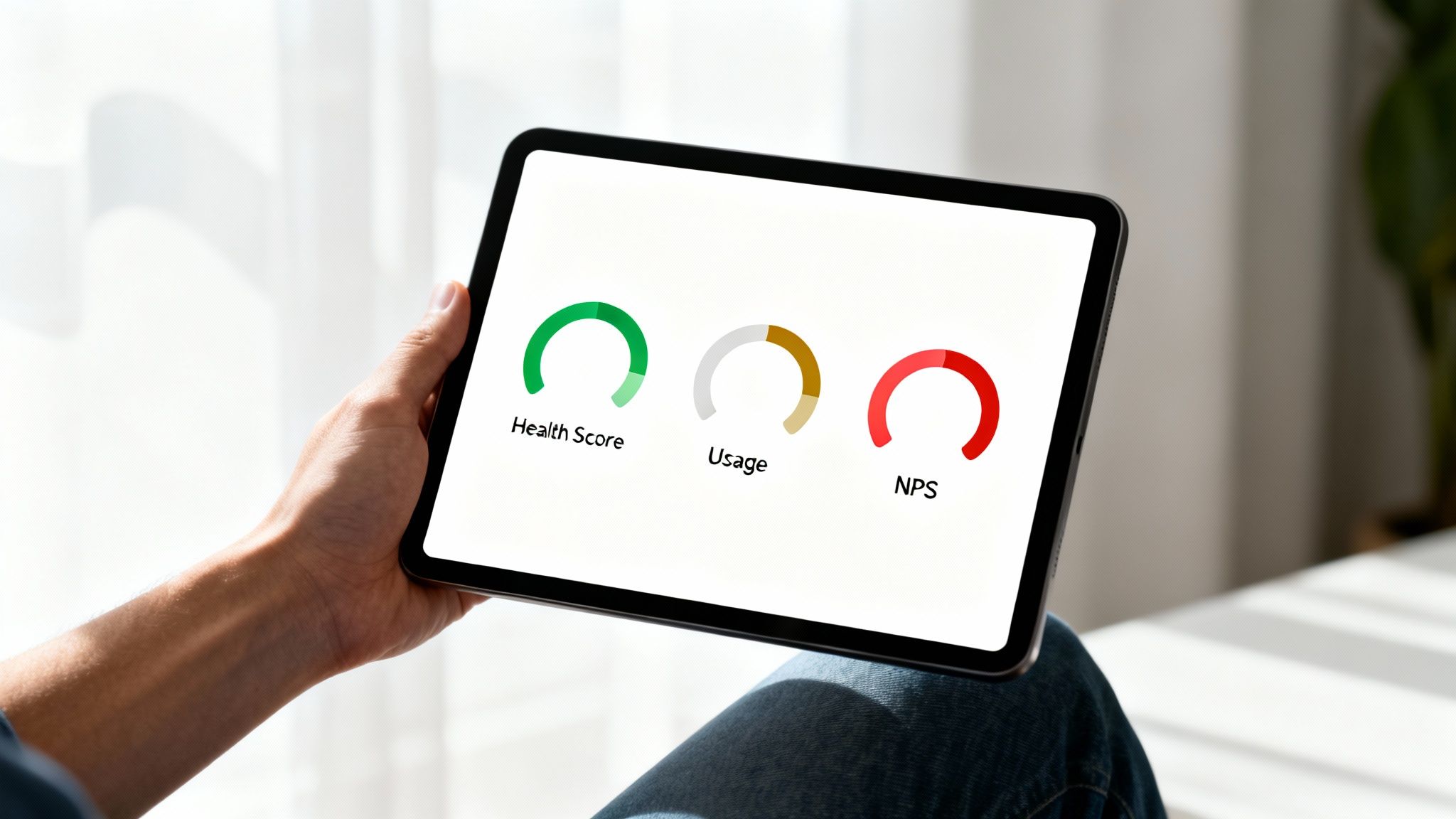
Reactive problem-solving is the enemy of great account management. To get ahead of churn and spot expansion opportunities, you need a data-driven way to measure client satisfaction and engagement. That's where customer health scoring comes in—a method for quantifying account wellness by combining multiple data points into a single, actionable score. Implementing this system is one of the most impactful best practices for account management because it acts as an early warning system, letting you intervene before minor issues become major problems.
Pioneered by customer success platforms like Gainsight and Totango, this approach moves beyond gut feelings. It uses a weighted algorithm that considers factors like product usage, support ticket volume, survey responses (like NPS), and payment history. This gives you a real-time view of the client relationship, helping you focus your efforts on accounts that are at risk or primed for growth, not just the loudest ones.
How to Implement Customer Health Scoring
A useful health score is tailored to your business and clients. It should be dynamic, transparent, and built into your daily workflow to drive proactive engagement.
- Start with Key Metrics: Don't overcomplicate it at first. Begin by picking 5-8 core metrics that are strong indicators of success for your customers, such as daily active users, feature adoption rates, or recent login frequency.
- Align Scoring to Business Goals: Assign different weights to your metrics based on what matters most. For a SaaS company, high product usage might be weighted more heavily than the number of support tickets.
- Automate Proactive Alerts: Set up your CRM or customer success platform to trigger alerts when an account's health score drops below a certain point. This lets your team engage immediately with a predefined playbook to get the account back on track.
By systematically tracking account health, you transform your team from firefighters into strategic advisors. To learn more about building these systems, explore these proven customer success strategies.
4. Executive and Stakeholder Relationship Management
Success in a strategic account rarely depends on a single contact. To truly entrench yourself, you need a systematic approach to mapping, managing, and developing relationships across multiple levels and departments. This means identifying and engaging with the entire buying committee—from decision-makers and influencers to the ultimate economic buyers. This is a cornerstone of best practices for account management because it turns a vendor-client relationship into a multi-threaded partnership, making it far more resilient.
This method is deeply embedded in the go-to-market strategies of top consulting and software firms like McKinsey, SAP, and Salesforce. They excel at building a web of influence by cultivating relationships at every level, from operational managers to the C-suite. By engaging stakeholders throughout the client's organization, they ensure their solutions are aligned not just with one department's needs but with the company's overall strategic goals.

How to Implement Stakeholder Relationship Management
Building a robust relationship map takes deliberate effort. It's about moving beyond your champion and understanding the entire political landscape of the account.
- Map the Organization: Create a detailed org chart for each key account. Identify not just titles, but roles in the buying process: who influences decisions, who holds the budget, and who will be a user? Tools like LinkedIn are invaluable for this.
- Assign Relationship Owners: Your account team should mirror the client's structure. Assign specific team members to build and maintain relationships with their counterparts, ensuring relevant communication at every level.
- Develop Role-Specific Value: The CFO cares about different outcomes than the Head of IT. Tailor your messaging and value propositions for each stakeholder, focusing on the metrics and objectives that matter most to their role. For a deeper dive, read more about how to engage the economic buyer.
- Facilitate Executive Connections: One of the most powerful strategies is connecting your executives with theirs. These peer-to-peer conversations build trust and strategic alignment at the highest levels, solidifying the partnership.

“We have very limited bandwidth, but Salesmotion was up and running in days. The template made it easy to load our accounts and embedding it in Salesforce was simple. It was one of the easiest rollouts we've done.”
Andrew Giordano
VP of Global Commercial Operations, Analytic Partners
5. Value Realization and ROI Demonstration
Simply selling a solution isn't enough; you have to prove its worth. Value realization is the process of quantifying, tracking, and communicating the business impact and return on investment (ROI) your clients get from your product or service. This proactive approach ensures customers see tangible results, reinforcing their decision to work with you. It is one of the most crucial best practices for account management because it shifts the conversation from cost to investment, directly linking your solution to the client's success.
This method is standard for top-tier enterprise software companies. For instance, Anaplan runs dedicated value realization programs to show how its platform impacts financial planning, while ServiceNow provides clear demonstrations of IT operations value. These companies don't leave ROI to chance; they build a business case from day one and continuously prove it, solidifying long-term loyalty. This strategy is central to an effective value selling framework.
How to Implement Value Realization
To effectively demonstrate ROI, you must integrate value tracking into every stage of the client lifecycle. It requires a disciplined, data-driven approach.
- Define Metrics Early: Establish clear, quantifiable success metrics and KPIs during the sales or negotiation phase. Work with the client to define what success looks like and how it will be measured.
- Establish a Baseline: Before implementation, capture baseline performance data. Without a starting point, it's impossible to accurately measure improvement and show the "before and after" impact.
- Conduct Regular Value Reviews: Schedule dedicated quarterly or semi-annual meetings focused solely on value. Use simple, visual ROI dashboards to present progress against the agreed-upon metrics, showing both quantitative and qualitative benefits.
6. Consultative Selling and Solution Selling
Great account managers act less like salespeople and more like trusted advisors. This shift is the core of consultative and solution selling, an approach where you prioritize understanding a client's challenges and goals before ever mentioning your product. It’s one of the most impactful best practices for account management because it transforms the relationship from a transactional dynamic into a strategic partnership focused on mutual success.
Pioneered by methods like SPIN Selling, this approach is standard for elite enterprise organizations. Consulting giants like McKinsey and Accenture built their entire business models on this principle, focusing on diagnosing problems and co-creating solutions. Similarly, tech leaders like Salesforce and Microsoft empower their account teams to act as solution architects, mapping their products to solve specific, high-level business problems rather than just pushing features.
How to Implement Consultative and Solution Selling
To become a consultative partner, lead with curiosity and focus on creating value in every conversation. Your primary goal is to diagnose, not to pitch.
- Lead with Insightful Questions: Instead of starting with your solution, ask open-ended questions that uncover the root causes of their challenges. What are their top priorities for the next 18 months? What's stopping them from reaching those goals?
- Prioritize Business Outcomes Over Features: Frame your solution in the language of business value. Connect every feature directly to a tangible outcome, such as reducing costs by 15% or increasing customer retention by 5%.
- Listen More Than You Talk: The classic 80/20 rule applies here. Spend 80% of your time listening to the client's needs and goals. This deep understanding allows you to tailor a solution that truly solves their most critical problems.
By adopting a consultative approach, you position yourself as an indispensable resource. You move beyond being a vendor and become a strategic advisor whose insights are integral to the client’s success.
7. Account Segmentation and Prioritization
Not all accounts are created equal, and treating them the same is a recipe for wasted resources. Strategic account segmentation means categorizing your client base into tiers based on their potential value and strategic importance. This framework lets you dedicate your best resources to high-potential accounts while efficiently managing others. It's one of the most fundamental best practices for account management for scaling revenue teams.
This tiered approach ensures that your time and effort are proportional to the potential return. For instance, major B2B companies like Salesforce and AWS built their empires on sophisticated segmentation. They don't offer the same level of hands-on support to a small startup as they do to a Fortune 500 enterprise. This is strategic allocation in action, allowing them to maximize growth from top-tier clients while effectively serving the broader market.
How to Implement Account Segmentation
Effective segmentation requires clear criteria and consistent application. The goal is to create a system that guides how you allocate resources and engage with your portfolio.
- Establish Clear Criteria: Define the metrics that will determine an account's tier. Common criteria include annual recurring revenue (ARR), growth potential, and strategic importance. Create clear thresholds for each tier, such as Strategic, Core, and Transactional.
- Create Segment-Specific Playbooks: Develop tailored engagement plans for each segment. A Strategic account might get a dedicated account manager and QBRs, while a Transactional account might be managed through a pooled model with tech-touch and digital communication.
- Review and Re-evaluate Annually: Markets and clients change. Make it a formal process to review and re-segment your accounts at least once a year. This ensures your classifications remain accurate and your resource allocation stays aligned with current potential.
By segmenting accounts, you create a focused, scalable model that aligns your team's efforts with your most significant growth opportunities. For more on this, the Strategic Account Management Association (SAMA) offers extensive resources on building these frameworks.
8. Proactive Issue Management and Risk Mitigation
Excellent account management isn't just about creating value; it's also about protecting it. A systematic approach to identifying and neutralizing potential risks before they escalate is a hallmark of high-performing teams. This means moving from reactive "firefighting" to a proactive process of monitoring account health and mitigating risks that could jeopardize retention and growth. This is one of the most vital best practices for account management because it builds trust and shows the client you are safeguarding their success.
This methodology is deeply embedded in enterprise-level service delivery. Professional services firms and cloud providers like AWS have perfected this through rigorous incident management systems. They understand that problems are inevitable; having a structured, transparent process for resolution is what separates a minor hiccup from a relationship-ending catastrophe. It turns potential negatives into opportunities to prove your team's reliability.
How to Implement Proactive Risk Mitigation
To build an effective issue management framework, focus on structure, communication, and continuous improvement. A random approach creates more chaos than it solves.
- Establish Clear Protocols: Define issue categories and severity levels (e.g., Critical, High, Medium, Low) so the team can prioritize effectively. Create a documented escalation path that clearly outlines who is responsible for what at each stage.
- Maintain a Central Issues Log: Use a CRM or project management tool to track all open issues. This log should include the issue description, severity, owner, status, and target resolution date, providing a single source of truth.
- Communicate Proactively: Never let a client wonder about the status of their issue. Provide regular, honest updates even if the news isn't what they want to hear. This transparency builds immense trust.
- Conduct Post-Resolution Reviews: After a significant issue is resolved, conduct a "post-mortem" to understand the root cause. This helps you identify systemic problems and implement preventative measures to improve over time.
9. Cross-Functional Team Collaboration and Alignment
No account manager is an island. Elite account management requires a coordinated team effort where sales, customer success, product, and support work together to deliver a seamless customer experience. This structured approach ensures the client receives consistent value at every touchpoint. Implementing cross-functional alignment is one of the most powerful best practices for account management because it shifts the burden from a single person to a well-oiled team, unified by a shared vision for the client's success.
This model is the standard for major enterprise players who understand that complex client needs can't be met by siloed departments. Companies like Salesforce and Microsoft build dedicated account teams with specialists from various functions to surround their most strategic clients. They know a technical issue requires product expertise, and a renewal conversation needs sales insight. This integrated structure prevents conflicting messages and ensures the client always interacts with the right expert.
How to Implement Cross-Functional Alignment
To build an effective account team, focus on clear communication, defined roles, and shared accountability. A lack of structure leads to confusion and a disjointed customer experience.
- Establish a Clear Account Team Structure: For each key account, formally define the team members and their roles. Designate a primary account manager who acts as the central point of coordination, ensuring everyone understands their responsibilities.
- Create Shared Visibility: Use collaboration tools and shared dashboards (within your CRM or a platform like Salesmotion) to maintain a single source of truth for all account activities, health scores, and communications. This transparency ensures everyone is on the same page.
- Implement a Regular Sync Cadence: Schedule bi-weekly or monthly account team meetings to review progress, discuss challenges, and align on next steps. These syncs are crucial for proactive problem-solving and maintaining strategic momentum.
By embedding collaboration into your process, you create a powerful support system that enhances value delivery and strengthens client relationships. The Strategic Account Management Association (SAMA) has long advocated for this team-based approach.
10. Continuous Learning and Knowledge Management
Top-tier account teams don’t just execute; they learn, adapt, and scale their successes. Continuous learning and knowledge management means systematically capturing, organizing, and sharing crucial information like customer insights, best practices, and competitive intelligence. This turns individual wins into a collective, repeatable advantage. It's one of the most impactful best practices for account management because it creates a strategic asset that compounds over time, enabling the entire team to operate with greater intelligence and consistency.
This approach is the lifeblood of elite consulting firms like McKinsey and Deloitte. They have built empires by creating powerful internal knowledge management systems that allow any consultant to leverage the firm’s entire history of client work. In the same way, tech giants like Salesforce and Oracle use robust knowledge platforms to ensure their account managers are always equipped with the latest product updates, competitive battle cards, and successful customer case studies.
How to Implement Continuous Learning and Knowledge Management
Building a culture of shared knowledge requires structure and deliberate effort. The goal is to make accessing collective wisdom easier than rediscovering it alone.
- Create a Central Knowledge Hub: Establish a single source of truth using a tool like Notion, a shared drive, or a dedicated platform. This is where you'll store templates, case studies, win/loss analyses, and competitive intelligence.
- Standardize and Document: Develop standardized templates for key documents like account plans and QBR decks. After significant events, like a major renewal or a lost deal, document the lessons learned and add them to the hub.
- Incentivize Contribution: Actively encourage and reward team members for sharing valuable insights or mentoring peers. This could involve recognition in team meetings or small incentives, making knowledge sharing a core part of the team culture.
Top 10 Account Management Best Practices Comparison
| Approach | Implementation complexity | Resource requirements | Expected outcomes | Ideal use cases | Key advantages |
|---|---|---|---|---|---|
| Account Planning and Strategy | High — multi-year plans and analysis | High — senior time, cross-functional involvement | Aligned growth roadmap; increased revenue and retention | Strategic or enterprise accounts with growth potential | Proactive, strategic alignment across teams |
| Regular Business Reviews (RBRs) | Medium — recurring preparation and facilitation | Medium — analytics, executive participation | Clear performance visibility; early risk detection | Large clients needing periodic alignment (quarterly) | Structured engagement; KPI-driven discussions |
| Customer Success and Health Scoring | High — data integration and modeling | High — tooling, data, CS resources | Proactive churn prevention; improved forecasting | Product-led / SaaS accounts with usage data | Data-driven risk detection and prioritization |
| Executive & Stakeholder Relationship Management | High — mapping and diplomatic engagement | Medium–High — senior relationship time | Access to decision-makers; larger deals; renewal protection | Enterprise accounts with multi-stakeholder buying cycles | Reduces single-point dependency; enables expansion |
| Value Realization & ROI Demonstration | Medium–High — measurement and reporting | Medium — analytics, client collaboration | Demonstrated business impact; higher renewals/upsell | High-investment solutions requiring quantified ROI | Tangible proof of value to justify spend |
| Consultative & Solution Selling | Medium — training and deep discovery | Medium — skilled reps, time for customization | Larger, outcome-focused deals; stronger trust | Complex B2B sales needing tailored solutions | Differentiates on value; reduces price competition |
| Account Segmentation & Prioritization | Low–Medium — criteria and governance setup | Low–Medium — data and decision frameworks | Better resource allocation; improved ROI on effort | Large, diverse account portfolios | Focuses resources where impact is highest |
| Proactive Issue Management & Risk Mitigation | Medium — processes and escalation paths | Medium — tracking tools, cross-functional effort | Fewer escalations; faster resolution; reduced churn | High-complexity implementations or support-heavy accounts | Prevents small problems from becoming critical |
| Cross-Functional Team Collaboration & Alignment | Medium–High — coordination and governance | High — multiple teams’ time and shared tools | Consistent customer experience; faster delivery | Accounts requiring combined services and specialists | Unified delivery; breaks down internal silos |
| Continuous Learning & Knowledge Management | Medium — platform and content governance | Medium — content creation, maintenance, adoption | Faster onboarding; consistent best practices; retained knowledge | Organizations scaling account teams or with turnover | Preserves institutional knowledge; improves consistency |
Key Takeaways
- Strategic account planning is the foundation of effective account management; a written plan for each key client forces long-term thinking and ensures every interaction is purposeful.
- Regular Business Reviews elevate the relationship from vendor-client to strategic partnership by focusing on business outcomes, not just activity metrics.
- Customer health scoring acts as an early warning system, combining data points like product usage, support tickets, and NPS to flag at-risk accounts before problems escalate.
- Multi-threading across executive and stakeholder levels protects your position when champions leave and opens doors to expansion opportunities across departments.
- Value realization through quantifiable ROI demonstration shifts conversations from cost to investment, directly strengthening renewal and upsell outcomes.
- The challenge is not knowing what to do but doing it consistently at scale, which is why embedding real-time intelligence into daily workflows transforms these best practices from theory into operational reality.
Putting It All Together: The Future is Automated and Insight-Driven
We’ve covered ten essential best practices for account management, from foundational planning to the nuances of stakeholder relationships and value realization. Each practice—whether it's conducting rigorous RBRs or fostering deep cross-functional collaboration—is a critical pillar for a world-class revenue organization. The common thread is a commitment to moving beyond a transactional mindset. The goal is to become an indispensable, proactive partner embedded in your customer's success.
The challenge, however, isn’t knowing what to do; it’s doing it consistently and at scale. Manually building account plans, tracking customer health, and preparing for executive conversations is a huge, time-consuming effort. Your teams get bogged down in admin tasks, leaving little time for the high-value, strategic work that actually drives growth. This is where the paradigm shifts from manual effort to intelligent automation.
The Unifying Force: From Data Overload to Actionable Intelligence
Mastering modern account management means turning a firehose of information into a clear, actionable point of view. Think about all the signals available today: earnings call transcripts, new executive hires on LinkedIn, strategy shifts in 10-K filings, and public sentiment. Manually tracking this for every key account is impossible. This is why the future of elite account management is tied to technology that automates insight generation. For a tactical breakdown, see our guide to key account management strategies.
The most effective revenue teams leverage AI-powered platforms to do the heavy lifting. These systems don't just aggregate data; they synthesize it. For instance, instead of just noting a new CIO was hired, an intelligent system can analyze their past projects to predict their tech priorities, arming your team with a relevant conversation starter. Similarly, to stay ahead of market trends, many teams now use AI social listening tools for brand monitoring and sentiment analysis to capture public signals that indicate risk or opportunity.
Making Best Practices Your Operational Reality
The true value of adopting these best practices for account management comes when they become a seamless part of your team's daily workflow, not just a checklist. Here’s how to put them into practice:
- Embed Intelligence into Your Cadence: Integrate real-time account intelligence directly into your existing processes. Before an RBR, your team should automatically get a brief summarizing key business changes, relevant news, and potential talking points.
- Align Around a Single Source of Truth: Centralize your account plans, stakeholder maps, and health scores in a system that everyone from SDRs to CSMs and revenue leaders can access. This eliminates silos and ensures the entire team works with the same up-to-the-minute context.
- Focus on Proactive, Value-Based Triggers: Shift from reactive firefighting to proactive engagement. Technology can create automated alerts for trigger events—a competitor's contract is up for renewal, a key champion changes roles, or the company announces a new market expansion. Each alert is a reason to engage with a highly relevant message.
Ultimately, elevating your account management is about empowering your people. By automating the research and analysis behind every best practice discussed, you free your team to do what they do best: build meaningful relationships, solve complex problems, and act as strategic advisors. This approach transforms account management from a defensive cost center into a powerful, proactive engine for revenue growth.
Frequently Asked Questions
What is the most important account management best practice to implement first?
Start with strategic account planning. A written plan for each key client creates the structure needed for every other best practice to work. Without a documented strategy covering goals, stakeholders, and growth opportunities, efforts like business reviews and health scoring lack direction and consistency.
How do I build a customer health score without expensive tools?
Begin with a simple spreadsheet model using five to eight core indicators: product login frequency, support ticket volume, NPS or CSAT scores, feature adoption rate, and payment history. Assign weights based on what best predicts churn or expansion in your business. As the model matures, migrate it into your CRM or a dedicated customer success platform.
How often should account plans be reviewed?
Conduct a formal deep-dive review quarterly for your top-tier accounts. Between quarterly reviews, update plans in real time whenever a significant event occurs, such as an executive departure, a new strategic initiative, or a competitive threat. The goal is to keep the plan as a living document rather than a static artifact.
How do I get buy-in from leadership for investing in account management practices?
Build a business case by comparing the performance of accounts with active plans against those without. Show metrics like higher net revenue retention, larger deal sizes, and shorter sales cycles in planned accounts. Frame the investment as a revenue growth engine rather than an operational cost, and start with a small pilot to prove results before scaling.
Ready to turn these best practices into your team's daily reality? Salesmotion is an AI-powered account intelligence platform that automates the research and provides the actionable insights your team needs to execute flawlessly. Stop drowning in data and start driving revenue by visiting Salesmotion to see how we transform your account management workflow.