Comparison
Databook focuses on financial analysis and C-suite selling for Fortune 500 accounts. Salesmotion delivers broader, real-time account intelligence that helps every rep sell smarter. Here is how these platforms compare and when to use each.
 By Semir JahicCEO & Co-Founder, SalesmotionLast reviewed
 | Feature | Databook | Salesmotion |
|---|---|---|
| Primary Function | Financial analysis + guided C-suite selling | Deep account intelligence + real-time buying signals |
| Core User | Enterprise AEs selling to public companies | Sales reps and AEs across all company types |
| Data Approach | Licensed financial datasets + earnings analysis | 1,000+ sources synthesized into account briefs |
| Signal Coverage | Primarily financial signals and executive priorities | 50+ signal types including financial, leadership, hiring, competitive |
| Time to Value | Weeks to months for enterprise implementation | Days — live in 3 days or less |
| Pricing | $29,000-$60,000+/year | $85/mo for individuals. Custom pricing for teams & enterprise. |
| Best For | Fortune 500 C-suite selling motions | Full-stack account intelligence for any B2B team |
| Rating (G2) | 4.5/5 | 4.8/5 |
Databook is an AI-powered strategic account intelligence platform designed for enterprise sales teams selling to large, publicly traded companies. Its core strength is financial intelligence — parsing earnings call transcripts, SEC filings, and annual reports to surface executive priorities, revenue guidance, and strategic initiatives that sellers can use to align their pitch with what the C-suite cares about.
The platform includes DatabookGPT, a conversational AI agent that generates role-specific insights, auto-generated sales decks, executive briefings, and account plans. Databook's patented algorithms combine licensed financial datasets with proprietary analysis to deliver guided selling recommendations tailored to each account.
Databook is built for Fortune 500 sales organizations running complex, multi-stakeholder deals. It integrates with Salesforce and Microsoft Copilot for Sales, and claims results like 2.5x larger deals and 1.5x faster deal cycles. The platform's enterprise focus means enterprise pricing ($29,000-$60,000+/year) and custom implementation timelines, with a data scope that centers on financial analysis rather than broader signal monitoring.
Best for: Large enterprise sales teams selling into publicly traded companies who need deep financial analysis, C-suite engagement intelligence, and AI-generated executive briefings
G2 rating: 4.5/5
Pricing: Custom enterprise pricing. Typically $29,000-$60,000+/year based on Vendr transaction data. Custom implementation and annual contracts required.
Salesmotion is an account intelligence platform purpose-built for B2B sales teams. Rather than focusing on financial data alone, Salesmotion synthesizes intelligence from over 1,000 sources — earnings calls, news articles, job postings, SEC filings, patent applications, and more — into ready-to-use account briefs that help reps prepare for calls in minutes instead of hours.
The platform continuously monitors target accounts for buying signals like leadership changes, strategic initiatives, funding rounds, competitive displacement, and expansion announcements. When a signal fires, Salesmotion generates contextual talking points tied to what is actually happening inside that account.
Salesmotion is designed for seller productivity, not quarterly planning cycles. It integrates directly into sales workflows via Salesforce, and its account-based pricing model means the entire team gets access without per-seat scaling costs. The platform delivers value from day one, with customers typically going live in days, not months.
Best for: B2B sales teams that need deep account intelligence, real-time buying signals, and AI-generated talking points to drive more relevant conversations
G2 rating: 4.8/5
Pricing: $85/mo for individuals — flexible monthly billing. Custom pricing for teams and enterprise on request.
How Databook and Salesmotion stack up across key capabilities.
| Feature | Databook | Salesmotion |
|---|---|---|
| Financial Intelligence | Core strength — earnings, SEC filings, revenue guidance | Earnings calls, SEC filings, M&A, plus 50+ other signal types |
| Account Research | Financial-focused dossiers with guided selling recommendations | Comprehensive briefs from 1,000+ sources including financial, news, hiring, tech |
| Talking Points | Auto-generated executive briefings and sales decks | AI-generated from real-time account events and signals |
| Signal Monitoring | Financial signals (earnings, filings, revenue) | Leadership changes, funding, hiring, competitive moves, earnings, tech shifts |
| AI Assistant | DatabookGPT with role-based responses | AI agent synthesizing research and generating outreach |
| CRM Integration | Salesforce, Microsoft Copilot for Sales | Salesforce-native with account and opportunity views |
| Implementation | Weeks-months with custom configuration | Days — minimal configuration required |
| Pricing Model | Custom enterprise (annual contract) | Flat account-based pricing, no per-seat costs |
Databook and Salesmotion sit at dramatically different price points, reflecting their different approaches. Based on Vendr transaction data, Databook typically costs $29,000-$60,000 per year with an average around $44,000. Pricing is custom-quoted based on the number of users and data access required, and annual contracts are standard. Implementation costs and onboarding time add to the total investment.
Salesmotion offers flexible account-based pricing starting at $85/month for individuals, with custom pricing for teams and enterprise rollouts. Pricing scales by accounts monitored, not per-seat. There are no implementation fees, no custom scoping, and no multi-year contract requirements — talk to us for a quote tailored to your team.
The pricing gap reflects distinct product philosophies. Databook charges a premium for deep financial intelligence and guided selling, built on licensed datasets and patented algorithms designed for Fortune 500 selling. Salesmotion provides broader account intelligence — including financial signals — at a price point that makes deep research accessible to every seller, not just the largest enterprises. See our pricing page for full details.
We'd rather you pick the right tool than the wrong one. Salesmotion isn't for everyone — here's when another option on this page is the smarter call.
“We're no longer fishing. We know who the right customers are, and we can qualify them quickly. Salesmotion has had a direct impact on pipeline quality.”

Andrew Giordano
VP of Global Commercial Operations, Analytic Partners
Salesmotion gives your reps the account intelligence they need to book more meetings and close bigger deals.
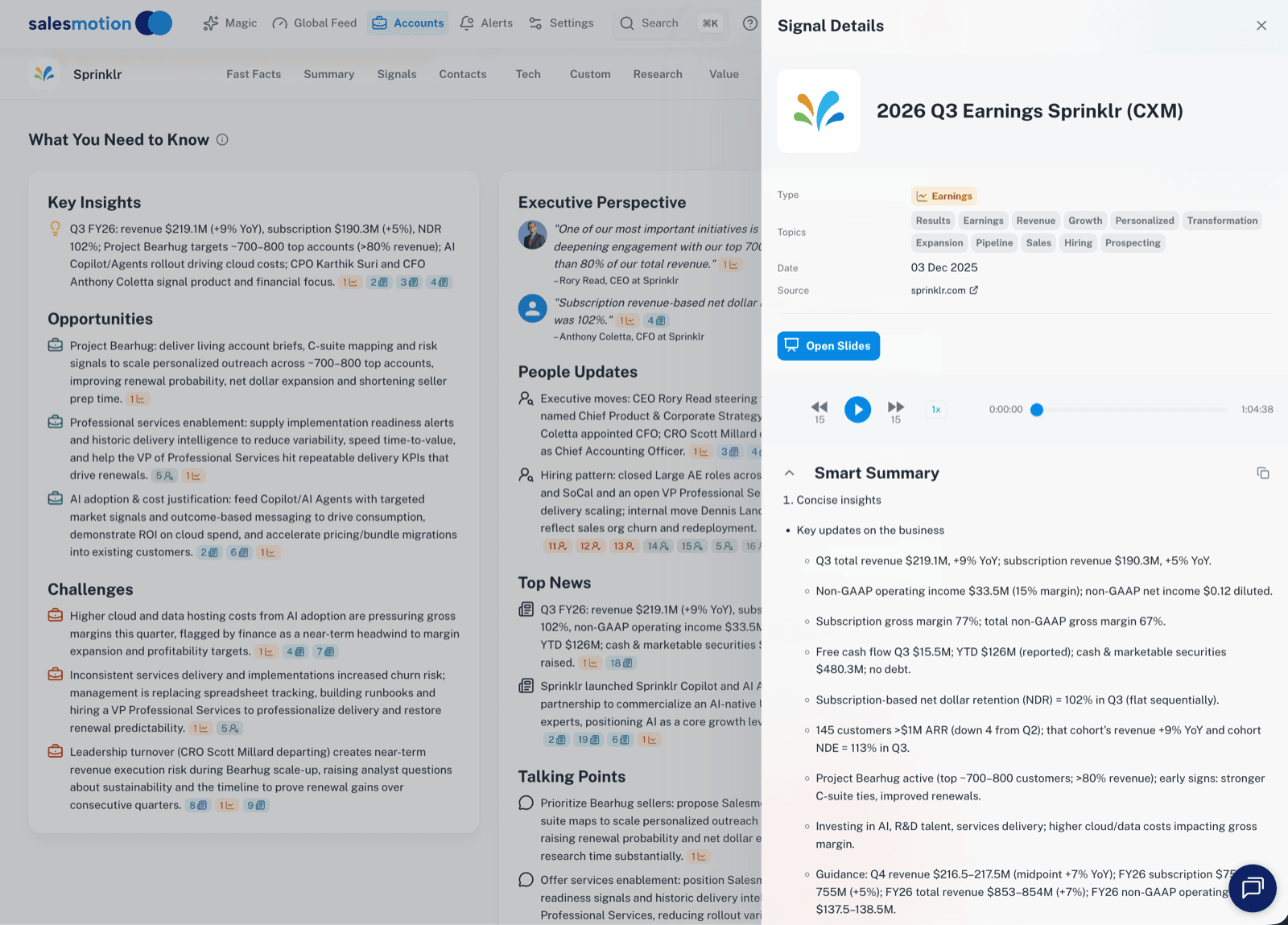
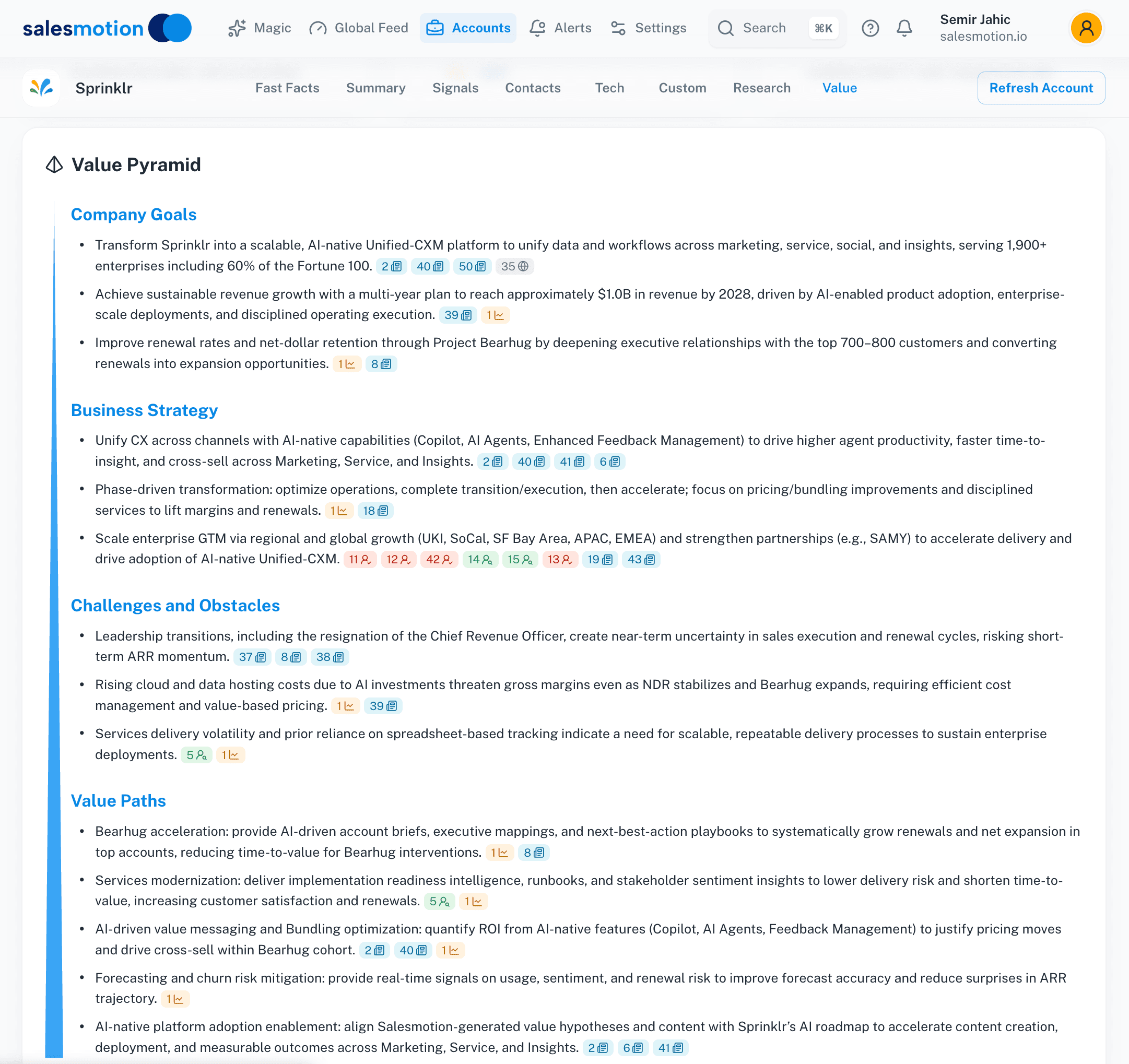
It depends on your selling motion. Salesmotion covers financial intelligence — earnings call analysis, SEC filings, M&A tracking, revenue signals — plus 50+ additional signal types (leadership changes, hiring surges, technology adoption, competitive displacement). Databook goes deeper on guided selling for Fortune 500 accounts with auto-generated executive decks and role-based engagement recommendations. If your team primarily sells to public companies and needs structured executive briefings, Databook's specialization is valuable. For broader real-time account intelligence across any B2B selling motion, Salesmotion covers more ground at a lower price point.
Yes. Earnings call analysis is a core Salesmotion capability. The platform uses AI to extract executive commentary on strategic priorities, revenue guidance, investment areas, and competitive dynamics from quarterly calls. Unlike Databook, Salesmotion also monitors the same accounts for leadership changes, hiring patterns, funding rounds, technology shifts, and dozens of other signals — providing a more complete picture of what is happening inside each account. See our guide on how to analyze earnings calls for pipeline generation.
The price difference reflects different go-to-market models, not different quality levels. Databook licenses expensive financial datasets and requires custom implementation with dedicated customer success — costs that are passed on to the buyer. Salesmotion's account-based pricing model eliminates per-seat costs, and its self-serve setup removes the need for weeks of custom configuration. The result is deeper, broader account intelligence at a price point accessible to teams of any size.
Salesmotion is significantly better for private companies. Databook's core value proposition revolves around public company financial data — earnings transcripts, SEC filings, and revenue guidance — which does not exist for private companies. Salesmotion monitors 1,000+ sources including news, hiring patterns, funding rounds, leadership changes, technology adoption, and more — intelligence available for both public and private companies.
Salesmotion typically goes live in 1-3 days with minimal configuration — no custom implementation or taxonomy alignment required. Databook implementations take weeks to months, requiring enterprise onboarding, data configuration, and workflow setup. Incredible Health went live with Salesmotion in 3 days and increased meetings booked by 50%. Book a demo to see the setup process.
A Signal Agent, Research Agent, and Outreach Agent — working 24/7 so your team spends less time researching and more time closing.