
Alternatives

Top 5 6sense Alternatives in 2026

Compare the best alternatives to 6sense for intent data, account-based marketing, and predictive sales intelligence.

At a glance

How 6sense Alternatives Compare

Side-by-side comparison of the key capabilities that matter most.

FeatureSalesmotionDemandbaseZoomInfoPocusCommon Room
Intent Data Approach1,000+ real-time signal sourcesProprietary intent + BomboraProprietary intent signalsProduct usage signals + third-party intentCommunity & digital signals aggregation
Account ResearchAI-generated briefs with full contextAccount-level insights & technographicsFirmographics & org chartsProduct usage analyticsCommunity engagement profiles
Predictive AnalyticsSignal-based prioritizationAI buying stage predictionsIntent-based scoringPLS scoring from product dataEngagement scoring across channels
Advertising / ABMFocused on sales intelligence (no ad platform)Full ABM ad platform includedDisplay advertising add-onNo ad platformNo ad platform
Ease of SetupLive in minutesComplex (weeks to months)Moderate setupModerate (requires product data integration)Moderate (requires channel integrations)
PricingFrom $85/mo (account-based, unlimited users on team plans)$50,000-$150,000+/yearFrom ~$15,000/year per userCustom pricing (mid-market)Free tier + custom enterprise pricing
Best ForSales teams needing deep account intelligenceEnterprise ABM programsContact data + intent signalsProduct-led sales teamsCommunity-led growth teams

Why teams switch from 6sense

6sense pioneered the use of AI-predicted intent data to help B2B companies identify accounts that are actively researching solutions. Its ability to detect anonymous buyer activity and predict buying stages has made it a cornerstone of enterprise ABM programs. However, the platform's complexity, cost, and reliance on opaque predictive models have pushed many teams to explore alternatives.

The most common frustrations with 6sense include its high price tag (often $60,000-$100,000+ per year), the lengthy implementation process that can take months, and the difficulty of trusting intent predictions when the underlying signals feel like a black box. Sales reps often struggle to act on abstract intent scores without the account context needed to craft relevant outreach.

The best 6sense alternatives in 2026 range from AI-powered account intelligence platforms that give reps transparent, actionable signals, to competing ABM platforms, to newer signal aggregation tools. The right choice depends on whether you need a full ABM suite or more focused sales intelligence.

Detailed Breakdown

Best 6sense Alternatives

An in-depth look at each platform, including features, pricing, and limitations.

1

Salesmotion

Our Pick
G2: 4.8/5 (25 reviews)

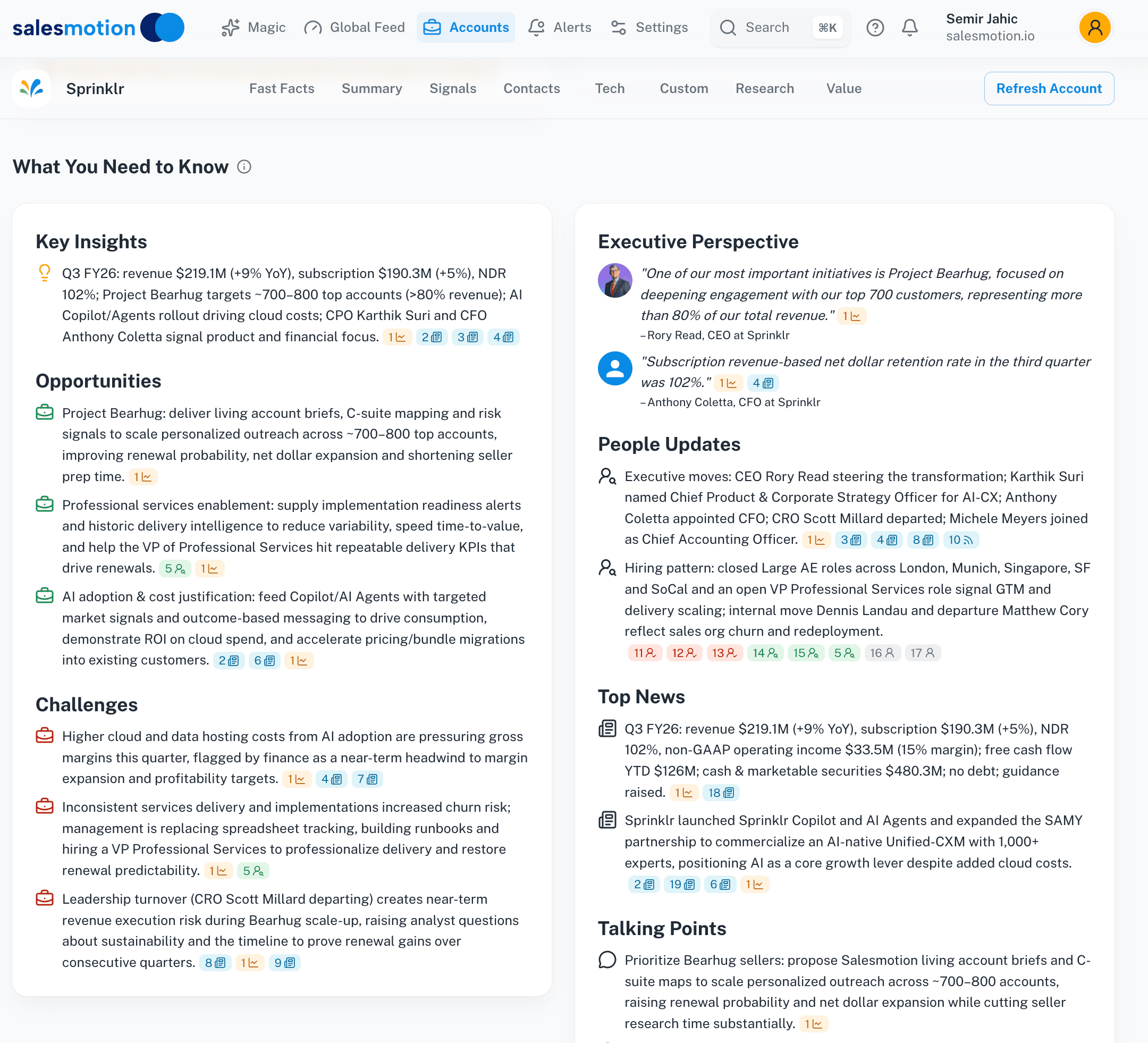
Salesmotion is an account intelligence platform that provides transparent, actionable buying signals rather than opaque intent scores. While 6sense tells you that an account is in a predicted buying stage, Salesmotion shows you exactly what the company is doing: what their CEO said on the last earnings call, which leadership changes occurred, what technology investments they have announced, and what business initiatives are publicly documented.

This transparency makes a massive difference for sales reps. Instead of calling on an account because it has a high intent score, reps can reference specific company events and tie their solution to real business priorities. The platform monitors over 1,000 sources and generates AI-powered research briefs that turn hours of manual research into minutes.

Salesmotion is also dramatically simpler to deploy (days versus months) and more affordable than 6sense, making it accessible to mid-market teams that cannot justify a six-figure ABM platform.

Best for:Sales teams that want transparent, actionable account signals instead of opaque intent predictions

Key Features

  • AI-generated account briefs from 1,000+ sources
  • Real-time buying signal monitoring with transparent source attribution
  • Personalized talking points and outreach drafts based on real company events
  • Salesforce and HubSpot integration (Enterprise plan)
  • Account-based pricing with no per-seat limits
  • Live in days, not months

Limitations

  • No account-based advertising platform (focused on sales intelligence)
  • Does not provide anonymous website visitor identification
  • Newer platform with smaller market presence than 6sense
Pricing: From $85/mo — flexible account-based pricing, unlimited users on team plans
2

Demandbase

G2: 4.3/5Visit site

Demandbase is 6sense's most direct competitor and the other major enterprise ABM platform. It combines account identification, intent data, advertising, and sales intelligence into a comprehensive ABM suite. Demandbase acquired InsideView and Engagio to build out its data and orchestration capabilities, and it offers both its own proprietary intent data and Bombora integration.

For teams already committed to an ABM strategy and wanting to switch from 6sense, Demandbase offers a comparable feature set with what many consider a more transparent approach to intent data and better account-level insights.

Best for:Enterprise organizations that want a full ABM platform with advertising, intent data, and sales intelligence in one suite

Key Features

  • Account-based advertising with DSP capabilities
  • Proprietary intent data plus Bombora integration
  • Account identification and web personalization
  • Sales intelligence with engagement minutes metric
  • Predictive analytics and journey stage modeling
  • Integration with Salesforce, HubSpot, and Marketo

Limitations

  • Very high price point similar to 6sense
  • Complex implementation requiring dedicated ABM operations resources
  • Can be overkill for teams that primarily need sales intelligence
Pricing: Custom enterprise pricing. Typically $50,000-$150,000+/year depending on modules and account volume
3

ZoomInfo

G2: 4.5/5Visit site

ZoomInfo is primarily known as a B2B contact data platform, but it has expanded into intent data and ABM capabilities. For teams that used 6sense mainly for account prioritization and do not need a full advertising platform, ZoomInfo can provide intent signals alongside its massive contact database, making it easier for reps to both identify and reach target accounts.

ZoomInfo's intent data is based on its own proprietary signals from content consumption across its publisher network. While less sophisticated than 6sense's predictive models, many teams find it more practical because it is paired with immediately actionable contact data.

Best for:Teams that want intent signals combined with the largest B2B contact database for immediate action

Key Features

  • 321M+ contacts with verified emails and direct dials
  • Proprietary intent data based on content consumption signals
  • Advanced company search with technographic and firmographic filters
  • ZoomInfo Engage for outreach and sequencing
  • Website visitor identification (add-on)
  • Org chart and reporting structure data

Limitations

  • Intent data is less sophisticated than 6sense or Demandbase predictive models
  • Per-seat pricing escalates quickly for larger teams
  • No account-based advertising capabilities
Pricing: Custom pricing starting around $14,995/year per user. Intent data and advanced features increase cost significantly
4

Pocus

G2: 4.6/5Visit site

Pocus is a product-led sales (PLS) platform that helps sales teams prioritize accounts based on product usage signals combined with third-party data. For companies with a free trial or freemium product, Pocus can replace 6sense's intent data by surfacing signals from actual product engagement rather than anonymous web behavior.

Pocus aggregates signals from your product analytics, CRM, data warehouse, and third-party tools to create a unified scoring model that identifies which accounts are most likely to convert or expand. It is particularly popular with PLG SaaS companies moving upmarket.

Best for:Product-led growth companies that want to prioritize sales efforts based on product usage signals

Key Features

  • Product usage signal aggregation and scoring
  • Playbook builder for rep workflows
  • Integration with product analytics (Amplitude, Mixpanel, Segment)
  • CRM and data warehouse connectors
  • AI-powered account prioritization
  • Custom scoring models based on your data

Limitations

  • Requires a product with meaningful usage data to be effective
  • Less useful for companies without a free trial or freemium motion
  • Does not provide account research or contact data
Pricing: Custom pricing based on connected data sources and team size. Typically mid-market pricing
5

Common Room

G2: 4.5/5Visit site

Common Room is a signal aggregation platform that identifies buying intent by monitoring community engagement, social media activity, and other digital signals. Unlike 6sense's anonymous intent data, Common Room surfaces signals from identifiable activities like GitHub contributions, Slack community engagement, social media mentions, and product usage.

Common Room is especially popular with developer-focused and community-driven companies. The platform can identify individuals within target accounts who are actively engaging with your ecosystem, making it easier for reps to find warm entry points.

Best for:Developer-focused and community-driven companies that want to monetize community engagement signals

Key Features

  • Signal aggregation from GitHub, Slack, Discord, Twitter/X, and more
  • Person-level identification from community activity
  • Automated workflows and alerts for sales teams
  • Integration with CRMs and sales engagement tools
  • Custom signal scoring and account prioritization
  • Free tier available for smaller communities

Limitations

  • Most valuable for companies with active developer or user communities
  • Limited utility for industries without significant online community engagement
  • Does not provide traditional contact data or account research
Pricing: Free tier for small communities. Paid plans with custom enterprise pricing based on signal volume and team size

Customer Story

How Cytel cut research time by 50% and consolidated 5 tools into one

50%

less research time

5 → 1

tool consolidation

30%

faster account planning

All of the vendors that I've worked with, all of the onboarding that I have had to deal with, I will say, hands down, Salesmotion was the easiest that I have had.

Lyndsay Thomson

Lyndsay Thomson

Head of Sales Operations, Cytel

Read the full case study

Ready to see a better way to sell?

Salesmotion replaces hours of manual research with real-time account intelligence your reps can use today.

FAQ

Frequently Asked Questions

What is the most affordable alternative to 6sense?

Salesmotion is the most affordable alternative with flexible account-based pricing from $85/month and unlimited users on team plans. Common Room offers a free tier for smaller teams. In contrast, Demandbase and ZoomInfo's full intent capabilities typically start at $15,000-$50,000+ per year. If you primarily need 6sense for account prioritization rather than advertising, Salesmotion or Pocus can deliver similar value at a fraction of the cost.

Can 6sense alternatives provide the same level of intent data?

No single alternative replicates 6sense's exact approach to anonymous intent prediction, but alternatives offer different types of buying signals that many teams find more actionable. Salesmotion surfaces transparent, real-time signals from 1,000+ sources. Demandbase offers its own predictive intent models. Pocus uses product usage data, and Common Room aggregates community engagement signals. Many teams find transparent, source-attributed signals more useful than opaque intent scores.

Is Demandbase really different from 6sense?

Demandbase and 6sense offer similar ABM capabilities including intent data, advertising, and predictive analytics. Key differences include Demandbase's engagement minutes metric (versus 6sense's buying stage model), Demandbase's self-serve advertising platform, and different approaches to data sourcing. Many enterprise buyers evaluate both side-by-side and choose based on data quality in their specific target market and ease of the sales team experience.

Do I need an ABM platform if I just want intent signals for my sales team?

No. Full ABM platforms like 6sense and Demandbase are designed for organizations that want to coordinate marketing and sales across advertising, web personalization, and sales outreach. If your primary goal is giving sales reps actionable account intelligence and buying signals, a focused tool like Salesmotion, Pocus, or Common Room will deliver better ROI at a fraction of the cost and complexity.

Related Comparisons

Explore more head-to-head comparisons and alternatives guides.

Your reps are researching. They should be selling.

Join the top-performing sales teams using Salesmotion to build more pipeline and close more deals.

Book a demo