
Alternatives

Top 5 Apollo.io Alternatives in 2026

Compare the best alternatives to Apollo.io for sales engagement, contact data, and B2B prospecting.

At a glance

How Apollo.io Alternatives Compare

Side-by-side comparison of the key capabilities that matter most.

FeatureSalesmotionZoomInfoLushaCognismClay
Account Research1,000+ sources, AI-generated briefsFirmographics, technographics & org chartsCompany overview & firmographicsCompany profiles with EMEA focus150+ enrichment providers, custom workflows
Contact DatabaseVerified contacts with account context321M+ contacts150M+ business profiles400M+ B2B profiles (phone-verified)Aggregates from multiple data vendors
Sales EngagementAI-drafted outreach with research contextEngage platform (add-on)Limited engagement featuresNo native sequencingAI outreach via integrations
Buying Signals24/7 monitoring across 1,000+ sourcesIntent data & company news alertsJob change alertsBombora intent + sales triggersReal-time enrichment triggers
CRM IntegrationSalesforce & HubSpot sync (Enterprise plan)Deep Salesforce & HubSpot integrationSalesforce, HubSpot & PipedriveSalesforce & HubSpotSalesforce, HubSpot & 100+ tools via API
Ease of SetupLive in minutesModerate (enterprise onboarding)Browser extension, instant startModerate setup with trainingRequires workflow building (steeper learning curve)
Pricing ModelFrom $85/mo (account-based, unlimited users on team plans)Custom pricing from ~$15,000/yearFree tier + plans from $36/moCustom pricing (per seat)Free tier + plans from $149/mo

Why teams switch from Apollo.io

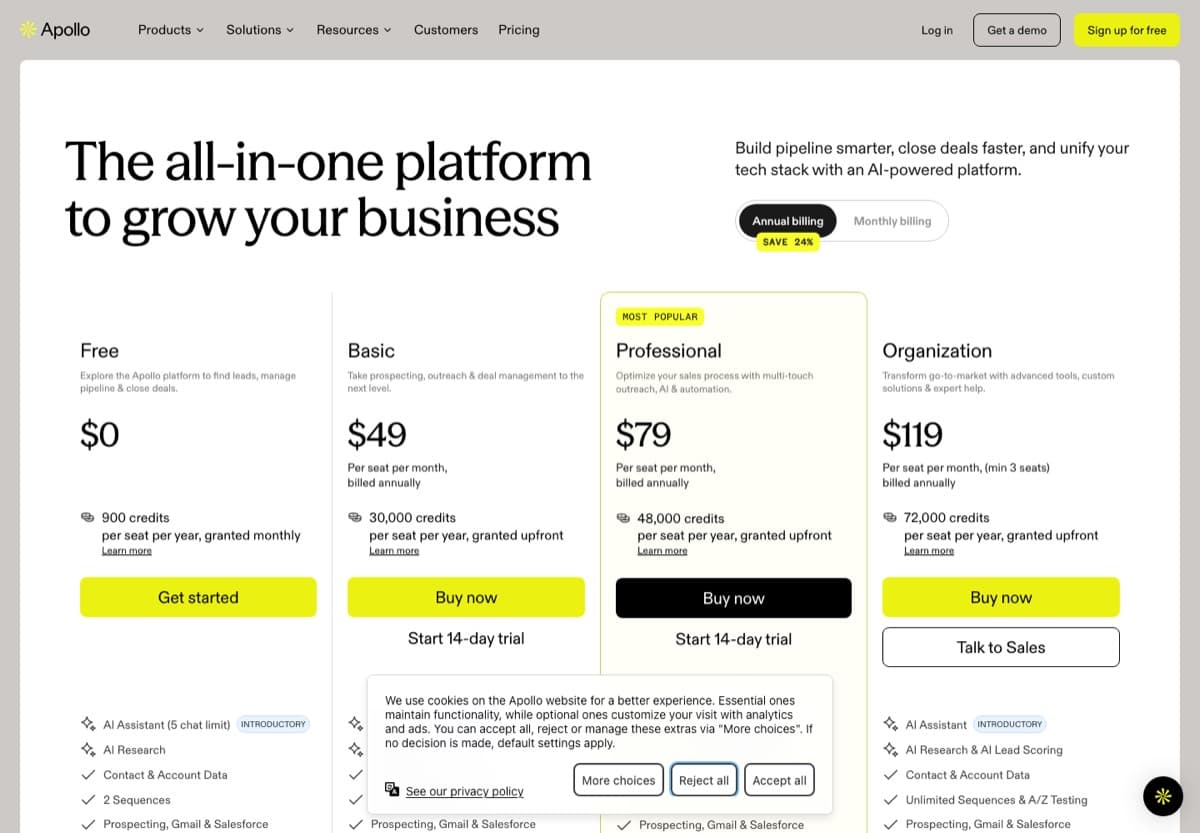
Apollo.io has quickly become one of the most popular sales tools on the market by combining contact data with built-in email sequences and a dialer, all at an accessible price point. Its free tier and large contact database make it an easy choice for startups and growing sales teams. But as teams scale and deals become more complex, many find that Apollo's strengths in volume-based prospecting become limitations.

The most common reasons sales teams look beyond Apollo include contact data accuracy issues (especially for international numbers and niche industries), limited account intelligence beyond basic firmographics, and the challenge of standing out when everyone on Apollo is sending similar AI-generated emails to the same contacts. Per-seat pricing also escalates quickly as teams grow.

The best Apollo alternatives in 2026 take different approaches: some offer deeper account context to fuel more relevant outreach, others provide better data coverage in specific regions, and others let you build custom enrichment workflows. Here are the top five options to consider.

Detailed Breakdown

Best Apollo.io Alternatives

An in-depth look at each platform, including features, pricing, and limitations.

1

Salesmotion

Our Pick
G2: 4.8/5 (25 reviews)

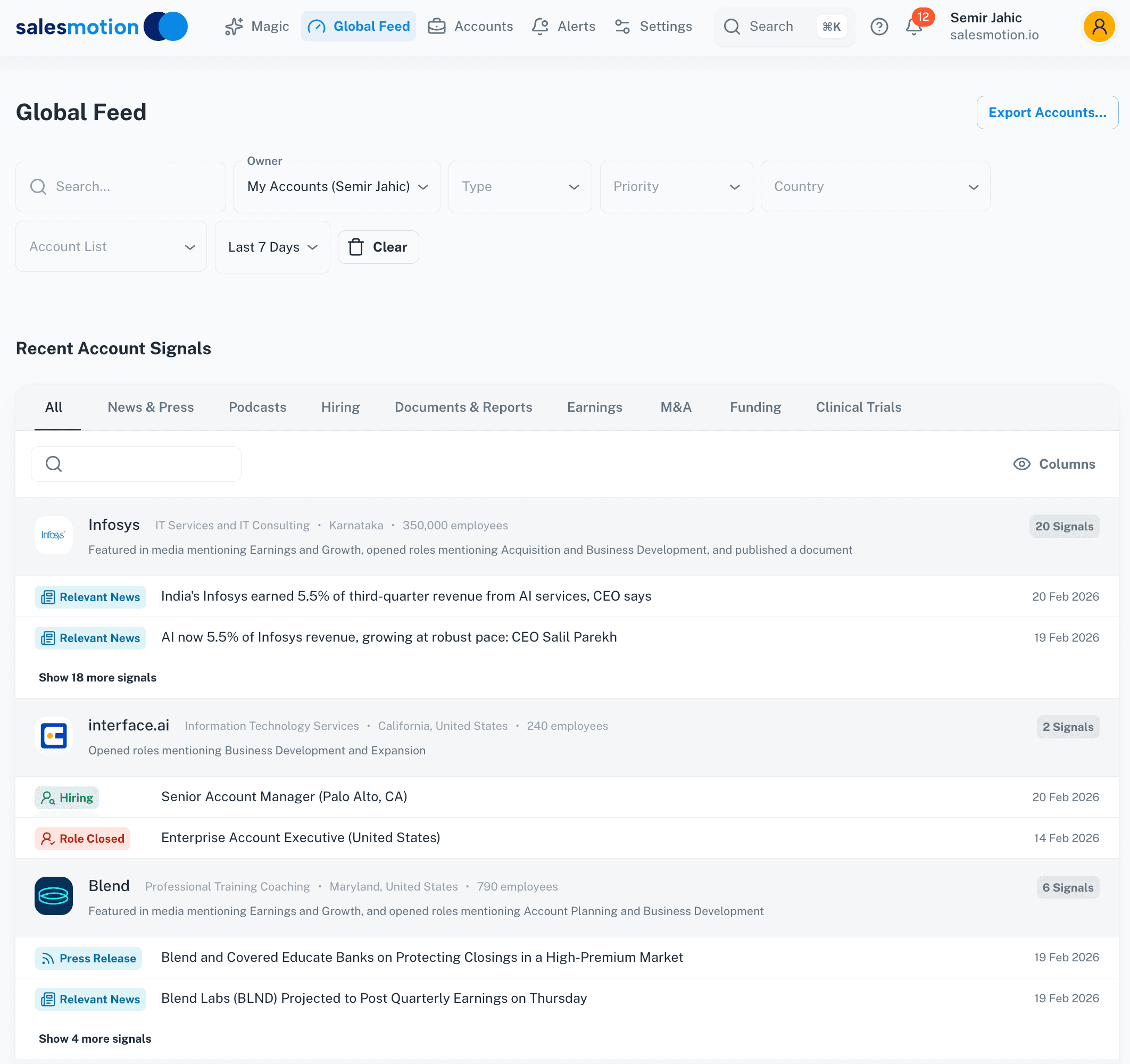
Salesmotion takes a different approach than Apollo by focusing on account intelligence rather than volume-based prospecting. While Apollo helps you find contacts and send sequences, Salesmotion helps you understand accounts deeply so that when you do reach out, your messaging is anchored to what the company actually cares about.

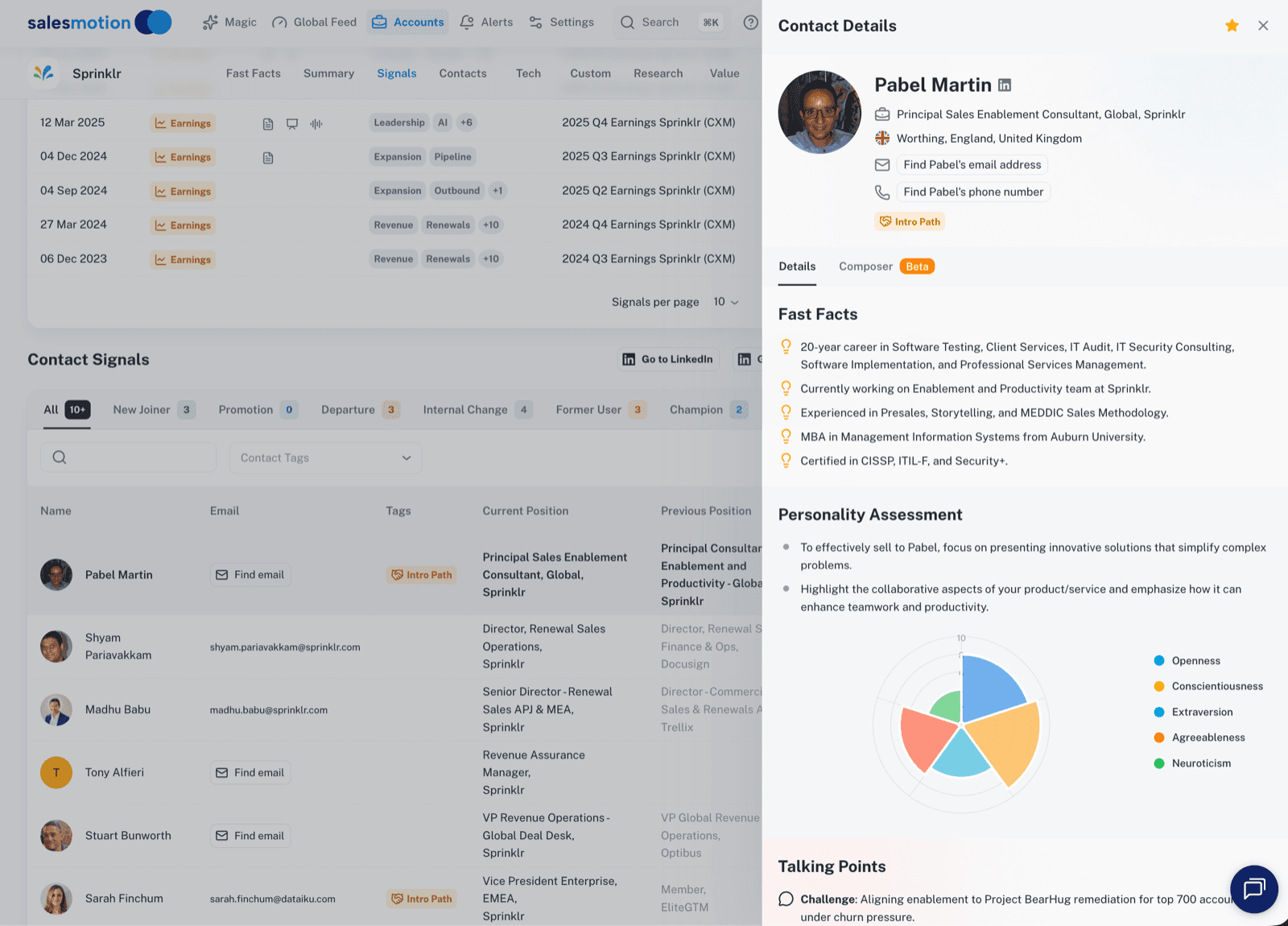
The platform monitors over 1,000 sources to surface buying signals, generate AI research briefs, and create personalized talking points for every account. This makes it especially valuable for teams selling into enterprise and mid-market accounts where generic outreach falls flat.

Salesmotion also provides verified contact data, but its real differentiator is turning hours of manual account research into minutes of AI-powered intelligence. Teams report saving 30+ minutes per account and seeing significantly higher response rates because their outreach is grounded in real company context.

Best for:Mid-market and enterprise sales teams that need account intelligence to fuel relevant, high-converting outreach

Key Features

  • AI-generated account briefs from 1,000+ sources
  • Real-time buying signal monitoring (leadership changes, funding, earnings, tech adoption)
  • Personalized talking points and outreach drafts anchored to real research
  • Salesforce and HubSpot integration (Enterprise plan)
  • Account-based pricing with no per-seat limits
  • 3-day average implementation time

Limitations

  • No built-in email sequencing or dialer (designed to complement your existing sales engagement tool)
  • Smaller contact database than Apollo's 275M+ records
  • No free tier available
Pricing: From $85/mo — flexible account-based pricing, unlimited users on team plans
2

ZoomInfo

G2: 4.5/5Visit site

ZoomInfo is the enterprise-grade contact and company data platform that has dominated the B2B data market for over a decade. With 321 million+ contacts and deep firmographic, technographic, and org chart data, ZoomInfo is the most comprehensive contact database available. It also offers an engagement platform (ZoomInfo Engage) and conversation intelligence (Chorus).

For teams stepping up from Apollo, ZoomInfo offers significantly better data accuracy and coverage, especially for enterprise accounts. However, this comes at a much higher price point and with a more complex implementation.

Best for:Large sales organizations that need the most comprehensive B2B contact database and are willing to pay enterprise pricing

Key Features

  • 321M+ contacts with verified emails and direct dials
  • Org charts and reporting structure data
  • Intent data powered by proprietary signals
  • ZoomInfo Engage for sequencing and calling
  • Advanced company and technographic filters
  • Chorus conversation intelligence (add-on)

Limitations

  • Expensive per-seat pricing that scales quickly with team growth
  • Long-term contracts with difficult cancellation terms
  • Contact data still requires manual account research for context
Pricing: Custom pricing starting around $14,995/year for a single user. Enterprise plans range from $25,000-$60,000+/year
3

Lusha

G2: 4.3/5Visit site

Lusha is a streamlined contact data platform that focuses on simplicity and fast time-to-value. Its highly rated browser extension lets reps instantly pull up verified emails and direct dials while browsing LinkedIn or company websites. For teams that found Apollo's contact data quality inconsistent, Lusha often provides more reliable direct dial numbers.

Lusha is ISO 27701 certified and GDPR compliant, making it a solid choice for teams with compliance requirements. The platform has expanded from a pure browser extension into a full prospecting tool with advanced company search and list building.

Best for:Individual reps and small teams that want reliable contact data through a simple browser extension workflow

Key Features

  • High-accuracy browser extension for LinkedIn contact lookup
  • 150M+ business profiles with direct dials and emails
  • Prospecting platform with company search and list building
  • Bulk enrichment and CRM data hygiene tools
  • API for custom data integration workflows
  • Free tier with 50 monthly credits

Limitations

  • No built-in sales engagement features (no sequences or dialer)
  • Smaller database than Apollo, particularly for technographic data
  • Limited account intelligence and buying signal capabilities
Pricing: Free plan available. Pro from $36/user/month. Premium from $59/user/month. Scale pricing is custom
4

Cognism

G2: 4.6/5Visit site

Cognism is the leading B2B data provider for teams selling into European markets. While Apollo has broad global coverage, Cognism excels specifically in EMEA with phone-verified mobile numbers (Diamond Data) that report 98% accuracy. For teams frustrated with Apollo's international data quality, Cognism is often the upgrade path.

The platform also includes Bombora-powered intent data, sales trigger events, and a Chrome extension. Cognism is headquartered in London and was built with GDPR compliance at its foundation, which gives compliance teams confidence in its data practices.

Best for:Sales teams with significant European outreach that need phone-verified, GDPR-compliant contact data

Key Features

  • Phone-verified mobile numbers (Diamond Data) with 98% accuracy
  • GDPR-first data collection and compliance
  • Bombora-powered intent data included in most plans
  • Sales trigger events (job changes, funding, hiring)
  • Chrome extension for LinkedIn prospecting
  • Strong EMEA and DACH region coverage

Limitations

  • Weaker North American data coverage compared to Apollo or ZoomInfo
  • No built-in email sequencing or dialer
  • Higher price point than Apollo with annual contracts required
Pricing: Custom pricing per seat. Typically $15,000-$30,000/year for small teams, with enterprise deals higher
5

Clay

G2: 4.9/5Visit site

Clay is a data enrichment and outreach automation platform that takes a radically different approach from Apollo. Instead of providing a single contact database, Clay lets you build custom enrichment workflows by pulling data from over 150 providers through a spreadsheet-like interface. This means you can waterfall across multiple data sources to maximize coverage and accuracy.

Clay is particularly popular with growth teams and RevOps professionals who want maximum flexibility in their data workflows. However, its power comes with a steeper learning curve, and its credit-based pricing can get expensive at high volumes.

Best for:Growth teams and RevOps professionals who want to build custom data enrichment workflows with maximum flexibility

Key Features

  • 150+ data enrichment providers in one platform
  • Waterfall enrichment across multiple sources for best coverage
  • Spreadsheet-like interface for custom workflow building
  • AI-powered research agent for personalized outreach
  • Integrations with Salesforce, HubSpot, and 100+ tools
  • Automated prospecting campaigns with custom logic

Limitations

  • Steeper learning curve than Apollo — requires workflow building skills
  • Credit-based pricing can get very expensive at scale
  • No native contact database — relies on third-party data providers
Pricing: Free plan with limited credits. Starter at $149/month. Explorer at $349/month. Pro at $800/month

Customer Story

How Cacheflow reduced prep time by 60% and tripled deal sizes

60%

less prep time

3x

deal sizes

Hours

saved per week

The moment we turned on Salesmotion, it became essential. No more hours on LinkedIn or Google to figure out who we're talking to. It's just there, served up to you, so it's always 'go time.'

Adam Wainwright

Adam Wainwright

Head of Revenue, Cacheflow

Read the full case study

Ready to see a better way to sell?

Salesmotion replaces hours of manual research with real-time account intelligence your reps can use today.

FAQ

Frequently Asked Questions

What is the best free alternative to Apollo.io?

Lusha offers the best free alternative with 50 monthly credits for contact lookups. Apollo's own free tier is generous (10,000 emails/month), so if you are happy with the platform but just want to reduce costs, staying on Apollo's free plan may be the simplest option. For account intelligence without per-contact charges, Salesmotion's account-based pricing can be more economical for larger teams.

Is Apollo.io accurate enough for enterprise sales?

Apollo's data accuracy has improved significantly, but many enterprise teams report inconsistencies with direct dials and international data. For enterprise selling, ZoomInfo and Cognism generally offer better data accuracy, while Salesmotion provides deeper account context that enterprise reps need to navigate complex buying committees. The right choice depends on whether your priority is contact volume or account intelligence.

Which Apollo alternative has the best sales engagement features?

Apollo's built-in sequencing and dialer are among its strongest features. ZoomInfo offers comparable engagement capabilities through ZoomInfo Engage, but at a higher price. Most other alternatives (Lusha, Cognism, Salesmotion) do not include native sequencing and are designed to complement dedicated sales engagement tools like Outreach or Salesloft.

Can I replace Apollo with just one tool?

It depends on what you use Apollo for. If you primarily use it for contact data, Lusha or Cognism can replace that function. If you need both data and engagement, ZoomInfo is the closest full replacement. For teams that want better account intelligence and outreach quality over volume, Salesmotion paired with a sales engagement tool often outperforms Apollo's all-in-one approach.

How does Clay compare to Apollo for prospecting?

Clay and Apollo serve different prospecting philosophies. Apollo provides a fixed contact database with built-in outreach tools for fast execution. Clay provides a flexible platform to waterfall across 150+ data providers and build custom enrichment workflows. Clay often yields better data quality through waterfall logic but requires more setup. Apollo is easier to use out of the box.

Related Comparisons

Explore more head-to-head comparisons and alternatives guides.

Your reps are researching. They should be selling.

Join the top-performing sales teams using Salesmotion to build more pipeline and close more deals.

Book a demo