Every commercial team selling into biopharma eventually asks the same question: how do we find sponsors before everyone else does?
The commercial logic is obvious. By the time a company registers a Phase 2 trial, it has already chosen its CRO, its central lab, and most of its service providers. The window that mattered closed well before the registration. A business development leader at a bioanalytical services firm put the problem to us directly: he needs to reach companies before they have established partners, which means finding them while they are still preclinical.
This post is about what is genuinely findable at that stage, and what is not. The honest answer has a real boundary in it, and knowing where the boundary sits is more useful than a vendor promise that it does not exist.
Why preclinical is hard, specifically
Most life sciences prospecting data ultimately derives from clinical trial registries. That is a good source: structured, public, updated, and rich with sponsor, phase, site, and status information.
It also has a defining limitation. A registry entry exists because a trial was registered. Before that point, the company is invisible to any tool built primarily on registry data, which is most of them.
The rest of the preclinical picture is genuinely private. Discovery-stage research is confidential by design. IND applications are not public documents. Much of the intellectual property that would tell you what a company is working on is exactly what it is protecting. A computational drug discovery company we spoke with was clear that most of their relevant work sits in IP-protected territory that no external tool could see.
So there is a real floor here. Anyone claiming complete preclinical visibility is describing something that does not exist.
What does exist before a trial
The picture is thinner than at clinical stage but not empty. Five source classes carry real signal.
Financing records. Companies raising capital in the US leave a filing trail, including Form D for exempt offerings. This is often the earliest reliable public marker that a company exists, has money, and intends to do something with it. A seed or Series A raise usually precedes trial registration by a long way. The funding round sales trigger guide covers how to work it.
Company registrations. Incorporation records establish existence and rough timing. Thin on their own, useful in combination.
Grant awards. Non-dilutive funding from public research agencies is publicly recorded and frequently describes the scientific program in specific terms, which is unusual and valuable. For academic spinouts especially, a grant award can be the most informative early document available.
Scientific and conference output. Publications, posters, and presentations reveal programs, mechanisms, and the people running them well before a trial. This is where a lot of genuine early insight lives, and where most commercial teams do not look.
Hiring patterns. Job postings are one of the most reliable preclinical indicators, because companies must recruit publicly. A company posting for a Director of Clinical Operations, a regulatory affairs lead, or CMC roles is telling you it intends to move into the clinic, usually months ahead. Hiring is intent made visible, which is why a hiring surge is a buying signal in its own right.
Investor and partnership announcements. Backers publicize new portfolio companies, and pharma partners announce collaborations. Both surface companies that have published nothing themselves.
The realistic sequence
Putting those together produces a workable early picture, with each source answering a different question:
| Signal | What it tells you | Typical timing |
|---|---|---|
| Incorporation | The company exists | Earliest |
| Grant award | What they are working on, in detail | Very early |
| Seed / Series A filing | They have capital and intent | Early |
| Publications, posters | The science and the people | Early to mid |
| CMC and regulatory hiring | They are preparing for the clinic | Mid |
| Series B | Scaling toward or through the clinic | Mid to late |
| Trial registration | The window has largely closed | Late |
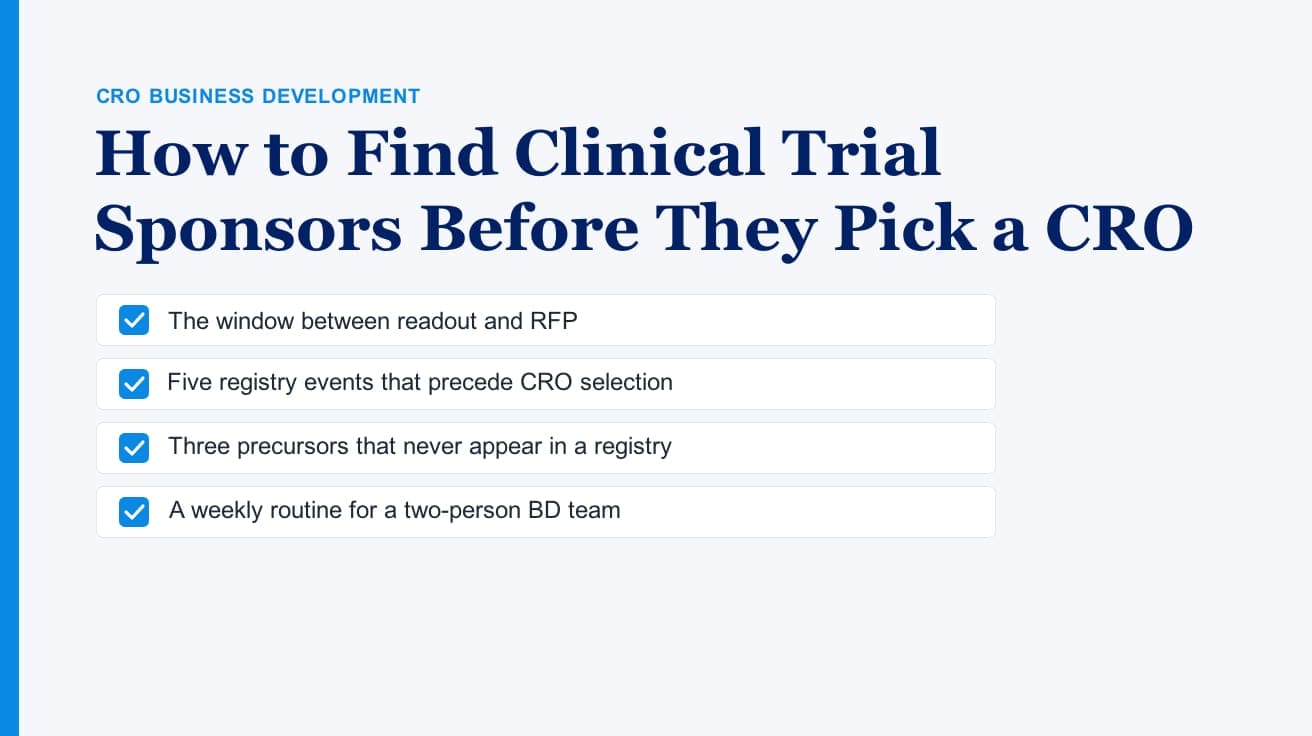
For a services provider, the actionable band is the middle. Grant awards and early financing tell you a company exists and is real. Hiring tells you when. A company that just posted its first regulatory affairs role is a materially better prospect than one that registered a trial last week, because the second one already chose its vendors. The registry events that follow are covered in how to find clinical trial sponsors before they pick a CRO.
Where this breaks
Four limits worth stating plainly, because they determine whether this approach fits your business.
Non-US coverage is weaker. Much of the strongest early signal, particularly securities filings, is US-centric. European, Japanese, and Chinese biotechs leave a different and generally thinner public trail. If your territory is Asia-Pacific or your targets are small European companies, expect meaningfully less early visibility.
Genuinely stealth companies are genuinely invisible. A company that has not raised publicly, taken no public grants, published nothing, and posted no jobs cannot be found by public-data methods. That is what stealth means. Those companies surface through your network, at conferences, or through investor relationships, and no tool substitutes for that.
Small private companies with no online presence are hard. Signal detection works by reading what companies publish. A company with no press releases and minimal web presence produces little to read regardless of stage.
Timing signals are probabilistic. A CMC hire suggests clinical intent. It does not guarantee it, and it does not tell you the month. Treat these as prioritization inputs, not predictions.
Building a process around the limits
Three practical adjustments distinguish teams doing this well.
Monitor continuously rather than searching periodically. The whole value of early signals is timing. A quarterly list-pull surfaces a company months after its first regulatory hire, which defeats the purpose. The question "who hired a regulatory lead this month" only pays off if you ask it every month.
Combine signals rather than filtering on one. Any single early signal is weak. A recent raise plus relevant hiring plus a grant describing a matching program is a strong prospect. One of those alone is noise.
Accept a wider funnel at this stage. Preclinical prospecting is inherently lower-precision than clinical-stage prospecting. Teams that demand the same hit rate at both stages end up abandoning early-stage prospecting entirely, which cedes the most valuable window to competitors willing to tolerate ambiguity.
Where Salesmotion fits
Salesmotion for Life Sciences discovers sponsors from clinical trial registries, regulatory filings, funding records, grants, and the open web, and monitors them continuously. That covers the source classes above, and it extends earlier than registry-only tools. Once a company reaches the clinic, it also appears in counts like biotech companies by modality and phase.
If your motion depends on reaching sponsors before they choose partners, the practical approach is to monitor the early public signals continuously, combine them, and accept that a portion of your market will always come through relationships instead. Details on coverage and filters are on the life sciences page.
For the related question of who to contact once you have found a company, see what life sciences BD teams get wrong about contact seniority.