Comparison
Copilot drafts the email. It does not know which account to email, or why today. Here is where Microsoft's assistant ends and account intelligence begins.
 By Semir JahicCEO & Co-Founder, SalesmotionLast reviewed
 | Feature | Microsoft Copilot | Salesmotion |
|---|---|---|
| Primary purpose | AI assistant across Microsoft 365 | Sales account intelligence |
| Working model | Assists inside the document or inbox | Monitors the territory and alerts proactively |
| Account awareness | Knows your emails and files, not your market | Every tracked account, continuously |
| Buying signals | Not detected | 50+ signal types from 1,000+ sources |
| CRM integration | Microsoft stack; Dynamics-oriented | Native Salesforce and HubSpot |
| Outreach quality ceiling | As good as the context the rep pastes in | Anchored to live research and signals |
| Pricing | $30/user/mo on top of M365 | $85/mo for individuals. Custom pricing for teams & enterprise. |
| Rating (G2) | — | 4.8/5 |
Microsoft 365 Copilot is Microsoft's AI assistant embedded across Outlook, Teams, Word, and Excel. For companies standardized on Microsoft, it is usually the first sanctioned AI sellers get: IT has approved it, it works inside the inbox, and it is genuinely good at the jobs it was built for. In our buyer conversations, sellers consistently use Copilot to draft follow-up emails, summarize Teams meetings, and tidy documents.
What those same sellers describe next is the gap: Copilot drafts the follow-up, then the rep goes elsewhere to find out what is actually happening at the company. One business development lead described exactly that split: Copilot writes the email, and the company context gets looked up separately, account by account. Copilot has no view of your territory, no buying-signal detection, no account monitoring, and no concept of which customer deserves attention today. It assists with the artifact, not the intelligence behind it.
Best for: Microsoft-standardized teams that want AI drafting and summarizing inside Outlook, Teams, and Office documents
Pricing: Microsoft 365 Copilot is $30/user/month (annual commitment) on top of a qualifying Microsoft 365 plan; consumer Copilot plans differ
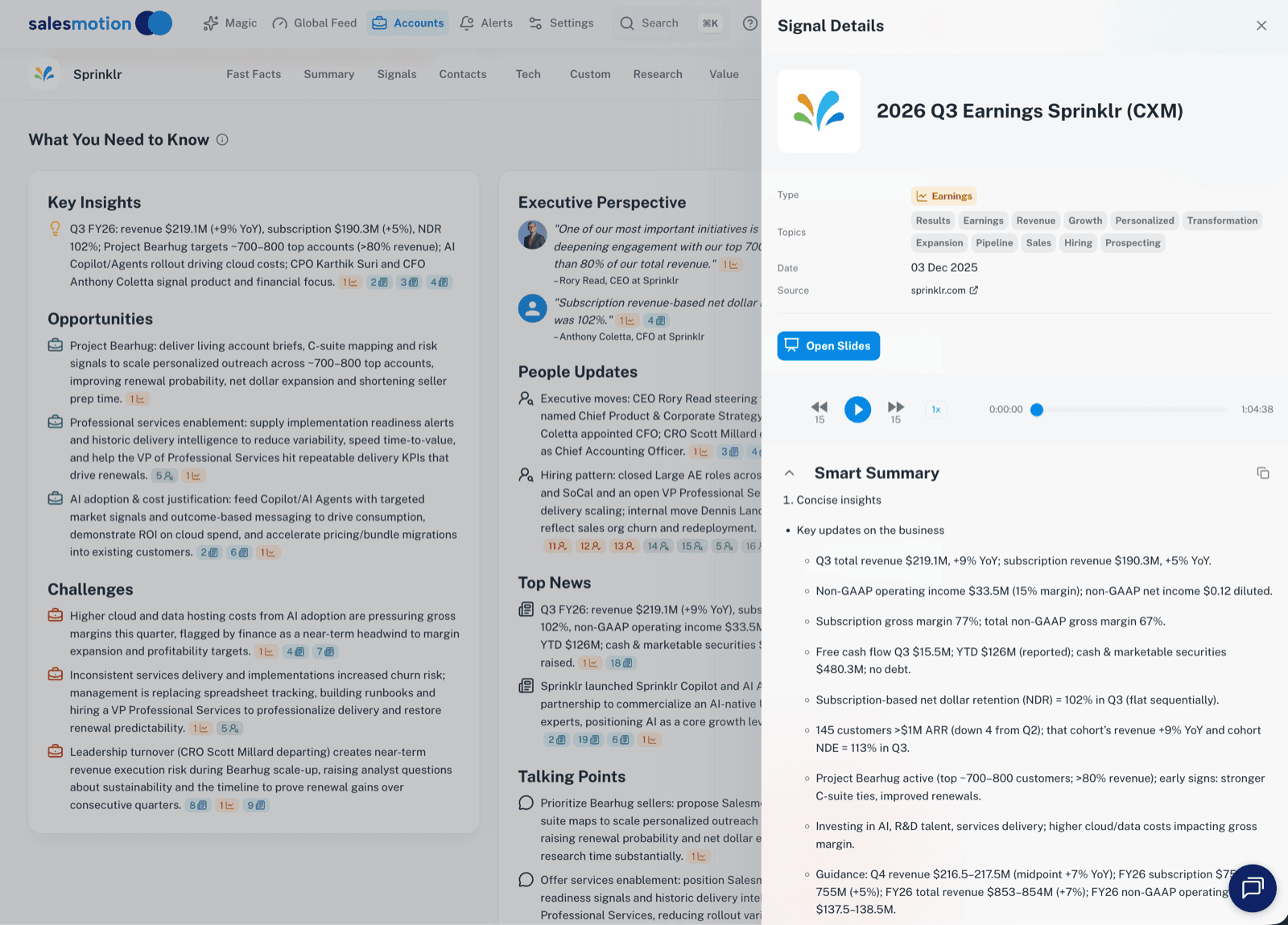
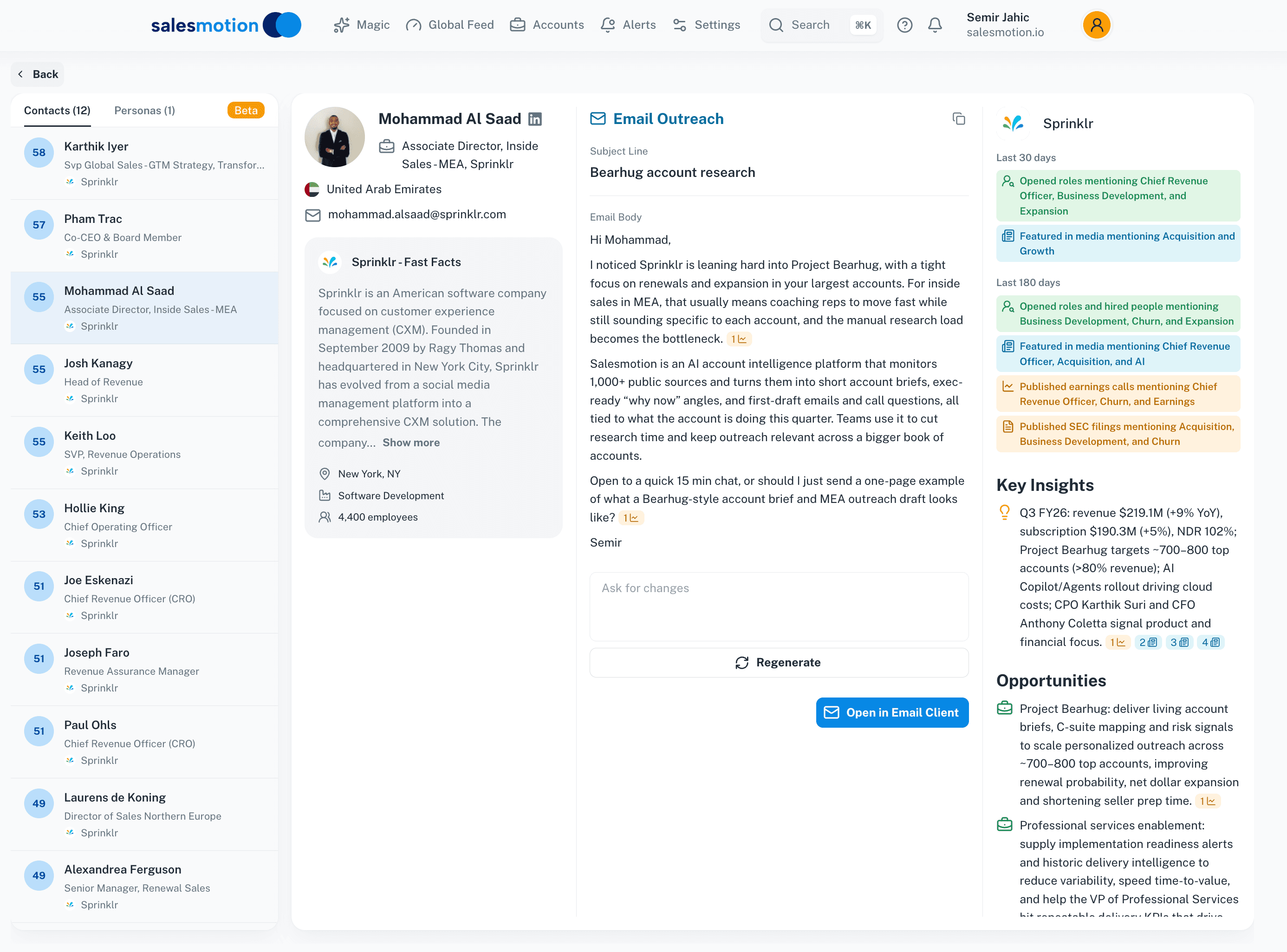
Salesmotion is an account intelligence platform purpose-built for B2B sales teams. Where Copilot helps a rep write, Salesmotion tells the rep what is worth writing about: its Signal Agent monitors 1,000+ sources continuously for buying signals across the territory, the Research Agent maintains a source-linked brief on every account, and the Outreach Agent drafts messages anchored to the specific event that makes outreach timely.
The two tools sit at different points in the workflow. Copilot improves the last step, producing the artifact. Salesmotion produces the intelligence that step depends on: which account, why now, and what to say. Signals and briefs land in Salesforce, HubSpot, and the rep's alerts, so the context arrives before the drafting starts rather than being hunted down afterwards.
Best for: B2B sales teams that need continuous account monitoring, buying signals, and research-anchored outreach across a territory
G2 rating: 4.8/5
Pricing: $85/mo for individuals — flexible monthly billing. Custom pricing for teams and enterprise on request.
How Microsoft Copilot and Salesmotion stack up across key capabilities.
| Feature | Microsoft Copilot | Salesmotion |
|---|---|---|
| Email drafting | Excellent inside Outlook | Drafts anchored to the signal and account brief |
| Meeting prep | Summarizes what is already in your mailbox | Brief built from 1,000+ external sources |
| Account monitoring | None | Continuous, with real-time alerts |
| Signal detection | None: reps must spot events themselves | Leadership, funding, earnings, hiring, M&A, trials |
| External research | Limited web answers in chat | Source-linked briefs with verifiable citations |
| Territory view | None | Scored accounts ranked by live signal activity |
| Team consistency | Varies with each rep's prompting | Same brief and signals for everyone |
| Where it lives | Outlook, Teams, Office | CRM, inbox alerts, and the platform |
Microsoft 365 Copilot costs $30 per user per month on an annual commitment, on top of a qualifying Microsoft 365 licence. For a 10-person sales team that is $3,600/year of drafting and summarizing assistance inside the Microsoft stack, governed by agreements your IT team already has.
Salesmotion starts at $85/month for individuals, with team plans that include the whole team; pricing scales with accounts monitored rather than headcount. See pricing.
They are not substitutes, and the buying mistake we see is treating Copilot as the AI budget line that covers sales intelligence. Copilot makes each email faster to write. It does not change which accounts get emailed or why, which is where pipeline outcomes actually move. Teams running both keep Copilot for the artifact and Salesmotion for the intelligence: the sellers we interview who rely on assistants alone describe the residual work precisely, drafting is covered while company context still gets looked up by hand, one account at a time.
We'd rather you pick the right tool than the wrong one. Salesmotion isn't for everyone — here's when another option on this page is the smarter call.
“We're no longer fishing. We know who the right customers are, and we can qualify them quickly. Salesmotion has had a direct impact on pipeline quality.”

Andrew Giordano
VP of Global Commercial Operations, Analytic Partners
Salesmotion gives your reps the account intelligence they need to book more meetings and close bigger deals.
Only in a narrow sense. Copilot is strongest with information already inside your Microsoft environment: your emails, meetings, and documents. It can answer some general questions in chat, but it does not monitor accounts, detect buying signals, or maintain research on your territory. The sellers we interview describe the resulting workflow split clearly: Copilot drafts the follow-up, and the company context gets looked up somewhere else, account by account.
For drafting and meeting summaries inside a Microsoft-standardized company, often yes: $30/user/month buys real time savings on artifact production, under governance IT already trusts. The mistake is expecting it to cover the intelligence layer. Which account to contact, why now, and what changed this week are questions Copilot has no data to answer.
They solve different problems and coexist cleanly. Keep Copilot for producing documents and emails faster inside Outlook and Teams. Use Salesmotion for territory intelligence: continuous monitoring, buying signals, source-linked briefs, and outreach drafts anchored to real events, delivered into Salesforce or HubSpot. Analytic Partners runs signal-driven outbound this way and grew qualified pipeline 40%.
Yes. Outreach drafts push to Outlook, alerts arrive by email, and the platform runs alongside a Microsoft-standardized stack. CRM-native integrations are Salesforce and HubSpot; teams on Dynamics 365 typically work from the platform and email alerts. If a native Dynamics integration is a hard requirement, ask us about the roadmap.
All three are general-purpose assistants with the same structural profile: strong drafting and summarizing, prompt-driven operation, no account monitoring, no signal detection, and no sales CRM integration. The choice among them usually follows your office suite. The gap between any of them and a purpose-built platform is the same; see Salesmotion vs ChatGPT and Salesmotion vs Gemini.
A Signal Agent, Research Agent, and Outreach Agent — working 24/7 so your team spends less time researching and more time closing.