Comparison
Gemini is the AI your company already pays for through Google Workspace, and reps use it daily. But a general assistant answers questions; it does not watch your territory. Here is where each fits.
 By Semir JahicCEO & Co-Founder, SalesmotionLast reviewed
 | Feature | Google Gemini | Salesmotion |
|---|---|---|
| Primary purpose | General AI assistant in Google Workspace | Sales account intelligence |
| Working model | Prompt-driven: answers when asked | Proactive: monitors and alerts 24/7 |
| Account awareness | None: each chat starts fresh | Every tracked account, continuously |
| Buying signals | Not detected | 50+ signal types from 1,000+ sources |
| CRM integration | None (Workspace apps only) | Native Salesforce and HubSpot |
| Consistency across team | Varies with each rep's prompting | Same brief and signals for everyone |
| Pricing | Included in Workspace plans | $85/mo for individuals. Custom pricing for teams & enterprise. |
| Rating (G2) | — | 4.8/5 |
Google Gemini is Google's general-purpose AI assistant, woven into Gmail, Docs, Sheets, and Meet through Google Workspace. For companies already on Workspace, Gemini is often the first AI a sales team touches: it is available under the corporate agreement, IT has already approved it, and it sits inside the tools reps use all day. Sellers use it to summarize threads, prep for meetings from financial disclosures, and draft follow-ups. Its Deep Research mode can compile long-form reports on a topic or company on request.
The limits show up when teams try to run account research on it at scale. Gemini is prompt-driven: nothing happens until a rep asks, and it answers one question at a time. It does not monitor accounts, fire alerts when something changes, connect to a CRM, or tie research to a territory. In buyer conversations we hear the same verdict from reps who built Gemini-based routines: useful for a daily industry digest, but the output is not specific to their accounts, and every rep prompts differently, so research quality varies across the team.
Best for: Teams on Google Workspace that want general AI assistance inside Gmail and Docs for drafting, summarizing, and ad-hoc research
Pricing: Included with Google Workspace Business and Enterprise plans; consumer Gemini plans from around $20/mo. Enterprise add-ons vary
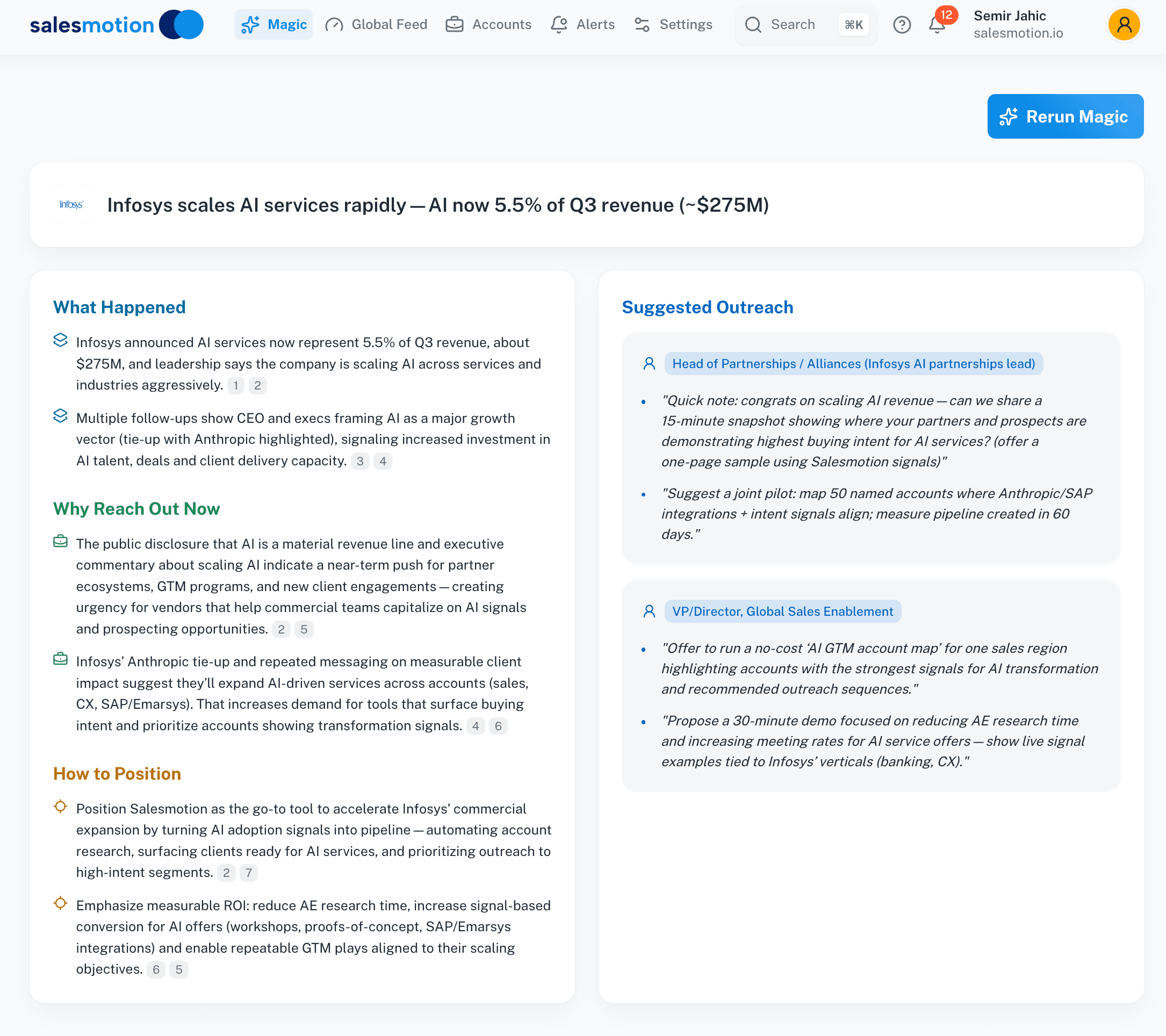
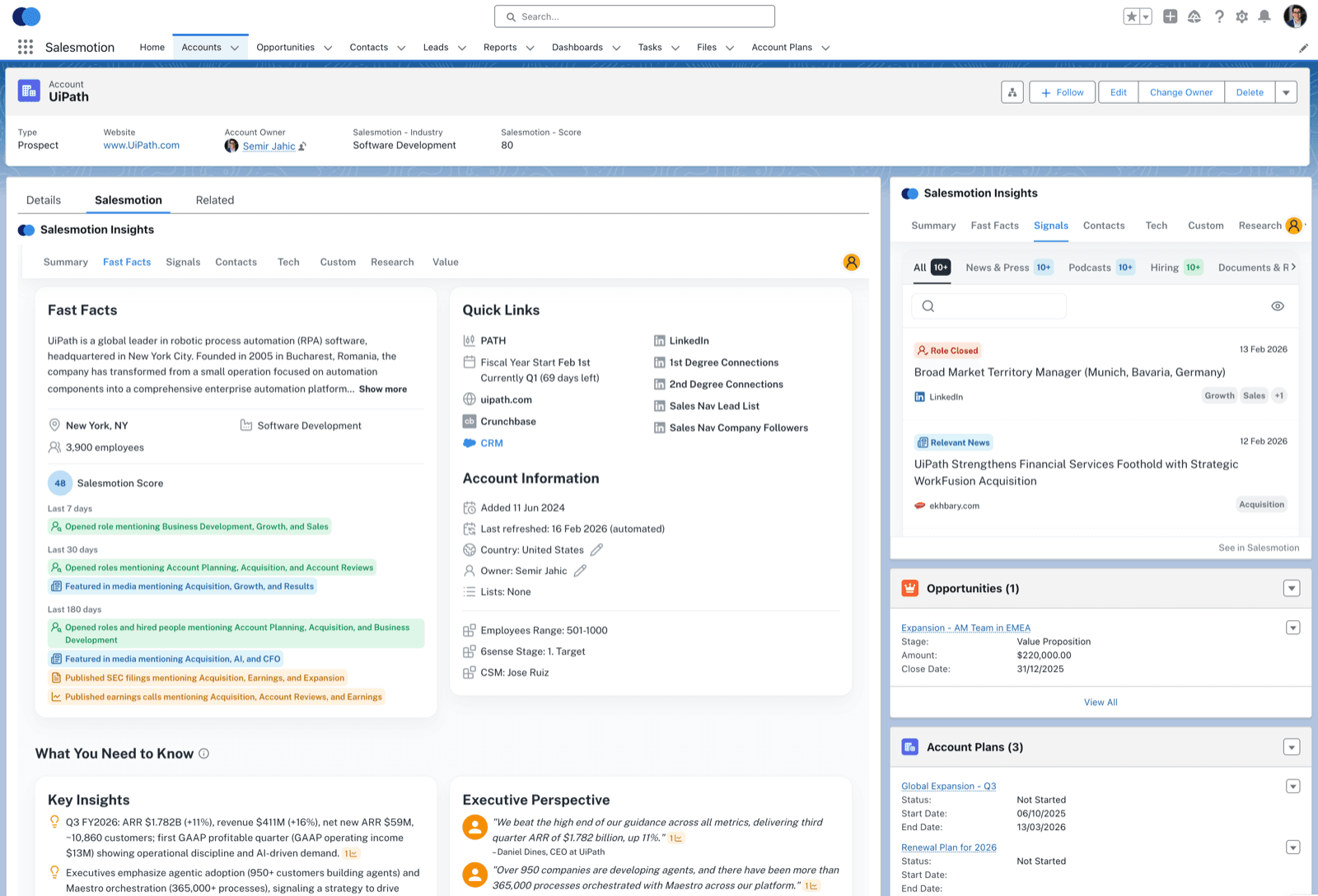
Salesmotion is an account intelligence platform purpose-built for B2B sales teams. Instead of waiting for a rep to ask, its three AI agents work the territory continuously: the Signal Agent monitors 1,000+ sources around the clock for buying signals, the Research Agent maintains a source-linked brief on every account, and the Outreach Agent drafts messages anchored to the specific signal that makes outreach timely.
The difference from a general assistant is structural, not incremental. Gemini answers the question you ask about the account you name. Salesmotion watches every account you own and tells you which one deserves attention today, with the research and the draft already prepared. Intelligence lands inside Salesforce and HubSpot rather than in a chat window, so the whole team works from the same, consistent account picture instead of whatever each rep's prompt produced.
Best for: B2B sales teams that need continuous account monitoring, consistent research quality, and signal-driven outreach across a territory
G2 rating: 4.8/5
Pricing: $85/mo for individuals — flexible monthly billing. Custom pricing for teams and enterprise on request.
How Google Gemini and Salesmotion stack up across key capabilities.
| Feature | Google Gemini | Salesmotion |
|---|---|---|
| Account monitoring | Not available: research is on-demand only | Continuous monitoring with real-time alerts |
| Research depth | Deep Research compiles reports on request | Source-linked briefs maintained on every account |
| Signal detection | None: reps must notice events themselves | Leadership, funding, earnings, hiring, M&A, trials |
| Outreach drafting | Drafts from whatever context you paste in | Drafts anchored to the live signal and account brief |
| Meeting prep | Strong when you provide the documents | Brief is already built before the meeting is booked |
| Source attribution | Inconsistent; answers can hallucinate | Every insight links to its source |
| Territory view | None | Scored accounts ranked by live signal activity |
| Where it lives | Gmail, Docs, chat window | CRM, inbox alerts, and the platform |
Gemini's business pricing is effectively bundled: since 2025, Google includes Gemini in Workspace Business and Enterprise plans, so for most companies the marginal cost of reps using it is zero. That makes it the natural default for drafting and summarizing, and there is no reason to stop using it for those jobs.
Salesmotion starts at $85/month for individuals, with team plans that include the whole team; pricing scales with accounts monitored, not headcount. See pricing for details.
The comparison is not really cost, it is coverage. A bundled assistant that requires a rep to ask the right question about the right account at the right moment produces value in proportion to rep effort. A monitoring platform produces value while reps sleep. Teams that tried to close the gap with prompting describe workflows that stayed roughly 70% manual: prompt, verify, look up context separately, paste into the CRM. The honest division of labor: keep Gemini for documents and drafting inside Workspace, and use a purpose-built platform for territory intelligence.
We'd rather you pick the right tool than the wrong one. Salesmotion isn't for everyone — here's when another option on this page is the smarter call.
“All of the vendors that I've worked with, all of the onboarding that I have had to deal with, I will say, hands down, Salesmotion was the easiest that I have had.”

Lyndsay Thomson
Head of Sales Operations, Cytel
Salesmotion gives your reps the account intelligence they need to book more meetings and close bigger deals.
Yes, on demand and one account at a time. Ask Gemini about a company and it will produce a useful summary, and Deep Research can compile a longer report. What it cannot do is watch your accounts: there is no monitoring, no buying-signal detection, no alerting, and no CRM connection. Reps we speak with who built daily Gemini routines describe the output as helpful but not specific to their accounts, and the workflow as mostly manual: prompt, verify, then transfer everything to the CRM by hand.
Effectively yes for companies on Google Workspace: Google bundles Gemini into Business and Enterprise plans, so reps can use it at no marginal cost. That is a genuine advantage for drafting and summarizing work. The cost shows up as time rather than licence fees when teams try to use it as their account-research system: the prompting, verifying, and copy-pasting stays with the rep.
Both, for different jobs. Keep Gemini for what it is bundled to do: summarizing threads, drafting documents, and answering ad-hoc questions inside Workspace. Use Salesmotion for the job a general assistant structurally cannot do: monitoring every account in your territory, flagging the buying signal the day it fires, and drafting outreach anchored to it. Teams like Cytel consolidated their research stack around that division and cut research time by 50%.
The same way it differs from Gemini: all three are prompt-driven general assistants, excellent at drafting and summarizing, with no account monitoring, no signal detection, and no CRM integration. The pattern we hear from buyers is identical across all three tools. See the full Salesmotion vs ChatGPT comparison for the detailed breakdown.
Salesmotion uses large language models as one layer of the platform, grounded in its own real-time source network of 1,000+ feeds. The difference from using a model directly is the grounding and the workflow: every insight links to a verifiable source, monitoring runs continuously without prompting, and output lands in the CRM and the rep's alerts rather than a chat window.
A Signal Agent, Research Agent, and Outreach Agent — working 24/7 so your team spends less time researching and more time closing.