
Most teams searching for GlobalData alternatives are not unhappy with the data. They are a five to twenty person CRO business development team paying for a research platform and using perhaps a tenth of it, and the tenth they use is the part it was least designed for.
Three mid-size CROs raised the same three things with us in a single fortnight this autumn: alerts that arrive too late to act on, headquarters tagging they clean by hand, and a renewal number that is hard to justify against how the tool actually gets used.
Worth saying up front, because it shapes everything below: none of those is a criticism of the product. They are symptoms of using a research platform as a selling tool.
What GlobalData is genuinely built for
GlobalData is a strong research and forecasting platform. It has deep pipeline and epidemiology coverage, market sizing, analyst commentary and report libraries across a wide set of industries. If your job is to size a market, build a five-year forecast, brief an executive team on a therapeutic area, or support a strategy decision with sourced analysis, it does that well and the breadth is a genuine advantage.
That is a real job and plenty of organisations have it. Strategy teams, corporate development, market access and commercial planning functions get value from exactly that breadth.
The mismatch appears when a BD rep is handed the same login and asked to find their next conversation.
What a small BD team actually does on a Tuesday
The day-to-day job is narrower and more repetitive than research work:
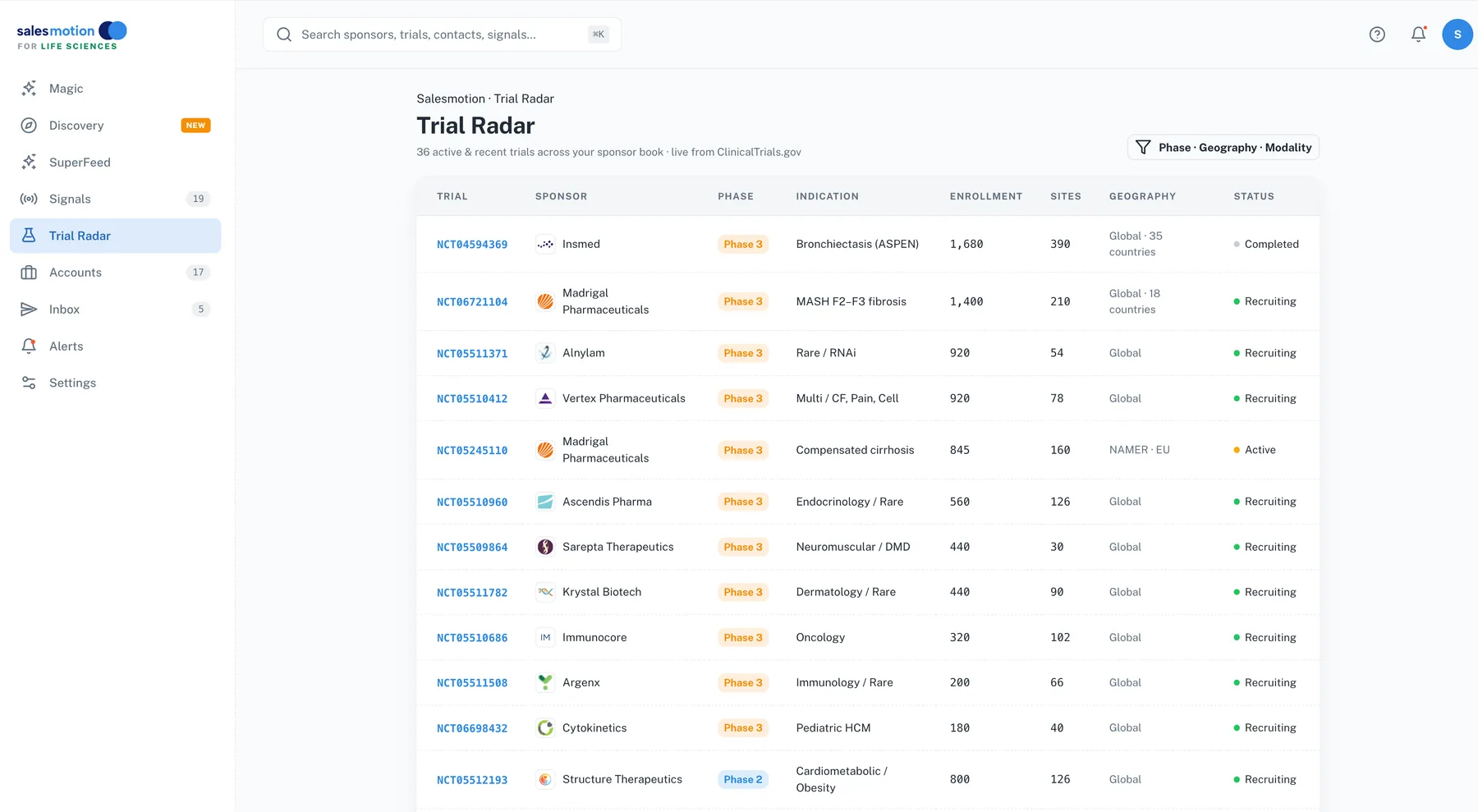
- Find out which of my accounts changed since last week
- Understand enough about one account to write something that does not embarrass me
- Find the person who scopes the work, and their email
- Do that for eighty accounts without it consuming the week
A research platform is optimised for depth on demand. This job is optimised for a short, reliable signal about many accounts, and the two are different products even when they run on overlapping data.
Options by job
An honest map. Each of these is a good product for the job in its right-hand column.
| Tool | Best at | Weaker for a BD desk | Published pricing? |
|---|---|---|---|
| GlobalData | Market sizing, forecasting, analyst support, broad industry coverage | Weekly per-account signal for a selling motion | No, not published |
| Citeline | Curated pipeline, trial and site data; the reference standard for R&D detail | People data is investigators and sites, not commercial buyers | No, quoted per organisation |
| AlphaSense | Search across filings, transcripts and expert calls; excellent for diligence | Sponsor discovery and contact data | No, not published |
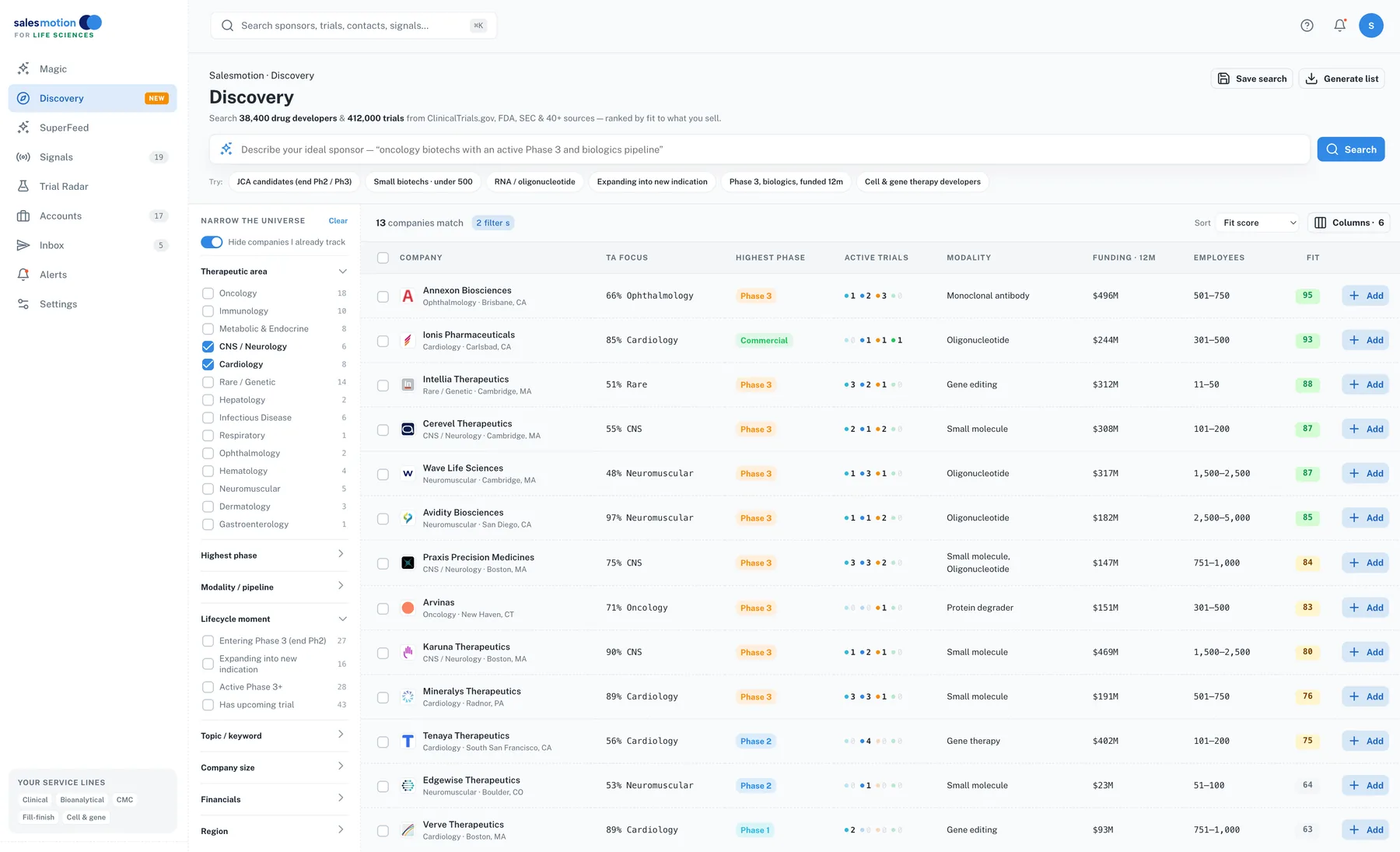
| Salesmotion | Per-account signals, briefs and contacts for a selling motion | Deep market forecasting and analyst reports | Yes, from $85 per month |
| A home-built agent | Exactly your criteria, and cheap to start | Entity resolution, contacts, alerting, and somebody owning it forever | Your team's time |
The honest read: if you need both jobs done, the research platform and a selling tool are not substitutes. Some organisations keep a single research seat for the strategy team and move the BD desk onto something built for the daily motion.
What is publicly known about pricing
Be careful with any article that quotes confident numbers here, including this one.
GlobalData does not publish platform pricing. It lists prices for individual store reports and offers trials on request. Third-party procurement data varies widely, and one marketplace reports a median around $68,500, which should be treated as approximate rather than a quote.
Citeline does not publish pricing. Pharmaprojects, Trialtrove and Sitetrove are quoted per organisation.
Clarivate does not publish pricing for Cortellis or the DRG portfolio; contracts are quoted per organisation.
AlphaSense does not publish pricing.
Salesmotion publishes: $85 per month for a single seat, $200 per month for the Life Sciences bundle at 200 tracked accounts, $500 per month for 500 accounts and up to 20 users, monthly. The single seat does not include life-sciences sponsor discovery, which is worth knowing before you compare like for like.
The reason to lay it out this way is that per-organisation pricing is not a flaw, it is a different commercial model for a different buyer. It does mean a four-person BD team cannot easily find out what it would cost without entering a sales process.
See Salesmotion on a real account
Book a 15-minute demo and see how your team saves hours on account research.
Switching without losing history
The fear that stops most switches is losing years of accumulated account context. Three things make it manageable:
Export what you can before the renewal date, not after. Access ends when the contract ends, and the notes and lists you built are the part you cannot rebuild. This sounds obvious and it is the step teams most often miss.
Accept that some history does not transfer, and decide whether it matters. Analyst reports and market models are the vendor's intellectual property and will not come with you. Your account lists, notes and contact records are yours.
Run both for one cycle if the budget allows. A single quarter of overlap removes almost all the risk and usually costs less than the mistake it prevents.
On the outcome side, consolidation is generally where the measurable saving shows up. Cytel reduced research time by 50% after consolidating five research sources into one, which is a consolidation result rather than a comparison result, and it is the pattern most teams are actually buying.
Frequently asked questions
Is GlobalData bad for CRO business development? No. It is built for a different job and it does that job well. The question is whether your BD desk is the right user for a research platform, and for a five to twenty person team the answer is often no.
What do we lose by moving off a research database? Market sizing, epidemiology, forecasting and analyst commentary. If anyone in your organisation relies on those, keep a seat rather than cancelling outright.
Can we filter sponsors by US state? Build the universe with therapeutic area, phase and modality, then resolve state from the account records once. Our guide to CRO territory planning by state covers the full approach.
How do we get lists into our own tools? Push to Salesforce, pull through the API, or work the list in place. Tell us where it needs to land and we will walk you through the route that fits your stack.
The fastest way to judge this is on your own therapeutic areas rather than a feature table. Half an hour on real records will tell you whether the daily motion is the job you are actually trying to solve. Compare the alternatives or see how it works for CRO business development.