You probably think your lost deals went to a competitor or died on price. Most did not. They died of indecision, the buyer froze and chose nothing. The JOLT effect is the research-backed method for un-sticking those frozen deals, and it overturns almost everything reps are taught about handling objections.
TL;DR: In The JOLT Effect, Matthew Dixon and Ted McKenna analyzed over 2.5 million sales conversations and found that 40-60% of qualified deals are lost not to a competitor but to "no decision" caused by buyer indecision. The JOLT method counters it: Judge the indecision, Offer a recommendation, Limit the exploration, and Take risk off the table. The counterintuitive finding: piling on more value and more urgency makes indecisive buyers freeze harder, not act faster.
What Is the JOLT Effect?
The JOLT effect is a sales method for overcoming buyer indecision, the single largest cause of lost B2B deals. It comes from The JOLT Effect, a 2022 book by Matthew Dixon and Ted McKenna (the team behind The Challenger Sale), built on an analysis of more than 2.5 million recorded sales conversations.
Their central finding upends conventional wisdom. For decades, reps were taught that the enemy is the status quo, the buyer's preference for doing nothing. Beat the status quo by amplifying pain and urgency, the thinking went, and the deal closes. Dixon and McKenna found that in roughly 56% of lost "no decision" deals, the buyer actually wanted to change. They were sold on the need. They froze anyway, paralyzed by the fear of making the wrong choice.
That distinction matters. A buyer stuck in the status quo needs to be convinced there is a problem. An indecisive buyer is already convinced and is now terrified of buying wrong. Treating the second buyer like the first, by adding more pressure, more features, and more FOMO, makes the paralysis worse. JOLT is the antidote. It is the rare sales methodology built specifically for the moment after the buyer agrees they need to change.
See Salesmotion on a real account
Book a 15-minute demo and see how your team saves hours on account research.
Indecision vs. Status Quo: Why Most Lost Deals Are Misdiagnosed
Most reps misdiagnose their losses, and the misdiagnosis leads them to do exactly the wrong thing. Understanding the difference between status-quo bias and indecision is the foundation of JOLT.
Status-quo bias is the buyer's inertia, the comfort of "what we have works well enough." The fear here is the fear of change: the disruption, the cost, the effort of doing something new. The cure is classic value selling, making the cost of inaction unbearable.
Indecision is different. The buyer has already decided to change. Now they are frozen by the fear of choosing wrong: picking the wrong vendor, missing a better option, getting blamed if it fails. Dixon and McKenna call this "omission bias," the tendency to prefer the safety of doing nothing over the risk of an active mistake.
Here is the trap. The tactics that beat status-quo bias (more urgency, more value, more pressure) actively worsen indecision. Every extra feature you pile on is one more thing the indecisive buyer feels they need to evaluate. Every "act now or lose the discount" raises the stakes of getting it wrong. You are pouring fuel on the fire and wondering why the deal will not move.
This is a pattern we see across sales teams. A rep accepts "let's discuss next quarter" without pushback, then doubles down on a longer feature list and a tighter deadline. Neither addresses the real problem. The buyer is not unconvinced. The buyer is afraid. JOLT treats the fear directly.

“Salesmotion empowers me to cultivate a great buyer experience. I'm able to challenge prospects' thinking and be a trusted consultative seller. A major part of this is Salesmotion insights.”
Austin Friesen
Account Executive, FY25 #1 President's Club, Clari
Omission vs. Commission: The Two Fears That Freeze Buyers
Buyer indecision splits into two distinct fears, and JOLT addresses each one specifically. Naming them is half the battle, because reps who can spot which fear is operating know exactly which lever to pull.
Fear of commission is the fear of doing the wrong thing actively: signing with the wrong vendor, choosing the wrong package, committing budget to something that fails. A buyer gripped by commission fear keeps asking for one more reference, one more case study, one more proof point. They are trying to buy certainty they will never fully get.
Fear of omission is the fear of missing a better option: a cheaper alternative, a feature you do not have, a vendor they did not evaluate. A buyer gripped by omission fear keeps expanding the search, looping in more stakeholders, and asking to "make sure we've looked at everything."
The signals differ. Commission fear shows up as repeated requests for reassurance on the same point. Omission fear shows up as scope creep in the evaluation itself. Both feel like engagement to an optimistic rep, but both are stalls. A demo "happening too early with the wrong people," curious juniors instead of real buyers, is often omission fear in action: the buyer widening the circle to avoid committing.
The four JOLT moves map onto these fears, which is what makes the method work where generic objection-handling fails.
The Four JOLT Moves
JOLT is an acronym for four behaviors that the highest-performing reps use to close indecisive buyers. Here they are as a single playbook you can run on any stuck deal.
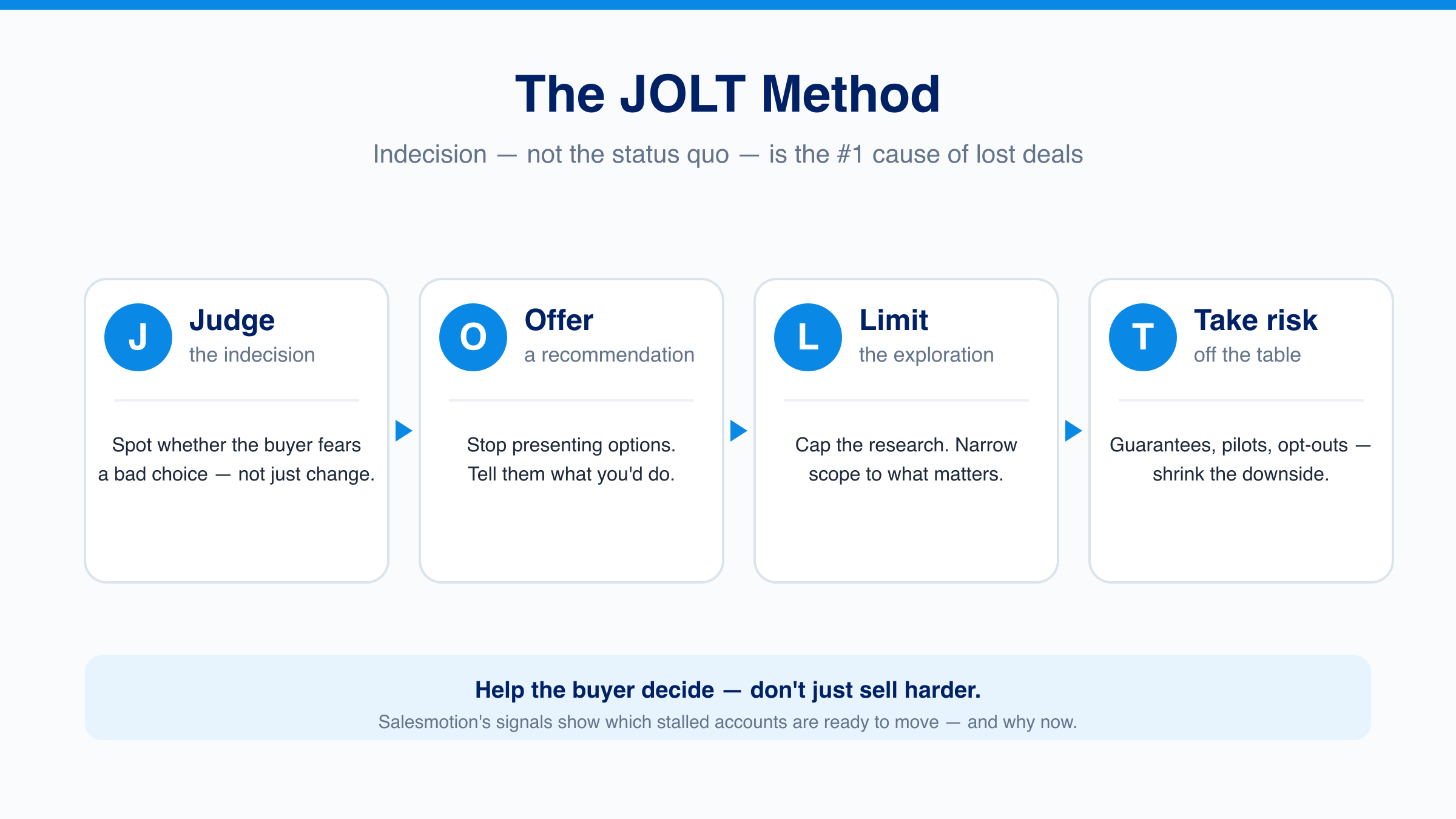 The four JOLT moves help an indecisive buyer actually decide — instead of selling harder into a stall.
Each move and the specific fear it counters:
| Move | What it means | What it counters |
|---|---|---|
| J — Judge the indecision | Diagnose early how indecisive this buyer is and why; qualify on decision-readiness, not just need | Wasting cycles on buyers who will never decide |
| O — Offer a recommendation | Stop presenting options neutrally; tell the buyer what you would do and why | Choice overload and commission fear |
| L — Limit the exploration | Constrain the endless evaluation; reassure that you have done the homework so they do not have to | Omission fear and scope creep |
| T — Take risk off the table | De-risk the decision with guarantees, pilots, opt-outs, and safety nets | The buyer's fear of being blamed if it fails |
The four JOLT moves each target a specific driver of buyer indecision, which is why they outperform generic urgency and objection-handling on frozen deals.
Judge comes first because not every buyer is winnable, and indecisive buyers need a different play. The best reps assess decision-readiness early and adjust, rather than discovering in month four that the buyer was never going to pull the trigger.
Offer a recommendation is the most counterintuitive. Reps are trained to be neutral guides who "let the buyer decide." Dixon and McKenna found that indecisive buyers desperately want a confident recommendation. Telling a buyer "given everything you've shared, here's what I'd do in your shoes" reduces choice overload and signals expertise.
Limit the exploration means proactively narrowing the search. Instead of fielding "can we also evaluate X?" you say "we've already looked at how X compares for teams like yours, and here's why this is the right fit." You absorb the research burden so the buyer does not feel they have to leave no stone unturned.
Take risk off the table addresses the deepest fear: getting blamed. Pilots, phased rollouts, money-back terms, and clear opt-out clauses all lower the personal stakes of saying yes. When the downside is capped, the decision gets easier.

“The moment we turned on Salesmotion, it became essential. No more hours on LinkedIn or Google to figure out who we're talking to. It's just there, served up to you, so it's always 'go time.'”
Adam Wainwright
Head of Revenue, Cacheflow
How to Spot Indecision Signals Early
The earlier you spot indecision, the cheaper it is to address. By the time a deal is in "we need to think about it" limbo, you have already lost weeks. Watch for these signals.
Repeated requests for the same reassurance. A buyer who keeps asking for one more reference after you have provided three is not gathering information. They are trying to feel certain, and certainty is not coming from more data. This is commission fear.
Expanding stakeholder lists late in the cycle. When new people keep getting pulled in after you thought you had alignment, the buyer is diffusing responsibility. More heads means less individual blame. This is omission fear and committee paralysis.
Vague timelines that keep slipping. "Let's revisit next quarter" with no concrete trigger is a classic indecision tell. A buyer with real urgency names a date and a reason. A frozen buyer punts.
Engagement without progression. The buyer takes every meeting, asks good questions, and seems genuinely interested, but never advances. High activity, zero momentum. Across sales teams, this is the most-missed signal, because it looks like a healthy deal right up until it dies.
The diagnostic question to ask yourself: is this buyer unconvinced, or afraid? If they are unconvinced, sell value. If they are afraid, run JOLT. Most stalled deals at this stage are fear, not doubt. For the broader skill of reading buyer hesitation, see our guide to overcoming objections in sales.
Why JOLT Breaks Down at Scale
JOLT is a brilliant individual skill. It is also nearly impossible to run consistently across a whole team without help, because every move depends on information reps rarely have when they need it.
To judge indecision, you need to know the account's context: is there real budget, a committed initiative, executive sponsorship, or is this a curious junior with no mandate? To offer a recommendation with authority, you need deep knowledge of the buyer's specific situation, not a generic pitch. To limit exploration credibly, you need to genuinely know the competitive landscape and the buyer's alternatives. To take risk off the table, you need to understand what the buyer is actually afraid of, which is usually tied to their internal politics and recent organizational changes.
Most of this lives outside the CRM and goes stale fast. A buyer who had budget in January may have lost it to a reorg by March. The executive sponsor who would have de-risked the deal may have left. Reps who run JOLT on outdated context offer recommendations that miss and reassurances that ring hollow.
There is a related pattern we see across sales teams: wins consistently trace back to a compelling operational trigger, executive sponsorship, or a referral, not to outbound volume. The deals that close are the ones where the rep had real context and timing. JOLT depends on exactly that context, and gathering it manually does not scale past a handful of accounts.
How Salesmotion Operationalizes JOLT
The hardest part of JOLT is not the four moves. It is having the live account context to run them well, on every deal, not just your best rep's top three. This is where signal-based selling turns JOLT from a coaching concept into a repeatable workflow.
Salesmotion continuously monitors buying signals across an account, leadership changes, earnings commentary, hiring patterns, funding, and competitive moves, so reps walk into every conversation knowing whether a buyer has the mandate, the budget, and the trigger to actually decide.
Here is the workflow in practice:
- Trigger. A deal in your pipeline has gone quiet, and the account just announced a leadership change in the buying unit plus a new strategic initiative on its earnings call.
- Platform action. The account brief auto-updates with the new sponsor, the stated priority, and the timing pressure behind it, the exact context you need to judge whether the indecision is fixable.
- Rep action. Instead of a generic "just checking in," the rep re-engages with a confident recommendation tied to the new initiative, limits the exploration by referencing what the buyer's peers chose, and offers a phased pilot to take risk off the table.
- Outcome. The frozen deal thaws because the rep addressed the real fear with real context. The "next quarter" stall turns into a defined next step.
That is JOLT operationalized. Buyers today are "drowning in data but starving for action," they want fewer choices and a clear next step, which is precisely what the JOLT method delivers when reps have the context to deliver it confidently.
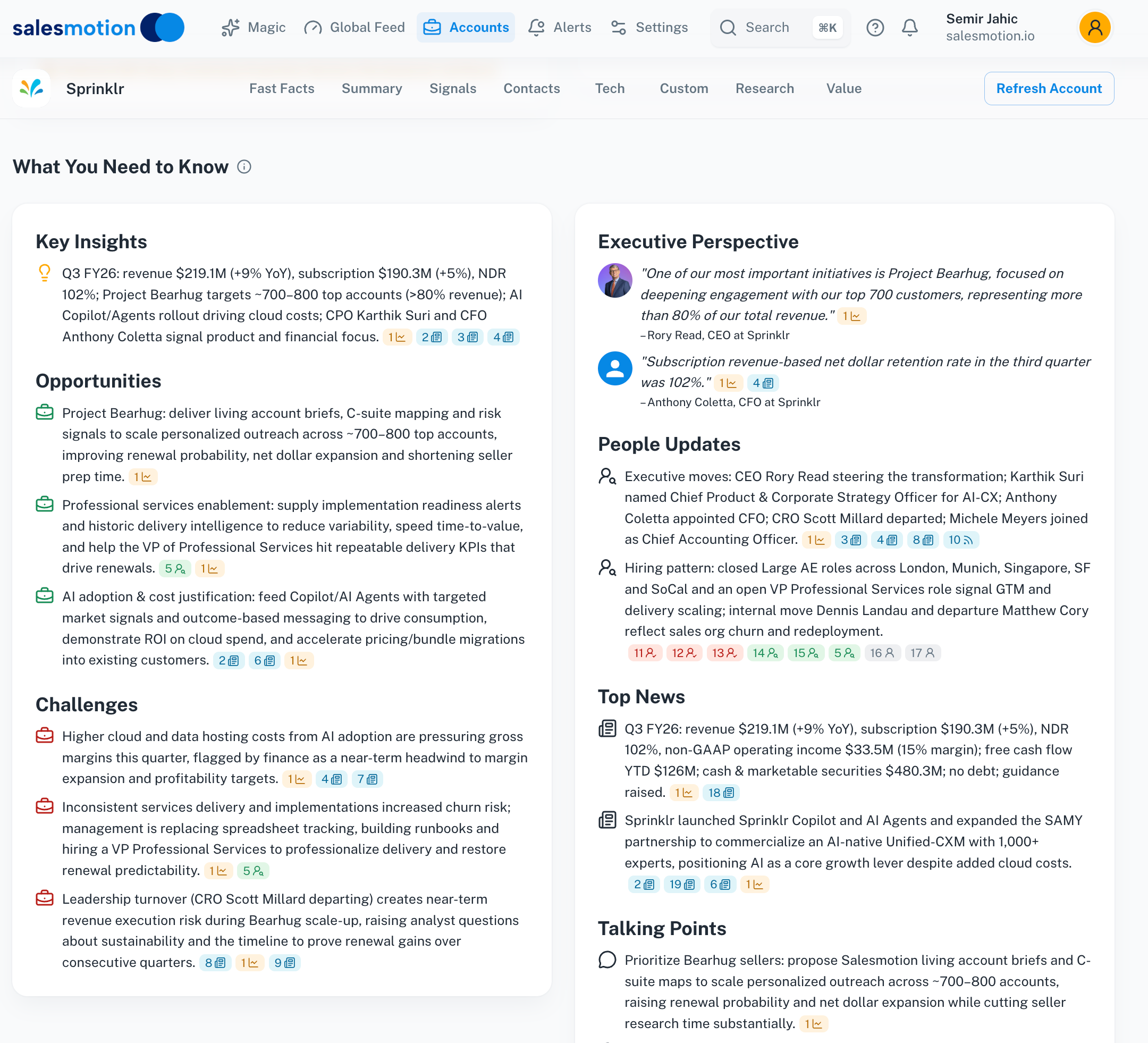 A live account brief gives reps the context to judge indecision and make a confident recommendation, the first two moves of the JOLT method.
The payoff shows up in the numbers. Teams that give reps live account context report faster cycles and higher win rates, because deals stop dying in the "no decision" zone. One team grew qualified pipeline 40% year over year after consolidating fragmented research into a single source of account intelligence, deals progressed because reps could finally read and resolve buyer hesitation in real time. See it on one of your accounts.
Key Takeaways
- 40-60% of lost qualified deals die from buyer indecision, not competitors or price. Dixon and McKenna found most "no decision" buyers actually wanted to change but froze.
- Indecision is not status-quo bias. The status-quo buyer fears change; the indecisive buyer has decided to change and fears choosing wrong. They need opposite treatments.
- Adding more value, urgency, and pressure makes indecisive buyers freeze harder. JOLT does the opposite: it simplifies, recommends, and de-risks.
- The four moves: Judge the indecision, Offer a recommendation, Limit the exploration, Take risk off the table. Each counters a specific fear.
- Spot indecision early through repeated reassurance-seeking (commission fear), late-stage stakeholder expansion (omission fear), slipping timelines, and engagement without progression.
- JOLT breaks at scale without live account context. Signal-based account intelligence gives reps the timing and context to run each move confidently on every deal.
Frequently Asked Questions
What is the JOLT effect in sales?
The JOLT effect is a method for overcoming buyer indecision, introduced by Matthew Dixon and Ted McKenna in their 2022 book The JOLT Effect. Based on an analysis of over 2.5 million sales conversations, it found that 40-60% of lost deals die from indecision rather than competition or price. JOLT stands for Judge the indecision, Offer a recommendation, Limit the exploration, and Take risk off the table.
What is the difference between buyer indecision and status-quo bias?
Status-quo bias is the buyer's preference for doing nothing because change feels risky or disruptive; the fix is making the cost of inaction clear. Buyer indecision is different: the buyer has already decided to change but is frozen by the fear of choosing wrong. The tactics that beat status-quo bias, more urgency and more value, actually make indecision worse, which is why diagnosing the difference matters.
What is the difference between fear of omission and fear of commission?
Fear of commission is the fear of actively doing the wrong thing, like signing with the wrong vendor; it shows up as repeated requests for reassurance on the same point. Fear of omission is the fear of missing a better option; it shows up as scope creep, expanding the evaluation and pulling in more stakeholders. JOLT addresses commission fear with a confident recommendation and omission fear by limiting the exploration.
How do you spot buyer indecision early?
Watch for repeated requests for the same reassurance, stakeholder lists that expand late in the cycle, timelines that keep slipping without a concrete trigger, and engagement without progression, a buyer who takes every meeting but never advances. The diagnostic question is whether the buyer is unconvinced or afraid. If they are afraid, run JOLT instead of piling on more value.
Does JOLT replace methodologies like MEDDIC or Challenger?
No. JOLT complements qualification frameworks like MEDDIC and engagement methods like Challenger. Those help you create the deal and prove value. JOLT addresses the specific late-stage moment when a qualified, convinced buyer freezes and risks becoming a "no decision" loss. Most teams layer JOLT on top of their primary methodology rather than replacing it.