Most sales advice still tells teams to increase activity. Build a bigger list. Add more contacts. Send more touches. Tighten the cadence.
That advice is why so many inboxes are full of messages that say nothing and arrive at the wrong time.
What is signal based selling? It's the practice of timing outreach around observable events that indicate buying readiness, not around arbitrary sequences or static lead lists. A new CRO joins. A company raises funding. Hiring accelerates. An earnings call reveals a strategic priority. A prospect visits a high-intent page. The outreach starts because something changed, and that change creates a reason to talk now.
That shift matters because buyers don't need more follow-up. They need relevance. If your team can connect the right account, the right contact, and the right moment, outbound stops sounding like interruption and starts sounding like good timing.
The End of 'Just Checking In'
“Just checking in” is usually a confession that the seller has no new reason to reach out.
That's the core problem with traditional prospecting. It assumes persistence can compensate for weak timing. Sometimes that works. Most of the time, it produces polite silence, low-quality replies, and activity metrics that look busy without creating much pipeline.
Modern buyers do a lot of research before they ever want to talk to a rep. If you want a useful overview of that environment, Ascendly Marketing does a good job analyzing the 2026 digital buying process. The practical implication for sales leaders is simple. Outreach has to align with something the buyer is already dealing with, evaluating, or prioritizing.
Why timing beats cadence
A static cadence treats every target the same way. A signal-based motion doesn't.
When a rep reaches out after a visible trigger, the message carries a built-in “why now.” That could be a leadership change, a product launch, a hiring surge, a funding announcement, or a pricing page visit. The trigger gives the rep context. Context gives the buyer a reason to read.
According to Amplemarket's definition of signal-based selling, the methodology triggers personalized outreach using real-time buying signals instead of static lists alone.
Generic outreach asks for attention. Signal-based outreach earns it with timing.
What changes for the team
This isn't just a messaging improvement. It's an operating model change.
Instead of asking reps to push through lists, leaders ask them to work a queue of accounts where something meaningful just happened. Instead of measuring pure output, they start caring about whether outreach is anchored to a real event. Instead of writing “following up on my last note,” reps reference something concrete and current.
Teams that are still anchored to volume-first outbound should understand what they're replacing. Salesmotion's overview of what cold outreach is is a useful baseline because it shows why cold outbound, by itself, often lacks the context that makes a message land.
The old model says more touches. The better model says better timing.
See Salesmotion in action
Take a self-guided interactive tour — no signup required.
From Guesswork to Certainty
Most outbound motions sit in one of three buckets. None of them solve timing as cleanly as signal-based selling.

List-based selling
List-based prospecting starts with fit. The account matches your ICP, so it goes into sequence.
That sounds sensible until you remember that fit is not timing. A company can look perfect on paper and still have no reason to engage this quarter. Reps end up sending competent emails to people who aren't ready, and the fallback becomes volume.
This is the classic spray-and-pray motion. It creates activity, but not much certainty.
Intent-based selling
Intent data improved on static lists by trying to identify research behavior. That's useful, but it often stays one step removed from an actionable conversation.
A lot of intent signals are account-level, anonymous, or inferred. They suggest interest somewhere inside the company, but they don't always tell you who is involved, what changed, or how urgent the issue is. That's why many teams struggle to turn intent into specific outreach that feels grounded.
If your team tends to lump these categories together, it helps to read Salesmotion's explanation of what intent data is. Intent can support a motion. It usually isn't enough to run one on its own.
Relationship-based selling
Relationship-led selling works. Warm intros work. Former champions opening doors works.
The problem is scale. You can't build a full pipeline strategy around hoping the right person knows the right person at the right moment. Relationship-based selling is powerful, but narrow.
What signal-based selling does differently
Signal-based selling starts with verifiable change.
A new CRO hire says priorities, vendors, and operating rhythms may be under review. A funding round suggests budget and growth pressure. An earnings call mention can expose a strategic initiative. A hiring surge can reveal where the company is investing. These are concrete events, not guesses.
"The common thread is that prospects are time-poor, working with fragmented stacks, and missing the right signals at the right time."
That's why signals are so effective. They reduce the uncertainty around both relevance and timing.
Here's the cleanest comparison:
| Approach | What triggers outreach | Main weakness |
|---|---|---|
| List-based | ICP fit and contact availability | High volume, weak timing |
| Intent-based | Anonymous or account-level research patterns | Often indirect and hard to operationalize |
| Relationship-based | Existing network access | Strong quality, limited scale |
| Signal-based | Observable events tied to buying readiness | Requires disciplined monitoring and interpretation |
The practical trade-off
Signal-based selling is not magic. It creates a different problem set.
You trade list fatigue for signal selection. You trade generic personalization for interpretation work. You trade broad activity for higher judgment. That's a better trade, but only if your team knows how to decide which signals matter and what they mean for your solution.
Without that layer, reps still end up guessing. They just guess later in the process.

“There's been a big focus on hyper personalization and relevance in our outbounding efforts. Salesmotion has been a key partner in hitting our significantly increased meeting targets. What stands out is how simple it is. Reps can log in and get valuable account insights within 30 seconds to a minute.”
Joe DeFrance
VP of Sales, Incredible Health
The Anatomy of a High-Value Sales Signal
Not every event deserves outreach. Good signal-based selling depends on choosing signals that effectively change a buying conversation.
The easiest way to think about it is this. A sales signal becomes valuable when it tells you what changed, why that change matters, and who is likely to care.
A sales lead at a cybersecurity software firm told us: "And these right signals are not necessarily somebody downloaded a white paper, right?" The events that open a conversation are usually changes in the business, and a content download is rarely one of them.
Leadership and ownership changes
Executive movement is one of the clearest signals because new leaders often reset priorities, process, and tooling.
A new VP of Sales may be evaluating pipeline coverage, rep productivity, forecasting discipline, or tech stack gaps. A new Head of RevOps may be looking for cleaner workflows, better reporting, or tighter execution across tools. A former customer champion landing at a new company is especially useful because there's already category familiarity.
Growth and investment events
Companies rarely raise capital or expand hiring for no reason. These changes usually create pressure to execute, scale, or fix bottlenecks.
Funding rounds often indicate budget and urgency. Hiring sprees can reveal where the company expects demand or where current systems may break under scale. M&A activity can create integration work, process disruption, and vendor re-evaluation.
Strategic shifts in public view
Some signals don't look like “sales signals” at first glance, but they're often the most revealing.
Earnings calls, investor updates, company blogs, executive interviews, podcasts, and product launch announcements can tell you what leadership is prioritizing. If a leadership team keeps talking about efficiency, expansion, or entering a new segment, that's not filler. It's a map of what they'll spend time on.
Pain indicators and friction signals
Some of the best outreach starts when a company's existing motion clearly isn't working.
That may show up in job posts that describe a messy process, public comments about operational challenges, competitor mentions, or role requirements that imply manual work and fragmented systems. These signals take more interpretation, but they often produce stronger messaging because the pain is close to the surface.
For a broader view of the categories teams watch, Salesmotion's post on what buying signals are is a practical reference.
Common B2B sales signals and their meanings
| Signal Category | Specific Signal Example | What It Indicates |
|---|---|---|
| Leadership Changes | A new CRO joins from a company with a different operating model | New priorities, potential vendor review, openness to change |
| Leadership Changes | A former customer champion moves into an ICP account | Existing trust, faster education, easier initial conversation |
| Company Growth | The company announces a funding round | Budget availability, growth pressure, urgency to invest wisely |
| Company Growth | Hiring spikes in sales, marketing, or operations | Capacity expansion and likely process strain |
| Strategic Shifts | An earnings call highlights efficiency or expansion | Leadership has named a problem worth solving |
| Strategic Shifts | A product launch targets a new market | New demand generation, enablement, or operational needs |
| Pain Indicators | Job posts mention manual reporting or fragmented tooling | Existing workflow problems are visible and active |
| Pain Indicators | Public content references execution gaps or missed targets | A business issue is already acknowledged internally or externally |
| Competitive Signals | A prospect engages with competitor-related content | Active evaluation or dissatisfaction with current options |
| First-Party Signals | A known contact visits a high-intent page | Direct research behavior tied to a specific person |
Practical rule: A signal matters most when a rep can answer one question fast. “Why does this event make my solution more relevant today than it was last week?”
What reps often get wrong
The common mistake is treating every event as a prompt to pitch.
A funding round does not automatically mean “they need our product.” A new executive hire does not always mean “rip and replace.” Good reps interpret before they act. They look for the operational consequence of the event, then decide whether their solution fits that consequence.
That's the difference between using signals as noise and using them to their advantage.
The Signal-to-Outreach Workflow
A signal-based motion only works when the team follows a repeatable workflow. Otherwise, signals pile up in Slack, reps cherry-pick the obvious ones, and execution becomes inconsistent.
The practical model is Detect, Interpret, Act.
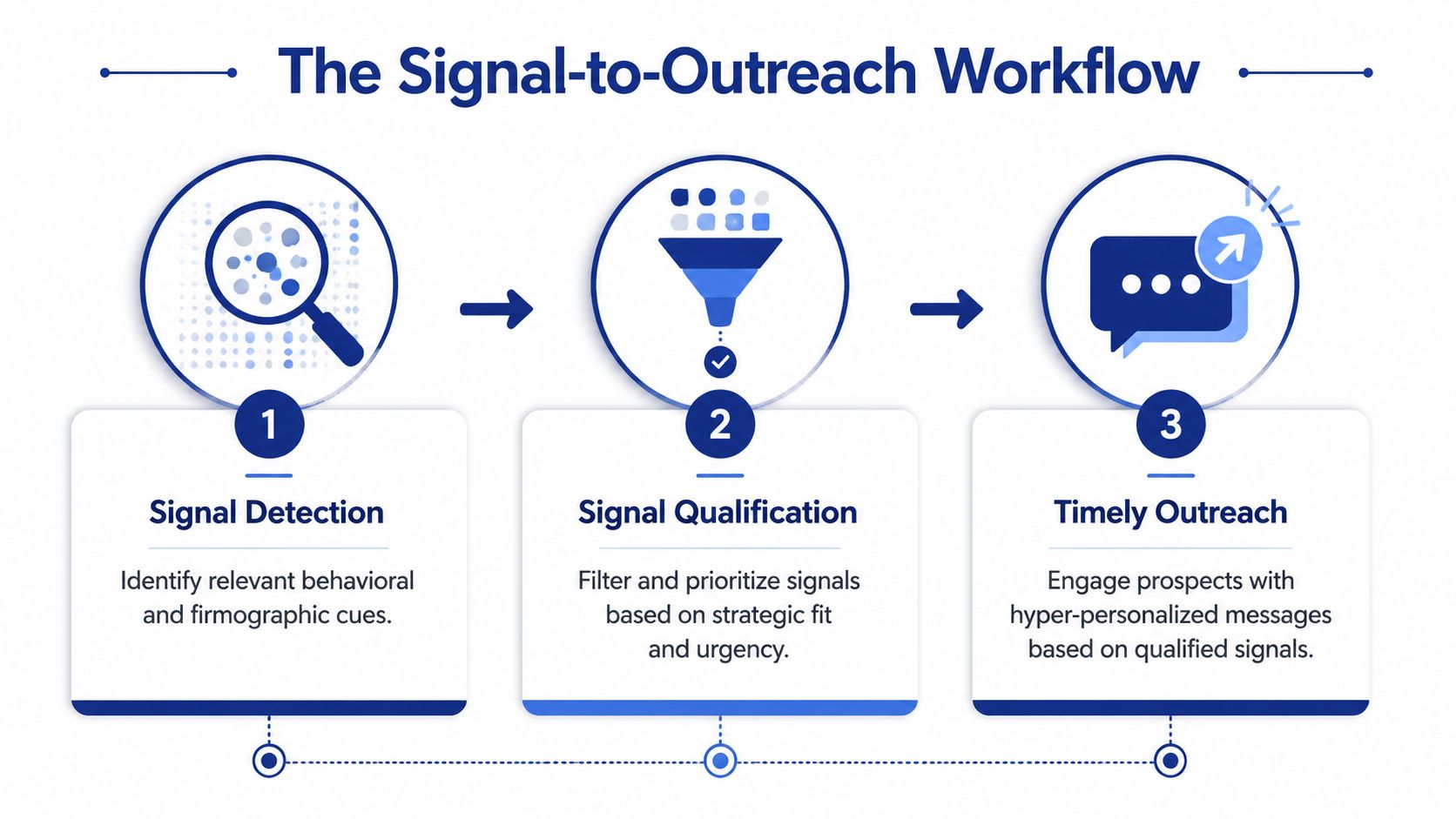
Detect relevant events
Signal detection means monitoring the events that correlate with buying windows in your market.
That usually includes leadership changes, hiring patterns, funding announcements, investor updates, press releases, public interviews, and first-party engagement where you can identify a real contact. The goal is not to collect every possible alert. The goal is to catch the few events that create real reasons to reach out.
Detection falls apart when teams monitor too broadly. If every mention becomes a task, reps stop trusting the feed.
Interpret the signal
Most programs fail at this point.
A raw signal is just an event. Interpretation answers the “so what.” If a company hires a new sales leader, what's likely changing? Team design, forecasting rigor, territory planning, tech stack, pipeline generation, onboarding, or all of the above? Which of those issues maps to your solution, and which persona should care first?
A commercial excellence manager at a pharma firm described a signal that arrives without that step: "Probably it is nice to have, but it doesn't inform the action for salesperson. What do I act on? What is my call to action?" That is the question interpretation has to answer before a signal reaches a rep.
Salesmotion's article on the signal-to-send outbound workflow gets at this operational gap well. The signal itself is not the advantage. The advantage comes from shortening the distance between an event and a useful message.
Act with signal-anchored outreach
Once the team understands the implication, the outreach should reference the signal directly and connect it to a plausible business issue.
Weak message: “We help companies like yours scale revenue.”
Better message: “Congrats on the new CRO hire. When teams bring in a revenue leader at this stage, pipeline coverage and operating consistency usually get reviewed fast. If that's happening now, I can share how other teams structure signal-led outbound around those moments.”
That message doesn't overstate. It doesn't pretend to know the whole situation. It uses the signal as context and opens a relevant conversation.
A simple operating checklist
Use this with reps and managers:
-
Confirm the event
Verify that the trigger is real, recent, and relevant to the account. -
Identify the consequence
Decide what the event likely changes inside the business. -
Choose the right contact
Reach out to the person most exposed to that consequence. -
Anchor the message
Reference the trigger in plain language and tie it to a business outcome. -
Move quickly
Signals lose value when teams wait, over-research, or route tasks through too many hands.
A good signal-based email reads like the rep noticed something important, not like software assembled a sentence.
What not to automate blindly
Teams should automate detection and research support. They should not automate judgment out of the process.
If every signal creates the same email pattern, prospects will notice. Reps still need to edit for fit, choose the right angle, and know when not to send anything at all. A signal-based workflow should reduce manual work, not remove thinking.

“This is my singular place that very simply summarizes a company's top initiatives, strategies and connects them to my solution. Something I would spend hours researching manually, now it's automated.”
Derek Rosen
Director, Strategic Accounts, Guild Education
Signal-Based Selling Playbooks in Action
The value of signal-based selling shows up when a team can turn a trigger into a repeatable action, not just a clever one-off email. That is the difference between using signals as extra data and running a timing-based sales model.
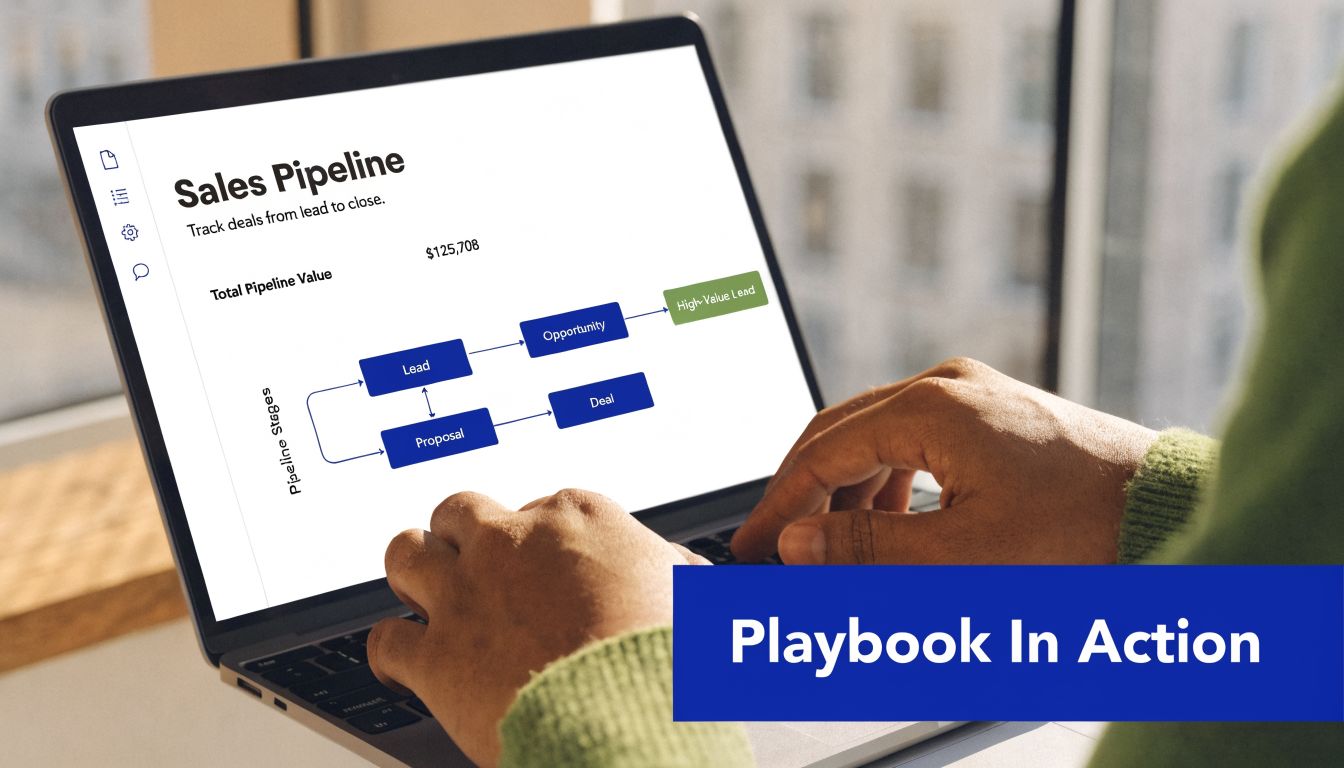
Two signals are especially useful because they appear often, matter to the buyer, and support clear action rules across the team.
Playbook one for a new executive hire
A new VP of Sales joins a target account. The rep spots the move on LinkedIn and sees that the executive came from a company with a more mature outbound motion.
That signal deserves attention because new leaders rarely spend their first months observing. They assess pipeline quality, team output, tooling, and coverage gaps quickly. If your message helps them frame one of those decisions, the outreach earns attention. If it just says congratulations, it gets ignored.
How to work it
- Confirm the move: Verify the title, the start date, and whether the prior company creates a relevant point of comparison.
- Study the operating context: Review the company's hiring pace, current sales org shape, and any comments from leadership about growth targets or execution issues.
- Pick one likely priority: Focus on a specific issue such as rep focus, pipeline consistency, or account prioritization.
- Write to the transition: New leaders are making decisions fast. The message should help them evaluate something, not sit through a product pitch.
Example email:
Subject: Congrats on the new role
Hi [Name], congrats on joining [Company].
Leaders stepping into this role usually need a fast read on pipeline quality and where reps are spending time. I noticed your team is growing, which often makes prioritization harder before it gets better.
If sharpening outbound focus is part of the first 90 days, I can share how teams use account and buying signals to decide where reps should engage now versus later.
Worth comparing notes?
Playbook two for a funding announcement
A company announces a new round. Many outbound reps treat that as a generic reason to reach out. The trigger is real, but the message often has no diagnosis behind it.
Funding only matters if the rep can explain what operational pressure comes next. A round tied to expansion creates different buying conditions than one tied to product development or efficiency. Good signal-based selling starts with that distinction.
How to work it
- Read beyond the headline: Use the announcement, executive quotes, and hiring activity to understand what the capital is meant to change.
- Map the pressure to an owner: Expansion may sit with revenue leadership. Efficiency may sit with operations or finance. Product-led growth may pull in a different buyer entirely.
- Connect to execution risk: The strongest angle is usually not growth in general. It is the cost of missing the window after the announcement.
- Keep the message specific: Reference the stated plan and the execution challenge attached to it.
Example email:
Subject: After the funding announcement
Hi [Name], I saw the announcement and the plan to expand into new markets.
That kind of push usually creates pressure on teams to prioritize the right accounts, spot active buying windows earlier, and keep reps focused on opportunities with near-term potential.
If that is part of the current plan, I can share how teams build outreach around those timing signals instead of running broad account lists.
Open to a quick conversation?
Why these playbooks hold up
These playbooks work because they start with a business event and end with a concrete outreach decision. That sounds simple, but it changes how teams operate.
Volume-based prospecting asks reps to work down lists and hope timing lines up. Signal-based selling asks reps to wait for evidence, interpret it correctly, and engage when the account has a reason to care. The playbook is what makes that model scalable. It gives managers a standard to inspect, helps reps act faster, and keeps the team from turning every trigger into the same templated message.
How to Operationalize Signal-Based Selling
A few reps can run signal-based selling manually. A revenue team needs process, coverage, and consistent judgment.
That means changing how managers inspect work. If the old review was “how many accounts did you touch,” the new review becomes “which signals did you act on, how did you interpret them, and what happened next?” This is a quality system first.

Build the motion before the tooling stack
Leaders usually make one of two mistakes. They either buy data and expect reps to figure it out, or they run a fully manual process that collapses under rep bandwidth.
The manual version still exists. A business developer at a logistics firm told us their buying signals come from someone reading trade magazines and alerting sales by hand.
A workable model is simpler:
- Define the signal set: Pick the events that map to your solution and ICP.
- Create interpretation rules: Decide what each signal likely means and which personas should own it.
- Standardize message patterns: Give reps examples of how to anchor outreach without sounding templated.
- Inspect signal quality: Managers should review whether the chosen signal justified the outreach.
Track the right performance questions
You don't need a complicated reporting philosophy to know whether the motion is working.
Look at whether signal-triggered outreach is creating better conversations than non-signal outreach. Look at which signal categories convert. Look at whether the team is acting while the signal is still relevant. Look at whether sales cycles feel tighter because reps are entering accounts when priorities are active instead of random.
Where platforms help
The hard part isn't finding one signal. It's operationalizing the full chain from monitoring to context to message creation.
According to Salesmotion's signal-based selling overview, leading teams using AI-powered signal intelligence have seen a 42% increase in sales velocity and 4x growth in self-sourced revenue, and the platform category can automate the workflow from signal detection to personalized outreach. In practice, that means handling three jobs reliably: continuous account research, real-time monitoring, and draft outreach generation.
Salesmotion is one example of that operating model. It runs three AI agents: a Research Agent that synthesizes account context from 1,000+ sources, a Signal Agent that monitors trigger events like earnings updates, hiring, executive moves, press releases, podcasts, and org changes, and a Outreach Agent that turns those signals into personalized sequences. That structure is useful because it addresses key failure points. Manual research, signal overload, weak “why now,” and inconsistent messaging.
Teams don't need more data. They need fewer blind spots and faster interpretation.
What good implementation looks like
The shift is cultural as much as technical.
Reps stop asking, “Who should I email today?” and start asking, “What changed in my accounts that gives me a reason to reach out?” Managers stop rewarding raw volume detached from context. RevOps starts thinking about routing and prioritization, not just list hygiene.
That's when signal-based selling stops being a tactic and becomes a system.
If your team wants to move from list-based prospecting to timing-based engagement, Salesmotion is worth evaluating. It operationalizes signal-based selling with AI agents for research, monitoring, and personalized outreach, which helps revenue teams turn real account activity into actions reps can use.