
Alternatives

Top Salesforce Sales Engagement Alternatives in 2026

Compare the best alternatives to Salesforce Sales Engagement for sales cadences, outreach automation, and pipeline acceleration.

At a glance

How Salesforce Sales Engagement Alternatives Compare

Side-by-side comparison of the key capabilities that matter most.

FeatureSalesmotionOutreachSalesloftApollo.ioHubSpot Sales Hub
Primary FocusAccount intelligence & buying signalsSales engagement & workflow automationSales engagement & revenue intelligenceProspecting database + outreach sequencingCRM-integrated sales engagement
Cadences / SequencesSignal-triggered outreach (not traditional cadences)Advanced multi-step sequences with branching logicCadence builder with A/B testing & analyticsEmail sequences with automated follow-upsSequences with task queues & automation
Account ResearchAI-generated briefs from 1,000+ sourcesBasic account-level engagement dataDeal intelligence & conversation analyticsFirmographic data & contact enrichmentCompany records with basic insights
Buying Signals50+ signal types with source attributionEngagement signals (opens, clicks, replies)Engagement + conversation intelligence signalsIntent data add-on + job change alertsWebsite visits & email engagement tracking
CRM IntegrationSalesforce & HubSpot (Enterprise plan)Salesforce, HubSpot, Microsoft DynamicsSalesforce, HubSpot, Microsoft DynamicsSalesforce, HubSpot + native CRMNative HubSpot CRM (built-in)
PricingFrom $85/mo (account-based, unlimited users on team plans)From ~$100/user/mo (annual contract required)From ~$140/user/mo (annual contract required)Free tier; paid from $49/user/mo annuallyFrom $20/seat/mo (Starter); $90/seat/mo (Pro)
Best ForTeams needing intelligence to guide outreachEnterprise sales teams with complex workflowsRevenue teams wanting engagement + coachingSMBs wanting prospecting + outreach in one toolTeams already using HubSpot CRM

Why teams look beyond Salesforce Sales Engagement

Salesforce Sales Engagement (formerly High Velocity Sales) brings cadence management, work queues, and a built-in dialer directly into the Salesforce Lightning console. For organizations deeply invested in the Salesforce ecosystem, it promises a seamless way to structure rep activity without switching between tools. In theory, that tight CRM integration should make it the obvious choice for Salesforce shops.

In practice, teams run into three recurring issues. First, cost: Sales Engagement is only available on Salesforce Unlimited ($350/user/mo) or as an add-on to Enterprise ($175/user/mo), making it one of the most expensive options in the category. Second, limited intelligence: the platform focuses on activity execution but does not help reps understand the accounts they are working. Third, feature depth: standalone engagement platforms like Outreach and Salesloft offer significantly more sophisticated sequencing, analytics, and AI capabilities.

The best alternatives in 2026 fall into two camps. If you need better execution tools, Outreach, Salesloft, Apollo.io, and HubSpot Sales Hub all deliver more features at competitive or lower price points. If the real problem is that your reps lack the context to personalize outreach, an account intelligence platform like Salesmotion fills the gap that no cadence tool can. Many teams end up pairing an intelligence layer with their execution tool of choice.

Why Trust This Guide?

Semir Jahic, CEO & Co-Founder of Salesmotion

I'm Semir Jahic, CEO of Salesmotion. Before founding an account intelligence platform, I spent years in enterprise sales at Salesforce itself and led revenue teams at Clari. I know the Salesforce ecosystem inside and out, including its strengths and where it falls short. My team and I have evaluated dozens of sales tools firsthand. This guide is based on real experience selling alongside (and sometimes replacing) Salesforce Sales Engagement. We work with teams at companies like Frontify, Analytic Partners, and Cytel who've made the switch. Salesmotion appears on this list because it solves a real gap, and we'll tell you where other tools are the better fit.

Semir Jahic — CEO & Co-Founder, Salesmotion

Detailed Breakdown

Best Salesforce Sales Engagement Alternatives

An in-depth look at each platform, including features, pricing, and limitations.

1

Salesmotion

Our Pick
G2: 4.8/5 (25 reviews)

Salesmotion takes a fundamentally different approach from Salesforce Sales Engagement. Rather than structuring activity execution, it provides the intelligence layer that makes every touchpoint more effective. The platform monitors over 1,000 sources to surface real-time buying signals -- leadership changes, earnings calls, funding rounds, technology investments, and strategic initiatives -- and synthesizes them into AI-generated account briefs.

For teams using Salesforce Sales Engagement, Salesmotion answers the question reps struggle with most: what should I actually say to this account? Instead of sending generic cadence emails, reps can reference specific company events and tie their outreach to real business priorities. The platform generates personalized talking points and outreach drafts anchored to verified signals.

Salesmotion integrates with Salesforce (Enterprise plan) and works alongside any execution tool. Teams typically pair it with their existing cadence platform to get both intelligence and execution in one workflow.

Best for:Sales teams that need account intelligence to make their outreach relevant and timely

Key Features

  • AI-generated account briefs from 1,000+ sources
  • Real-time buying signal monitoring with 50+ signal types
  • Personalized talking points and outreach drafts based on real events
  • Salesforce and HubSpot integration (Enterprise plan)
  • Account-based pricing with no per-seat limits on team plans
  • Live in days, not months

Limitations

  • Not a cadence/sequence execution tool (complements them)
  • No built-in dialer or email sending
  • Newer platform with smaller market presence than Salesforce
Pricing: From $85/mo — flexible account-based pricing, unlimited users on team plans
2

Outreach

G2: 4.3/5Visit site

Outreach is widely considered the most feature-rich standalone sales engagement platform. It pioneered the category and offers sophisticated multi-step sequences with conditional branching logic, A/B testing, and detailed analytics. For teams outgrowing Salesforce Sales Engagement's limited cadence capabilities, Outreach is the most common destination.

Outreach's sequence builder supports complex workflows that adapt based on prospect behavior -- if a prospect opens an email but does not reply, the sequence can automatically branch to a different follow-up path. The platform also includes conversation intelligence (via its Kaia acquisition), deal management, and pipeline analytics.

The tradeoff is cost and complexity. Outreach requires annual contracts starting around $100-120 per user per month, with implementation fees on top. For large teams, the total investment can rival Salesforce's pricing.

Best for:Enterprise sales teams that need the most advanced sequencing, automation, and conversation intelligence

Key Features

  • Multi-step sequences with conditional branching and A/B testing
  • AI-powered email assistance and send-time optimization
  • Conversation intelligence with call recording and analysis
  • Deal management and pipeline analytics
  • Salesforce, HubSpot, and Microsoft Dynamics integrations
  • Team performance analytics and coaching tools

Limitations

  • Annual contract required with no monthly option
  • No built-in contact database (need separate data source)
  • Complex setup and steep learning curve for full feature adoption
Pricing: From ~$100/user/month with annual contract. Implementation fees typically $1,000-$8,000
3

Salesloft

G2: 4.5/5Visit site

Salesloft is Outreach's closest competitor and the other major standalone sales engagement platform. It combines cadence management with conversation intelligence, deal management, and revenue forecasting in a single platform. Salesloft has invested heavily in its AI capabilities and coaching features, making it popular with revenue leaders who want both execution and coaching in one tool.

Compared to Salesforce Sales Engagement, Salesloft offers significantly more sophisticated cadence building, better analytics, and built-in conversation intelligence. Its Rhythm feature uses AI to prioritize the highest-impact actions for reps. For teams that found Sales Engagement's work queue too basic, Salesloft's AI-driven prioritization is a meaningful upgrade.

Salesloft integrates deeply with Salesforce CRM, so teams do not lose CRM connectivity by switching from Sales Engagement to Salesloft.

Best for:Revenue teams wanting engagement execution combined with conversation intelligence and coaching

Key Features

  • Cadence builder with templates, A/B testing, and automation rules
  • Conversation intelligence with call recording and AI analysis
  • Deal management and revenue forecasting
  • AI-driven Rhythm feature for action prioritization
  • Deep Salesforce and HubSpot CRM integration
  • Coaching and team performance analytics

Limitations

  • High per-user cost that scales with team size
  • No built-in contact database
  • Annual contract with 3-seat minimum
Pricing: From ~$140/user/month (Essentials) to ~$180/user/month (Advanced). Annual contract required, minimum 3 seats
4

Apollo.io

G2: 4.7/5Visit site

Apollo.io combines a 275M+ contact database with email sequencing and outreach automation, making it the most cost-effective all-in-one alternative to Salesforce Sales Engagement. For teams that found Sales Engagement limiting because it lacks both contact data and sophisticated sequences, Apollo solves both problems at a fraction of the price.

Apollo's sequencing capabilities include automated email follow-ups, A/B testing, and basic conditional logic. While not as advanced as Outreach or Salesloft for complex enterprise workflows, they are more than sufficient for most mid-market teams and significantly more capable than Salesforce Sales Engagement's built-in cadences.

The platform also includes a free tier with limited credits, making it easy to evaluate before committing. Apollo's biggest advantage over Salesforce Sales Engagement is the bundled contact database -- reps can find prospects, enrich records, and launch sequences without switching tools.

Best for:Budget-conscious teams that want prospecting data and outreach sequencing in a single, affordable platform

Key Features

  • 275M+ contact database with verified emails and phone numbers
  • Email sequencing with automated follow-ups and A/B testing
  • Chrome extension for LinkedIn prospecting
  • Intent data signals and job change alerts (paid tiers)
  • Built-in dialer with call recording
  • Salesforce and HubSpot integration

Limitations

  • Credit-based system can lead to unexpected costs at scale
  • Sequencing is less sophisticated than Outreach or Salesloft
  • Data accuracy varies by region (strongest in North America)
Pricing: Free tier with 100 credits/month. Paid plans from $49/user/month (annual) to $119/user/month (Organization)
5

HubSpot Sales Hub

G2: 4.4/5Visit site

HubSpot Sales Hub is the natural alternative for teams that want CRM-integrated sales engagement without the Salesforce price tag. Like Salesforce Sales Engagement, it provides sequences, task queues, and email tracking built into the CRM -- but at a significantly lower cost and with a gentler learning curve.

For teams considering a move away from Salesforce entirely, HubSpot Sales Hub offers a complete CRM plus engagement platform starting at $20/seat/month (Starter). The Professional tier ($90/seat/month) includes advanced sequences, forecasting, and playbooks that match or exceed what Salesforce Sales Engagement offers. The platform is particularly strong for marketing and sales alignment since it shares a database with HubSpot Marketing Hub.

The main limitation is that HubSpot's engagement features are less configurable than standalone platforms. Enterprise teams with complex multi-touch workflows may find the sequencing too simple compared to Outreach or Salesloft.

Best for:Teams that want CRM-integrated engagement at a lower price point, especially those already using or considering HubSpot CRM

Key Features

  • Email sequences with personalization tokens and task automation
  • Meeting scheduling with calendar integration
  • Pipeline management and deal tracking
  • Email tracking, templates, and snippets
  • AI-powered email writing and conversation intelligence (Pro+)
  • Native marketing and service hub integration

Limitations

  • Sequencing is less sophisticated than Outreach or Salesloft
  • Advanced features require Professional or Enterprise tiers
  • Migrating from Salesforce CRM is a major undertaking
Pricing: Starter from $20/seat/month. Professional from $90/seat/month. Enterprise from $150/seat/month. One-time onboarding fee for Pro ($1,500) and Enterprise ($3,500)

Customer Story

How Frontify achieved 4x self-sourced revenue and 42% faster sales velocity

4x

self-sourced revenue

42%

faster sales velocity

35%

higher win rates

Read the full case study

Founder's Take

Salesforce Sales Engagement does exactly what it says: it gives reps a structured way to execute cadences inside the CRM. The problem is it assumes reps already know what to say and who to prioritize. In practice, most reps burn 30-60 minutes researching each account before they can even start a cadence. That is the gap we built Salesmotion to fill. If your team already has strong messaging and just needs execution rails, Sales Engagement is fine. But if your reps struggle with relevance and personalization at scale, you need the intelligence layer first.
Semir Jahic

Semir Jahic

CEO & Co-Founder, Salesmotion

Summary

Key Takeaways

  1. 1Salesforce Sales Engagement (formerly High Velocity Sales) is strong at activity execution -- cadences, work queues, and dialer -- but requires a separate Salesforce license ($175+/user/mo for Enterprise) plus the Sales Engagement add-on.
  2. 2Outreach and Salesloft are the market leaders in standalone sales engagement, offering more sophisticated sequencing, analytics, and AI coaching than Salesforce's built-in tools.
  3. 3Apollo.io provides the best value for budget-conscious teams, combining a 275M+ contact database with email sequences starting at $49/user/month.
  4. 4HubSpot Sales Hub is the natural choice for teams already on HubSpot CRM, with sequences, meeting scheduling, and pipeline management in one platform.
  5. 5Salesmotion fills a fundamentally different gap: it provides the account intelligence and buying signals that tell reps what to say and when to reach out, complementing any execution tool.
  6. 6Most teams switching from Salesforce Sales Engagement cite cost (Salesforce licensing + add-on fees) and the lack of actionable intelligence as their primary motivations.

Ready to see a better way to sell?

Salesmotion replaces hours of manual research with real-time account intelligence your reps can use today.

Product

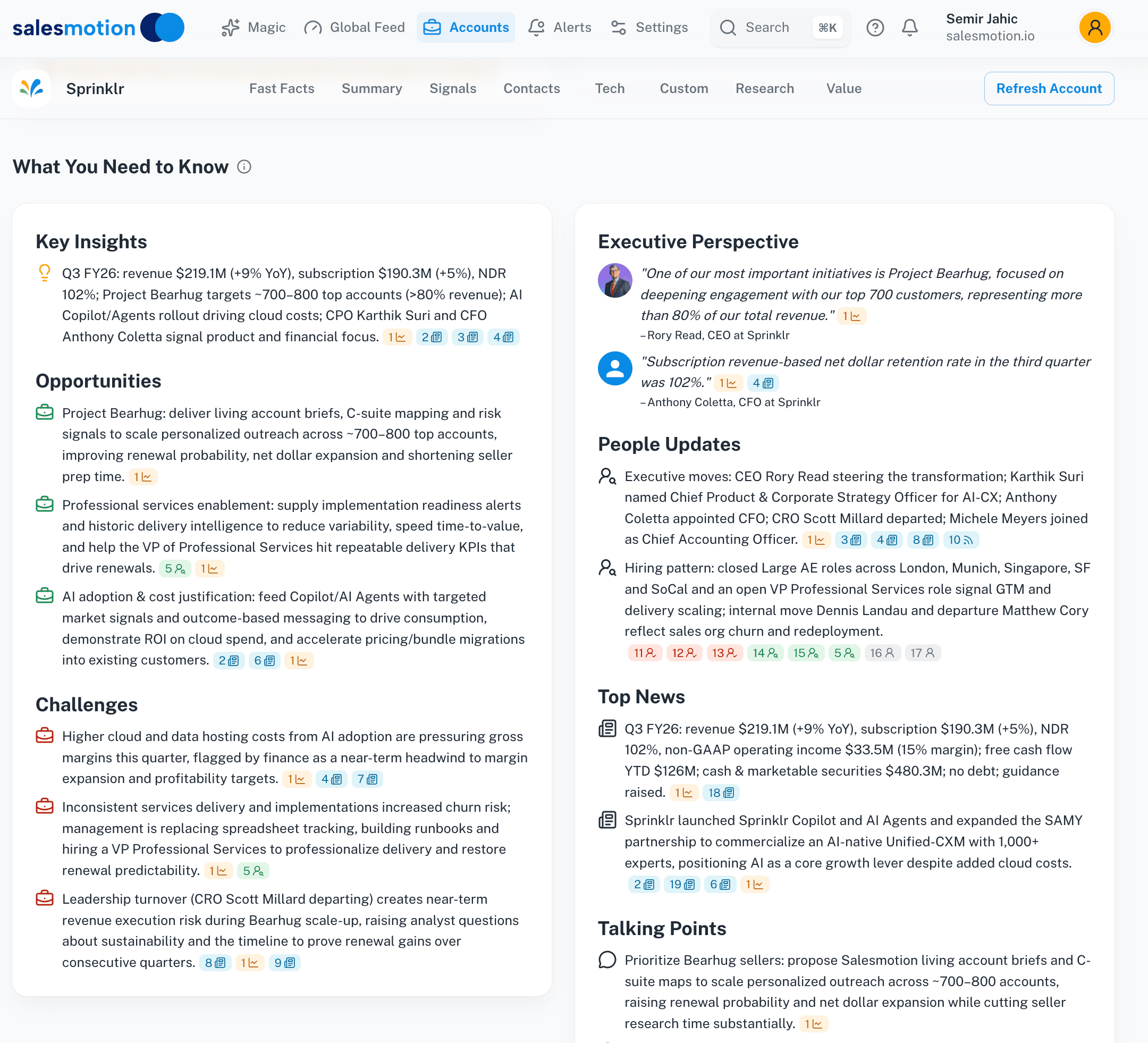
See Salesmotion in Action

Salesmotion account summary showing AI-generated intelligence brief for a target account
Deep account briefs synthesized from 1,000+ sources in one click.
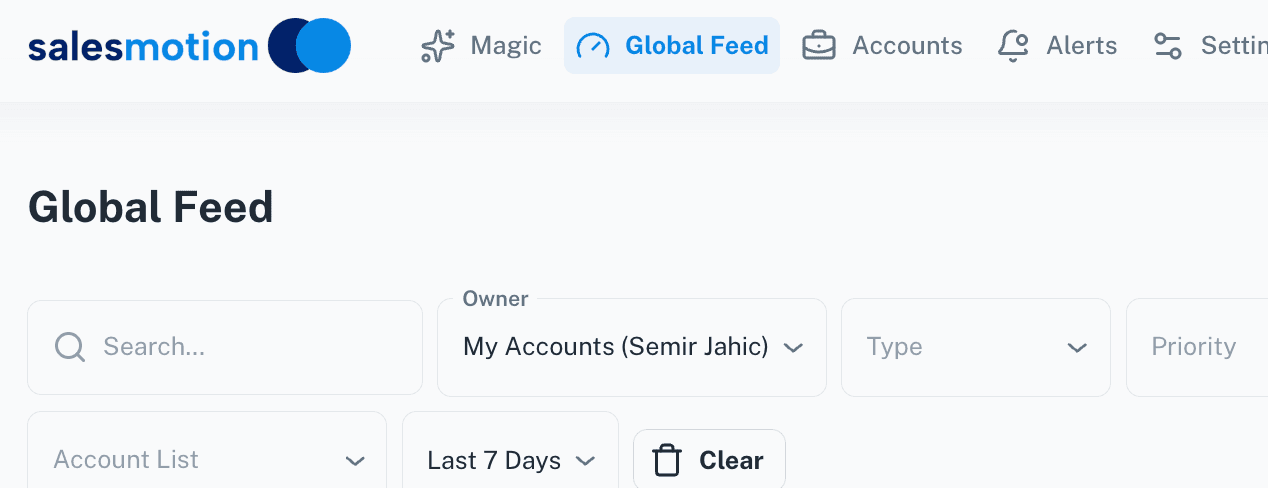
Salesmotion signal feed with filters showing real-time buying signal monitoring
Monitor 50+ buying signal types across your entire territory in real time.
FAQ

Frequently Asked Questions

Is Salesforce Sales Engagement the same as High Velocity Sales?

Yes. Salesforce rebranded High Velocity Sales as Sales Engagement in 2022. The core functionality is the same: cadences, work queues, and a built-in dialer inside the Lightning Sales Console. If you see references to High Velocity Sales in older documentation, it refers to the same product.

What is the total cost of Salesforce Sales Engagement?

Salesforce Sales Engagement requires a Sales Cloud license (Enterprise at $175/user/month or Unlimited at $350/user/month where it is included). On Enterprise, Sales Engagement is an additional add-on. When you factor in the base CRM license plus the engagement add-on, you can expect to pay $200-$350+ per user per month -- making it one of the most expensive sales engagement options available. See how Salesmotion compares at our pricing page.

Can I use Salesmotion alongside Salesforce Sales Engagement?

Absolutely. Salesmotion is not a replacement for cadence execution tools -- it provides the intelligence layer that makes your cadences more effective. Many teams use Salesmotion for account research and buying signals while continuing to use their existing engagement tool (including Salesforce Sales Engagement) for activity execution. Salesmotion integrates with Salesforce CRM on the Enterprise plan.

What is the best free alternative to Salesforce Sales Engagement?

Apollo.io offers the most capable free tier, with 100 credits per month for contact data plus basic email sequencing. HubSpot Sales Hub also has a free CRM with limited sales tools. For intelligence specifically, Salesmotion offers a free trial to explore the platform. None of these free tiers fully replace Salesforce Sales Engagement's cadence capabilities, but Apollo's free plan is the closest for teams with limited budgets.

Should I choose a better execution tool or an intelligence platform?

It depends on where your team struggles. If reps know what to say but need better workflow automation, a tool like Outreach or Salesloft will improve execution efficiency. If reps struggle with relevance -- sending generic emails because they don't have time to research accounts -- an intelligence platform like Salesmotion will have a bigger impact on reply rates and meetings booked. Many high-performing teams use both: Salesmotion for the what-to-say and a cadence tool for the how-to-send.

Related Comparisons

Explore more head-to-head comparisons and alternatives guides.

Give every rep three AI agents to build more pipeline.

A Signal Agent, Research Agent, and Outreach Agent — working 24/7 so your team spends less time researching and more time closing.