Apollo.io has become one of the most popular sales intelligence platforms on the market, with 240 million contacts in its database and pricing that starts at free. But the sticker price rarely tells the full story. Between credits that are granted per seat, pooled across the team and expire each billing cycle, phone numbers that cost eight credits each, and add-ons priced separately from the seat, the actual spend often looks very different from what the headline price suggests. We broke down every Apollo.io plan, mapped the credit system, and calculated the real costs so you can budget with confidence before signing a contract.
TL;DR: Apollo.io pricing ranges from free to $119/user/month (annual billing). The seat price is the easy part to model; the harder part is the credit allowance (an email costs 1 credit, a phone number costs 8), the add-ons priced per team, and how much contact volume your motion needs.
 Apollo.io sells an all-in-one sales platform — paid tiers run $49–$119 per user/month billed annually, with a free tier to start.
Apollo
Free–$119/user/mo
published tiers · annual billing
Salesmotion
From $85/mo
monthly contract · verified contacts included
Apollo gives you contacts. Salesmotion gives you why-now context — verified contacts included.
- 3 AI agents on every account: signals, research briefs, drafted outreach
- Live in an hour, monthly billing, no annual contract
- Verified contacts included; CRM integration on custom team & enterprise plans
Key Takeaways
- Apollo.io offers four plans: Free, Basic ($49/user/month annual), Professional ($79/user/month annual), and Organization ($119/user/month annual). Monthly billing is $65 on Basic and $99 on Professional; Organization is annual only. Apollo advertises savings of up to 24% on annual billing.
- The credit system is the real cost driver. Credits are granted per seat, pooled across the team and expire at the end of each billing cycle. An email costs 1 credit and a phone number costs 8.
- International, parallel and power dialing are sold as the Advanced Dialer add-on at $149 per team per month on any paid plan. The Organization plan ($119/user/month) requires a minimum of 3 seats and is annual only.
- Intent topics are included on every plan (1 on Free, 6 on Basic and Professional, 12 on Organization), and a US dialer is included from Basic, so check what you need before paying for a higher tier.
- For teams that need deep account intelligence rather than raw contact data, account-based alternatives like Salesmotion offer flexible pricing starting at $85/month with unlimited users on team plans and 200 contact credits a month included — far more cost-effective than per-seat models.
See Salesmotion on a real account
Book a 15-minute demo and see how your team saves hours on account research.
Apollo vs Salesmotion at a Glance
If you are weighing Apollo against an account intelligence platform, here is the short version. For the full feature-by-feature breakdown, see our Apollo vs Salesmotion comparison.
| Apollo.io | Salesmotion | |
|---|---|---|
| Starting price | $49/user/month (annual); $65/user/month (monthly) | $85/month individual plan; custom pricing for teams (unlimited users on team plans) |
| What you get | 240M contact database, email sequencing, US dialer from Basic (credits apply), credit-based enrichment | Account intelligence: buying signals, deep account research from 1,000+ sources, AI agents for research and outreach |
| Contract terms | Monthly or annual billing on Basic and Professional; Organization is annual only; cancellation takes effect at the end of the plan term | Self-serve monthly individual plan, no annual commitment |

“The moment we turned on Salesmotion, it became essential. No more hours on LinkedIn or Google to figure out who we're talking to. It's just there, served up to you, so it's always 'go time.'”
Adam Wainwright
Head of Revenue, Cacheflow
Apollo.io Pricing Plans Overview
Apollo structures its pricing across four tiers, each designed for different team sizes and outreach volumes. Prices below are verified against Apollo's pricing page as of October 2026. Apollo acquired Pocus in March 2026; pocus.com now offers a waitlist for "Pocus + Apollo" rather than a demo or signup, and packaging within Apollo's tiers has not been announced. Here is the full comparison:
| Feature | Free | Basic | Professional | Organization |
|---|---|---|---|---|
| Monthly price (annual) | $0 | $49/user | $79/user | $119/user |
| Monthly price (monthly) | $0 | $65/user | $99/user | Annual only |
| Credits per seat/year | 900 | 30,000 | 48,000 | 72,000 |
| Cost per reveal | Email 1 credit, phone 8 credits | Same | Same | Same |
| Active sequences | 2 | Unlimited | Unlimited | Unlimited |
| CRM integration | Salesforce extension; 100 CRM enrichments/month | CRM integrations | CRM integrations | CRM integrations |
| Dialer | No | US dialer (credits apply) | US dialer (credits apply) | US dialer (credits apply) |
| Minimum users | 1 | 1 | 1 | 3 |
| Intent topics | 1 | 6 | 6 | 12 |
Apollo advertises savings of up to 24% on annual billing. Apollo lets you reduce seats or downgrade at any time, but issues no refund for the unused part of the term; cancellation takes effect at the end of the plan term.
The Free Plan: What You Actually Get
Apollo's free tier gives you access to the contact database and basic search filters, with 900 credits per seat per year, granted monthly (75 a month), to spend on revealing emails and phone numbers.
The catch is the arithmetic: an email costs 1 credit and a phone number costs 8, so 75 credits a month is 75 emails or about 9 phone numbers. That is enough to test data quality on a shortlist, but not enough to run any real outbound campaign. The free plan also includes just 2 sequences, which makes it impractical for teams managing multiple campaigns.
Who it works for: Solo founders or individual reps who want to evaluate the data quality before committing. It is not viable for ongoing prospecting.
The real limitation: Free credits are granted monthly, 75 per seat, and unused credits expire at the end of each billing cycle.

“The Business Development team gets 80 to 90 percent of what they need in 15 minutes. That is a complete shift in how our reps work.”
Andrew Giordano
VP of Global Commercial Operations, Analytic Partners
Basic Plan: $49/User/Month
The Basic plan at $49/user/month (annual) is where Apollo becomes usable for small sales teams. You get unlimited sequences, CRM integrations, waterfall enrichment, a US dialer (credits apply), and 6 intent topics with intent filters.
The credit allocation is 30,000 credits per seat per year (2,500 a month), pooled across the team. A team of 5 on Basic shares 150,000 credits a year, which is 150,000 emails or 18,750 phone numbers at 8 credits each.
Annual cost for a 5-person team: $2,940 ($49 x 5 x 12).
What to check: Basic includes the US dialer, which draws 1 credit per 30 seconds, and 150 minutes of call recording. Teams that rely on phone outreach should model dialer and phone-number credits together, since each phone number costs 8 credits.
Professional Plan: $79/User/Month
The Professional plan is Apollo's most popular tier. It raises call recording to 4,000 minutes, adds AI lead scoring and A/Z testing, and makes daily email sends unlimited. The credit allowance rises to 48,000 per seat per year, a 60% increase over Basic.
This tier makes sense for SDR teams that combine email and phone outreach and need the higher credit allowance and unlimited daily sends.
Annual cost for a 10-person team: $9,480 ($79 x 10 x 12).
The add-on to budget for: The dialer included in the plan is US-only. International, parallel and power dialing are sold as the Advanced Dialer add-on at $149 per team per month on any paid plan. All seats on an Apollo account are on the same plan, so you cannot mix tiers within a single account.
Organization Plan: $119/User/Month
The Organization plan is Apollo's top published tier. It adds 12 intent topics, unlimited inbound routers and 8,000 minutes of call recording to Professional, and the credit allowance rises to 72,000 per seat per year. It is sold on annual billing only.
The minimum of 3 users means the entry price is $357/month or $4,284/year.
Annual cost for a 15-person team: $21,420 ($119 x 15 x 12).
Worth noting: Apollo lets you reduce seats or downgrade at any time, but issues no refund for the unused part of the term, and cancellation takes effect at the end of the plan term. Size the commitment to the team you have.
How Apollo's Credit System Works
Apollo's credit system is the single most important factor in understanding your real costs. The mechanics are simpler than most teams expect:
Emails cost 1 credit; phone numbers cost 8. Apollo's pricing page lists an email at 1 credit and a phone number at 8 credits, so a calling-heavy team draws down its allowance eight times faster than an email-only team.
Credits are granted per seat and pooled. The allowance is 900 per seat a year on Free, 30,000 on Basic, 48,000 on Professional and 72,000 on Organization, and it is pooled across your entire team. Nobody has a personal budget, so heavy users draw on the same pool as everyone else.
Credits expire. They do not roll over at the end of your billing cycle. This creates a use-it-or-lose-it dynamic that encourages over-consumption early and rationing late.
The practical planning question is therefore not "what does a seat cost" but "how many emails and phone numbers does each rep need per month." Convert that to credits (1 per email, 8 per phone number), multiply by headcount and 12, and compare it to the per-seat allowances above before choosing a plan.
Hidden Costs and Gotchas
Beyond the sticker price and credits, several costs are worth budgeting for:
1. Email verification. Apollo does not publish an accuracy rate for its contact data. As with any contact database, verify emails before a large send; teams commonly add a third-party email verification tool ($50-$200/month) for this.
2. Add-ons sit outside the seat price. The Advanced Dialer (international, parallel and power dialing) is $149 per team per month, and Apollo's Inbound add-on runs from $149 (Essentials) to $799 (Max) per team per month. Apollo labels both as introductory pricing that may change. API access starts on the Free plan; Apollo routes advanced or custom integrations to a Custom plan.
3. Cancellation timing. Cancellations take effect at the end of your current plan term, and Apollo issues no refund for unused time when you downgrade or drop seats. You can request cancellation from Plan Overview in the app or by emailing Apollo support, so put the term end date in the calendar.
4. Sender reputation risk. High-volume sending puts your email domain reputation at stake whatever the data source. Google and Microsoft track bounce rates, and consistent bounces can land your domain on blocklists. The downstream cost of a damaged sender reputation far exceeds the cost of the tool itself.
Is Apollo.io Worth the Price?
Apollo delivers strong value for small teams (under 10 reps) doing primarily email-based outbound in the US market. The combination of a large contact database, built-in sequencing, and competitive pricing makes it a solid entry point for startups and early-stage sales teams.
The fit is less obvious in three scenarios:
Heavy cold calling teams. A phone number costs 8 credits against 1 for an email, and the US dialer draws 1 credit per 30 seconds, so a calling-led team uses its allowance far faster than an email-led one. Model credits per connected call before choosing a tier.
International teams. The dialer included in the plans is US-only. International dialing comes with the Advanced Dialer add-on at $149 per team per month, available on any paid plan.
Teams that need deep account intelligence. Apollo is built around contact data, sequencing and AI research inside the outbound workflow; Salesmotion is built around account-level research and signal monitoring. If your sales motion depends on knowing why and when to engage an account, not just who to contact, work out which of those two jobs is your bottleneck.
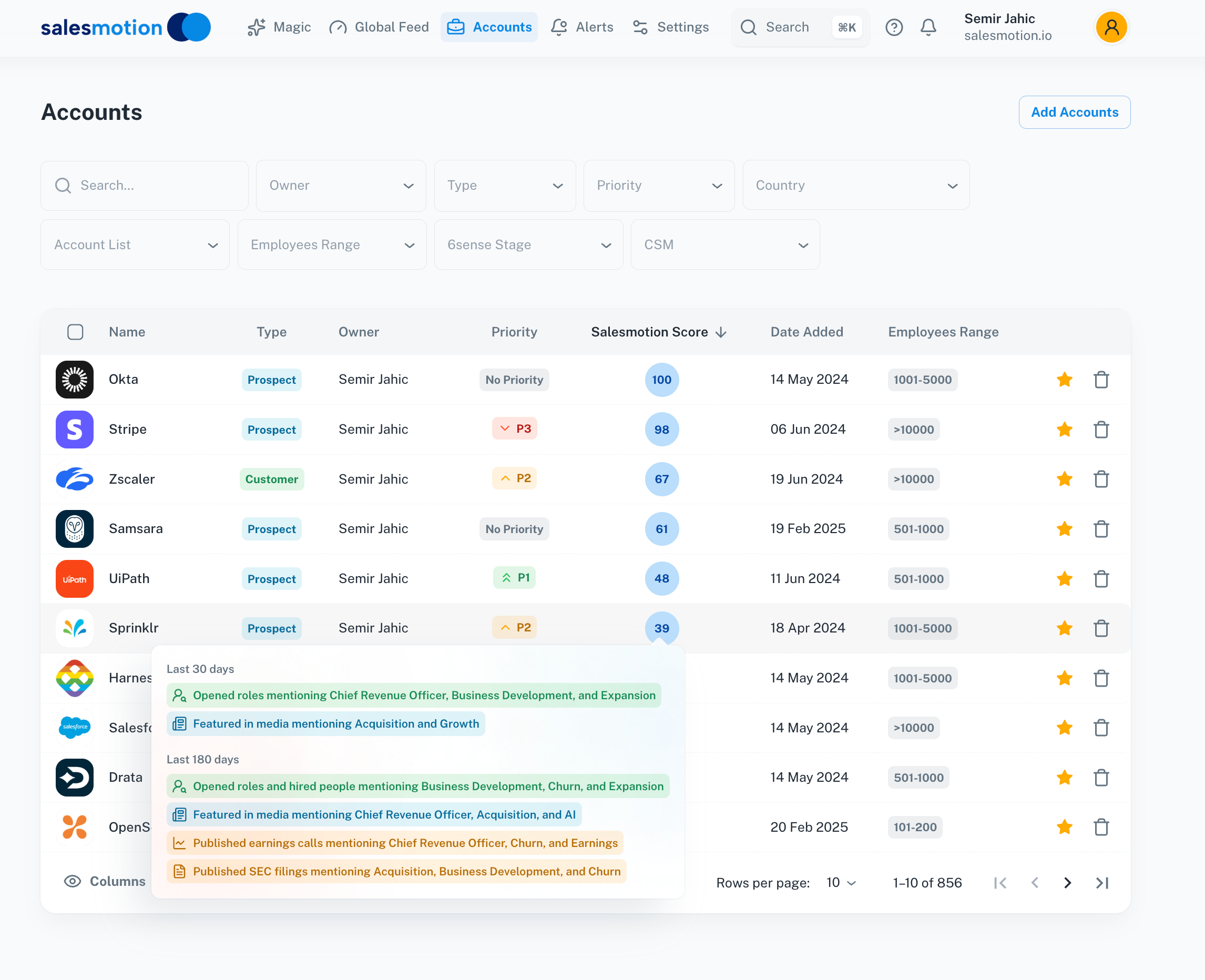 Expanding an account's score in Salesmotion shows the specific signals behind it: hiring, earnings mentions, and SEC filings.
Salesmotion's Take
I'll give Apollo its due: for a small team that needs volume and a built-in sequencer, the price-to-database ratio is genuinely hard to beat. But the objection I hear constantly from teams leaving Apollo is the same one every time — "the data does the volume, not the context." They burned credits enriching thousands of contacts, then watched a chunk of those emails bounce and quietly hurt their sender reputation. The deeper issue is that a contact database answers "who do I email," when the question that actually moves pipeline is "which accounts are in a buying window right now, and what do I say." That's the gap account intelligence fills — and it's why "more contacts" stopped being the thing teams were short on.

Semir Jahic
CEO & Co-Founder, Salesmotion
Apollo.io vs Account Intelligence Platforms
Apollo and account intelligence platforms like Salesmotion solve different problems. Apollo combines a contact database with sequencing, a dialer and AI research. Account intelligence platforms monitor buying signals, automate account research across 1,000+ sources, and generate outreach anchored to real business events.
| Dimension | Apollo.io | Account Intelligence Platform |
|---|---|---|
| Core function | Contact database + sequencing | Account intelligence + signals |
| Pricing model | Per-seat + credits | Account-based (from $85/mo, unlimited users on team plans) |
| Seat limits | Per-user billing | Unlimited users on team plans |
| Credit system | Yes (per seat, pooled, no rollover) | Research uncapped; 200 contact credits/mo on Individual |
| Account research | AI research on contacts and accounts | 1,000+ source deep briefs |
| Signal monitoring | Intent topics, signal filters and AI research inside the prospecting workflow | Earnings, hiring, leadership, M&A, product launches |
| Outreach | Built-in sequencer | AI-generated, signal-anchored messages |
| CRM integration | Salesforce, HubSpot | Native Salesforce integration; HubSpot integration |
| Data approach | 240M contacts and 30M companies, plus waterfall enrichment | 1,000+ public sources, cited |
| Best for | SDR teams, email-first outbound | Enterprise AEs, account-based selling |
| G2 rating | 4.7/5 (9,000+ reviews) | 4.8/5 |
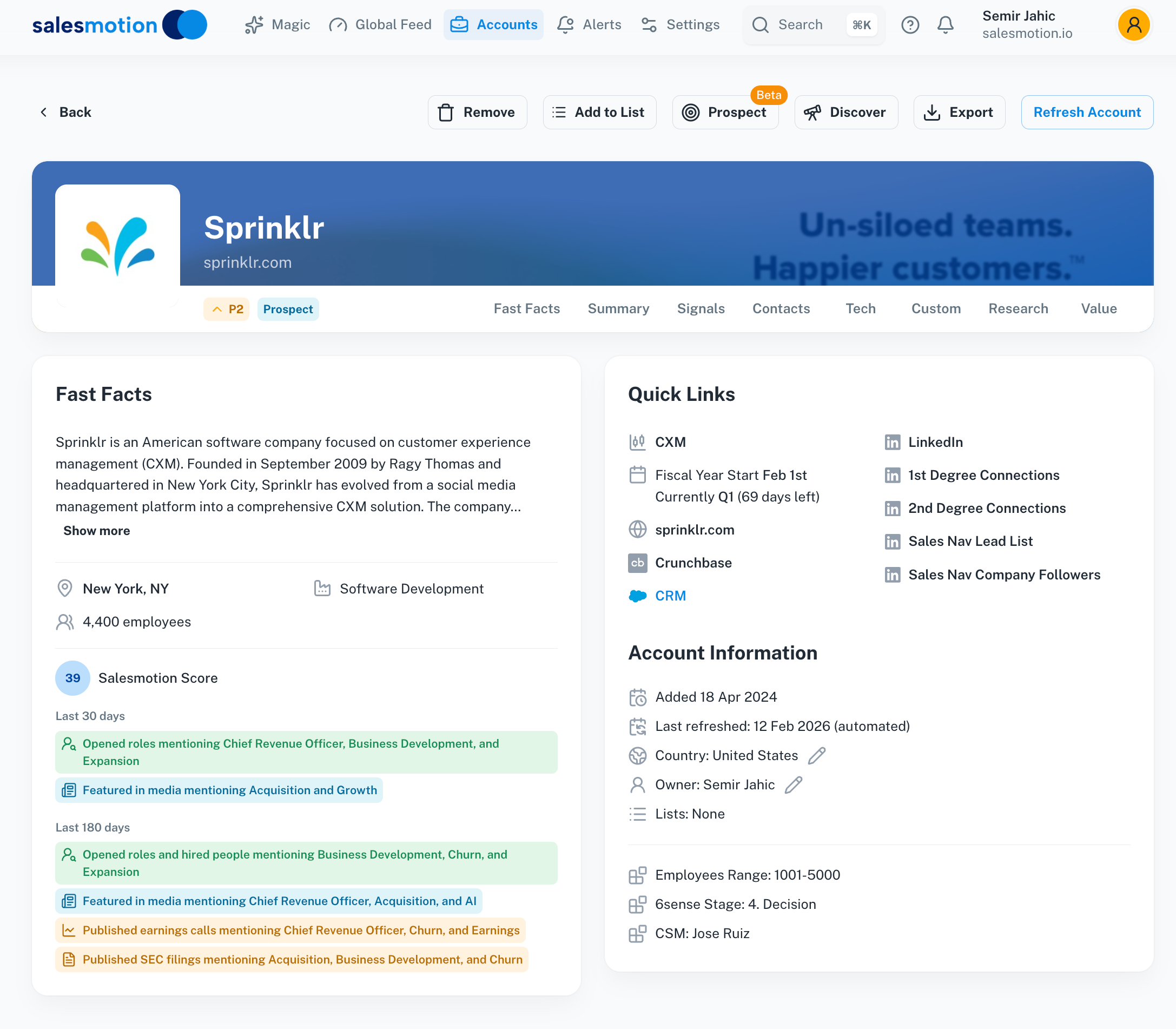 An account brief in Salesmotion: company overview, scored signal history, and research links in a single view.
The pricing models reflect different philosophies. Apollo charges per seat and per action (credits), which means costs scale linearly with team size and usage. Flat-rate account intelligence platforms charge per organization, so adding reps does not increase cost.
For teams evaluating both approaches, the question is not which tool is cheaper. It is whether your sales motion is driven by volume (more contacts, more sequences, more dials) or by intelligence (deeper research, better timing, higher conversion on fewer accounts). For alternatives to Apollo across both categories, we compared the top options.
Apollo.io Pricing vs Competitors
How does Apollo stack up against other B2B sales intelligence tools on price? Here is a direct comparison of the major platforms:
| Platform | Starting Price | Pricing Model | Free Tier | Credit Limits | Contract |
|---|---|---|---|---|---|
| Apollo.io | $49/user/mo (annual) | Per-seat + credits | Yes (900 credits/seat/yr) | Yes (expire each billing cycle) | Monthly or annual |
| ZoomInfo | Not published | Consumption-based, custom quotes | ZoomInfo Lite (10 credits/mo) | Yes (credit-based) | Annual |
| Lusha | $37.45/mo (Starter, annual) | Per plan + credits | Yes (40 credits/mo) | Yes (monthly plans roll over up to 2x) | Monthly or annual |
| Cognism | Not published | Credit-based, custom quotes | Free data sample | Yes (1 credit = 1 contact) | Not published |
| Salesmotion | $85/mo (individual) | Per-organization | No | Research uncapped; 200 contact credits/mo on Individual | Monthly or annual |
Key pricing differences
Apollo vs ZoomInfo: Apollo publishes a rate card; ZoomInfo does not. ZoomInfo's own pricing page says it publishes no dollar figures because pricing is consumption-based, and the closest thing to a benchmark is Vendr, which reports a median ZoomInfo contract of $33,500 a year based on 1,576 purchases. That is an order of magnitude above a small Apollo team, though it covers 500M+ contacts against Apollo's 240M and a broader product line. For a full breakdown, see our ZoomInfo vs Apollo comparison.
Apollo vs Lusha: Similar entry points. Apollo's Basic is $49 per seat per month on annual billing; Lusha's Starter is $37.45 per month on annual billing ($49.90 billed monthly), and Lusha's self-serve plans cover teams of up to 5 users, with larger teams routed to sales. Apollo also bundles a sequencer and a US dialer in the same plan. See our detailed Apollo vs Lusha comparison and Lusha alternatives guide.
Apollo vs Cognism: Cognism does not publish pricing; it sells Standard and Pro packages, each listed with 5 seats included, on a credit system where one credit reveals one contact. Both vendors meter reveals, so the comparison comes down to data quality per credit rather than sticker price. See our Apollo vs Cognism comparison and Cognism alternatives page for deeper analysis.
Apollo vs Salesmotion: Fundamentally different tools. Apollo is a contact database priced per seat with credits. Salesmotion is an account intelligence platform priced per organization with no per-seat charges, uncapped research, and a monthly contact credit allowance (200/mo on Individual). A 10-person team on Apollo Professional costs $9,480/year, and the bill grows with every seat you add. Salesmotion starts at $85/month for individuals on a self-serve monthly plan, and team plans use custom pricing with unlimited users on team plans — so adding reps never increases the price, and you get deep account research instead of raw contacts. For teams focused on account-based selling rather than high-volume outbound, Salesmotion delivers more value per dollar. See the full side-by-side Apollo vs Salesmotion breakdown, or browse all Apollo alternatives.
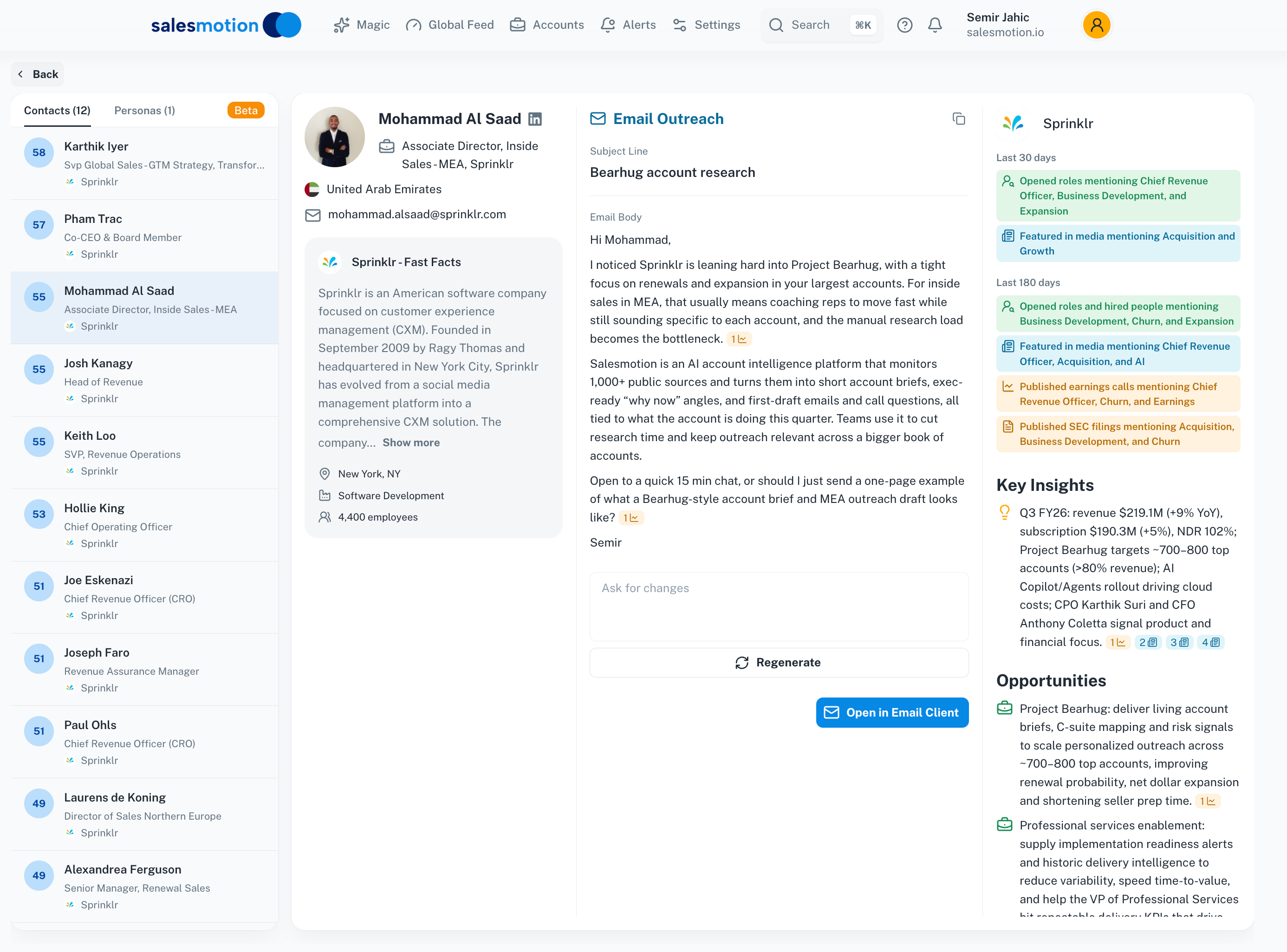 Salesmotion drafts outreach anchored to the account's live signals (right panel) rather than running volume sequences — the workflow difference behind the two pricing models.
Frequently Asked Questions
Does Apollo.io have a free plan or free subscription?
Yes. Apollo offers a free plan with no time limit and access to its 240M contact database. You get 900 credits per seat per year, granted monthly (75 a month); an email costs 1 credit and a phone number costs 8. The free plan includes 2 sequences, the Salesforce extension and 100 CRM enrichments a month; full CRM integrations start on Basic. It is useful for testing data quality but not sufficient for ongoing prospecting. The paid Basic and Professional plans also start with a 14-day trial.
Does Apollo.io give 75 credits every month?
Yes, on the Free plan. Apollo's pricing page lists 900 credits per seat per year on Free, granted monthly, which is 75 credits per seat per month. An email costs 1 credit and a phone number costs 8, and unused credits expire at the end of each billing cycle. The 14-day trial on Basic and Professional also includes 75 credits.
What are the Apollo.io plans?
Apollo.io has four plans: Free, Basic, Professional and Organization. Free includes 900 credits per seat per year and 2 sequences; Basic costs $49 per seat per month on annual billing with 30,000 credits per seat per year, unlimited sequences and CRM integrations; Professional costs $79 with 48,000 credits, unlimited daily email sends and AI lead scoring; Organization costs $119 with 72,000 credits, a 3-seat minimum and annual billing only. All seats on an Apollo account are on the same plan.
How do Apollo credits work?
Apollo credits are the allowance you spend to reveal and enrich contact data: an email costs 1 credit and a phone number costs 8. Credits are granted per seat (900 a year on Free, 30,000 on Basic, 48,000 on Professional and 72,000 on Organization) and pooled across the team. Enriching data costs 1 to 8 credits, AI research costs 1 credit per run, and the US dialer costs 1 credit per 30 seconds. Unused credits expire at the end of each billing cycle and do not carry over.
How much does Apollo.io cost?
Apollo.io costs $0 on the Free plan, $49/user/month on Basic, $79/user/month on Professional, and $119/user/month on Organization (all annual billing; monthly billing runs $65 and $99; Organization is annual only at $119). Organization has a 3-seat minimum, so its real entry point is $4,284/year. The credit allowance, not the seat price, is what determines whether a plan fits, so model your expected email and phone-number volume before committing.
Do Apollo.io credits roll over?
No. All Apollo credits expire at the end of your billing cycle, whether monthly or annual. Unused credits are forfeited with no refund or extension. This creates a use-it-or-lose-it dynamic that can lead to wasteful spending early in the cycle and rationed usage at the end.
Can I cancel Apollo.io mid-contract?
Yes. Cancellations take effect at the end of your current plan term, and you can request one from Plan Overview in the app or by emailing Apollo support. Apollo lets you reduce seats or downgrade at any time, but issues no refund for the unused part of the term.
Who are Apollo's main competitors?
Apollo's closest competitors in contact data and sales engagement are ZoomInfo, Lusha, RocketReach, Cognism, Seamless.AI, and Clay. ZoomInfo competes at the enterprise end; it does not publish a rate card, and Vendr reports a median contract of $33,500 a year based on 1,576 purchases. Lusha and RocketReach compete on published, self-serve pricing; Seamless.AI offers a free allowance and quotes paid plans. Cognism is built for prospecting into Europe, with phone-verified mobile data. For teams whose bottleneck is account research and timing rather than contact volume, account intelligence platforms like Salesmotion compete from a different angle: signals and AI-driven research instead of a bigger database. We compared all of them in our guide to Apollo alternatives.
Is Apollo worth it for B2B sales teams?
For small teams running high-volume, email-first outbound in the US, yes. Apollo's database size, built-in sequencer, and entry pricing are hard to beat, which is reflected in its 4.7/5 G2 rating across 9,000+ reviews. The fit is less obvious for heavy cold-calling teams (a phone number costs 8 credits), for international calling (the Advanced Dialer is a $149 per team per month add-on), and for enterprise teams whose bottleneck is account-level research rather than contact volume. See the Apollo vs Salesmotion comparison if your motion is account-based.
How does Apollo.io compare to account intelligence platforms?
Apollo is built around contact data, sequencing and AI research inside the outbound workflow. Account intelligence platforms like Salesmotion provide deep research across 1,000+ sources, including earnings call analysis, leadership changes, hiring patterns, strategic initiatives, and competitive moves. Apollo's strength is who to contact and how to reach them at volume. Account intelligence tells you why and when to reach out, which matters most for enterprise deals where timing and context determine win rates. Teams using account intelligence platforms report 85% reductions in research time and 40% increases in qualified pipeline.