A lot of teams are in the same spot right now. Reps are working hard, demos are solid, buyers like the product, and deals still slip away to a competitor that merely sounds sharper. Not better in every category. Just clearer.
That's the cost of weak competitive positioning. You end up with messaging that says everything and therefore says nothing. Buyers hear “cutting-edge,” “best-in-class,” and “end-to-end,” then default to the vendor that gives them a cleaner reason to choose.
Strong positioning fixes that. But static positioning decks don't hold up for long, especially when competitors change pricing, launch features, raise capital, hire new leaders, or shift upmarket. The teams that win treat positioning as a living system tied to signals, not a one-time brand exercise.
Beyond We're Better Why Vague Positioning Fails
Sales teams rarely lose only because the product is weaker. They lose because the buyer couldn't quickly understand why this option fit their situation better than the alternative.
That problem shows up in common language. “More flexible.” “Easier to use.” “Built for modern teams.” None of that gives a rep a usable angle in a live deal. It doesn't help when procurement asks why your price is higher. It doesn't help when a competitor claims the same thing on their homepage. And it definitely doesn't help when an executive sponsor wants a reason to change now instead of later.
Generic claims create generic deals
Vague positioning usually comes from inside-out thinking. Product teams list features. Marketing compresses them into polished copy. Sales inherits a message that sounds fine on a homepage but collapses in a head-to-head deal.
The pattern looks like this:
- No clear target: The message tries to serve everyone, so it doesn't feel precise to anyone.
- No sharp contrast: Reps can explain what the product does, but not why it wins against a specific alternative.
- No proof: Claims aren't anchored to evidence the buyer can trust in a live conversation.
- No urgency: The positioning explains value in general terms, but not why the account should act now.
If this sounds familiar, revisit how your team defines the buyer problem in the first place. A useful starting point is this guide on building a value hypothesis, because positioning gets much easier when the commercial team agrees on the change the buyer is trying to make.
Practical rule: If a rep can swap your company name with a competitor's and the sentence still sounds believable, the positioning isn't strong enough.
Positioning is now a business discipline, not a copywriting task
This has become more urgent because the market is putting real money behind competitive intelligence and benchmarking. The global competitive benchmarking market is projected to reach USD 92.41 billion by 2030, growing at a CAGR of 8.84%, according to Research and Markets' competitive benchmarking market forecast. That investment tells you something important. Companies aren't treating competitive positioning as optional polish. They're treating it as operating infrastructure.
The practical implication for revenue teams is simple. If competitors are refining their message with better intelligence, your static pitch won't hold.
What vague positioning looks like in the field
A rep says, “We automate workflows better than legacy tools.”
A buyer hears, “So does everyone else.”
A stronger version sounds more like this: “Teams move to us when they're tired of stitching together separate tools for handoffs and approvals, and they need one system business users can run without waiting on admins.” That statement narrows the problem, hints at the alternative, and gives sales a path to follow-up questions.
Competitive positioning works when buyers can place you quickly in their mind. If they can't, the deal drifts toward the safest-looking option.
See Salesmotion in action
Take a self-guided interactive tour — no signup required.
What Is Competitive Positioning Really
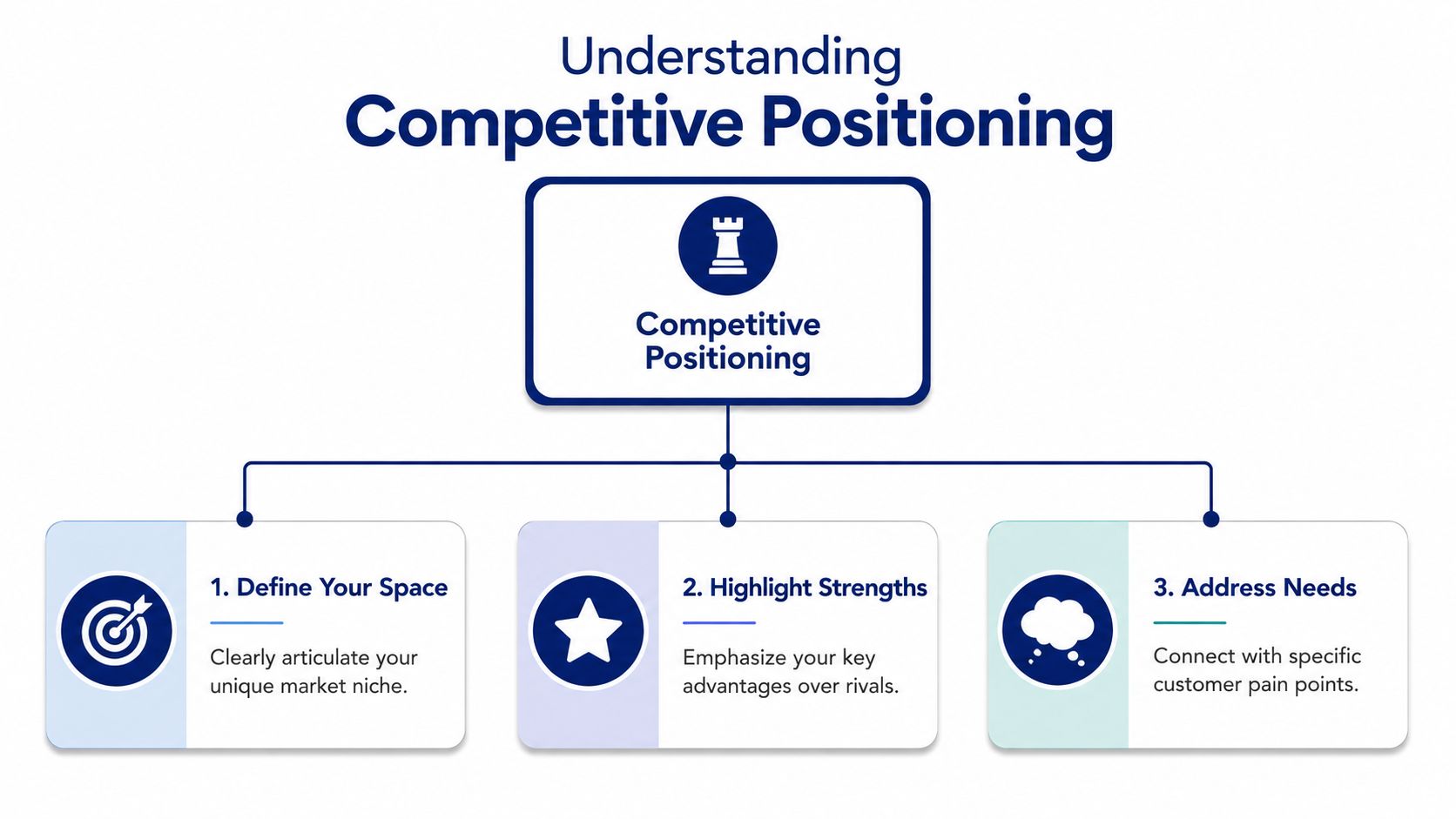
Competitive positioning is the deliberate choice of how you want buyers to understand your offer relative to alternatives. Not in theory. In the moment they compare options, justify budget, and decide whether changing is worth the hassle.
A good way to think about it is real estate. In a crowded city, you don't win through mere ownership of a building. You win because you occupy a location with a clear advantage for a specific kind of tenant. Easy commute. Better foot traffic. Lower operating friction. Prestige. Competitive positioning works the same way. You're claiming a valuable space in the buyer's mind and making it hard for another vendor to dislodge you.
The four parts that matter
Most weak positioning misses at least one of these four pieces.
-
Target audience
Who exactly are you for? Not “mid-market” in the abstract. Which team, buying context, and operating problem? A position without a defined audience becomes generic fast. -
Market category
What are buyers comparing you to? Category shapes evaluation criteria. If buyers think you're one type of tool, they'll judge you on one set of expectations. If you belong in a different category, you need to make that clear early. -
Differentiation
What's the single most compelling reason to prefer you over the next-best alternative? Not a long list. One idea that sales can lead with. -
Proof
Why should the buyer believe the claim? Proof can come from product design, customer outcomes, implementation fit, workflow alignment, pricing logic, or the way your solution handles a known pain point better than others.
Positioning is bigger than a tagline
Teams often get tripped up on this point. They think positioning is the sentence on the website hero section. It isn't. It's the commercial logic underneath product packaging, pricing, sales talk tracks, objection handling, and campaign strategy.
If the position says you win on speed, then onboarding, implementation, and proof points all need to support speed. If the position says you win on control, then the demo, pricing model, and stakeholder narrative should reinforce control. The message only works when the business can back it up.
Buyers don't reward the company with the most adjectives. They choose the vendor whose promise feels specific, relevant, and credible.
For a broader brand lens, Legacy Builder's guide to brand positioning is useful because it separates broad brand identity from the sharper competitive edge a revenue team needs in market conversations.
The fast test
Ask three questions:
- Who is this for
- Why this instead of the main alternative
- Why should the buyer trust that claim
If your team answers those three in a way that sounds consistent across sales, marketing, and product, you're close. If every function answers differently, you don't have positioning yet. You have opinions.

“Salesmotion helps you spot signals from prospect accounts, news items / job hiring alerts etc that indicate that now is a good time to reach out with a well-crafted message.”
Rob Douglas
Director of Sales, icit business intelligence
The Strategist's Toolkit Three Proven Positioning Frameworks
Positioning gets easier when you stop trying to solve everything with one document. Different tools do different jobs. Good teams use more than one.
Positioning Frameworks at a Glance
| Framework | Primary Use Case | Key Output |
|---|---|---|
| Value Proposition Canvas | Match customer pains, gains, and jobs to your offer | Clear fit between buyer needs and product value |
| Positioning Statement | Turn strategic choices into a concise internal message | A tight statement sales and marketing can align around |
| Perceptual Map | Visualize how buyers see competitors in the market | A picture of whitespace, crowding, and contrast |
Value Proposition Canvas for fit
Use this when the team is still fuzzy on what buyers are trying to get done. The canvas is strong because it forces discipline. Customer jobs on one side. Pains and gains next to them. Product capabilities only matter if they relieve a pain or create a gain the buyer cares about.
This framework is especially helpful when a product team keeps leading with features. It pushes the conversation back to commercial relevance.
A simple example: if you're selling forecasting software, “scenario modeling” isn't the value by itself. The value might be helping finance leaders explain risk faster when plans change. That distinction matters in sales calls.
Positioning statement for internal alignment
The classic fill-in-the-blanks statement still works because it imposes clarity. For target customers who need X, our product is Y that delivers Z because of A, unlike B.
It won't win deals by itself. But it is a strong internal forcing function. If sales says the main alternative is spreadsheets, product says it's a larger platform, and marketing says it's a niche startup, the statement exposes the disagreement immediately.
Use this rule: If the team can't finish a positioning statement without arguing about the alternative, you haven't identified the real battlefield yet.
Once you have the core statement, turn it into sales-ready language. That's where practical enablement matters more than elegant wording. A good companion resource is this breakdown of sales playbook examples, because positioning only becomes useful when reps can apply it in discovery, demos, and objection handling.
Perceptual maps for strategic contrast
Perceptual maps help when every competitor claims the same strengths. You pick two dimensions buyers care about and plot the market visually. That can reveal whether you're differentiated or just telling yourself you are.
For a more rigorous version, a positioning map can normalize price against a composite benefit metric, then plot competitors as points with bubble size based on share or revenue and color by segment or channel, as described in Umbrex's competitive positioning map framework. That matters because it turns a subjective debate into a working strategy tool.
Which one to use when
- Use the canvas when the product sounds impressive but buyers still seem indifferent.
- Use the statement when the company needs one clear story across teams.
- Use the map when you need to see market whitespace or justify why your pricing should hold.
None of these replaces judgment. They make bad assumptions harder to hide.
Know Your Battlefield Analyzing Competitors and Customers
Most competitive positioning fails before messaging even starts. The team doesn't have enough real market evidence, so it fills the gaps with assumptions.
That usually means reading competitor homepages, skimming a few comparison pages, and calling it research. The problem is obvious. Homepages tell you what a company wants the market to believe. They don't tell you where customers struggle, where rivals are stretching beyond their strengths, or where a rep can credibly attack.

Where the useful signals actually are
The best inputs are usually scattered across places that don't look polished.
- Customer reviews: Mid-range reviews are often more useful than angry extremes because they describe practical friction. Onboarding. Missing workflows. Weak support handoffs. Poor reporting logic.
- Industry communities: Reddit threads, practitioner groups, and niche forums reveal how buyers talk when they aren't speaking to vendors.
- Job postings: Hiring patterns tell you where a competitor is investing. New enterprise roles, implementation hires, or partner-focused jobs often signal a strategic move before the website changes.
- Release notes and product updates: These show where a rival is trying to close a gap or create a new story.
- Sales calls and win-loss notes: Your own field data often contains the clearest clues, but many teams never organize it well enough to spot patterns.
Manual research doesn't scale
Many sales orgs struggle because research is valuable, but the work involved is scattered and repetitive. In sales technology, competitive intelligence can reduce the 2–3 hours a rep spends on manual prep to minutes by producing a structured, opinionated brief with initiatives and risks, as described in MarketsandMarkets' piece on competitive intelligence in sales technology.
That “opinionated brief” idea matters. A pile of links isn't intelligence. A useful brief answers four commercial questions:
- What changed
- Why it matters
- Which accounts are affected
- How a rep should respond
If your team is still stitching that together manually, consistency will always be a problem. The first rep might do deep prep. The fifth rep won't.
For teams building a more disciplined process, this competitive analysis framework is a practical reference because it turns ad hoc research into a repeatable operating model.
The goal isn't to know everything about competitors. The goal is to know enough to say something sharper than they do when a live deal is on the line.
Customer insight beats competitor obsession
Don't over-rotate into competitor-first thinking. Some of the best positioning angles come from customer language, not rival analysis.
If buyers repeatedly describe a tool as “powerful but hard to operationalize,” that's not just a review comment. It may be your opening. If accounts say they have too many systems and no one trusts the handoffs, that can define a more valuable position than any feature checklist.
The strongest teams combine both views. They study where competitors are weak and where buyers already feel the pain.

“Automatic account profile detail I can use to manage my territory. Using Salesmotion AI to generate value statements per persona, account, etc. Using Salesmotion to give me a starting point based on new hires, or news alerts is critical.”
Adam Wainwright
Head of Revenue, Cacheflow
Crafting Your Positioning A Step-by-Step Guide
Research only becomes useful when the team can turn it into a position that sales can use. That requires choices. Not a brainstorm wall filled with every possible angle.
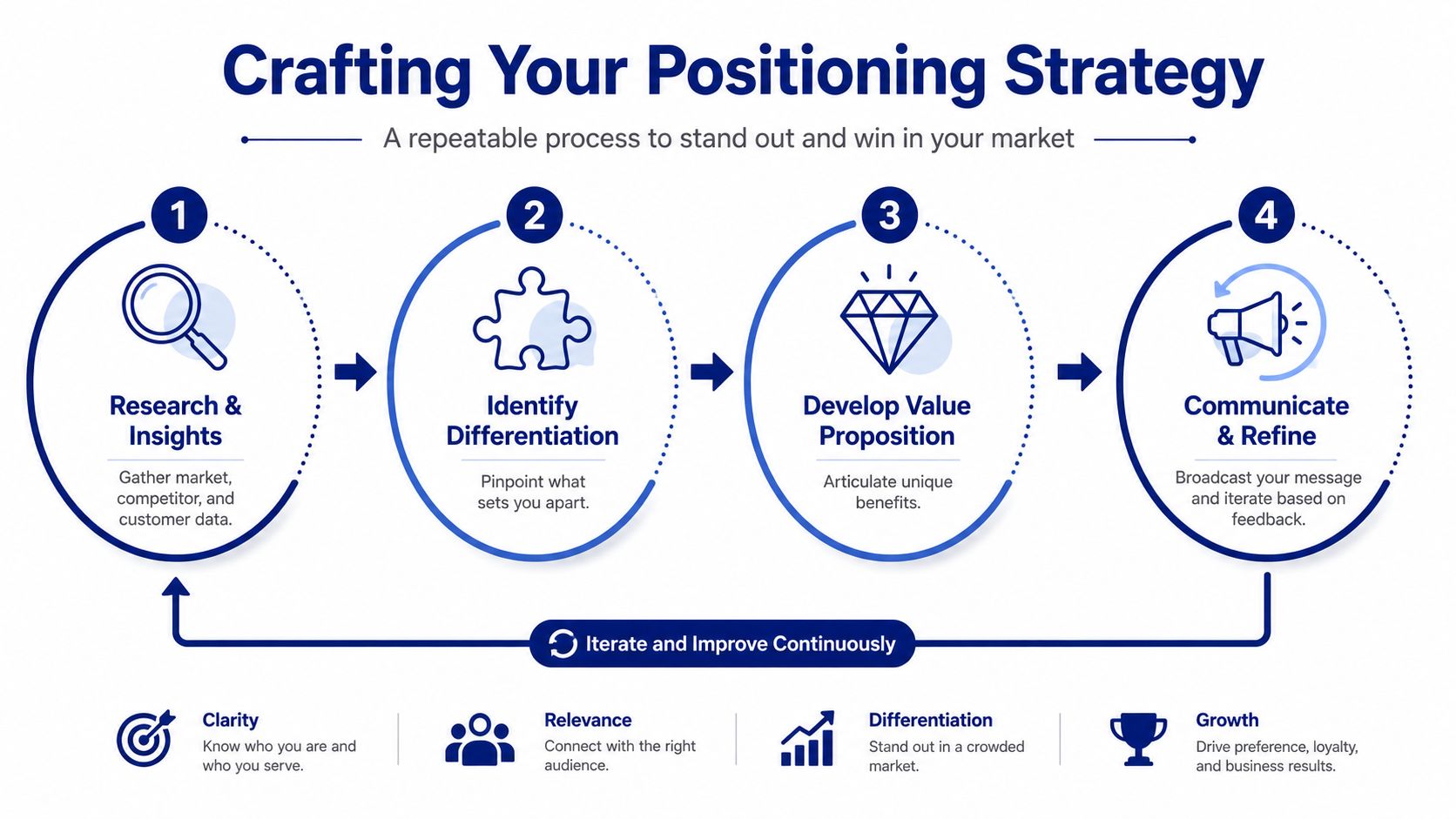
Step 1 Gather the evidence in one place
Pull together the inputs that matter most. Customer interviews, deal notes, lost-deal reasons, review themes, competitor changes, and product strengths that show up repeatedly in wins.
Then reduce the noise. You are not looking for every observation. You are looking for recurring commercial patterns.
Create three lists:
- Buyer pains that appear often
- Alternatives buyers consider
- Reasons your team wins when it wins
That last list is important. Many teams spend too much time cataloging gaps and not enough time studying where they already win naturally.
Step 2 Generate a small set of viable angles
At this stage, don't settle on the first idea that sounds clever. Draft a few possible positions.
One might focus on speed to value. Another might focus on control. Another might focus on fit for a specific team or operating model. Keep each one anchored to a clear buyer problem and a real alternative.
If you're shaping this for search and market language, pay attention to how buyers phrase the problem. To establish a first-mover advantage, teams should identify untapped keyword opportunities competitors haven't claimed and use the phrases customers use when searching, according to the Competitive Intelligence Alliance's guidance on positioning. That's useful because internal jargon almost always makes positioning weaker.
Step 3 Filter hard
At this juncture, many organizations quickly improve. Every positioning option should survive three tests.
Believable
Can the market credibly accept this claim? If you say you're the easiest platform in the category, but implementation is known to be complex, buyers won't buy the message.
Important
Does the buyer care? Plenty of differentiated things are true and still not commercially meaningful. Interesting isn't enough.
Defensible
Can a competitor copy the claim quickly or neutralize it in one slide? If yes, the position is fragile.
A good position is not merely different. It is different in a way buyers care about and competitors struggle to dismiss.
A rough scoring exercise can help, but the discussion matters more than the number. Push the team to justify each angle with observed evidence, not optimism.
Step 4 Write the positioning statement
Once one angle clearly stands out, turn it into a working statement. Keep it simple enough that sales can remember it and specific enough that it doesn't dissolve into fluff.
A useful structure is:
- For a defined buyer
- Who faces a specific problem or trigger
- Our product is the category or solution approach
- That delivers the key outcome
- Because of a distinct capability or operating advantage
- Unlike the main alternative
This is internal language first. It doesn't need to sound polished.
Step 5 Validate before rollout
Pressure-test the statement with people who have to use it and people who have to believe it.
Start with:
- Sales leaders: Can they coach to it
- Top reps: Can they use it naturally in calls
- Customer success: Does it match what customers value after the sale
- Trusted customers or prospects: Does it feel true and relevant
Look for hesitation. If reps keep adding caveats, the position may be too broad. If customers nod but don't react, it may be accurate but not important enough.
Validation is where strong positioning gets practical. The right answer isn't the one that sounds smartest in a workshop. It's the one that holds up in discovery, in demos, and in procurement.
From Static to Dynamic Using Real-Time Signals
Most positioning work goes stale because it's treated like a launch artifact. Teams write the message, train the reps, update the deck, and move on. The market doesn't.
Competitors change direction. Accounts hire new executives. Funding shifts priorities. Product launches reset evaluation criteria. If your competitive positioning doesn't absorb those changes, reps end up using yesterday's message in the current deal.

Signal-based positioning in practice
The modern shift is from competitor-first tracking to deal-first intelligence, where tools deliver what a seller needs to win a specific opportunity at the moment it arises, as explained in Klue's overview of competitive intelligence platforms. That shift matters because reps don't need more general updates. They need context tied to a live account and a live motion.
A few examples make this concrete:
-
A competitor launches a new enterprise package
Your message may need to sharpen around implementation burden, support model, or fit for mid-market teams that don't want enterprise complexity. -
A target account hires a new operations leader
The positioning can tilt toward change management, standardization, or visibility if that role typically owns transformation efforts. -
An account raises funding
Messaging can move toward speed, scale, and category expansion if the company is now under pressure to deploy capital and show momentum. -
A competitor starts hiring heavily in services or partnerships
That may signal product gaps or a shift in go-to-market that changes how you frame your own delivery model.
Set alerts for noise, investigate for strategy
Not every signal deserves a message change. General industry news should be monitored passively. Bigger shifts need deeper review.
A practical operating model looks like this:
- Always-on alerts for product launches, pricing changes, hiring patterns, executive moves, and major account events
- Targeted investigation when the signal affects deal strategy, category perception, or a core objection pattern
- Fast enablement updates that give reps a new talk track, not a long memo
If your team wants a practical reference point for this approach, signal-based selling is the right commercial mindset. It connects market movement to timely outreach and stronger “why now” messaging.
Static positioning answers “why us.” Dynamic positioning answers “why us, for this account, right now.”
What changes for sales teams
When positioning becomes dynamic, reps stop using the same story for every account. They can still anchor to a core position, but the angle becomes more specific.
That usually improves three things qualitatively. Discovery gets sharper because reps ask better, signal-aware questions. Outreach gets more relevant because there is a real trigger. Competitive conversations get tighter because the rep knows which part of the story matters in this deal.
That is the true upgrade. Not more information. Better timing and better contrast.
Measuring What Matters Metrics for Positioning Success
If you can't tell whether the new position changes outcomes, the work stays subjective. Revenue leaders need a cleaner test.
The most important metric is competitive win rate, which is the percentage of deals won when a competitor was involved. According to Unkover's guide to competitive analysis frameworks, this is the right metric to track before and after a new framework so teams can validate whether stronger positioning is improving sales velocity and competitive performance.
What to watch besides win rate
Competitive win rate should lead, but it shouldn't stand alone. Track a small set of supporting indicators:
- Time to response: How quickly can the team answer competitive questions from the field
- Battlecard usage: Are reps using the material in CRM or enablement workflows
- Deal review confidence: Do reps give fewer “I don't know” answers when competitor questions come up
- Sales cycle movement in competitive deals: Are the right stories helping reps move opportunities forward with less drift
A few strategy teams also use market structure metrics such as Share of Growth and HHI to understand momentum and concentration in a category, as outlined in Umbrex's commercial due diligence playbook on competitive landscape and positioning. That can help leaders decide where a stronger position has the best chance to win, especially by segment or channel.
The main point is straightforward. Competitive positioning is not a messaging exercise you “complete.” It is a revenue system you measure, refine, and use to win more head-to-head deals.
If your team wants to move from static messaging to real-time, signal-driven execution, Salesmotion is built for that job. It helps revenue teams track account changes, competitor movement, and buying signals, then turns that context into actionable briefs, alerts, and outreach so reps can act with a sharper point of view.