
A value hypothesis is your educated guess—a strategic one—about the specific, measurable value your product delivers to a customer. In B2B sales, every winning deal starts with a well-formed value hypothesis that connects your solution to a real business problem and the outcomes a buyer cares about.
Unlike a generic pitch deck or feature list, a value hypothesis forces you to be precise: which pain are you solving, for whom, and with what measurable result? This framework shifts your entire sales motion from guesswork to relevant, problem-focused conversations—exactly the kind of signal-based selling that top-performing teams rely on today.
What Is a Value Hypothesis and Why Does It Matter?
A value hypothesis is like a treasure map for your sales team. Instead of wandering through an account with a generic pitch, it guides you straight to your customer's biggest business pains.
It shows the clearest path to solving those pains and, more importantly, how to prove you’ve found the treasure.
This approach is essential for modern B2B selling. Today’s buyers are well-informed and have little patience for reps who don’t understand their world. A strong value hypothesis ensures your team enters every conversation with a credible point of view, resonating with decision-makers because you're speaking their language—the language of problems and outcomes.
Moving from Guesswork to Strategy
Without a clear hypothesis, sales teams fall back on describing features. This forces the prospect to connect your product to their challenges. A value hypothesis flips this dynamic.
It forces your team to answer critical questions before sending the first email:
- Who is our ideal customer? (Industry, company size, persona)
- What critical problem do they face? (What keeps them up at night?)
- How does our solution solve it? (What's the direct connection?)
- What is the measurable impact? (How will they quantify success?)
A well-formed value hypothesis isn't just a sales tool; it's a strategic alignment mechanism. It ensures marketing, sales, and product teams focus on delivering and communicating the same core value to the right audience.
This structured thinking transforms your outreach from a speculative guess into a confident assertion. It’s the difference between saying, "Our software is great," and, "We believe we can cut your team's manual data entry by 15%, saving you $50,000 annually, just as we did for Company X."
The second statement is powerful, specific, and testable. It provides a real foundation for a business conversation and is a core principle in methodologies like value-based selling, which you can explore further in our detailed guide on the topic.
To build this kind of framework, every value hypothesis needs four essential components.
Core Components of a Value Hypothesis
Think of these four pillars as the coordinates on your map to predictable revenue. They provide the structure for every strong hypothesis.
| Component | What It Answers | Example Focus |
|---|---|---|
| Pain | What critical business problem is the customer facing? | High customer churn, inefficient sales cycles, data silos. |
| Outcome | What does the "after" state look like for them? | Increased customer retention, accelerated pipeline, unified data. |
| Metrics | How will we measure the change and prove success? | Reduce churn by 10%, decrease sales cycle by 15 days. |
| Proof | Why should they believe we can deliver this result? | Case studies, customer testimonials, industry benchmarks. |
These components—Pain, Outcome, Metrics, and Proof—work together to create a compelling narrative that gets a buyer's attention and builds trust from the first interaction.
See Salesmotion in action
Take a self-guided interactive tour — no signup required.
The Four Building Blocks of a Winning Value Hypothesis
A powerful value hypothesis is a carefully built argument made of four distinct pillars. Each one answers a critical question your prospect has, turning a simple assumption into a compelling reason to listen.
Think of it like building an archway. Every stone is essential. If you don't nail the pain, can't articulate the outcome, fail to provide metrics, or lack proof, the entire structure crumbles.
This concept map shows how these four elements—Pain, Outcome, Metrics, and Proof—connect to create a cohesive argument.
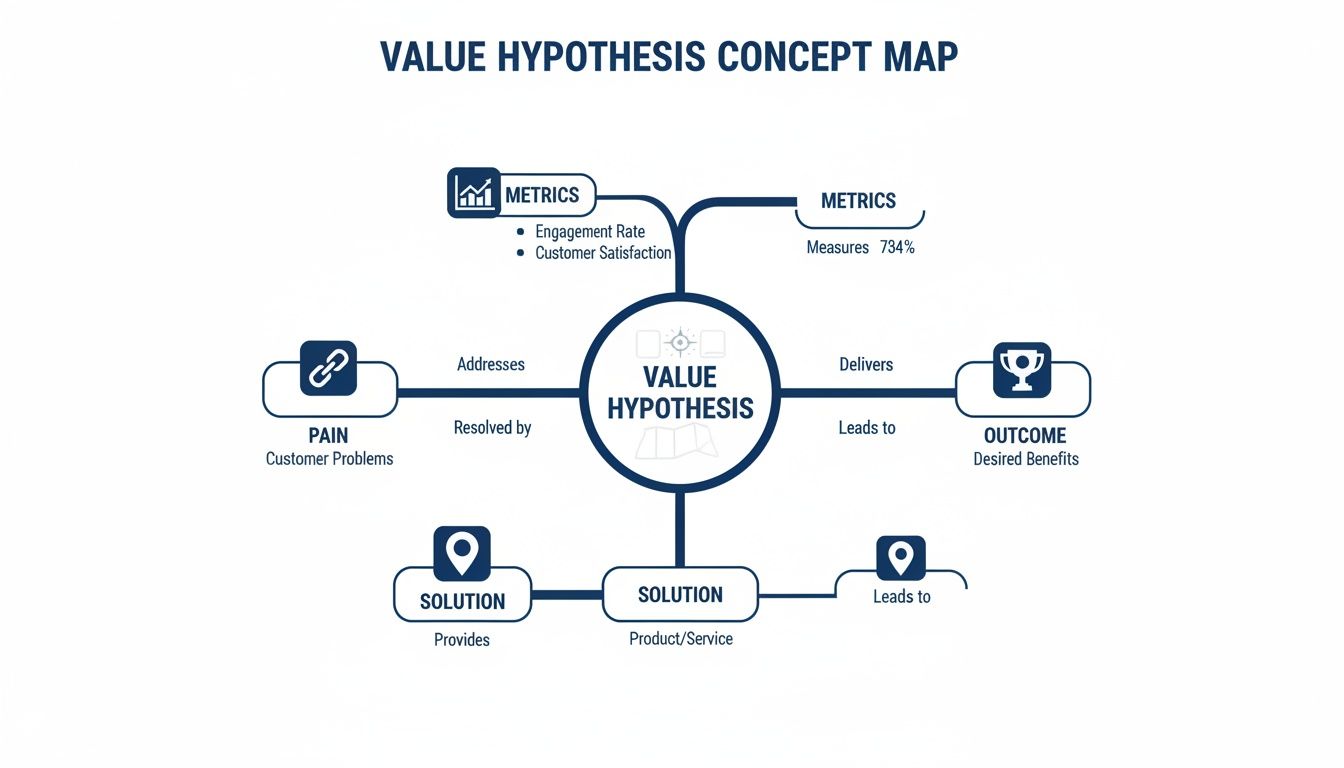
As the map illustrates, each component flows logically into the next. You end up with a complete narrative that speaks to both the emotional and rational sides of a buying decision.
1. Uncovering the Real Pain
Every major B2B purchase starts with pain. Not a minor inconvenience, but a critical business challenge. The first block of your value hypothesis is to find this deep-seated issue.
Surface-level problems, like "our reporting is slow," are just symptoms. The real pain is what happens because the reporting is slow. Does it lead to missed market opportunities? Does it cause the company to lose deals to more nimble competitors?
Your job is to dig deeper than the initial complaint to find the underlying business threat or missed opportunity. This is the difference between being a vendor and becoming a strategic partner.
The best sales teams don't just solve the problems customers know they have. They uncover the costly problems customers have learned to live with.
For example, a prospect might say their team wastes time on manual research. The true pain isn’t the wasted time itself. It’s the consequences: sloppy account planning, generic outreach that gets ignored, and promising deals that stall because there’s no compelling "why now."
2. Defining the Desired Outcome
Once you've diagnosed the pain, the next step is to paint a clear picture of the future state. What does life look like after your solution is in place? This is the desired outcome.
This isn’t about listing product features. It's about describing the new reality your customer will experience. If the pain is a fractured sales process, the desired outcome is a predictable, scalable revenue engine where reps focus on high-value activities.
This outcome must be framed in the customer's language.
- Weak Outcome: "Our software provides AI-driven insights."
- Strong Outcome: "Your account executives will walk into every meeting with the context they need to build instant credibility and shorten the sales cycle."
The stronger version connects your solution directly to a tangible business result, making the value immediately obvious. Crafting this outcome is similar to defining strengths in a business strategy; you can learn more about how a SWOT analysis can give you a competitive advantage.
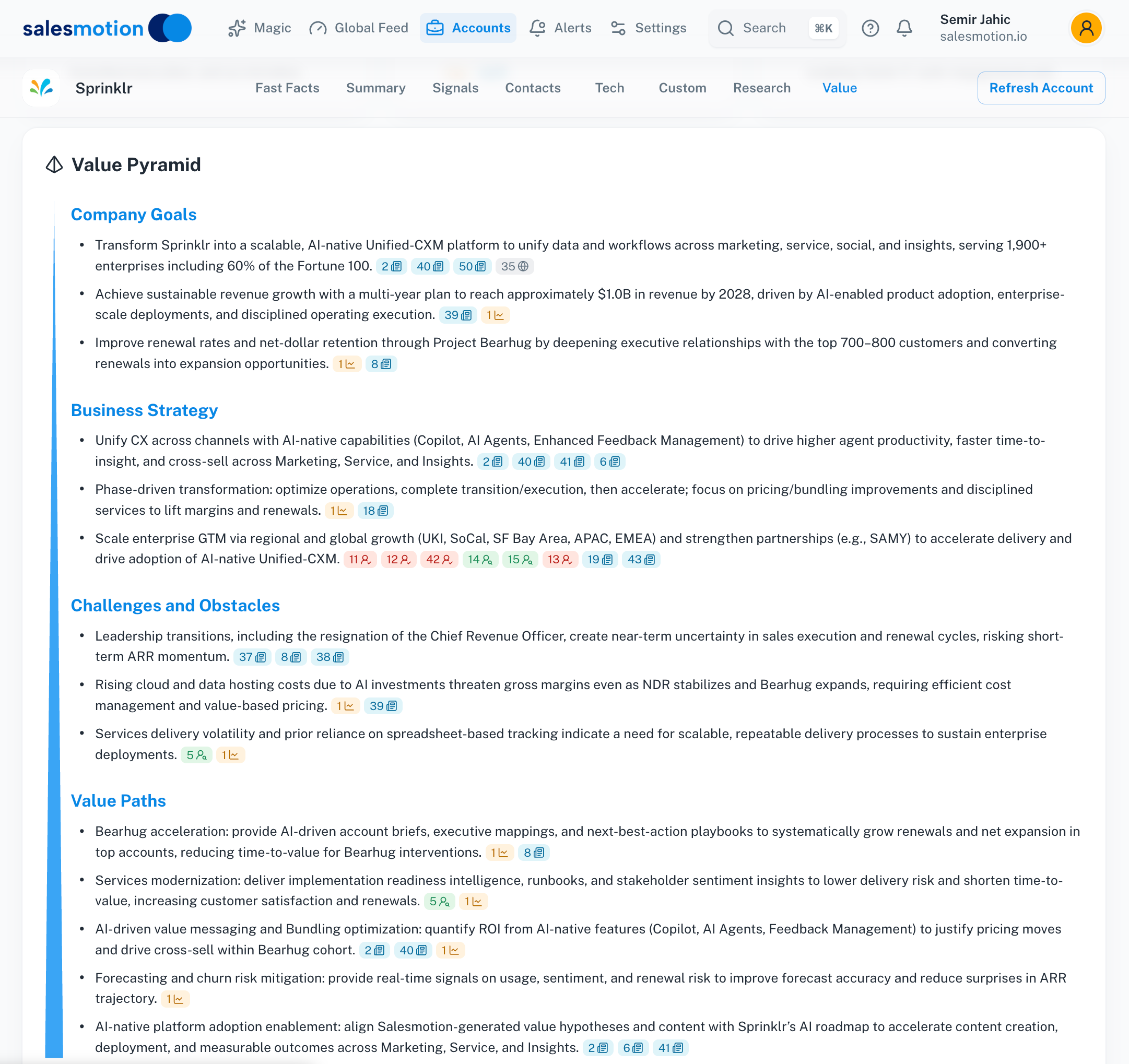 A value pyramid maps an account's strategic priorities to specific business outcomes — giving reps the structure to build a hypothesis grounded in real data.
3. Quantifying the Key Metrics
Words are good, but numbers are better. A value hypothesis without metrics is just an idea. A hypothesis with metrics is a business case. This is where you connect the desired outcome to specific, measurable Key Performance Indicators (KPIs).
Metrics make your claims tangible. They transform your hypothesis from an assumption into a testable theory.
This component answers the question, "How will we know we've succeeded?" The metrics you choose must tie back to the pain you've uncovered.
- If the pain is high customer churn, the metric is reducing churn by X%.
- If the pain is a long sales cycle, the metric is decreasing the average cycle length by Y days.
- If the pain is low rep productivity, the metric is increasing qualified meetings booked per rep by Z%.
These numbers give the prospect a clear yardstick for success and a baseline for measuring ROI.
4. Assembling Credible Proof
The final building block is proof. You’ve identified the pain, described the outcome, and provided the metrics. Now, you have to answer the prospect's last question: "Why should I believe you can do this?"
Proof is the credibility that holds your entire argument together. It comes in various forms, each designed to build trust and lower perceived risk.
Here are the most powerful types of proof:
- Relevant Case Studies: Showing how you solved a similar problem for a similar company is the gold standard. It proves your solution works in their world.
- Customer Testimonials: Direct quotes from happy clients add a human element and provide social proof, assuring the prospect that others have trusted you and won.
- Data and Benchmarks: Using industry-specific data or aggregated results from your customer base can show the typical impact your solution delivers. For example, "Our customers in the fintech space see a 20% reduction in compliance reporting time on average."
Without proof, your value hypothesis is just an empty promise. With it, you're presenting a low-risk, high-reward proposition that a buyer can confidently take to their internal team.

“Salesmotion has been a game-changer for me. I used to spend 12 hours a week on prospect research, now it's down to 4. Plus I'm finding stuff I was totally missing - podcasts, news mentions, the good bits.”
George Treschi
Account Executive, FY25 President's Club, Sigma
Putting Your Value Hypothesis into Action
A well-crafted value hypothesis is a great starting point, but it’s just theory until you use it. This is where the framework becomes a powerful asset that drives revenue. A value hypothesis gives your team a credible point of view for every interaction, making conversations sharper, more relevant, and more likely to convert.
It's not about creating a rigid script. It's about building a strategic foundation for genuine, problem-focused dialogue. Let's break down how to apply this concept across three critical B2B sales motions.

Driving Insightful Sales Discovery Calls
Discovery is the most crucial stage of the sales process. A preliminary value hypothesis acts as your compass, steering your questions away from generic features and toward core business issues. You walk into the call with an educated guess about their likely pains and desired outcomes.
This allows you to ask sharper, more insightful questions. Instead of, "What are your biggest challenges?" you can lead with a hypothesis-driven question that shows you’ve done your homework.
Mini-Script Example:
"In working with other B2B SaaS companies, we often see that disconnected data between sales and marketing leads to a 10% drop in lead conversion. Is that a challenge you're currently navigating?"
This one question does three things instantly:
- It demonstrates industry knowledge.
- It presents a specific, quantifiable problem.
- It invites the prospect to either confirm or correct your assumption—and both responses give you valuable information.
Your goal during discovery isn't to be 100% right from the start. It’s to use your initial hypothesis as a tool to uncover the actual pain, validate your assumptions, and build a business case with the prospect.
Powering Hyper-Personalized Outbound Prospecting
Generic outbound emails are dead. A value hypothesis is the secret to crafting personalized messages that get a response. It provides the core narrative for your email and call scripts, ensuring you lead with the customer's problem, not your product's features.
Your hypothesis lets you create a "problem-centric" opening that grabs their attention. By referencing a specific pain point relevant to their industry or role, you signal that this isn't another automated sequence.
Here’s a simple framework for an outbound email based on a value hypothesis:
- Lead with the Pain: "Noticed your company is expanding its enterprise sales team. Often, this rapid growth stretches account planning resources thin, leading to inconsistent deal execution."
- State the Outcome & Metrics: "We help CROs at fast-growing tech firms standardize their planning process, which typically shortens sales cycles by 15-20%."
- Provide Proof: "We achieved this for [Similar Company], and I believe we could do the same for you."
- Call to Action: "Are you open to a brief call next week to explore how this might apply?"
This structure transforms cold outreach into a relevant business suggestion. It’s concise, valuable, and directly answers the "what's in it for me" question.
Aligning Account-Based Marketing Efforts
In Account-Based Marketing (ABM), success hinges on alignment and relevance. A value hypothesis serves as the central pillar for your ABM strategy, ensuring marketing and sales tell the same story to a target account. If you're running an account-based selling motion, this is where your hypothesis becomes non-negotiable.
For each high-value account, develop a bespoke hypothesis. This means digging into the company's strategic goals, recent news, and executive priorities. Are they focused on international expansion? Improving operational efficiency? Reducing security risks? Your value hypothesis must connect your solution directly to those initiatives.
An ABM value hypothesis isn't just about a single pain point; it's about connecting your solution to the company's most important strategic objectives. This elevates the conversation from a tactical purchase to a strategic partnership.
For example, if a target manufacturer's annual report emphasizes reducing its carbon footprint, your hypothesis must be tailored. The pain isn't "inefficient machinery"; it's "failing to meet public sustainability goals, which impacts investor relations." The outcome becomes "achieving a 5% reduction in energy consumption to meet ESG targets."
This tailored hypothesis then informs every touchpoint—from ads and content to the specific talking points the sales rep uses. This creates a consistent and compelling narrative across the entire buying journey.
How to Build a Value Hypothesis with Industry Examples
Theory is one thing, but seeing a value hypothesis in action makes it click. Let's build a few detailed examples for three different B2B sectors to show how it works in the real world.
This hands-on approach will show you how the four core components—pain, outcome, metrics, and proof—look different depending on the industry. You can use these as a blueprint for crafting your own.

SaaS Example: Customer Churn
For any B2B SaaS company, customer churn is a constant threat. High churn is usually a symptom of a deeper problem, like clunky onboarding, a failure to prove ongoing value, or a reactive customer success team. The specific value offered by different e-commerce SaaS companies, for example, shows just how tailored a hypothesis needs to be.
Let's build one for a customer success platform.
- Pain: Mid-market SaaS companies are losing 15% of their customers annually because their customer success process is reactive. This leaks revenue, drives up acquisition costs, and damages their brand.
- Outcome: They can shift to a proactive model that flags at-risk accounts before they churn, driving higher net revenue retention and creating predictable growth.
- Metrics: We believe we can help them reduce customer churn by 30% (from 15% down to 10.5%) within the first year.
- Proof: We helped [Similar SaaS Company], another high-growth firm, cut their churn by 28% in nine months. Our latest case study breaks down how.
Manufacturing Example: Production Efficiency
In manufacturing, efficiency is profitability. Every minute of unplanned downtime on a production line hits the bottom line, leading to missed deadlines, bloated labor costs, and contractual penalties.
Here’s a value hypothesis for a company selling predictive maintenance sensors for industrial equipment.
- Pain: An automotive parts manufacturer deals with 20 hours of unplanned production downtime each month from equipment failures. This costs them an estimated $500,000 a year in lost output and overtime pay.
- Outcome: The plant will move from a reactive, "break-fix" model to a proactive, predictive maintenance schedule. This means maximizing uptime and getting more products out the door.
- Metrics: Our IoT sensors will help them slash unplanned downtime by 75%, saving them at least $375,000 annually.
- Proof: At [Competitor Manufacturing Plant], our solution cut their machine failures by 80% in the first year. Their Plant Manager provided a public testimonial about it.
A strong value hypothesis pinpoints a specific, quantifiable operational pain and connects it directly to a clear financial gain. It translates technical features into the language of business results.
This approach instantly elevates the conversation. You're no longer talking about sensors; you're talking about profitability and operational excellence.
Financial Services Example: Regulatory Compliance
For financial services firms, navigating regulations is a massive operational headache. A single slip-up can lead to crippling fines, legal battles, and a damaged reputation. The compliance process is often slow, manual, and prone to human error.
Let’s build a value hypothesis for a RegTech (Regulatory Technology) software provider.
- Pain: A regional investment bank burns 5,000 person-hours a year on manual anti-money laundering (AML) reporting. This is expensive and creates a huge risk of mistakes and potential fines.
- Outcome: The bank will automate its AML reporting, ensuring accuracy, reducing audit risk, and freeing up skilled analysts for high-value strategic work.
- Metrics: We can cut time spent on AML reporting by 90% and lower compliance processing costs by over 60%.
- Proof: We helped [Regional Bank X], a firm of a similar size, automate their entire compliance workflow. Their Chief Compliance Officer said it saved them from a potential $1.2 million fine.
These examples show how the same four-part framework can be adapted to fit different business problems and industries. It’s a versatile tool for making your value proposition concrete and compelling.
Quick-Start Value Hypothesis Templates
Need something you can adapt right now? Here are three ready-to-use value hypothesis examples for common B2B scenarios.
1. SaaS Sales Tool (e.g., account intelligence platform)
"We believe mid-market sales teams that rely on manual account research waste 8+ hours per rep per week on data gathering. By automating signal tracking and account insights, we can help them reclaim that time and increase qualified meetings booked by 25% within one quarter—just as we did for a 200-person SaaS company that saw a 30% lift in pipeline."
2. B2B Marketing Platform (e.g., demand generation software)
"We believe B2B marketing teams running 10+ campaigns per quarter lose 20% of their budget to poorly targeted audiences because they lack real-time intent data. Our platform can help them focus spend on in-market accounts, improving cost-per-opportunity by 35%—validated by three enterprise customers who cut wasted ad spend by over $150,000 annually."
3. Management Consulting Firm (e.g., operations advisory)
"We believe mid-size manufacturers with 3+ production facilities lose $1.2M per year to duplicated procurement processes across sites. Our operational audit and centralized procurement framework can reduce raw material costs by 12% within six months, as proven by two engagements with Fortune 500 industrial clients."
Each template follows the same Pain-Outcome-Metrics-Proof structure. Swap in your own numbers and customer references to make them yours.
Value Hypothesis Examples By Industry
Here’s a quick-glance table breaking down how the core components of a value hypothesis shift across various B2B sectors.
| Industry | Common Pain Point | Desired Outcome | Key Metric |
|---|---|---|---|
| Logistics & Supply Chain | High last-mile delivery costs and delays are eroding profit margins and damaging customer satisfaction. | Optimize delivery routes in real-time to reduce fuel costs and improve on-time delivery rates. | Reduce fuel costs by 15% and improve on-time delivery from 85% to 95%. |
| Healthcare Administration | Manual patient scheduling and billing processes lead to high administrative overhead and frequent errors. | Automate administrative workflows to reduce staff burnout and improve revenue cycle management. | Decrease patient no-shows by 20% and reduce billing errors by 90%. |
| Commercial Real Estate | Inefficient energy usage in large office buildings results in unnecessarily high operational expenses. | Implement a smart building management system to optimize HVAC and lighting usage based on occupancy. | Lower annual energy costs by 25%, saving an estimated $200,000 per building. |
Each row tells a simple but powerful story: a clear problem, a better future, and a measurable path to get there. That’s the core of a great value hypothesis.

“The Business Development team gets 80 to 90 percent of what they need in 15 minutes. That is a complete shift in how our reps work.”
Andrew Giordano
VP of Global Commercial Operations, Analytic Partners
Testing and Validating Your Assumptions
A value hypothesis is an educated guess. Its power is only unlocked when you prove it right.
An untested hypothesis is just an assumption, and building a sales strategy on assumptions is like building a house on sand. You must move from theory to reality, using real market feedback to validate, refine, or even pivot your entire approach.
This process transforms sales from an art into a repeatable science. You stop hoping your message lands and start knowing why it does. The goal isn't to be perfect on the first try but to have a framework for continuous improvement.
From Educated Guess to Data-Backed Fact
Testing your value hypothesis doesn’t require a complex research department. It starts with simple, practical methods. The key is to isolate variables and measure the results.
Here are a few proven ways to validate your assumptions:
- A/B Test Outbound Messaging: Create two versions of an outbound email. One uses your primary value hypothesis, while the second tests a different pain point or metric. Track response rates to see which resonates more.
- Analyze Discovery Call Recordings: Listen for recurring themes in discovery calls. When prospects describe their challenges, are they using the same language as your hypothesis? This qualitative data is invaluable for refining your understanding of their pain.
- Track Conversion Rates: If you’re directing prospects to a landing page with a specific value proposition, measure the conversion rate. A low rate may indicate your hypothesized value isn't compelling enough.
Using buyer intent data can also give you clues about which accounts are researching the problems your hypothesis aims to solve. For a deeper look, you can learn more about what intent data is and how it works in our detailed guide. This helps you test your hypothesis on prospects who are already in-market.
Why Statistical Significance Matters
So you're running tests. How do you know if a higher response rate is a real trend or just luck?
This is where statistical significance comes in. It’s a way to measure with confidence whether the outcome of a test is due to the change you made, not just chance.
In sales and marketing tests, achieving statistical significance means you've gathered enough data to confidently say one version of your messaging is genuinely more effective than another. It provides the proof needed to make strategic decisions.
For decades, the 0.05 significance level has been the gold standard in market research. Research on U.S. e-commerce A/B tests from 2018-2023 found that 68% of significant results led to revenue uplifts between 15-25%. This framework is crucial for turning your assumptions into validated, revenue-generating strategies. Explore more insights about statistical significance in market research.
Ultimately, validating your value hypothesis is an ongoing loop: test, learn, and iterate. Every prospect interaction is an opportunity to gather data, sharpen your point of view, and build a more predictable path to revenue.
How to Scale Your Value Hypothesis with Automation
Crafting a unique value hypothesis for every prospect is powerful, but it doesn't scale. For revenue teams trying to cover hundreds of accounts, manual research becomes a bottleneck.
This is where smart sales technology comes in. Automation lets you accelerate the entire hypothesis lifecycle, from the initial idea to market validation. It allows a small team to perform like a much larger one, systematically finding the winning formulas that build a predictable revenue engine.

From Manual Research to Automated Insights
The first big win is automating the research and generation process. Instead of reps losing hours digging through news articles and company reports, technology can do the heavy lifting.
Modern platforms can monitor your target accounts for critical signals—like executive changes, new product launches, or a shift in strategic priorities. These signals are the raw material for generating tailored, relevant hypotheses instantly.
- Automated Signal Tracking: AI can scan thousands of sources to pinpoint timely triggers and useful context, flagging accounts that are ready for outreach.
- Hypothesis Generation: Based on these signals, the platform can automatically construct a solid first draft of a value hypothesis, connecting a recent event to a likely business pain and your solution.
This flips the script. Your team goes from reactive researchers to proactive strategists. Reps get a steady flow of high-quality, data-driven hypotheses they can immediately put into action.
Deploying and Testing Hypotheses at Scale
Once you have a stream of automated hypotheses, the next challenge is to deploy and test them efficiently. This is where sales process automation is crucial for modern GTM strategies.
Automation platforms can pipe these hypotheses directly into your sales engagement tools. This means you can run dozens of campaigns simultaneously, each testing a different value hypothesis on a specific market segment.
By automatically deploying and tracking engagement on different messages, you turn your entire outbound motion into a powerful learning engine. The market itself tells you which value hypotheses are resonating and which are falling flat.
To get this right, you first need a solid grasp of understanding the basics of sales automation. This isn't just about sending more emails; it's about building a system that sends smarter, more effective ones.
The process looks like this:
- Segment Your Audience: Group accounts by industry, size, or a specific trigger event.
- Deploy Tailored Sequences: Launch automated outreach with messaging built around the value hypothesis for each segment.
- Track Engagement Metrics: Monitor open rates, reply rates, and meeting booking rates for each hypothesis.
- Identify the Winners: Let the data tell the story. See which hypotheses generate the most positive engagement.
This systematic approach takes the guesswork out of the equation. It provides the hard data you need to double down on what works and create a feedback loop that consistently improves performance.
Key Takeaways
- A value hypothesis is a specific, testable assumption connecting your solution to a prospect's pain, desired outcome, measurable metrics, and credible proof.
- The four building blocks of every strong hypothesis are Pain, Outcome, Metrics, and Proof, and each must be present for the argument to hold together.
- Value hypotheses power three critical sales motions: discovery calls (as a compass for sharper questions), outbound prospecting (as a narrative for personalized emails), and ABM campaigns (as a unifying message across touchpoints).
- Testing your hypothesis through A/B tests, discovery call analysis, and conversion rate tracking transforms it from an educated guess into a data-backed sales strategy.
- Automation platforms can scale hypothesis generation and deployment by monitoring account signals and piping tailored messaging into your sales engagement tools.
Common Questions About Value Hypotheses
As you start working this framework into your sales motion, a few questions always come up. Getting these sorted out early will help you use the value hypothesis more effectively.
Value Proposition Versus Value Hypothesis
What's the difference between a value proposition and a value hypothesis?
Think of it like this: your value proposition is your company's billboard. It’s the high-level message on your website, like "We help companies reduce operational costs." It's a broad claim.
A value hypothesis is your detective's magnifying glass. It’s a specific, testable assumption for a particular customer segment or even a single account. It's the active, investigative version: "We believe we can reduce your operational costs by 15% by automating your manual compliance reporting."
A proposition is a claim; a hypothesis is a theory you're ready to prove.
How Often to Update a Value Hypothesis
A value hypothesis is not a "set it and forget it" tool. The market is always shifting—customer priorities change, new competitors emerge, and your product evolves.
Your value hypothesis should be a living document. It has to be continuously refined based on real-world feedback from sales calls, email responses, and closed deals.
If your win rates dip or your messaging isn't landing, that's a signal to revisit your core assumptions. As a rule of thumb, review your main hypotheses quarterly to keep them sharp and relevant.
Using a Value Hypothesis for Existing Customers
Can you use this framework for more than just landing new logos? Absolutely.
A value hypothesis is a powerhouse for account management and expansion. You can build new hypotheses centered on:
- Upselling: Finding a new pain point in an existing account that a premium version of your product can solve.
- Cross-selling: Spotting a challenge in a different department that another one of your products can fix.
- Renewals: Revisiting the initial value hypothesis, but this time with updated metrics and fresh proof to show ongoing ROI and lock in the renewal.
Stop wasting hours on manual research. Salesmotion automatically tracks what's happening across your target accounts and turns signals into actionable context. Get the "why now" for every conversation and build your next winning value hypothesis in minutes. See how it works at Salesmotion.
Frequently Asked Questions
What is a value hypothesis in sales?
A value hypothesis is a specific, testable assumption about the measurable value your product delivers to a particular customer segment. It connects your solution directly to a prospect's pain point and the business results they can expect, structured around four components: Pain, Outcome, Metrics, and Proof. Unlike a generic pitch, it gives your team a credible, data-backed point of view for every sales conversation.
How is a value hypothesis different from a value proposition?
A value proposition is your company's broad, public-facing message about the value you deliver, like what appears on your website. A value hypothesis is a specific, testable assumption targeted at a particular customer segment or even a single account. Think of the proposition as a billboard and the hypothesis as a detective's magnifying glass: one is a general claim, while the other is a theory you are ready to prove with data.
What are the four components of a value hypothesis?
Every strong value hypothesis is built on four pillars: Pain (the critical business problem the customer faces), Outcome (what the improved future state looks like), Metrics (the specific, measurable KPIs that will prove success), and Proof (case studies, testimonials, or benchmarks that demonstrate you can deliver the promised results). All four must be present for the hypothesis to hold together as a compelling argument.
How do I test whether my value hypothesis is working?
Use three practical methods: A/B test your outbound messaging by creating two versions with different pain points or metrics and tracking response rates, analyze discovery call recordings to see if prospects describe their challenges using the same language as your hypothesis, and track conversion rates on landing pages that feature your value proposition. Statistical significance matters, so gather enough data before drawing conclusions about which version performs better.
Can a value hypothesis be used for existing customers, not just new prospects?
Absolutely. A value hypothesis is a powerful tool for account management and expansion. You can build new hypotheses centered on upselling by identifying new pain points a premium product tier can solve, cross-selling by spotting challenges in different departments, or renewals by revisiting the initial hypothesis with updated metrics and fresh proof to demonstrate ongoing ROI and secure the renewal.