Medical sales software is a purpose-built system for teams that sell into regulated clinical environments. It goes beyond contact management to cover field activity capture, compliance and audit trails, territory alignment, and the account context reps need before every conversation.
TL;DR: A standard CRM stores contacts and tasks; medical sales software supports the actual work of medical, pharma, and device selling: accurate field activity capture, account and HCP intelligence, audit trails and document control, and integrations with ERP and clinical systems. Select a platform by mapping it to your real field workflow, asking for a live demo of its compliance controls, and pricing implementation and admin load alongside licenses. The next advantage comes from signal-driven automation that turns outside account changes into timely, compliant outreach.
Your team probably knows the pattern. A rep finishes a hospital visit, promises to log the conversation later, then gets pulled into product questions, pricing follow-up, and internal approvals. By Friday, half the activity is missing, next steps are fuzzy, and the forecast review turns into a debate over gut feel instead of pipeline evidence.
That setup is painful in any B2B team. In medical sales, it's worse. You're dealing with long evaluation cycles, regulated interactions, clinical nuance, and buyers who expect every conversation to reflect their specific environment. Generic systems can store contacts and tasks. They usually can't support the actual work.
Medical sales software matters because it changes the operating model. It gives reps the structure to capture field activity accurately, gives managers a real view of progression, and gives leadership a cleaner path from account insight to compliant execution. The strongest platforms also do something most guides still miss. They turn external signals and regulatory requirements into an advantage instead of treating them as overhead.
Why Your Standard CRM Is Costing You Medical Sales Deals
A lot of teams still assume a standard CRM is good enough if they customize a few fields. That assumption breaks fast in medical sales.
A rep covering provider networks, hospital systems, or device accounts doesn't just need a place to store names. They need reliable activity capture, complete engagement history, account-level context, and a workflow that reflects clinical buying motion. Without that, they spend too much time reconstructing reality.
The operational damage is familiar. Notes live in inboxes. Follow-ups depend on memory. Managers ask for forecast updates and get interpretations instead of evidence. As Gitnux notes in its medical sales software overview, modern medical sales software specifically resolves critical operational failures like inconsistent call logging, missing engagement history, weak pipeline discipline, and limited visibility into forecasting that generic CRM tools often fail to prevent.
Where generic tools fail in the field
Generic CRMs usually break in four places:
- Activity capture: Reps leave calls, demos, trainings, and evaluations without a clean, consistent way to log what happened.
- Account continuity: When a territory changes hands, the new rep inherits fragments instead of a usable engagement record.
- Forecast integrity: Stage progression becomes subjective because the system isn't built around the milestones that matter in regulated healthcare selling.
- Pre-call prep: Reps waste selling time searching for updates across company sites, LinkedIn, hiring pages, and internal notes.
One of the biggest hidden costs is research time. Teams that rely on fragmented tools force reps to do manual stitching before outreach. That's exactly why many leaders start evaluating a dedicated sales intelligence platform for account research and trigger monitoring alongside core CRM decisions.
Generic CRM software doesn't usually fail all at once. It fails one missed note, one vague stage change, and one preventable blind spot at a time.
The liability isn't just inefficiency
Medical sales is relationship-led, but it's also process-heavy. If a rep can't see who trained, who evaluated, who raised objections, and what compliance documentation is tied to the account, the team loses momentum. A standard CRM may keep the record technically alive while the deal itself drifts.
That's why specialized software isn't a nice-to-have for mature teams. It's infrastructure. It helps reps spend more time selling and less time rebuilding account history from memory, scattered emails, and side spreadsheets.
Skip the comparison fatigue?
If you're shopping for a sales intelligence tool, here's the short version.
Salesmotion combines account intel, buying signals, verified contacts, and AI-drafted outreach in one tool. From $85/mo, live in an hour, no annual contract.
Defining Medical Sales Software Beyond the Buzzwords
Medical sales software isn't just a CRM with healthcare branding. It's a purpose-built operating system for teams that sell into regulated clinical environments and need more than contact management.
The distinction is functional. Generic CRM platforms are designed to support broad sales motion across many industries. Medical sales software is built around account complexity, healthcare workflows, territory reality, and compliance expectations. It has to support the way medical, pharma, and device teams move deals forward.
What it does in practice
At a practical level, medical sales software connects commercial execution with the systems and controls that matter in healthcare. That includes structured account planning, field activity capture, territory alignment, regulated content access, and integrations that keep operational and commercial data in sync.
For medical device organizations, the requirements get sharper. Teams need software that can support audit readiness, document control, and the surrounding workflows that make long sales cycles manageable. That's also why many teams pair their CRM decision with healthcare-focused intelligence layers such as sales intelligence for healthcare teams, especially when outreach relevance depends on timely market context.
Generic CRM vs. Medical Sales Software
| Capability | Generic CRM | Medical Sales Software |
|---|---|---|
| Core purpose | Broad pipeline and contact tracking | Healthcare-specific selling, compliance, and account execution |
| Compliance workflow | Basic permissions and recordkeeping | Built for regulated interactions, audit support, and controlled documentation |
| Territory alignment | Standard account ownership rules | Designed for complex territories, provider structures, and field coverage |
| Clinical sales motion | General deal stages | Supports evaluations, training, committee review, and extended buying cycles |
| Healthcare integrations | Limited or custom-heavy | Better fit for ERP, hospital systems, and adjacent healthcare workflows |
| Rep readiness | Generic content libraries | More structured access to approved product, clinical, and competitive knowledge |
| Manager visibility | Standard dashboards | Better visibility into activity quality, progression discipline, and account risk |
| External context | Often manual | Increasingly paired with tools that bring market signals into rep workflows |
Why the category deserves its own budget line
A medical sales leader shouldn't have to justify specialized software by saying, “our version of Salesforce is complicated.” That's too soft. The stronger case is that the job itself is different.
You're not only managing opportunities. You're managing regulated interactions, long education cycles, field execution, account nuance, and internal coordination across sales, legal, marketing, and operations. A generic system can be stretched to fit. Medical sales software is built to fit.
Buyers feel the difference quickly. Reps using the right system sound prepared, follow up with the right material, and keep momentum without relying on heroic manual effort.

“Salesmotion has been a game-changer for me. I used to spend 12 hours a week on prospect research, now it's down to 4. Plus I'm finding stuff I was totally missing - podcasts, news mentions, the good bits.”
George Treschi
Account Executive, FY25 President's Club, Sigma
Key Features That Ensure Compliance and Boost Performance
A rep walks out of a hospital meeting after a strong product discussion. Then the critical work begins. The follow-up has to use approved materials, the activity has to be documented correctly, internal teams need visibility into what changed, and the next step has to reflect what is happening inside that account. If the system cannot support that chain cleanly, the deal slows down and compliance risk rises.
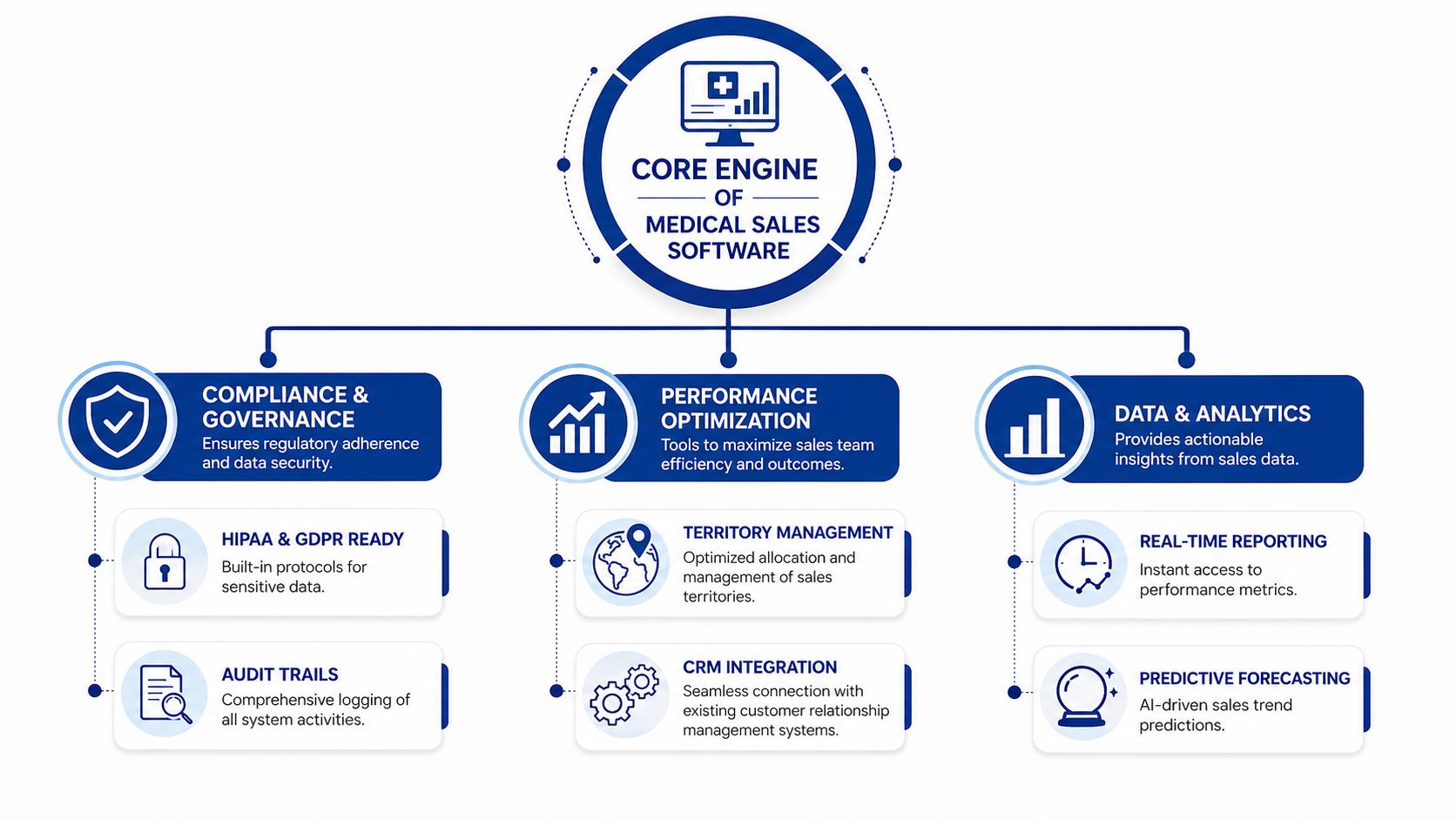
The strongest medical sales platforms improve performance because they turn controlled execution and outside account context into part of the selling motion.
Account and HCP intelligence
A useful account record in medical sales should answer practical questions fast. Who influences the decision? Which clinicians have engaged before? What product, clinical, or contracting issues are active? What changed since the last visit?
Generic CRM fields rarely capture that well. Reps end up keeping the complete story in notebooks, inboxes, or side spreadsheets. That creates handoff problems and weakens manager visibility.
Specialized software handles account intelligence at the level the job requires. It connects HCP roles, engagement history, stakeholder maps, approved content usage, and account-specific notes in one place. The better platforms also bring in external buying and market context so reps can adjust timing, message, and follow-up based on real movement, not just internal activity logs. Teams evaluating that capability should look closely at how vendors handle sales intelligence tools for signal-based account prioritization, not just contact enrichment.
Ironclad compliance and audit trails
Compliance controls have to be built into the workflow, not checked after the fact.
For medical device organizations, version control, access controls, and documented activity history matter because sales motions often involve evaluations, technical review, training, and shared materials over long periods. Wikimundi's review of CRM requirements for medical device sales highlights the need for audit trail capability and document control in these environments: medical device CRM requirements and audit considerations.
Here is the practical test I use. If a rep sends product documentation during an evaluation, the system should show which version was approved, who accessed it, when it was shared, and how that interaction ties back to the account record. If your team has to reconstruct that from email threads, your process is exposed.
For adjacent workflow areas, it also helps to review resources like this 2026 HIPAA scheduling software guide, because scheduling, communication, and sales operations often touch the same compliance expectations even when they sit in different systems.
Practical rule: If a vendor says they support compliance, ask for a live demo of audit trails, document version history, permission controls, and approval-dependent workflows.
Integration with operational systems
Medical sales teams do not operate inside one commercial application. The sales platform has to reflect what is happening across operations, product, and customer delivery.
The integrations that usually matter most are:
- ERP connectivity: Reps and managers need current inventory, order, and fulfillment context without relying on side conversations.
- Provider or hospital structure data: Account plans break down fast when the system cannot reflect the customer's actual organization.
- Clinical and product systems: Evaluation details, training status, and configuration requirements need to stay tied to the opportunity and the account.
- Data warehouse or BI layers: Revenue teams need clean reporting across field activity, pipeline progression, compliance actions, and post-sale outcomes.
Weak integrations create duplicate records, delayed updates, and conflicting answers in forecast reviews. Strong integrations reduce those failures and improve decision speed.
Secure tracking and field execution
Field activity in medical sales often includes evaluations, in-servicing, sample handling, controlled collateral, and follow-up tasks that have deadlines and approval requirements. Those steps need structure.
Specialized software gives teams that structure. Reps can see what happened at the account and what is due next. Managers can identify stalled evaluations, missing documentation, or incomplete follow-up before the opportunity slips. Operations gets a clearer record of what happened in the field without chasing down reps for basic details.
That discipline shows up in close rates and in audit readiness.
Analytics that improve decisions
Reporting should help managers coach and help leaders allocate resources. Too many systems produce activity charts that look busy but say very little about account progress.
Useful analytics answer sharper questions. Which territories create meetings but fail to advance evaluations? Which accounts show strong engagement but weak stakeholder coverage? Where are reps using approved content effectively, and where are deals slowing after clinical review? Which opportunities carry compliance-related process gaps that could delay the sale?
That level of visibility changes how teams manage performance. Coaching gets more specific. Forecast calls get less political. Revenue operations can spot patterns early and fix process issues before they become quarter-end surprises.
A Practical Framework for Selecting Your Platform
Most buying mistakes happen because teams compare feature lists instead of operating requirements. A polished demo can hide a weak fit for months.
The selection process works better when you treat it like a strategic infrastructure decision. You're not buying a nicer interface. You're choosing the system that will shape rep behavior, manager visibility, compliance execution, and data quality across the commercial organization.
Start with the hard questions
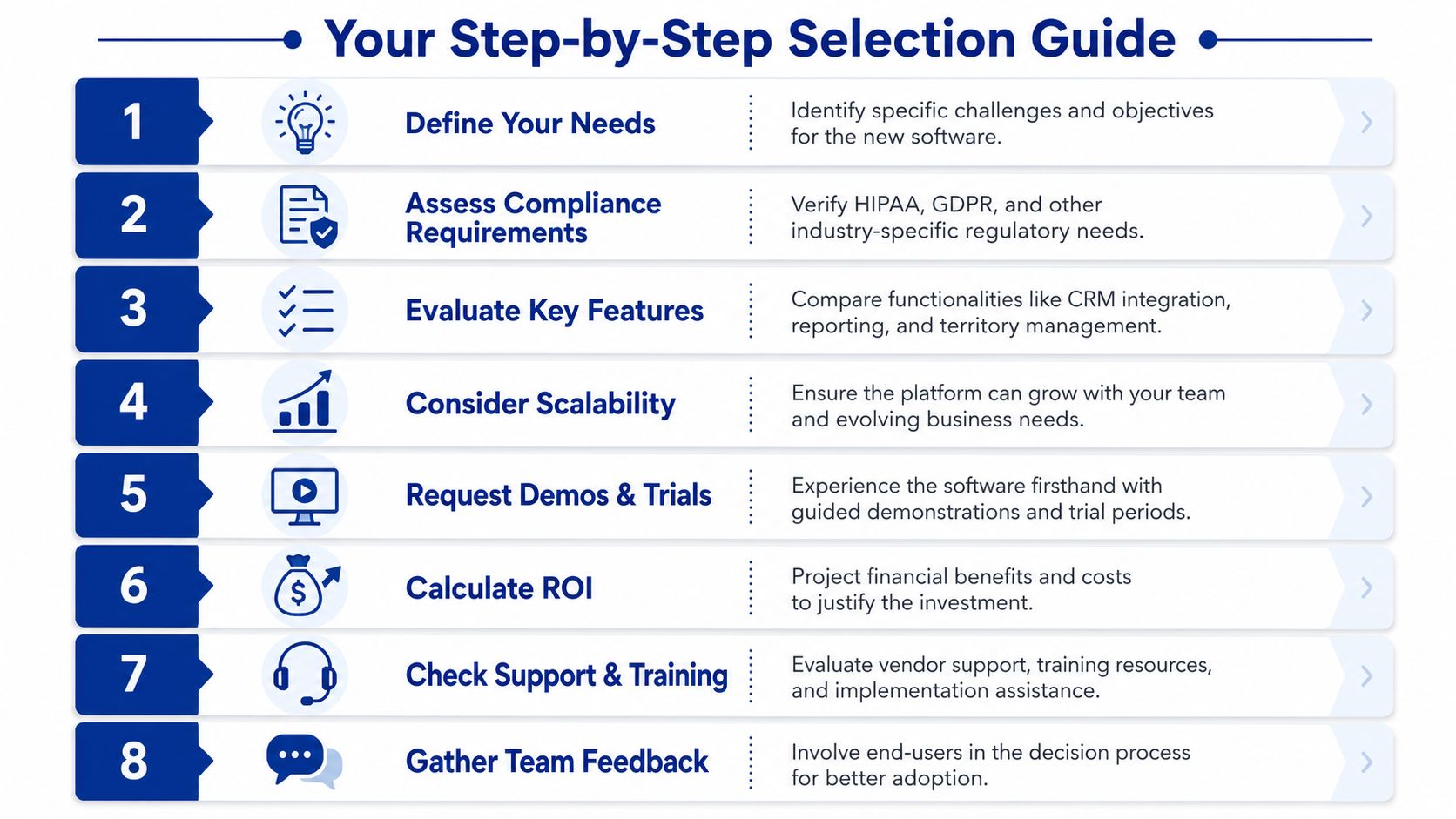
Use a checklist that forces real trade-offs.
- Can it fit your actual workflow: Ask the vendor to map your field process, not a generic SaaS funnel. Include evaluations, training events, approvals, committee review, and post-meeting documentation.
- Can it prove healthcare compliance capability: Don't accept broad claims. Ask how the platform handles permissions, approved content, audit support, and controlled document history.
- Can it integrate cleanly: Look at your existing CRM, ERP, data warehouse, and any healthcare-adjacent systems that reps depend on.
- Can managers coach from it: If frontline leaders still need spreadsheets to understand activity quality or forecast risk, the platform isn't doing enough.
- Can reps use it in actual field conditions: Field usability matters. If logging activity feels slow or clunky, adoption will collapse.
Price the platform honestly
Specialized platforms cost more for a reason. In life sciences sales, solutions like Veeva CRM set a pricing floor of $250 to $500 per rep per month, reflecting the cost of compliance, territory management, and multichannel engagement capabilities required for HCP interactions, according to BuzzBox Media's overview of medical sales CRM pricing.
That number shouldn't scare serious buyers. It should reset expectations. If a vendor is dramatically cheaper, ask what they left out.
A realistic cost review should include:
- License cost: Per rep, per manager, and any admin or integration seats.
- Implementation effort: Configuration, migration, validation, and training.
- Process change cost: Time required to standardize activity definitions and opportunity stages.
- Ongoing admin load: How much internal support the platform will need after launch.
A useful side-by-side method is to pair vendor pricing with a structured evaluation worksheet like this guide on how to choose sales intelligence tools, then score each option against business fit rather than surface polish.
Choose the vendor, not just the software
Some vendors sell software. Better ones understand how medical sales teams operate.
That difference shows up in implementation. A strong partner asks about field reporting, role-based workflows, content approval, manager inspection cadence, and integration dependencies. A weak partner asks how many seats you want and starts talking about dashboards.
The best demo question is simple: “Show me how one rep, one manager, and one compliance stakeholder would use this in the same account over thirty days.”

“The Business Development team gets 80 to 90 percent of what they need in 15 minutes. That is a complete shift in how our reps work.”
Andrew Giordano
VP of Global Commercial Operations, Analytic Partners
Calculating the Real ROI of Specialized Sales Software
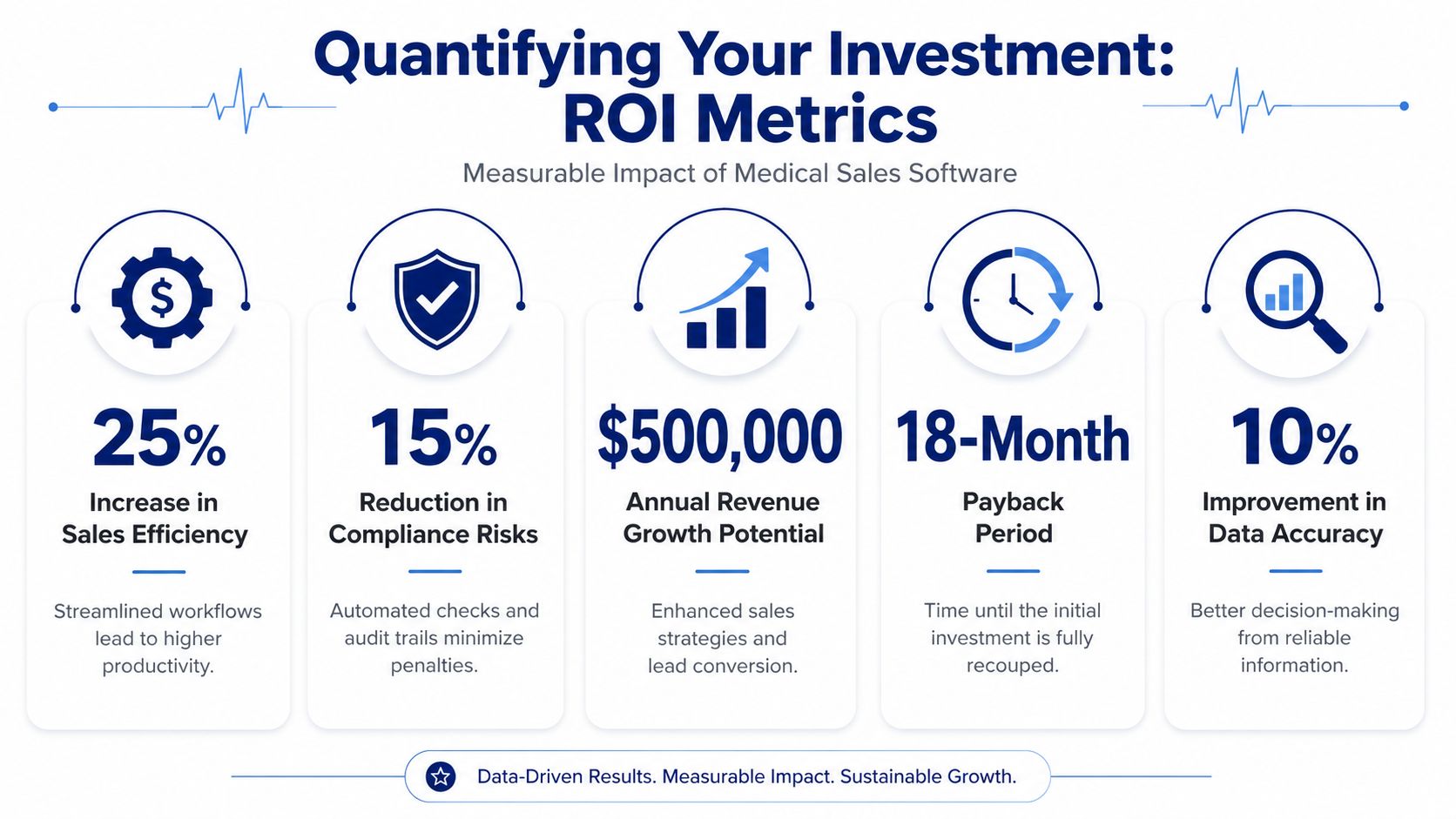
The ROI conversation usually gets trapped in admin efficiency. That's too narrow. Specialized medical sales software earns budget when it improves rep readiness, sharpens execution, and reduces avoidable risk.
This is the visual finance teams care about.
Revenue impact starts with readiness
Medical reps often need deep product and clinical fluency before they can sell effectively. Sales enablement platforms with AI-assisted search and CRM-native analytics help address the 12 to 18 month clinical training period for new reps, and reps with access to real-time product knowledge show stronger closing skills and faster pipeline growth velocity, according to BuzzBox Media's review of medtech sales enablement tools.
That matters because readiness affects every commercial metric downstream. Better-prepared reps handle objections earlier, use the right material, and move conversations forward with more confidence.
A simple ROI lens:
- Ramp value: Faster rep competence means managers spend less time patching knowledge gaps.
- Pipeline value: Better product fluency supports cleaner opportunity progression.
- Retention value: Reps are more likely to stick with systems that help them sell.
Efficiency is only valuable if it becomes selling time
It's easy to overstate efficiency. Saving time doesn't help if reps fill the gap with more admin work.
The right way to calculate gains is to ask where time gets redeployed. If automated activity capture, better search, and structured account intelligence reduce manual prep, the benefit comes when reps use that recovered time for outreach, follow-up, and stakeholder coordination. That's also where a framework for the ROI of sales intelligence tools becomes useful, because the business case needs to connect workflow improvements to pipeline outcomes.
Try a practical model with three buckets:
| ROI area | What to measure qualitatively | Why it matters |
|---|---|---|
| Revenue growth | Faster opportunity movement, stronger targeting, better conversation quality | Better execution creates more winnable pipeline |
| Operational efficiency | Less manual research, cleaner data entry, fewer side spreadsheets | Reps and managers spend more time on selling and coaching |
| Risk reduction | Better recordkeeping, approved content use, cleaner audit support | Compliance mistakes are expensive even before penalties appear |
Risk mitigation belongs in the business case
Finance teams sometimes dismiss compliance as a checkbox. That's a mistake. When software improves documentation, visibility, and control, it reduces the chance that a commercial process creates legal, regulatory, or operational cleanup later.
If your ROI model ignores compliance exposure, it's probably understating the value of the platform.
The strongest business cases combine all three dimensions. They show that the platform doesn't just make work easier. It makes revenue execution more reliable.
The Future Closing the Gap with Signal-Driven Automation
A rep opens the CRM at 8:15 a.m. The target account looks unchanged. By 9:00, the health system has posted a leadership move, launched hiring for a new specialty program, and issued a press release about expansion. If none of that reaches the rep in a usable way, the team works from stale context and sends outreach that sounds late or generic.
That is the gap standard systems still leave behind. They store activity well. They rarely convert external market change into a timely next step that a medical sales team can use within compliance rules.
Why the next advantage comes from external context
Medical sales teams already have internal workflow covered. The harder problem is deciding when something outside the account changed enough to justify outreach, what that change means, and how to respond without improvising off unapproved language.
As noted earlier, healthcare buyers ignore generic outreach that misses account context. The edge comes from catching relevant change early, filtering out weak signals, and giving reps a compliant reason to contact the account now.
A good companion read on this shift is expert outbound insights from Reachly, which explains why signal-based outreach performs better when the trigger maps to a real business reason to start the conversation.
What signal-driven automation looks like
The best platforms add a layer that sits between raw market noise and rep execution.
- Research agents pull structured account context from public sources and organize it around the buyer, facility, service line, and recent changes.
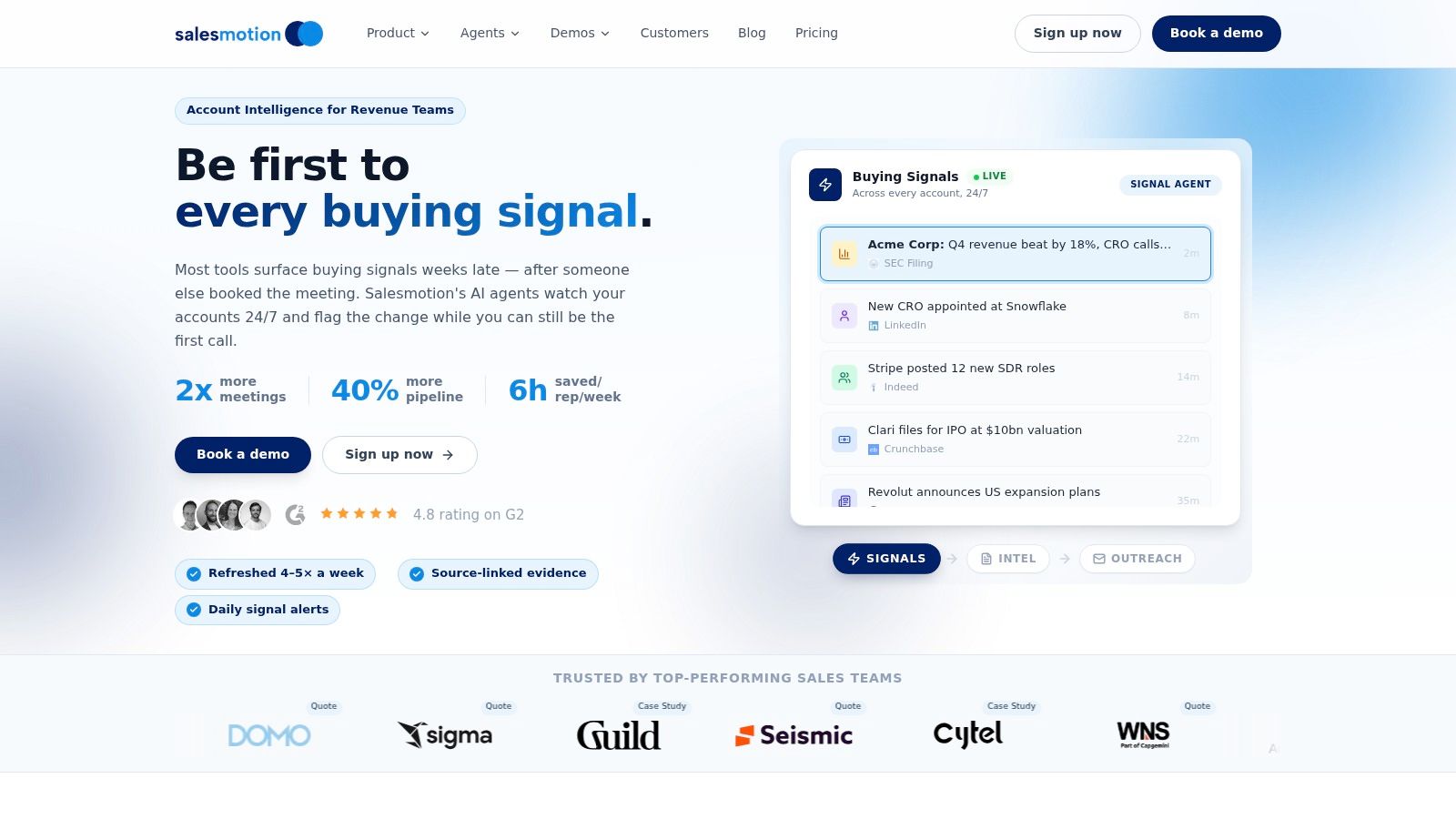
- Signal monitoring flags events that can change buying priorities, including executive transitions, new hiring patterns, expansion announcements, funding activity, and partnership news.
- Prospecting automation drafts account-specific messaging tied to the signal, then routes it through the guardrails your team already uses for review, approval, and documentation.
That matters because speed alone is not enough in medical sales. Reps need relevance, and managers need control.
Why this closes the final-mile problem
I have seen teams invest heavily in CRM discipline and still miss good opportunities because nobody owned external signal capture. News sat in inboxes, tabs stayed open for days, and by the time a rep reached out, the moment had passed.
Signal-driven automation fixes that operational gap. It turns account change into a monitored input, applies rules to separate useful triggers from noise, and gives the rep a drafted path forward. That is how outside information becomes pipeline activity instead of interesting research.
The teams that pull ahead will not be the ones with the cleanest fields alone. They will be the ones that can detect change, interpret it fast, and respond with compliant, account-specific outreach before competitors do.
If your reps are still piecing together account context by hand, it's worth seeing how Salesmotion helps revenue teams monitor target accounts, surface meaningful buying signals, and turn those signals into actionable outreach without heavy setup.