Most CROs underestimate the ROI of sales intelligence tools because they frame the purchase as software spend. That's the wrong lens. You're already paying for sales intelligence today through rep time, slow account research, missed trigger events, stale outreach, and weak prioritization.
TL;DR: The ROI of sales intelligence tools comes from three drivers: research time recovered, faster pipeline movement and better deal quality. Build the model in that order, with conservative assumptions and inputs finance already trusts. Lock a baseline before launch, compare high-adoption and low-adoption cohorts, and report the result to leadership on one page.
The strongest business case isn't “this tool saves clicks.” It's “we are converting manual research cost into pipeline efficiency and revenue impact.” That framing is backed by guidance that says ROI should be measured through win rate, revenue per rep, and pipeline velocity, not just adoption, and even a targeted improvement in one upstream metric can create meaningful downstream revenue lift on a large revenue base, as outlined in Humantic AI's ROI measurement guidance.
That's the standard your CFO will care about. Not feature lists. Not vague productivity claims. A defensible model tied to hard outcomes.
Stop Paying for Research and Start Investing in Revenue
The hidden cost of poor sales intelligence isn't the software line item. It's the salary you burn every day on manual research that never turns into selling time.
Most reps still patch together account context from earnings calls, LinkedIn, company blogs, news articles, job posts, and executive interviews. That work feels necessary, but it's also expensive, inconsistent, and hard to scale. One rep does deep prep. Another skims headlines. A third sends a generic email because they ran out of time.
That's not a tooling problem. It's an operating model problem.
The cost is already on your payroll
If your team is doing research by hand, you're already funding a sales intelligence motion. You're just funding the least efficient version of it.
A more useful way to think about the category is this:
- Manual research is labor cost. You're paying fully loaded rep compensation for work that software can standardize and accelerate.
- Slow follow-up is pipeline leakage. By the time a rep notices a hiring spike, funding event, or executive move, the window may already be gone.
- Inconsistent prep is quality risk. Good reps create relevant outreach. Average reps create noise.
Buyers already frame it as a payroll decision. A business development lead at a software firm told us the annual budget choice was between hiring more BDRs and automating part of their work.
Practical rule: If a rep spends material time gathering context instead of acting on context, you don't have a sales intelligence strategy. You have a research tax.
That's why the more interesting conversation isn't whether to add another tool. It's whether to keep tolerating a manual process that creates hidden cost and uneven execution. The broader shift in data aggregation and intelligence markets is well captured in insights from The Business Model Analyst, especially the move from fragmented information gathering to consolidated, workflow-ready intelligence.
If you want a practical view of what that automation looks like in day-to-day prospecting, this breakdown of AI-driven sales research workflows is a useful reference point.
Sales intelligence shopping list this long?
Skip the matrix. Salesmotion combines account intel, signals, and outreach drafts in one tool.
1,000+ public sources monitored 24/7, verified contacts with 200 credits/mo included, $85/mo. Monthly contract, no lock-in.
The Three Pillars of Sales Intelligence ROI
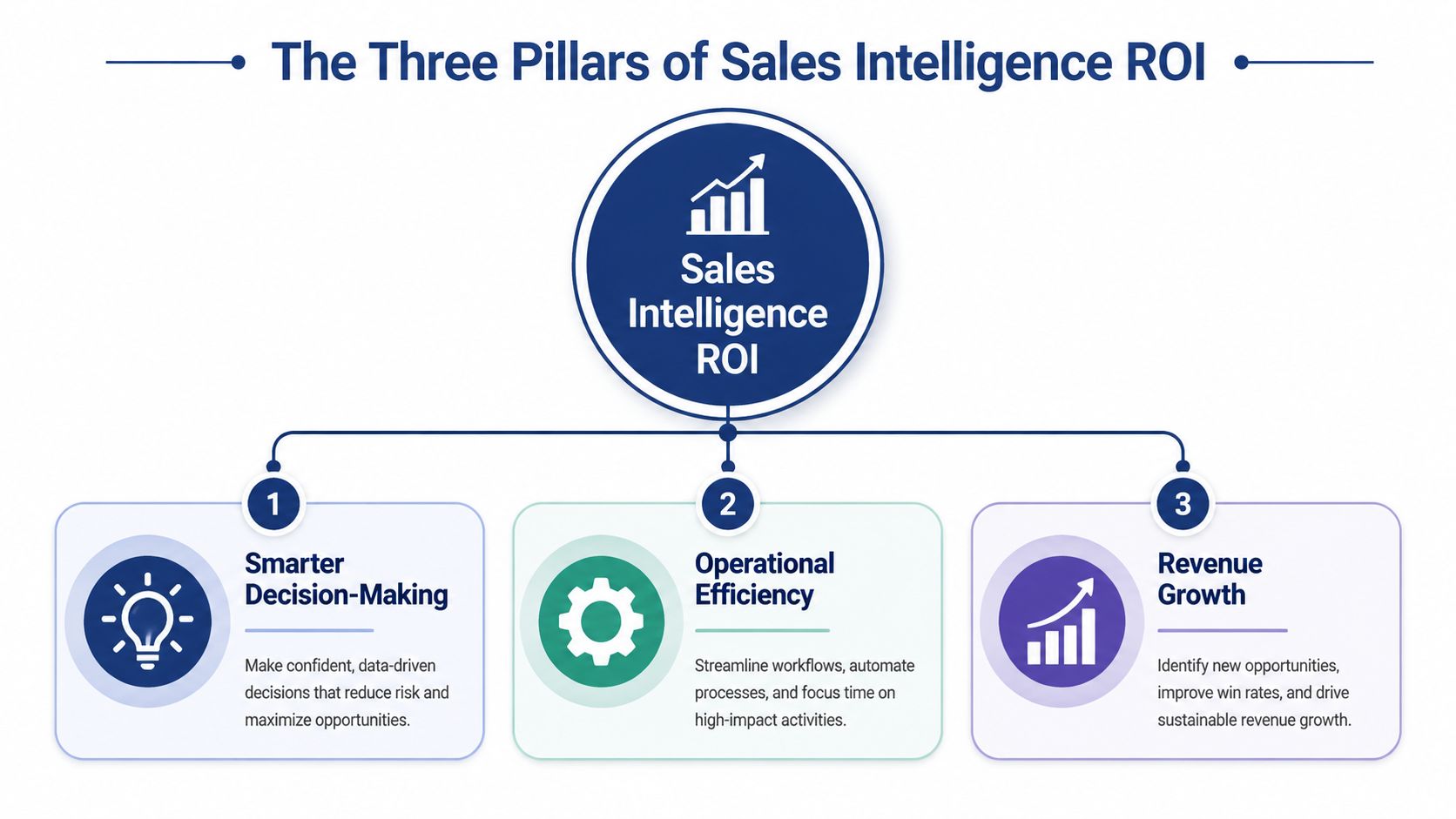
Sales intelligence ROI stands or falls on three measurable value drivers. If your business case only shows labor savings, it is too weak to survive finance review.
Many leaders mistakenly justify the tool on labor savings alone. That misses how the category creates revenue. The complete model has three layers: time savings, pipeline velocity, and deal quality. Together, those drivers show how sales intelligence changes rep capacity, buying-cycle timing, and opportunity conversion.
Smarter faster reps
The first pillar is operational efficiency. Reps spend less time assembling account context and more time acting on it.
That gain matters because sales productivity is won in the hours between account selection and first conversation. If a rep can start with firmographic data, buying signals, contact details, and recent company changes inside the tools they already use, prep time drops and activity quality becomes more consistent. That is the first economic benefit to model because it is visible fast and easy to audit.
Tools such as Apollo, ZoomInfo, Cognism, Clay, and workflow-focused platforms like Salesmotion reduce the manual work required to build account context and surface signals inside CRM or engagement workflows.
A practical example makes the point. A rep who previously researched every account from scratch can begin with a usable brief, a current trigger, and a shortlist of relevant contacts. The immediate output is more selling time. The more important output is standardized execution across the team.
For a broader category primer, this explanation of what sales intelligence means in practice is useful if your leadership team still treats these tools as glorified contact databases.
Bigger better pipeline
The second pillar is pipeline velocity. Better intelligence improves who reps contact, when they contact them, and how quickly they respond to change.
Speed matters here. A rep who sees a funding round, executive hire, product launch, or hiring surge early can prioritize accounts while the problem is active and budget is easier to tie to urgency. A rep who works from stale data shows up late, sends generic outreach, and burns sequence volume on accounts that are not in motion.
Crunchbase makes this point well in its sales intelligence guide, which emphasizes signal freshness and action speed over static list building. That is the right framing for CROs. The question is not whether the database is large. The question is whether your team can act on current signals before the window closes.
Fresh signals only matter when they change rep behavior the same day.
This pillar is where a simple cost-savings story becomes a revenue story. Faster identification of in-market accounts increases meeting quality, speeds first meaningful touch, and pushes qualified pipeline into the funnel earlier.
Higher quality deals
The third pillar is deal quality. This is the pillar that makes the investment defensible at the executive level because it connects intelligence to revenue outcomes, not just rep activity.
When reps engage accounts with a credible why-now, discovery starts with stronger context and qualification improves. The team enters fewer weak opportunities and more deals tied to active priorities. That changes the mix of pipeline, which is what leadership should care about most.
Focus your ROI case on three outcomes:
- Win rate
- Sales cycle efficiency
- Revenue per rep
Real-time, workflow-embedded intelligence is better than static databases for one reason. It increases the odds that reps act on relevant signals before those signals go stale. That is why the strongest ROI model does not stop at hours saved. It shows how saved time creates faster pipeline movement, and how better timing improves the quality of deals that enter the funnel.

“Salesmotion empowers me to cultivate a great buyer experience. I'm able to challenge prospects' thinking and be a trusted consultative seller. A major part of this is Salesmotion insights.”
Austin Friesen
Account Executive, FY25 #1 President's Club, Clari
Building Your ROI Model A Step by Step Guide
A weak ROI model gets a sales tool rejected. A disciplined model gets budget approved because it ties the purchase to capacity, pipeline movement, and revenue quality in terms finance can verify.
Build the case in three layers from day one. Start with time savings because it is easiest to audit. Then quantify pipeline velocity. Then add deal quality improvements. That sequence gives you a model that survives CFO review and still reflects how sales intelligence creates value in the field.
Start with inputs finance already trusts
Use inputs your company already has in payroll, CRM, and vendor pricing. Keep the first version tight.
| Category | Variable | Example Value | Your Value |
|---|---|---|---|
| Team | Number of reps | 50 | |
| Productivity | Hours spent on research | 2 hours per account before, 30 minutes after | |
| Cost | Loaded cost per hour | $72 | |
| Investment | Tool cost per month | enter your vendor quote |
That table does two jobs. It gives finance a clean audit trail, and it keeps the discussion anchored in operating economics instead of vendor promises.
After you size the labor impact, model downstream revenue impact with a pipeline velocity calculator for sales teams. Use it to connect faster research and faster account action to pipeline created, pipeline advanced, and revenue timing.
Layer one. Quantify recovered selling capacity
Start with the simplest formula in the model:
Annual time savings in dollars = hours saved per account × accounts worked per rep × loaded hourly cost × number of reps
Using the example above:
- Research time drops from 2 hours to 30 minutes per account
- Time saved equals 1.5 hours per account
- Each rep works 50 accounts
- Loaded cost equals $72 per hour
- Team size equals 50 reps
That produces $270,000 in annual research time savings.
Use this number carefully. It is a capacity value, not a cash rebate. The point is that you now have a hard baseline for how much selling time the team gets back before you assign any credit for better conversion or faster deal movement.
Layer two. Add pipeline velocity
Often, business cases fall short on depth. Hours saved matter, but leadership buys revenue impact.
Model the effect of speed on the funnel with a few measurable inputs:
- increase in first-touch speed after a trigger
- increase in meetings booked in priority accounts
- increase in meeting-to-opportunity conversion
- reduction in days between stage changes for intelligence-assisted deals
Keep the math simple. Estimate how many additional qualified opportunities the team can create each quarter from faster action on the right accounts. Then multiply that by your current average pipeline value per opportunity. If your CRM already tracks stage duration, calculate how many days the tool could remove from the sales cycle for accounts where reps acted on live signals instead of stale lists.
Layer three. Add deal quality
Deal quality is the part of the model that turns a productivity purchase into a revenue case.
Use three outcome metrics:
- Win rate
- Average deal size
- Revenue per rep
Do not spread assumptions across the whole funnel. Apply them only to the segment where the tool is expected to change behavior, such as signal-driven outbound, named accounts, or late-stage account research. That keeps the model credible and prevents inflated ROI.
Calculate break-even and ROI multiple
Once all three layers are in place, calculate the investment case in the order finance expects:
- Annualize recovered capacity
- Estimate added pipeline from faster execution
- Estimate revenue impact from better deal selection and qualification
- Total the expected value
- Subtract annual software cost
- Divide net return by total investment to get ROI
- Estimate break-even month based on monthly realized value
A common mistake is waiting for closed-won attribution before calling the rollout successful. That delays decisions and understates early value. Track break-even first through regained capacity and early funnel movement. Add closed-won impact as the evidence matures.
Keep assumptions conservative
Conservative models close deals internally. Aggressive models create skepticism.
Set a low adoption rate for the first quarter. Discount the share of saved time that gets redirected into customer-facing work. Limit pipeline and revenue lift assumptions to the opportunities where reps actively used the tool. If the case still works under those constraints, you have a business case leadership can defend in procurement, budget review, and board reporting.
That is the standard. Build an ROI model that stands up even when finance pushes on every assumption.
Expect the audience for that model to be senior. A sales leader at a software firm told us: "I am seeing decisions now that are elevating far beyond. ... Certain executive to include not only the cfo, CEO, but a lot of times the board of directors."
Measuring Lift and Attributing Success
If you cannot prove lift, you do not have ROI. You have a software bill.
Finance is right to push here. Many sales tech business cases fail at attribution because teams buy the tool, celebrate adoption, and only later decide how they will measure impact. Fix that before launch.
Establish the baseline before launch
Start with a tight measurement plan tied to revenue outcomes leadership already trusts. Do not flood the dashboard with activity metrics that look busy and explain nothing.
Track a short list of baseline measures such as:
- Revenue per rep
- Win rate
- Pipeline velocity
- Meeting-to-opportunity conversion
- Time to first action after a trigger
- Meeting rate in prioritized accounts
Focus the model on pipeline efficiency and rep productivity. Feature clicks matter only if they show up in commercial results.
Compare cohorts, then inspect the deal level
Anecdotes are useful for training. They are weak evidence for budget approval.
Use cohorts based on actual usage. Compare high-adoption reps against low-adoption reps over the same period. Then compare assisted opportunities against similar baseline opportunities. That gives you two views of impact: whether behavior changed at the rep level, and whether outcomes changed at the deal level.
Do not claim causation from one good quarter. Control what you can. Keep territories, segments, and selling motion as consistent as possible. If enterprise AEs use the tool in named accounts, compare them against enterprise AEs in the same motion, not SMB reps running high-volume outbound.
Present controlled comparisons with clear usage criteria. That is what makes the attribution story credible.
What good attribution looks like
A defensible plan usually includes three cuts of the data:
| View | What to compare | Why it matters |
|---|---|---|
| Rep view | high adopters vs low adopters | shows whether consistent usage maps to stronger output |
| Deal view | assisted deals vs baseline deals | isolates impact at the opportunity level |
| Account view | prioritized accounts vs non-prioritized accounts | shows whether signal-based focus improves conversion quality |
This does not require a data science project. It requires operating discipline.
Set the rules before rollout:
- define what counts as an assisted deal
- lock the baseline period
- review usage weekly
- report commercial outcomes monthly
- keep rep notes on why the tool was used in specific opportunities
That last point matters more than teams expect. Qualitative context helps you separate real lift from timing, territory mix, or a single large account that would have progressed anyway.
A good attribution model connects directly to the three value drivers in your ROI case. Time savings should show up in faster first actions and more selling capacity. Pipeline velocity should show up in stage progression and conversion speed. Deal quality should show up in better qualification, cleaner opportunity selection, and stronger win rates inside the accounts you chose to pursue. That is how you defend the investment with evidence finance can use.

“We have very limited bandwidth, but Salesmotion was up and running in days. The template made it easy to load our accounts and embedding it in Salesforce was simple. It was one of the easiest rollouts we've done.”
Andrew Giordano
VP of Global Commercial Operations, Analytic Partners
Real World Impact and Time to Value
Sales intelligence pays back only when it changes rep behavior fast enough to show up in pipeline. That is the standard. Feature adoption alone is not a business case.
The strongest field examples all follow the same path. A rep gets a relevant trigger, understands why the account deserves attention now, reaches out with context, and creates a better conversation earlier in the cycle. That is how these tools produce revenue. They improve how time is spent, how quickly accounts move, and which deals get pursued in the first place.
What impact looks like in practice
Start with opportunity creation. Signal-based outreach can surface a large deal that generic prospecting would have missed because the rep entered with a clear point of view tied to a real business event — in one customer example we've seen, AI-prepared research contributed to a more than $1M opportunity.
Prioritization is the second pattern to watch. Teams that focus coverage on accounts showing active buying signals and clear reasons to engage now usually produce cleaner pipeline than teams spreading effort evenly. Customer examples point to meaningful lifts in qualified opportunities and total opportunity volume. Treat those as directional examples, not market benchmarks.
The third pattern is less flashy and often more valuable. Reps stop spending hours on stale accounts. They spend that time on accounts with visible change, current pain, or clear expansion signals. That shift improves meeting quality before it improves dashboards.
Good sales intelligence gives reps a stronger reason to start the conversation and a better basis for deciding which conversations are worth having.
Time to value follows the rollout
For many teams, early proof should be visible inside the first quarter if implementation is handled with discipline. You do not need to wait for annual renewal data to know whether the investment is working.
A practical timeline looks like this:
- First 30 days: confirm adoption inside daily workflow, measure research time saved, and track time to first action on prioritized accounts
- Days 30 to 90: look for lift in meeting creation, opportunity creation, and account engagement in the segments using the tool consistently
- After 90 days: review deal progression, qualification quality, and whether assisted opportunities are converting better than your baseline
This is why a three-driver ROI model matters. Time savings should appear first. Pipeline velocity should follow. Deal quality usually takes longer, but it is what makes the case durable with finance and the board.
If you need to package that early evidence for executives, use a clear executive summary format for ROI reporting instead of burying it in usage screenshots.
What slows ROI down
The delays usually come from operating choices, not the software itself.
Common failure points:
- Weak workflow fit, where reps have to leave core systems to find and use the intelligence
- Loose manager inspection, where usage is optional and coaching never changes
- No action rules, where signals arrive but nobody knows which accounts deserve immediate follow-up
- No baseline period, which turns every later ROI discussion into an argument about assumptions
Fix those four issues before rollout. Time to value usually depends on rollout quality, manager discipline, and measurement design. Teams that get those right see results faster and defend the spend with less effort later.
I say this as someone who sells software: tools alone are not going to do the trick. It is always people, process, technology. I have seen it many times: shelfware in big companies, people not logging in, then the churn discussion a year later.
A Simple Plan for Reporting ROI to Leadership
Leadership doesn't want a dense deck full of screenshots, activity metrics, and feature usage charts. They want a short narrative with numbers that connect investment to business impact.
That means your reporting should fit on one page.
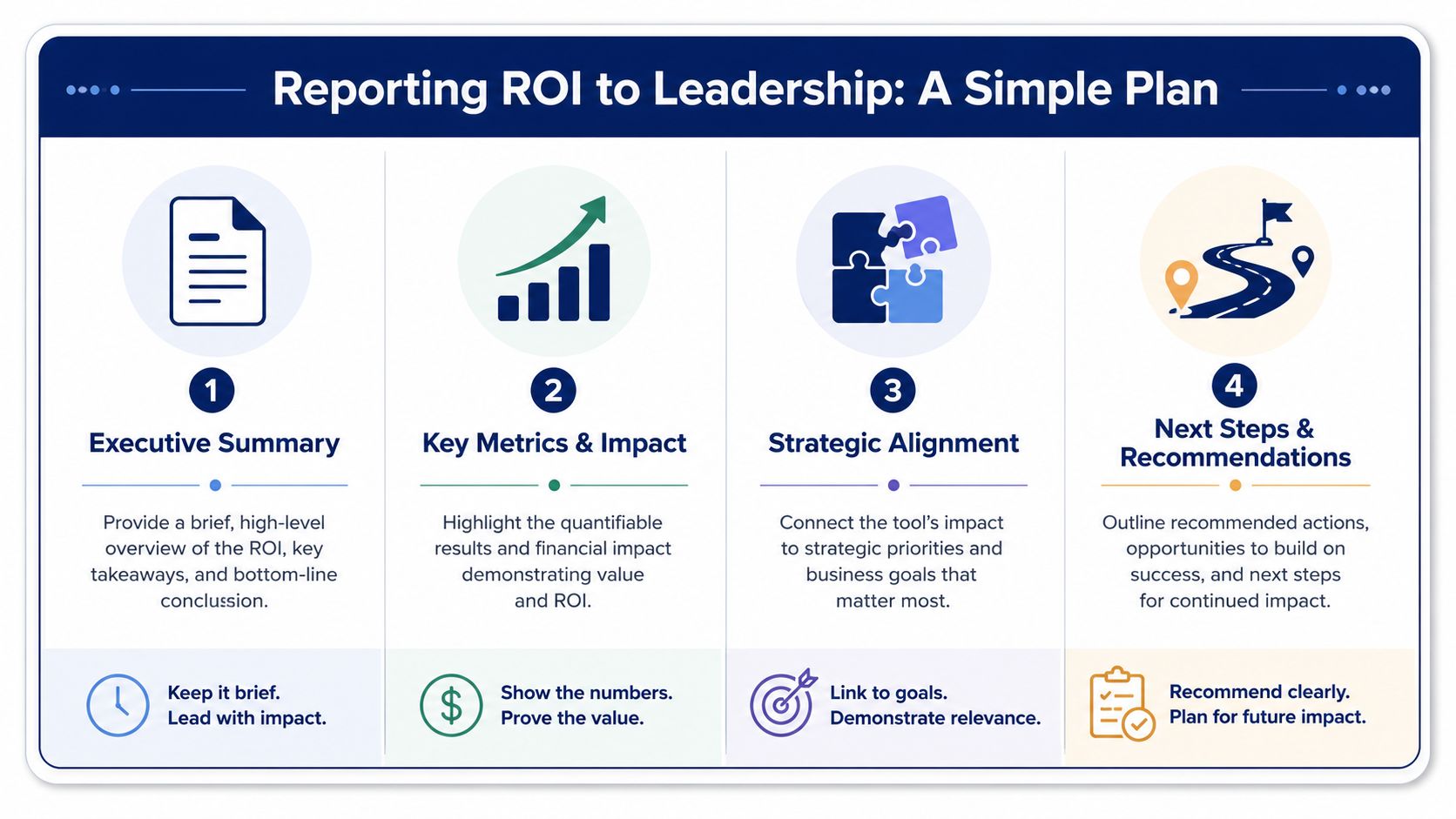
Use a simple executive structure
Build your update around four blocks:
- Investment
- Operational return
- Commercial impact
- Recommendation
That's it. Keep the structure predictable. Executives reward clarity.
What goes on the page
Your one-page summary should include:
-
Investment summary
Annual contract value, implementation cost if relevant, and the team covered. -
Operational metrics
Time saved on research, faster time to first action, and rep adoption by manager or segment. -
Pipeline metrics
Meeting rate in prioritized accounts, opportunity creation from signal-based outreach, and pipeline velocity movement. -
Revenue metrics
AI-assisted deal performance versus baseline, revenue per rep, and any movement in win rate or cycle efficiency.
If you need help tightening the top section, this guide on writing a clear executive summary is a practical template.
The narrative to use
Your summary should sound like this:
We invested in a sales intelligence workflow to reduce manual research and improve account prioritization. The operational return showed up first through rep time savings and faster action on live signals. That translated into better pipeline efficiency, and the strongest results came from reps and deals where usage was consistent.
Short. Specific. Easy to defend.
Then make a recommendation:
- expand licenses
- hold current scope
- improve manager inspection
- replace low-adoption workflows
- reallocate budget if the signal quality is poor
A good ROI report doesn't just justify past spend. It tells leadership what decision to make next.
If you're evaluating platforms and need a practical way to connect account research, live signals, and rep workflows to measurable pipeline outcomes, Salesmotion is one option to review. It uses AI agents to track account changes, generate structured research, and turn signals into outreach actions inside existing sales workflows, which fits the operating model this ROI framework is built around.
Two Questions Buyers Always Ask Late
Two things reliably surface at the end of an evaluation, usually from finance rather than sales. Getting them into the model early avoids a stall at approval.
What does year two cost? Introductory or first-year pricing is common, and a business case built on it overstates the return from year two onward. Ask every vendor for the ongoing rate in writing alongside the first-year rate, and build the model on the ongoing number. If the two differ substantially, model both.
What does it cost at the next tier? If pricing scales with tracked accounts rather than seats, the relevant question is not the price today but the price at the account volume you expect in twelve months. Ask for the rate at several tiers, for example 1,000, 2,000, 5,000 and 10,000 accounts, so you can see the shape of the curve rather than one point on it. Buyers who ask this early avoid discovering a cliff after rollout.
A business case that answers both, at the volume you will actually reach, survives procurement review considerably better than one built on a promotional rate and current usage.
For how the underlying pricing models differ, see per-seat vs account-based pricing.