Your buyer is not sitting around waiting for your pitch. They are buried in 200 unread emails, three Slack channels on fire, and a calendar with no white space until next Thursday. SNAP selling is the framework built for exactly that buyer: the frazzled, time-crunched, decision-fatigued professional who will tune you out the moment you make their life harder. If your outreach assumes the buyer has time and attention to spare, SNAP selling explains why it keeps getting ignored.
TL;DR: SNAP selling is a framework from Jill Konrath, author of SNAP Selling, designed for selling to overwhelmed, time-strapped buyers. SNAP stands for four rules: keep it Simple, be iNvaluable, always Align, and raise Priorities. Konrath argues that buyers make three sequential decisions, allow access, move away from the status quo, and change resources, and that your job is to make each one as easy as possible. Reps who reduce complexity and tie their pitch to the buyer's top priority win the limited attention they get.
What Is SNAP Selling?
SNAP selling is a sales methodology built around the reality that modern buyers are overwhelmed and have almost no time. It was created by Jill Konrath in her 2010 book SNAP Selling, which argued that the biggest obstacle in B2B sales is no longer the competitor, it is the buyer's own crazy-busy state. The seller who reduces friction and respects the buyer's time wins.
SNAP is an acronym for four rules that govern every interaction:
- Simple — reduce complexity at every step; make it effortless to engage and decide.
- iNvaluable — become a resource the buyer cannot get elsewhere, not an interchangeable vendor.
- Align — stay relevant to the buyer's actual goals, values, and needs.
- Priorities — connect everything you do to what matters most to the buyer right now.
The core insight is that overwhelmed buyers protect their time by defaulting to "no" or "not now". Every additional click, decision, or ounce of complexity you introduce pushes them further toward that default. Like every effective sales methodology, SNAP gives reps a repeatable way to do the opposite: remove friction until saying yes is easier than saying no.
This framing is more relevant in 2026 than when the book was published. According to Gartner, B2B buyers spend only about 17% of their purchase journey meeting with potential suppliers, and 77% describe their last purchase as complex or difficult. The buyer is not just busy, they are actively struggling with the decision. SNAP selling is the framework for meeting them there.
See Salesmotion on a real account
Book a 15-minute demo and see how your team saves hours on account research.
The Four SNAP Rules, Explained
SNAP's four rules are not a sequence you run once, they are filters you apply to every email, call, and meeting. Run each interaction through all four before it reaches the buyer.
Here is the framework as a single reference:
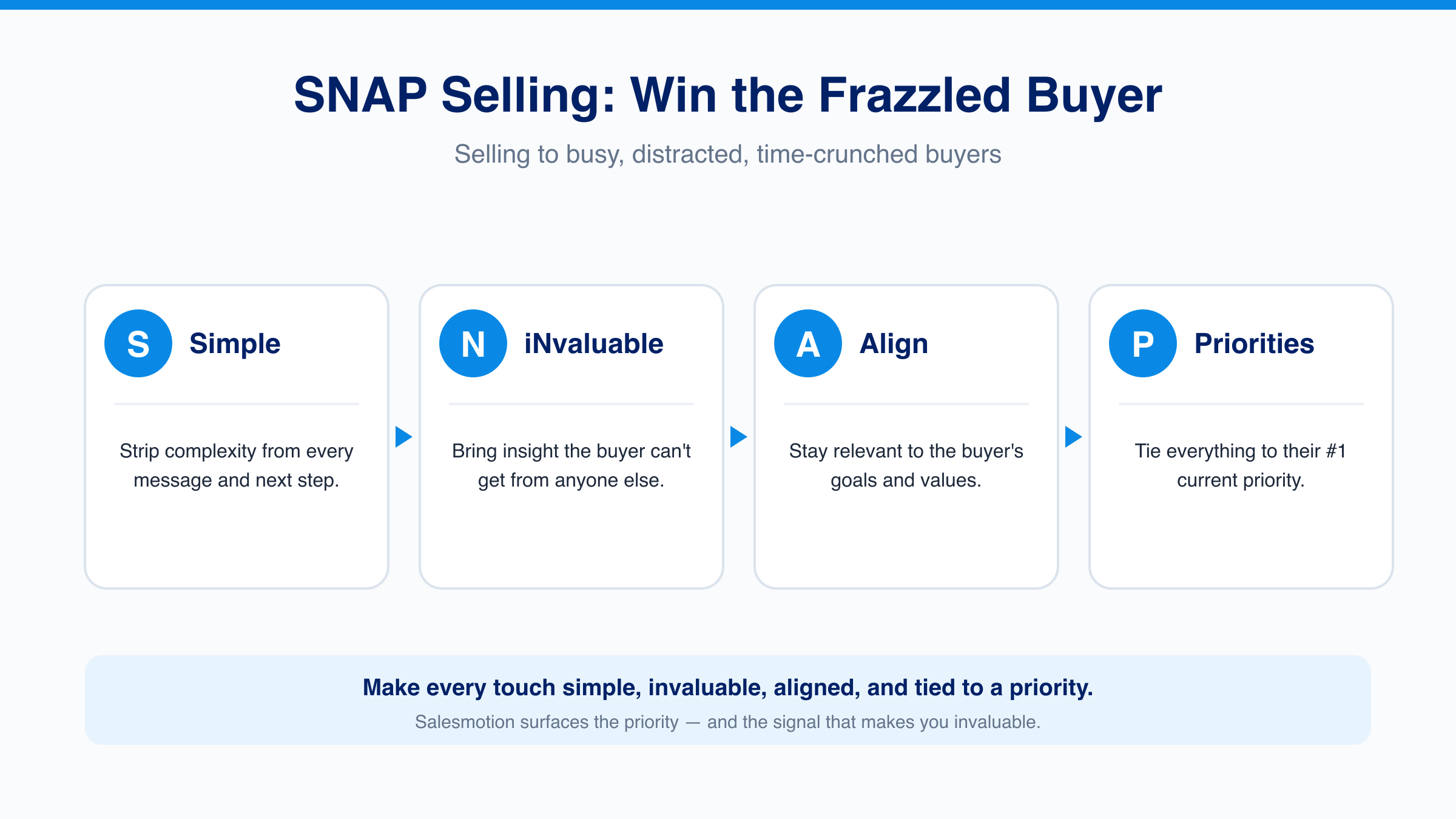 Run every email, call, and meeting through all four SNAP rules before it reaches a busy buyer.
The table below shows each rule and what it eliminates:
| Letter | Rule | What it means in practice | What it kills |
|---|---|---|---|
| S | Simple | Strip complexity from every message and next step | Long emails, multi-option asks, jargon |
| N | iNvaluable | Bring insight the buyer cannot get from anyone else | Interchangeable "checking in" outreach |
| A | Align | Stay relevant to the buyer's goals and values | Pitches about your product, not their world |
| P | Priorities | Tie everything to the buyer's top current priority | Talking about a problem they have deprioritized |
SNAP selling runs every interaction through four filters: is it simple, invaluable, aligned, and tied to a top priority? If not, the overwhelmed buyer ignores it.
Simple is the rule reps break most often. A frazzled buyer will not parse a 300-word email with three asks. Simplicity means one clear point, one easy next step, and zero cognitive load. The test: could the buyer act on this in 30 seconds without re-reading it?
iNvaluable is what earns you a place on the buyer's calendar. If your outreach could have come from any of the ten vendors in your category, it gets deleted. Being invaluable means you bring a specific insight about the buyer's business, an industry shift they should know about, or a relevant pattern from similar companies. You become a resource, not a pitch.
Align means every interaction maps to the buyer's goals, values, and needs, not your sales process. A buyer focused on cutting costs does not want to hear about your premium feature set. Alignment is the difference between "here's what we do" and "here's how this connects to what you're trying to achieve".
Priorities is the trump card. Overwhelmed buyers triage ruthlessly, and they only engage with what touches their top priority right now. If you can connect your solution to the one initiative the buyer's leadership is watching this quarter, you jump the queue. If you connect it to a problem they have parked, you wait in line forever.

“The moment we turned on Salesmotion, it became essential. No more hours on LinkedIn or Google to figure out who we're talking to. It's just there, served up to you, so it's always 'go time.'”
Adam Wainwright
Head of Revenue, Cacheflow
The Three Decisions Every Buyer Makes
SNAP selling maps the sale to three sequential decisions the buyer makes, and your job is to make each one easy. You do not get to the third decision until you have won the first two. Most reps lose the deal at decision one without realizing it.
| Decision | What the buyer decides | How to win it |
|---|---|---|
| 1. Allow access | "Is this person worth my limited time?" | Be invaluable and relevant from the first touch |
| 2. Move away from status quo | "Is my current situation bad enough to change?" | Make the cost of doing nothing concrete and tied to a priority |
| 3. Change resources | "Is this specific solution worth reallocating budget and effort?" | Reduce risk and complexity; align to the priority decision |
Konrath's three decisions are sequential: a buyer who has not decided to grant access will never seriously evaluate whether to change resources.
Decision 1: Allow access. Before a buyer engages, they make a snap judgment about whether you are worth their time. This is where simple and invaluable do the heavy lifting. Generic outreach fails here, full stop. A demo booked at this stage with curious juniors instead of the real buyer is a sign you won a low-value version of decision one, not the real thing.
Decision 2: Move away from the status quo. Even an interested buyer will not change unless staying put feels worse than moving. This is where you make the cost of inaction concrete and tie it to a priority. The status quo is your real competitor, not the other vendor.
Decision 3: Change resources. Only now does the buyer evaluate your specific solution against the budget, time, and political capital it would take to adopt it. Reduce the perceived risk and complexity here, or a buyer who agrees they have a problem still does nothing.
This maps closely to how value-based selling frames the buyer's journey: access, then dissatisfaction with the status quo, then commitment to a specific path. The discipline is recognizing which decision the buyer is actually on, and not pitching decision three to someone still stuck on decision one.
How to Apply SNAP Selling in 2026
Applying SNAP in 2026 means engineering every touchpoint for an overwhelmed buyer who has even less attention than they did when the book came out. The principles hold; the execution has to be sharper, because the noise is louder.
Lead every outreach with a priority, not a product. The fastest way to win decision one is to reference the buyer's top current priority in the first line. "Saw your earnings call flagged a go-to-market efficiency push" beats "I wanted to introduce our platform" every time. The first is invaluable and aligned. The second is noise.
Make the next step a single click. Simple is not a tone, it is a structure. One ask per message. One link. One clear reason to respond. If your email forces the buyer to make more than one decision, you have already lost some of them.
Be invaluable before you ask for anything. Send the relevant insight first. A pattern from a similar company, a shift in their market, a specific observation about their business. Earn the right to ask for time by giving value before you take any.
Tie the cost of inaction to a priority, not a generic pain. To win decision two, the status quo has to feel expensive in terms the buyer's leadership cares about right now. Generic "you could be more efficient" does not move a frazzled buyer. "This is the bottleneck on the initiative your CEO named on the earnings call" does.
There is a pattern we see across sales teams that confirms Konrath's thesis. Wins rarely trace back to outbound volume. They trace back to a compelling trigger event, an executive sponsor, or a warm referral, exactly the things that let a rep be invaluable and aligned from the first touch. Buyers are drowning in data but starving for action; they want fewer tools and one clear next step. The rep who delivers that wins the access decision while everyone else is still getting deleted. Our guide to signal-based outreach goes deeper on anchoring that first touch to a real trigger.
“Automatic account profile detail I can use to manage my territory. Using Salesmotion AI to generate value statements per persona, account, etc. Using Salesmotion to give me a starting point based on new hires, or news alerts is critical.”
Adam Wainwright
Head of Revenue, Cacheflow
Common SNAP Selling Mistakes
Even teams that adopt SNAP fall into predictable traps, almost all of which boil down to making the buyer's life harder instead of easier.
Confusing "simple" with "short". A short email that is vague or irrelevant is not simple, it is just brief noise. Simple means low cognitive load and an obvious next step, which sometimes takes a few more words, not fewer.
Being invaluable about the wrong thing. Bringing insight the buyer does not care about is not invaluable, it is showing off. The insight has to connect to their priority, or it is just more data on top of the pile they are already drowning in.
Pitching the solution before winning access. Jumping to decision three, change resources, when the buyer is still on decision one, allow access, is the most common and fatal mistake. You cannot sell the solution to someone who has not yet decided you are worth their time.
Aligning to a deprioritized problem. A real but parked problem will not move an overwhelmed buyer. If the pain you are addressing is not on their current priority list, no amount of simplicity or insight will get them to act.
Treating SNAP as a script instead of a filter. SNAP is not a sequence of steps, it is four questions you ask of every interaction. Reps who memorize it as a pitch flow miss the point: the buyer's priorities change, and so must your alignment.
Why SNAP Selling Breaks at Scale
SNAP is intuitive for a great rep on a handful of accounts and nearly impossible to execute consistently across a whole team, because being invaluable, aligned, and tied to the buyer's top priority all require knowing the buyer's current situation in detail. That knowledge is the bottleneck.
To be invaluable, you need a specific, current insight about the buyer's business, which means knowing their initiatives, their leadership changes, and their market pressures. To align, you need to know the buyer's actual goals this quarter, not last quarter. To raise the right priority, you need to know what the buyer's leadership is focused on right now, which lives in earnings commentary, strategic announcements, and hiring patterns outside the CRM. And to win the access decision, you need a trigger event that makes your first touch relevant.
Most reps gather none of this before reaching out. They send the same template to 200 accounts, and the overwhelmed buyer deletes all 200, because nothing in the message is simple, invaluable, aligned, or tied to a priority. The framework is sound; the manual research it requires does not scale. Worse, what you know goes stale fast: the priority a buyer had in January is replaced by March, so even a well-researched touch decays.
This is the pattern across sales teams that struggle with SNAP: it is not that reps do not understand the four rules. It is that they cannot personalize at volume. Doing the research to be genuinely invaluable for one account takes an hour. For a 200-account territory, it is impossible by hand. The spreadsheet approach works for 10 accounts. It collapses at 50.
How Salesmotion Operationalizes SNAP Selling
SNAP needs three things to work at scale: relevance (what is the buyer's situation), priority (what do they care about right now), and timing (when did your touch become relevant). This is where signal-based selling turns SNAP from a skill into a workflow that runs across an entire territory at once.
Salesmotion continuously monitors buying signals across 1,000+ public and private sources: leadership changes, earnings commentary, hiring patterns, funding, product launches, and competitive moves. Each signal is the raw material for a SNAP-compliant touch. Earnings commentary reveals the buyer's current priority. A leadership change is the trigger that wins the access decision. The assembled brief is what lets a rep be invaluable from the first line instead of generic.
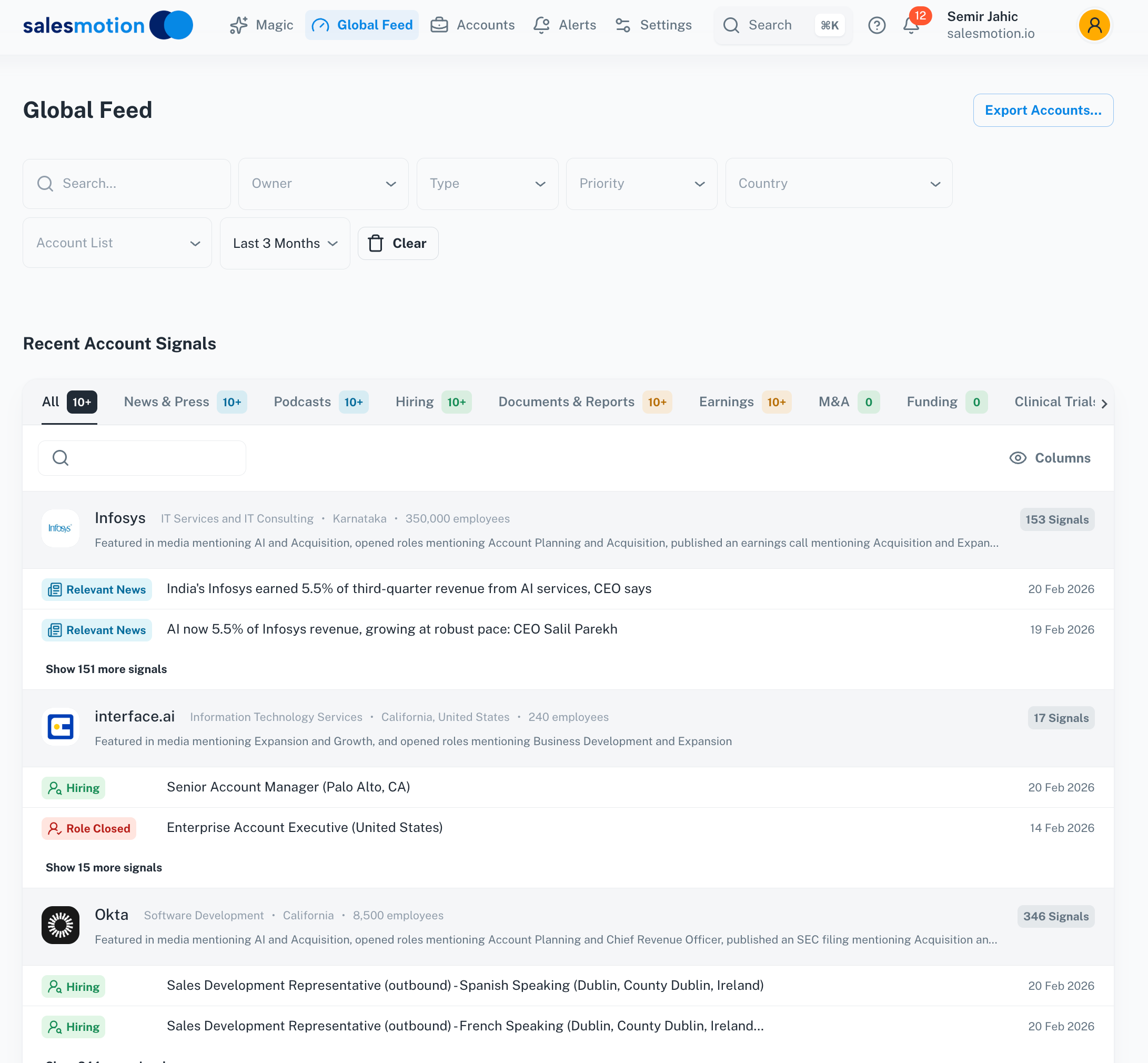 A live signal feed surfaces the trigger events and priorities that make a SNAP touch relevant, so reps win the access decision instead of getting deleted.
Here is the workflow in practice:
- Trigger. A target account's earnings call flags a "go-to-market efficiency initiative" as a top priority, and the company posts a RevOps leadership role.
- Platform action. The platform flags the account and assembles the brief: the stated priority, the leadership change, and the metrics the company is under pressure to move.
- Rep action. The rep sends a simple, invaluable, aligned first touch that opens with the buyer's actual priority, then drafts the message anchored to the real signal rather than a generic template.
- Outcome. Instead of being deleted as noise, the touch wins the access decision because it is relevant from the first line. The rep moves the buyer toward decision two with the cost of inaction already tied to a priority.
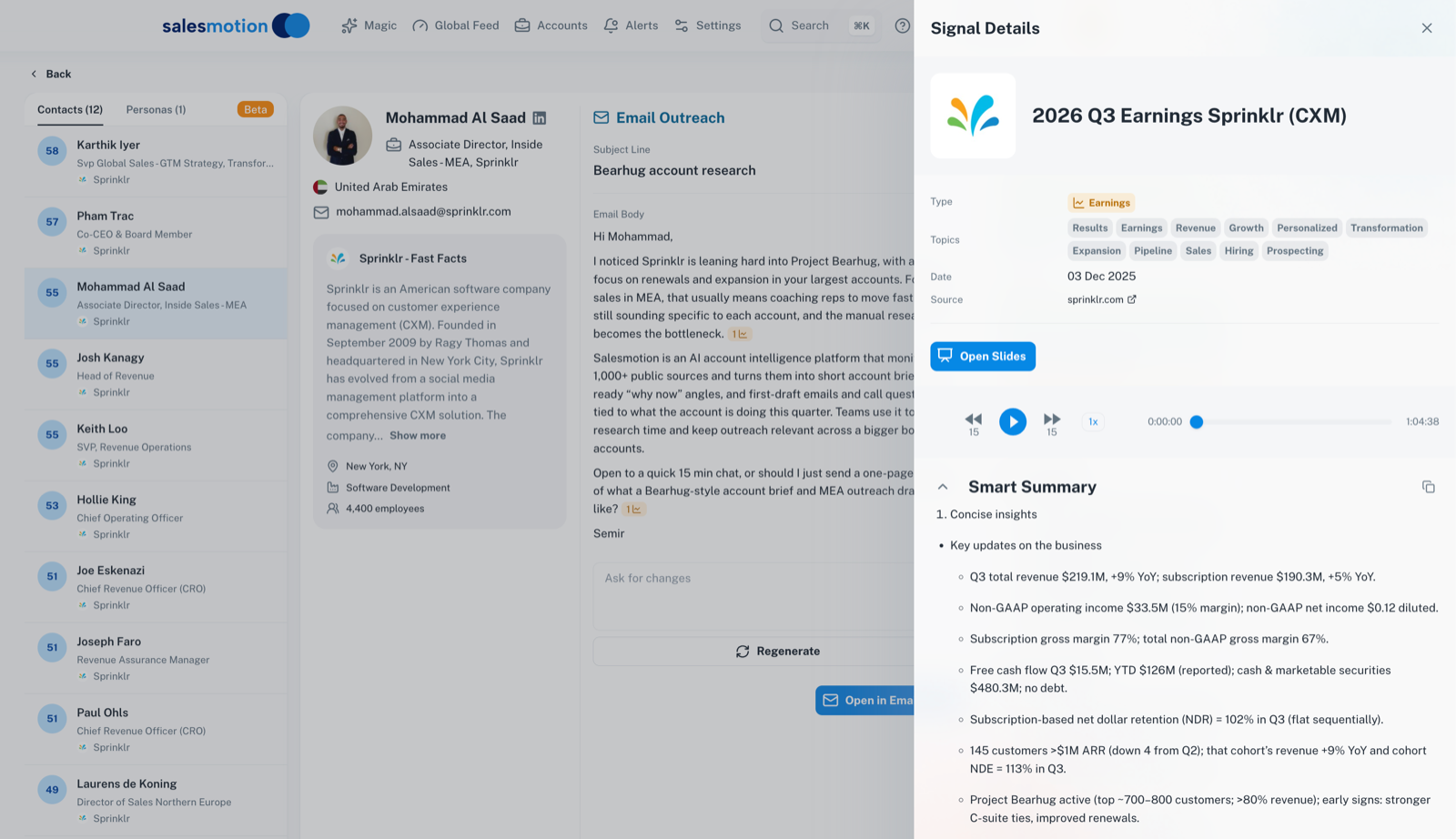 Outreach anchored to a real trigger event and the buyer's top priority is what makes a SNAP touch invaluable instead of interchangeable.
The lever that wins these deals is exactly the one SNAP is built around: tying the first touch to a timely trigger event and the specific priority it affects. Teams that operationalize this report the difference in hard numbers. A CPQ startup cut meeting prep from 90 minutes to 30 and tripled its average deal size, because every touch was relevant and timely instead of generic. That is SNAP at scale: simple, invaluable, aligned outreach powered by live signals, not by reps burning hours on manual research. See how it works on a real account.
Key Takeaways
- SNAP selling is built for overwhelmed, time-crunched buyers. The four rules are Simple, iNvaluable, Align, and Priorities, applied as filters to every interaction.
- Buyers make three sequential decisions: allow access, move away from the status quo, and change resources. You must win each one in order, and most reps lose at decision one.
- "Simple" means low cognitive load and one clear next step, not just a short message. The buyer should be able to act in 30 seconds without re-reading.
- Tying your outreach to the buyer's top current priority is the trump card. It wins the access decision while generic, deprioritized pitches get deleted.
- The most common mistake is pitching the solution (decision three) to a buyer who has not yet decided you are worth their time (decision one).
- SNAP breaks at scale because being invaluable, aligned, and priority-relevant for a whole territory requires fresh, account-specific intelligence. Signal-based account research makes that personalization possible at volume.
Frequently Asked Questions
What does SNAP stand for in SNAP selling?
SNAP stands for Simple, iNvaluable, Align, and Priorities. It is a sales methodology created by Jill Konrath for selling to overwhelmed, time-strapped buyers. The four rules act as filters on every interaction: keep it simple to reduce the buyer's cognitive load, be invaluable so you cannot be ignored, align to the buyer's goals and values, and tie everything to their top current priority.
What are the three decisions in SNAP selling?
SNAP selling maps the sale to three sequential decisions the buyer makes. First, allow access: is this seller worth my limited time? Second, move away from the status quo: is my current situation bad enough to change? Third, change resources: is this specific solution worth reallocating budget and effort? You must win each decision before the buyer will consider the next, and most reps lose at the access decision by leading with a generic pitch.
How is SNAP selling different from other sales methodologies?
Most methodologies focus on the seller's process, such as qualification (BANT or NEAT) or discovery (SPIN selling). SNAP focuses on the buyer's mental state: overwhelmed, distracted, and protecting their time. Its central premise is that the biggest obstacle to a sale is the buyer's busyness, not a competitor, so the rep who reduces friction and stays relevant to the buyer's top priority wins. It complements qualification and discovery frameworks rather than replacing them.
Is SNAP selling still relevant in 2026?
More than ever. Buyers today face more noise, more tools, and more decision fatigue than when Konrath wrote the book. Gartner reports that the majority of B2B buyers describe their last purchase as complex or difficult, and they spend only a small fraction of their journey with any single vendor. SNAP's focus on simplicity, relevance, and the buyer's top priority maps directly to winning the limited attention an overwhelmed buyer can spare.
How do you make outreach "invaluable" in SNAP selling?
Being invaluable means bringing a specific insight the buyer cannot get from anyone else, tied to their current priority. That could be a pattern from a similar company, a shift in their market, or an observation about their business based on a recent trigger event such as an earnings call or leadership change. The key is relevance: insight the buyer does not care about is just more noise. Anchoring the first touch to a real buying signal is how reps stay invaluable at scale.