Imagine you're selling boats. You could knock on every door in town, or you could wait for someone to search online for "buy a new boat." A sales trigger event is even better. It’s like seeing a company build a new dock on a lakefront property—an immediate, real-world signal that a specific need has just been born. It's an opportunity to provide a solution at the exact moment a problem appears.
What is a Trigger Event?

A sales trigger event is an observable change within a company that creates a timely and relevant reason to reach out. Think of it as a catalyst. This isn’t just random news; it’s a specific event that disrupts the status quo and opens a window of opportunity for your solution.
People often confuse trigger events with buying signals, but they are fundamentally different. A buying signal, like a prospect downloading a whitepaper, shows interest. A trigger event, such as a new executive hire or a major funding round, signals an urgent, strategic shift happening right now. For a deeper dive, check out our guide on what is a buying signal in sales.
Why Timing Is Everything
The real power of a trigger event lies in its timing. When a significant change occurs, companies must rethink their priorities, budgets, and existing tools. This creates a brief "window of dissatisfaction" with the current state before they commit to a new solution.
This concept, first introduced by Craig Elias, highlights a key psychological moment. Research shows that reaching a prospect within two weeks of a trigger event can boost your odds of winning the deal by 74% compared to cold outreach.
Your message arrives at the exact moment the prospect is most open to change. You aren't manufacturing a need; you're responding to one that has just emerged, positioning yourself as a timely problem-solver.
From News to Actionable Insights
Not all company news qualifies as a trigger event. The key is to filter out the noise and focus on events that directly point to a pain your product can solve.
Here’s how to translate common events into actionable sales intelligence:
- New C-Suite Hire: A new executive almost always arrives with a new budget, fresh ideas, and a mandate to make an impact within their first 90 days. This is a prime opportunity to introduce solutions that align with their vision for change.
- Major Funding Round: Fresh capital is earmarked for one thing: growth. This means scaling operations and investing in new technology to support that expansion.
- Company Expansion or New Office: A new location creates immediate needs for everything from IT infrastructure and logistics to local hiring and operational software.
- Product Launch: Rolling out a new product is a major strategic initiative. It often creates a need for new marketing, sales, and customer support tools to ensure a successful launch.
By monitoring for these specific moments, B2B sales teams can move beyond generic outreach. They can start conversations that solve real problems at the precise moment their prospects are looking for answers. This proactive, insight-driven approach is what separates good sales teams from great ones.
Knowing a trigger event creates an opportunity is one thing. Knowing exactly which events to watch for turns that theory into a robust pipeline.
Let's break down the seven most important types of sales triggers that top-performing reps monitor.
1. Growth Signals
Growth is the most exciting and visible category of triggers. When a company is scaling rapidly, it inevitably outgrows its old tools and processes. This creates an urgent need for new solutions to maintain momentum. These are positive, forward-looking triggers that signal ambition.
Keep an eye out for these signs:
- Hiring Surges: A company suddenly posts dozens of roles for a new department, like its first sales team. This signals a need for everything from a CRM and sales enablement tools to recruiting software.
- New Product Launches: Announcing a new enterprise-grade product means they’ll need robust support for marketing, customer success, and project management to ensure the launch is a success.
- Market or Office Expansion: Opening an office overseas creates immediate needs for localized HR platforms, global payment processors, and new IT infrastructure.
2. Financial Events
Money talks, and a major financial event is one of the loudest signals a company can send. These events directly impact a company’s ability and willingness to spend, creating clear windows of opportunity.
A new funding round is essentially a starting gun for investment. The company has a mandate from investors to spend that capital on growth, making it highly receptive to solutions that promise scale and efficiency.
For instance, a B2B SaaS company that just closed a $50 million Series C round is a prime target for an analytics platform that can help them demonstrate ROI to their new board. Similarly, a public company that exceeds earnings expectations might suddenly have the budget for projects that were previously on hold.
3. Leadership Changes
A new leader, especially in the C-suite, is one of the most powerful triggers you can find. New executives are hired to make an impact. They often bring their own preferred tools, strategies, and budgets, and their mandate is to drive change.
A new Chief Revenue Officer (CRO) at a tech firm will almost certainly re-evaluate the entire sales stack within their first 90 days. This is the perfect moment for a sales intelligence provider like Salesmotion to introduce a new way of working. Likewise, a new CFO tasked with cutting costs opens the door for efficiency-focused software.
4. Organizational Shifts
Mergers, acquisitions, and major restructurings create massive, and often messy, disruption. When two companies combine, you get an inevitable clash of technologies, processes, and cultures. This period of change is ripe with opportunity.
- Mergers & Acquisitions (M&A): A large bank acquires a smaller fintech. Now they must integrate different IT systems, compliance rules, and customer databases. This creates a clear need for integration platforms and specialized consulting.
- Internal Reorganizations: A company spins off a business unit or creates a new division. That new entity must build its operational infrastructure from the ground up, and they need to do it quickly.
This table maps different trigger types to the opportunities they create, helping you connect events to real-world sales plays.
Mapping Trigger Events to Sales Opportunities
| Trigger Event Type | Example | Implied Need or Pain Point | Potential Sales Opportunity |
|---|---|---|---|
| Growth Signals | Company posts 20+ new sales roles. | The old way of onboarding and managing reps won't scale. | Pitch CRM, sales enablement, or recruiting software. |
| Financial Events | A startup closes a $30M Series B. | Investors expect rapid growth and ROI. | Offer analytics, marketing automation, or efficiency tools. |
| Leadership Changes | A new Chief Marketing Officer is hired. | The new CMO needs to make an impact in the first 90 days. | Introduce new marketing tech or campaign strategies. |
| Org Shifts (M&A) | A large firm acquires a smaller competitor. | Disparate systems (IT, HR, CRM) need to be integrated. | Sell integration platforms or migration consulting services. |
| Market Pressures | A key competitor launches a disruptive new product. | Risk of losing market share and falling behind. | Position your solution as a way to innovate and compete. |
| Regulatory Updates | A new data privacy law is announced. | Existing systems are not compliant; risk of fines. | Offer compliance software or cybersecurity solutions. |
| Tech Stack Changes | A prospect drops a competitor's CRM. | They are actively in-market for a replacement solution. | Immediately outreach with a competitive displacement play. |
As you can see, each trigger is a direct signal of a problem or goal that you can align your solution with.
5. Competitive and Market Pressures
Sometimes the best trigger is an event that puts your target account on the defensive. Losing a major customer, facing a disruptive new competitor, or receiving negative press can create an urgent need to adapt and innovate.
Imagine a software company loses its largest enterprise client to a rival. That "threat scenario" creates an immediate need to double down on customer retention and product strategy. This opens the door for customer success platforms, market intelligence tools, or any solution that can help them strengthen their position.
6. Regulatory and Compliance Updates
For highly regulated industries like Financial Services or Life Sciences, new rules are a constant and powerful source of trigger events. A change in the law isn't optional—it's a deadline-driven mandate that forces companies to act.
When a new data privacy law like GDPR or CCPA is enacted, every company handling customer data in that region must update its technology and processes. This is a clear, time-sensitive opportunity for cybersecurity firms and compliance software providers to step in with a ready-made solution.
7. Technology Stack Changes
Finally, pay close attention to the tools your prospects are adding or dropping. This is one of the most direct signals you can get. A company dropping a competing CRM is a clear sign they are actively in-market for a replacement.
Likewise, seeing a company adopt a foundational platform like Salesforce often signals future opportunities for apps and integrations that plug into that ecosystem. We cover this topic in more detail in our article about the best signals for enterprise sales.
See Salesmotion in action
Take a self-guided interactive tour — no signup required.
How to Systematically Find and Prioritize Trigger Events
Knowing what a trigger event is gives you an edge. But building a repeatable system to find and act on them is what separates top-performing sales teams from everyone else. Relying on random, manual searches is inefficient and leads to missed opportunities. To do this at scale, you need a consistent workflow.
The most effective approach is a simple, three-part framework: Detect, Match, and Act. This process helps you cut through market noise and zero in on clear, actionable sales opportunities.
Detect The Signals
The first step, Detect, is about building your listening station. The goal is to tune into the right channels where triggers are most likely to appear. Since you can’t check every source manually, the key is knowing where the highest-value information lives for your specific industry.
Your detection system should pull from a few key channels:
- Public Financial Data: SEC filings (like 10-Ks and 8-Ks), earnings call transcripts, and investor presentations are goldmines. They reveal financial performance, strategic shifts, and risk factors directly from the source.
- Press Releases and Company News: Keep an eye on official company announcements for product launches, M&A activity, and new partnerships.
- Social and Professional Networks: LinkedIn is essential for tracking executive moves, key hires, and department-level hiring surges. A new leader announcing their "first 90 days" plan is a classic trigger.
- Industry Media: Trade publications are fantastic for news on competitive wins, project awards, and market trends that might signal an opportunity for your target accounts.
The main challenge here is the sheer volume of information. Sifting through these sources for every account is a massive time sink, which is why modern sales teams use specialized tools to do the heavy lifting.
Match Events to Your Solution
Once you’ve detected a potential trigger, the next step is to Match it to your value proposition. This is the crucial filtering stage where you ask, "So what?" Not every event is a real trigger for you.
A new funding round is just noise unless you can connect it directly to a problem your product solves. For example, a marketing agency that sees a company hire its first-ever VP of Marketing can immediately match that event to a need for brand strategy and campaign execution. For an industrial equipment supplier, that same trigger is irrelevant. This matching process turns raw data into true sales intelligence.
As your sales process matures, this workflow should be formalized. Research shows that 63% of best-in-class firms already use formal trigger event tools—like alerts and automated feeds—that follow a structured approach. As you can learn in this industry analysis, modern platforms use natural language processing to automatically detect and match events from unstructured text, removing much of the manual work.
Act and Prioritize Your Outreach
The final step is to Act. After you've detected an event and matched it to a relevant pain point, it’s time to prioritize your response. Speed is almost always your biggest advantage.
You can prioritize triggers based on three key criteria:
- Recency: How recently did the event happen? An executive hired last week is a much hotter opportunity than one from six months ago. That initial window of dissatisfaction closes quickly.
- Relevance: How closely does the trigger align with your core value proposition? A company announcing a "digital transformation" initiative is a perfect fit for an IT services firm. A strong account prioritization framework is invaluable here.
- Impact: How significant is the event? A $100 million funding round signals a much bigger potential for investment than a small seed round. A change in the C-suite implies more budget and strategic authority than a manager-level move.
By systematically applying the Detect-Match-Act framework, you create a powerful engine for generating timely, relevant pipeline. You stop chasing cold leads and start engaging prospects at the precise moment they need you.
This simple framework shows how to cut through market noise and turn it into clear sales action.
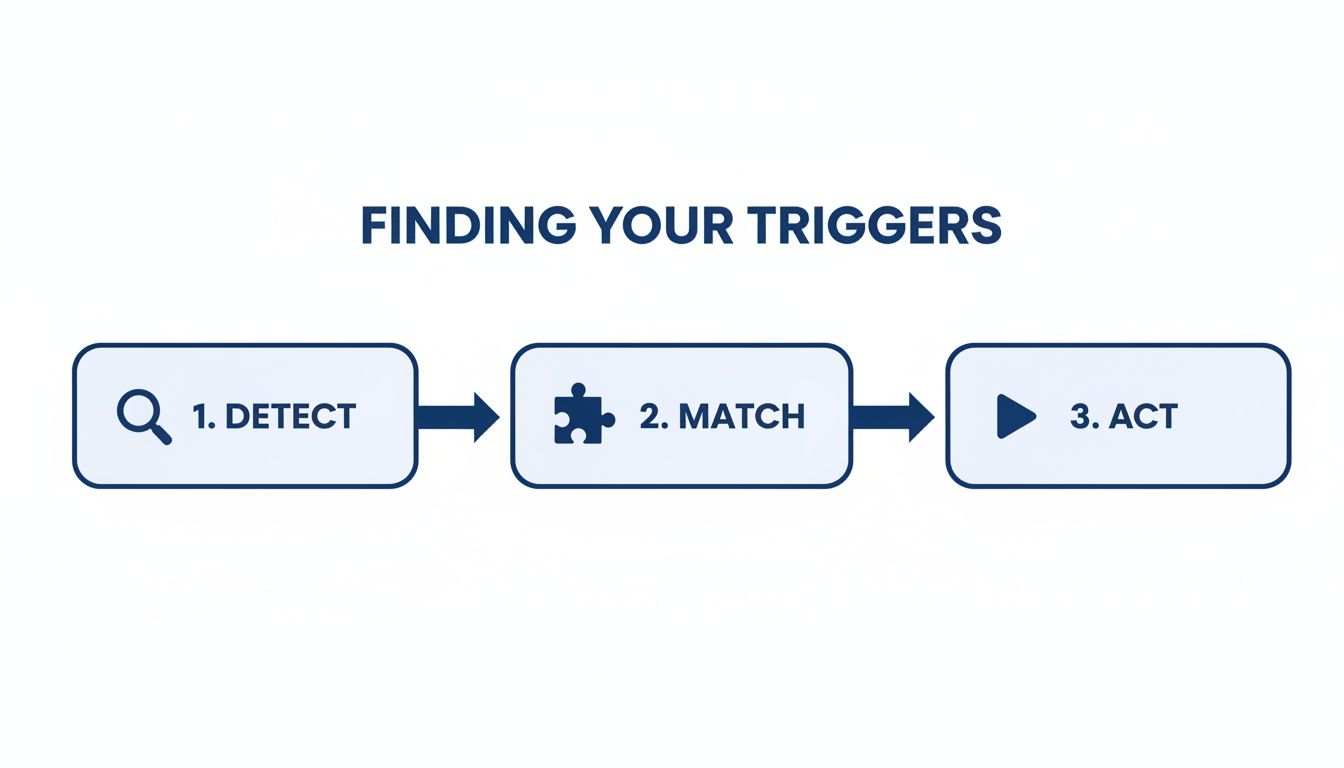
This flow—detecting an event, matching it to your value, and acting decisively—is the backbone of any modern, proactive sales strategy.
Crafting Value-Based Outreach
The biggest mistake reps make is mentioning a trigger without explaining why it matters. Your prospect doesn't care that they hired a new CRO; they care about what that new CRO is expected to accomplish. Your job is to connect the dots for them.
A powerful, trigger-based message follows a simple formula: Observation + Implication + Value Proposition.
- Observation: "Saw your recent announcement about expanding into the European market."
- Implication: "Scaling across different regulatory environments often creates complex compliance and data localization challenges."
- Value Proposition: "Our platform helps companies like yours simplify global compliance, reducing risk as you grow."
This approach immediately frames you as a thoughtful advisor, not just another salesperson.
Building Trigger-Based Sequences
A single email rarely cuts it. To capitalize on a trigger, build it into a multi-touch sequence. This keeps you top-of-mind while your prospect is in that crucial decision-making window.
Integrating triggers into your sales cadence provides timely, relevant context for follow-ups. Instead of a generic "just checking in," your second or third touchpoint can reference a new development, keeping the conversation fresh and valuable.
A sequence might look like this:
- Day 1 (Email): Initial outreach connecting the primary trigger to their implied pain.
- Day 3 (LinkedIn): Connect with the key stakeholder, referencing a shared connection or commenting on a post they made about the new initiative.
- Day 7 (Email): Follow up with a short case study on how you helped a similar company navigate the exact challenge their trigger event suggests.
This methodical approach respects the buyer’s time while demonstrating your expertise. A consistent process like this is a crucial part of learning how to build a sales pipeline that is both predictable and scalable.
Driving Strategic Account Planning
Triggers aren't just for opening new doors; they are vital for keeping your strategic account plans current and relevant. A static account plan from Q1 is often obsolete by Q2.
When a trigger hits a key account—like an acquisition or a major product pivot—it's a signal to revisit your plan immediately.
- Does this change who the key decision-makers are?
- Does it create a new high-priority business initiative?
- Does it open up a new budget or shift existing priorities?
By continuously folding new trigger intelligence into your account plans, you ensure your team is always aligned with the customer's current reality. This transforms account planning from a chore into a dynamic, strategic exercise that proactively uncovers expansion opportunities.
Mastering Meeting Preparation
Walking into a discovery call armed with trigger context is a game-changer. Instead of wasting the first 15 minutes on basic questions, you can lead with genuine insight.
Imagine starting a call with a newly hired VP of Engineering like this:
"I saw you recently joined and that the company just announced a major push into AI-driven features. In your first 90 days, how are you thinking about building the infrastructure to support that roadmap?"
This immediately elevates the conversation from a generic pitch to a strategic discussion about their most pressing priorities. You prove you’ve done your homework and are there to solve their specific, time-sensitive problems.

“Salesmotion helps you spot signals from prospect accounts, news items / job hiring alerts etc that indicate that now is a good time to reach out with a well-crafted message.”
Rob Douglas
Director of Sales, icit business intelligence
Real-World Examples of Trigger Selling in Action
Theory only gets you so far. Let's look at how trigger selling plays out in the real world. The best reps don't just see a news alert; they see the story behind it and know exactly where their solution fits.
Let's walk through a few plausible scenarios across different industries.
Enterprise Software: A Cybersecurity Play
Imagine a fast-growing fintech company just hired a new Chief Information Security Officer (CISO). This is a classic leadership change trigger, and for a cybersecurity software company, it’s a prime opportunity.
- The Trigger: A publicly announced new CISO hire at a mid-sized fintech firm.
- The Implied Pain: The new CISO has a 90-day mandate to assess the environment, find vulnerabilities, and present a new security strategy. They are under immense pressure to make an impact quickly, especially in the high-stakes financial sector. The old tools and processes are all under review.
- Actionable Outreach: An account executive at a cybersecurity platform sees this trigger. They skip the generic "congrats" email and send something far more valuable.
Their outreach shows they understand the situation: "CISOs in their first quarter are often tasked with consolidating their security stack and proving a rapid reduction in risk." The message then offers a one-page brief on how their platform helped a similar fintech CISO achieve a 30% reduction in critical vulnerabilities within their first 60 days. This isn't a sales pitch; it's a lifeline from an expert who understands the pressures of the role.
Life Sciences: A CRO's Perfect Moment
Now, let’s look at life sciences. A small biotech firm announces it has successfully closed a $75 million Series B funding round. This financial trigger is a massive green light for a Contract Research Organization (CRO) specializing in clinical trial support.
- The Trigger: A press release announcing a successful Series B funding round.
- The Implied Pain: The biotech now has a mountain of cash and even more pressure from investors to hit its development milestones. Their small in-house team cannot scale clinical trial operations fast enough to meet these aggressive new timelines. They need an experienced partner to manage multi-site trials, patient recruitment, and regulatory paperwork—and they need it now.
- Actionable Outreach: A business development director at a CRO spots the funding news. They know this isn’t just about money; it’s about the race against time that the money just started.
Their outreach is all about speed and expertise. The message might lead with, "Congratulations on the new funding to advance your oncology pipeline. Companies at your stage often need to scale from a Phase I to a global Phase II trial in under six months, a challenge that can overwhelm internal resources." The call to action? Offer to share a case study on how they helped another Series B biotech launch its pivotal trial three months ahead of schedule.
IT Services: An M&A Integration Opportunity
Finally, let's consider the IT Services space. A large manufacturing company acquires a smaller, tech-focused competitor to boost its digital footprint. This M&A event is a prime trigger for an IT integration consultancy.
When two companies merge, they don't just combine headcounts; they combine decades of disparate technology, conflicting data structures, and incompatible software. This creates an immediate and complex integration challenge that can derail the entire value of the acquisition if not handled correctly.
The table below breaks down how a specific event creates the perfect opening for a relevant conversation.
Trigger-Based Outreach Examples by Industry
| Industry Vertical | Plausible Trigger Event | Effective Outreach Hook |
|---|---|---|
| Enterprise Software | A new Chief Information Security Officer (CISO) is hired. | "As you assess the security stack in your first 90 days, our platform can help you identify and consolidate redundant tools." |
| Life Sciences | A biotech firm secures a large Series B funding round. | "With new funding to accelerate clinical trials, our team can help you scale operations without overwhelming your internal resources." |
| IT Services | A large company acquires a smaller competitor. | "Integrating disparate CRM and ERP systems post-acquisition is a huge challenge. We specialize in making that process seamless." |
In each example, the trigger event is the foundation for a relevant, strategic conversation. By understanding the pain behind the event, sales teams can stop pitching products and start offering timely solutions.
How to Automate Your Trigger Event Strategy

While the Detect-Match-Act framework provides a solid roadmap, manual execution is a battle. Reps spend countless hours digging through news sites, LinkedIn feeds, and SEC filings instead of selling. This "manual research tax" kills productivity and means great opportunities fall through the cracks.
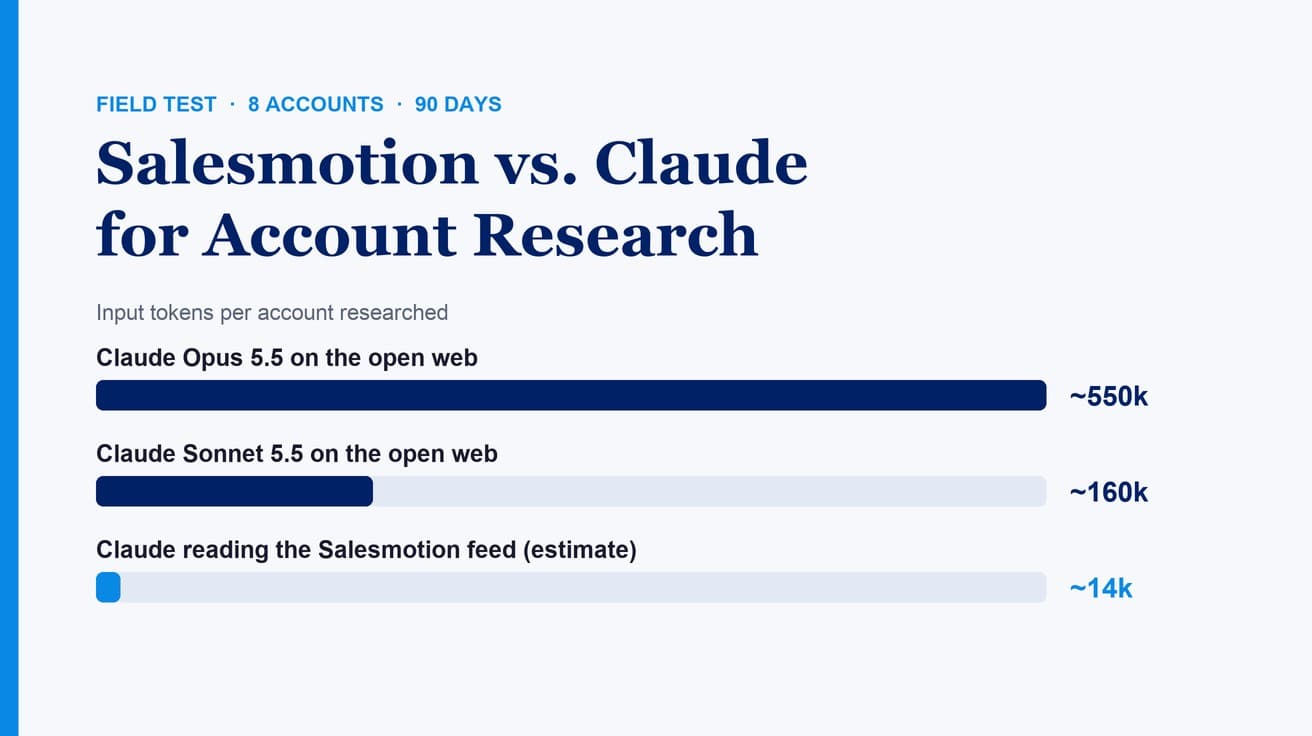
This is where automation becomes non-negotiable for any serious revenue team. A dedicated account intelligence platform like Salesmotion automates this entire process, allowing you to focus on building relationships and closing deals.
Move from Manual Research to Always-On Monitoring
Imagine a system that does the heavy lifting for you. Automation platforms solve the problem of manual research by providing always-on account monitoring. Instead of you hunting for triggers, the platform constantly scans thousands of sources—from press releases and podcasts to LinkedIn activity and earnings calls—for the signals that matter to your business.
When a relevant event occurs, a crisp, actionable alert is delivered straight into the tools your reps use daily, like Slack, email, or their CRM. This means your team can act fast, with full context at their fingertips. What used to be hours of research is now a single, timely notification.
Automation transforms trigger selling from a reactive, luck-based activity into a proactive, systemized process. It ensures no opportunity slips through the cracks and frees up your sales team to focus on high-value conversations, not endless searching.
For a parallel, look at the world of finance. The principles behind automating trading strategies offer a useful blueprint. The domain is different, but the core idea of using technology to act on predefined events is the same.
Translate Triggers into Actionable Insights
One of the biggest hurdles in trigger selling is knowing the "so what?" of an event. A news alert is just noise until you can clearly explain why it matters to your prospect. This is where AI-powered platforms provide a massive advantage.
Instead of just flagging a trigger, these systems use AI to generate instant insights. They connect the event to a specific pain point and can even suggest talking points.
- From Weak to Strong "Why Now": A generic alert about a new funding round is transformed into a specific insight: "This capital will likely be used to accelerate their product roadmap, creating an urgent need for scalable QA testing solutions."
- Faster, More Relevant Outreach: Reps no longer have to guess. They get the trigger, the context, and the reason for reaching out all in one package, letting them craft hyper-relevant messaging in minutes.
By automating both the detection and the interpretation of trigger events, you empower your entire team to operate at a higher level. They can consistently lead with value, drive timely conversations, and turn real-time account activity into measurable pipeline growth.

“Automatic account profile detail I can use to manage my territory. Using Salesmotion AI to generate value statements per persona, account, etc. Using Salesmotion to give me a starting point based on new hires, or news alerts is critical.”
Adam Wainwright
Head of Revenue, Cacheflow
Frequently Asked Questions About Sales Triggers
To wrap up, let's address a few common questions leaders have when implementing a trigger event strategy. Clarity on these points will help your team adopt this powerful approach with confidence.
How Is a Trigger Event Different From a General Buying Signal?
Think of it this way: a buying signal is broad, while a trigger event is specific and demands action now.
A prospect downloading a whitepaper is a signal. It shows general interest. But a trigger is a distinct change at their company that creates a clear and often urgent need for a solution like yours.
A new funding round, for instance, is the trigger. It’s a catalyst for new spending and signals that a window of opportunity just opened. Signals suggest interest; triggers demand a response.
How Many Trigger Events Should My Team Track?
It’s tempting to track everything, but the key is quality over quantity. Start by identifying the 3-5 trigger events that most directly point to a need for your specific solution.
For a cybersecurity firm, a 'New CISO Hire' or 'Announced Digital Transformation Initiative' is far more valuable than a generic hiring announcement. Align your chosen triggers with your ideal customer profile to ensure every alert is a real opportunity.
This focus prevents your team from drowning in noise and allows them to act decisively on the events that actually matter.
What Is the First Step to Implement a Trigger Event Strategy?
The best way to begin is to start small and prove the concept. Pick one high-impact trigger that aligns perfectly with what you sell. If you’re a sales tech company, that might be tracking when your target accounts hire a 'New VP of Sales'.
Next, choose a specific account segment and manually track that single trigger for a few weeks. Craft personalized outreach for every one you find and carefully measure the response rates against your team's normal baseline.
This targeted pilot will give you a rock-solid business case for a wider, automated rollout.
Ready to stop searching and start selling? Salesmotion is the AI-powered account intelligence platform that automates your trigger strategy. We turn market signals into timely, revenue-generating conversations.