Here is a test for any sales call. Count how many minutes the rep spends talking versus the buyer. If the rep dominates, it is a pitch wearing a discovery costume. Consultative selling inverts that ratio. The rep asks more than they tell, diagnoses before they prescribe, and earns the buyer's trust by being genuinely useful before asking for anything. It is the difference between a vendor and a trusted advisor, and in complex B2B deals, only the advisor wins.
TL;DR: Consultative selling is the posture of a trusted advisor: you lead with disciplined discovery, ask far more than you pitch, bring insight the buyer cannot get elsewhere, and build credibility before you build a case for your product. It outperforms transactional selling on complex, high-consideration deals where trust and diagnosis matter more than speed. The hard part is not the philosophy, it is doing it consistently across a team, which is where account intelligence turns the approach into a repeatable workflow.
What Is Consultative Selling?
Consultative selling is a sales approach where the rep acts as a trusted advisor, using disciplined discovery and relevant insight to help the buyer make a good decision, rather than pushing a product. The sale is a byproduct of being genuinely useful. Trust is the currency, and diagnosis comes before prescription.
The term traces to Mack Hanan's 1970 book Consultative Selling, which argued that the most effective sellers behave less like vendors and more like consultants who improve the customer's business. The product is incidental. What the buyer is really purchasing is the rep's judgment, expertise, and the confidence that this person understands their problem better than the alternatives do.
Every serious sales methodology since has borrowed from this. Solution selling added a structured pain-development process on top of it. SPIN selling added a questioning sequence. The Challenger model added a teaching edge. But they all rest on the consultative foundation: the rep earns the right to recommend by first understanding deeply.
There is a pattern we see across sales teams that explains why this matters more than ever. The deals that close rarely trace back to outbound volume. They trace back to a trigger event, an executive sponsor, or a referral, moments built on relevance and trust. A rep who shows up as an advisor, with something useful to say about the buyer's specific situation, manufactures those moments. A rep who shows up to pitch waits for them.
See Salesmotion on a real account
Book a 15-minute demo and see how your team saves hours on account research.
Asking vs. Pitching: The Core Discipline
The defining behavior of consultative selling is asking more than pitching. Top consultative reps spend the majority of a discovery call listening, asking sharp questions, and reflecting back what they hear. The pitch shrinks to a few sentences delivered at exactly the right moment, after the buyer has revealed what they actually need.
This is harder than it sounds, because every instinct pushes the other way. Reps are trained on product knowledge, comped on closing, and pressured by quotas, so they default to telling. The consultative rep resists that pull. They treat the early conversation as a diagnosis, not a presentation, and they are comfortable leaving a call without having pitched anything.
The contrast is stark enough to map directly:
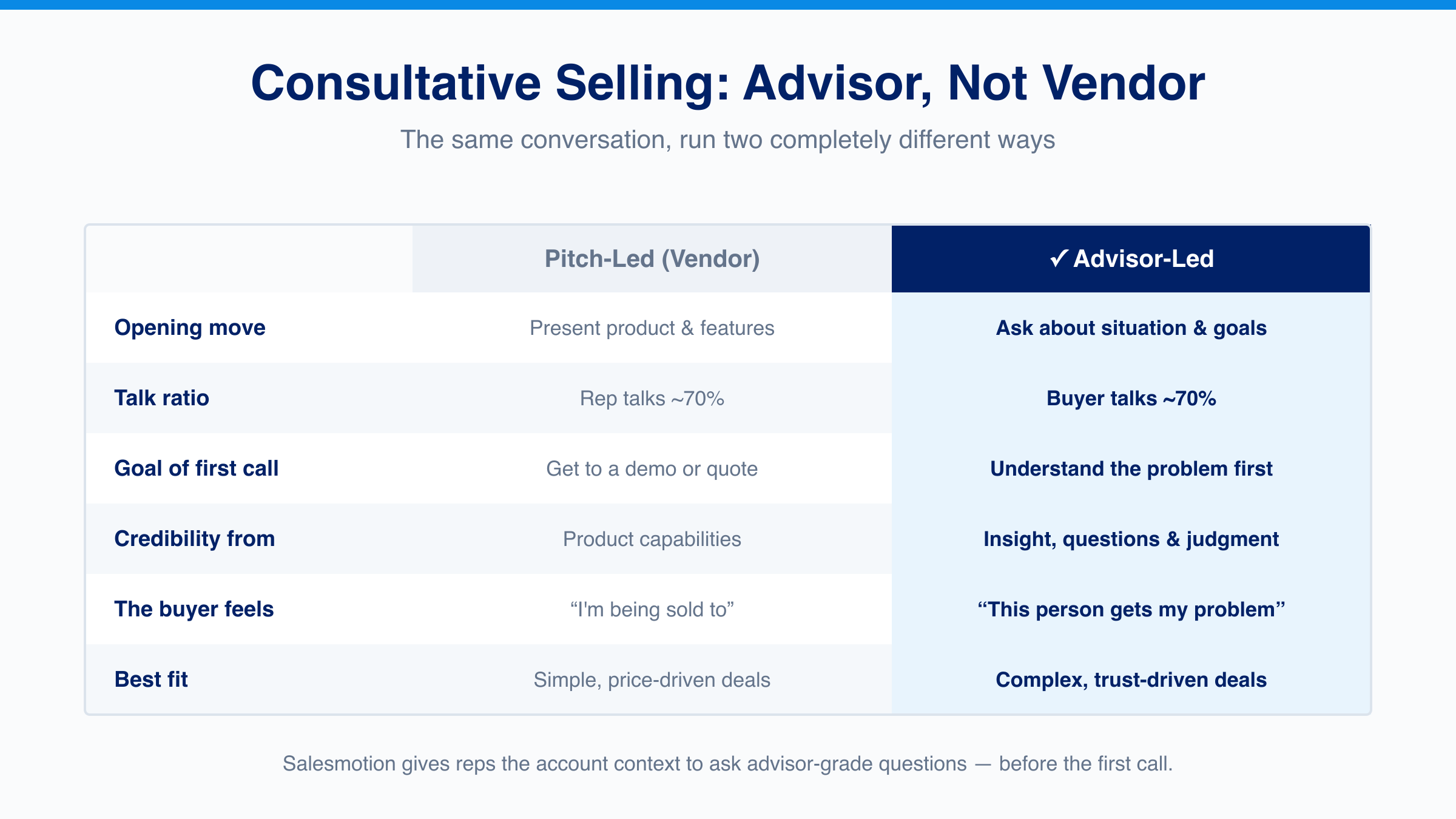 The same conversation, run two ways: the advisor-led rep diagnoses before pitching and lets the buyer do most of the talking.
Here is the same contrast in detail:
| Dimension | Transactional / Pitch-Led | Consultative / Advisor-Led |
|---|---|---|
| Opening move | Present the product and its features | Ask about the buyer's situation and goals |
| Talk ratio | Rep talks ~70% of the time | Buyer talks ~70% of the time |
| Goal of first call | Get to a demo or a quote | Understand the problem well enough to add value |
| Source of credibility | Product capabilities | Insight, relevant questions, and judgment |
| What the buyer feels | "I'm being sold to" | "This person gets my problem" |
| Best fit | Simple, low-consideration, price-driven | Complex, high-consideration, trust-driven |
Consultative selling inverts the transactional ratio: the buyer does most of the talking, the rep earns credibility through insight and questions, and the product enters only after the problem is understood.
The talk ratio is not a soft metric. Gong's analysis of sales calls has repeatedly found that top performers let the buyer talk more, especially in early-stage conversations. The reason is simple. A buyer who talks is a buyer revealing their criteria, their pain, and their politics. Every minute a rep spends pitching is a minute they spend not learning the thing that would help them win.

“Salesmotion empowers me to cultivate a great buyer experience. I'm able to challenge prospects' thinking and be a trusted consultative seller. A major part of this is Salesmotion insights.”
Austin Friesen
Account Executive, FY25 #1 President's Club, Clari
Discovery Discipline: The Heart of the Advisor Sale
Discovery discipline means running a structured, curious, layered conversation that uncovers not just the surface problem but its root cause, its business impact, and the people it touches. It is the single skill that separates consultative reps from order-takers. Without it, "consultative" is just a friendlier pitch.
Disciplined discovery has a structure even when it feels like a natural conversation. The strongest reps move through layers:
- Situation. What does the buyer's current process, team, and tooling look like? Establish the facts before the feelings.
- Problem. Where does the current state break down? What frustrates them, and how often?
- Impact. What does that problem cost in time, money, missed targets, or risk? This is where a complaint becomes a business case.
- Vision. What would "solved" look like, and what would it unlock? Let the buyer describe the better future.
This sequence will look familiar to anyone who has studied SPIN selling, which formalized the Situation-Problem-Implication-Need-payoff progression. Consultative selling is the broader posture; SPIN is one disciplined way to execute its discovery. The point is the same: you do not earn the right to prescribe until you have done the diagnosis.
The failure mode is predictable. We see a pattern across sales teams where reps accept vague answers and move on. The buyer says "we just need better data," and the rep nods and pitches data, instead of asking why, what it costs, and who else feels it. Buyers are drowning in data but starving for action, they do not need another rep confirming their surface-level self-diagnosis. They need one who digs until the real problem is on the table.
Insight-Led Conversations: Bringing Something the Buyer Doesn't Have
Asking great questions earns you a seat. Bringing insight earns you the recommendation. Insight-led selling means showing up with a relevant perspective the buyer cannot get from a Google search, a benchmark they have not seen, a pattern across similar companies, or a risk they have not considered. It is what turns a good listener into a trusted advisor.
There is a tension to manage here. Pure discovery, asking endless questions without ever contributing, frustrates senior buyers who value their time. An executive does not want to educate a rep for 40 minutes. They want a conversation with a peer who already understands their world and can sharpen their thinking. That is why modern consultative selling pairs disciplined discovery with a genuine point of view.
Insight comes in a few forms, in rough order of value:
- A relevant pattern. "We see teams at your stage hit a wall when account research starts eating more than five hours a week per rep." You connect their situation to a broader trend they recognize.
- A reframe. "Most teams treat this as a tooling problem. In our experience it is usually a timing problem, reps researching the wrong accounts at the wrong moment." You change how they see the issue.
- A specific, account-relevant observation. "I noticed your CRO mentioned a sales transformation initiative on the last earnings call, that usually means the timing question is already on your leadership's mind." You prove you did the homework.
That third form is the most powerful and the rarest, because it requires knowing something specific about the buyer's company before the call. It is also the clearest line between an advisor and a vendor. Anyone can recite a benchmark. Only a rep who did real research can connect their insight to this buyer's actual situation, which is the same standard that defines effective signal-based selling.

“The talking points are gold. If they're in Salesmotion, I know they're being discussed inside that business. That makes it easy to spark a real conversation, which is 90 percent of the battle.”
Andrew Giordano
VP of Global Commercial Operations, Analytic Partners
Building Credibility: How Trust Compounds
Credibility is the asset that makes consultative selling work, and it is built through a sequence of small proofs, not a single big claim. Buyers extend trust to reps who demonstrate competence, show they did their homework, behave consistently, and prioritize the buyer's outcome over a fast close. Each proof point compounds the next.
Credibility builds along a path:
- Relevance first. A well-researched opening that references the buyer's actual situation signals you are worth their time. A generic intro signals the opposite.
- Useful questions next. Questions that make the buyer think ("huh, I hadn't considered that") prove you understand their domain.
- Honest trade-offs. A rep who says "we are not the right fit if your priority is X" earns more trust than one who claims to do everything.
- Restraint at the close. Not forcing a demo or a quote before the buyer is ready signals you are optimizing for their decision, not your quota.
That last point matters more than reps think. We see a pattern across sales teams where AEs accept "let's discuss next quarter" without pushback, or dance around the deal instead of driving it. Both erode credibility in opposite ways: the passive rep looks like they do not care, and the pushy rep looks like they only care about themselves. The credible consultative rep does neither. They ask a sharp question about why next quarter and what would change, holding the buyer's decision quality as the shared goal.
Credibility is also why consultative selling reaches power. An executive sponsor extends time to a rep they trust, and that sponsorship is what advances enterprise deals. The pattern is consistent: the wins trace to a trusted relationship with someone who has influence, not to the volume of touches. Trust is the lever, and it is built one credible interaction at a time.
When Consultative Selling Beats Transactional, and When It Doesn't
Consultative selling wins when the deal is complex, the consideration is high, and trust drives the decision. It loses, or at least wastes effort, when the purchase is simple, fast, and price-driven. Knowing which game you are in is itself a consultative skill, because applying the wrong approach burns time and credibility.
Use the consultative approach when:
- The deal involves multiple stakeholders and a long cycle.
- The buyer's problem is ambiguous or under-diagnosed and needs expert framing.
- The cost of a wrong decision is high, so the buyer values guidance.
- Differentiation comes from fit and outcomes, not just price.
Lean transactional when:
- The product is simple and the buyer already knows exactly what they want.
- The cycle is short and the decision is largely about price and availability.
- Heavy discovery would annoy a buyer who just wants to transact.
The mistake most teams make is running one mode for everything. A transactional rep applying a pitch to a complex enterprise deal loses to the advisor who diagnosed first. An over-consultative rep running a 40-minute discovery on a self-serve buyer who just wanted a quote loses to speed. The skill is matching the approach to the deal, which itself depends on knowing the deal, the same intelligence problem that defines how to choose a sales methodology in the first place.
Why Consultative Selling Breaks at Scale
Consultative selling is easy to admire and hard to operationalize. The approach assumes the rep arrives at every call already understanding the buyer's world, their likely pain, their initiatives, and the people involved. One or two of your best reps can do that for their top accounts. A 15-person team cannot do it for every account, every week, by hand.
The research bottleneck is brutal. To run an insight-led, well-credentialed conversation, a rep needs the account's recent leadership changes, earnings commentary, hiring patterns, strategic initiatives, and competitive pressures. Gathering that manually across five tools takes hours per account. Multiply by a full territory and the math collapses. So reps cut corners, show up under-researched, and slide back into pitching, the exact behavior consultative selling was meant to replace.
The intelligence also decays. The insight that made you credible in January is stale by March, because the buyer's leaders, budgets, and priorities have moved. Consultative selling assumes fresh, account-specific knowledge, but that knowledge lives outside the CRM and goes out of date within weeks. The spreadsheet of "account notes" works for ten accounts. It does not survive fifty.
This is why consultative selling stays a top-rep skill instead of a team-wide standard. It is not that average reps cannot ask good questions or bring insight. It is that they cannot consistently feed the approach with current, specific knowledge. The advisor posture is only as strong as the research behind it, and manual research does not scale.
How Salesmotion Operationalizes Consultative Selling
Consultative selling needs three inputs to work across a team: relevance (what is specifically true about this account), timing (when is a conversation worth having), and insight (what does the rep know that the buyer values). Signal-based selling supplies all three, turning the advisor posture from a talent into a repeatable workflow.
Salesmotion continuously monitors buying signals across 1,000+ public and private sources: leadership changes, earnings commentary, hiring patterns, funding, product launches, and competitive moves. Each signal is raw material for an insight-led conversation. A new VP of Sales is a relationship to build. An earnings call mentioning "improving sales productivity" is a problem the rep can speak to with credibility, before the first call.
Here is the workflow in practice:
- Trigger. A target account posts a VP of Revenue Operations role and mentions a "go-to-market efficiency initiative" on its earnings call.
- Platform action. Salesmotion flags the account and assembles the brief: the leadership change, the stated initiative, the metrics under pressure, and the likely stakeholders.
- Rep action. The rep opens the conversation already knowing the buyer's situation and a relevant insight, then runs disciplined discovery instead of a cold pitch. Credibility is established in the first two minutes.
- Outcome. Because the rep showed up as an informed advisor rather than a vendor, the buyer engages openly, talks more, and the deal advances on trust. The consultative call happens at the right moment, with the right person, on the right topic.
 A live signal feed tells reps when an account has a relevant trigger worth a consultative conversation, so outreach lands as insight rather than interruption.
The lever is always the same: tying the conversation to a timely trigger event and the specific person it affects. That is what makes a consultative opener land as genuine insight instead of a generic check-in. One marketing analytics team using this approach grew qualified pipeline 40% year over year while cutting account research from three hours to 15 minutes, because every rep walked into every call already prepared to advise. See how it works on a real account.
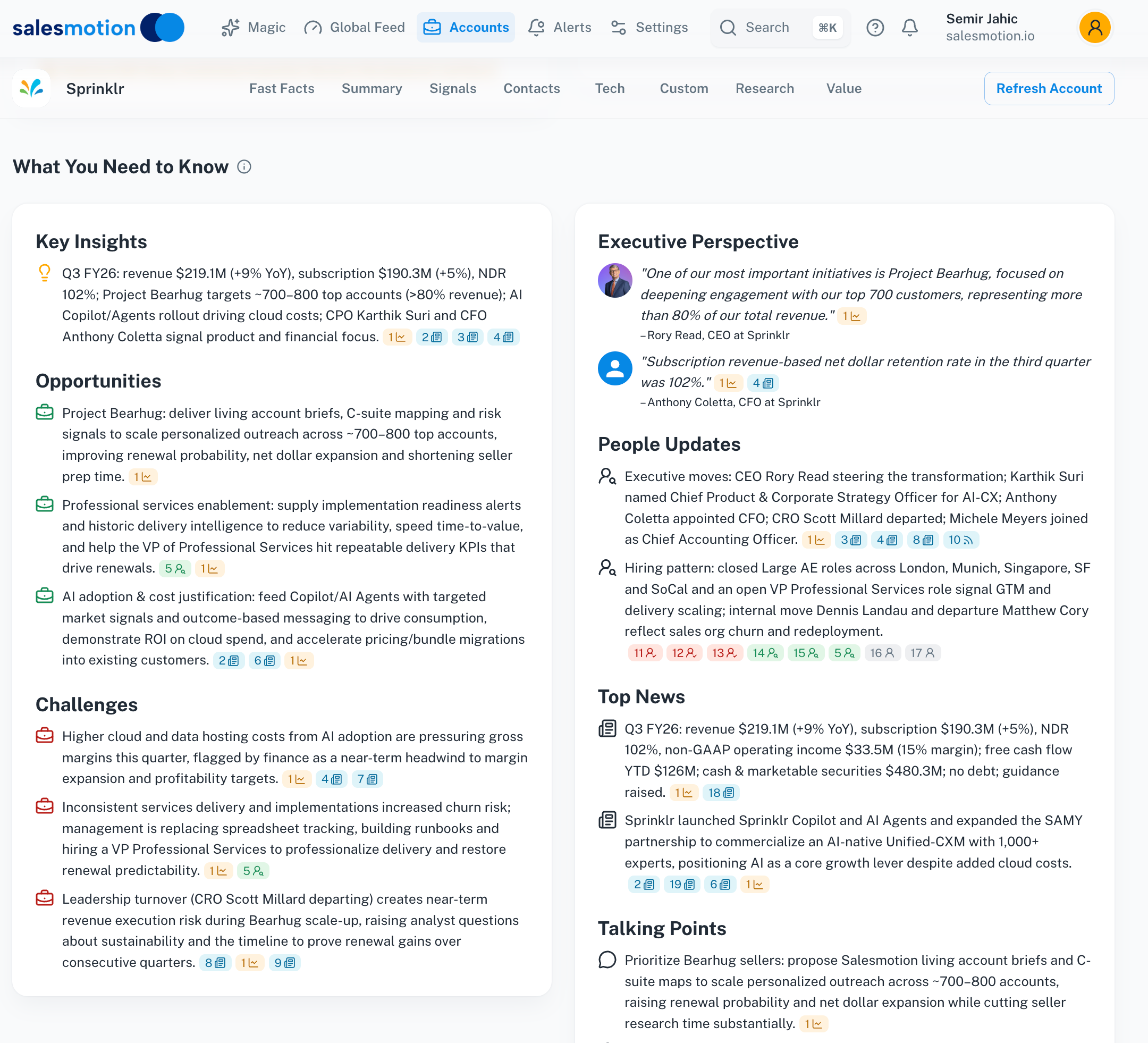 The account brief gives every rep the specific, current context that makes a consultative conversation credible, the homework that separates an advisor from a vendor.
That is consultative selling at scale: the trusted-advisor posture, fed by live intelligence, available to every rep on every account, not just the two who have time to do the research by hand.
Key Takeaways
- Consultative selling is the posture of a trusted advisor: lead with disciplined discovery, ask far more than you pitch, and earn the right to recommend by being genuinely useful first.
- The core discipline is the talk ratio. In strong consultative calls the buyer does most of the talking, because a buyer who talks is revealing the criteria, pain, and politics you need to win.
- Discovery discipline means layering through situation, problem, impact, and vision until you reach the root cause, not accepting the buyer's surface-level self-diagnosis.
- Insight-led conversations separate advisors from vendors. Bring a relevant pattern, a reframe, or a specific account observation the buyer cannot get from a search.
- Consultative selling beats transactional on complex, high-consideration, trust-driven deals, and wastes effort on simple, price-driven ones. Matching the approach to the deal is itself a skill.
- The approach breaks at scale because it depends on fresh, account-specific research that decays within weeks. Signal-based account intelligence keeps every rep prepared to advise, not just your top performers.
Frequently Asked Questions
What is consultative selling in simple terms?
Consultative selling is a sales approach where the rep acts as a trusted advisor instead of a product pusher. You lead with disciplined discovery, ask far more than you pitch, bring relevant insight the buyer cannot easily get elsewhere, and build credibility before making a case for your product. The sale becomes a byproduct of being genuinely useful. The term comes from Mack Hanan's 1970 book Consultative Selling.
How is consultative selling different from solution selling?
They share a problem-first philosophy and overlap heavily. Solution selling is a more structured methodology with specific tools, the pain chain, the nine-box vision model, and a defined progression from latent to active pain. Consultative selling is the broader posture of acting as a trusted advisor through discovery, insight, and credibility. In practice, consultative selling describes the relationship stance, and solution selling gives you one rigorous framework for running it.
What is the ideal talk-to-listen ratio in consultative selling?
There is no single magic number, but analysis of sales calls consistently shows top performers let the buyer talk more, often around 60-70% of an early discovery call. The logic is that a buyer who talks reveals their pain, criteria, and internal politics, which is the information a rep needs to win. Reps who dominate the conversation tend to pitch into a vacuum and learn nothing that would help them advance the deal.
When should you use consultative selling instead of a transactional approach?
Use consultative selling on complex, high-consideration deals where trust drives the decision: multiple stakeholders, long cycles, ambiguous problems, and a high cost of choosing wrong. Use a faster, more transactional approach when the product is simple, the buyer already knows what they want, and the decision is mainly about price and speed. Running heavy discovery on a buyer who just wants a quote wastes their time and yours.
How do you build credibility in a consultative sale?
Credibility builds through a sequence of small proofs. Open with research that references the buyer's actual situation, ask questions that make them think, be honest about trade-offs and fit, and avoid forcing a demo or quote before they are ready. Each proof point compounds. The fastest way to lose credibility is showing up under-researched, which is why fresh, account-specific intelligence and buying signals are the foundation of a credible consultative conversation.