Sales organizations with a dynamic, formalized sales methodology achieve 27% higher win rates and 21% higher quota attainment than those winging it with informal processes. That finding comes directly from Korn Ferry's Sales Maturity Survey, and it aligns with what the Sales Management Association found: 90% of companies using a guided sales process rank as top performers.
Yet only 30% of organizations actually follow a formal methodology consistently. The rest operate on tribal knowledge, inconsistent training, and whatever approach their last VP of Sales brought with them.
This guide breaks down the 9 most widely adopted sales methodologies for teams planning 2027, with visual frameworks, honest pros and cons, and practical guidance on choosing the right one for your team.
TL;DR: MEDDIC, Challenger, and SPIN remain the three most adopted enterprise sales methodologies heading into 2027. Each excels in different selling environments. The biggest mistake isn't picking the wrong methodology. It's picking one and never operationalizing it with live account data.
Why Methodology Adoption Still Defines Top Sales Teams
The gap between methodology-driven teams and everyone else is widening. Korn Ferry's research shows organizations with greater than 75% methodology adoption see +15% win rates and +6% revenue attainment compared to peers. Teams that combine a dynamic methodology with comprehensive CRM usage generate four times more sales wins.
Meanwhile, 48% of underperforming organizations have either informal sales processes or none at all. That's not a knowledge gap. It's an execution gap. Most sales leaders know they need a methodology. What they lack is a system to operationalize it across every account, every call, and every forecast review.
AI is changing this equation. For a team planning 2027, the question isn't "which methodology should we adopt?" It's "how do we feed live account intelligence into whatever methodology we already use?" Because the framework is only as strong as the data flowing through it.
The 9 methodologies below represent the most proven and widely deployed approaches in enterprise B2B sales today.
Methodologies fail without the right account intelligence
Salesmotion surfaces the signals, talking points, and stakeholder maps that make MEDDIC, Challenger, and SPIN actually work — for every rep, every account. From $85/mo.
The 9 Most Popular Sales Methodologies
Each methodology below includes how it works, why it persists, honest trade-offs, and where it fits best. We've ranked them roughly by current adoption in enterprise B2B selling, though the best methodology for your team depends on your deal complexity, sales cycle, and buyer type.
1. MEDDIC / MEDDPICC
Developed by Dick Dunkel and Jack Napoli at PTC in the 1990s, MEDDIC became the gold standard for enterprise qualification after helping PTC grow from $300M to $1B in revenue.
 MEDDIC Academy offers the official certification and training for the MEDDIC framework.
How It Works: MEDDIC is a qualification framework built on six criteria: Metrics, Economic Buyer, Decision Criteria, Decision Process, Identify Pain, and Champion. The extended MEDDPICC adds Paper Process (procurement and legal) and Competition. Reps score each element throughout the deal cycle, surfacing gaps before they become lost deals.
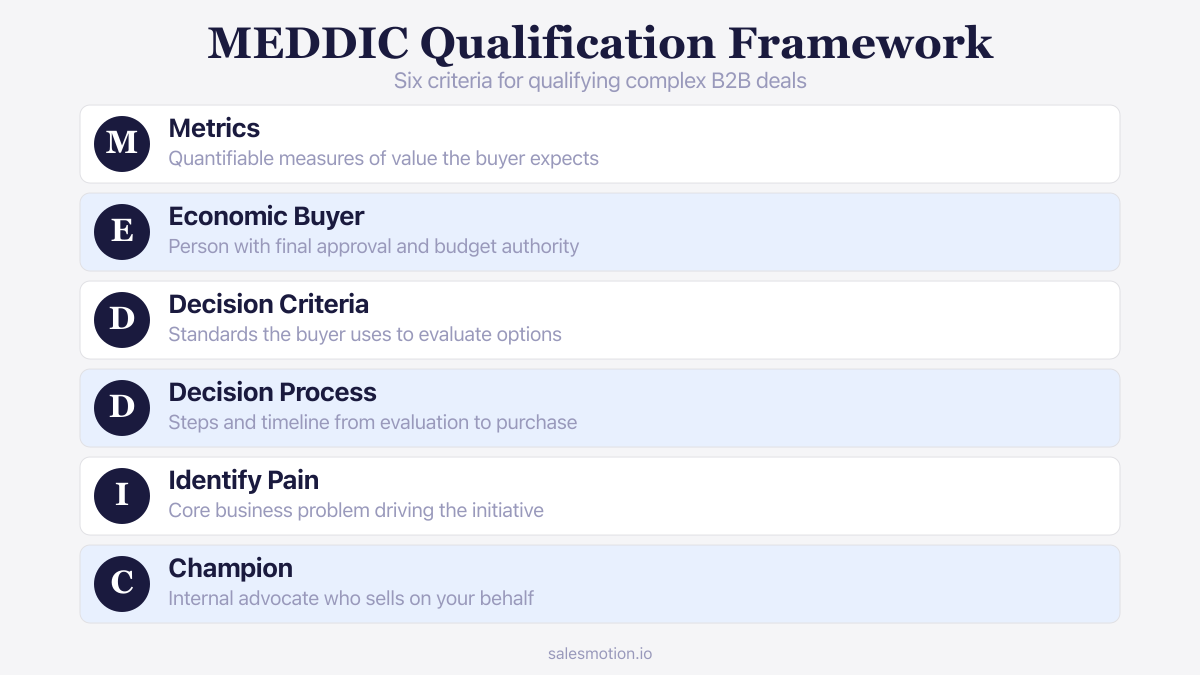 The six pillars of MEDDIC qualification, from Metrics to Champion.
Why It's Popular: MEDDIC dominates enterprise SaaS. Teams adopting MEDDIC consistently report 20-30% higher close rates and 40% more accurate forecasting. Its strength lies in forcing rigor where most deals fail: understanding who actually decides, what they're measuring, and whether your champion can sell internally.
Pros:
- Forces reps to validate deals early
- Dramatically improves forecast accuracy
- Scales across large sales organizations
Cons:
- Steep learning curve for new reps
- Can feel bureaucratic without good tooling
- Requires management discipline to enforce
Best For: Enterprise SaaS teams selling complex, multi-stakeholder deals with 90+ day sales cycles.
Go Deeper: MEDDIC: The Complete Qualification Guide | MEDDIC vs MEDDPICC | MEDDIC Academy
2. The Challenger Sale
Based on research by Matthew Dixon and Brent Adamson at CEB (now Gartner), The Challenger Sale emerged from a study of more than 6,000 sales reps across 44 attributes and dozens of industries.
 Challenger Inc. provides the official Challenger training and certification programs.
How It Works: The research identified five seller profiles: Relationship Builders, Hard Workers, Lone Wolves, Reactive Problem Solvers, and Challengers. The finding: 40% of top-performing reps were Challengers who teach customers something new about their business, tailor their message to the stakeholder, and take control of the sale. In complex sales, that number rises to 54%. The methodology trains reps to lead with insight rather than relationship.
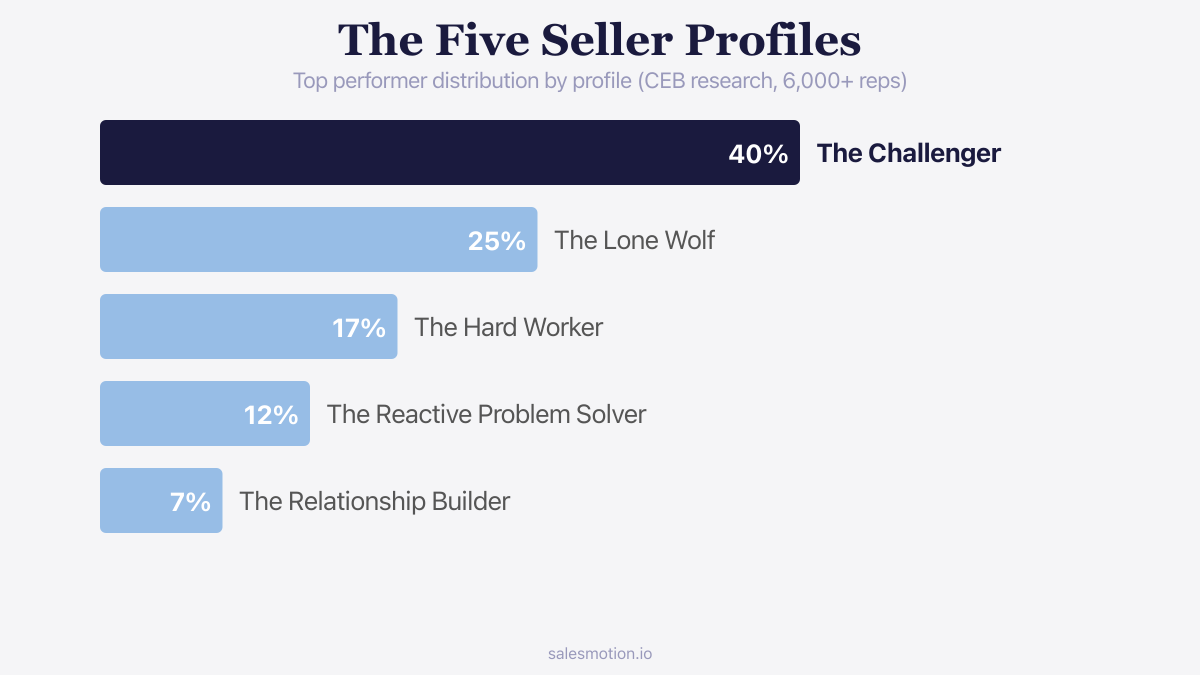 The five seller profiles from CEB's research. Challengers represent 40% of top performers.
Why It's Popular: Challenger resonates because it aligns with how modern B2B buyers operate. Buyers are often 57-70% through their decision process before engaging a sales rep. Challengers succeed because they add value before the buyer asks. Organizations adopting the model report up to 30% increase in sales over traditional relationship-based approaches.
Pros:
- Teaches reps to lead with value
- Effective in consensus-driven buying
- Backed by rigorous research (6,000+ reps)
Cons:
- Requires deep industry knowledge
- Hard to implement without strong content team
- Can alienate buyers when poorly executed
Best For: Teams selling into change-resistant organizations where the status quo is the real competitor.
Go Deeper: Challenger Sales Methodology Explained | The Challenger Sale (Amazon)
3. SPIN Selling
Neil Rackham's SPIN Selling, published in 1988, was one of the first sales methodologies grounded in empirical research. Huthwaite International analyzed over 35,000 sales calls involving 10,000+ salespeople across 20+ countries over 12 years to develop the framework.
 Huthwaite International maintains the official SPIN Selling training program.
How It Works: SPIN structures discovery conversations around four question types: Situation (understand current state), Problem (surface challenges), Implication (quantify the cost of inaction), and Need-Payoff (have the buyer articulate the value of solving). The key insight: top performers ask more Implication and Need-Payoff questions than average reps.
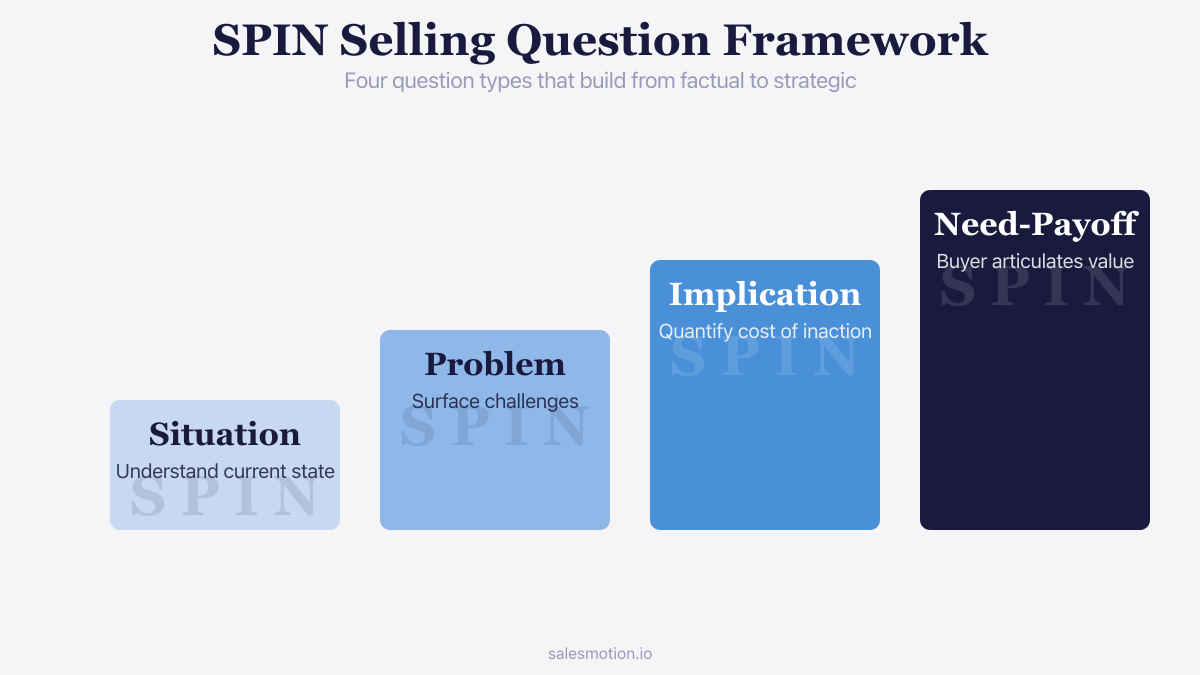 SPIN's four question types build from factual to strategic, moving buyers toward self-discovered need.
Why It's Popular: SPIN endures because it's universally applicable. Whether you sell software, consulting, or manufacturing equipment, the questioning framework works. Its emphasis on making the buyer articulate their own need creates stronger commitment than any pitch.
Pros:
- Research-backed, universally applicable
- Improves discovery conversation quality
- Easy to learn, hard to master
Cons:
- Less structured for complex multi-threaded deals
- Doesn't address post-discovery deal management
- Original research predates digital selling
Best For: Consultative selling environments where discovery quality drives deal outcomes, especially mid-market.
Go Deeper: SPIN Selling: The Complete Framework | SPIN Selling (Amazon)
4. Miller Heiman Strategic Selling
Developed by Robert Miller and Stephen Heiman in 1985, Strategic Selling pioneered the concept of mapping multiple buying influences within complex deals. Now part of Korn Ferry, the methodology remains one of the most widely taught in enterprise sales.
 Korn Ferry (Miller Heiman Group) maintains the Strategic Selling and Blue Sheet frameworks.
How It Works: Strategic Selling identifies four buying influences in every deal: Economic Buyer (final authority), User Buyer (end user), Technical Buyer (evaluator), and Coach (internal champion). The famous Blue Sheet is a planning tool that maps these influences, red flags, and strategic position for each opportunity. Reps use it to identify gaps in their coverage and plan next steps.
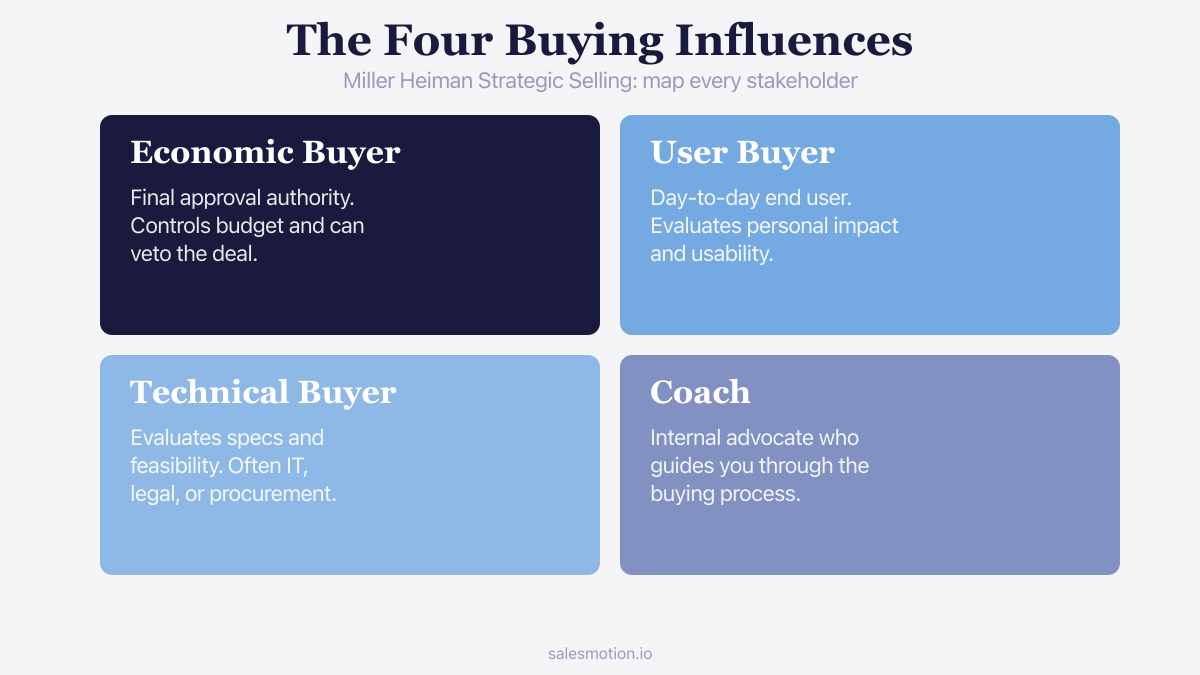 The four buying influences that shape every complex B2B purchase decision.
Why It's Popular: No methodology handles multi-stakeholder complexity better. For deals involving 6-10+ decision makers, Miller Heiman provides a structured way to understand who matters, where you stand with each, and what to do next.
Pros:
- Best framework for multi-stakeholder deals
- Forces systematic account strategy
- Integrates well with account planning
Cons:
- Blue Sheet maintenance is time-intensive
- Doesn't address messaging or discovery technique
- Training is expensive (Korn Ferry pricing)
Best For: Enterprise teams selling to buying committees of 6+ stakeholders where political navigation determines outcomes.
Go Deeper: Miller Heiman Strategic Selling | The Blue Sheet Guide | Korn Ferry Miller Heiman
5. BANT
Developed by IBM in the 1960s, BANT (Budget, Authority, Need, Timeline) is the oldest and most widely recognized qualification framework in B2B sales. It's not a full methodology but a qualification checklist that many teams use as their first filter.
 BANT originated at IBM and remains the most recognized qualification acronym in sales.
How It Works: Reps qualify prospects against four criteria: Does the prospect have Budget allocated? Are you speaking with someone who has Authority to decide? Is there a confirmed Need your solution addresses? Is there a defined Timeline for the decision? Prospects meeting all four criteria are considered qualified leads.
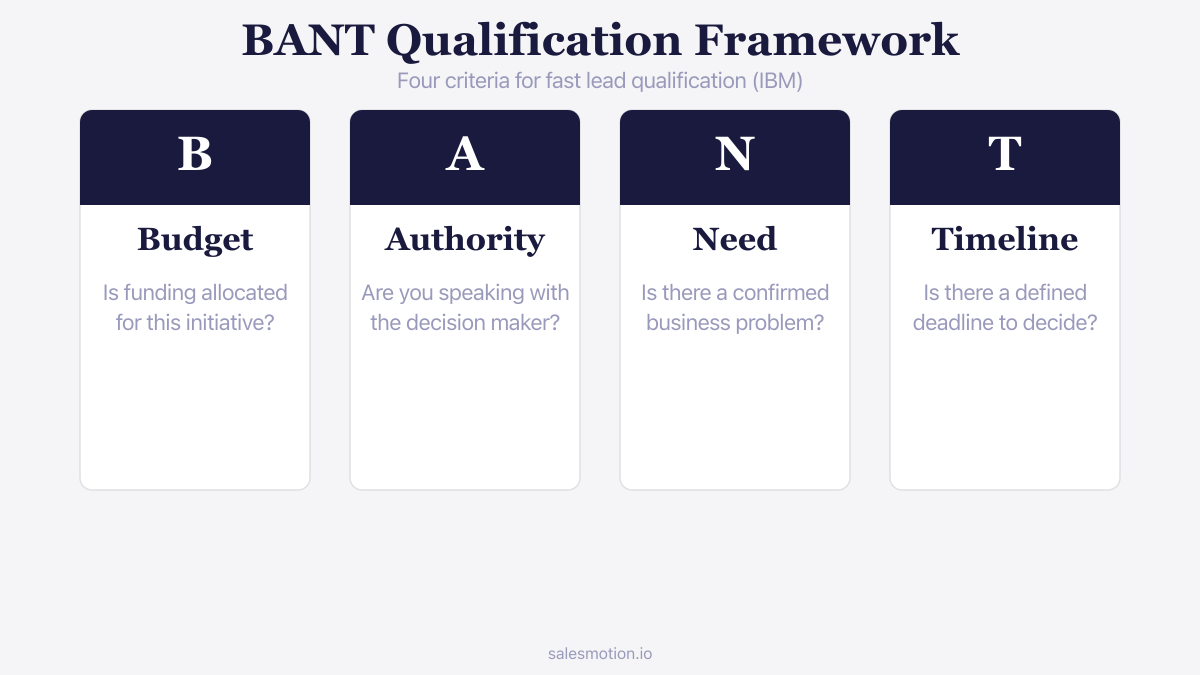 BANT's four qualification criteria provide a fast initial filter for sales teams.
Why It's Popular: BANT persists because it's simple. Every new SDR can learn it in an afternoon. 52% of sales professionals still rely on BANT to qualify leads, and 4 in 10 sellers value its flexibility. For high-volume, velocity-driven sales teams, having a fast checklist prevents reps from wasting time on unqualified prospects.
Pros:
- Simple, fast, easy to train
- Works well for SDR qualification
- Universal recognition across sales orgs
Cons:
- Outdated for complex enterprise deals
- Assumes linear buying process
- Misses decision process and competition
Best For: SDR/BDR teams doing initial qualification for velocity-driven sales motions and SMB segments.
6. ValueSelling Framework
Created by ValueSelling Associates, this methodology centers every conversation on the business value your solution delivers rather than features or capabilities.
 ValueSelling Associates provides training to help sales teams lead with quantifiable business outcomes.
How It Works: ValueSelling structures each interaction around four questions: What business issue does the buyer face? What's the problem underneath? What's the solution? And what measurable value does solving it deliver? Reps build a "Visionmatch" between the buyer's needs and the solution's differentiated value. Every conversation ladders up to quantifiable ROI.
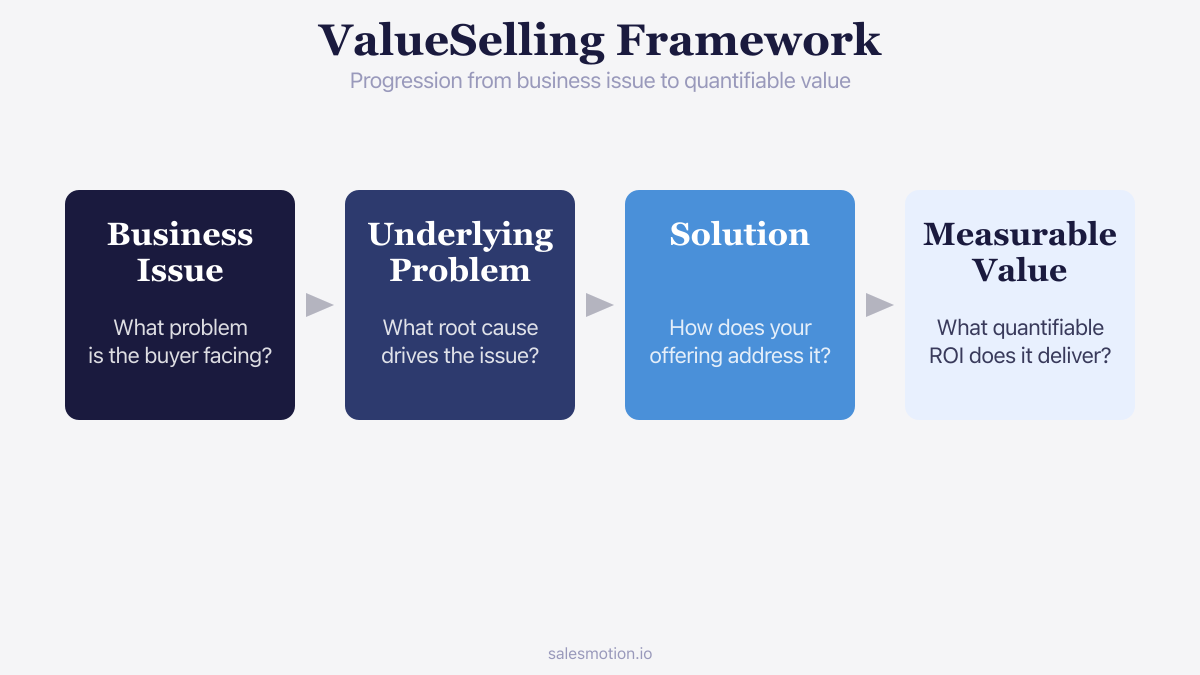 ValueSelling's progression from business issue to quantifiable value.
Why It's Popular: In an era where buyers evaluate 3-5 vendors simultaneously, teams that can articulate specific financial value outperform those selling on features. ValueSelling gives reps a repeatable way to connect capabilities to business outcomes, which is critical for getting deals past procurement.
Pros:
- Aligns sales conversations to buyer ROI
- Helps justify premium pricing
- Strong for getting past procurement
Cons:
- Requires reps to understand buyer financials
- Less prescriptive about discovery questioning
- Value quantification takes time per deal
Best For: Teams selling premium or complex solutions where ROI justification drives the purchase decision.
Go Deeper: Value Selling Framework | ValueSelling Associates
7. Gap Selling
Developed by Keenan (Jim Keenan) and published in 2018, Gap Selling is one of the newest methodologies on this list. It focuses on the gap between the buyer's current state and their desired future state.
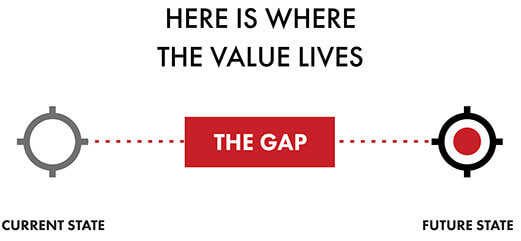 A Sales Growth Company provides Gap Selling training and certification.
How It Works: Gap Selling trains reps to deeply understand three elements: the buyer's current state (processes, tools, outcomes), their desired future state (goals, metrics, capabilities), and the gap between them. The sale happens when the rep helps the buyer see the gap clearly, quantify its cost, and understand why their solution closes it. The larger the gap, the more urgency and willingness to pay.
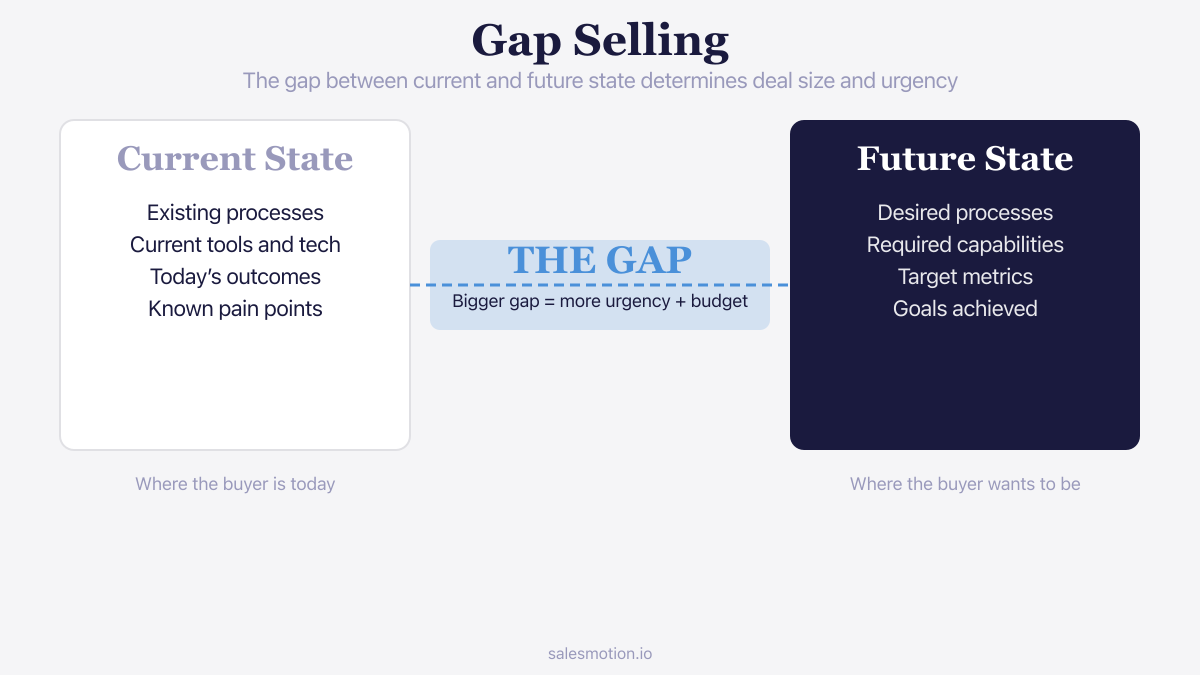 Gap Selling: the distance between current state and future state determines deal size and urgency.
Why It's Popular: Gap Selling appeals to reps frustrated with feature-benefit selling. By anchoring every conversation in the buyer's actual situation and desired outcomes, it creates natural urgency without pressure tactics. It's particularly effective for reps who struggle with discovery because it gives them a clear framework for understanding what the buyer actually needs.
Pros:
- Creates natural urgency without pressure
- Excellent discovery framework
- Easy to understand conceptually
Cons:
- Relatively new, less enterprise adoption
- Limited guidance on multi-stakeholder deals
- Requires deep buyer research per deal
Best For: Mid-market teams that need a modern, buyer-centric discovery framework to replace feature-based selling.
8. Command of the Message
Developed by Force Management, Command of the Message is a messaging and positioning framework that helps teams articulate value consistently across every customer interaction.
 Force Management delivers the Command of the Message and MEDDICC sales training programs.
How It Works: Command of the Message builds a "value framework" that aligns the entire organization around consistent messaging. It defines your biggest competitive differentiators, required capabilities, metrics of success, and proof points for each market segment. Reps learn to connect their solution's capabilities to the buyer's specific pain through "positive business outcomes" (PBOs) and "negative consequences" of inaction.
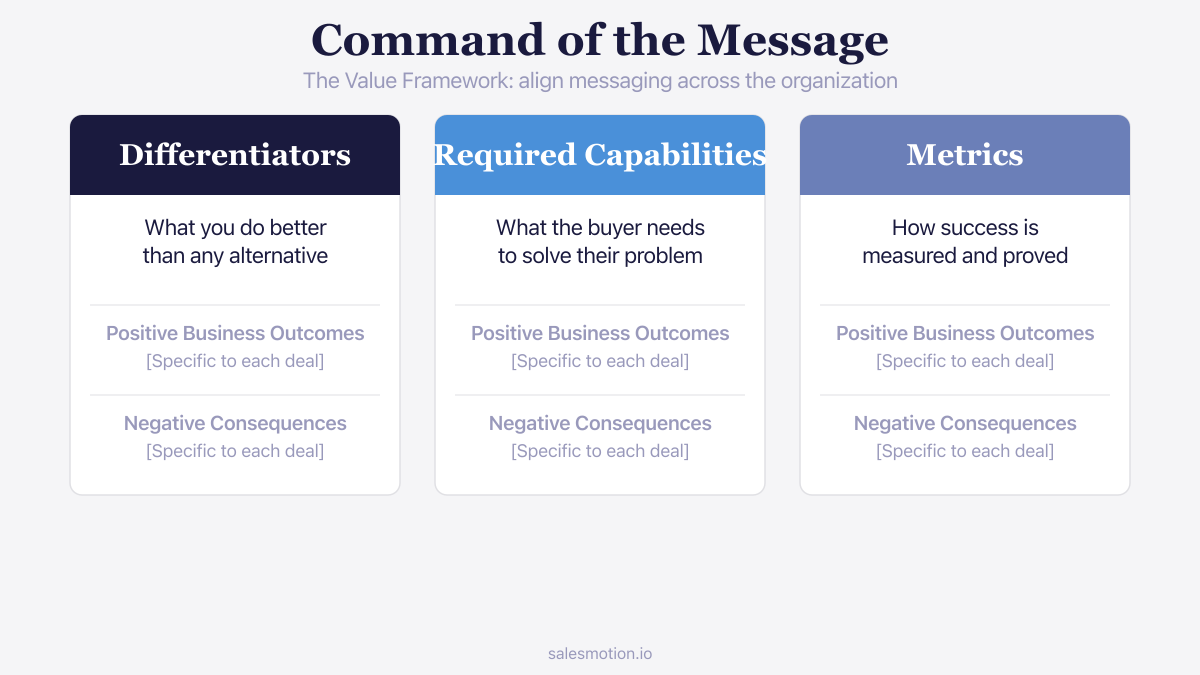 Command of the Message aligns differentiators, capabilities, and metrics into a consistent value framework.
Why It's Popular: Force Management's clients include many high-growth B2B companies, and the methodology is particularly valued by CROs who need consistency across large, distributed sales teams. It pairs well with MEDDIC for qualification and addresses the messaging gap that MEDDIC doesn't cover.
Pros:
- Creates messaging consistency across teams
- Pairs well with MEDDIC qualification
- Strong for competitive differentiation
Cons:
- Expensive to implement (Force Management consulting)
- Requires significant upfront investment in content
- Not a standalone methodology for deal management
Best For: Growth-stage companies preparing for scale that need messaging alignment across SDRs, AEs, and CSMs.
Go Deeper: Force Management Sales Methodology | Force Management
9. Solution Selling
Originally developed by Michael Bosworth in the late 1980s and formalized in his book Solution Selling (1993), this methodology pioneered the shift from product-centric to customer-centric selling.
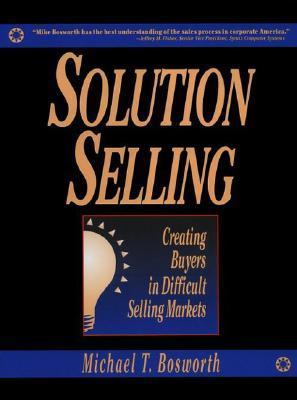 Solution Selling established the foundation for consultative, customer-centric B2B sales.
How It Works: Solution Selling trains reps to diagnose buyer problems before prescribing solutions. The process moves through three phases: Diagnose (understand the buyer's pain and its root causes), Design (collaboratively build a solution that addresses the pain), and Deliver (present the solution in terms of business outcomes, not features). Reps use "pain sheets" and "reference stories" to guide conversations.
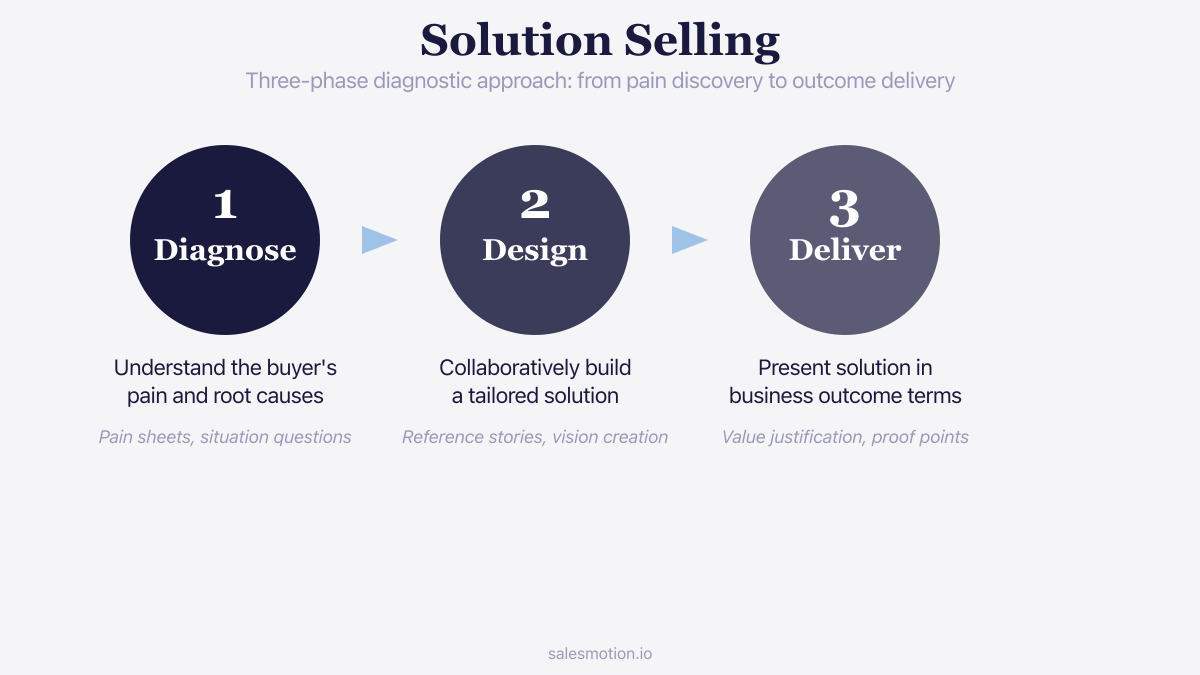 Solution Selling's three-phase approach: diagnose, design, deliver.
Why It's Popular: While newer methodologies have built on its foundation, Solution Selling remains influential because it established many concepts now considered standard: leading with pain, asking diagnostic questions, and presenting solutions in business terms rather than feature lists. Many teams practice a form of Solution Selling without even knowing it.
Pros:
- Foundational concepts still apply widely
- Easy to combine with other methodologies
- Strong emphasis on pain-based selling
Cons:
- Original framework feels dated for modern SaaS
- Doesn't address digital buying behavior
- Less structured than MEDDIC or Challenger
Best For: Teams looking for a foundational consultative selling approach they can layer with other frameworks for qualification or messaging.

“Salesmotion empowers me to cultivate a great buyer experience. I'm able to challenge prospects' thinking and be a trusted consultative seller. A major part of this is Salesmotion insights.”
Austin Friesen
Account Executive, FY25 #1 President's Club, Clari
How to Choose the Right Sales Methodology
Most teams pick a methodology for its brand name, a keynote, or what the last company used. Fit matters more. Three factors decide it: deal complexity, buyer sophistication, and team maturity.
Factor 1: Deal Complexity
| Complexity level | Characteristics | Best methodologies |
|---|---|---|
| Low | 1-2 decision makers, under $25K, under 30 days | Sandler, Straight Line |
| Medium | 3-5 stakeholders, $25K-100K, 30-90 days | SPIN, Challenger, Value Selling |
| High | 6+ stakeholders, over $100K, over 90 days | MEDDIC/MEDDPICC, Strategic Selling |
Factor 2: Buyer Sophistication
- Educated buyers who have already researched their problem need Challenger-style teaching. Discovery questions they have already answered frustrate them.
- Exploratory buyers who know something is wrong but have not found the root cause need SPIN-style question sequences.
- Mandate-driven buyers with a set problem and deadline need Value Selling that builds the business case for their internal stakeholders.
Factor 3: Team Maturity
- Early-stage teams (under 10 reps) need basic discipline: MEDDIC qualification or Sandler's upfront contracts.
- Scaling teams (10-50 reps) need a shared language for how reps engage buyers, which Challenger or SPIN provide.
- Mature teams (50+ reps, several segments) often assign different methodologies per segment: Strategic Selling for enterprise, Sandler or SPIN for faster mid-market cycles.
Best Sales Methodologies for Big Deals
For large, multi-stakeholder deals, these eight approaches come up most often. Most enterprise teams blend them: MEDDIC for qualification, SPIN for discovery, Challenger for a disruptive point of view, and an account-based overlay for their highest-value accounts.
| Method | Implementation effort | Ideal use case | Key advantage |
|---|---|---|---|
| MEDDIC / MEDDPICC | High: disciplined discovery and qualification | Complex enterprise deals with opaque buying processes | Clear economic focus; fewer late-stage surprises |
| Conceptual Selling | High: deep strategic discovery | Strategic-fit evaluations and transformational platform sales | Positions the rep as a strategic advisor |
| SPIN Selling | Medium: structured question progression | Long cycles with consensus-based decisions | Buyers build their own case for change |
| Account-Based Selling | High: sales and marketing coordination | High-value accounts that need tailored engagement | Concentrates effort on the accounts with the highest return |
| Value-Based Selling | Medium to high: financial modeling | Deals that need CFO sign-off or explicit ROI | Quantifies business impact in the buyer's KPIs |
| Challenger Sale | High: insight-led teaching | Competitive markets and complacent buyers | Creates urgency and displaces incumbents |
| Consultative Selling | High: advisory-level engagement | Complex transformations and consulting engagements | Deep credibility and long-term trust |
| SNAP Selling | Low to medium: simple messaging | Outreach to time-poor executives | Short, clear messages with easy next steps |
Make It Stick
- Put the fields in your CRM. If reps document buying influences or qualification criteria, those fields belong in Salesforce or HubSpot, not a separate document.
- Train on real deals. Apply the framework to live pipeline, not hypothetical scenarios.
- Reinforce in pipeline reviews. Use the methodology's language in every deal review.
- Measure adoption and outcomes separately. High adoption with flat win rates means the wrong methodology. Low adoption means an enablement problem, not a framework problem.
Why Every Methodology Breaks Without Live Intelligence
Every methodology on this list shares one critical assumption: reps have accurate, current information about their accounts. In practice, that assumption fails at scale.
Here's what actually happens. Reps adopt MEDDIC. They fill out qualification fields after calls. Two weeks later, the economic buyer they identified takes a new role at another company, and nobody in the organization notices. A Challenger rep prepares a teaching pitch based on the buyer's strategic priorities from last quarter's earnings call, not knowing the company just pivoted its strategy after a competitive loss.
The pattern repeats across every methodology:
- Data goes stale within weeks. Job changes, new initiatives, budget shifts, and competitive moves happen continuously. CRM fields represent a snapshot, not reality.
- Signals that matter most live outside the CRM. Hiring patterns, earnings commentary, technology adoption, leadership changes, and strategic initiatives aren't captured in Salesforce fields.
- Reps don't consistently update qualification fields. Even the most disciplined teams see CRM hygiene degrade under quota pressure.
- The spreadsheet approach collapses at 50+ accounts. Manually tracking buying signals across a territory-sized book of business is physically impossible.
Teams using Salesmotion cut account research from 60 minutes to under 5 per account, with signals automatically surfacing the context that makes any methodology actually work: who changed roles, what the company just announced, where the budget is shifting, and when the timing is right.
Operationalize your methodology across every account
Most methodologies live in PDFs. Salesmotion makes them living workflows — built into Salesforce or HubSpot, surfaced before every meeting, used by every rep.
Book a 30-min demo →Operationalizing Any Methodology with Account Intelligence
The best sales organizations don't pick a single methodology and hope reps follow it. They layer methodologies together and feed them with live data.
Here's what that looks like in practice:
Trigger: A target account posts a VP of Revenue Operations role on LinkedIn while their CEO discusses "sales transformation" on the latest earnings call.
Platform: Salesmotion's company intelligence flags both signals, surfaces the account brief with the full context: the new hire posting, the earnings commentary, recent leadership changes, and the company's stated strategic priorities.
Rep Action: The rep enters the first conversation already knowing the likely pain (operational complexity), the initiative driving it (sales transformation), and the key stakeholders involved — exactly the kind of signal-based selling motion that turns a framework into a daily habit. Instead of running generic SPIN questions, they use Challenger-style teaching to share insight about what similar companies discovered during their own transformation, then qualify the opportunity using MEDDIC criteria.
Outcome: The first meeting is a consultative conversation, not a discovery interrogation. Deal velocity increases because the rep compressed two calls into one.
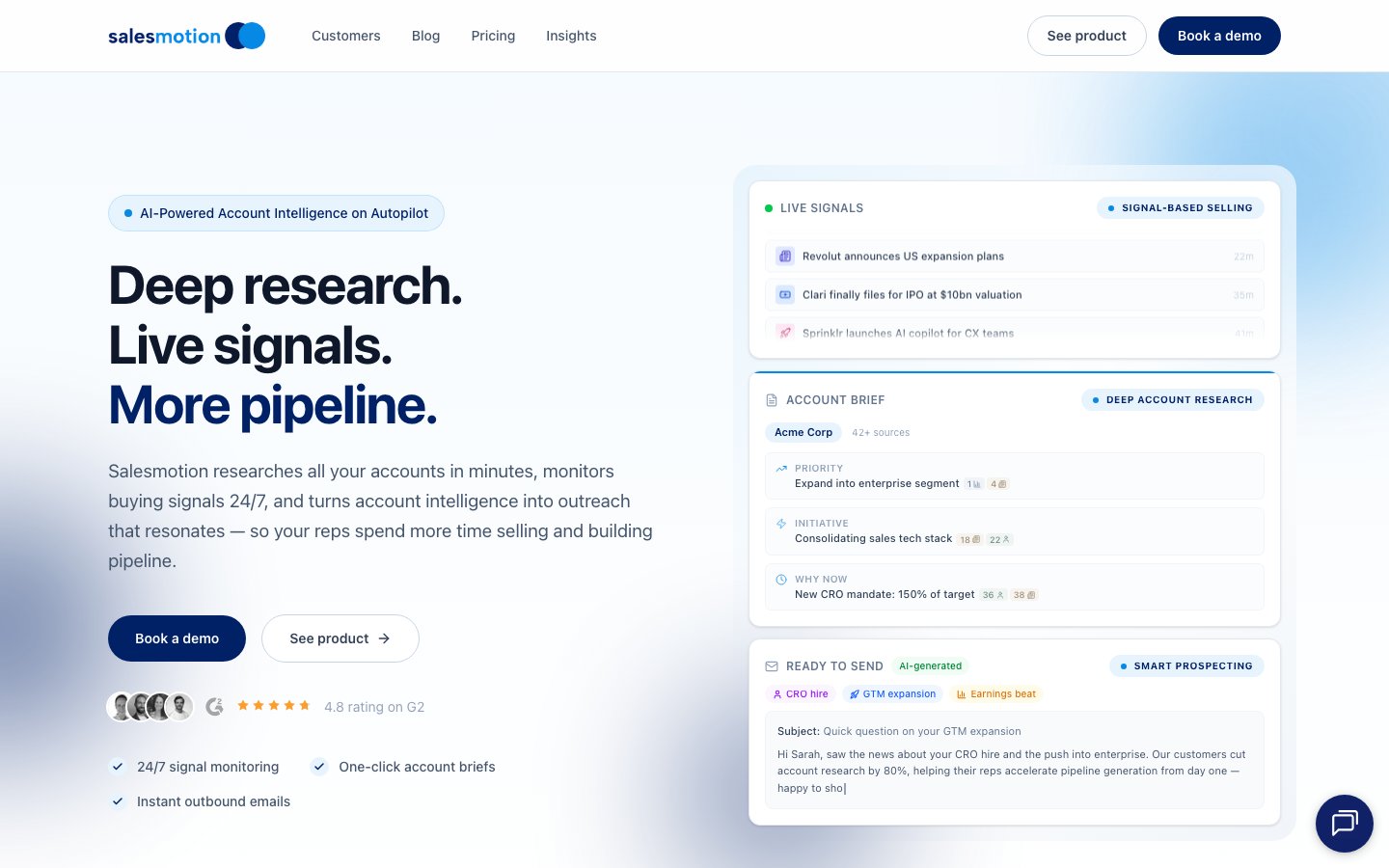 Salesmotion surfaces live signals, deep account research, and ready-to-send outreach — the intelligence layer that makes any methodology work.
This is what Analytic Partners experienced: an 85% reduction in research time per account and a 40% year-over-year increase in qualified pipeline. At Frontify, teams saw a 42% increase in sales velocity and a 35% improvement in win rates.
The methodology provides the framework. Live account intelligence provides the data that makes the framework work.
Ready to Operationalize Your Sales Methodology?
The difference between a methodology that sticks and one that gets abandoned in 90 days is the intelligence feeding it. Salesmotion gives your reps the live signals, deep account research, and AI-generated outreach they need to execute any framework — MEDDIC, Challenger, SPIN, or your own hybrid — on every account, every call. See pricing to find the right plan for your team.
Book a demo to see how teams like Analytic Partners cut research time by 85% and generated 40% more qualified pipeline.
Key Takeaways
- No methodology works without fresh data. The framework is the scaffolding. Account intelligence is the building material. One without the other produces inconsistent results.
- MEDDIC dominates enterprise SaaS for good reason: it forces the qualification rigor that prevents late-stage losses. If you sell complex, multi-stakeholder deals, start here.
- Challenger and SPIN address different problems. Challenger is for when the status quo is your main competitor. SPIN is for when discovery quality is your bottleneck.
- Layer methodologies for best results. The highest-performing teams combine a qualification framework (MEDDIC) with a messaging framework (Challenger or Command of the Message) and a discovery framework (SPIN or Gap Selling).
- Operationalize with automation. Tools like Salesmotion eliminate the manual research that causes methodology execution to break down at scale. When reps have live signals and account context before every interaction, methodology adoption becomes natural, not forced. Book a walkthrough to see how it works with your methodology.
- The best methodology is the one your team actually uses. Adoption matters more than perfection. Pick the framework that fits your deal complexity and sales cycle, train aggressively, and reinforce with data.
Related Reading
- B2B marketing KPIs — the upstream metrics that prove your methodology is converting pipeline into revenue.
- Account management strategies — extending whichever methodology you pick into post-sale expansion.
- What is a trigger event? — the live signals that decide which methodology lever to pull and when.
- Best sales enablement platforms: the content, coaching and readiness tools teams use to roll a methodology out and keep it in use.
- Best enterprise sales tools: the stack behind multi-stakeholder deals, from account research to forecasting.
Frequently Asked Questions
What is the most widely used sales methodology in enterprise B2B?
MEDDIC/MEDDPICC is the most widely adopted methodology in enterprise B2B SaaS, particularly for deals with average contract values above $50K. Korn Ferry's research shows that organizations with dynamic methodology adoption see 27% higher win rates. Challenger and Miller Heiman Strategic Selling are also widely used, especially in industries with longer sales cycles and larger buying committees.
Can you combine multiple sales methodologies?
Yes, and top-performing teams usually do. The most common combination is MEDDIC for qualification, Challenger or Command of the Message for positioning, and SPIN or Gap Selling for discovery. The key is defining which methodology governs which part of your sales process. Using MEDDIC for qualification fields in your CRM while training reps on Challenger messaging creates a comprehensive system without conflict.
How long does it take to implement a new sales methodology?
Most organizations see initial adoption within 60-90 days, but meaningful behavior change takes 6-12 months. The biggest implementation risk isn't training, it's reinforcement. According to Korn Ferry, only 30% of organizations follow a formal methodology consistently. Research shows that 73% of sales framework implementations fail within 90 days without daily reinforcement. Build methodology checks into deal reviews, pipeline meetings, and QBRs for sustained adoption.
What's the difference between a sales methodology and a sales process?
A sales process defines the stages a deal moves through: prospecting, discovery, proposal, negotiation, close. A sales methodology defines how reps execute within each stage: what questions to ask, how to qualify, how to position value, and how to advance. Process is the "what" (sequential steps). Methodology is the "how" (tactical approach). You need both. A process without a methodology is a checklist. A methodology without a process has no structure.
Which sales methodology works best for complex, high-value deals?
For deals over $100K with multiple stakeholders and 6+ month sales cycles, MEDDIC/MEDDPICC combined with Miller Heiman Strategic Selling provides the strongest framework. MEDDIC ensures you qualify rigorously, while Miller Heiman's buying influence mapping helps you navigate complex buying committees. Adding Command of the Message for consistent value articulation rounds out the approach for enterprise-grade deals.