Most reps think they sell solutions. They don't. They sell features and hope a problem shows up to justify them. Solution selling flips that order. It starts with the buyer's pain, develops that pain into something the buyer can feel and measure, then builds a vision of the future where the pain is gone. The product comes last, not first. Done right, solution selling turns a vendor into a guide and a price tag into an obvious decision.
TL;DR: Solution selling is a pain-first methodology: you diagnose latent pain the buyer has accepted as normal, develop it into admitted pain with real cost, and co-create a vision of a solution before you ever position your product. The classic tools are the pain chain, the nine-box vision-creation model, and a deliberate hunt for the economic buyer and your champion. It evolved because buyers got smarter, but its core discipline (sell the problem, not the product) is more relevant in 2026 than ever.
What Is Solution Selling?
Solution selling is a sales methodology where the rep diagnoses and develops a buyer's business pain before presenting any product, then guides the buyer to a vision of how that pain gets solved. The product is the answer to a problem the buyer now fully understands, not the opening pitch.
The methodology was formalized by Michael Bosworth in the 1980s and later expanded by Keith Eades in The New Solution Selling. It emerged as a reaction to feature-led selling, which assumed that if you described enough capabilities, a buyer would self-diagnose and connect the dots. They rarely did. Solution selling argued the opposite: the rep does the diagnosis, and the buyer buys because they finally see their problem clearly and believe it can be fixed.
That reframing is why solution selling sits at the root of nearly every modern sales methodology. Consultative selling, gap selling, and value selling all inherit its central move: lead with the problem, earn the right to talk about the product. The difference between a rep who closes complex deals and one who stalls is usually not product knowledge. It is diagnostic discipline.
There is a pattern we see across sales teams that proves the point. Wins rarely trace back to outbound volume. They trace back to a compelling trigger event, an executive sponsor, or a warm referral, in other words, a moment where pain became visible and someone with power decided to act. Solution selling is the discipline of manufacturing that moment on purpose instead of waiting for it.
See Salesmotion on a real account
Book a 15-minute demo and see how your team saves hours on account research.
Latent Pain vs. Active Pain: The Diagnosis That Decides the Deal
The single most important distinction in solution selling is between latent pain and active pain. Latent pain is a problem the buyer has, but has accepted as normal or unsolvable. Active pain is a problem the buyer is actively trying to fix and has budget to address. Most reps only know how to sell to active pain, which is why they fight over the same in-market 3% of accounts.
The buyers worth pursuing are usually in latent pain. They have learned to live with the friction. They do not have a project, a budget line, or an RFP. They have a workaround and a shrug. Your job is to develop that latent pain into admitted, active pain, the kind that justifies spending money.
Here is the progression every solution-selling deal has to move through:
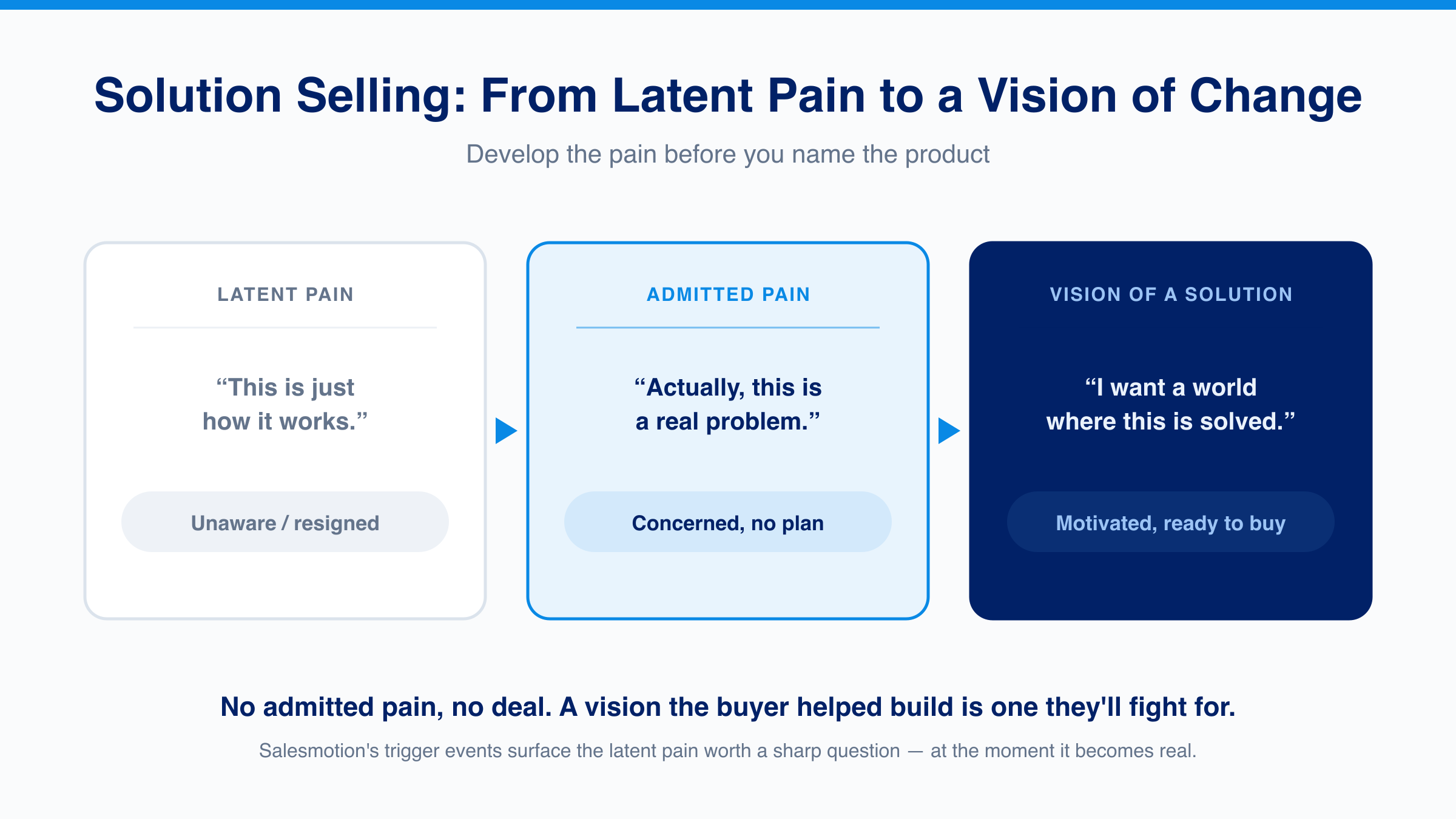 Solution selling moves a buyer from latent pain to a vision they helped build — develop the pain before you name the product.
The table below breaks down what happens at each stage:
| Stage | What the buyer believes | What the rep does | Buyer's mental state |
|---|---|---|---|
| Latent Pain | "This is just how it works. Nothing to fix." | Surface the problem with a sharp, specific question or a relevant trigger | Unaware / resigned |
| Admitted Pain | "Actually, yes, this is a real problem." | Develop the pain: quantify cost, expose root cause, widen the impact | Concerned, but no plan |
| Vision of a Solution | "I can picture a world where this is solved, and I want it." | Co-create the vision before naming your product | Motivated, ready to evaluate |
Solution selling moves a buyer from resigned acceptance to active demand by developing latent pain into admitted pain, then into a vision of the solution, all before the product enters the conversation.
The discipline is patience. Reps lose deals by jumping from latent pain straight to the demo, skipping the development entirely. The buyer hears a feature pitch for a problem they have not yet agreed is worth solving, and politely passes. Develop the pain first. The vision, and the budget, follow.

“The talking points are gold. If they're in Salesmotion, I know they're being discussed inside that business. That makes it easy to spark a real conversation, which is 90 percent of the battle.”
Andrew Giordano
VP of Global Commercial Operations, Analytic Partners
The Pain Chain: How One Person's Problem Becomes the Company's Problem
The pain chain is solution selling's tool for connecting a single person's frustration to a business-wide consequence that an executive will fund. A symptom one rep feels rolls up to a metric a VP owns, which rolls up to a number the CFO is accountable for. The deal gets funded at the top of the chain, not the bottom.
A user-level pain ("I waste hours every week pulling account data from five tools") feels minor to a CFO. But trace it up the chain and it changes shape. Hours lost per rep becomes reduced selling capacity, which becomes lower pipeline coverage, which becomes a missed revenue target. Now the same problem has a number an executive cares about.
Building the pain chain forces three moves:
- Identify who feels each level of the pain. The end user, their manager, the function leader, the executive. Each experiences a different face of the same problem.
- Connect symptom to business impact. The user's wasted time is the executive's missed quota. Make that line explicit.
- Quantify at the highest level you can reach. A user pain measured in hours is a complaint. The same pain measured in lost revenue is a business case.
This is also how solution selling protects you from single-threading. A pain that only your champion feels dies when your champion goes quiet. A pain chain that reaches the economic buyer gives the deal a sponsor who controls budget and a reason that survives a champion's departure. Mapping that chain is the same discipline behind any rigorous lead qualification framework: you are not just qualifying a person, you are qualifying a consequence.
Vision Creation and the Nine-Box Model
Vision creation is the heart of solution selling, and the nine-box model is its engine. The idea: before you pitch anything, you help the buyer construct a mental picture of a capability that solves their pain. Because they helped build that vision, it feels like theirs, not yours.
The nine-box vision-processing model gives reps a structured way to run that conversation. It crosses three exploration types (diagnose the reasons, explore the impact, visualize the capability) with three question styles (open, control, confirm). The result is a grid of nine question moves that walk a buyer from "I have a vague problem" to "here is exactly what I need a solution to do."
In practice, you do not recite all nine boxes. You move through three phases:
- Diagnose reasons. "What's causing the delay in your account research today?" You establish the root cause, not just the symptom.
- Explore impact. "When research takes three hours per account, what does that do to the number of accounts a rep can actually work?" You widen the pain across the business.
- Visualize capability. "If a rep could open a brief with the leadership changes, earnings commentary, and buying signals already assembled, would that change how many accounts they could cover?" You let the buyer describe the solution in their own words.
By the time you demo, the buyer has already told you what they need the product to do. You are not pitching. You are confirming a vision they built. That is why solution-selling demos convert: the buyer pre-sold themselves. It is the same insight-led discipline that underpins consultative selling, where asking out-converts pitching every time.
There is a failure mode worth naming. We see a pattern across sales teams where demos happen far too early, in front of curious juniors instead of the people who own the pain. A demo before vision creation is a demo to the wrong audience at the wrong time. It teaches a junior how your product works, not why their executive should buy it.
“The Business Development team gets 80 to 90 percent of what they need in 15 minutes. That is a complete shift in how our reps work.”
Andrew Giordano
VP of Global Commercial Operations, Analytic Partners
Champions, Power, and Why Solution Selling Needs Both
Solution selling does not just diagnose pain, it diagnoses people. Two roles decide the deal: the champion who sells for you internally, and the economic buyer who controls the money. A vision without a champion has no advocate. A champion without access to power has no budget. You need both, and you need to know which you have.
A champion is someone who feels the pain personally, believes in your vision, and has the internal credibility to push it forward. You do not appoint champions, you develop them by making them look smart and helping them win something they care about. The pain chain is your tool here: show your champion how solving the problem advances their own goals, and they will carry the deal into rooms you will never enter.
The economic buyer is the person who can release budget. In solution selling, reaching them is non-negotiable, because vision and budget live in different heads. Your champion creates the vision internally; the economic buyer funds it. If you have only ever spoken to users, you have a deal that feels alive but cannot close.
This is where solution selling intersects with stakeholder mapping methodologies like Miller Heiman's Strategic Selling. Solution selling tells you what pain to develop. Strategic Selling tells you who has to agree. The strongest enterprise reps run both: develop a quantified pain chain, then map it onto the economic buyer, the champion, and the blockers who could stall the deal.
Why Solution Selling Evolved, and What Survived
Solution selling came under fire in the 2010s, most famously from The Challenger Sale, which argued that empowered buyers no longer needed a rep to diagnose their problems. By the time a buyer engaged, the data said, they were already 57% through their purchase decision and had self-diagnosed. The conclusion: classic solution selling was dead.
That conclusion was half right. What died was the passive version, the rep who waited for a buyer to surface an admitted pain and then "solutioned" it. Buyers really did get better at self-diagnosis for obvious problems. But that critique missed the harder cases: latent pain the buyer has not recognized, and problems too complex for the buyer to diagnose alone. Those still need a rep who can develop pain and build vision.
What survived, and got stronger, is the core discipline:
- Lead with the problem, not the product. More true now that buyers tune out feature pitches faster than ever.
- Develop latent pain. The accounts not already in-market are where the pipeline actually is.
- Build the pain chain to power. Self-serve buyers still cannot release enterprise budget without an executive sponsor.
- Co-create vision. A buyer who self-diagnoses the obvious still needs help visualizing a solution to the non-obvious.
Modern solution selling is not the 1980s script. It is faster, more research-driven, and more dependent on timing. Which is exactly where it breaks at scale.
Why Solution Selling Breaks at Scale
Solution selling is brilliant on a single deal and brutal across a whole team. The methodology assumes the rep arrives already knowing the account's pain, the people who feel it, and the moment the pain became acute. Most reps know none of that before discovery, so they default to pitching, the exact behavior solution selling was built to kill.
To diagnose latent pain, you need to know the account's initiatives, leadership changes, earnings commentary, hiring patterns, and competitive pressure. To time the conversation, you need to know when a trigger event made the pain active. To build the pain chain, you need to know who owns each metric. Gathering that for one account by hand takes hours. Gathering it for fifty, every week, as it changes, does not scale.
Solution selling also decays. A pain you diagnosed in January is stale by March, because the buyer's initiatives, budget, and leaders have moved. The methodology assumes fresh, account-specific intelligence, but that intelligence lives outside the CRM and goes out of date within weeks. The spreadsheet approach works for ten accounts. It collapses at fifty.
This is the real reason solution selling fails on most teams. It is not that reps reject the framework. It is that they cannot feed it. The diagnosis is only as sharp as the intelligence behind it, and gathering that intelligence manually does not scale past a handful of accounts.
How Salesmotion Operationalizes Solution Selling
Solution selling needs three things to work across a team: timing (when did the pain become active), context (what is the account's latent pain), and reach (who owns the impact). Signal-based selling supplies all three, turning the methodology from a quarterly workshop into a daily workflow.
Salesmotion continuously monitors buying signals across 1,000+ public and private sources: leadership changes, earnings commentary, hiring patterns, funding, product launches, and competitive moves. These signals are latent pain becoming visible. A new VP of Revenue Operations is a pain chain forming in real time. An earnings call mentioning a "sales transformation initiative" is admitted pain, announced publicly, before any rep makes a call.
Here is the workflow in practice:
- Trigger. A target account posts a VP of Sales Operations role and mentions "improving sales productivity" on its earnings call.
- Platform action. Salesmotion flags the account and assembles the brief: the leadership change, the stated initiative, the metrics the company is under pressure to move, and the likely economic buyer.
- Rep action. The rep enters discovery already knowing the latent pain, the business impact, and who owns it. Diagnosis and pain-chain mapping are half done before the call.
- Outcome. Instead of a feature demo to a junior, the first conversation is a pain-development discussion with someone who owns the metric. The buyer co-creates the vision, and the deal moves because the rep showed up as a diagnostician, not a vendor.
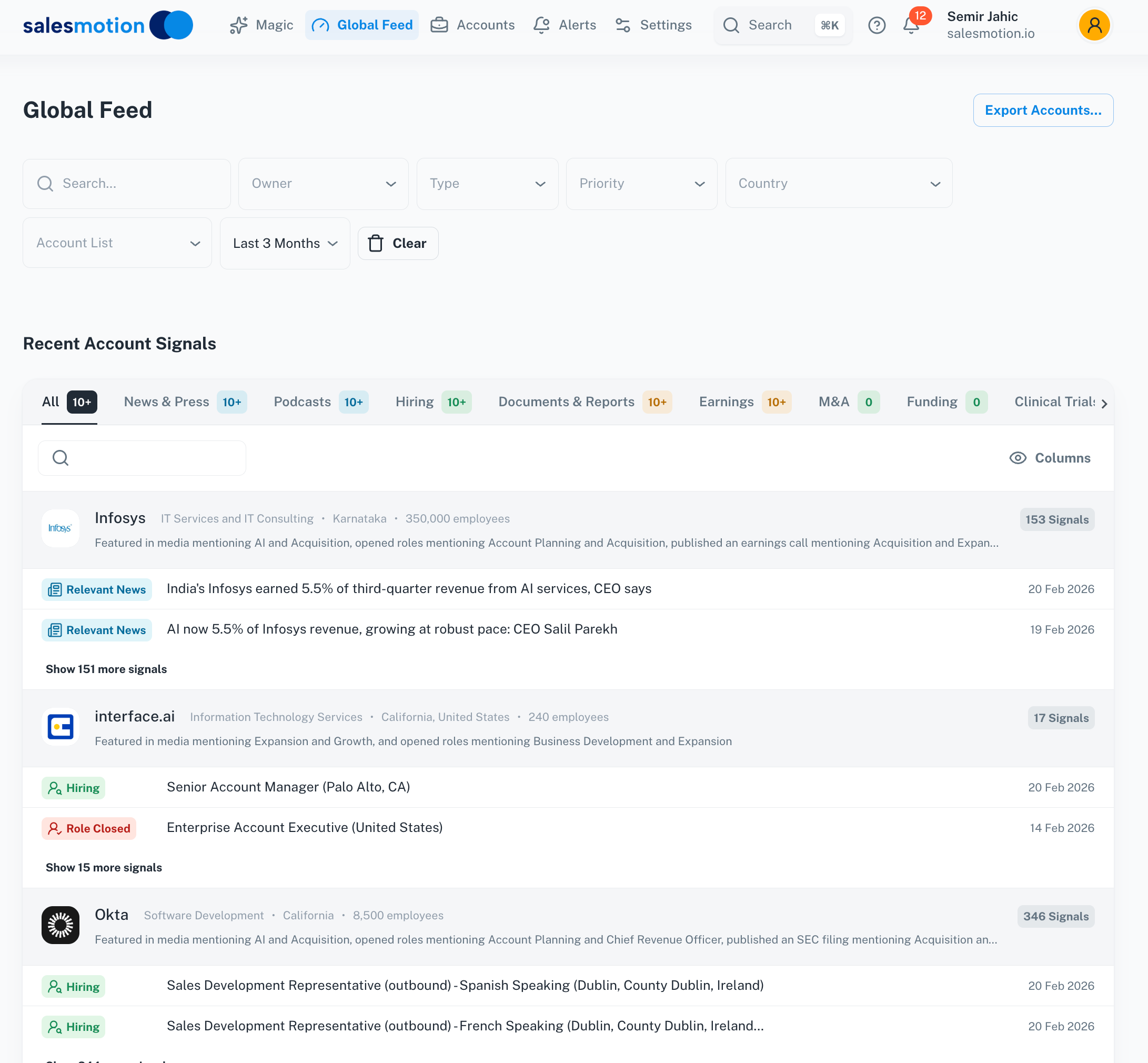 A live signal feed surfaces the moment a buyer's latent pain becomes active, so reps run pain-development discovery at the right time instead of pitching cold.
The lever that closes these deals is always the same: tying the methodology to a timely trigger event and the specific person it affects. That is the difference between a generic pain pitch and a diagnosis a buyer cannot ignore. One marketing analytics team using this approach cut account research from three hours to 15 minutes and grew qualified pipeline 40% year over year, because every rep walked in already knowing the pain to develop. See how it works on a real account.
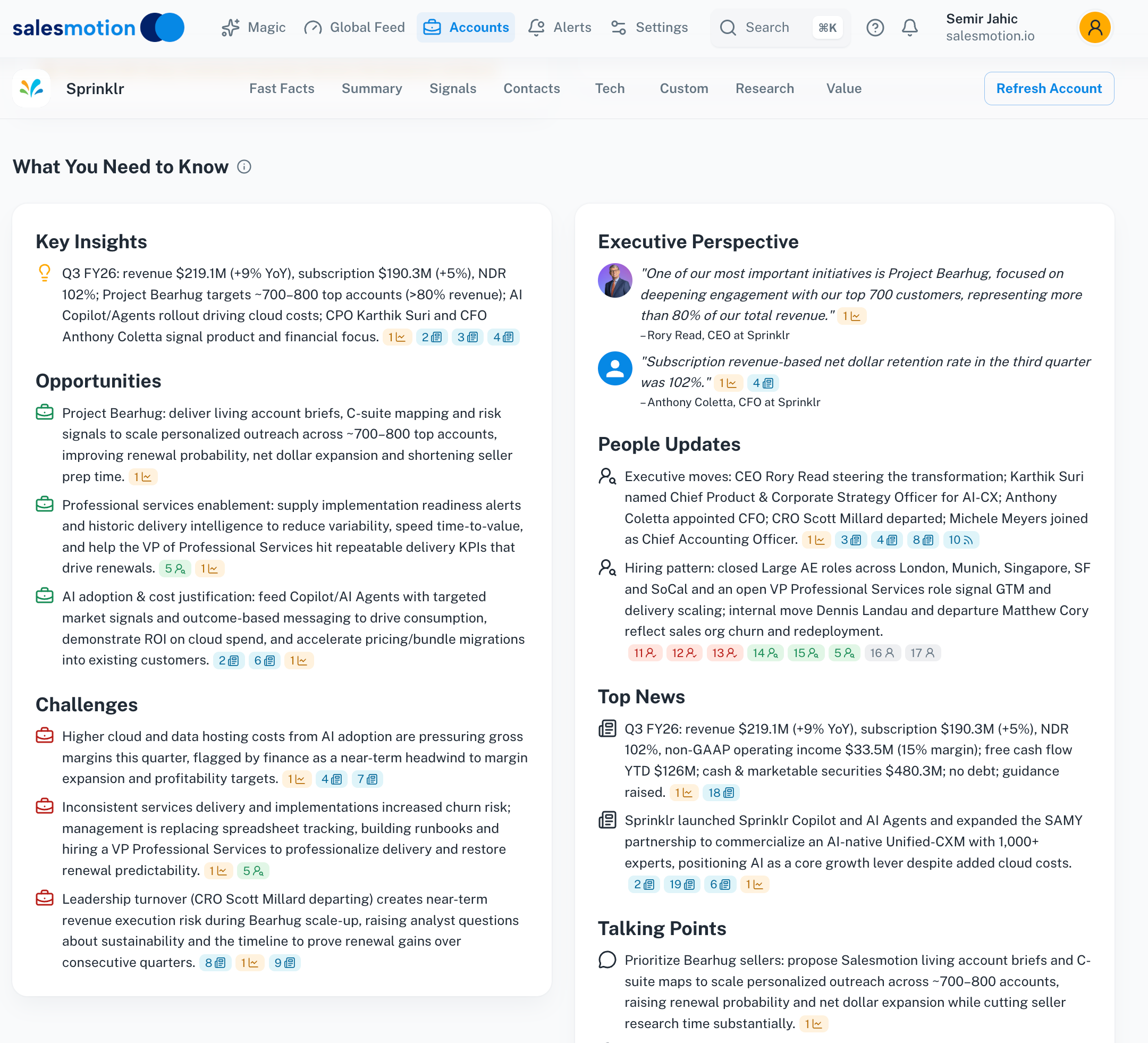 The account brief surfaces an account's initiatives and pressures, the raw material for diagnosing latent pain and building the pain chain to the economic buyer.
That is solution selling at scale: pain diagnosis fed by live intelligence, run on every account, not just the ten your best rep has time to research by hand.
Key Takeaways
- Solution selling is pain-first: diagnose the buyer's pain, develop it, and co-create a vision of the solution before you ever position your product.
- The decisive skill is converting latent pain (a problem the buyer accepts as normal) into admitted, active pain with real cost, which is where most of the addressable pipeline actually lives.
- The pain chain connects one person's symptom to a business consequence an executive will fund, protecting you from single-threading and reaching the budget holder.
- Vision creation, run through the nine-box model, gets the buyer to describe the solution in their own words, so the demo confirms a vision they built rather than pitching one they did not ask for.
- Solution selling needs both a champion (who sells internally) and the economic buyer (who controls budget), because vision and money live in different heads.
- The methodology breaks at scale because diagnosis depends on fresh, account-specific intelligence that decays within weeks. Signal-based account research keeps pain diagnosis timely across the whole territory.
Frequently Asked Questions
What is solution selling in simple terms?
Solution selling is a sales methodology where you diagnose and develop a buyer's business pain before presenting any product. You uncover latent pain the buyer has accepted as normal, develop it into admitted pain with measurable cost, and help the buyer build a vision of how it gets solved. The product is positioned last, as the answer to a problem the buyer now fully understands. It was formalized by Michael Bosworth and expanded by Keith Eades in The New Solution Selling.
What is the difference between latent pain and active pain?
Latent pain is a problem the buyer has but has accepted as normal, with no budget or project to fix it. Active (admitted) pain is a problem the buyer is actively trying to solve and has resources to address. Most reps only sell to active pain, which is why they compete for the same in-market accounts. The skill in solution selling is developing latent pain into active pain, which opens up the much larger pool of accounts not yet shopping.
How is solution selling different from consultative selling?
They overlap heavily and share a problem-first philosophy. Solution selling is the more structured parent methodology, with specific tools like the pain chain, the nine-box vision model, and a defined progression from latent to active pain. Consultative selling is the broader posture of acting as a trusted advisor through disciplined discovery and insight. In practice, solution selling gives you the diagnostic framework, and consultative selling describes the relationship stance you hold while running it.
Is solution selling still relevant in 2026?
Yes. The critique from The Challenger Sale killed the passive version, where reps waited for buyers to surface an obvious problem. But the core discipline (lead with the problem, develop latent pain, build a pain chain to the economic buyer) is more relevant now that buyers ignore feature pitches faster than ever. The bigger challenge today is execution: modern solution selling depends on fresh account intelligence and buying signals to know when pain is active and who owns it.
What is the pain chain in solution selling?
The pain chain is a tool that links one person's symptom to a business-wide consequence an executive will fund. A user's wasted hours roll up to reduced selling capacity, which rolls up to lower pipeline coverage, which rolls up to a missed revenue target the CFO owns. Building the chain forces you to identify who feels each level of the pain and to quantify it at the highest level you can reach, which is how you reach the budget holder and avoid single-threading the deal.