Your CRM is your revenue team's command center, but if it's running on incomplete or outdated information, it's leaking revenue. A data enrichment CRM strategy is what transforms a basic contact list into a powerful collection of actionable account profiles. It’s the difference between guessing what your customers need and knowing exactly how to solve their problems.
Why Your CRM Is Leaking Revenue Without Data Enrichment
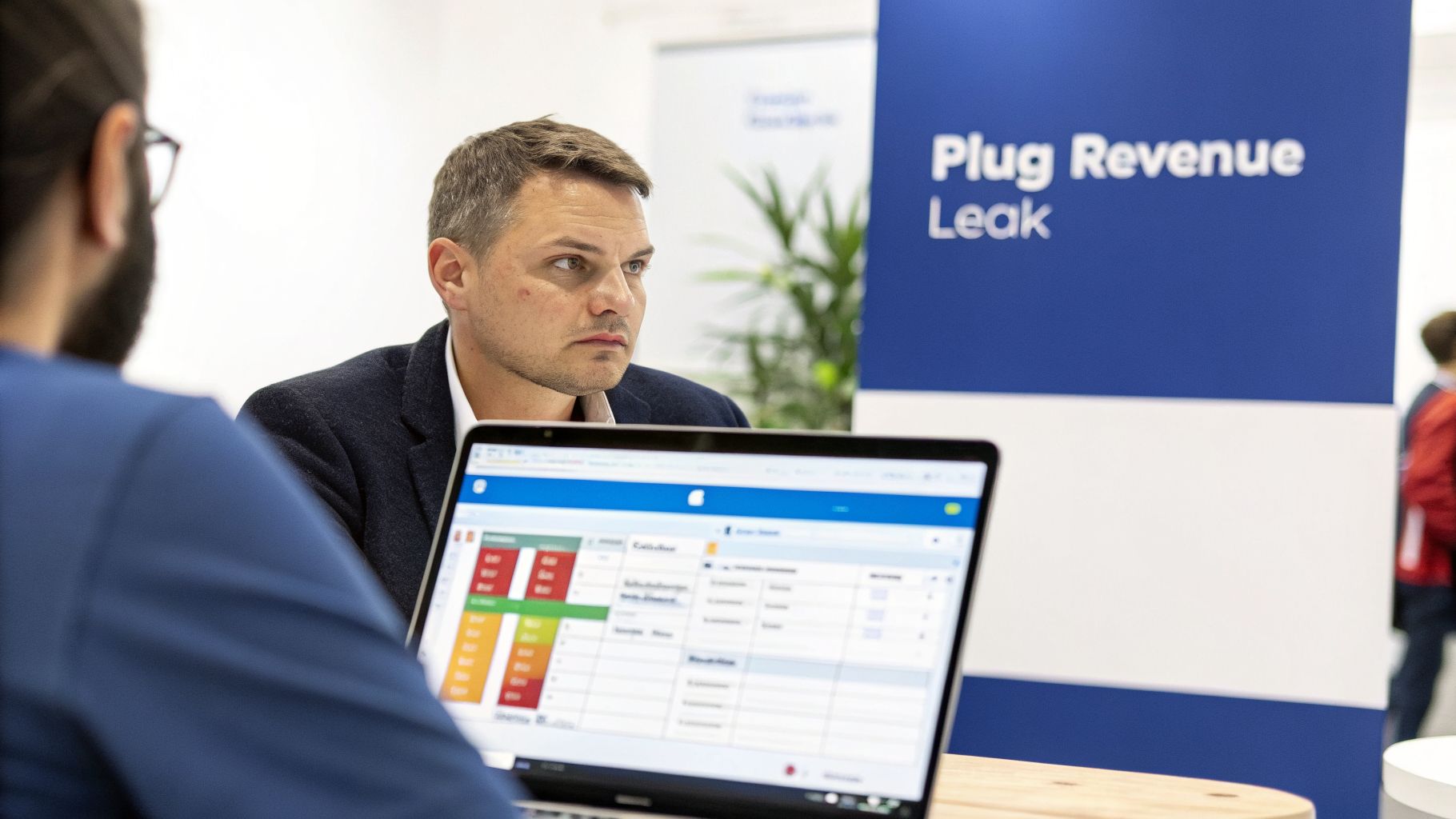
Think of your customer relationship management (CRM) system as a high-performance engine. You can't fuel it with low-quality data and expect peak performance. When data is poor, your sales reps waste hours on manual research, marketing campaigns miss their targets, and revenue opportunities slip through the cracks. This isn’t just an operational headache—it’s a direct drain on your bottom line.
The core problem is that raw CRM data—often just a name, email, and company—lacks the context needed for modern B2B selling. It’s like giving your sales team a blurry photo of a prospect when they need a full HD profile to understand who they're talking to.
The Real Cost of Bad Data
Bad data creates significant financial and operational drag. Every minute a sales rep spends digging for a contact’s correct job title or a company’s recent funding news is a minute they aren't selling. Many companies get bogged down by the sheer effort of these manual tasks, which is why adopting a robust Data Enrichment CRM solution has become so essential.
This wasted effort scales across your entire revenue team, leading to:
- Inefficient Outreach: When reps only have generic information, they’re forced to use generic messaging. The result? Low engagement and even lower reply rates.
- Missed Opportunities: Without real-time intelligence, your team can't jump on crucial buying signals like a new executive hire or a company's expansion plans.
- Flawed Strategy: Inaccurate data leads to poor segmentation, mismatched territory planning, and unreliable forecasting, undermining your entire go-to-market strategy.
The financial impact is staggering. Studies show that poor data quality costs organizations an average of $13 million annually due to wasted efforts and missed opportunities.
The High Cost of Data Gaps in Your Sales Funnel
This table breaks down the tangible business impact of poor CRM data versus the benefits of a solid enrichment strategy. It’s a clear before-and-after snapshot.
| Sales Activity | Without Data Enrichment (The Problem) | With Data Enrichment (The Solution) |
|---|---|---|
| Lead Routing | Leads are assigned based on incomplete data, causing misaligned territories and poor rep-to-lead fit. | Leads are automatically routed to the right rep based on accurate territory, industry, and company size data. |
| Outreach | Reps use generic templates, resulting in low reply rates and wasted effort. | Outreach is hyper-personalized with relevant context about the prospect’s role, company, and tech stack. |
| Prioritization | Reps treat all leads equally, spending time on low-quality prospects who will never convert. | Reps focus on high-fit accounts showing real buying intent, increasing productivity and pipeline velocity. |
| Forecasting | Forecasts are based on guesswork and incomplete opportunity data, leading to missed targets. | Forecasts are built on reliable, complete data, improving accuracy and business predictability. |
The upside of getting this right is just as significant. Research shows that companies with clean, enriched data can see up to a 66% increase in revenue. This boost is supported by a 20% improvement in campaign response rates and a 15% lift in sales close rates within just six months of implementing a data strategy.
Ultimately, data enrichment is the antidote to weak outreach and inefficient sales cycles. Maintaining excellent CRM hygiene is the first step toward plugging these revenue leaks for good. By automatically adding layers of firmographic, technographic, and intent data, you empower your team to stop guessing and start engaging with precision.
See Salesmotion in action
Take a self-guided interactive tour — no signup required.
What Does CRM Data Enrichment Really Mean?

Let's cut through the buzzwords. At its core, CRM data enrichment is the process of taking your raw, basic customer data and layering it with valuable external information. It’s about adding context that turns a simple contact record into a rich, three-dimensional customer profile.
Think of your CRM contacts as simple sketches—just names and emails. Data enrichment adds the color, texture, and background details, turning those sketches into fully realized portraits that tell a complete story. This process transforms your CRM from a passive address book into an active intelligence hub. It’s no longer just about who your customers are, but what they do, what they need, and when they are most likely to buy.
From Basic Records to Actionable Intelligence
Effective data enrichment isn’t about piling on random facts; it’s about strategically adding specific information that is critical for B2B revenue teams. Instead of just knowing a company’s name, you gain a deep understanding of their entire business context. For a deeper look at these concepts, check out our guide on B2B data enrichment and its strategic uses.
The most valuable data types fall into a few key categories:
- Firmographics: This is your foundational business data—company size, annual revenue, industry (like NAICS/SIC codes), location, and number of employees. It’s the fastest way to confirm if an account fits your ideal customer profile (ICP).
- Technographics: This is a game-changer. It reveals the technology stack a company uses. Knowing if a prospect uses a competitor's product or complementary software gives your sales team a powerful angle for a truly personal conversation.
- Buying Intent Signals: These are the behavioral breadcrumbs that show an account is actively researching solutions like yours. This could be a spike in online research on certain topics, a visit to your pricing page, or a recent C-level hire in a key department.
With this layered information, a sales rep doesn't just see "Jane Doe at Acme Corp." They see Jane Doe, a VP of Engineering at a 500-person SaaS company that just landed Series B funding and is actively hiring software developers—a crystal-clear signal that they may need new tools.
The Unseen Enemy: Data Decay
Here’s the hard truth about CRM data: it doesn't stay fresh for long. This natural process is called data decay, and it happens much faster than most people realize. In fact, research indicates that business contact data decays at a rate of nearly 30% per year.
People change jobs, companies get acquired, phone numbers are updated, and new offices open. A contact that was perfectly accurate last quarter might be completely useless today, sending your outreach straight to a bounce-back.
This is exactly why data enrichment can't be a one-time project. A one-off cleanup is like taking a single snapshot of a moving train; the information starts aging the second the process is complete.
True CRM data enrichment must be a continuous, always-on process. It ensures your team is always working with the most current, accurate, and relevant information available. This ongoing refresh is the bedrock of any modern, high-performing sales motion, empowering your reps to act with confidence and precision.

“Salesmotion is instrumental in helping me prioritize net-new accounts, understand their strategic initiatives, and cover more ground. With a lot of green-field accounts, I'm heavily leaning on the AI insights to tier my accounts and focus my time. The platform is incredibly intuitive and easy to use.”
Rob Webster
Enterprise Account Executive, Synthesia
Choosing Your Enrichment Strategy: Batch vs. Continuous
So, you're ready to get serious about data enrichment. The next big question is how to do it. This isn't just a technical detail—the approach you choose will either give your team a firehose of timely intelligence or leave them acting on old news.
The two main paths are batch enrichment and continuous enrichment.
Think of batch enrichment like taking a high-resolution photo of your entire database. It’s a powerful way to get a single, comprehensive update. You export your CRM data, run it against a provider's database, and then re-import it, now cleaned and complete. It’s perfect for a big, one-time cleanup or a quarterly data health check. But just like a photo, the moment it's taken, the data starts to get old.
The Power of Batch Enrichment for Foundational Cleanup
For many companies, a batch process is the perfect place to start. It’s the best way to fix systemic data problems and set a clean baseline to build upon.
Key uses for batch enrichment include:
- Initial Data Audit and Cleanup: If you're inheriting a messy CRM or have never tackled data quality, a batch update is the most efficient way to standardize records, fill gaps, and purge outdated contacts.
- Segment-Specific Projects: Got a new campaign for a specific list of target accounts? Run a batch process on just that segment to ensure your messaging is built on accurate firmographics.
- Cost-Effective Refresh: For data points that don’t change often (like a company's founding year or main industry), a scheduled batch update is a smart, economical choice.
This approach gives you a solid foundation. But for B2B revenue teams in fast-moving markets, relying only on periodic snapshots means you're always reacting to what already happened. This is where continuous enrichment completely changes the game.
Continuous Enrichment: The Live Intelligence Feed
If batch enrichment is a snapshot, continuous enrichment is a live video feed streamed directly into your CRM. It’s an always-on process that constantly scans for critical buying signals and updates your records in near real-time. This dynamic approach isn't a luxury anymore—it’s the engine that powers modern, relevant B2B sales.
The market reflects this shift. The global data enrichment market reached $2.37 billion in 2024 and is projected to hit $4.58 billion by 2030. This explosive growth shows a fundamental change: companies now see live data quality as a competitive must-have. You can discover more insights about this growth on Introspective Market Research.
Continuous enrichment does more than just update a contact’s job title. It alerts your team to trigger events that signal opportunity, like:
- A target account receiving a new round of funding.
- A key executive joining or leaving a company.
- A competitor announcing a product issue or a major strategic change.
- A company launching a major hiring spree or expanding into a new market.
By streaming this context directly into your CRM, you arm your sales reps with a powerful "why now" for every interaction. They're no longer acting on information that's weeks or months old; they're engaging with prospects based on what's happening today.
For instance, a continuous enrichment tool would instantly flag that a target account just hired a new CRO. Your rep can then craft a timely, hyper-relevant outreach congratulating them and connecting that event to a business challenge you can solve. This turns what would have been a cold call into a warm, strategic conversation. Batch enrichment cleans up what you already have. Continuous enrichment tells you where to go next.
Turning Enriched Data Into Deal-Winning Insights
Having a CRM filled with enriched data is a great start, but information without application is just noise. The real magic happens when your revenue team learns to translate these rich data points into deal-winning strategies. This is where a continuous data enrichment CRM moves beyond simple data quality and becomes a true account intelligence engine.
It’s about turning signals into action. An alert about a new funding round is just a fact. A sales play that uses that funding news to highlight a specific business pain? That’s a strategy. This process transforms your reps from generic sellers into trusted advisors who arrive with timely, relevant insights from the very first touchpoint.
From Trigger Events to Actionable Sales Plays
A trigger event is any new piece of information that signals a potential opportunity at a target account. With a continuous enrichment platform, these triggers are delivered directly into your team's workflow. The key is to have a playbook that turns each type of trigger into a specific, repeatable action.
Let's look at a concrete example. Your continuous enrichment tool flags that a target account, "Innovate Inc.," just announced its expansion into Europe.
- The Signal: Innovate Inc. is expanding to the EU.
- The "So What?": Expansion creates complexity. They'll face new regulatory hurdles, need to scale operations, and likely hire new regional leadership.
- The Actionable Sales Play: Your rep initiates an outbound sequence that bypasses generic "checking in" emails. The first touchpoint is an email with the subject line, "Congrats on the EU expansion - a thought on scaling compliance." The email body directly connects your solution to the specific challenges of international growth.
This approach immediately establishes credibility and relevance. You're not just selling a product; you're offering a solution to a problem you know they're facing right now.
Powering Rapid Meeting Preparation
How much time do your reps spend on last-minute meeting prep? It's a common pain point: scrambling across LinkedIn and news sites minutes before a call. A modern data enrichment CRM automates this research, delivering a concise, actionable brief.
Imagine a rep has a discovery call with a new VP of Operations. Instead of frantic manual research, the system automatically provides:
- Key Initiatives: A summary of recent company announcements related to operational efficiency.
- Relevant Background: The VP's previous roles and accomplishments, pulled from their updated profile.
- Potential Pain Points: Insights derived from recent news, such as a competitor's market share gain, suggesting a need for a competitive edge.
- Compelling Talk Tracks: Pre-built questions that directly link the VP’s role and the company’s initiatives to your value proposition.
This automated briefing doesn't just save time—it changes the quality of the conversation. Reps walk into meetings armed with the exact context needed to ask smarter questions, build immediate rapport, and steer the discussion toward value. This transforms sales calls from interrogations into strategic consultations.
Enabling Dynamic Account Planning
Static account plans created at the start of a quarter are often outdated by month's end. A continuous enrichment strategy makes account planning a living, dynamic process. As new signals appear, the account plan evolves. You can learn more about turning data into strategy by exploring resources on sales analytics and decision intelligence.
Consider this workflow:
- Signal Identified: A key target account, "FutureTech," announces a strategic partnership with a major cloud provider.
- Plan Updated: The account plan is automatically updated to reflect this new relationship, highlighting potential integration opportunities.
- Strategy Adjusted: The sales team revisits their approach. The conversation is no longer just about their product's features but how it complements FutureTech's new partnership ecosystem.
- Action Taken: Outreach is adjusted to focus on a new stakeholder—the alliance manager—with a message tailored to maximizing the value of their new partnership.
A true account intelligence platform doesn't just add data to your CRM. It automates the tedious research and equips your team with the context to build credibility and create urgency from the first touch.

“The Business Development team gets 80 to 90 percent of what they need in 15 minutes. That is a complete shift in how our reps work.”
Andrew Giordano
VP of Global Commercial Operations, Analytic Partners
How to Build a Data Enrichment Workflow in Your CRM
Turning raw data into revenue isn't about buying another tool. It's about building a smart workflow that feeds intelligence directly into your team's daily hustle. A great data enrichment CRM workflow doesn't add more clicks; it removes them, freeing up your reps to do what they do best: sell.
The whole point is to create a straight line from signal to action. Enriched insights need to show up where your team already lives—in the CRM, in Slack, in their email—making them impossible to ignore. A successful rollout is just as much about people as it is about technology.
Get Your Tools and Data Connected
First, you need to get the plumbing right. This means connecting your data enrichment platform to your CRM for an automated information flow. The best setups use native integrations or solid APIs, which cuts down on manual work for your RevOps team.
If you're using Salesforce, our guide on Salesforce CRM integration is a great place to start for a step-by-step walkthrough.
Once you’re connected, it’s time to define the process:
- Build Custom Fields: Create dedicated spots in your CRM to hold the new intelligence, like "Last Funding Date," "Key Executive Hire," or "Active Buying Signals."
- Set Up Automated Alerts: Configure real-time pings that notify a rep via Slack or email the moment a trigger event happens at one of their target accounts.
- Map Your Data Points: Ensure data from your provider maps cleanly into your new custom fields. This creates a single source of truth and stops reps from hunting for information.
This technical foundation ensures valuable intel gets actively pushed to your sales team right where they can act on it.
From Signal, to Strategy, to Action
This simple flow shows how a real-time signal gets turned into a concrete sales action, giving reps the context they need to engage with perfect timing.
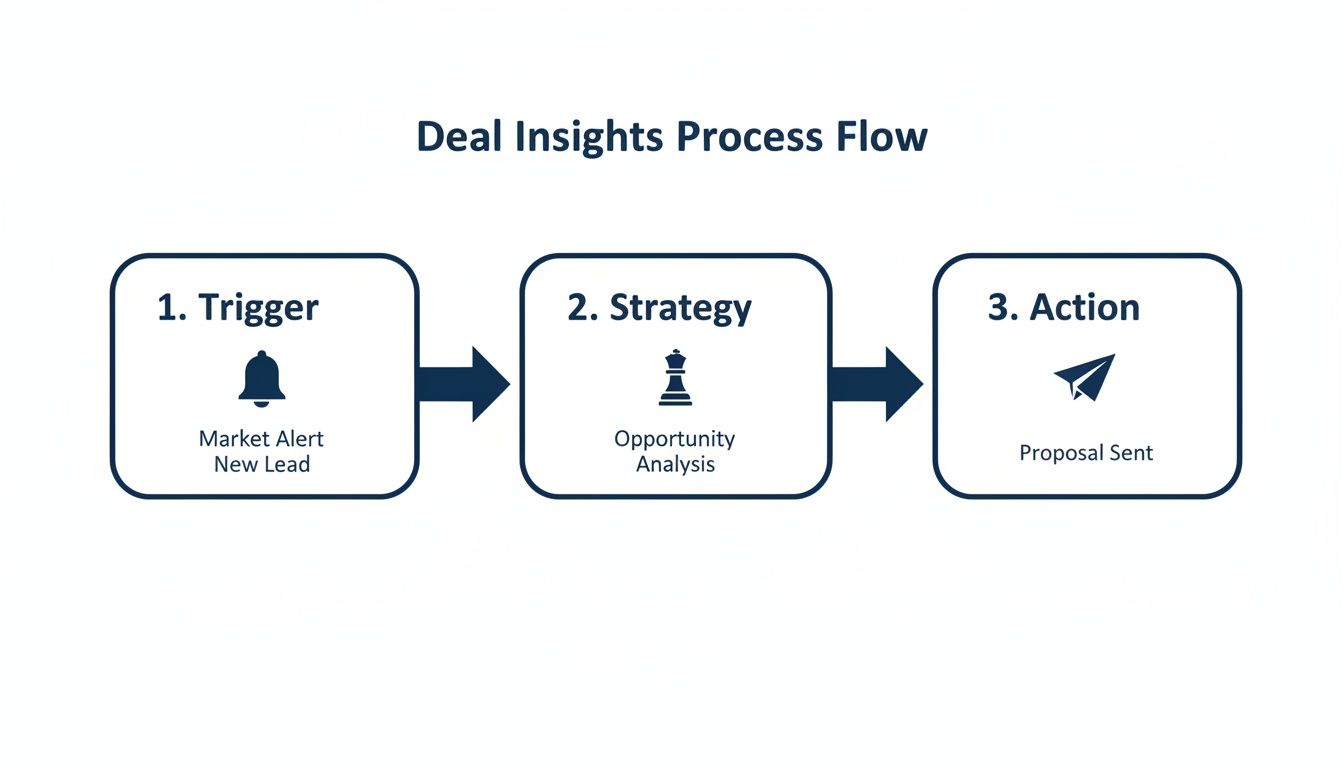
As you can see, a trigger isn't just a notification. It's the starting pistol for a strategic response that leads to purposeful, relevant outreach.
Train Your Team to Use the New Insights
Let's be honest: tech alone won't change behavior. The most crucial part of any implementation is training your team to actually use the new insights. Focus on creating simple, repeatable plays that are easy to adopt.
The goal is to make acting on enriched data the path of least resistance. If it’s easier for a rep to use an insight-driven talk track than to create a generic one, they’ll adopt the new workflow. Every time.
Here are a few practical training tips:
- Develop Sales Plays: Build a playbook with specific actions for different trigger events. For example, a "New Executive Hire" play could have a specific email template and a tailored LinkedIn connection request ready to go.
- Role-Play Scenarios: Use your sales meetings to practice opening a conversation with a recent buying signal. For example: "I saw your company just announced a new partnership, which often brings up challenges around X. Is that on your radar?"
- Showcase Early Wins: When a rep uses enriched data to book a meeting or move a deal forward, celebrate it publicly. Success stories are contagious and the best way to get the rest of the team on board.
The data enrichment market is competitive for a reason—it’s now a core part of the B2B revenue engine. While providers like ZoomInfo and Clearbit are well-known, and North America makes up 38% of global revenue, the real story is the rapid growth in regions like Asia-Pacific. This signals a global shift toward data-driven sales. For B2B teams in fast-moving industries like fintech and life sciences, this technology is what turns a flood of raw data into context you can actually sell with.
Your Data Enrichment Implementation Checklist
A successful rollout requires a plan. This checklist provides a clear path for RevOps and Sales Leaders to guide their teams from initial setup to full adoption, ensuring the new data enrichment strategy delivers real results.
| Phase | Key Action | Success Metric |
|---|---|---|
| 1. Foundation | Identify and document 5-7 key buying signals. | 90% team agreement on top signals. |
| 1. Foundation | Select and integrate an enrichment vendor with your CRM. | Data flowing into CRM within 24 hours of setup. |
| 1. Foundation | Create custom fields in the CRM for new data points. | All new data points successfully mapped to fields. |
| 2. Workflow | Configure real-time alerts (Slack/email) for high-priority signals. | 100% of reps receive a test alert successfully. |
| 2. Workflow | Develop 3-5 sales plays based on top trigger events. | Plays documented and stored in a shared repository. |
| 2. Workflow | Build 1-2 reports to track signal-to-opportunity conversion. | Dashboards live and accessible to leadership. |
| 3. Adoption | Conduct initial team training and role-playing sessions. | 85%+ rep attendance and positive feedback. |
| 3. Adoption | Publicly showcase the first 3-5 "wins" from using enriched data. | Wins shared in team meetings or Slack channel. |
| 3. Adoption | Schedule monthly check-ins to review metrics and gather feedback. | Feedback used to refine plays or alerts. |
By following these phases, you can move from a purely technical integration to a fully embedded, revenue-driving workflow. This structured approach ensures that your investment in data enrichment translates directly into more pipeline and bigger deals.
Your Data Enrichment Questions, Answered
When revenue leaders dig into CRM data enrichment, the same questions always pop up. They’re practical, they’re important, and getting straight answers is the only way to move forward with confidence.
Let's cut through the noise. Here are the real-world answers to the questions we hear most often.
How Quickly Will We See a Return on Investment?
You'll see the first signs of ROI almost immediately—often within the first quarter. While big-ticket wins like higher close rates might take six to twelve months to fully prove out, the impact on your sales team's productivity is instant.
Think about it: your reps will spend drastically less time on manual research and more time selling. You'll notice early wins in metrics like better email open rates and more replies—strong signals that your outreach is finally hitting the mark. Better yet, the best platforms deliver value from day one by sending actionable alerts your reps can use to prep for a meeting, leading to higher-quality conversations from the very first week.
Is Data Enrichment Compliant with GDPR and CCPA?
Yes, any reputable data enrichment provider builds its platform on a foundation of compliance. The key is that enrichment focuses on business-related data—like company size, tech stack, and professional roles—not sensitive personal information. That distinction is critical for staying on the right side of privacy laws.
When evaluating vendors, you must dig into their data sourcing methods and compliance policies. The best platforms are transparent about where their data comes from and provide tools to help you stay compliant. They ensure the data you're adding to your CRM is accurate, relevant, and used for legitimate business purposes, which is exactly what regulations like GDPR and CCPA are all about.
Will This Just Add More Complexity for Our Sales Team?
The right data enrichment platform does the exact opposite: it kills complexity, it doesn't create it. The entire point is to end the chaos of reps juggling a dozen browser tabs just to prepare for a call.
A well-designed tool plugs directly into the workflows your team already uses—your CRM, Slack, and email. Intelligence is delivered as crisp, actionable alerts with the "so what?" already figured out for them.
Instead of yet another dashboard to check, your reps get timely context pushed directly to them when it matters. This removes the burden of manual research, freeing up their time and mental energy to do what they do best: build relationships and close deals. The right tool simplifies their day and makes them better at their job.
Ready to stop guessing and start selling with precision? Salesmotion is an AI-powered account intelligence platform that turns real-time signals into actionable sales plays, delivered right into your team's workflow. See how you can win more timely conversations and drive measurable pipeline growth.