Sales teams track more metrics than ever and understand their pipeline less than ever. The average revenue organization has dashboards for activity, conversion, pipeline coverage, and forecast accuracy. But when deals slip, forecasts miss, and pipeline stalls, those dashboards explain what happened without helping anyone decide what to do next. The gap between sales analytics and sales decisions is where revenue gets lost.
TL;DR: Traditional sales analytics reports the past. Modern sales analytics must guide present decisions. Companies using AI-powered analytics report 15-20% higher forecast accuracy and 25% shorter sales cycles. The shift from lagging indicators to real-time decision support requires tracking the right metrics (pipeline velocity, deal health scores, stage conversion rates), connecting analytics to execution workflows, and investing in data quality before layering AI on top. Dashboards that do not drive action are expensive decoration.
Why Traditional Sales Analytics Falls Short
Most sales analytics platforms were built for a different era: high-volume, transactional sales where tracking rep activity (calls made, emails sent, meetings booked) provided meaningful insight into future performance.
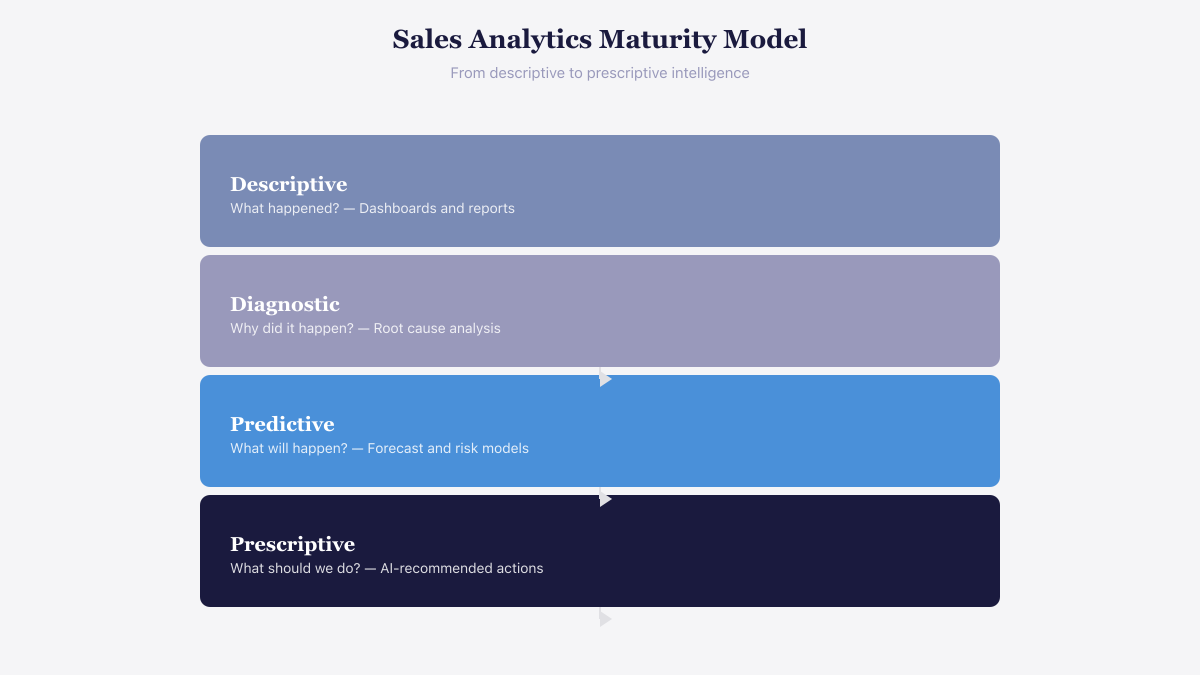 Most teams are stuck at descriptive analytics — the real value is in predictive and prescriptive layers.
Enterprise B2B sales in 2026 does not work that way. Buying committees average 10 to 11 stakeholders. Sales cycles stretch past six months. Procurement processes add layers of complexity. In this environment, counting rep activities tells you almost nothing about whether a deal will close.
Traditional analytics fails in three specific ways:
Lag. Weekly and monthly reports arrive after buyer momentum has already shifted. By the time a dashboard shows a deal has stalled, the window to intervene may have closed.
Wrong level of analysis. Most analytics tracks individual rep performance when the actionable unit is the account or deal. A sales intelligence platform can bridge this gap by surfacing account-level signals. Knowing that a rep made 50 calls last week is far less useful than knowing that three key stakeholders at a strategic account have gone silent.
Execution gap. Insights live in dashboards. Actions happen in CRMs, email tools, and call platforms. The human translation layer between "this deal looks risky" and "here is what to do about it" is where most analytics value gets lost.
See the product in action
Take a self-guided tour of the Salesmotion platform — no signup required.
The Metrics That Actually Predict Revenue
Not all sales metrics deserve attention. Some measure activity. Others measure outcomes. The metrics that predict revenue sit in between: they measure pipeline health in ways that signal future results.
Pipeline velocity. The speed at which deals move through your pipeline, calculated as (number of deals x average deal value x win rate) divided by average sales cycle length. This single metric captures more about pipeline health than any activity report. A decline in velocity signals problems weeks before they show up in revenue.
Stage conversion rates. What percentage of deals advance from each stage to the next? Tracking this by segment, rep, and deal size reveals where your process breaks down. If 60% of deals stall between proposal and negotiation, that is a specific problem you can address with specific interventions.
Deal health scores. AI-driven scoring that evaluates engagement patterns, stakeholder involvement, competitive presence, and momentum changes for each active deal. Companies using AI deal scoring report 15-20% higher forecast accuracy because the scores detect risk signals that human intuition misses.
Pipeline coverage ratio. Total pipeline value divided by quota. McKinsey recommends 3-4x coverage for most B2B teams, but the optimal ratio depends on your win rate and cycle length. Enterprise teams with longer cycles may need 4-5x. High-velocity SaaS teams can operate effectively at 2-3x.
Win rate by source. Track conversion rates separately for inbound, outbound, referral, and partner-sourced deals. This reveals which channels produce genuinely qualified opportunities versus which produce pipeline that inflates coverage ratios without converting.

“The talking points are gold. If they're in Salesmotion, I know they're being discussed inside that business. That makes it easy to spark a real conversation, which is 90 percent of the battle.”
Andrew Giordano
VP of Global Commercial Operations, Analytic Partners
Connecting Analytics to Action
The highest-impact change a sales organization can make is closing the gap between what analytics reveals and what reps do about it.
Embed insights in workflows. Analytics that requires reps to open a separate dashboard will be ignored. Push deal risk alerts into Slack. Surface account insights inside the CRM. Make recommended actions appear where reps already work. If the insight does not reach the rep's daily workflow, it does not exist.
Automate the response to predictable signals. When a deal sits in the same stage for twice the historical average, the system should automatically create a task for the rep, notify the manager, and suggest recovery actions. Requiring humans to notice and act on every dashboard change is why execution gaps persist.
Make analytics the foundation for coaching. The most effective sales managers use analytics not for reporting but for coaching. Instead of asking "why did that deal slip?", they ask "the data shows engagement dropped after the second meeting. What happened and how do we re-engage?" Data-specific coaching conversations produce more actionable outcomes than generic pipeline reviews.
Organizations that systematically measure pipeline metrics and use them to drive coaching are 10% more likely to grow revenue year-over-year because they address pipeline problems proactively rather than reactively.
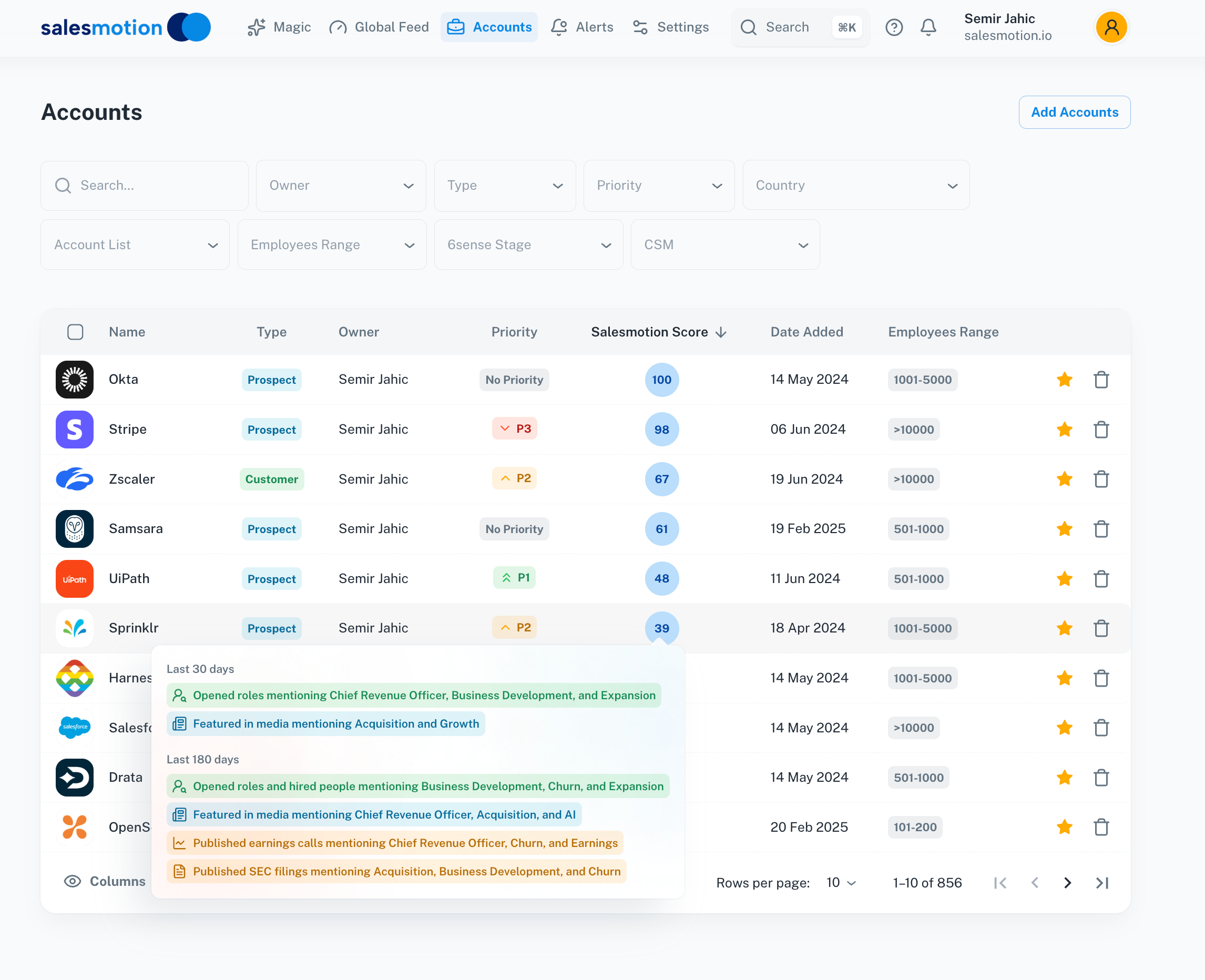 A score breakdown shows exactly which signals drive an account's buying readiness rating, turning analytics from a backward-looking report into forward-looking guidance.
The AI Analytics Advantage
AI transforms sales analytics from retrospective reporting to predictive guidance. The impact is measurable.
According to Gartner, companies implementing predictive analytics in sales experience a 10% increase in revenue and 15% reduction in cycle length. Organizations using more advanced AI forecasting tools report 25% shorter sales cycles and up to 30% improvement in quota attainment.
The practical applications of AI in sales analytics:
Predictive deal scoring. Machine learning models analyze historical deal data and current engagement signals to predict close probability. Each deal gets a data-driven health score that is more accurate than rep self-assessment, which research consistently shows is biased toward optimism.
Anomaly detection. AI identifies unusual patterns that human reviewers miss: a sudden drop in email response rates across an account, a key stakeholder disappearing from meeting invitations, or a competitor appearing in call transcripts for the first time.
Forecast modeling. AI-generated forecasts incorporate buying signals, engagement velocity, historical patterns, and market conditions to produce probability-weighted revenue projections that outperform spreadsheet-based forecasting.
Automated pipeline cleanup. AI flags deals that have not progressed in 60+ days, contacts that have bounced, and stages with missing required fields. This keeps the pipeline accurate so the analytics built on top of it remains reliable.

“We're saving about 6 hours per week per seller on account research alone. That's time they can reinvest in actually selling.”
Derek Rosen
Director, Strategic Accounts, Guild Education
Building the Foundation: Data Quality First
Every AI analytics benefit assumes clean, consistent data. Implementing AI on a poor data foundation produces confidently wrong predictions that erode trust in the entire analytics program.
Before investing in advanced analytics, audit three areas:
CRM hygiene. Are deal stages consistently defined and applied? Are close dates realistic or aspirational? Are contacts associated with the right accounts? A CRM where "Stage 3" means different things to different reps will produce analytics that means nothing to anyone.
Integration completeness. Does your analytics platform see all relevant data? Email engagement, call recordings, account intelligence, and intent signals all contribute to deal health assessment. Missing data sources create blind spots that analytics cannot compensate for.
Input consistency. Do all reps follow the same process for updating records? If one rep logs every meeting while another updates weekly, the analytics will show misleading patterns. Process consistency matters as much as data quality.
an Integrate.io analysis of Salesforce integration ROI shows that organizations building unified data platforms achieve 299% average ROI over three years with 13-month payback periods. The investment in data quality pays for itself before the advanced analytics even kicks in.
Key Takeaways
- Sales analytics must answer "what should we do next?", not just "what happened?" The execution gap between insight and action is where revenue gets lost.
- Track metrics that predict revenue: pipeline velocity, stage conversion rates, deal health scores, and coverage ratios. Activity metrics are misleading proxies.
- AI-powered analytics delivers 15-20% higher forecast accuracy and 25% shorter sales cycles. But it requires clean data as a foundation.
- Embed analytics in rep workflows. Insights that live only in dashboards get ignored. Push alerts and recommendations into CRM, Slack, and email.
- Invest in data quality before advanced analytics. CRM hygiene, integration completeness, and input consistency determine whether AI produces useful outputs or confident noise.
- Use analytics for coaching, not just reporting. Data-specific conversations about deal patterns produce better outcomes than generic pipeline reviews.
Frequently Asked Questions
What is the most important sales metric to track?
Pipeline velocity, because it combines four critical factors (deal count, deal value, win rate, and cycle length) into a single indicator of pipeline health. Teams using signal-based selling often see velocity improve because reps focus on accounts with active buying intent. A decline in velocity signals problems before they appear in revenue numbers. However, no single metric tells the whole story. Track velocity alongside stage conversion rates and deal health scores for a complete picture of pipeline performance.
How accurate are AI sales forecasts compared to human forecasts?
AI forecasts are consistently more accurate, typically by 15-20% according to multiple studies. The advantage comes from AI's ability to process more data points without the optimism bias that affects human forecasting. Reps tend to overestimate close probability for deals they are emotionally invested in. AI evaluates engagement patterns, historical close rates, and behavioral signals objectively. The most accurate forecasting combines AI predictions with human judgment for strategic context that data alone cannot capture.
How often should sales teams review their analytics?
Frontline reps should see real-time or daily signals: deal risk alerts, account priority changes, and engagement updates. Managers should conduct weekly pipeline reviews using analytics to guide coaching conversations. Leadership should review monthly or quarterly analytics for strategic decisions about territory allocation, resource investment, and process changes. The cadence should match the decision speed required. Real-time signals need real-time visibility. Strategic trends need longer review cycles.