Data enrichment platforms are the automated research team your reps wish they had. They systematically fill in the blanks on your contacts and accounts, turning skeletal CRM records into fully fleshed-out strategic assets that drive real revenue.
TL;DR: A data enrichment platform automatically fills in and refreshes your CRM records with firmographic, technographic, contact and intent data. All-in-one databases answer who a company is, signal-focused platforms answer why to reach out now, and many teams use both. When you choose one, test data quality on your own records first, then check for native CRM integration and real-time buying signals.
What Are Data Enrichment Platforms?

Imagine your sales team trying to navigate a new city with a map from a decade ago. That’s what they’re doing every single day with an unenriched CRM. The information is stale, incomplete, and often dead wrong, leading to wasted hours and missed opportunities.
Data enrichment platforms are your team's real-time GPS for sales. They transform those static, patchy records into dynamic assets that guide your team to the right conversations at the right time, with the right message.
Eliminating the "Manual Research Tax"
Without these platforms, sales reps get crushed by the "manual research tax"—the countless hours they lose digging for context instead of actually selling. Think of the time spent piecing together a prospect's story from scattered sources like LinkedIn, company websites, and news articles just to prepare for a single call.
This manual grind isn't just inefficient; it's wildly inconsistent. One rep's deep dive is another's quick glance, creating a fragmented understanding of your target accounts across the entire team. Data enrichment automates this entire process, standardizing intelligence and freeing your reps to focus on what they do best: building relationships and closing deals.
A data enrichment platform takes a basic lead record—maybe just a name and an email—and automatically appends critical business context. It transforms a simple contact into a complete profile, providing the "who, what, and why" needed for meaningful engagement.
The market's explosive growth shows just how essential these tools have become. The global market for this technology hit USD 2.37 billion in 2023 and is projected to grow at a healthy 10.1% CAGR through 2030. This surge reflects a clear shift as revenue leaders strategically tackle the manual research burden head-on.
Companies that implement data enrichment see dramatic improvements. For example, a mid-sized SaaS company could see its lead conversion rates jump by 25% while slashing customer acquisition costs by 15%, simply by ensuring their sales team is always working with accurate, relevant information.
From Raw Data to Actionable Insight
At its core, a data enrichment platform solves a fundamental business problem: your customer data is a depreciating asset. People change jobs, companies get acquired, and priorities shift constantly. These platforms keep your data fresh, accurate, and ready for action.
Let’s look at what that transformation looks like for a typical CRM record.
Data Enrichment At a Glance
| Data Point | Before Enrichment (Raw Data) | After Enrichment (Actionable Intelligence) |
|---|---|---|
| Contact | jane.doe@acme.com | Jane Doe, VP of Marketing |
| Phone | (none) | +1-555-123-4567 (Direct Dial) |
| Company | Acme | Acme Corp. |
| Industry | (unknown) | SaaS, Enterprise Software |
| Size | (unknown) | 1,500 Employees |
| Revenue | (unknown) | $250M ARR |
| Tech Stack | (unknown) | Salesforce, Marketo, Outreach |
What starts as a single email address becomes a rich, multi-dimensional profile you can actually use for segmentation, prioritization, and personalized outreach.
Here’s a breakdown of what a platform delivers:
- Completing the Profile: It fills in missing firmographic data like company size, industry, and annual revenue.
- Adding Context: It appends technographic data, revealing the software and tools a company currently uses—a goldmine for competitive and complementary plays.
- Providing Contact Details: It verifies and adds crucial contact info, such as direct-dial phone numbers and exact job titles for key decision-makers.
By automating this process, you ensure every member of your revenue team works from the same high-quality intelligence. This consistency is the foundation for building a predictable, scalable sales engine. You can explore different types of data enrichment software to see how to get started. In today's market, these platforms are no longer a luxury but an absolute necessity for personalizing outreach and having truly effective sales conversations.
Evaluating data enrichment tools?
Enrichment without intelligence is just bigger spreadsheets. Salesmotion adds the why-now layer.
Verified contacts plus 24/7 account intelligence — from earnings calls to hiring signals. $85/mo.
How Data Enrichment Turns Raw Data Into Revenue Signals

Think of a data enrichment platform as an intelligence refinery for your revenue team. It takes in raw, incomplete bits of information—perhaps just a work email address—and refines it into a high-value asset that tells you where to focus your time and energy.
This isn't just about filling in a missing phone number. It's about finding the "so what?" behind every piece of data.
The process starts with massive, ethical data collection. The best platforms cast a wide net, pulling information from a huge variety of public sources. This includes everything from structured corporate filings and press releases to unstructured goldmines like social media posts, executive podcast interviews, and company blogs.
But raw data from the wild is messy and often contradictory. This is where smart algorithms and AI step in to clean, verify, and organize everything. The goal is to build a coherent, trustworthy profile for every single account in your CRM.
The Three Pillars of Enriched Data
Data enrichment platforms typically organize information into three distinct categories. Each one serves a specific purpose for your revenue team. Understanding them helps you see how a simple contact record can become a powerful strategic tool.
-
Firmographic Data: This is the foundational layer. It answers the question, "Who is this company?" This includes the essentials: industry, employee count, annual revenue, and physical locations. Knowing a lead is a 10,000-employee manufacturing firm in Germany instantly tells you if it fits your Ideal Customer Profile (ICP).
-
Technographic Data: This layer reveals a company's tech stack, answering, "What tools do they rely on?" For instance, knowing a prospect uses a competitor's CRM or a marketing automation platform that pairs well with your solution gives your sales team a perfect, value-driven conversation starter.
-
Intent Data: This is the most dynamic piece of the puzzle. It answers the question, "What are they interested in right now?" Intent data tracks online behavior, like an unusual number of employees from one company suddenly researching a topic directly related to your product. It’s a clear signal that an account is moving into an active buying cycle.
By weaving these three data types together, a platform goes way beyond basic contact info. It helps you spot strategic shifts, like a key executive hire announced in a press release or a new corporate initiative mentioned on an earnings call.
The real power of data enrichment platforms isn’t just adding data; it’s synthesizing it into a story. It’s connecting the dots between a job posting for a new VP of Sales (firmographic), their adoption of Salesforce (technographic), and a surge in research around "sales analytics" (intent).
Turning Data Into Actionable Signals
The final, crucial step is translating all this rich, synthesized data into clear, actionable signals for your sales team. A great platform doesn't just dump a wall of information on your reps; it surfaces the most important insights and tells them why it matters.
One of the biggest benefits here is the platform's ability to create a unified customer view. It turns all those scattered data points into a single source of truth, making sure marketing and sales are perfectly aligned and working from the same playbook.
For a sales rep, this means no more guesswork. Instead of a generic CRM entry, they get the full picture:
- The Target: Acme Corp, a $500M logistics company.
- The Context: They just hired a new CFO and are expanding into Europe.
- The Trigger: Multiple employees are downloading whitepapers on supply chain optimization.
This isn't just data; it's a revenue signal. It gives you the "why you, why now" that turns a cold call into a timely, relevant conversation. To dig deeper into how this works, you can find valuable details in guides on B2B data enrichment.

“The talking points are gold. If they're in Salesmotion, I know they're being discussed inside that business. That makes it easy to spark a real conversation, which is 90 percent of the battle.”
Andrew Giordano
VP of Global Commercial Operations, Analytic Partners
From Data to Deals: Practical Use Cases for Your Revenue Team
Theory is great, but what does a data enrichment platform actually do for your revenue team on a Tuesday morning? It's all about tackling the daily grind that slows your reps down and costs you deals. Let's look at three real-world scenarios where enriched data directly translates into more pipeline and better win rates.
These aren't just features on a checklist. They're specific plays that shift your team from reactive, manual work to proactive, strategic selling.
Automated Account Briefs
We’ve all seen it. Before a big sales call, reps spend hours jumping between LinkedIn, news sites, and a company's career page, trying to piece together a coherent story. The result? Inconsistent, often incomplete prep that leads to painfully generic discovery calls.
Data enrichment automates this entire process. An integrated platform can build a standardized, in-depth account brief right inside your CRM, on demand.
- What this looks like: A rep opens an account record and instantly sees a summary of the company’s latest strategic initiatives, key executive changes, recent press releases, and even competitive mentions from their last earnings call.
- The impact: Every rep starts every conversation with the same deep level of context. It standardizes the quality of call prep and empowers your reps to sound like informed partners, not just another vendor asking questions they should already know the answers to.
This single piece of automation can give back hours of selling time to each rep every week—time they can reinvest in building relationships and closing deals.
Hyper-Personalized Outreach
Let's be honest: generic email templates are dead. Outreach that just says, "I noticed you work at [Company Name]" doesn't cut it anymore. Real personalization needs a specific, timely trigger—a real reason to reach out right now.
Data enrichment platforms deliver these triggers by monitoring your target accounts for meaningful events. This is how your team swaps out stale templates for outreach anchored to something that just happened.
Imagine your rep gets an alert: a target account just posted a new job for a "Head of Cybersecurity." A data enrichment platform doesn't just flag the job post. It connects it to the company's recent acquisition and surfaces the new CIO's name, teeing up a perfectly relevant message.
Here’s the difference:
Instead of this: "Hi John, I saw your company is in the logistics space and thought you might be interested in our solution."
The rep can now send this: "Hi John, I saw your team is hiring a new Head of Cybersecurity following the acquisition. As you integrate your new infrastructure, our platform can help unify your security posture from day one."
This kind of relevance is what gets responses and gets your team into conversations they would have otherwise completely missed.
Intelligent Lead Prioritization
Not all leads are created equal. A sales team's most valuable asset is its time, yet many reps spend their days chasing accounts with low purchase intent. Intelligent prioritization ensures reps focus their energy where it counts the most—on accounts showing real buying momentum.
Data enrichment platforms make this happen by layering intent data and other buying signals over your existing leads. Instead of just sorting by company size or a prospect's title, reps can prioritize based on what an account is actually doing.
This means you can automatically surface accounts where:
- Multiple stakeholders are suddenly researching your product category.
- The company is actively hiring for roles that align perfectly with your solution.
- They recently landed a new round of funding, signaling fresh budget for new projects.
This shifts your team from a "first-in, first-out" model to one where they engage accounts at the absolute peak of their interest. Companies making this switch see a clear jump in lead-to-opportunity conversion rates, simply because they're having the right conversations with the right people at exactly the right time.
How to Choose the Right Data Enrichment Platform in 2027
Picking the right data enrichment platform can feel daunting. With a market flooded with options, it's easy to get lost in marketing jargon. This guide will cut through that noise, giving you a practical framework to focus on what actually drives revenue.
The truth is, choosing the right partner is less about buying a tool and more about investing in a reliable engine for your go-to-market team.
The demand for these platforms is exploding, with the market surging as companies seek more accurate, real-time data. You’ll see big names like ZoomInfo and Apollo.io everywhere, but their approaches can be quite different. Apollo, for instance, has gained significant traction with smaller businesses thanks to its accessible pricing.
But here’s the secret: the number one differentiator is, and always will be, data quality. While many providers claim high accuracy rates, only a handful consistently deliver 95%+ accuracy on the data points that truly matter, like verified emails and direct-dial phone numbers. You can learn more about how different providers stack up by reading a comparative analysis of data enrichment APIs.
Assess Data Quality and Source Transparency
Let's be blunt: the single most important factor is the quality of the data. Inaccurate or old information doesn't just cause bounced emails—it actively destroys your team's trust in your systems and leads to countless wasted hours.
When you’re evaluating a vendor, it's time to play detective. Dig deep into their data practices.
- Ask about their sources: Where does this data actually come from? A reputable platform will have no problem explaining their mix of public records, proprietary data collection methods, and third-party partnerships.
- Inquire about refresh rates: How often is the data verified and updated? Contact data can decay by over 30% in a single year, so you need a provider who is obsessed with keeping it fresh.
- Demand a data sample test: This is non-negotiable. The best way to know if the data is any good is to test it against your own records. Give them a sample of your contacts and see how well they can clean, correct, and append the data.
If a provider gets defensive or vague about their sources and processes, consider it a major red flag. True partners are proud of the quality they deliver and are happy to show you how their process works.
Prioritize Seamless Integrations
A data enrichment platform is only as valuable as its ability to disappear into your existing workflow. If your reps have to log into yet another system or manually copy-paste information, you haven't solved a problem—you've created a new one. The whole point is to automate, not to add more clicks.
Your number one priority should be a rock-solid, native integration with your CRM, especially Salesforce. The platform must be able to read and write data directly to your account and contact records in real-time.
A powerful integration doesn't just dump a wall of data into your CRM. It should be smart. It needs to map fields correctly, avoid overwriting valuable, human-gathered intel your reps have collected, and even trigger workflows based on new intelligence.
Beyond the CRM, think about the other critical tools in your sales stack:
- Sales Engagement: Can enriched data and buying signals automatically enroll prospects into outreach sequences in tools like Outreach or Salesloft?
- Team Communication: Does it integrate with Slack or Microsoft Teams to push real-time alerts about key account activities directly to your reps?
The more seamlessly a platform plugs into your team's daily life, the higher its adoption—and ultimately, its ROI—will be.
Compare Provider Types: All-in-One vs. Specialized
Data enrichment platforms typically fall into two main buckets: broad, all-in-one databases and specialized, signal-focused tools. For a deeper look at the specific players, check out our data enrichment tools comparison.
- All-in-One Platforms (e.g., ZoomInfo, Leadspace): Think of these as massive, comprehensive libraries. They offer a huge range of firmographic, technographic, and contact data. They're fantastic for building a foundational understanding of your market and filling in the blanks in your database, but the sheer volume of information can sometimes be overwhelming.
- Signal-Focused Platforms (e.g., Salesmotion): These tools are built to answer the "why now?" question. They specialize in monitoring real-time events—like an executive hire, a new funding round, or a major company initiative—and turning those events into actionable sales triggers that give your team a compelling reason to reach out.
So, which is right for you? It depends on your team's maturity and what you're trying to accomplish. Are you building a clean database from the ground up? Or are you trying to arm a seasoned team with timely, relevant reasons to start a conversation?
Increasingly, we see companies using a combination of both. They use an all-in-one platform for the foundational "who" and "what," and a signal-focused platform for the critical "why now." This layered approach provides the perfect balance of static data and real-time intelligence.
To help you navigate these decisions, we've put together a simple checklist to guide your evaluation process. Think of it as your field guide to cutting through the noise and finding a partner that will truly move the needle for your revenue team.
Data Enrichment Platform Buyer's Checklist
Use this checklist to systematically evaluate potential vendors. It will help you ask the right questions and ensure you're choosing a solution that aligns with your team's real-world needs, not just a list of features.
| Evaluation Criteria | Key Questions to Ask | Why It Matters |
|---|---|---|
| Data Quality & Accuracy | What is your verified email accuracy rate? How do you measure and validate it? Can we run a data sample test with our own contacts? | Bad data wastes time and erodes trust. You need a partner who is transparent and can prove their quality. |
| Data Sources & Refresh Cadence | Where does your data come from? How often is contact and company data refreshed and re-verified? | Data decays quickly (over 30% a year). Stale data leads to bounced emails and missed opportunities. |
| CRM Integration (Native) | Do you have a native, bi-directional integration with our CRM (e.g., Salesforce)? How do you handle field mapping and prevent data overwrites? | The tool must live inside the CRM. If reps have to switch tabs, adoption will plummet and you'll lose the ROI. |
| Workflow & Automation | Can your data trigger workflows in our sales engagement and marketing tools? Can we create real-time alerts in Slack/Teams? | The goal is automation, not more manual work. The data should do things for you, like kicking off a sequence or alerting a rep. |
| Signal vs. Static Data | Does your platform provide real-time buying signals (e.g., hiring, funding, tech changes) or primarily static firmographic/contact data? | Static data tells you who to call. Signal data tells you why to call them now. The best strategies use both. |
| Usability & Adoption | How intuitive is the platform for an end-user (e.g., an Account Executive)? What does your onboarding and training process look like? | A powerful tool that no one uses is worthless. It needs to be simple enough for reps to get value on day one. |
| Support & Partnership | What level of customer support is included? Do we get a dedicated customer success manager to help with strategy? | You're not just buying software; you're entering a partnership. You need a vendor who is invested in your success. |
By walking through these questions with each potential vendor, you'll get a much clearer picture of who can actually deliver on their promises. This isn't just about ticking boxes—it's about finding a partner that can become a core part of your revenue-generating machine.

“All of the vendors that I've worked with, all of the onboarding that I have had to deal with, I will say, hands down, Salesmotion was the easiest that I have had.”
Lyndsay Thomson
Head of Sales Operations, Cytel
The Power of Real-Time Intelligence
Standard data enrichment platforms are fantastic for answering one question: "Who is this company?" They fill in the firmographic and technographic blanks your team needs to get a baseline understanding. But the question that actually drives revenue is much more powerful: "Why should I reach out to them right now?"
This is where the next frontier of sales intelligence comes in. It’s the critical difference between having static data and using dynamic, real-time intelligence.
Static enrichment gives you the what—the company's size, industry, and tech stack. It's a snapshot in time. Dynamic intelligence, on the other hand, gives you the why now—a timely event or signal that creates a compelling reason to start a conversation.
From Static Data to Dynamic Signals
Think of it this way: static data is a company’s resume. It tells you their background and qualifications. Real-time intelligence is like getting a live news feed about their day-to-day activities, alerting you the moment something significant happens. It’s this shift that turns your reps from researchers into timely advisors.
These dynamic events, which we call "buying signals," are the triggers that show a window of opportunity has just opened. They are the moments when a prospect is most likely to be receptive to a solution like yours.
The most advanced data enrichment platforms have evolved to include signal-based intelligence. They don't just fill in a contact's title; they alert you the moment that contact gets a promotion, giving you a perfect reason to connect.
This flow shows how raw, static data gets transformed by dynamic signals to create a powerful "why now" for your team.
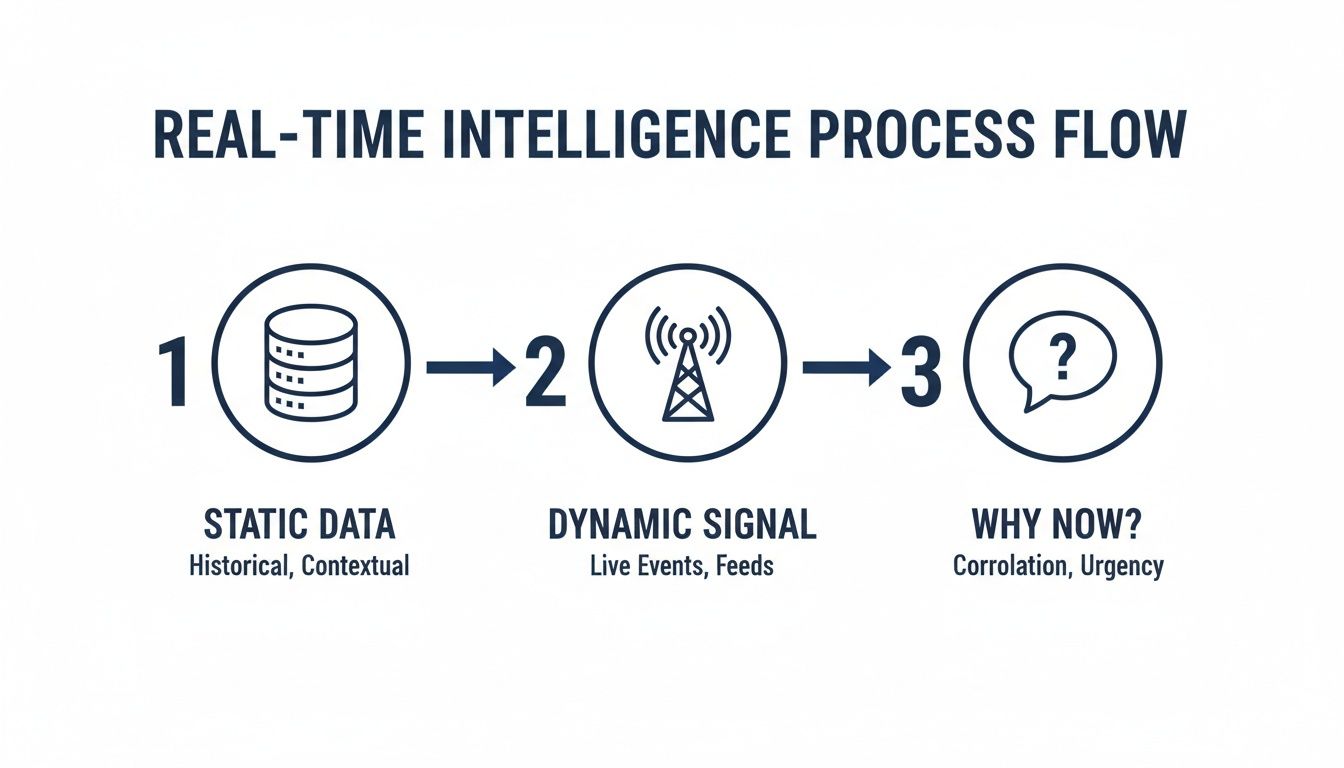
While static data provides the foundation, you can see it's the dynamic signals that generate the urgent, actionable insights needed for modern sales.
Your Eyes and Ears in the Market
So how does this actually work? Modern platforms use AI agents that act as your team’s autonomous eyes and ears, monitoring your target accounts 24/7. These agents tirelessly scan thousands of public sources for the handful of events that actually matter to you.
Imagine one of your account executives getting an instant alert with this level of detail:
- The Signal: Your top-tier target account, Acme Corp, just mentioned a key competitor's weakness in their latest earnings call transcript.
- The "So What": This is a clear sign of dissatisfaction and an opportunity to position your solution as a superior alternative.
- The Action: The alert includes a direct link to the transcript and suggests a talk track for a competitive displacement play.
This is the power of real-time intelligence. It’s not just "news"—it's curated, contextualized insight delivered directly into a rep’s workflow, whether that's Slack, email, or your CRM. You can find more detail on how this is delivered in our guide to data APIs.
Examples of High-Impact Buying Signals
These AI agents can be configured to track a huge array of triggers that line up perfectly with your value proposition. Here are just a few examples of signals that can turn a cold outreach into a warm, relevant conversation:
- Executive Moves: A new Chief Revenue Officer is hired at a target account, signaling a potential strategy shift and a window to influence their new budget.
- Strategic Initiatives: A company announces a major push into sustainability in a press release, creating a perfect opening if your product supports green initiatives.
- New Job Postings: An account suddenly posts several jobs for "data scientists," indicating they are building an internal analytics team you could support.
- Funding Announcements: A startup in your territory closes a Series B round, meaning they now have fresh capital to invest in new tools and technologies.
By tracking these events, you equip your team to lead timely, relevant conversations that are anchored to real business pain. You stop asking, "Are you interested in our product?" and start saying, "I saw you're expanding into Europe, and we can help you navigate that." This is how you build trust and close more deals.
Putting It All Together: From Signal to Sale

Let's tie it all together. What does it actually look like when a modern revenue team turns a single market signal into a real sales conversation? This is where automated research, real-time intelligence, and AI-driven outreach click into place in a practical, day-to-day workflow.
This process is the definitive answer to the grind of manual research and inconsistent account planning. It’s how you scale personalization, win more meetings, and turn market chatter into measurable pipeline growth.
The Automated Account Brief
The journey starts not with a sales rep staring at a blank CRM record, but with an AI research agent. Think of this as a dedicated analyst assigned to your top accounts, whose only job is to build a deep, insightful account brief before a rep even lays eyes on it.
This agent is constantly pulling from over a thousand public sources—earnings call transcripts, press releases, company blogs, and even executive podcast interviews. It then distills this mountain of information into a structured, opinionated brief right inside your CRM.
- The result: A rep opens an account and immediately finds a ready-made summary of the company’s strategic initiatives, recent leadership changes, competitive risks, and key priorities for the quarter.
- The impact: This completely eliminates hours of manual digging and ensures every rep starts from the same high-quality baseline. Call prep that once took hours is now done in minutes.
The Critical Buying Signal
With that foundational intelligence set, a second AI agent takes over: the signal agent. This agent is your 24/7 lookout, watching every target account for a specific, actionable trigger. Its entire purpose is to answer the "why now?" question for your team.
For this example, the signal agent flags a critical event: the target company has just hired a new Chief Revenue Officer.
The agent doesn't just send a generic news alert. It provides the crucial "so what?" by connecting the dots. It highlights that this new CRO has a history of investing in sales technology at their past companies, flagging a prime opportunity to get in front of their new budget and tech stack decisions.
This alert gets pushed instantly to the account owner via Slack, complete with a link to the press release and the new executive's LinkedIn profile. The window of opportunity is officially open.
From Signal to Personalized Outreach
This is where intelligence becomes action. A third AI agent, the prospector, takes the signal and the account brief and instantly drafts a personalized outreach sequence. This isn't a generic template with a \{\{first_name\}\} field.
The email is anchored specifically to the event. It references the new CRO hire, alludes to their known priorities based on past roles, and positions your solution as a tool to help them achieve their goals in the first 90 days. This level of detail makes the outreach sound like a rep did hours of homework.
The final workflow for the sales rep looks like this:
- Receive a Slack alert about the new CRO hire at a key account.
- Review the AI-generated outreach sequence, already pre-filled with context.
- Make a few minor tweaks to add their personal voice.
- Hit "send."
This entire process, from a signal hitting the wire to a personalized email going out the door, takes just a few minutes, not hours. Data enrichment platforms are reshaping B2B sales by injecting this kind of precision into every dataset, and the results are clear.
Key benefits like reduced manual research through CRM auto-appends and buying signal detection for perfectly timed outreach are becoming table stakes. As AI gets more common, this kind of quality data foundation isn't just an advantage; it's the edge teams need to win. You can find more details in this guide to top data enrichment platforms for B2B sales. This is how you turn market activity into revenue.
Frequently Asked Questions
Still have questions about how a data enrichment platform could really change things for your revenue team? Here are some straightforward answers to the questions we hear most often from sales leaders.
How Is Data Enrichment Different From Just Buying a Contact List?
That’s a great question. Buying a list is like getting a paper map of a city—it’s static information that was accurate at a single point in time. The second you print it, it starts getting old.
Data enrichment, on the other hand, is your live GPS with real-time traffic updates. It’s a dynamic, ongoing process that doesn't just give you a name and email. It constantly adds rich context—like company size, the tech they use, and recent funding news—to the records you already have. It also keeps an eye out for changes, so your data is always fresh and ready to use.
What Is the Typical ROI on a Data Enrichment Platform?
While the exact numbers will differ from company to company, the ROI for data enrichment platforms boils down to two things: a big boost in efficiency and serious pipeline growth.
The biggest win is getting your reps out of the business of manual research. Think about all the hours they burn just trying to find the right person or a relevant reason to call. Automating that work frees them up to do one thing: sell. That translates directly into more outreach, higher-quality conversations, and, ultimately, more closed deals.
How Can I Ensure the Enriched Data Is Accurate and Compliant?
This is the most important question you can ask. Your data is only valuable if it’s right—and if using it won't get you in trouble.
The most critical evaluation point when choosing a data enrichment platform is ensuring the data is both accurate and compliant. Top-tier platforms are transparent about their sources, refresh rates, and adherence to regulations like GDPR and CCPA.
Any provider worth your time will be completely transparent about where their data comes from and how often they refresh it. Look for platforms with clear accuracy guarantees and solid compliance frameworks for GDPR and CCPA.
The best way to know for sure? Always ask for a data sample test. Give them a small slice of your own CRM data and see what they send back. Seeing how a vendor cleans and appends your own records is the ultimate proof of quality. Many top platforms also use a "waterfall" method, cross-checking multiple sources to make sure every data point is as reliable as possible.
Ready to stop the manual research tax and give your reps a real edge? Salesmotion's AI agents autonomously track what matters across your target accounts, turning market signals into timely, revenue-generating conversations. Learn how Salesmotion can build your pipeline.