Ever look at your CRM and feel like you’re staring at a ghost town? It's filled with names and companies, but half the information is outdated, incomplete, or just wrong. This is the reality for most B2B teams, and it’s a massive, silent killer of your sales pipeline.
Data enrichment software is the tool that brings that ghost town back to life. Think of it as an automated data detective, working 24/7 to fix, update, and complete the profiles in your database so your team can focus on what they do best: selling.
TL;DR: Data enrichment software automatically fixes, completes and refreshes the contact and company records in your CRM, so reps work from accurate firmographic, demographic and technographic data. The strongest platforms add real-time buying signals and push insights into the CRM, Slack and email. Choose on data sources, freshness, integration depth and whether the output is raw fields or actionable insight.
What Is Data Enrichment Software Anyway?
At its core, data enrichment software solves a very expensive problem: data decay. This is the natural process where your customer and prospect information becomes inaccurate over time.
People change jobs, companies get acquired, and phone numbers are disconnected. Without a system to keep up, your database quickly turns into a graveyard of useless contacts, making effective outreach nearly impossible.
Data enrichment tools fight this by constantly cross-referencing your internal records against massive, third-party databases. It’s not just a one-time cleanup; it's a foundational piece of any modern sales and marketing engine that ensures your team is always working with accurate, up-to-date information.
The Problem of Decaying Data (and the Solution)
Data decay isn’t a minor annoyance; it’s a constant drag on your team's efficiency and effectiveness. When your data is unreliable, every part of the sales process suffers—from prospecting to closing. In contrast, enriched data creates a powerful advantage, turning guesswork into a clear, strategic plan.
The table below shows just how different these two realities are.
Data Decay vs. Data Enrichment at a Glance
| Business Challenge | Impact of Data Decay (The Problem) | Impact of Data Enrichment (The Solution) |
|---|---|---|
| Sales Prospecting | High email bounce rates, wasted calls, and low morale. | Accurate contact info, higher connection rates, and focused outreach. |
| Lead Routing | Leads go to the wrong reps or get stuck, leading to slow follow-up. | Leads are routed instantly based on accurate territory, industry, or size. |
| Personalization | Outreach is generic ("Hi there!") and gets ignored. | Reps can personalize with job titles, tech stack info, and company details. |
| Lead Scoring | Inaccurate scoring sends unqualified leads to sales. | Scoring models are precise, prioritizing the best opportunities. |
| Total Addressable Market (TAM) | Poor understanding of the market, leading to flawed strategy. | A clear, data-driven view of your true market potential. |
| Forecasting | Unreliable pipeline data leads to missed forecasts. | Higher forecast accuracy based on a clean, trusted CRM. |
Ultimately, data decay creates friction and inefficiency at every turn, while data enrichment removes those roadblocks, allowing your team to operate with speed and confidence.
Fixing the Inevitable Decay of Business Data
The need for this technology is fueled by a simple, powerful fact: B2B data goes stale incredibly fast. The global data enrichment software market hit USD 2.37 billion in 2023 and is projected to reach USD 4.58 billion by 2030. This growth isn't hype; it’s a direct response to contact info decaying at a rate of 22.5% to 70% annually, causing millions in lost productivity.
Think of it this way: if your sales team relies on a static database, a huge portion of their contacts could be unreachable by this time next year. That means bounced emails, wasted calls, and countless missed opportunities.
Data enrichment software acts as an always-on data steward, making sure your team always has an accurate, complete picture to start meaningful conversations.
Turning Basic Contacts into Rich Profiles
So, what does this look like in practice? Imagine you have a new lead in your CRM with just a name and an email address. That's not much to go on. Data enrichment software automatically gets to work, finding and appending the critical details that give that contact context.
It can fill in the blanks and verify existing information, turning a simple contact record into a rich, actionable profile. This process usually adds a few key layers of information:
- Firmographic Data: This tells you about the company. We're talking industry, annual revenue, employee count, and office locations.
- Demographic Data: This zooms in on the person. It verifies their job title, seniority, and finds direct contact details like a phone number or a LinkedIn profile.
- Technographic Data: This reveals the technology a company uses. Knowing your prospect uses Salesforce or Marketo can be a powerful entry point for a conversation.
By adding these layers, you move from knowing who someone is to understanding their role within the business context. This deeper view is essential for effective sales and marketing, a topic we explore further in our guide to B2B data enrichment. Instead of guessing, your team can operate with confidence, armed with data that paints a clear and current picture of your target accounts.
Evaluating data enrichment tools?
Enrichment without intelligence is just bigger spreadsheets. Salesmotion adds the why-now layer.
Verified contacts plus 24/7 account intelligence — from earnings calls to hiring signals. $85/mo.
The Essential Features of Top Enrichment Platforms
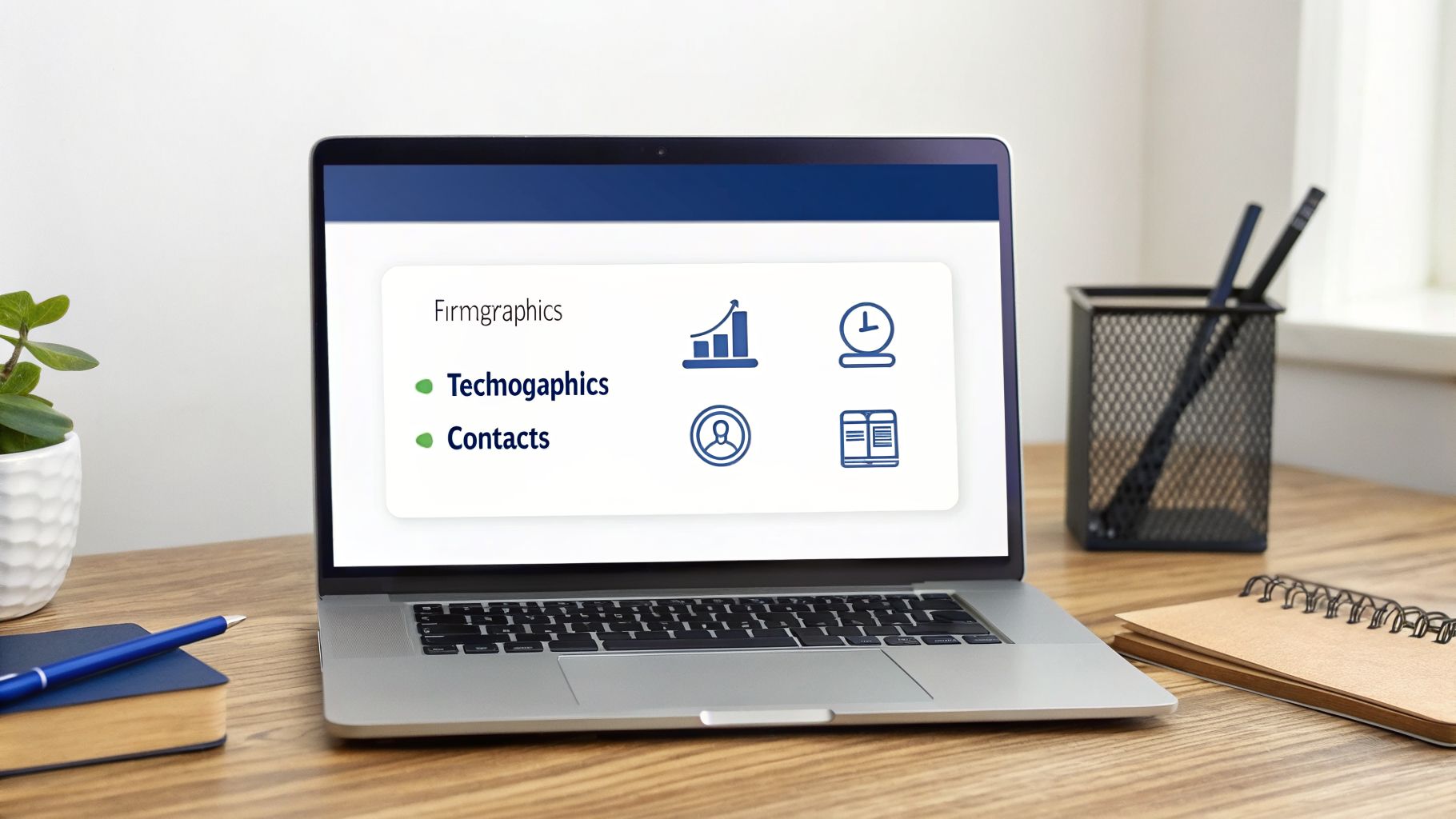
When you're evaluating data enrichment software, it's easy to get lost in feature lists. But the truth is, not all platforms are created equal. The best tools do more than just clean up your contact lists—they give your team a genuine strategic edge.
Think of it like upgrading from a standard-definition TV to 4K Ultra HD. Basic tools give you a fuzzy picture of your market. Top-tier platforms reveal crisp, actionable details that were invisible before, showing you exactly who to talk to and why.
These platforms are built on a foundation of three core data types.
Foundational Data Layers
The bedrock of any useful enrichment tool is its ability to flesh out your existing records with three critical categories of information. This is the absolute minimum for turning a name on a list into a prospect you actually understand.
-
Firmographic Data: This is all about the company itself. You get essentials like industry, annual revenue, employee count, and physical locations. This is the data that helps you segment your market and make sure you’re even talking to the right kind of companies.
-
Demographic Data: This layer zooms in on the person. It validates their job title, estimates their seniority level, and, most importantly, provides contact info like direct-dial phone numbers and verified work emails. This ensures your reps can actually reach the decision-makers.
-
Technographic Data: This is a big one. It uncovers the technology stack a company is already using. Knowing a prospect uses a complementary software—or, even better, a competitor’s product—gives your team an immediate and relevant reason to start a conversation.
While these three layers are non-negotiable, they're just the starting point. The most advanced data enrichment software takes this static information and turns it into dynamic intelligence.
Advanced Capabilities That Drive Growth
True intelligence platforms are set apart by their ability to deliver real-time, forward-looking insights. This is where you graduate from just having data to having a strategic advantage. Top data enrichment platforms often boast advanced capabilities that can even help you uncover hidden profiles, giving you a much more complete picture of your leads and customers.
The real power isn't just knowing a company's revenue; it's knowing why you should call them today. This is the difference between a data provider and a strategic growth partner.
These advanced features are what separate the best from the rest:
-
Buying Signals and Intent Data: This is the game-changer. The software scans the web for triggers that signal a company is in a buying cycle. This could be a spike in research around solutions like yours, a surge in relevant keyword searches, or engagement with a competitor’s content. This helps you focus your energy on accounts that are actually ready to talk.
-
Real-Time Trigger Events: Beyond just vague intent, the best platforms track specific company events that create an opening. You get an alert when a target account hires a new "VP of Sales Operations," announces a Series C funding round, or files for a new office expansion. Each event is a timely and hyper-relevant reason to reach out.
-
Seamless CRM and Tool Integration: The best data enrichment software doesn't force you to live in yet another tab. It plugs directly into your CRM (like Salesforce) and sales engagement tools, automatically enriching records and pushing alerts right to your team in Slack or email. This makes the data immediately actionable and embeds it into your reps' daily workflow.
For a deeper dive into how different tools stack up, you can read our comparison of data enrichment tools to see which features matter most for your team. By focusing on these advanced capabilities, you ensure the platform you choose delivers not just data, but a clear signal on where to focus for maximum impact.
How Enrichment Translates into Real Revenue
So, you understand the features. But let's get to the real question every business leader asks: "What's the ROI?" It's a fair question. You don’t invest in a new tool unless it directly grows the bottom line, and this is exactly where data enrichment proves its worth.
This isn't just about having cleaner data; it's about generating tangible business outcomes you can measure in dollars and cents. The magic happens when enrichment transforms three core parts of your go-to-market engine: how you personalize outreach, how accurately you score leads, and how productive your team is. When those three things are firing on all cylinders, the path from data to revenue becomes crystal clear.
From Generic Outreach to Hyper-Relevant Conversations
Without rich data, most sales outreach is dead on arrival. Reps fall back on generic, uninspired templates that get deleted on sight because they scream, "I know nothing about you."
You've seen this email a thousand times: "Hi, I saw your company is growing and thought you might be interested in our solution." It’s a complete shot in the dark, and your prospect knows it.
Now, imagine that same rep armed with insights from data enrichment software. Their message transforms:
"Following your company's recent Series C funding and the announcement of a new office opening in Texas, I thought you'd find this case study on scaling remote teams valuable. We helped a similar company in your space navigate that exact challenge."
The second message isn't just better—it's in a different league entirely. It's timely, relevant, and proves the rep did their homework. This level of personalization radically boosts response rates because it hits on a specific, current business need. It turns a cold pitch into a valuable consultation. You can get a closer look at the mechanics in our guide to CRM data enrichment strategies.
The Power of Data-Driven Focus
The impact here is massive. B2B data enrichment tools are actively fighting what some analyses call a $3.1 trillion data decay problem in the U.S. alone. A staggering 88% of B2B marketers confirm that enriched data skyrockets lead quality and conversions.
In fact, nearly 65% of Fortune 500 firms now use these tools, seeing results like a 22% lift in marketing conversions and a 40% ROI on analytics. You can discover more insights about data enrichment statistics on enricher.io to see the full scope of this impact.
For account directors and sales teams, this is a game-changer. They go from having zero context on a target account to being ready for a highly relevant conversation in seconds.
Eliminating the Manual Research Tax
One of the biggest hidden costs in any sales organization is the "manual research tax." This is the time your reps waste every single day bouncing between LinkedIn, news sites, and company websites, trying to piece together the very context that enrichment provides automatically.
This manual grind isn't just inefficient; it's a direct tax on your most valuable resource: selling time. Every hour a rep spends digging for intel is an hour they aren't talking to prospects, running demos, or closing deals.
Data enrichment software kills this tax. By automating the collection and synthesis of key account information, it gives that time back to your reps. Here’s what that looks like in the real world:
- Smarter Lead Scoring: With complete firmographic and technographic data, your lead scoring models finally become accurate. Sales teams stop wasting cycles on poorly qualified leads and can focus entirely on opportunities with a high probability of closing.
- Increased Productivity: Reps can instantly find the "why now" for every account without ever leaving their CRM. This means less prep time and more active selling time each day, which directly leads to more at-bats and a healthier pipeline.
- Higher Morale: When reps are equipped with the insights to have meaningful conversations, they win more. Success builds confidence and momentum across the entire sales floor, creating a culture of high performance.

“We're no longer fishing. We know who the right customers are, and we can qualify them quickly. Salesmotion has had a direct impact on pipeline quality.”
Andrew Giordano
VP of Global Commercial Operations, Analytic Partners
From Data Points to Strategic Plays
Having more data is one thing. Knowing how to use it to win bigger, smarter deals is something else entirely. This is where the world of data enrichment software moves beyond just filling in spreadsheet cells and becomes a core part of your strategic intelligence.
Basic enrichment gives you a high-resolution photograph of your target account—a static, detailed snapshot in time. But what if you could have a live video feed instead, complete with an expert commentator telling you what’s happening and why it matters right now? That's the leap from simple data enrichment to modern account intelligence.
The Shift to Account Intelligence
Account intelligence is the next logical step. It’s a dynamic approach focused on turning those static data points into actionable insights that actually drive revenue. It's not about having thousands of data fields; it's about having the right information synthesized into a clear, strategic brief your team can use immediately.
This evolution is critical because today's complex B2B sales cycles are won on timing and relevance, not brute force. An account intelligence platform doesn't just tell you a company's annual revenue; it tells you that their recent earnings call prioritized a new initiative that your product directly solves.
It's the difference between knowing a contact's job title and knowing they just posted on LinkedIn about a problem you can fix. One is a data point; the other is an open door.
The visual below shows how this works in practice. Enriched data becomes the foundation for smarter sales and marketing functions, enabling more strategic plays across the board.
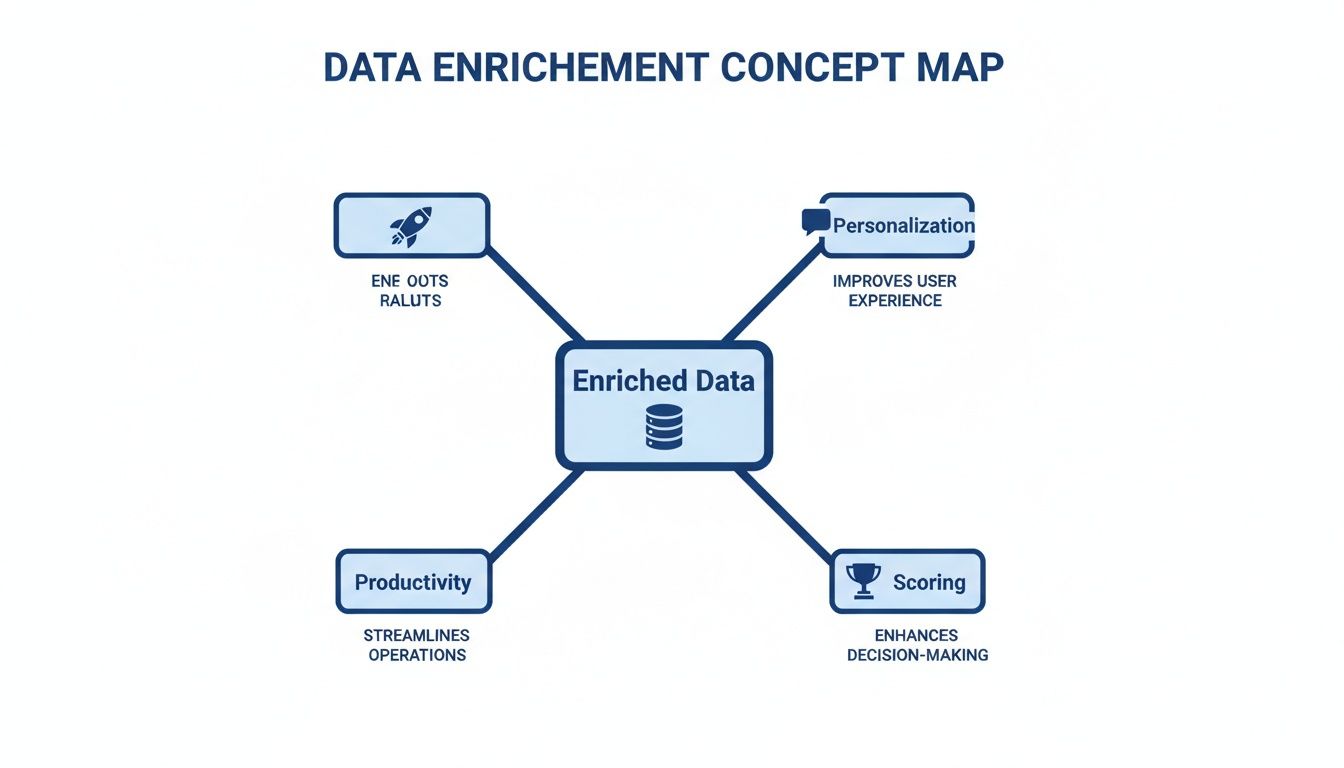
This map isn't just a diagram; it's a blueprint. High-quality data directly fuels improvements in personalization, lead scoring, and team productivity—the building blocks of a sophisticated GTM strategy.
From Raw Data to Actionable Briefs
Modern platforms are built to do the heavy lifting for your reps. They move way beyond simply appending firmographics and start synthesizing information. Imagine your reps getting an automated, opinionated brief on a target account that includes:
- Key Strategic Initiatives: Pulled directly from earnings calls and press releases.
- Identified Risks: Flagged from mentions in SEC filings or industry news.
- Competitive Landscape: Context on who they compete with and how they position themselves.
- Organizational Changes: New executive hires, key promotions, and department shifts.
This isn’t just a news feed. It’s a distilled summary that tells your rep what the company is doing, what's changing, and why it matters to your deal. This is the kind of prep work that normally takes a star performer hours to complete, delivered automatically.
Monitoring for Real-Time Buying Signals
The most powerful advantage of account intelligence is its ability to monitor for real-time buying signals. These are the trigger events that create a window of opportunity. The software acts as a 24/7 scout, alerting your team the moment something important happens.
Here are a few real-world examples:
-
A New Executive Hire: An alert fires when a target account hires a new CRO. The system explains that new leaders often re-evaluate their tech stack within the first 90 days, providing a perfect, timely reason to reach out.
-
Funding or M&A Activity: Your team is notified that a prospect just closed a Series B round. The insight highlights that the funding is earmarked for market expansion—a key use case for your solution.
-
Specific Job Postings: A signal flags a new job posting for a "Sales Enablement Manager" that lists experience with a competitor's tool as a requirement. This tells you they have an active need and an approved budget for that function.
Each signal is delivered with the "so what" clearly explained, turning a random event into a strategic opening. This is how data enrichment software transforms from a database utility into a pipeline-generating machine, turning raw information into measurable growth.
How to Choose the Right Data Enrichment Partner
Picking a data enrichment tool can feel like wading through a sea of marketing promises. Dozens of vendors claim to have the best data, but it’s easy to get lost in feature lists that all sound the same.
Here's the truth: choosing the right partner isn't about finding the most data. It’s about finding the right data, delivered in a way your team can actually use to close deals. This is your practical buyer’s guide—a clear checklist to help you cut through the noise and find a partner that delivers real signal.
Data Sources and Quality
The first and most important question to ask any vendor is simple: “Where does your data come from?” Their answer will immediately tell you if you’re buying high-quality intelligence or just repackaged noise scraped from public websites.
Not all data is created equal. Many providers simply crawl public sites, which is a recipe for stale, inaccurate, and incomplete information. You need a partner who uses verified, multi-source, and ideally, first-party data.
When you're evaluating a vendor, press them on the details:
- Data Verification: How do you actually verify emails and phone numbers? What’s your process for making sure this contact is still at that company?
- Data Freshness: How often is the data updated? Is it in real-time, or are we talking about a quarterly refresh? For dynamic info like job changes, anything less than real-time is already out of date.
- Source Transparency: Will they openly show you where their intelligence comes from? A reputable partner is proud of their data methodology and won't be cagey about it.
If a vendor gets vague about their sources, consider it a major red flag.
Integration and Ease of Use
The most powerful data in the world is useless if your team has to jump through hoops to access it. The best tools are designed to disappear into your existing workflow, not create a new one.
This is all about integration. The platform has to connect directly with the tools your revenue team lives in—your CRM (like Salesforce or HubSpot) and your sales engagement platforms. The goal is to put crucial information right at their fingertips, at the exact moment they need it.
The real test of a tool's usability is how quickly it moves from being a 'new software' to an indispensable part of your team's daily routine. If it requires extensive training or forces reps to work out of a separate tab, adoption will fail.
Look for platforms that push insights directly into your CRM, Slack, or email. The data needs to find your reps where they already work.
From Raw Data to Actionable Insights
This is arguably the biggest differentiator. Does the software just dump a spreadsheet of raw data points on you, or does it deliver synthesized, actionable insights? Because drowning in data is just as bad as having none at all.
Think about the output. A basic enrichment tool might tell you a company’s revenue is $500M. An advanced account intelligence platform tells you why that number matters—because their CFO just mentioned a new cost-cutting initiative in their earnings call that your product is perfect for. For a closer look at the different types of providers, check out our analysis of top data enrichment companies.
Your goal is to find a partner that connects the dots for your team, turning raw data into strategic plays that your sellers can execute immediately.
Evaluation Checklist for Data Enrichment and Intelligence Platforms
To help you compare vendors, we've put together a simple scorecard. Use this to see if you're looking at a basic data provider or a true intelligence partner that can drive revenue.
| Evaluation Criterion | Basic Enrichment Tool | Advanced Account Intelligence Platform |
|---|---|---|
| Data Sources | Primarily public, scraped data; sources often opaque. | Multi-source, verified data including private, first-party, and public sources. Full transparency. |
| Data Freshness | Updated quarterly or monthly, leading to stale information. | Real-time updates for dynamic signals like job changes, hiring, and earnings call insights. |
| Output Type | Provides static data points (firmographics, contacts). | Delivers synthesized, actionable insights and context (the "why" behind the data). |
| Workflow Integration | Basic CRM field mapping, often requiring manual exports/imports. | Deep, native integrations that push insights directly into CRM, Slack, and email where reps work. |
| Ease of Use | Often requires reps to work in a separate platform or tab. | Seamlessly embeds insights into existing workflows, requiring minimal training. |
| Business Value | Fills in missing data fields. | Identifies timely opportunities, suggests strategic plays, and helps reps build a point of view. |
Ultimately, a basic tool gives you a list of contacts to call. An advanced platform tells you who to call, why you should call them now, and what you should say.
“We have very limited bandwidth, but Salesmotion was up and running in days. The template made it easy to load our accounts and embedding it in Salesforce was simple. It was one of the easiest rollouts we've done.”
Andrew Giordano
VP of Global Commercial Operations, Analytic Partners
Frequently Asked Questions about Data Enrichment
As you start to think about a new data strategy, a few common questions always seem to pop up. Let's tackle the practical side of using data enrichment software and account intelligence so you know what to expect.
How Does Data Enrichment Software Integrate with Our Existing CRM?
Most modern enrichment platforms are built to plug right in. They typically connect to your CRM—think Salesforce or HubSpot—using an API. Once you’ve connected it, the software can automatically enrich new and existing records in real-time or in scheduled batches.
But the best platforms don’t just dump raw data on you. They push actionable alerts and synthesized insights directly into the tools your team already lives in, like your CRM, Slack channels, or email. This means your sales reps see critical information right where they work, making it instantly useful without breaking their flow.
Is This Just for Large Enterprises, or Can Small Businesses Benefit Too?
While large enterprises were definitely the first to jump on this, the rise of cloud-based subscription models has made this tech a game-changer for small and medium-sized businesses. In fact, smaller companies often see a more immediate and dramatic ROI.
Suddenly, they have access to the kind of market intelligence that used to require a dedicated research team. It completely levels the playing field, letting agile teams compete on relevance and timing, not just budget. It’s how they punch far above their weight.
It's not just about 'who' to contact, but 'why now' and 'with what message.' An enrichment platform is the difference between having a phone book and having a personal advisor for each account.
How Is This Different from Just Buying a Contact List?
This is a crucial distinction. Buying a list gets you static, rapidly decaying contact information that has zero context. It’s a one-time data dump that starts going stale the second you buy it.
Data enrichment, on the other hand, is a dynamic, ongoing process. It actively monitors companies for trigger events like new funding rounds, key executive hires, or strategic initiatives announced on an earnings call. The software then turns this information into a clear, actionable reason to reach out, helping you craft a message that actually resonates.
The Salesmotion platform takes this a step further. Our AI agents don't just find data; they build account briefs, monitor for buying signals, and even draft personalized outreach for your team. This is how you transform raw signals into measurable pipeline growth. See how Salesmotion turns intelligence into action.