Talent mapping is a structured labor-market intelligence workflow. Teams define future skill needs, then build a named, segmented candidate database before requisitions open so recruiting becomes proactive market coverage instead of reactive search.
That matters because most hiring teams are still working against the clock. Only 12% of U.S. HR leaders do strategic workforce planning on a 3-year horizon (PIN talent mapping guide), while the best candidates often leave the market in about 10 days and the global average time-to-fill sits at 54 days (Recruiterflow market mapping overview). If your process starts when the role opens, you're already late.
A lot of revenue leaders feel this in a very familiar way. A manager gets budget approval, HR opens the req, sourcing starts, and the strongest people are already in late-stage interviews elsewhere. The fix isn't just “hire faster,” it's to build a map of the talent market the same way strong sales teams build account intelligence before they launch outreach.
Why Reactive Hiring Is Costing You Top Talent
A critical role opens, the team drops everything, and each week spent searching shrinks the pool. By the time recruiters have a short list, the candidates everyone wanted have already moved on. The issue runs deeper than sourcing alone, it is a timing problem.
Talent mapping changes that timing. Instead of waiting for a requisition, teams identify the roles and skill families they will need, then build a living database of named candidates, internal and external, segmented by location, seniority, company, and relevance signals. In practice, that turns hiring into a coverage model, much like account-based selling, where teams build target coverage before demand becomes urgent.
The market friction is real. Recruiterflow reports that many employers struggle to fill roles, and hiring cycles stretch long enough for approvals, scheduling, and offer negotiation to slow the process even further (Recruiterflow market mapping overview). When your candidate window is measured in days and your hiring cycle is measured in weeks, reactive recruiting loses by default.
Practical rule: if a role is important enough to hurt when it is vacant, it is important enough to map before it opens.
That is why talent mapping belongs in the same conversation as pipeline management, not just HR ops. Sales teams do not wait until the quarter is ending to identify target accounts, and talent teams should not wait until a vacancy exists to understand supply, competition, and readiness. If you want a tactical way to connect sourcing with pipeline discipline, the framework in talent sourcing strategies for startups is a useful companion read, especially for smaller teams that need focus more than complexity.
Talent mapping also helps revenue organizations make better trade-offs. If a product line is launching, a sales org needs to know whether the bottleneck is product management, technical selling, or implementation capacity. The earlier the map is built, the less likely it is that a launch gets delayed because the team assumed the talent would appear on demand.
For a useful way to think about this from the hiring side, the logic behind job posting analysis is similar, because it starts with market reality instead of wishful thinking. Talent mapping goes broader, earlier, and deeper, so the team sees where the market is moving before the requisition forces a decision.
See Salesmotion in action
Take a self-guided interactive tour — no signup required.
Talent Mapping vs Succession Planning vs Talent Pipelines
These terms get blended together constantly, and that usually creates a weak program. A team says it has a talent map, but what it really has is a succession list for two executives, or a spreadsheet of external names for one open role. The result is narrower than the business needs.
Talent mapping is the broadest layer. It covers internal and external talent across skill families and geographies, and it produces a living dataset that informs hiring, development, and mobility decisions. Succession planning is narrower, focused on internal readiness for specific leadership or critical roles. Talent pipelines are the most tactical layer, usually built for specific open or anticipated roles.
| Dimension | Talent Mapping | Succession Planning | Talent Pipeline |
|---|---|---|---|
| Primary focus | Broad capability coverage across the labor market | Internal readiness for key roles | External candidates for near-term roles |
| Typical owner | HR, TA, workforce planning, sometimes RevOps | HR and business leaders | Recruiters and hiring managers |
| Trigger | Business strategy, capability gaps, market change | Leadership continuity risk | Open role or anticipated vacancy |
| Output | Living talent intelligence dataset | Ready-now or ready-soon internal bench | Short list of targeted candidates |
| Best used for | Workforce planning, mobility, sourcing, and gap analysis | Critical leadership continuity | Fast activation when a req opens |
The ownership question matters more than many organizations admit. If succession planning sits only with HR, it can become disconnected from operating priorities. If pipelines sit only with recruiters, they can become too tactical and never feed broader workforce decisions.
A well-run program layers all three. Talent mapping identifies where the market and the workforce are headed. Succession planning protects continuity for critical roles. Talent pipelines help recruiters move quickly once a search becomes real.
When leaders confuse the three, they overbuild the wrong thing. They either spend months creating a succession matrix no one uses, or they collect external names without understanding the internal skill base they already have. The cleaner model is to treat talent mapping as the intelligence layer, succession planning as the continuity layer, and pipelines as the activation layer.
For a deeper view of how these pieces fit into one operating model, the strategic framing in strategic talent management strategy is worth a look because it reinforces the idea that planning, development, and hiring should work together.

“The talking points are gold. If they're in Salesmotion, I know they're being discussed inside that business. That makes it easy to spark a real conversation, which is 90 percent of the battle.”
Andrew Giordano
VP of Global Commercial Operations, Analytic Partners
A Practical 6-Step Talent Mapping Process
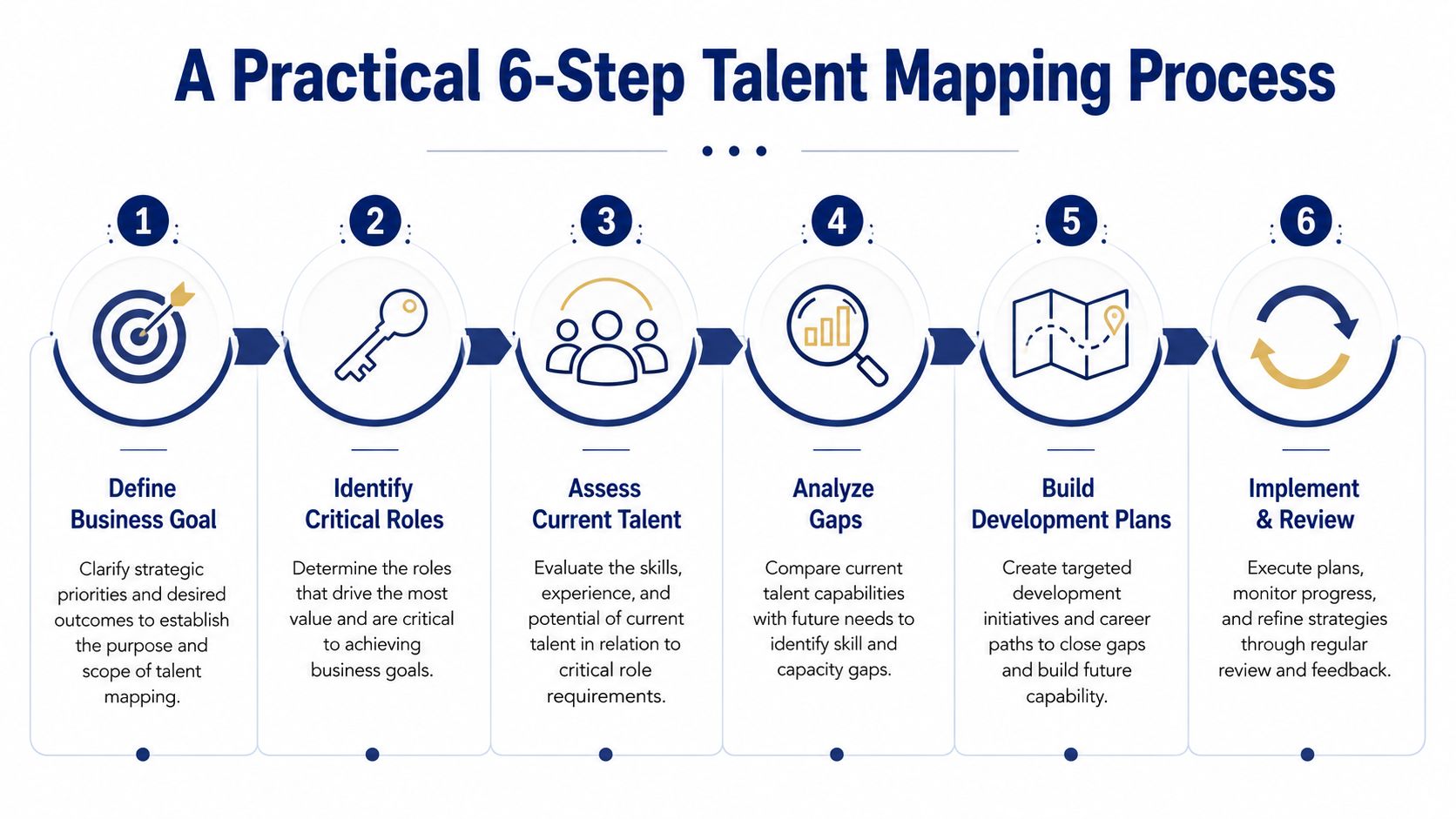
The fastest way to make talent mapping useful is to keep the scope tight. Strong programs usually focus on a bounded set of 10 to 15 critical and scarce capabilities, rather than trying to model every role in the company (Paychex talent mapping guide). That keeps the work tied to business outcomes instead of turning it into a long HR spreadsheet that nobody uses.
1. Define the business goal
Start with the operating outcome, not the job title. If the company is launching into a new market, expanding a product line, or rebuilding a sales motion, identify the capabilities that will slow execution if they are missing. That usually includes the roles closest to revenue, delivery, or customer retention.
2. Identify the critical roles and skills
Translate the business goal into role families and skill requirements. Be strict here, because mapping everything weakens the map. If a capability does not affect growth, continuity, or margin, it probably does not belong in the first pass.
3. Assess current talent
Audit what is already inside the business. Useful inputs include skill profiles, proficiency levels, certifications, development interests, and performance data, along with skills tests, self-assessments, and 360-degree feedback (MuchSkills talent mapping framework, SocialTalent talent mapping glossary). This is also where internal mobility opportunities often surface, because the company sees capability it was not using. For a practical way to keep that movement visible, managing the talent pipeline helps connect assessment, development, and hiring decisions.
Do not trust a spreadsheet that cannot tell you who is ready, who is developing, and who is irrelevant to the target role.
4. Analyze the external labor market
Map where the talent sits, which employers have it, and how scarce it is. That labor-market intelligence makes the map actionable instead of theoretical. The goal is to know where supply is concentrated before you need it.
5. Build the candidate database
Create a named, segmented database with structured fields for location, current company, seniority, tenure, and relevance signals. That structure lets a recruiter or manager prioritize outreach quickly when a role opens. Without it, you just have a list of profiles that nobody trusts.
6. Refresh and act
Talent maps go stale quickly if they are treated like a one-time project. Refresh the data on a regular cadence, then push the findings into hiring plans, development plans, succession decisions, and internal mobility conversations. If the map does not change an actual decision, it is decoration.
Real-World Talent Mapping Examples for Sales Organizations
A product launch can expose talent gaps long before it shows up in revenue. One company planning a new product line might map whether it already has enough product managers, technical sellers, and implementation specialists, then decide which of those roles can be covered internally and which need external hiring. That single exercise prevents a common mistake, hiring too late for the capability mix the launch requires.
The value gets even clearer in a revenue operations context. A RevOps team might map the external market for enterprise account executives across three target cities, segment candidates by current employer, tenure, and move readiness, then use that intelligence to decide who to contact first. The goal isn't to gather names, it's to understand which competitors are producing the strongest talent and where outreach should start.
In that second scenario, the team is basically running an account-based strategy for candidates. It's building a named market, identifying the most relevant targets, and using readiness signals to prioritize effort. That's much closer to how strong sales teams run territory planning than to the old model of posting a role and waiting.
Strong talent maps reduce guesswork before the req opens, which is where most time gets wasted.
A revenue team can also use the same logic to decide how to balance internal development against external hiring. If the company has a good bench in one region but a weak one in another, the map should show that difference clearly. That prevents managers from forcing a single answer, like “always promote internally” or “always buy talent,” when the business reality is more mixed.
For a practical follow-up on keeping candidate relationships organized once the map is built, managing the talent pipeline is the natural next layer. The map tells you where to look, while the pipeline tells you who to engage now.

“All of the vendors that I've worked with, all of the onboarding that I have had to deal with, I will say, hands down, Salesmotion was the easiest that I have had.”
Lyndsay Thomson
Head of Sales Operations, Cytel
Common Talent Mapping Mistakes and How to Avoid Them
The most common failure mode is scope creep. Teams try to map every role in the company, then the project becomes too big to maintain and too vague to influence decisions. The countermeasure is simple, focus on strategic roles and scarce capabilities first, then expand only after the process proves useful.
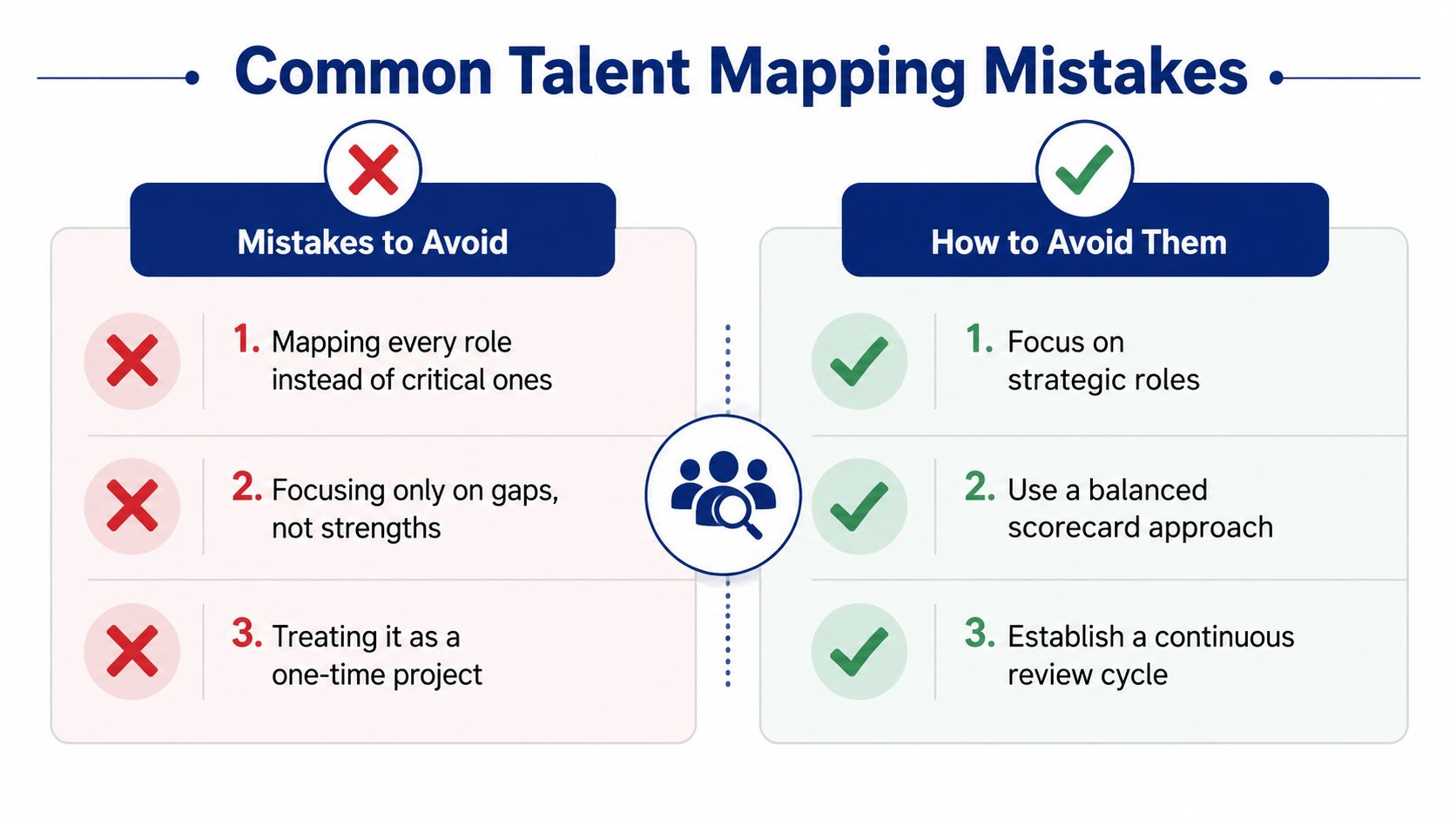
Mistakes that quietly kill the program
- Mapping every role instead of critical ones. This usually happens because leaders want completeness, but completeness is expensive and rarely useful. The fix is to prioritize the roles that would create business pain if they were vacant.
- Focusing only on gaps, not strengths. Teams get fixated on what's missing and ignore where the organization already has depth. A balanced view matters because internal mobility depends on seeing strengths clearly.
- Treating the map as a one-time project. Data gets stale, candidates move, and capability changes. A regular review cycle is the only way the map stays credible.
What good looks like instead
A healthy talent map is tied to business planning, refreshed on a schedule, and used in real hiring or development decisions. It's not a document sitting in a shared drive, it's a working input to operating reviews and staffing conversations. The best teams also assign ownership, because a map with no owner becomes old news fast.
The second mistake is relying on gut feel for skills assessment. That tends to overrate loud performers, undervalue quiet specialists, and miss transferable skills entirely. Structured inputs like assessments, feedback, and performance evidence are a better foundation than manager memory.
The third mistake is building the map in isolation from strategy. If the business is changing its go-to-market model, opening a new region, or launching a new product line, the map has to reflect that shift. Otherwise, it becomes a historical artifact instead of a planning tool.
KPIs That Prove Your Talent Mapping Is Working
A talent map should change how fast hiring teams can act and how confident managers feel about the candidates in front of them. Recruiterflow recommends tracking time-to-first-submit, and it points to a 20 to 30% reduction as an early signal that mapping is doing useful work. That is the kind of measure that shows whether the map is helping recruiters move faster, not just keeping names in a database.
A useful scorecard needs both leading and lagging indicators. Leading indicators show whether the system is healthy. Lagging indicators show whether the hiring outcome improved. If you only watch the final result, you miss the part of the process that needs attention.
A simple KPI set looks like this:
- Time-to-first-submit. How quickly can recruiters present qualified candidates once the req opens?
- Time-to-fill reduction. Is the search shorter than your normal hiring cycle?
- Map freshness. How recently was the talent data updated?
- Pre-identified coverage. Do critical roles already have internal or external names attached?
- Engagement rate. Are mapped candidates responding when outreach starts?
- Quality of source. Are mapped candidates progressing better than unmapped ones?
A talent map that never improves speed, coverage, or hiring quality is just a filing cabinet.
The most useful internal benchmark is usually coverage discipline. When a role matters, there should already be a short list of likely internal and external options attached to it. If leaders keep finding that no one has been mapped for the roles that matter most, the process is too shallow to help in a real hiring cycle.
One more KPI matters, and it gets missed often. A good map should help managers decide whether to train, promote, or recruit. If the KPI conversation only covers recruiter efficiency, the business leaves half the value on the table.
That is where the operating model starts to look more like account-based selling for candidates. Sales teams do not wait for a quarterly clean-up before they update account signals, and talent teams should not wait that long either. A practical way to keep the map current is to pair it with the same kind of signal review used in AI-driven account research workflows, then feed those updates back into hiring and succession decisions as new information appears.
Tools and Workflows for Continuous Talent Mapping
Manual research cannot support a modern talent mapping program by itself. HR and revenue teams usually need a mix of skills assessment tools, labor-market intelligence sources, an ATS or CRM to hold the candidate database, and an automation layer that keeps the system current. Without that stack, the process drifts back into quarterly cleanup work, which is too slow for real hiring demand.
The shift is from annual planning to continuous intelligence. That matters because talent signals change the same way account signals do in sales, through hiring moves, promotions, role changes, and shifts in team structure. Teams that use a signal-driven workflow can respond before the need becomes urgent, instead of waiting for a manager to notice a gap after a resignation or a missed forecast.
A practical workflow usually has four parts. First, skills platforms and feedback tools capture internal capability. Second, labor-market sources show where external talent is concentrated. Third, the ATS or CRM stores the named candidate map. Fourth, automation watches for changes like hiring spikes, org moves, or market shifts and pushes updates back into the map so the list does not go stale.
Sales teams already work this way. The logic behind how to use AI for account research applies here because the goal is to turn raw signals into a usable next action. In talent work, that means identifying who to watch, who to engage, and where the organization should build internally instead of buying in the market.
Salesmotion is one example in this category because it tracks account and org signals continuously and maps stakeholders and relationships inside target organizations, which is useful for revenue teams that want the same kind of signal-driven workflow on the demand side. The broader point is straightforward. Talent mapping works best when it behaves like an always-on intelligence system, not a one-time manual project.