A short sales cycle is one that closes faster than the norm for its deal size and category: under 30 days for low-ACV tools, under 90 days for mid-market and under 120 days for enterprise. For teams planning 2027, the way to get there is to remove friction from the buyer's path, not to push reps harder.
TL;DR: Cycles drag because of process inertia, growing buying committees and qualification gaps. Compress them by agreeing a concrete next step in the first meeting, surfacing legal, security and procurement needs early, prioritizing accounts with a live trigger event, and running a weekly stall review. Judge "short" against your category, not an absolute number.
Most advice about a short sales cycle misses the point. Reps don't usually lose speed because they failed to push harder. They lose speed because the deal was built with hidden friction, extra approvals, and weak buyer urgency from the start.
That distinction matters when you set 2027 targets, because what counts as “short” depends on the deal. In the latest market data, the median B2B SaaS cycle is 84 days, up 22% from 2022 source. Against that backdrop, teams that compress time-to-revenue are usually the ones that remove drag from the buyer's path, not the ones that send more follow-ups.
Why Most Short Sales Cycle Advice Fails
The usual advice sounds useful, but it stops at the rep's behavior. Qualify harder. Follow up faster. Simplify the proposal. Those things can help, but they don't fix a deal that was structurally slow from the beginning.
A deal gets slow when the buyer has to do too much work to say yes. That includes internal alignment, approval chains, security review, procurement, and the simple reality that different stakeholders often want different outcomes. If the seller hasn't designed for that complexity, no amount of urgency language will make the cycle short.
The real bottleneck is usually not effort
A lot of revenue teams overestimate the value of “more hustle” and underestimate how much hidden friction sits in the buying path. That's why generic tactics often create activity without moving close rates. They make the rep feel busy, while the buyer still waits on internal consensus.
The better question is whether the deal is capable of moving fast at all. If the product touches finance, security, legal, and operations, then a short cycle depends on how cleanly those groups can move through the process. If the seller can't reduce that burden, the calendar stretches no matter how strong the rep's cadence is.
A useful revenue strategy lens is to look at the structure around the deal, not just the activity inside it. A practical framing on that broader motion appears in this revenue growth strategy guide, because cycle speed is really a byproduct of how well the go-to-market motion is designed.
Practical rule: If the buyer has to keep re-explaining the problem to new people, the deal is already drifting toward a long cycle.
Generic advice rarely touches buyer friction
“Clarify next steps” sounds good because it's easy to say and hard to argue with. But next steps don't solve misalignment between the economic buyer, technical evaluator, and procurement team. They also don't remove the back-and-forth that happens when presales and sales hand off a half-formed narrative.
The short sales cycle conversation needs to move beyond rep discipline. The advantage comes from deal design, not pressure. That means fewer blind spots, clearer mutual commitment, and far less friction between trigger event and buyer action.
See Salesmotion in action
Take a self-guided interactive tour — no signup required.
What a Short Sales Cycle Looks Like in 2027
A short sales cycle is not one fixed number, because buyer motion varies by ACV, deal complexity, and category. A timeline that would feel slow in DevTools may be completely normal in cybersecurity or pharma.
For SMB deals under $15K ACV, typical cycles run 14 to 30 days. In low-ACV tools, a short cycle is often defined as under 30 days. For mid-market deals, the short-cycle benchmark is usually under 90 days, and for enterprise deals it is often under 120 days source. If you want a plain-language view of how the sales process is defined end to end, this overview of the sales cycle is a useful reference. The same source notes that the median B2B SaaS cycle in 2026 is 84 days, up 22% from 2022, which shows how compressed “short” really is in real markets.
Benchmarks by deal size and category
| Deal Type | Typical Cycle Length | What “Short” Means |
|---|---|---|
| SMB, under $15K ACV | 14 to 30 days | Faster than the normal buying motion |
| Low-ACV tools | Under 30 days | A fast yes with little process drag |
| Mid-market | Under 90 days | A clean cycle with limited stall points |
| Enterprise | Under 120 days | Strong velocity for a complex motion |
| DevTools | 14 to 40 days | Well below average if the buyer is moving quickly |
| HR tech | 30 to 60 days | Fast enough to suggest strong buyer momentum |
| Cybersecurity | 120 to 270 days | Short is rare because trust and risk review are high |
| Pharma | 138 days on average | A short cycle is far below the norm |
The practical read is simple. In a complex motion, “short” is usually relative to category norms, not absolute speed. In enterprise, a close under 90 days is already a strong sign of buying momentum, even though the broader pattern stretches much longer source.
Buyers do not experience “fast” the same way sellers do. A deal feels short only when the next decision is easy to make.
That gap matters in the market data too. Salesforce reports that 57% of sales professionals say the sales cycle is getting longer, and broader B2B research shows 74.6% of new-customer deals take at least 4 months to close, while 46.4% take 7 months or longer source. So when a team claims to have a short sales cycle, the question is whether it is short for its category, not whether it feels quick inside the rep workflow.

“The moment we turned on Salesmotion, it became essential. No more hours on LinkedIn or Google to figure out who we're talking to. It's just there, served up to you, so it's always 'go time.'”
Adam Wainwright
Head of Revenue, Cacheflow
The Real Reasons Your Sales Cycle Drags On
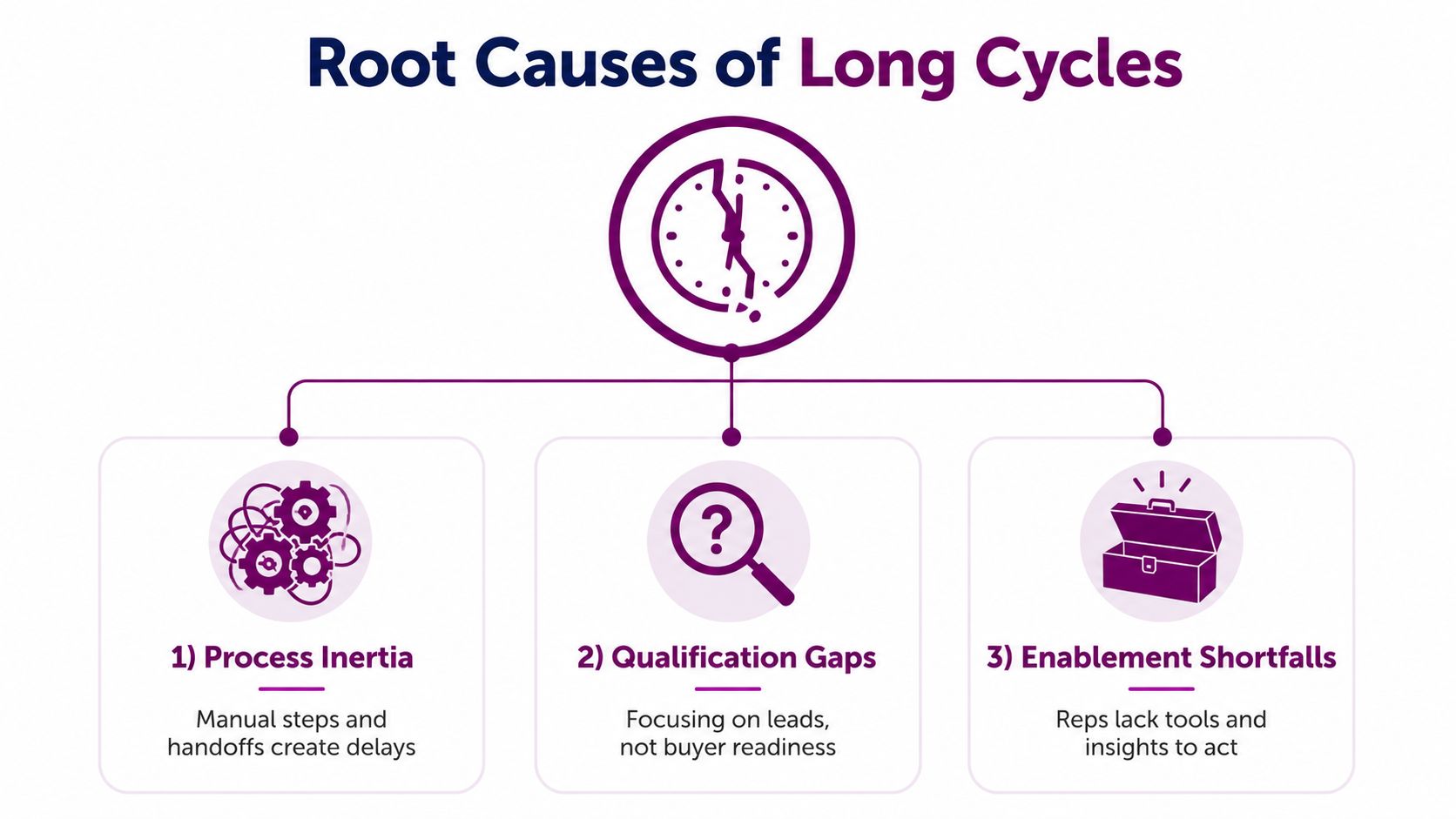
Long cycles usually come from compounding friction, not one obvious failure. A buyer starts with interest, then each added layer slows the process a little more. By the time the deal stalls, the problem is usually spread across stakeholders, process, and enablement.
Process inertia creates hidden delay
Every manual handoff adds waiting time. Sales, presales, security, legal, and procurement each have their own pace, and that pace gets worse when nobody owns the full path from first meeting to signed agreement. The seller may think the deal is moving, but the buyer is waiting for answers.
Internal misalignment hurts most here. If the champion likes the solution but can't get the economic buyer aligned, the cycle slows. If the buyer wants proof but the seller can't deliver a crisp narrative, the deal starts to drift. The result is not just delay, it's deal fatigue, where energy fades before commitment appears.
Committee size changes the math
Salesforce's benchmark data says each additional decision maker adds an estimated 8 to 15 days to the sales cycle, and enterprise deals over $500K average 270 days to close source. That's why committee growth matters so much. More people means more opinions, more scheduling pain, and more chances for the story to break.
The most common mistake is pretending that stakeholder sprawl can be solved with one more demo. It can't. If the account hasn't been mapped well, the rep ends up discovering the buying process late, when the cost of confusion is already high.
Qualification gaps and enablement shortfalls make it worse
The underrated part of cycle drag is that sales teams often qualify for pain, but not for buying readiness. A prospect can be interested and still not be ready to move. That's where many “good opportunities” become long ones.
A separate friction point is the rep's own preparation. Teams waste time assembling context, searching for account relevance, and figuring out what to say next. A practical breakdown of that hidden time sink is covered in this note on how sales reps waste time on research, because poor prep slows every downstream step.
The fastest deals usually aren't the most persuasive. They're the most legible, internally and externally.
The Playbook for Compressing Your Sales Cycle
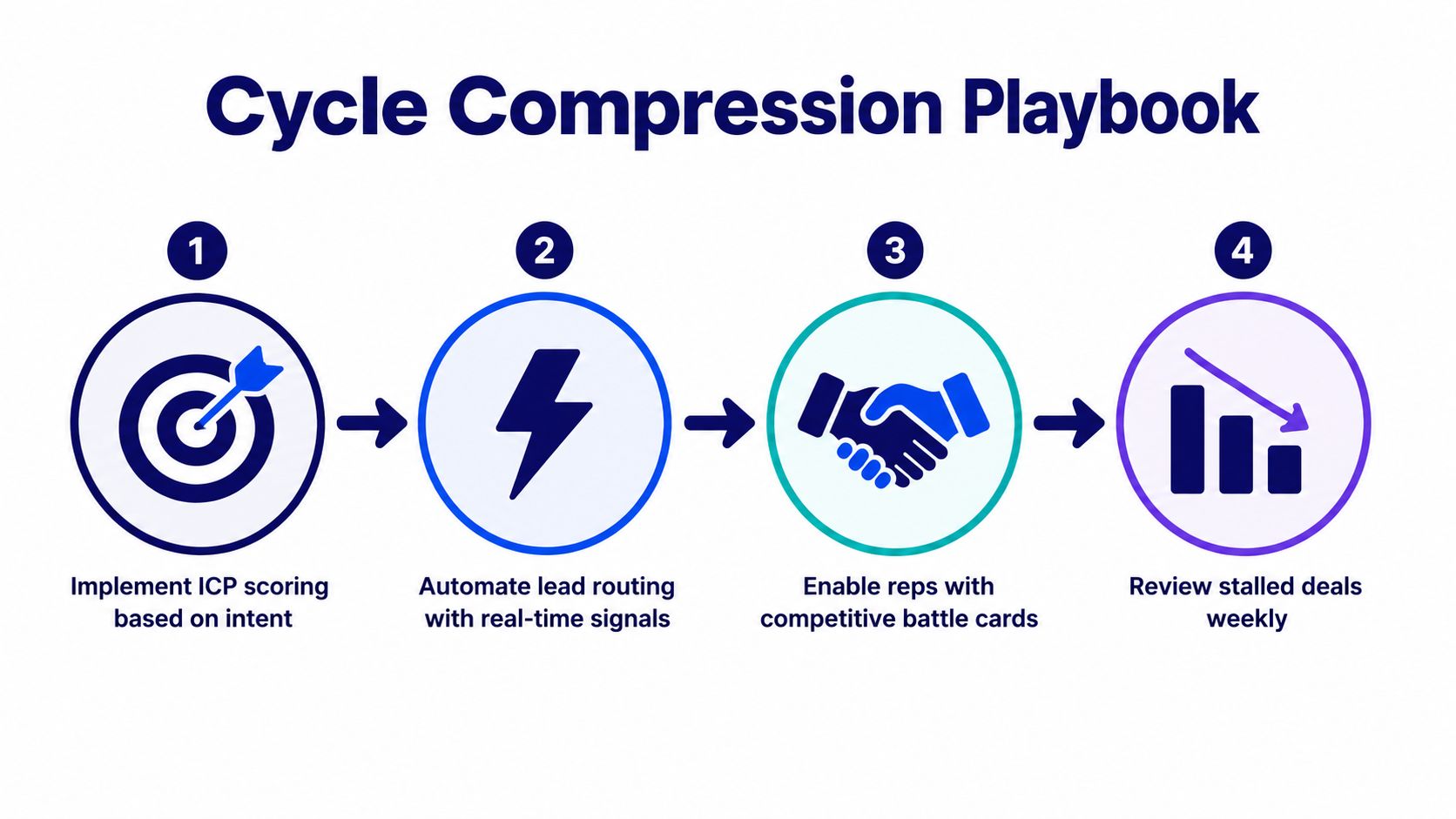
The goal isn't to force urgency. It's to remove delay from the buying path and make the next step obvious. That starts before the first demo and continues all the way through approval.
Start with next-step commitment in the first meeting
Fast deals tend to have clearer commitment early. In the fastest deals, sellers spent 53% more time discussing next steps in the first meeting than in slow-cycle deals source. That doesn't mean pushing for a close on day one. It means leaving the first call with a concrete path the buyer has already accepted.
A good next step is not “let's reconnect soon.” It's a defined action with an owner, a date, and a reason. If the buyer leaves the meeting without one, the cycle often expands by default.
Remove approval friction before it shows up
Most teams wait until the buyer asks about legal or security, then scramble. Better teams surface those blockers earlier and package answers in a way that matches the buyer's process. That can mean a cleaner mutual action plan, a lighter proposal, or a shorter internal approval path for lower-risk deals.
The simplest rule is this. If procurement is involved, the seller should know what procurement needs before the buyer does. If presales must join, the handoff should preserve context instead of restarting the conversation. Small process fixes like that save far more time than another polished pitch deck.
Prioritize accounts with high velocity potential
Not every account deserves the same motion. A short cycle usually comes from focusing on the accounts most likely to buy quickly, then tailoring the workflow around them. That's where trigger-based qualification matters more than static lists.
A signal-led view of prioritization helps here, especially when timing is visible in the market. A practical framework for that kind of motion is in this guide to signal-based selling, because a buyer who just hired a new leader or launched a relevant initiative often has a different purchase window than an account that merely fits ICP on paper.
Build a weekly stall review
Don't let stalled deals hide inside the pipeline. Review where they sit, what's missing, and which stakeholder has gone quiet. The goal isn't to shame reps, it's to isolate the friction point fast enough to remove it.
A compact operating rule works well:
- Reps own buyer clarity: If the buyer is confused, the rep needs to tighten the story.
- Managers own process removal: If approvals are stalling, leaders should simplify the path.
- RevOps owns visibility: If stall reasons aren't visible, the team can't fix them.
“Automatic account profile detail I can use to manage my territory. Using Salesmotion AI to generate value statements per persona, account, etc. Using Salesmotion to give me a starting point based on new hires, or news alerts is critical.”
Adam Wainwright
Head of Revenue, Cacheflow
How Real-Time Signals and AI Agents Accelerate Deals
A deal shortens when outreach hits at the right moment, with the right context, before the opportunity cools. Static qualification still helps, but it does not show when a buyer has entered a live window. Real-time signals matter because they point sellers to the moments when action is more likely to turn into a conversation.
A hiring signal is a practical example. A prospect posts a new role that maps directly to your product category. An AI agent can capture that event, gather the account context, and surface why it matters. The rep does not have to research the company from scratch, and the team gets a reason to act while the trigger is still fresh.
Trigger first, research second, outreach third
Short-cycle motions start with an event. Funding, leadership moves, earnings, product launches, org changes, and hiring activity can all create a real reason to reach out now instead of later. The seller's job is to turn that trigger into a specific conversation that fits the buyer's current situation.
Salesmotion supports that workflow without turning the section into a product tour. The useful part is simple, public signals get collected, context gets organized, and reps get a cleaner path from trigger to outreach.
A realistic workflow beats generic speed
A rep sees a trigger in Slack, opens the brief, and gets the context without digging through scattered tabs. That saves time, but the bigger gain is timing. Outreach can go out within hours instead of days, which is often the difference between a live buying window and a cold one.
The reason this works is straightforward. Buyers move when the event matters to them, not when the seller finally follows up. Teams that respond to real-time triggers shrink the gap between market change and outreach, and that gap is where many opportunities stall out.
For teams watching public opportunity signals, the government RFP database is another useful input because it helps identify live buying intent before a cycle fully forms.
Speed matters, but relevance matters more. The fastest message still fails if it does not connect to a live change in the account.
Metrics That Prove Your Cycle Is Getting Shorter
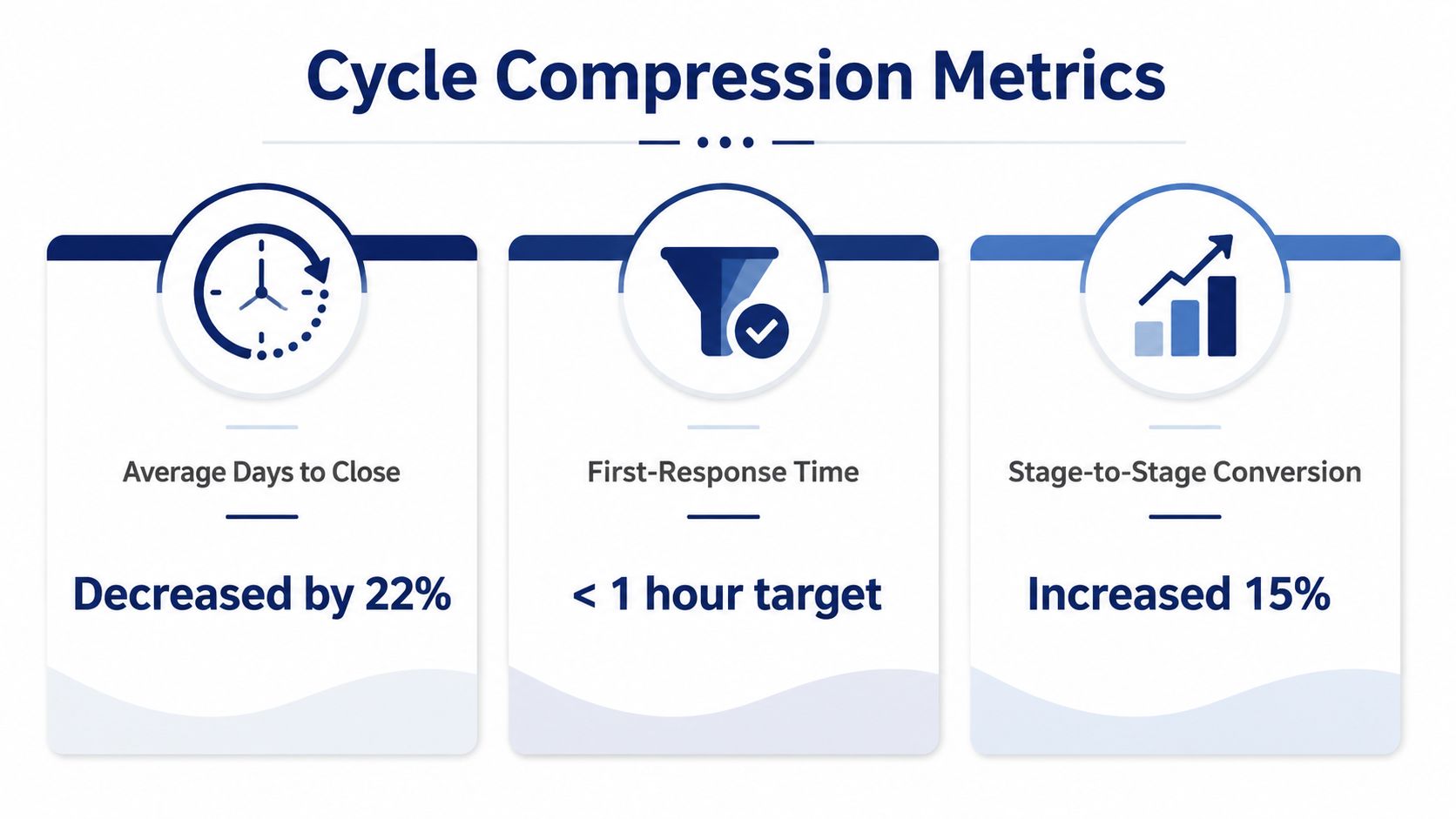
Cycle compression only matters when the numbers move in the right direction. Teams often celebrate activity spikes while ignoring whether buyers are moving faster. A useful dashboard keeps those two things separate.
Track the lag between signal and outreach
One of the clearest indicators is how quickly the team responds after a meaningful trigger. If that lag stays long, the motion is not really signal-driven yet. The team is still reacting on a schedule instead of responding in context.
That metric matters because it shows whether the system is working. If the buyer changes behavior and the rep responds the next day, the window may already be closing. The goal is not just faster activity, but faster relevance.
For teams watching public opportunity signals, the government RFP database is another useful input because it helps identify live buying intent before a cycle fully forms.
Measure stage duration and engagement depth
Stage-by-stage timing shows where deals freeze. If discovery moves quickly but evaluation drags, the team probably needs stronger proof or cleaner handoffs. If proposals stall, the issue may be approval friction, not interest.
Decision-maker engagement rate also deserves attention. If only the champion is active, the deal is more fragile than it looks. A short cycle usually involves broader stakeholder movement, not just one enthusiastic contact.
Segment by deal size and cycle length
Cycle data gets more useful when you separate it by deal size, industry, and rep. A fast close in SMB does not tell you much about enterprise motion. A rep with unusually short cycles might also be working a narrower segment, not necessarily selling better.
One practical way to start is to compare:
- Time to first meeting for inbound and outbound leads.
- Stage duration by segment.
- Win rate by cycle length to see whether faster deals convert better.
- Response time after a trigger to test whether signal use is real or cosmetic.
Salesforce data is useful here as a benchmark for where teams often lose time across the pipeline, especially when the reported cycle looks healthy but deal movement slows underneath it. Salesforce has repeatedly pointed to the gap between activity and outcomes, which is exactly why cycle metrics need to be read together rather than in isolation.
Short-cycle work is never done once. It needs retrospectives, coaching, and a willingness to remove friction wherever it shows up. The teams that keep improving usually treat cycle compression as an operating discipline, not a campaign.
Building a Signal-Driven Sales Motion That Scales
Static ICP lists are useful, but they're not enough on their own. Accounts change, people change, and buying windows open and close faster than most manual workflows can keep up with. A signal-driven motion gives revenue teams a way to move with the market instead of chasing it after the fact.
The organizational shift is straightforward. RevOps needs to define which signals matter. Sales needs a clear response motion. Marketing can support the same timing with relevant content, while AI agents handle the research and first-draft outreach that usually slows reps down.
That's the advantage of a short sales cycle strategy built around signals. It scales personalization without scaling headcount in the same way, and it gives teams a practical path to relevance. In a market where cycles are getting longer, the teams that compress time-to-revenue with signals and AI are the ones that stay competitive.
If you're trying to shorten cycles without burning out your reps, Salesmotion gives revenue teams AI agents that track account signals, build context, and turn triggers into ready-to-send outreach. Visit Salesmotion to see how signal-driven selling can help your team act faster on the accounts that matter most.