The data scientist job market is still expanding, but the story is no longer as simple as “more jobs means easier hiring.” The Bureau of Labor Statistics projects 34% employment growth from 2024 to 2034, about 23,400 openings per year, and a median annual wage of $112,590 in May 2024 for data scientists, with employment rising from 245,900 jobs to 328,300 over the decade (BLS occupation outlook). That combination tells you the role is large, durable, and well-paid, but it also hides a narrower reality, the market is splitting into broad analytics work on one side and production-ready AI and ML work on the other.
TL;DR: The data scientist job market is still growing, but it is splitting in two: broad analytics roles on one side and production-ready AI and ML engineering roles on the other. The latest available data, from 2024 to 2026, shows strong pay, few fully remote roles and rising demand for deployment skills. For revenue teams, data and AI job postings are a public signal that an account is investing.
The Macro View of Data Science Employment
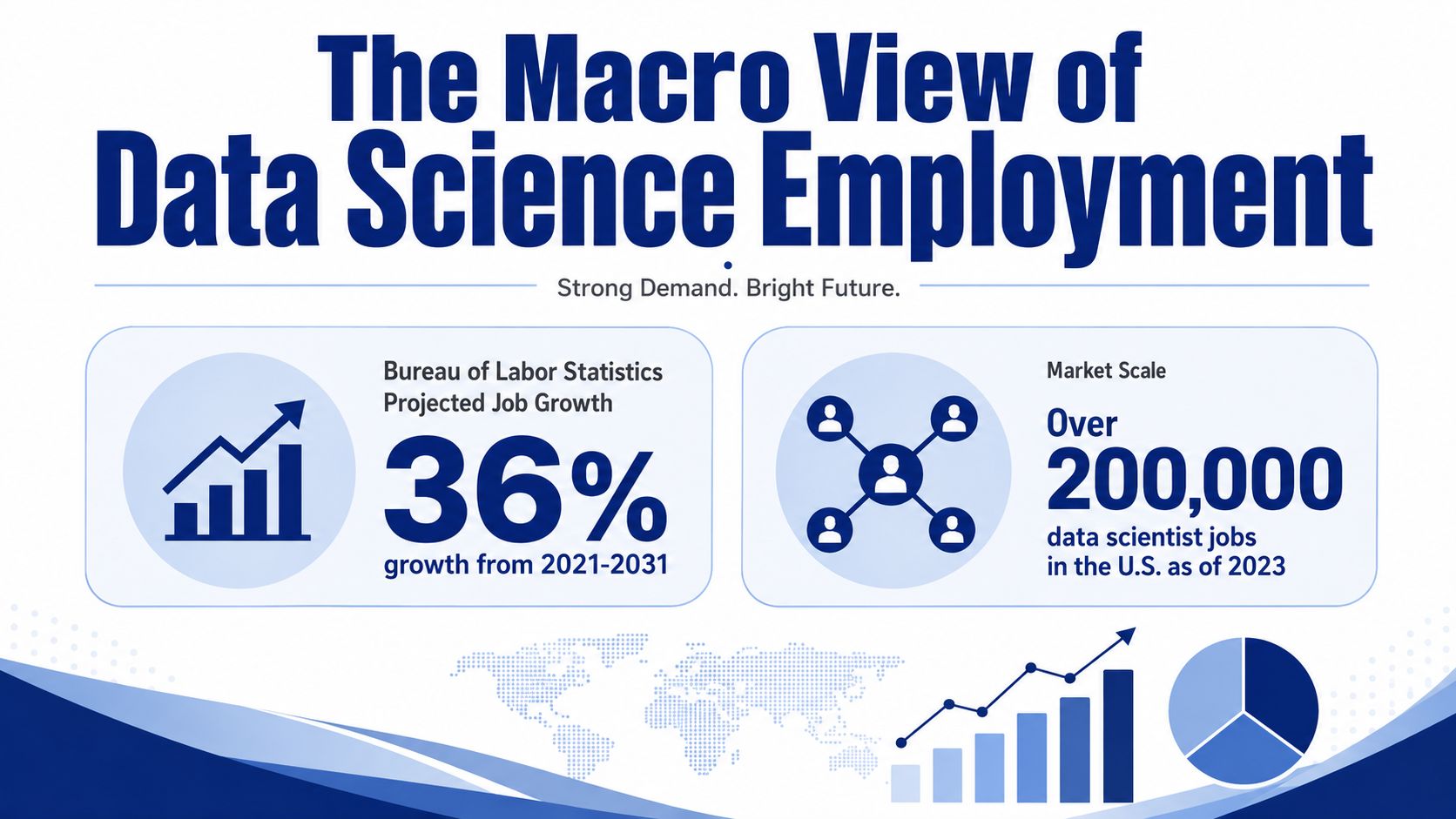
The clearest macro signal still comes from the BLS projection. Data scientist employment is expected to grow 34% from 2024 to 2034, far faster than the average for all occupations, and the occupation is projected to add about 23,400 openings per year while moving from 245,900 jobs in 2024 to 328,300 in 2034 (BLS occupation outlook). That is a large labor market with steady replacement demand and a strong wage floor, which means demand for the function remains real even when recruiting feels uneven.
Why the headline growth still matters
A lot of job seekers see slower hiring headlines and conclude the field has cooled. That reading misses the difference between short-term recruiting cycles and long-term labor demand. The BLS forecast shows the core occupation is still expanding, and the wage level indicates employers continue to pay for people who can turn data into decisions and systems into outcomes (BLS occupation outlook).
That matters for candidates and hiring teams. When compensation stays high and the role keeps growing, companies do not stop investing in analytics, AI, and data infrastructure. They become more selective about which version of the role they need. For candidates, the market is still open, but the threshold has shifted from general analysis to solving the specific problem a team is trying to ship.
For revenue and talent leaders, the broader labor signal helps explain why hiring plans stay resilient even when pipelines feel uneven. A market with sustained growth and strong pay levels usually supports continued budget for data functions, especially in larger U.S. markets where hiring patterns often shape expectations elsewhere. If you want a companion guide that maps analytical roles more broadly, the Icypeas career guide for analysts is a useful reference point for adjacent career paths.
Practical rule: Do not read a selective hiring cycle as a shrinking profession. Read it as a market that keeps demand high while tightening the definition of what qualified means.
That is also why data hiring belongs inside broader talent planning, not as a one-off requisition. Teams that tie data recruitment to account strategy, workforce planning, and budget cycles usually make better choices about timing, role design, and compensation. A useful internal model for that kind of planning is strategic talent management strategy, because the market now rewards employers that hire with precision instead of volume.
See Salesmotion in action
Take a self-guided interactive tour — no signup required.
Market Bifurcation and the Shift to AI Engineering
The market is splitting into two clear tracks. On one side are broader data science roles that are getting harder to hire for at scale. On the other are specialized ML and AI engineering positions that sit closer to deployment, infrastructure, and product delivery. Interview activity for Data Scientist roles fell from 1,763 sessions per month in September 2025 to 772 in June 2026, a 56% drop, while demand shifted toward ML Engineer and AI Engineer roles that absorb work once labeled data science (FinalRoundAI market report). The work did not disappear, it moved into titles that signal execution rather than general analysis.
That split shows up in how employers write jobs and allocate hiring attention. Broad openings are less visible, while roles tied to shipping models, maintaining pipelines, and supporting product teams keep showing up. Interview Query's January 2026 report said hiring had flattened across most core roles, with growth concentrated in AI-adjacent positions, and it estimated month-over-month change at +3–5% while still sitting 2–5% below January 2025 benchmarks (Interview Query report). The direction is consistent with a market that is reallocating demand instead of expanding every title equally.
Why the junior squeeze is real
Early-career candidates feel the pressure first. Public commentary often focuses on long-run demand, but near-term hiring is more selective, especially for applicants without direct production experience. A LinkedIn analysis of the post-boom market describes employers favoring hybrid profiles that combine statistics, coding, infrastructure, experimentation, and AI fluency rather than a generic entry-level title (LinkedIn post-boom analysis). That is the junior squeeze in practical terms.
Employers are screening for evidence that you can join a team and contribute to production work without a long ramp.
The résumé problem follows from that filter. Coursework, dashboards, and a few Kaggle-style projects rarely show enough proof of shipping. Hiring managers want evidence that a candidate can work in the same operating environment as engineers and product teams, handle edge cases, and stay useful after the first handoff. A broad claim of analytical skill matters less than work that resembles the team's actual delivery cycle.
For hiring managers, the bifurcation changes how roles should be framed. If the team needs experimentation support, say that directly. If the opening requires model deployment, name that too. If the role sits between data science and AI engineering, define that boundary clearly so candidates know what problem they are joining to solve. Generic titles attract mismatched applicants and make it harder for qualified people to self-select in.
That same logic applies when teams compare adjacent workflows outside data science. A discussion of whether AI can replace sales research, for example, is useful because it shows how automation changes task design before it changes headcount, which is exactly the kind of shift hiring teams should expect in analytical roles as well. For teams benchmarking that crossover, the sales research and AI analysis guide is a relevant reference point.
A useful resource for teams comparing adjacent technical profiles is the CTO playbook for AI hiring, because the market is increasingly treating data scientist, ML engineer, and AI engineer hiring as overlapping decisions with different execution requirements.

“The moment we turned on Salesmotion, it became essential. No more hours on LinkedIn or Google to figure out who we're talking to. It's just there, served up to you, so it's always 'go time.'”
Adam Wainwright
Head of Revenue, Cacheflow
The New Technical Baseline for Candidates
The posting data shows a market that is narrowing around production-ready skill signals rather than broad analytical comfort. 82% of data science postings mention Python, 55% mention SQL, 69% reference machine learning, and the share asking for natural-language-processing skills rose from 5% in 2024 to 19% in 2025 (Axial Search job data). That is a clear move toward roles where analysis, modeling, and implementation sit closer together.
What stands out is the direction of travel. Hiring managers are increasingly looking for candidates who can move from model work into deployment-oriented execution, especially where ML, data engineering, and AI tooling overlap. In other words, the market is rewarding people who can build something that survives contact with production, not just something that looks good in a notebook.
What the résumé signal now says
Generic analytics resumes struggle because they don't show enough proof of shipping. A recruiter can't tell, from a list of tools alone, whether a candidate has built pipelines, maintained models, or worked with stakeholders long enough to handle edge cases. That is why applied experience matters more than broad vocabulary.
The right portfolio signal is concrete. A candidate who shows a deployed churn model, a monitored recommendation pipeline, or an NLP workflow that handles messy text data is speaking the language of current hiring. A candidate who only lists “machine learning” and “data visualization” is still using the language of older, more generalized postings.
If you want a practical way to review your own profile, use this simple filter:
- Can I show a deployed artifact? If not, the portfolio is probably too academic.
- Can I explain the business use case? If not, the work may be technically sound but commercially thin.
- Can I describe the data flow end to end? If not, the profile may read as analysis-only.
- Can I talk about model maintenance or monitoring? If not, it may not read as production-ready.
Candidate rule: A project that ends at model accuracy is weaker than a project that shows how the model reached users and stayed useful.
The 365 Data Science review adds another layer to this shift. It reports that 47.4% of data scientist roles require a data science degree, and that Python was explicitly mentioned in 78% of offers in 2024 but 57% in 2025 (365 Data Science job market review). That does not mean formal education disappeared or Python became irrelevant. It suggests hiring is becoming more selective about background while also broadening the skill mix it expects.
For hiring teams, the best use of this signal is simple. If you want people who can work across analytics, experimentation, and stakeholder communication, write that into the posting and screen for it directly. The wording of a requisition now shapes the applicant pool more than many teams realize, which makes job posting analysis a useful discipline rather than a content exercise.
The split between generic analytics and production-oriented work is also showing up in adjacent technical hiring. Teams tracking programming jobs and AI shifts are seeing a similar pattern, where employers want candidates who can connect code, models, and deployment instead of treating each as a separate specialty.
Compensation Realities and Remote Work Trends
The compensation picture is still strong, but it's not evenly distributed. According to 365 Data Science's 2026 analysis, the largest salary band, covering 32% of roles, is $160,000–$200,000, followed by $120,000–$160,000 at 27% (365 Data Science career outlook). That tells you where the market is concentrated. It doesn't say every role pays that much, but it does show that a meaningful share of openings sits in a high-compensation range.
The remote story is more constrained. The same analysis reports that only 5% of data science jobs are fully remote (365 Data Science career outlook). That makes remote work a niche feature, not the default. Most enterprise employers are still anchoring these roles in hybrid or on-site structures, especially when the work connects closely to product, infrastructure, or executive stakeholders.
| Category | Percentage of Roles | Key Insight |
|---|---|---|
| Fully remote roles | 5% | Remote-only options are limited and niche |
| Salary band $160,000–$200,000 | 32% | Compensation clusters at the top end |
| Salary band $120,000–$160,000 | 27% | A large share still pays well, but below the top band |
That distribution matters for job seekers because salary expectations and location flexibility are now part of the same trade-off. Candidates who want pure remote work may need to accept a smaller subset of openings. Candidates who want the strongest compensation bands may need to be more open about hybrid arrangements and the industries that use them.
For hiring managers, the lesson is sharper. Don't assume flexibility alone will solve your recruiting problem. If the role needs close collaboration with product, engineering, or leadership, hybrid may be the actual operating model, not a compromise. Being honest about that upfront can improve applicant quality and reduce wasted cycles.
The other useful comparison point is how compensation communicates role maturity. When pay clusters high, employers are usually buying specificity, not generic support. That means the salary offer itself can be used to signal whether the job is really analytics, ML, AI, or something in between. Teams that ignore that signal often end up with mismatched expectations on both sides.
If your compensation model includes variable pay or incentive language, it helps to define it clearly. A practical framing of that concept appears in what does OTE mean, especially for teams that are trying to translate role value into a clean offer structure.
“Automatic account profile detail I can use to manage my territory. Using Salesmotion AI to generate value statements per persona, account, etc. Using Salesmotion to give me a starting point based on new hires, or news alerts is critical.”
Adam Wainwright
Head of Revenue, Cacheflow
Strategic Signals for Revenue and Hiring Leaders
Data science hiring is one of the cleanest public signals that a company is investing in data infrastructure, workflow maturity, or applied AI. When a target account posts for ML engineers, NLP specialists, or AI-adjacent product talent, that's not just a recruiting event. It's a buying signal that says the company is moving work closer to production and needs the systems around it to scale.
The current market data helps you read that signal more accurately. 82% of postings mention Python, 55% mention SQL, and 69% reference machine learning, while NLP demand climbed from 5% in 2024 to 19% in 2025 (Axial Search job data). If a company is hiring into those skill clusters, it's likely building around deployment, not just reporting. Revenue teams should treat that as a trigger to map the account's data stack, AI roadmap, and likely procurement path.

How to use the signal without overreading it
Start with role specificity. A generic “data scientist” posting is informative, but an ML engineer or NLP role usually tells you more about where the company is trying to operationalize value. The more production-oriented the title, the more likely the team needs data infrastructure, cloud support, observability, MLOps, or adjacent software tooling.
Then connect the job language to account context. If the posting mentions model deployment, experimentation, or customer-facing AI features, sales teams can infer that the company has an active implementation agenda. That's the point where account research becomes useful for outreach, because the “why now” is no longer speculative. The company has already signaled it.
For hiring leaders, the same data should shape internal planning. If your organization is posting for junior analysts while the market is clearly rewarding production-ready AI and ML profiles, your funnel is going to feel inconsistent. If you need to hire fast, write the role around the actual work and the actual skill stack, then screen for shipped work, not generic familiarity.
The best outreach and the best hiring briefs both start from the same question, what changed in the company that made this role necessary now?
Salesmotion is one example of a platform that monitors real-world account signals, including job postings, and turns them into alerts and account context for revenue teams. In this market, that matters because hiring data often shows up before the broader procurement story is obvious.
Navigating the Future of Data Careers
The next phase of the data scientist job market won't be defined by a single title. It'll be defined by specialization, with one track leaning toward analysis and experimentation, and another leaning toward production-ready AI and ML work. The candidates who do best will be the ones who can show evidence of shipping, not just studying, and the employers who do best will be the ones who write roles that reflect the work they need done.
The three moves that matter most
- Specialization is Key. Generic profiles get screened out more often because the market now separates analytics, ML, and AI engineering more clearly than it did before.
- Master Production Skills. Python, SQL, machine learning, and deployment-oriented experience are the most useful signals when employers need work that ships.
- Build a Strategic Roadmap. Candidates should map their skills to the role family they want, and hiring teams should match their job descriptions to the actual operating model.
The clearest mistake to avoid is treating headline growth as proof that every subsegment is equally healthy. The overall market is expanding, but the openings are not all pointing in the same direction. If you're a candidate, that means choosing a lane and proving you can operate in it. If you're a leader, it means hiring against the actual work, not the old label.
For teams trying to align account strategy with real market movement, Salesmotion helps revenue organizations track signals such as job postings, hiring changes, and other public account events, then turn those signals into outreach context and pipeline action. Visit Salesmotion if you want to connect hiring activity to account prioritization and use public workforce signals to decide where to focus next.