Imagine having a dedicated research team working 24/7 for your sales reps, pinpointing the exact moment to engage with a target account. That's the real power behind modern demand generation software. This isn't just another tool to add to the stack; it’s a strategic shift away from manual grunt work and generic outreach, turning your entire go-to-market motion into an intelligence-driven engine for predictable growth.
TL;DR: Demand generation software monitors your target accounts for buying signals, turns what it finds into account briefs, and drafts outreach tied to the trigger. When you evaluate tools for 2027, test four things: intelligence quality, fit with the workflow your reps already use, custom signals, and time to value. Then measure the result in pipeline velocity, conversion rates and rep productivity.
Beyond Buzzwords: What Demand Generation Software Actually Is

Let's get straight to the point. The concept of "demand generation" isn't new. It’s the essential top-of-funnel work marketing teams do—like content marketing, webinars, and SEO—to build awareness and interest in a company’s solutions.
But when we talk about demand generation software, we're referring to a specific category of technology designed to automate and supercharge that entire process. It’s an intelligent system that flips revenue teams from being reactive to proactively creating pipeline by flagging the critical 'why now' moments to engage.
Think of it this way: a top-performing sales rep spends hours researching an account before ever making a call. They’re digging for triggers—a new C-suite hire, a fresh funding round, or a new initiative mentioned in an earnings call. This software automates that work, but at scale and in real-time.
Key Insight: Demand generation software isn't about generating more leads. It’s about generating smarter conversations by arming your team with the intelligence they need to be relevant and timely.
The Problems It Actually Solves
Most B2B sales teams are stuck dealing with two core pain points that this software is built to fix:
- Inconsistent Account Planning: Without a system, account research is often shallow and hit-or-miss. Your A-players might do deep dives, but everyone else is just scratching the surface, leading to unpredictable results and missed opportunities.
- Irrelevant Outreach: Generic emails and cold calls that lack a compelling "why now" get deleted. Reps constantly miss the very signals that would make their outreach welcome and effective.
Modern platforms address this by continuously monitoring thousands of data points. At its core, modern demand generation software relies on robust marketing automation, enabling businesses to pull in potential customers and nurture leads around the clock. The system synthesizes all this information and pushes actionable insights directly into a salesperson's existing workflow, whether that's their CRM or a Slack channel.
A Shift From Manual Effort to Automated Intelligence
This technology represents a fundamental shift in how go-to-market teams operate. It’s about moving away from time-consuming manual tasks and embracing a more strategic, intelligence-led approach. The difference is stark.
Traditional Outreach vs. Intelligence-Driven Demand Generation
| Activity | Traditional Approach (Manual & Reactive) | Modern Approach (Demand Generation Software) |
|---|---|---|
| Research | Reps spend 3-4 hours manually digging through news, social media, and reports for a single account. | The platform automatically surfaces relevant signals and insights in minutes. |
| Timing | Outreach is based on a predetermined cadence or a guess. | Outreach is triggered by real-time events like a funding round or new hire. |
| Messaging | Reps use generic, one-size-fits-all templates that often get ignored. | Messaging is hyper-relevant, referencing the specific trigger that matters now. |
| Focus | Effort is spread thinly across a large, unfiltered list of accounts. | Effort is concentrated on accounts showing clear intent or experiencing change. |
| Outcome | Low response rates, inconsistent pipeline, and reps burning out on low-value tasks. | Higher engagement, predictable pipeline, and reps focused on building relationships. |
Instead of a rep spending 3-4 hours prepping for one key meeting, the software delivers a synthesized brief in minutes. Instead of missing a critical company announcement, the system sends an instant alert with context on why it matters. You can learn more about this strategic approach in our complete guide to B2B demand generation.
By automating the research and signal detection, demand generation software frees up your most valuable resource—your sales team's time. It lets them focus on what humans do best: building relationships, strategic thinking, and closing deals.
Skip the comparison fatigue?
If you're shopping for a sales intelligence tool, here's the short version.
Salesmotion combines account intel, buying signals, verified contacts, and AI-drafted outreach in one tool. From $85/mo, live in an hour, no annual contract.
The Core Capabilities of Modern Platforms
To really understand what separates a powerful demand generation platform from just another sales or marketing tool, you have to look past the surface features. The best modern platforms are built on a core set of capabilities that work together, creating an intelligent, proactive system for finding and engaging your target accounts.
Let's break down the three foundational pillars that define today's top-tier software. These pillars shift your team away from just reacting to inbound leads or spending hours manually digging for clues. Instead, they create an automated, always-on loop of intelligence gathering, signal monitoring, and personalized outreach that drives predictable pipeline.
Autonomous Account Intelligence
The first, and most critical, capability is autonomous account intelligence. Think of it as having an AI-powered research analyst assigned to every single one of your target accounts, working 24/7.
This goes far beyond just scraping a few news headlines. A sophisticated platform automatically builds deep, structured company profiles by pulling data from thousands of public and proprietary sources. This includes:
- Financial Filings: Sifting through earnings call transcripts, SEC filings, and investor decks to pull out strategic priorities, risks, and direct quotes.
- Company Communications: Analyzing press releases, official blog posts, and website updates that announce new products, partnerships, or initiatives.
- Hiring and Org Data: Spotting new job postings and executive changes that signal expansion, new projects, or a shift in strategy. For example, hiring five new roles that mention "supply chain logistics" is a powerful buying signal.
- External Media: Monitoring podcast interviews, news articles, and conference talks where key stakeholders discuss their goals and challenges in their own words.
Instead of just giving you a wall of unstructured links, the software synthesizes all this information into a coherent brief. It flags key initiatives, competitive dynamics, and potential pain points, giving your reps the kind of deep preparation that would normally take hours to compile on their own.
Real-Time Signal Monitoring
Once you have a deep understanding of an account, the next step is to watch it for changes. This is where real-time signal monitoring comes in. It acts as your team's early-warning system, alerting you to the precise moments an account becomes ripe for engagement.
But not all signals are created equal. A generic news alert about a company is just noise. Actionable signal monitoring provides context and answers the crucial "so what?" question for your sales team.
Key Takeaway: An effective demand generation platform doesn't just tell you what happened; it explains why it matters to your deal and suggests a next step. This transforms raw data into a clear "why now" for your outreach.
Imagine your platform detects a target account's CEO mentioning a key competitor on an earnings call. A powerful system won't just send you a link to the transcript. It will flag the specific mention, explain the context, and even suggest how you can position your solution as a better alternative. Suddenly, your rep has a timely and highly relevant talking point. For a deeper dive, our guide on choosing a B2B sales intelligence platform offers more on this.
AI-Powered Prospecting
Intelligence and signals are valuable, but they only turn into pipeline when you act on them. The final pillar, AI-powered prospecting, closes the loop by turning that intelligence into personalized outreach at scale. It’s the bridge between knowing and doing.
Based on the insights from the first two pillars, an advanced platform can automatically draft hyper-personalized outreach. We're not talking about your standard mail-merge with a \{\{company_name\}\} field. The AI generates entire emails and talk tracks that reference the specific trigger event or strategic initiative you're targeting.
Let's say a signal flags a new VP of Engineering hire who used your competitor's product at their last company. This could trigger an automated sequence:
- Email 1: A congratulatory note referencing their new role and past experience.
- Email 2: A follow-up that contrasts your solution with the competitor they already know, focusing on your key differentiators.
- Email 3: An invitation for a brief chat, highlighting a feature that addresses a known weakness of that competitor's tool.
This AI-generated content is then routed to your sales reps for a final human touch before being sent. It gives them a massive head start, ensuring every touchpoint is anchored in real, relevant account data. This makes their outreach feel less like a cold call and more like a well-timed, helpful conversation.

“We're no longer fishing. We know who the right customers are, and we can qualify them quickly. Salesmotion has had a direct impact on pipeline quality.”
Andrew Giordano
VP of Global Commercial Operations, Analytic Partners
How Software Powers Your Sales Workflow
Let’s move from theory to practice. It's one thing to talk about account intelligence and real-time signals, but what does this actually look like for a sales team on the ground? How does demand generation software change the day-to-day for a rep under pressure to hit quota?
Imagine a sales rep, Sarah, starting her day. Instead of opening her CRM to an overwhelming, static list of accounts, she gets a single Slack alert. A top-tier target account just announced a new strategic initiative to expand into European markets in their latest press release. This is where the workflow completely changes.
Without this software, Sarah would have likely missed this news or stumbled upon it days later. With it, she has a perfect, timely reason to reach out. This is the core job of modern demand generation software—to transform the sales process from a reactive, manual slog into a proactive, intelligence-driven motion.
From Hours of Research to Minutes of Review
In a traditional sales environment, that single press release is just the beginning of the work. Sarah would then have to burn the next 2-3 hours digging through financial reports, LinkedIn profiles, and news archives just to piece together the context. Who's leading this new initiative? Have they hired for it yet? What are their stated goals?
With demand generation software, this entire research process gets automated. The Slack alert doesn't just give her a link to the press release; it delivers a full, AI-synthesized brief.
The real power isn't just getting the signal; it's getting the signal with the story. The software connects the dots, explaining the 'so what' and turning a piece of news into a genuine sales opportunity.
With a single click, Sarah gets an executive summary that includes:
- The Key Initiative: The European expansion and its stated goals.
- The Power Players: The executives mentioned in connection with the project.
- The Context: How this move fits into their broader company strategy.
- The Opening: A suggested talk track and email draft that directly references the expansion.
This is how demand generation software turns account intelligence and signal monitoring into actionable prospecting steps.
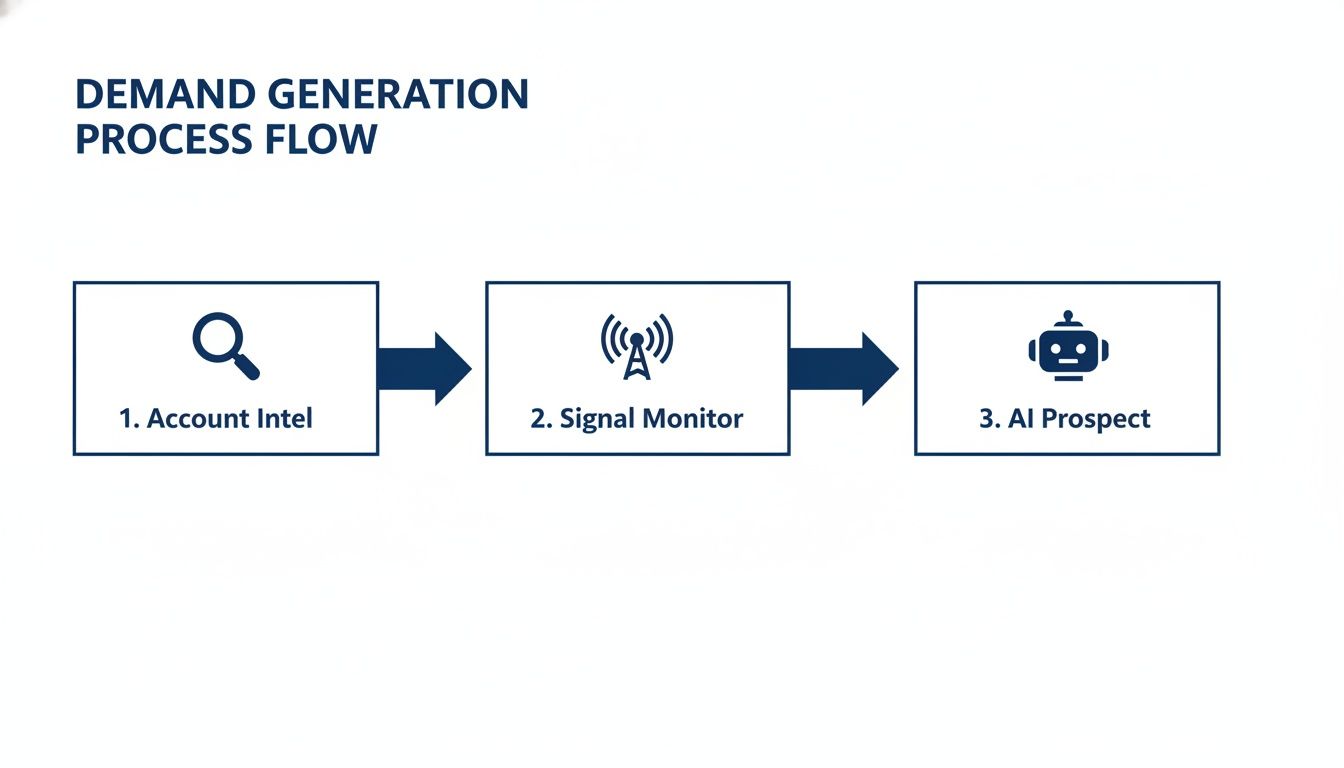
The flow is simple but powerful. It starts with deep account intelligence, moves to continuous signal monitoring, and finally feeds into AI-assisted prospecting. This seamless handoff is what allows sales teams to act on opportunities with incredible speed and relevance.
Solving the “Weak Why Now” Problem
The single biggest problem plaguing most sales teams is a weak—or nonexistent—“why now.” Why should a prospect talk to you today instead of next quarter? Generic outreach like "I saw your company is growing" just doesn't cut it anymore. It lacks urgency and specificity.
Demand generation software directly solves this. The "why now" is no longer a guess; it's a data-backed event.
For example, the software might alert a rep to one of these triggers:
- A target account’s CFO mentions "supply chain consolidation" on an earnings call, giving your supply chain software company the perfect opening.
- A key decision-maker you're targeting just connected with three of your competitors on LinkedIn, signaling they are actively evaluating solutions.
- The company posts five new software engineering jobs with "cloud migration" in the description, making it the ideal time to reach out with your cloud cost-management tool.
Each of these signals provides a powerful, specific, and timely reason to start a conversation. The rep isn't just "checking in"—they're offering a relevant solution at the exact moment the prospect is thinking about the problem.
This approach not only increases response rates by over 50% in many cases but also elevates the entire conversation. If you want to see how this fits into a larger strategy, check out our guide on automating your sales process.
How to Evaluate Demand Generation Software
Picking the right demand generation software is a high-stakes decision that can make or break your pipeline goals for the year. With every vendor promising to revolutionize your sales process, it’s easy to get lost in marketing jargon and slick demos. You need a practical framework to cut through the noise.
This isn’t about running down a feature checklist. It’s about knowing what to ask to figure out if a tool will solve your team's real-world problems. The best platforms don’t just dump more data on your reps; they feed actionable intelligence directly into your existing sales plays.
Intelligence Quality and Synthesis
First and foremost, scrutinize the quality of the intelligence itself. Many tools just scrape headlines and give your reps a list of links. That doesn't help—it just creates more work. A great platform does the hard work of synthesizing information from dozens of sources into a clear, opinionated brief.
When you’re in a demo, push beyond the surface with these questions:
- Where does your data come from? News and press releases are table stakes. Dig deeper. Ask if they analyze earnings call transcripts, SEC filings, podcasts, and executive interviews. The more diverse the sources, the richer the insights.
- How do you turn data into insight? A good platform doesn’t just tell you what happened; it tells you why it matters. The final output should feel like a strategic summary, not a wall of links.
- Can you show me an example of an AI-generated account brief for one of our target accounts? You're looking for clear summaries of strategic initiatives, identified risks, and competitive context. It should be the kind of analysis that would take one of your top reps hours to compile manually.
A platform’s value is measured by its ability to reduce manual work, not create more of it. If your reps still have to connect the dots themselves, the software has failed its primary mission.
Seamless Workflow Integration
Even the world's best intelligence is useless if your team has to go hunting for it in another tab. The software must slide seamlessly into the tools your reps live in every single day. Friction is the enemy of adoption.
Your goal is to find a platform that brings insights to your team, not one that makes them log into yet another system.
Key Questions to Ask:
- How are real-time alerts delivered? Can my reps get these pings directly in Slack, email, and our CRM?
- Does the platform automatically push insights into our CRM's account records, like Salesforce?
- How does your AI-generated outreach plug into our sales engagement tools like Outreach or Salesloft?
A truly seamless workflow means a rep gets a Slack alert about a key account signal, clicks to see the full AI brief, and finds a pre-written, ready-to-personalize email draft waiting in their engagement tool.
Customization and Targeting
Your Ideal Customer Profile (ICP) is unique, and so are the buying triggers that matter to your business. A one-size-fits-all approach to signal monitoring is a recipe for disaster, flooding your team with irrelevant noise they'll quickly learn to ignore. Customization isn't a nice-to-have; it's non-negotiable.
You need to be able to tell the software precisely what to look for. Our guide on how to choose sales intelligence tools dives deeper into why tailored intelligence is so critical.
Questions for your demo:
- Can we build our own custom triggers based on specific keywords, events, or company changes? For example, can we track mentions of "cost optimization" in financial reports?
- How granular can we get with targeting? Can we monitor for signals only within certain departments or for specific job titles at our target accounts?
- Show me how you'd set up a new signal for a specific event like "a competitor being mentioned negatively in an earnings call."
If you can't fine-tune the signals to match what's important for your reps, you’re just buying a sophisticated noise machine.
Ease of Implementation and Adoption
Finally, you have to weigh the implementation lift. Some legacy enterprise platforms require a massive, multi-month project that bogs down your RevOps team. Modern demand generation software should be built for speed and agility.
You want a fast time-to-value. Your team should start getting actionable insights in days, not quarters. Ask about the entire process from start to finish—initial setup, onboarding, and ongoing support—to ensure it fits your team's need for agility.
“We have very limited bandwidth, but Salesmotion was up and running in days. The template made it easy to load our accounts and embedding it in Salesforce was simple. It was one of the easiest rollouts we've done.”
Andrew Giordano
VP of Global Commercial Operations, Analytic Partners
Measuring the ROI of Your Software Investment

Buying new tech is the easy part. Proving it was worth the money is where the real work begins. To justify the cost of demand generation software, you have to connect the dots between the tool's capabilities and your team's bottom-line results.
This means moving past vanity metrics like the number of alerts fired. Your CFO doesn't care about that. They care about pipeline, revenue, and efficiency. Your business case needs to clearly show how signal-based workflows translate into a healthier bottom line.
Key Metrics That Go Beyond the Surface
When it comes to measuring ROI, forget surface-level activity. The numbers that matter are the ones that show your team is working smarter, not just harder. These are the metrics that tell a compelling story to leadership.
Focus your tracking on these three core areas:
- Pipeline Velocity: How quickly does an account move from a signal to a booked meeting to a qualified opportunity? This is a direct measure of how timely, relevant outreach shortens your sales cycle.
- Conversion Rates: Are you seeing an uptick in conversions from the first outreach to a booked meeting? A higher rate proves your reps are hitting the mark with the right message at the right time.
- Rep Productivity: How much time are reps getting back by automating manual research? That reclaimed time is reinvested into what they do best: personalizing outreach and building relationships.
Shifting your focus to these metrics changes the entire conversation. It’s no longer about "how much does this cost?" but "how much more revenue can we drive with this?"
The Real ROI: The true value is unlocked when reps stop spending hours looking for a reason to call and start spending minutes acting on a reason the software found for them. A 25% increase in meetings booked per rep isn't just possible—it's a common outcome for teams that master this approach.
Building Your Business Case with Data
Let's make this tangible. Imagine you have a team of 10 reps who each book an average of 8 meetings per month. That's a total of 80 meetings. It’s a solid number, but you know there's room to improve.
After implementing demand generation software, your team starts acting on timely, signal-based insights. Within a single quarter, you see that each rep is now booking 10 meetings per month—a 25% jump. That brings the team total to 100 meetings per month, giving you an extra 20 qualified at-bats.
Now, let's talk money. If your average deal size is $50,000 and your meeting-to-close rate is 10%, those 20 extra meetings directly translate to $100,000 in new pipeline. Every single month.
This is how you build a rock-solid, defensible business case. The software stops being a line item on an expense report and becomes a proven revenue multiplier. By tracking the right numbers, you can confidently show leadership the financial impact of turning raw data into strategic, revenue-driving conversations.
Your Questions About Demand Generation Software Answered
Whenever a new category of tech emerges, the same practical questions come to mind. Let's tackle the most common ones that revenue leaders ask when they're evaluating modern demand generation software.
How Is This Different From a Standard Sales Intelligence Tool?
This question comes up a lot, and for good reason. A standard sales intelligence tool is great for getting static data—think firmographics, contact lists, and basic company information. It’s like having a detailed encyclopedia; it's full of facts, but you have to know what to look for and how to connect the dots yourself.
Modern demand generation software, on the other hand, is like having an active research team working for you 24/7. It doesn't just hand you a list of facts; it constantly monitors those facts for meaningful changes and then tells you exactly what to do about them.
The core difference is the shift from providing static data lists to powering dynamic, actionable workflows. A sales intelligence tool tells you who a company is; demand generation software tells you why you should talk to them now.
For instance, a traditional tool might tell you a company's headcount and industry. A true demand generation platform alerts you that the company just posted five new engineering jobs mentioning "cloud migration," and then helps you draft an email that references that specific initiative.
Is This Difficult to Integrate With Our Existing Tech Stack?
Another common fear is the "integration headache." We’ve all experienced a long, complicated setup that drains RevOps resources. Modern platforms are built specifically to avoid this problem. They're designed for a light, seamless setup.
These tools aren't meant to rip and replace your core systems like your CRM or sales engagement platforms. They’re built to act as an intelligent layer on top of them, bringing crucial insights directly into the tools your reps already use.
- CRM Integration: Most offer native connections to systems like Salesforce, automatically enriching your account records with fresh intelligence so reps aren't stuck doing manual data entry.
- Communication Tools: Real-time alerts get pushed directly into Slack or email, ensuring your team never misses a critical buying signal.
- Sales Engagement: AI-generated outreach can be sent straight to tools like Outreach or Salesloft, ready for reps to personalize and send in seconds.
Implementation is typically fast. You can expect your team to be up and running with valuable insights in a matter of days, not months.
Will My Sales Reps Actually Use It?
Adoption is where the rubber meets the road. You can buy the fanciest tech in the world, but if your reps don’t use it, it’s a wasted investment. The secret to high adoption is simple: the tool has to make their job easier and help them make more money.
This is why the seamless workflow integration we just talked about is so critical. Reps resist being forced to log into yet another platform or add more clicks to their day.
But when a tool delivers a perfectly timed opportunity directly into their Slack channel—complete with all the context and a pre-written email—adoption is a non-issue. Reps will use what helps them hit their quota. When they see that signal-based outreach leads to a 25% increase in booked meetings, they won't just use it; they'll wonder how they ever worked without it.
Ready to see how an intelligence-driven approach can transform your pipeline? Salesmotion deploys AI agents that autonomously track what matters across your target accounts and turn signals into action. Discover how Salesmotion can help you win more timely conversations.