Let's be honest—the old playbook of blasting generic messages to anyone with a pulse is dead. Today's buyers are drowning in noise, armed with more information than ever, and have zero time for pitches that don't immediately click. This makes traditional b2b demand generation feel like shouting into the void.
The secret isn't more volume. It's smarter relevance, delivered at the exact moment it matters.
Why Your B2B Demand Generation Is Stalling

If your team is grinding away but struggling to build a predictable pipeline, you’re not alone. Many revenue teams are stuck in a frustrating cycle, weighed down by outdated processes that don't connect with how modern B2B buyers operate.
The problem isn't a lack of effort. It’s a misalignment with how companies actually make decisions. This friction usually shows up in a few painful ways.
The Manual Research Tax
How much time do your reps burn each week trying to find a compelling reason to reach out? They're digging through press releases, scrolling social media, and deciphering financial reports just to find one useful nugget.
This "manual research tax" is a massive productivity killer. Every hour a rep spends digging for the "why now" is an hour they aren't selling. It also creates a pipeline built on luck. One rep might stumble upon a key insight while another finds nothing, leading to inconsistent results. That’s no way to scale.
Signal Overload Creates Inaction
To solve the research problem, many teams subscribe to a firehose of news alerts and data feeds. Suddenly, they're swamped with information—funding announcements, executive hires, product launches—but have no clear way to act on it.
This signal overload leads to paralysis. Without a system to prioritize which signals matter for which accounts, the noise becomes a distraction. An alert about a competitor's partnership is interesting, but what does it mean for your deal? Lacking that crucial context, most signals get ignored, and reps fall back on generic outreach.
The goal is to shift from a volume-based mindset to a value-based one. Every interaction should be timely, contextual, and built on a true understanding of an account's immediate needs.
The Shift to a Signal-Driven Approach
The answer is a fundamental shift in strategy. Instead of guessing what buyers care about, a modern b2b demand generation program is built on interpreting real-world business signals. This means creating a system that not only captures triggers but translates them into actionable talking points for your team.
Here’s what that looks like in practice:
- Timely Engagement: You reach out the week an account announces a major expansion, not three months later.
- Contextual Messaging: You reference their new CIO's past projects in your outreach instead of sending a generic feature list.
- Value-Centric Conversations: You focus the conversation on solving the challenges implied by their recent M&A activity.
This approach turns your team from generic sellers into trusted advisors who show up with the right message at the perfect time. It’s how you break through the noise, build credibility, and create a scalable engine for predictable growth.
See Salesmotion in action
Take a self-guided interactive tour — no signup required.
Building Your Foundation with Goals and a Clear ICP
Jumping into a B2B demand generation strategy without a destination is like setting sail without a map. Before you generate a single opportunity, you need to define what success looks like and who you’re targeting with precision.
This foundation isn't just a formality; it's the bedrock of your entire revenue engine. It ensures your sales and marketing teams are rowing in the same direction, focused on the same prize. A strong foundation stops you from wasting budget on accounts that will never buy and keeps your team from chasing metrics that don't translate to revenue.
Defining Goals That Actually Matter
Forget vanity metrics like "more leads" or "higher traffic." While they can be useful indicators, they don’t tell the whole story and won't impress your CRO. A modern demand generation program is measured by its direct impact on revenue.
Your goals need to be tied to tangible business outcomes. We're talking about KPIs that dictate the health of your pipeline and the predictability of your growth.
Start by focusing on metrics like:
- Pipeline Contribution: What percentage of new, qualified pipeline comes directly from your signal-driven campaigns? This is the ultimate measure of impact.
- Deal Velocity: Are accounts targeted with this approach moving through the sales cycle faster? A 20% reduction in sales cycle length is a massive win.
- Win Rates: How do win rates for signal-targeted accounts compare to your baseline? A higher win rate proves you’re engaging the right companies at the right time.
Setting these goals shifts the conversation from "how many leads did we get?" to "how much revenue did we influence?" This alignment is critical for proving ROI and securing future investment.
Go Deeper Than Firmographics for Your ICP
Your Ideal Customer Profile (ICP) is more than just company size, industry, and location. Those are table stakes. An effective ICP goes deeper, identifying the specific traits of companies that get the most value from your solution and are most profitable for you. To get started, you can explore a comprehensive ideal customer profile template to structure this process.
Think about the strategic verticals where your solution is a "must-have," not just a "nice-to-have." For a compliance software company, this might be heavily regulated industries like Life Sciences or Financial Services. For a company selling manufacturing automation, it could be businesses in the Industrial or Energy sectors.
An ICP isn't just a description; it's a focusing lens. It tells your team where to point their most valuable resource—their time—to get the highest possible return.
Once you’ve identified these verticals, the magic happens when you map specific buying signals to each one. A signal that’s a high-priority trigger in B2B SaaS (like a Series B funding round) might be less relevant in Manufacturing, where a plant expansion announcement is the real game-changer.
Map Buying Signals to Your Strategic Verticals
Understanding these nuances is what separates generic outreach from a relevant conversation. This approach allows you to build an "always-on" monitoring system that alerts your team to real opportunities, not just random news.
Here’s a practical look at how different buying signals can serve as powerful "why now" triggers across various B2B industries. This table can help you start mapping which events matter most for your target markets.
Mapping Key Buying Signals to Strategic Verticals
| Strategic Vertical | High-Value Buying Signals to Monitor | Example 'Why Now' Trigger |
|---|---|---|
| Life Sciences | New clinical trial phases, FDA announcements, M&A activity, executive hires in R&D. | A biotech firm announces Phase II trial success, signaling a need for new data management or CRO services. |
| B2B SaaS | Funding rounds (Series A, B, etc.), key leadership changes (new CRO/CMO), product launches, significant hiring sprees. | A SaaS company hires a new VP of Sales, creating an opportunity to discuss sales enablement or intelligence tools. |
| IT Services & Consulting | Large project wins, new partnership announcements, mentions of digital transformation in earnings calls. | A global systems integrator wins a major contract, suggesting they need to scale their delivery teams or technology stack. |
| Manufacturing | Plant expansion or new facility announcements, supply chain restructuring news, new compliance mandates. | An industrial company issues a press release about a new factory, triggering outreach about logistics or automation tech. |
By building this foundational map, you arm your revenue team with the context they need to stop guessing and start engaging with intelligence. It’s the first, most critical step in creating a scalable and predictable B2B demand generation engine.

“There's been a big focus on hyper personalization and relevance in our outbounding efforts. Salesmotion has been a key partner in hitting our significantly increased meeting targets. What stands out is how simple it is. Reps can log in and get valuable account insights within 30 seconds to a minute.”
Joe DeFrance
VP of Sales, Incredible Health
Turning Account Signals Into Actionable Opportunities
So, you’ve got a clear ICP and you know your goals. That’s the foundation. But the real magic in b2b demand generation happens when intelligence sparks immediate action.
Think about it. A signal—like a funding announcement, a key executive hire, or a competitor's product launch—is just noise until you plug it into a workflow. Without a system to catch and route it, that golden nugget of information dies in an inbox or gets lost in a news feed.
The point is to shift from being reactive to proactive. This means building an 'always-on' system that doesn't just collect data, but pushes actionable alerts straight into the tools your team uses every day, like Slack and your CRM. This turns intelligence from a research project into a real-time sales motion.
This flow chart nails the basic process: it all starts with knowing who you're after and what you want to achieve before you think about tactics.
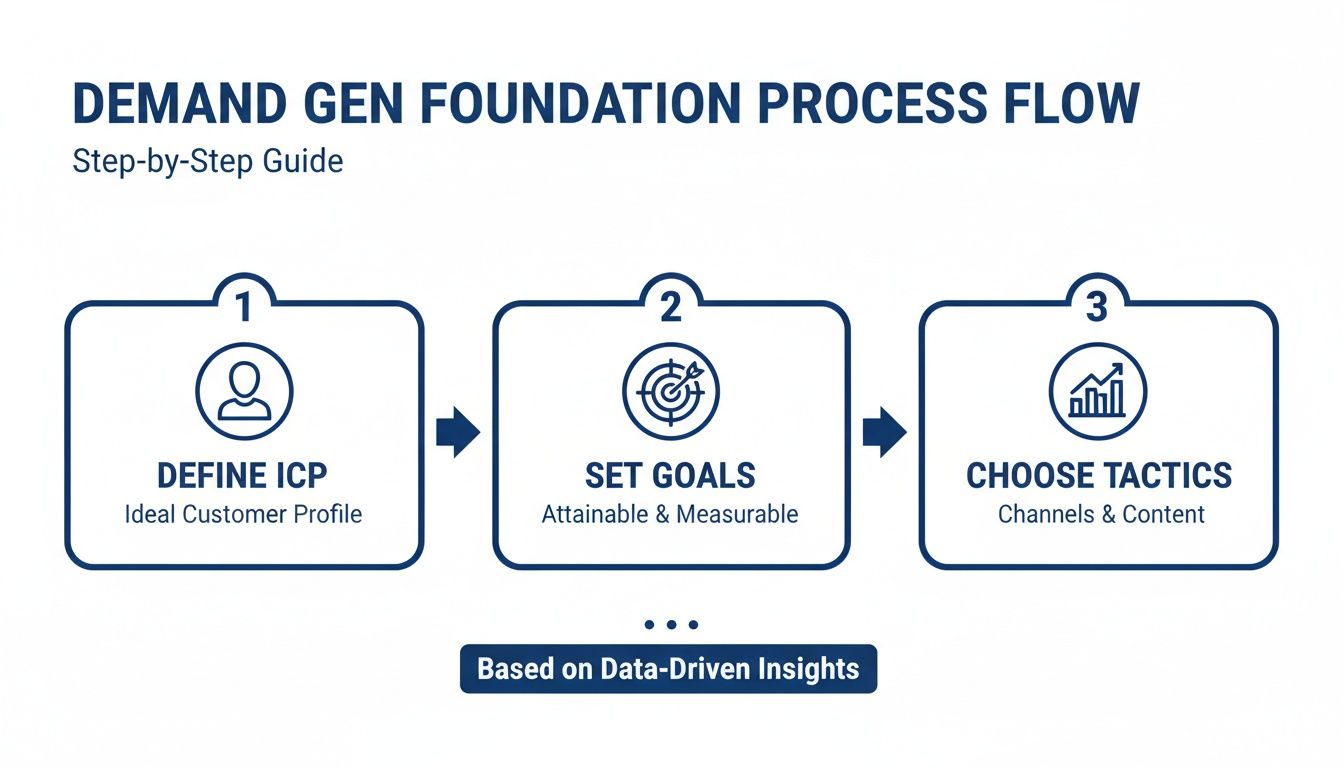
As the visual shows, a winning strategy is built on a clear understanding of your target and your goals. Only then can you pick the right plays.
From Raw Signal to Sales Opportunity
Let's walk through a real-world example. Imagine one of your top manufacturing accounts drops a press release announcing a $50 million investment to expand their main production facility. A traditional sales team might miss this or hear about it weeks too late. A modern, signal-driven system catches it instantly.
But catching the signal isn't enough. The real value is what happens next: translating that raw fact into a "so what?" for your sales team.
- The Signal: "Company X announces plant expansion."
- The 'So What?': "This expansion means they'll face supply chain headaches, need new automation tech, and have to stay compliant with new standards. Their VP of Operations is under insane pressure to get this done on time and on budget."
This context lets your reps stop pitching features and start solving real problems. The alert they get shouldn't just be a link to the news article. It should be a pre-packaged conversation starter that frames them as a strategic partner.
The best demand gen programs are built on one simple rule: make it incredibly easy for your team to act on intelligence. The less friction between a signal and an action, the more pipeline you’ll build.
This rhythm—signal, context, action—is the engine of a predictable pipeline. It ensures every piece of outreach is tied to a timely, relevant business trigger, which massively boosts your chances of getting a response.
Creating a Seamless Alert-to-Action Workflow
An alert system is only effective if reps use it. If you just flood their channels with notifications, you're creating the same noise you're trying to cut through. The key is to deliver high-quality, prioritized alerts directly into their daily workflow.
For example, when a high-value signal pops for a Tier 1 account, an automated workflow should kick in:
- Instant Slack Notification: An alert hits the account owner’s Slack, complete with the signal, a source link, and the "so what" context.
- Automated CRM Task: A task is automatically created in your CRM, telling the rep to run a specific, pre-built playbook tied to that trigger (e.g., "Expansion Initiative Playbook").
- Meeting Prep Brief: All relevant data is pulled into a dynamic account brief, so the rep can prep for a call in minutes, not hours.
This seamless flow cuts out manual work and decision fatigue. It lets reps focus on what they do best: building relationships and closing deals. It's about making intelligence so easy to use that it becomes a natural part of their daily routine. Understanding the different types of triggers is key here; you can dive deeper into the various kinds in our guide to B2B intent data.
Executing Integrated Campaigns with Sales Playbooks

A powerful buying signal is wasted without a proven playbook to act on it. This is where the real work of B2B demand generation kicks in—translating real-time intelligence into coordinated, multi-channel campaigns that surround your target accounts with a consistent, relevant message.
True integration isn't a buzzword. It means sales and marketing are operating from the same set of triggers. The same signal that prompts a sales sequence should also inform marketing’s ad targeting and content. This creates a surround-sound effect that makes your outreach feel less like a cold interruption and more like a helpful, timely conversation.
Using Signals to Power Sales Playbooks
For sales teams, signal-based intelligence is the secret to creating outbound sequences that are personalized, perfectly timed, and highly relevant. Forget generic, one-size-fits-all messaging. Each outreach is now anchored to a specific business event, giving your reps an immediate and compelling reason to connect.
A playbook isn't just a script; it's a strategic response plan for a specific trigger. Building a library of these is essential for scaling your efforts. For an in-depth look at structuring these, you can explore a variety of sales playbook examples that cover different scenarios and industries.
Your goal is to make relevance repeatable. A great playbook takes the guesswork out of outreach, empowering every rep to engage like your top performer by codifying what works for specific buying triggers.
Consider these common signals and the playbooks they can trigger:
- New Executive Hire: A playbook focused on a new leader's first 90 days, offering insights or solutions that help them achieve a quick win.
- Funding Announcement: A sequence congratulating the company and pivoting to how your solution can help them deploy their new capital effectively.
- Product Launch: Outreach that acknowledges their new offering and positions your solution as a way to support its go-to-market success, such as scaling their sales team.
Sharpening Marketing Campaigns with Account Activity
While sales executes targeted outbound plays, marketing can use the same intelligence to make its campaigns more effective. Real account activity provides the context needed to move beyond broad firmographic targeting and deliver ads and content that resonate on a deeper level.
For instance, if your system flags several target accounts announcing digital transformation initiatives, that’s a powerful insight. Marketing can immediately spin up a LinkedIn ad campaign targeting those companies with content about change management or technology integration. This ensures your brand is visible and helpful at the exact moment prospects are actively thinking about the problem you solve.
Efficient execution here often involves powerful tech. Consider exploring the capabilities of advanced SaaS marketing automation tools to streamline these complex workflows.
A Sample Integrated Campaign Workflow
Let's see how a single signal can kick off a coordinated campaign that brings sales and marketing together seamlessly.
The Signal: A Tier 1 account in the Life Sciences vertical issues a press release announcing a new corporate compliance initiative to meet upcoming regulatory changes.
-
Automated Alert: The signal is captured. An alert is sent to the account owner in Slack and logged in the CRM. The alert provides the "so what"—the company is now under pressure to implement new systems and training.
-
Sales Playbook Activated: The sales rep launches the "Compliance Initiative Playbook." This triggers a 3-touch sequence over two weeks:
- Touch 1 (Email): A personalized email referencing the announcement and sharing a relevant case study.
- Touch 2 (LinkedIn): A connection request to the new Head of Compliance with a relevant note.
- Touch 3 (Call): A call focused on discussing the common pitfalls of implementing new compliance frameworks.
-
Marketing Air Cover Activated: Simultaneously, the marketing team adds this company to a specific ad audience. For the next two weeks, key stakeholders at the account see targeted ads on LinkedIn promoting a whitepaper on "Navigating Life Sciences Compliance."
This integrated approach ensures the account is engaged across multiple fronts with a consistent and relevant message. It’s a perfect example of how sales and marketing can use the same intelligence to work together, amplifying each other's efforts and increasing the odds of securing a meeting.

“This is my singular place that very simply summarizes a company's top initiatives, strategies and connects them to my solution. Something I would spend hours researching manually, now it's automated.”
Derek Rosen
Director, Strategic Accounts, Guild Education
Measuring What Matters to Optimize Your Program
If you can't measure it, you can't improve it. In a modern B2B demand generation program, this means looking beyond vanity metrics like open rates and social media likes.
Sure, those numbers might look nice on a dashboard, but they don’t tell your CRO what they really want to know: how much predictable revenue is this engine driving?
The focus has to shift to key performance indicators that directly reflect pipeline health and business impact. This is how you prove ROI and build a data-backed case for more investment.
Shifting from Activity Metrics to Revenue Metrics
For too long, revenue teams have been measured on pure activity—calls made, emails sent, content downloaded. But activity doesn't always equal progress. A signal-driven approach demands a more sophisticated way to measure, one that connects specific plays to financial outcomes.
Instead of tracking opens and clicks, start obsessing over these core metrics:
- Pipeline Created from Signal-Driven Plays: This is your north star. It directly measures the value of your intelligence-led efforts by tracking qualified opportunities generated from specific triggers.
- Influence on Deal Velocity: Are accounts targeted with timely outreach moving through the sales cycle faster than those that aren't? A 15-20% reduction in sales cycle length is a massive win.
- Improved Win Rates for Targeted Accounts: This metric proves the quality of your targeting. If your win rate for signal-targeted accounts is significantly higher than your baseline, it’s a clear sign your "why now" is resonating.
Leveraging Signal-Based Scoring for Prioritization
This is where Revenue Operations (RevOps) becomes the strategic heart of your demand generation program. A sharp RevOps team can build a signal-based scoring model that helps prioritize accounts, ensuring reps spend their time on opportunities most likely to convert.
For example, an account that just announced a major funding round and hired a new executive in a key buying role would get a much higher priority score than an account with only one trigger. This data-driven approach removes the guesswork and directs your team's energy with precision.
To get a better handle on which metrics to prioritize, it's useful to explore foundational lead generation key performance indicators.
Proving the ROI of Your Demand Generation Engine
Data has become the critical differentiator in B2B performance, yet huge skill gaps persist. It's a paradox: 95% of B2B marketers agree that using data improves demand generation, yet only 41% feel confident in measuring their results. Even worse, just 39% feel equipped to make that data actionable.
This gap highlights the core challenge. Knowing data is important is easy. Actually using it is hard. You can discover more insights about this B2B demand generation paradox by reading the full report on these findings.
The goal of measurement isn't just to report on past performance; it's to generate insights that make your next move smarter. Every metric should answer the question, "What should we do differently next quarter?"
By tracking the right KPIs, you can build a powerful narrative backed by hard numbers. You can show exactly how a specific signal, like a plant expansion, led to a playbook being activated, which in turn created a seven-figure pipeline opportunity.
This is the story that gets leadership excited and secures the resources you need to scale. This level of measurement transforms demand generation from a cost center into a predictable, revenue-driving machine.
Common Questions About Modern B2B Demand Generation
Moving to a signal-driven model for your B2B demand generation will bring up questions. That’s perfectly normal. Let's dig into some of the most common ones we hear from revenue leaders.
My goal is to give you direct, no-fluff answers to help you navigate this shift. If you want a deeper dive into the foundational concepts, check out this excellent guide on B2B Demand Generation.
How Do I Start with a Small Team and Budget?
You don’t need a huge team or a massive budget to make this work. Starting small is actually an advantage. It forces you to be hyper-focused. The key is to prove the model on a small scale before you expand.
First, pick a single, high-potential strategic vertical. Don't spray and pray across your entire market. Zero in on the niche where you have the highest win rates and best case studies.
Next, identify the top three to five buying signals that are most predictive for that niche. If you're a SaaS company selling to other tech firms, a Series B funding round or the hiring of a new CRO might be gold. For a manufacturer, it could be an announcement about a plant expansion.
Focus is your superpower when you're small. Prove that signal-driven outreach generates more qualified meetings on a curated list of 50 accounts. That success story is the business case you need to expand the program.
Once you have your signals, use an automation tool to track them for a hand-picked list of 50-100 target accounts. Build out one or two high-quality, trigger-based outreach playbooks and measure everything.
What Is the Difference Between Demand and Lead Generation?
This is a big one. Many teams use these terms interchangeably, but they serve very different functions. Getting this right is critical.
- Lead Generation is the act of capturing contact information. Think of a form on a landing page to download an ebook. The output is a "lead"—a person who raised their hand and gave you their details. It's a transaction.
- Demand Generation is the broader, ongoing strategy of creating awareness and building credibility for your solution across your entire target market. It’s thought leadership, brand building, and all the educational content that makes you the obvious choice when a buyer decides they have a problem to solve.
A signal-driven approach fuels both motions. It helps you create relevant content for your demand generation efforts (the "why") and tells you the perfect time to reach out for lead generation activities (the "when").
How Can Marketing and Sales Best Align on Efforts?
Real alignment isn't about more meetings or shared slide decks. It’s about operating from a single source of truth.
Both teams must agree on the Ideal Customer Profile (ICP) and, more importantly, on the specific buying signals that mean an account is ready for a conversation.
When a sales rep gets an automated alert about a key trigger—like a target account hiring a new VP of Engineering—that same intelligence needs to hit the marketing team’s dashboard in real-time.
This shared intelligence unlocks powerful, coordinated plays:
- Sales Action: A rep immediately launches a personalized, trigger-based outbound sequence referencing the new hire.
- Marketing Air Cover: At the same time, marketing starts a hyper-targeted ad campaign aimed at that same account, with content that reinforces the sales rep's message.
The best alignment happens when both teams are running plays from the same book. A single signal should trigger a coordinated, multi-channel response. Your message becomes consistent, amplified, and far more likely to break through the noise. Regular joint meetings to review campaign performance are essential to keep refining this process.
Ready to stop guessing and start engaging accounts with timely, relevant intelligence? Salesmotion is an AI-powered platform that tracks key signals across your target accounts and turns them into actionable opportunities for your revenue team. Learn how Salesmotion can help you build a predictable pipeline.