Most reps lose deals before they ever pitch. Not because the product is wrong, but because they never diagnosed the problem they were supposedly solving. Gap selling fixes that. It forces you to understand the buyer's current state, their desired future state, and the distance between the two before you say a single word about your product.
TL;DR: Gap selling, popularized by Keenan in his book Gap Selling, shifts the entire sale away from your product and onto the buyer's problem. You diagnose the current state, define the future state, quantify the gap between them, and find the root cause. The bigger and more measurable the gap, the more urgency the buyer feels. Reps who skip diagnosis end up pitching features to people who do not yet believe they have a problem worth solving.
What Is Gap Selling?
Gap selling is a problem-centric sales methodology built around one idea: people buy to close the distance between where they are and where they want to be. The "gap" is that distance. Your job as a seller is to expose it, measure it, and tie its cost to a business outcome the buyer already cares about.
The framework comes from Keenan (A. Keenan), CEO of A Sales Growth Company, whose 2018 book Gap Selling argued that traditional, product-led selling fails because it starts with the solution instead of the problem. Buyers do not care about your features. They care about the gap between their current results and the results they need.
Gap selling reframes the rep from "vendor pitching a product" to "diagnostician uncovering a problem." That shift matters more than ever. According to Gartner, B2B buyers spend only about 17% of their purchase journey actually meeting with potential suppliers, and across all the vendors they consider, any single rep may get just 5-6% of a buyer's total time. If you spend that sliver of attention talking about your product instead of their problem, you lose. This is the foundation that every serious sales methodology shares, but gap selling makes the diagnosis explicit.
See Salesmotion on a real account
Book a 15-minute demo and see how your team saves hours on account research.
The Three Parts: Current State, Future State, and the Gap
Gap selling rests on three components. Get all three right and the deal qualifies itself. Miss one and you are guessing.
The current state is the buyer's reality today: their metrics, their process, their tools, their pain, and the literal and emotional cost of staying where they are. The future state is where they want to be: the target metric, the new process, the outcome that matters to the business. The gap is the measurable distance between them, and it is the only thing the buyer is actually paying to close.
Here is the framework as a single diagram you can run on any deal:
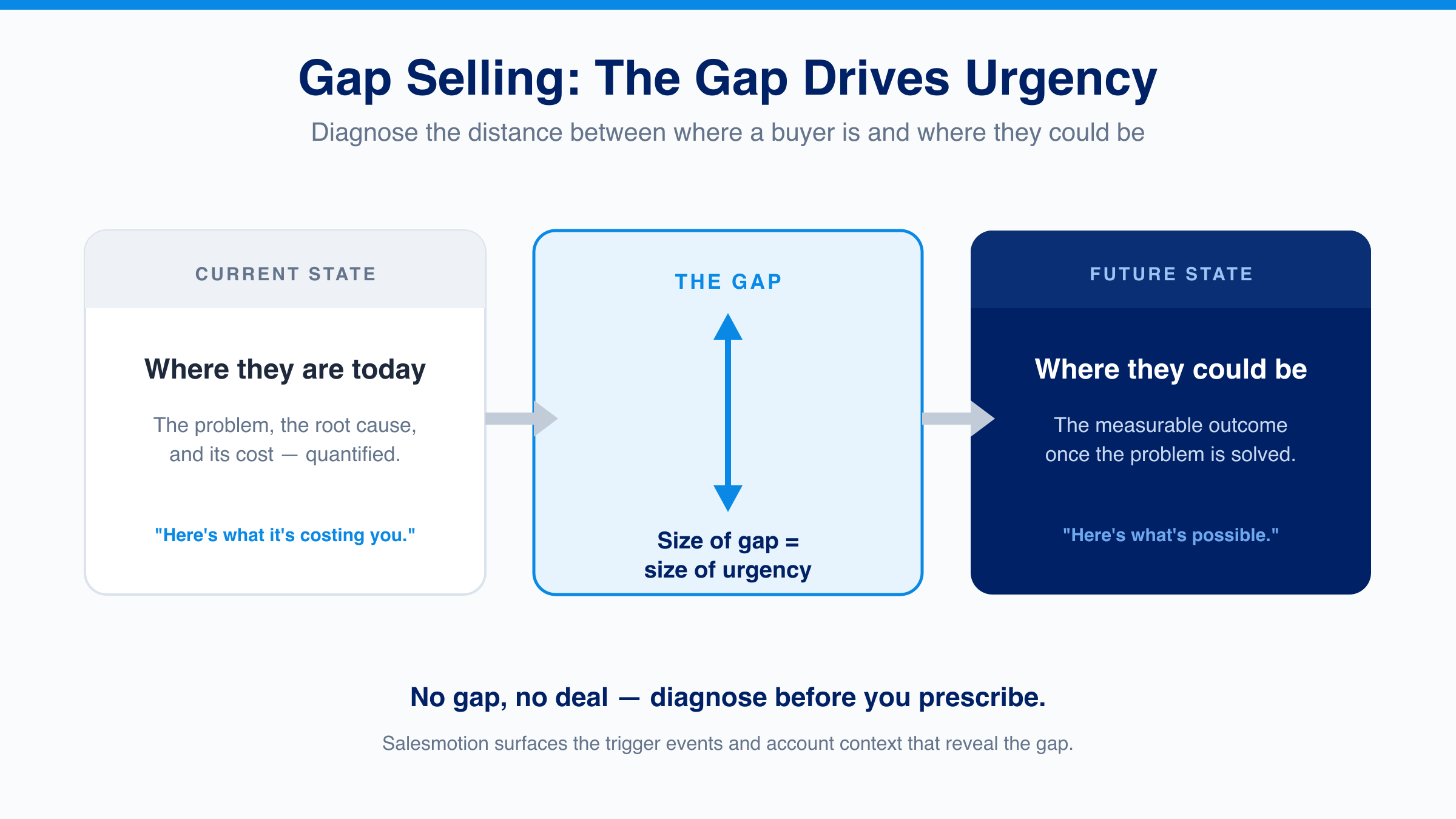 The gap is the measurable distance between today's reality and the future state — and its size is the urgency. No gap, no deal.
The table below shows how each part plays out on a real deal:
| Stage | What you uncover | Example (RevOps buyer) |
|---|---|---|
| Current State | Today's metrics, process, tools, pain, and the cost of inaction | Reps spend 10+ hours/week on manual account research; win rate stuck at 18% |
| The Gap | The measurable distance and what it costs the business | 6 hours/week lost per rep; ~$2M in winnable pipeline going stale each quarter |
| Future State | The target metric and the business outcome it unlocks | Research under 30 min/account; win rate at 25%; reps selling, not Googling |
Gap selling forces you to quantify the distance between where the buyer is and where they want to be, then make closing that gap the whole conversation.
The discipline here is quantification. "Our process is slow" is not a gap. "Our reps lose 6 hours a week to manual research, which costs us roughly $2M in stalled pipeline per quarter" is a gap. The first is a complaint. The second is a business case the buyer can take to their CFO.

“The talking points are gold. If they're in Salesmotion, I know they're being discussed inside that business. That makes it easy to spark a real conversation, which is 90 percent of the battle.”
Andrew Giordano
VP of Global Commercial Operations, Analytic Partners
Why Gap Size Equals Urgency
A small gap creates no urgency. A large, quantified, root-caused gap creates urgency the buyer feels on their own, without you pushing. This is the most underused lever in the methodology.
When a buyer can see the full cost of their current state in hard numbers, the status quo becomes the expensive option. That reframes the entire negotiation. You are no longer asking them to spend money. You are showing them they are already bleeding money by doing nothing. The cost of inaction, made concrete, is what moves deals from "interesting" to "we need to fix this now."
This is also why creating real urgency has nothing to do with fake deadlines or end-of-quarter discounts. Manufactured urgency erodes trust. Diagnosed urgency builds it. The buyer feels the pressure because you helped them measure a problem they were underestimating, not because you invented a countdown clock.
There is a pattern we see across sales teams here. Reps who accept "let's revisit next quarter" without pushback almost always failed to quantify the gap. If the buyer truly felt the cost of waiting a quarter, they would not casually punt it. When a rep is "dancing around" instead of driving the cycle, it usually traces back to a gap that was never measured. The fix is not more pressure. It is better diagnosis.
The Role of Root Cause and Impact
Surface-level problems do not close deals. Root causes do. Gap selling demands that you keep asking "why" until you reach the underlying driver, then connect that driver to its business impact.
A buyer might say "our outbound isn't working." That is a symptom. Dig deeper and the root cause might be that reps are targeting the wrong accounts at the wrong time, with no signal telling them which accounts are actually in a buying window. The impact is wasted rep capacity, low conversion, and missed quota. Only when you reach that root cause can you connect your solution to something that genuinely matters.
The structure is a chain: problem → root cause → impact → desired outcome. Each link must hold. If you pitch a solution to a symptom, the buyer's real problem stays unsolved and the deal stalls even if they buy. If you reach the root cause but never quantify the impact, the buyer agrees there is a problem but feels no urgency to fix it now.
Impact is what makes the gap matter to people beyond your champion. A symptom affects one team. A quantified root-cause impact (lost revenue, missed targets, rising costs) affects the executive who controls budget. That is how you turn a single contact into a buying committee with a shared reason to act.
“The Business Development team gets 80 to 90 percent of what they need in 15 minutes. That is a complete shift in how our reps work.”
Andrew Giordano
VP of Global Commercial Operations, Analytic Partners
How to Run Gap-Selling Discovery
Gap-selling discovery is a structured interview, not a feature demo. Your goal is to map the current state, the future state, and the gap before you ever position your product. Here is how to run it.
Start with the current state, in numbers. Ask what their process looks like today, what it produces, and what it costs. Push for specifics: "How many hours per week?" "What's your current win rate?" "What happens to deals that stall?" Vague answers mean you keep digging.
Quantify the problem. Translate the pain into a number the business tracks. Time, money, win rate, cycle length, missed quota. If you cannot attach a metric, you have not found the real problem yet.
Find the root cause. Keep asking why. The first answer is almost never the actual driver. A demo happening "too early with the wrong people" is a symptom; the root cause is often that reps cannot tell which contacts are real buyers versus curious juniors.
Define the future state. Ask what "fixed" looks like and what hitting that target would mean for them personally and for the business. Now you have both ends of the gap.
Reflect the gap back. Restate the current state, the future state, and the measured distance. When the buyer hears their own problem quantified, urgency becomes their idea, not your pitch.
Only after all five steps do you connect your solution to the gap. This is the inverse of how most reps sell, and it is exactly why gap selling outperforms product-led approaches in complex deals. For more on running this kind of structured conversation, see our guide to SPIN selling, which pairs well with gap-selling discovery.
Common Gap-Selling Mistakes
Even teams that adopt gap selling tend to fall into the same traps. Avoid these and you will close the gap faster than most of your competitors.
Pitching before diagnosing. The cardinal sin. The moment you talk product before you have mapped the gap, you are guessing at what the buyer needs and signaling that you care more about your quota than their problem.
Accepting symptoms as problems. "We need better data" is a symptom. Stopping there means you solve the wrong thing. Always trace to the root cause.
Leaving the gap unquantified. A gap without a number is a feeling, and feelings do not get budget approved. If you cannot express the gap in dollars, hours, or percentage points, the buyer cannot justify the spend internally.
Single-threading the gap. A gap that only your champion understands dies when your champion goes quiet. The impact has to be visible to the economic buyer too.
Confusing activity with progress. Across sales teams, the biggest tell of a weak cycle is a rep who is busy but not driving. They send follow-ups, schedule calls, and "stay in touch," but they never re-quantify the gap or escalate the impact. Movement is not momentum.
How Gap Selling Breaks at Scale
Here is the uncomfortable truth: gap selling is brilliant in theory and brutal to execute consistently across a whole team. The diagnosis depends on information most reps do not have at the start of a cycle.
To map a buyer's current state, you need to know their initiatives, their recent leadership changes, their earnings commentary, their hiring patterns, and the competitive pressure they face. To time the conversation, you need to know when a trigger event just made the gap acute. To reach the economic buyer, you need to know who actually owns the problem. Most reps gather none of this before discovery, so they walk in cold and default to pitching.
Gap selling also decays. A gap you quantified in January is stale by March: budgets shift, leaders change, priorities move. The methodology assumes fresh, account-specific intelligence, but that intelligence lives outside the CRM and goes out of date within weeks. The spreadsheet approach works for 10 accounts. It collapses at 50.
This is the pattern across sales teams that struggle with gap selling: it is not that reps do not understand the framework. It is that they cannot feed it. The diagnosis is only as good as the intelligence behind it, and gathering that intelligence manually does not scale.
How Salesmotion Operationalizes Gap Selling
Gap selling needs three things to work at scale: timing (when did the gap become acute), context (what is the buyer's current state), and reach (who owns the impact). This is where signal-based selling turns the methodology from a quarterly exercise into a living workflow.
Salesmotion continuously monitors buying signals across 1,000+ public and private sources: leadership changes, earnings commentary, hiring patterns, funding, product launches, and competitive moves. These signals tell you when a buyer's gap just widened, so you run discovery while the problem is acute instead of cold-calling at random.
Here is the workflow in practice:
- Trigger. A target account posts a VP of Revenue Operations role and mentions a "sales transformation initiative" on its earnings call.
- Platform action. Salesmotion flags the account and auto-assembles the brief: the leadership gap, the stated initiative, the metrics the company is under pressure to move, and the likely economic buyer.
- Rep action. The rep enters discovery already knowing the probable current state, the future state the company has publicly committed to, and who owns the impact. Diagnosis is half done before the call starts.
- Outcome. Instead of pitching cold, the first conversation is a consultative diagnosis of a gap the buyer already feels. Deal velocity rises because the rep arrives with the business case, not a feature list.
That last point is the whole game. The gap that closes deals is the one tied to a timely trigger event and the specific person it affects. Salesmotion surfaces both, then drafts outreach anchored to the real signal, so the methodology becomes a repeatable workflow instead of a skill only your best rep has.
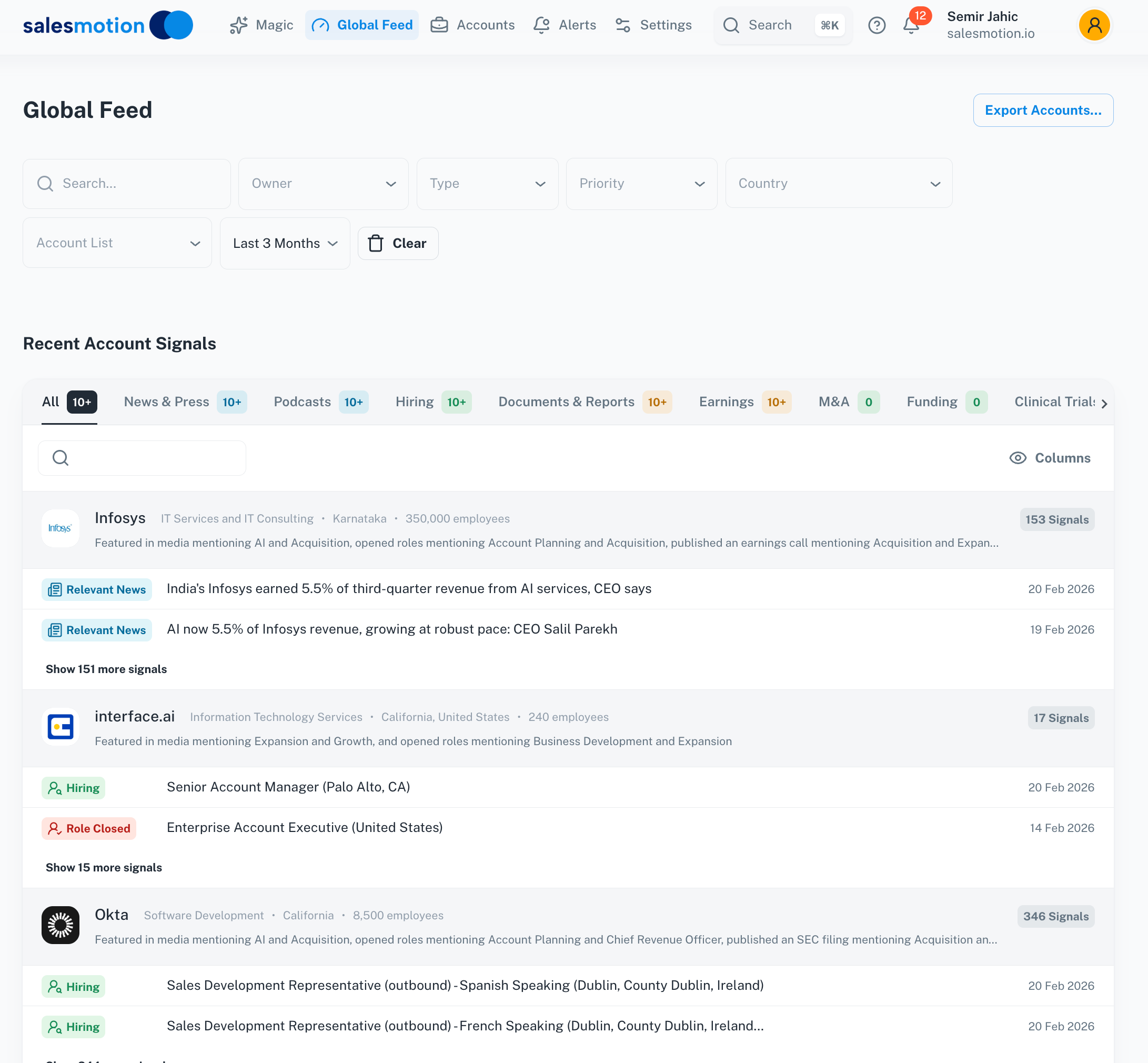 A live signal feed surfaces when a buyer's gap becomes acute, so reps run gap-selling discovery at the right moment instead of cold.
The result mirrors what teams report after operationalizing this kind of intelligence. One marketing analytics team cut account research from three hours to 15 minutes and grew qualified pipeline 40% year over year, because reps walked into every conversation already knowing the gap. That is gap selling at scale: diagnosis powered by live intelligence, not guesswork. See how it works on a real account.
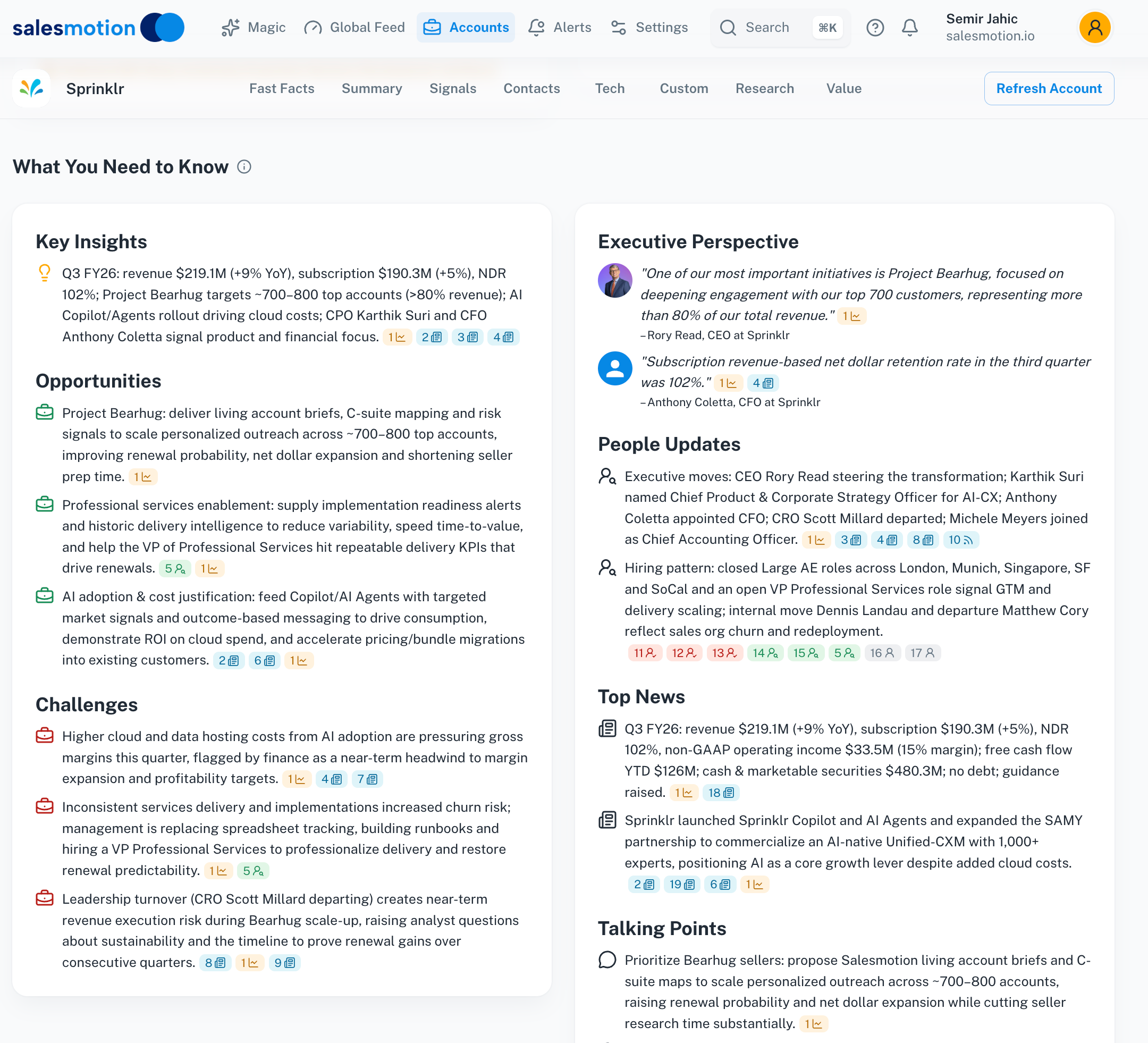 The account brief surfaces the buyer's current state and the initiatives behind their desired future state, the raw material for a quantified gap.
Key Takeaways
- Gap selling is problem-centric: you diagnose the buyer's current state, define their future state, and quantify the gap before you ever pitch your product.
- A quantified gap creates real urgency. "Our process is slow" is a complaint; "we lose 6 hours per rep per week, costing $2M in stalled pipeline" is a business case.
- Always trace symptoms to their root cause, then connect the root cause to its business impact, so the problem matters to the economic buyer, not just your champion.
- Run discovery as a structured interview: current state in numbers, quantify the problem, find the root cause, define the future state, reflect the gap back.
- The most common failure is pitching before diagnosing, followed by leaving the gap unquantified, which kills internal budget approval.
- Gap selling breaks at scale because diagnosis depends on fresh, account-specific intelligence that lives outside the CRM. Signal-based account research keeps the methodology fed and timely.
Frequently Asked Questions
What is gap selling in simple terms?
Gap selling is a sales methodology that focuses on the buyer's problem rather than your product. You diagnose where the buyer is today (current state), where they want to be (future state), and the measurable distance between the two (the gap). The bigger and more quantified the gap, the more urgency the buyer feels to close it. It comes from Keenan's 2018 book Gap Selling.
How is gap selling different from solution selling?
Solution selling leads with your product as the answer, then looks for problems it can solve. Gap selling reverses the order: you fully diagnose and quantify the buyer's problem first, and only connect your solution once the gap is clear and measured. This makes gap selling more diagnostic and harder to dismiss, because the buyer arrives at the need on their own rather than being pitched.
Why does gap size create urgency?
When a buyer can see the full, quantified cost of their current state, doing nothing becomes the expensive option. A large, root-caused gap makes the status quo feel risky and costly, so the buyer feels urgency on their own without manufactured deadlines. A small or vague gap creates no urgency, which is why unquantified deals stall and slip to "next quarter."
What is the role of root cause in gap selling?
Root cause is what separates a real diagnosis from treating symptoms. Buyers often describe symptoms ("outbound isn't working") rather than the underlying driver (reps target the wrong accounts at the wrong time). Gap selling requires you to keep asking why until you reach the root cause, then quantify its business impact. Solving a symptom leaves the real gap open and the deal stalls even after a purchase.
Does gap selling still work in modern B2B sales?
Yes, and arguably more than ever. With buyers spending only a small fraction of their journey with any single vendor, the rep who diagnoses a quantified problem wins the limited attention they get. The challenge is feeding the diagnosis: modern gap selling depends on fresh account intelligence and buying signals to know when a gap is acute and who owns it, which is why teams pair the methodology with signal-based account research.