Sales reps spend only 24% of their time actually selling. The rest goes to admin, research, and chasing leads that were never going to buy. Effective lead qualification fixes this by systematically filtering out poor-fit prospects before they consume your team's most valuable resource: selling time.
TL;DR: The right lead qualification framework depends on your deal complexity. BANT works for high-volume, transactional sales (59% conversion rate increase when implemented well). MEDDIC fits complex enterprise deals with multiple stakeholders (25% win rate improvement). CHAMP puts customer challenges first and works best when budget is fluid. Most modern teams combine frameworks: BANT for initial screening, then MEDDIC or CHAMP for deeper discovery. Layer in buying signals to add timing intelligence that no framework captures on its own.
Why Most Qualification Fails
The typical B2B qualification process breaks down in one of two ways.
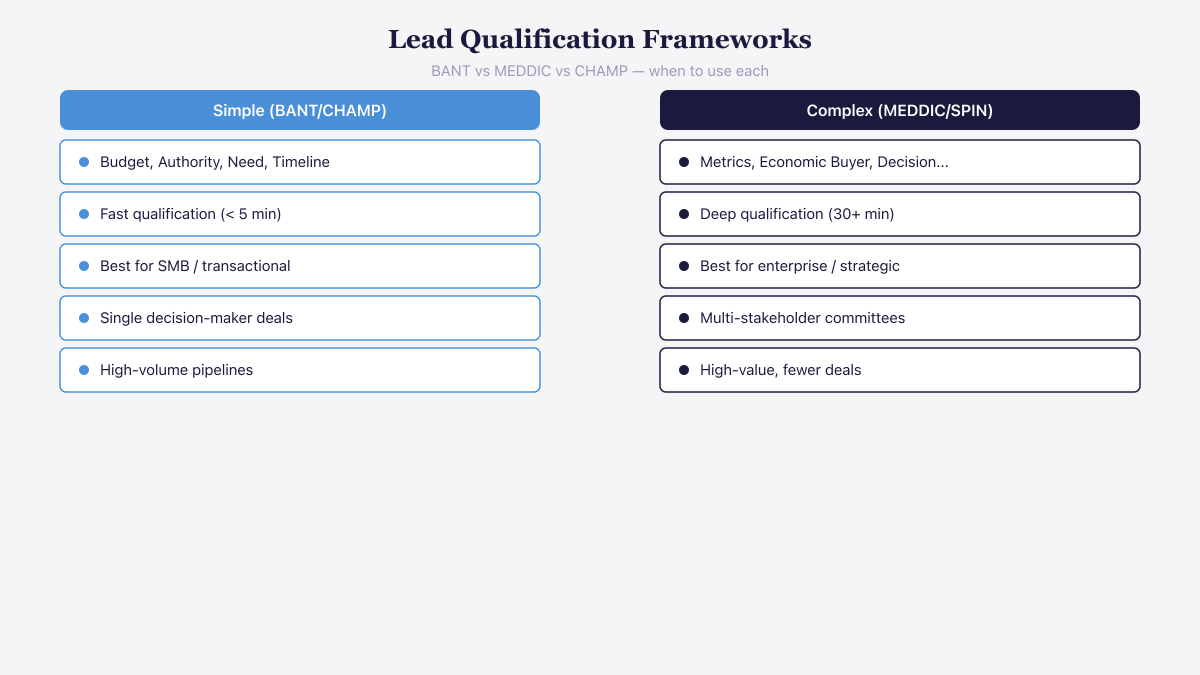 Match framework complexity to deal complexity — BANT for SMB, MEDDIC for enterprise.
Too loose: Marketing passes every form fill to sales. SDRs accept any meeting where the prospect has a pulse and a budget. AEs run discovery calls with accounts that will never close. The result is a bloated pipeline with sub-10% win rates and frustrated reps who stop trusting marketing-sourced leads.
Too rigid: Qualification criteria are so strict that reps disqualify accounts that could have closed. Budget is not yet allocated. The decision-maker has not been identified. The timeline is vague. These are normal conditions for early-stage enterprise opportunities, not disqualifiers.
The fix is not a single framework applied uniformly. It is choosing the right framework for each deal type and stage, then enhancing it with behavioral signals that reveal timing and urgency.
See Salesmotion on a real account
Book a 15-minute demo and see how your team saves hours on account research.
Three Frameworks That Work and When to Use Each
BANT: Budget, Authority, Need, Timeline
BANT is the oldest and simplest qualification framework. It asks four questions: does the prospect have budget, does your contact have authority, is there a genuine need, and is there a timeline for a decision?
Best for: High-volume sales with shorter cycles, transactional deals under $25K, and SDR teams that need a fast, repeatable screening process. Companies that implemented BANT effectively saw a 59% increase in conversion rates according to InsideSales research.
Limitations: BANT assumes budget is allocated before the conversation starts. In modern B2B sales, budget often gets created during the sales process. Asking "what is your budget?" in a first conversation can disqualify opportunities that would have closed if the rep had focused on building a business case first.
When to skip it: Complex enterprise deals where multiple stakeholders influence the decision and budget allocation is a process, not a precondition.
MEDDIC: Metrics, Economic Buyer, Decision Criteria, Decision Process, Identify Pain, Champion
MEDDIC goes deeper. It maps the buying committee, identifies the economic buyer, documents how the organization makes decisions, and requires an internal champion who advocates for your solution.
Best for: Enterprise deals above $50K with sales cycles longer than three months. Companies implementing MEDDIC saw a 25% average improvement in win rates according to the Sales Benchmark Index. Salesforce, IBM, and Oracle all credit MEDDIC for improving their sales processes.
Limitations: MEDDIC requires significant time investment per deal. If your average deal is $10K and your sales cycle is two weeks, MEDDIC creates overhead that does not justify the return.
When to use it: Any deal where losing means months of wasted effort. The upfront investment in understanding the buying process prevents late-stage surprises that kill deals.
CHAMP: Challenges, Authority, Money, Prioritization
CHAMP puts the prospect's challenges first and treats budget as a downstream consideration. The logic: if the pain is acute enough, budget will follow.
Best for: Selling to accounts that may not have a predefined budget category for your solution. CHAMP works well when you are creating a new category or displacing an incumbent the prospect has not decided to replace yet. Organizations using CHAMP report a 15% higher win rate.
Limitations: CHAMP's emphasis on challenges can lead reps into long consultative conversations with prospects who have real pain but no realistic path to purchasing. Without the budget and prioritization checks, pipeline can fill with "interested but stuck" accounts.

“We're no longer fishing. We know who the right customers are, and we can qualify them quickly. Salesmotion has had a direct impact on pipeline quality.”
Andrew Giordano
VP of Global Commercial Operations, Analytic Partners
Combining Frameworks for Different Stages
The most effective qualification processes are not single-framework. They layer frameworks across the buyer's journey.
Stage 1: Initial screening (BANT). When a lead enters your pipeline, use BANT to verify basic fit. Does the company match your ICP? Is there a plausible need? Is there any timeline pressure? This takes five minutes and filters out the clear mismatches.
Stage 2: Discovery (CHAMP). For leads that pass initial screening, shift to CHAMP. What specific challenges is the prospect facing? How are those challenges affecting the business? What have they tried so far? This stage builds the relationship and surfaces pain points that inform your pitch.
Stage 3: Deal qualification (MEDDIC). For opportunities that progress to a proposal or evaluation stage, apply MEDDIC. Map the full buying committee. Identify the economic buyer. Understand the decision criteria and process. Confirm you have an internal champion. This is where enterprise deals are won or lost.
This layered approach keeps early-stage qualification fast while ensuring late-stage qualification is thorough enough to prevent deal collapse.
Adding Signal Intelligence to Any Framework
Every framework has a blind spot: timing. BANT, MEDDIC, and CHAMP tell you whether a prospect fits and whether the opportunity is real. They do not tell you whether the prospect is actively researching solutions right now.
Intent data fills this gap. When a prospect's company is actively visiting competitor comparison pages, downloading category research, or showing multiple stakeholders engaging with your content, the opportunity is not just qualified. It is urgent.
Layer signal intelligence onto your framework:
- High-intent signals + BANT fit = Immediate outreach. This account is both qualified and actively buying.
- MEDDIC-qualified + no intent signals = Nurture sequence. The opportunity is real but the timing is not right yet.
- Strong intent signals + weak BANT fit = Investigate. The account might be worth pursuing despite not matching your typical profile.
Teams that combine qualification frameworks with intent-driven prioritization consistently outperform those using either approach alone. The framework ensures fit. The signals ensure timing.

“All of the vendors that I've worked with, all of the onboarding that I have had to deal with, I will say, hands down, Salesmotion was the easiest that I have had.”
Lyndsay Thomson
Head of Sales Operations, Cytel
Five Qualification Mistakes That Kill Pipeline
Qualifying on demographics alone. A VP of Sales at a 500-person SaaS company matches your ICP perfectly. But if they are not experiencing the pain your product solves, the fit is superficial. Qualification must include problem validation, not just title and company size.
Treating qualification as a single event. Qualification is not a gate that prospects pass through once. It is continuous. An account that was not ready six months ago might be actively buying today. Revisit disqualified accounts when new signals appear.
Ignoring the buying committee. Qualifying a single contact and calling the deal "qualified" is the most common pipeline fiction. Enterprise purchases involve 10 to 11 stakeholders on average. If your qualification only covers one person's perspective, you are missing 90% of the decision dynamics.
Skipping disqualification. Strong qualification requires the discipline to remove opportunities from pipeline when they do not meet criteria. Sales leaders who tolerate inflated pipelines to hit coverage ratios end up with poor forecast accuracy and reps spread too thin across unwinnable deals.
Over-qualifying early-stage opportunities. Asking a prospect for their budget, timeline, and decision process on a first call is interrogation, not discovery. Match the depth of qualification to the stage of the relationship. Early conversations should focus on understanding challenges. Budget and process conversations happen later.
Key Takeaways
- Choose your qualification framework based on deal complexity: BANT for speed, CHAMP for consultative sales, MEDDIC for enterprise deals.
- Layer frameworks across stages: BANT for initial screening, CHAMP for discovery, MEDDIC for deal qualification.
- Add intent signals to every framework. Qualification tells you fit; signals tell you timing.
- Qualification is continuous, not a one-time gate. Revisit accounts when new signals appear.
- Qualify the buying committee, not just the individual contact. Enterprise deals involve 10+ stakeholders.
- Disqualify deliberately. Removing bad-fit opportunities from pipeline improves forecast accuracy and focuses rep time.
Frequently Asked Questions
Which lead qualification framework is best for SaaS sales?
It depends on your deal size. For self-serve or SMB SaaS with deal values under $25K, BANT provides fast, repeatable screening. For mid-market SaaS ($25K-100K), CHAMP's focus on challenges helps build business cases that create budget. For enterprise SaaS above $100K, MEDDIC's comprehensive approach to mapping buying committees and decision processes prevents the late-stage deal collapse that is common in complex sales cycles.
How do you qualify leads without being pushy?
Frame qualifying questions as genuine curiosity about the prospect's situation, not as a checklist you are checking boxes on. Instead of "what is your budget?", ask "how does your team typically evaluate and fund new tools?" Instead of "are you the decision-maker?", ask "who else would be involved in a decision like this?" The information you need is the same. The framing determines whether the conversation feels like discovery or interrogation.
Should marketing or sales own lead qualification?
Both, at different stages. Marketing should own initial qualification: does the lead match ICP criteria and has the lead engaged meaningfully with your content or product? Sales should own opportunity qualification: is there a real pain point, a viable buying process, and a realistic path to a decision? The handoff between these stages is where most qualification breaks down. Shared definitions of what constitutes a qualified lead and regular feedback loops between teams prevent the misalignment that leads to wasted effort on both sides.