
Most reps still qualify deals the way they learned a decade ago: budget, authority, need, timeline, in that order. NEAT selling flips the priority. It puts the buyer's core need first and treats budget as a downstream conversation, because the modern buyer rarely has a clean line-item budget for a problem they have not fully scoped yet. If you have ever lost a "qualified" deal that had budget on paper but no real urgency, NEAT selling is the framework that explains why.
TL;DR: NEAT selling is a qualification framework from The Harris Consulting Group that stands for Need, Economic impact, Access to authority, and Timeline. It was built as a modern successor to BANT, which over-weighted budget and authority and missed the deeper "why" behind a purchase. NEAT leads with the buyer's core need and the economic impact of solving it, then qualifies access to the real decision-makers and a compelling event that drives timing. Reps who run NEAT discovery qualify on urgency and impact, not just on who has a checkbook.
What Is NEAT Selling?
NEAT selling is a sales qualification methodology that evaluates a deal on four dimensions: Need, Economic impact, Access to authority, and Timeline. It was developed by The Harris Consulting Group together with Sales Hacker as a direct response to the limitations of older qualification frameworks like BANT. Where BANT starts with budget, NEAT starts with the problem worth solving.
The shift is more than a reordering of letters. NEAT assumes that in a complex B2B sale, budget is a symptom of need, not a precondition for it. When a buyer's need is acute and the economic impact of solving it is clear, budget tends to appear. When you lead with "do you have budget?", you filter out exactly the deals where the buyer has not yet built a business case, which is most of the good ones.
This matters more in 2026 than it did when BANT was coined inside IBM in the 1950s. According to Gartner, B2B buyers now spend only about 17% of their purchase journey meeting with potential suppliers, and the journey itself has become non-linear, with buying groups of 6 to 10 stakeholders revisiting the same decisions repeatedly. Qualifying on budget alone in that environment tells you almost nothing about whether a deal will close. NEAT, like every serious sales methodology, exists to qualify on what actually predicts a purchase.
See Salesmotion on a real account
Book a 15-minute demo and see how your team saves hours on account research.
The Four Parts of NEAT, Explained
NEAT rests on four components, and the order is deliberate. You qualify need and economic impact before you ever ask about authority or timing, because the first two determine whether the last two are worth pursuing.
Here is the framework as a single reference you can run on any deal:
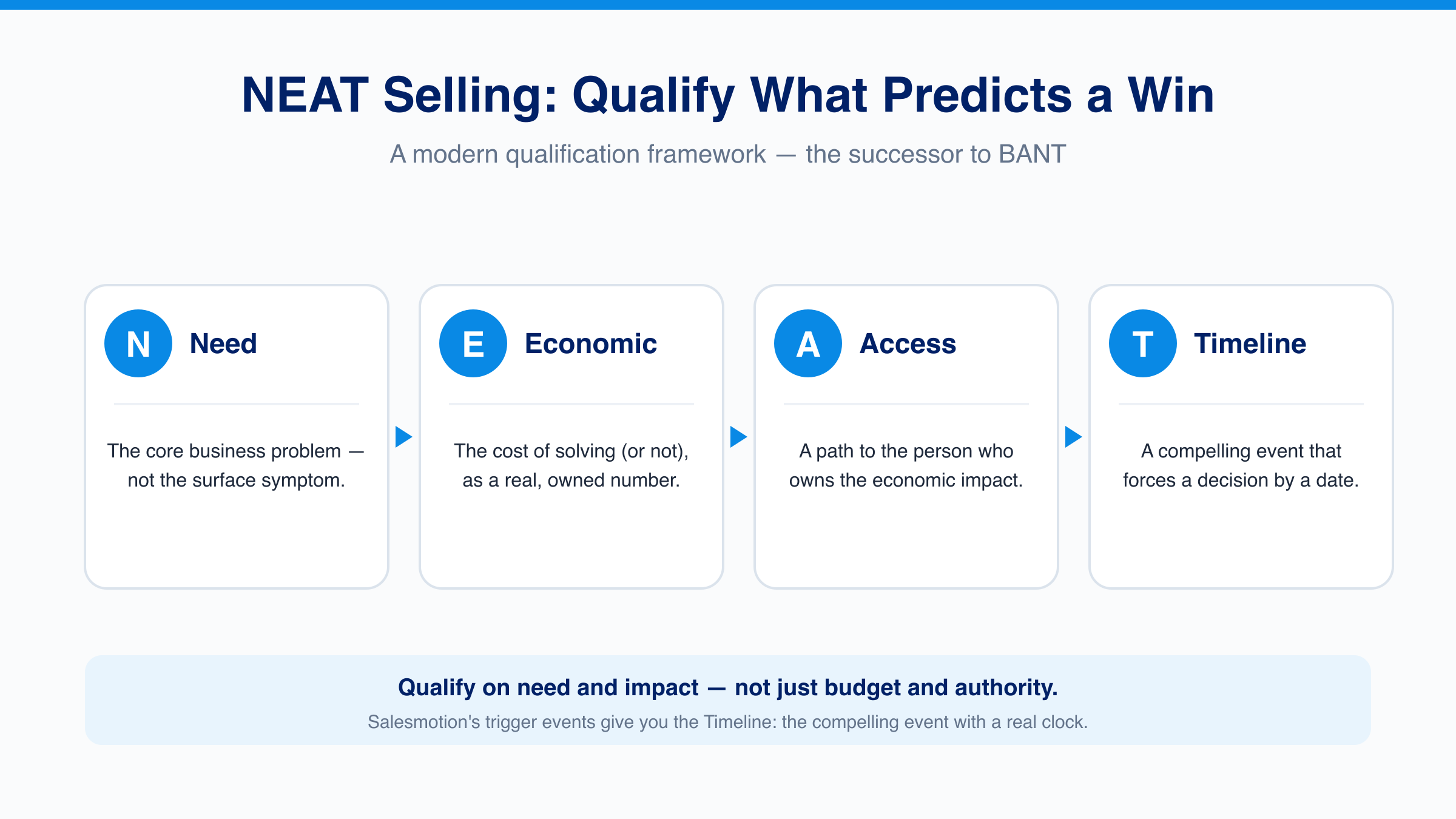 NEAT qualifies need and economic impact first — the two things that actually predict a win — before budget and authority.
The table below breaks down each component:
| Letter | What it stands for | What you are actually qualifying | Strong signal |
|---|---|---|---|
| N | Need | The core business problem, not the surface symptom | The buyer can articulate the pain and what it costs them |
| E | Economic impact | The financial consequence of solving (or not solving) the problem | A quantified number: hours, dollars, win rate, churn |
| A | Access to authority | Whether you can reach the person who owns the economic impact | You have a path to the economic buyer, not just a champion |
| T | Timeline | The compelling event that forces a decision by a date | A trigger event, deadline, or initiative with a real clock |
NEAT qualifies on the depth of the need and the economic impact first, then on access to the real decision-maker and a compelling event that drives timing.
Need goes deeper than BANT's version. BANT asks whether a need exists. NEAT asks what the core need is underneath the stated one. A buyer who says "we need better reporting" has a surface need; the core need might be that the VP of Sales cannot forecast accurately and is losing credibility with the board. The deeper you go, the more durable the deal.
Economic impact is the dimension BANT lacks entirely, and it is the most important one. Instead of asking "what's your budget?", you ask "what does this problem cost you, and what is solving it worth?". This reframes the conversation from spending money to recovering value. A buyer who can name the economic impact has effectively built their own business case.
Access to authority replaces BANT's blunt "authority" check. You rarely sell to a single decision-maker anymore. Access to authority means you have a credible path to the person who owns the economic impact, even if your first conversation is with a champion several levels below them.
Timeline in NEAT is about a compelling event, not a vague "sometime this quarter". A real timeline is anchored to something concrete: a contract renewal, a new executive's first 90 days, a product launch, a regulatory deadline. Without a compelling event, "timeline" is just hope.

“We're no longer fishing. We know who the right customers are, and we can qualify them quickly. Salesmotion has had a direct impact on pipeline quality.”
Andrew Giordano
VP of Global Commercial Operations, Analytic Partners
NEAT vs BANT: Where NEAT Wins
NEAT beats BANT in complex, consultative B2B sales because it qualifies on impact and urgency rather than on budget and a single decision-maker. BANT was designed for a transactional era with shorter cycles and clearer org charts. It breaks down in modern enterprise deals.
Consider the failure modes. BANT disqualifies a buyer with no allocated budget, even when the need is severe and budget would materialize once the business case is clear. BANT treats "authority" as a single person, when real deals involve a buying committee. BANT accepts any stated timeline, even when there is no compelling event behind it, which is how reps end up with pipeline that perpetually slips to "next quarter".
NEAT closes each of those gaps:
- Budget becomes economic impact. You qualify on the value of solving the problem, which is a leading indicator, instead of on existing budget, which is a lagging one.
- Authority becomes access. You qualify on whether you can reach the economic buyer, accepting that the buying committee is the real unit of decision.
- Timeline becomes a compelling event. You qualify on a concrete trigger, not a soft date, which kills the "next quarter" slippage that plagues BANT-qualified pipeline.
There is a pattern we see across sales teams that illustrates the difference. Reps trained on BANT routinely accept "let's discuss budget next quarter" and mark the deal as still qualified. Reps running NEAT hear the same sentence and recognize there is no compelling event, so they either find one or disqualify. The result is a leaner, more honest pipeline. The deals that survive NEAT qualification close at a far higher rate, because they were qualified on the things that actually drive a purchase. This is the same discipline you see in value-based qualification, where impact, not budget, leads the conversation.
How to Run NEAT Discovery
NEAT discovery is a structured conversation that uncovers need and economic impact before it ever touches budget or process. Run it as a sequence, not a checklist, because each answer informs the next question.
Start with the need, then go one layer deeper. Ask what problem they are trying to solve, then ask why it matters now. The first answer is the surface need. The "why now" question gets you closer to the core. A demo run too early, with curious juniors instead of the people who feel the pain, is almost always a sign the rep skipped this step and qualified on interest instead of need.
Quantify the economic impact. Translate the need into a number the business tracks. "How much time does your team lose to this each week?" "What's the cost of a deal slipping a quarter?" "What would a five-point win-rate improvement be worth?" If the buyer cannot attach a number, you have not found the real economic impact yet, and the deal is weaker than it looks.
Map access to authority. Identify who owns the economic impact you just quantified. Then ask your champion directly: "Who else needs to be involved for this to move forward, and can you help me get to them?" Access is something you build through the conversation, not something you assume.
Find the compelling event. Ask what changes if they do nothing for six months. If the answer is "not much", there is no real timeline and the deal will slip. If a concrete event is forcing the issue, a new exec, a renewal, a board mandate, a launch, you have a timeline you can build a close plan around.
Reflect it all back. Summarize the need, the economic impact, the path to authority, and the compelling event. When the buyer hears their own situation framed this way, the deal qualifies itself, and you both know whether it is real.
The wins almost always trace back to the same three things: a compelling trigger event, a real executive sponsor, and a quantified impact. Notably, none of those is budget. Outbound volume rarely makes the list. For more on running a structured discovery conversation, our guide to SPIN selling pairs naturally with NEAT, since SPIN's implication questions are how you surface economic impact.
“The Business Development team gets 80 to 90 percent of what they need in 15 minutes. That is a complete shift in how our reps work.”
Andrew Giordano
VP of Global Commercial Operations, Analytic Partners
How to Score a NEAT-Qualified Deal
Scoring turns NEAT from a conversation into a forecasting tool. Rate each dimension and the gaps tell you exactly what to work on next. A simple 0-to-3 scale per letter works well.
| Dimension | 0 (no signal) | 1-2 (partial) | 3 (strong) |
|---|---|---|---|
| Need | Surface symptom only | Core need stated, not validated | Core need confirmed and felt |
| Economic impact | No number | Rough estimate | Quantified and buyer-owned |
| Access to authority | Champion only, no path up | Champion plus one intro | Direct access to economic buyer |
| Timeline | "Sometime" | Soft date | Concrete compelling event |
Scoring each NEAT dimension turns qualification into a forecasting and coaching tool: low scores show exactly where the deal is weak.
A deal scoring 12 out of 12 is genuinely qualified and should be forecast with confidence. A deal scoring high on need and impact but low on access and timeline is a real opportunity that is single-threaded and unscheduled, so the next move is obvious: build a path to the economic buyer and find the compelling event. If you cannot score the economic impact above a 1, you do not understand the deal well enough to forecast it. The scoring discipline is what makes NEAT useful to managers, not just reps, because it standardizes what "qualified" means across the whole team.
Common NEAT Selling Mistakes
Even teams that adopt NEAT fall into predictable traps. Avoid these and your qualification will be sharper than most of your competitors'.
Stopping at the surface need. "They need a new tool" is not a NEAT need. If you cannot articulate the underlying business problem and what it costs, you have qualified on interest, not need.
Skipping economic impact. This is the most common failure and the most damaging, because economic impact is the dimension that BANT never had and that NEAT exists to capture. A deal with no quantified impact has no internal business case and will stall the moment your champion gets busy.
Confusing a champion with access. A friendly contact who cannot get you to the economic buyer is not access to authority. Champions who go quiet kill deals that looked qualified. Always validate the path up.
Accepting a timeline with no compelling event. "We're hoping to decide this quarter" is not a timeline. Without a concrete trigger, the date is fiction, and the deal will slip exactly as far as the buyer's attention drifts.
Treating NEAT as a one-time gate. Qualification decays. The economic buyer you had access to in January may have left by March. NEAT has to be re-run as the deal evolves, not stamped once and forgotten.
Why NEAT Breaks at Scale
NEAT is excellent in theory and difficult to execute consistently across a whole team, because three of its four dimensions depend on information most reps do not have when a cycle starts. The framework assumes you already know the buyer's situation. In practice, gathering that knowledge is the bottleneck.
To qualify economic impact, you need to understand the buyer's metrics, their initiatives, and the financial pressure they are under, much of which lives in earnings commentary, strategic announcements, and hiring patterns outside the CRM. To qualify access to authority, you need an accurate, current map of the buying committee, but org charts go stale within weeks as people change roles. To qualify timeline, you need to know when a trigger event just created a compelling reason to act, which means monitoring every account continuously.
Most reps gather none of this before discovery. They walk in cold, default to the surface need, skip the economic impact, and accept a soft timeline, which collapses NEAT back into the same weak qualification BANT produces. The framework is only as good as the intelligence feeding it, and gathering that intelligence by hand does not scale past a handful of accounts.
This is the pattern across sales teams that struggle with NEAT: it is not that reps misunderstand the framework. It is that they cannot feed it. A buyer is "drowning in data but starving for action", and so is the rep trying to qualify them. The spreadsheet approach works for 10 accounts. It collapses at 50.
How Salesmotion Operationalizes NEAT Selling
NEAT needs three things to work at scale: economic impact (what is the problem worth), access (who owns it), and timing (when did it become urgent). This is where signal-based selling turns NEAT from a quarterly exercise into a living workflow that runs on every account at once.
Salesmotion continuously monitors buying signals across 1,000+ public and private sources: leadership changes, earnings commentary, hiring patterns, funding, product launches, and competitive moves. Those signals map directly onto NEAT. Earnings commentary and strategic initiatives reveal the economic impact the company is under pressure to move. The buying-committee map surfaces who has access to authority. And the signal itself is the compelling event that anchors the timeline.
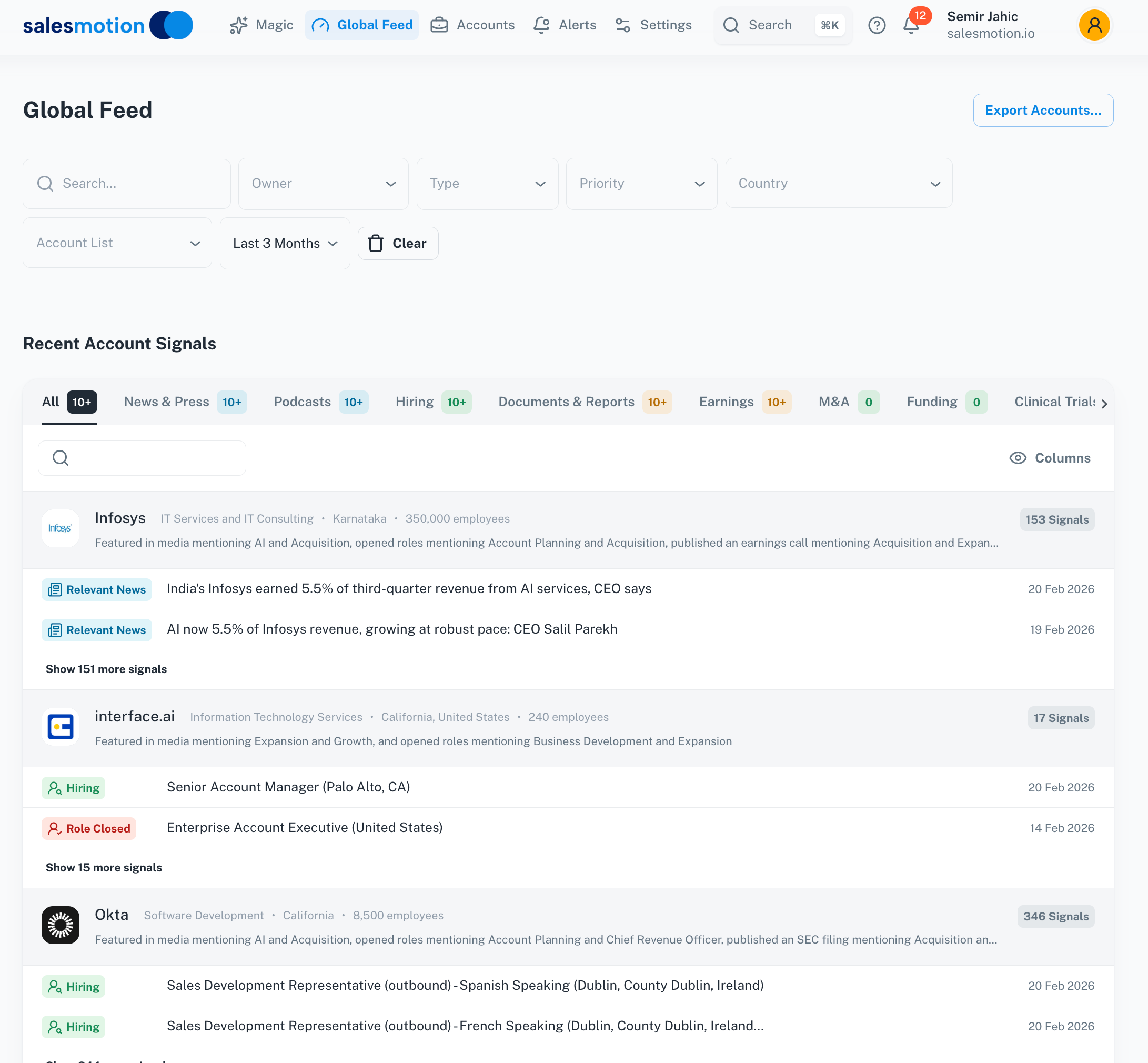 A live signal feed surfaces the compelling events that drive a NEAT timeline, so reps qualify on real triggers instead of soft dates.
Here is the workflow in practice:
- Trigger. A target account's earnings call mentions a "go-to-market efficiency initiative", and the company posts a VP of Revenue Operations role the same week.
- Platform action. Salesmotion flags the account and assembles the brief: the stated initiative (economic impact), the leadership change and likely economic buyer (access to authority), and the timing of both (compelling event).
- Rep action. The rep enters discovery already knowing the probable core need, the metric the company is under pressure to move, who owns it, and why now. Three of NEAT's four dimensions are pre-qualified before the call starts.
- Outcome. Instead of a generic intro call, the first conversation validates a quantified need with the right person at the right moment. Deal velocity rises because qualification is half done before discovery begins.
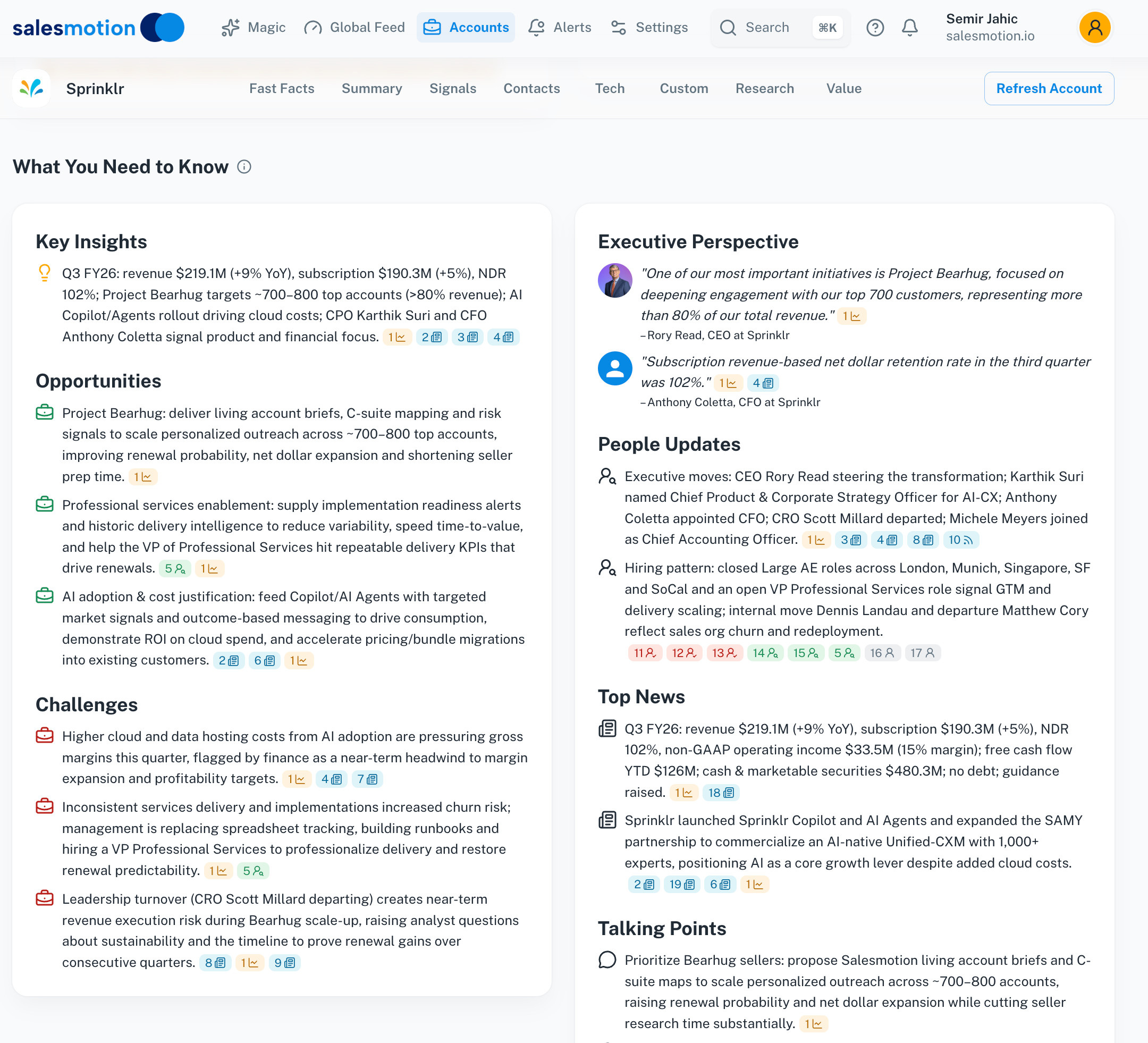 The account brief surfaces the economic impact and the likely economic buyer, the two NEAT dimensions reps most often miss.
The lever that closes these deals is the one NEAT was built around: tying qualification to a timely trigger event and the specific person it affects. The platform surfaces both, then drafts outreach anchored to the real signal, so NEAT becomes a repeatable workflow instead of a skill only your best rep has. Teams that operationalize this kind of intelligence report the difference in hard numbers: one marketing analytics team cut account research from three hours to 15 minutes and grew qualified pipeline 40% year over year, because reps walked into every conversation already knowing the need, the impact, and the buyer. See how it works on a real account.
Key Takeaways
- NEAT selling qualifies deals on Need, Economic impact, Access to authority, and Timeline, leading with the core need and the value of solving it rather than with budget.
- NEAT is the modern successor to BANT: budget becomes economic impact (a leading indicator), authority becomes access to the buying committee, and timeline becomes a concrete compelling event.
- Economic impact is the dimension BANT never had and the one NEAT exists to capture. A deal with no quantified impact has no internal business case and will stall.
- Score each NEAT dimension 0 to 3 to turn qualification into a forecasting and coaching tool. Low scores show exactly where a deal is weak and what to work on next.
- The most common mistakes are stopping at the surface need, skipping economic impact, confusing a champion with real access, and accepting a timeline with no compelling event.
- NEAT breaks at scale because economic impact, access, and timing all depend on fresh, account-specific intelligence that lives outside the CRM. Signal-based account research keeps the framework fed and timely.
Frequently Asked Questions
What does NEAT stand for in sales?
NEAT stands for Need, Economic impact, Access to authority, and Timeline. It is a sales qualification framework developed by The Harris Consulting Group with Sales Hacker. The order is deliberate: you qualify the buyer's core need and the economic impact of solving it before you assess access to the decision-maker and the timeline, because need and impact determine whether the deal is worth pursuing at all.
How is NEAT selling different from BANT?
NEAT is a modern successor to BANT. BANT leads with budget and treats authority as a single person, which breaks down in complex deals where budget follows the business case and decisions are made by a committee. NEAT replaces budget with economic impact (a leading indicator of a purchase), authority with access to the economic buyer, and a vague timeline with a concrete compelling event. NEAT qualifies on what predicts a close rather than on who currently has a checkbook.
What is economic impact in NEAT selling?
Economic impact is the financial consequence of solving or not solving the buyer's problem, expressed as a concrete number: hours lost, dollars at risk, win-rate points, or churn. It is the dimension BANT lacks entirely. Instead of asking "what's your budget?", you ask "what does this problem cost you, and what is solving it worth?". A buyer who can name the economic impact has effectively built their own business case, which is why NEAT treats it as the most important dimension to qualify.
How do you run NEAT discovery?
Run NEAT discovery as a sequence: uncover the core need by asking "why now", quantify the economic impact into a number the business tracks, map your access to the person who owns that impact, then find the compelling event that forces a decision by a date. Finish by reflecting all four back to the buyer. Each answer informs the next question, so it is a structured conversation rather than a checklist you tick off.
Does NEAT selling still work in modern B2B sales?
Yes, and arguably better than the frameworks it replaced. With buying groups of 6 to 10 stakeholders and buyers spending only a small fraction of their journey with any single vendor, qualifying on budget alone tells you almost nothing. NEAT's focus on quantified impact, access to the real economic buyer, and a concrete compelling event maps to how modern deals actually close. The challenge is feeding the framework with fresh account intelligence and buying signals, which is why teams pair NEAT with signal-based account research.